
 100% FREE ACCESS
12th Standard CBSE Syllabus & Materials
12th Standard CBSE
CBSE 12th Economics Government Budget and the Economy Previous year Question Papers Study Material - QB365 Set A
NEW12th Standard CBSE
CBSE 12th Computer Science Interface Python with MySQL - New Previous year Question Papers Study Material - QB365 Set A
NEW12th Standard CBSE
CBSE 12th Computer Science Database Concept - New Previous year Question Papers Study Material - QB365 Set A
NEW12th Standard CBSE
CBSE 12th Computer Science Data Communication - New Previous year Question Papers Study Material - QB365 Set A
NEW12th Standard CBSE
CBSE 12th Computer Science Data Structures - New Previous year Question Papers Study Material - QB365 Set A
NEW12th Standard CBSE
CBSE 12th Computer Science Functions - New Previous year Question Papers Study Material - QB365 Set A

Published on: 25/10/2025
Download CBSE Class 12th Standard CBSE Physics question papers, sample papers, important questions, and previous year solved papers in PDF format. Get free study materials, NCERT solutions, and exam preparation resources for Class 12th Standard CBSE Physics
Questions + Answers key
Take MCQ Physics Test
1.
i) A resistance of 30\(\Omega\) and a capacitor of \(\frac{250}{\pi} \mu \mathrm{F}\) are connected in series to a 200 V, 50 Hz AC source. Calculate (a) the current in the circuit and (b) voltage drops across the resistor and the capacitor (c) Is the algebraic sum of these voltages more than the source voltage? Ifyes, solve the paradox.
ii) A series LCR circuitwith R=20 \(\Omega\), L =2H and C=50\(\mu\)F is connected to a 200V AC source of variable frequency.What is (a) the amplitude ofthe current, and (b) the average power transferred to the cycle, at circuit in one complete resonance? (c) Calculate the potential drop across the capacitor.
2.
Why can a galvanometer not be used as such to measure current in a given circuit? Write two reasons.
3.
A proton is placed in a uniform electric field directed along a positive X-axis. In which direction will it tend to move?
4.
A series L-C-R circuit with \(R=20\Omega \), L = 1.5H and \(C=5\mu F\) is connected to a variable frequency of 200 V AC supply. When the frequency of the supply equals the natural frequency of the circuit, what is the average power transferred to the circuit, what is the average complete cycle?
5.
How is the mutual inductance of a pair of coil affected when a thin iron sheet is placed between the two coils, Other factor remaining the same?
6.
A wire in the form of a tightly would solenoid is connected to a DC source, and carries a current. If the coil is stretched so that there are gaps between successive elements of the spiral coil, will the current increase or decrease? Explain.
7.
Which material is used in making permanent magnets and why ?
8.
There is a sphere of radius 20 cm. What charge should be given to the sphere so that it acquires a surface charge density of \({ 3 }/{ \pi }{ cm }^{ -2 }\)?
9.
Discuss the use of transformer for long distance transmission of electrical energy.
10.
A step-up transformer operates on a 220 V line and supplies a load of 2 A. The ratio of the primary to the secondary windings is 1:5. Determine the secondary voltage, primary current and power output. Assume efficiency to be 100%.
11.
How will you represent a resistance of 3700 Q ± 10% by colour code?
12.
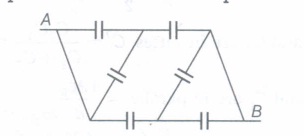
A network of six identical capacitors, each of value C is made as shown in the figure. Find the equivalent capacitance between the points A and B.
13.
A choke is needed to operate an arc lamp at 160 V, 50Hz. The lamp has a resistence of 5\(\Omega \) when running at 10A. Calculate inductance of the choke coil. If the same arc lamp is to be operated on 160V d.c., what additional resistance is required? Compare the power losses in both cases.
14.
Find the cost of electricity for running an electric motor of 1 hp for 5 hrs a day at the rate of Rs. 1.50 per unit of electricity for the month of November.
15.
Two solenoids A and B spaced close to eachother and sharing the same cylindrical axis have 400 and 700 turns respectively. A current of 3.5 A in coil A produced an average flux of \(300\mu \ T-m {^2 }\) through each turns of A and a flux of \(90\mu \ T-{ m }^{ 2 }\) through each turns of B Calculate.
(a) mutual inductance of two solenoids.
(b) the self inductance of A.
What emf is induced in B when the current in A increases at the rate of 0.5 A/s?
16.
The self inductance of an inductance coil having 100 turns is 20 mH. Calculate the magnetic flux through the cross section of the coil corresponding to a current of 4 milliampere. Also, find the total flux.
17.
The current flows from A to B is as shown in the figure. The direction of the induced current in the loop is
clockwise.
anticlockwise.
straight line.
no induced e.m.f. produced.
18.
In which type of material the magnetic susceptibility does not depend on temperature
Diamagnetic
Paramagnetic
Ferromagnetic
Ferrite
19.
A rectangular loop carrying a current i is situated near a long straight wire such that the wire is parallel to the one of the sides of the loop and is in the plane of the loop. If a steady current I is established in wire as shown in figure, the loop will
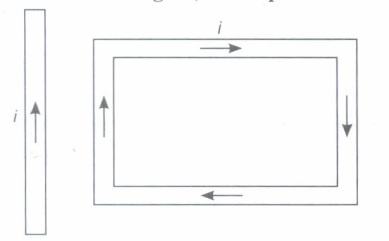
rotate about an axis parallel to the wire.
move away from the wire or towards right
move towards the wire
remain stationary.
20.
In an experiment of meter bridge, a null point is obtained at the centre of the bridge wire. When a resistance of 10 ohm is connected in one gap, the value of resistance in other gap is
10 Ω
5 Ω
15 Ω
500 Ω
21.
Ohm's law is true.
For metallic conductors at low temperature.
For metallic conductors at high temperature
For electrolytes when current passes through them
For diode when current flows
22.
Gauss's law will be invalid if
there is magnetic monopoles
the inverse square law is not exactly true.
the velocity of light is not a universal constant.
none of these
23.
The maximum electric field that a dielectric medium of a capacitor can withstand without break down (of its insulating property) is called its
polarisation
capacitance
dielectric strength
None of these
24.
In a purely inductive AC circuit, L = 30.0 mH and the rms voltage is 150 V, frequency v = 50 Hz. The inductive reactance is
15.9 \(\Omega\)
9.42 \(\Omega\)
10 \(\Omega\)
8.85 \(\Omega\)
25.
The self-inductance of a coil is 2 mH. The rate of flow of current in it is 103 A/S. The induced electromotive force in the coil is
1V
2V
3V
4V
26.
A 15.0 \(\mu\)F capacitor is connected to a 220 V,50 Hz source. The capacitive reactance is
220 \(\Omega\)
215 \(\Omega\)
212 \(\Omega\)
204 \(\Omega\)
27.
The relative permeability of a substance is 0.9999. The nature of substance will be
diamagnetic
paramagnetic
magnetic moment
intensity of magnetic field
28.
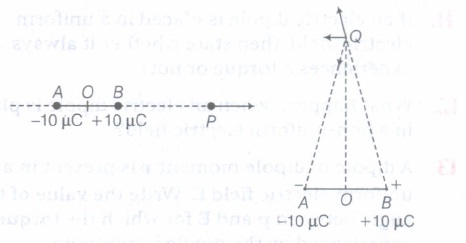
In given figures, OP = OQ = 15 cm, OA = OB = 2.5 mm Magnitudes of electric field at P and Q are respectively
2.6 x 10⁵ NC-1, 2.6 x 10⁵ NC-1
1.3 x 10⁵ NC-1, 1.3 x 10⁵ NC-1
2.6 x 10⁵ NC-1, 1.3 x 10⁵ NC-1
1.3 x 10⁵ NC-1, 2.6 x 10⁵ NC-1
29.
Mid way between the two equal and similar charges, we place the third equal and similar charge. Which of the following statements is correct?
The third charge experiences a net force inclined to the line joining the charges
The third charge is in stable equilibrium
The third charge is in unstable equilibrium
The third charge experiences a net force perpendicular to the line joining the charges
30.
Three equal resistors each of resistance R are connected so as to form a triangle. The equivalent resistance across any two corners is:
2R/3
R/3
3R/2
3R
31.
which of the following electromagnetic waves has smaller wavelengths?
X-rays
Microwaves
\(\gamma \) -rays
Radiowaves
32.
(i) Derive the expression for the torque acting on a current carrying loop placed in a magnetic field.
(ii) Explain the significance of a radial magnetic field, when a currrent carrying coil is kept in it.
33.
(a) Define electric flux. Write its SI units.
(b) Using Gauss's law, prove that the electric field at a point due to a uniformly charged infinite plane sheet is independent of the distance from it.
(c) How is the field directed if
(i) the sheet is positively charged,
(ii) negatively charged?
34.
A circular coil of radius 8.0 cm and 20 turns is rotated about its vertical diameter with an angular speed of 50 rad s–1 in a uniform horizontal magnetic field of magnitude 3.0 x 10⁻² T. Obtain the maximum and average emf induced in the coil. If the coil forms a closed loop of resistance 10 Ω, calculate the maximum value of current in the coil. Calculate the average power loss due to Joule heating. Where does this power come from?
35.
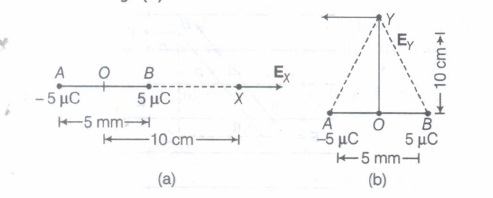
Two charges ± 5 \(\mu\)C are placed 5 mm apart. Determine the electric field at
(i) a point X on the axis of dipole 10 cm away from its centre 0 on the side of the positive charge' as shown in Figure (a).
(ii) a point Y, 10 cm away from centre a on a line passing through a and normal to the axis of the dipole as shown in Figure (b).
36.
A \(2\mu F\) capacitor, \(100 \ \Omega\) resistor and 8H inductor are connected in series with an
AC source.
What should be the frequency of the source such that current drawn in the circuit is maximum? What is this frequency called?
If the peak value of emf of the source is 200 V, find the maximum current.
Draw a graph showing variation of amplitude of circuit current with changing frequency of applied voltage in a series L-C-R circuit for two different values of resistance R1 and R2(R1>R2).
Define the term 'Sharpness of" Resonance'. Under what condition, does a circuit become more selective?
37.
(i) With the help of a labelled diagram, describe briefly the underlying principle and working of a step up transformer.
(ii) Write any two sources of energy loss in a transformer.
(iii) A step up transformer converts a low input voltage in to a high output voltage. Does it violate law of conservartion of energy? Explain.
38.
A proton is traveling with horizontal velocity.\({ u }_{ x }=2.5\times { 10 }^{ 8 }cm/s\)Calculate the transverse deflection in traveling horizontal distance, x = 5 cm in electric field of,\({ E }_{ y }=400V/cm\) mass of proton,\(m=1.6\times { 10 }^{ -24 }g\) charge oh proton,\(m=1.6\times { 10 }^{ -19 }c\)
39.
A parallel plate capacitor contains a mica sheet of thickness \(d_1=10^{-3}m\) and one fibre sheet of thickness \(d_2=0.5\times 10^{-3}m.\) Values of K for mica and fibre are 8 and 2.5 respectively. Fibre breaks down in electric field of \(6.4\times 10^6Vm^{-1}\). What maximum voltage can be applied to the capacitor?
1.
i) a ) R = 30 \(\Omega\)
\(\begin{aligned} & C=\frac{250}{\pi} \times 10^{-6} \mathrm{~F} \\ & V=200 \mathrm{~V} \\ & f=50 \mathrm{~Hz} \end{aligned}\)
\(\begin{aligned} Z & =\sqrt{R^2+\left(X_C\right)^2} \\ & =\sqrt{(30)^2+\frac{1}{\omega C}} \\ & =\sqrt{900+\frac{1 \times 10^6}{2 \times \pi \times 50 \times \frac{250}{\pi}}} \\ & =\sqrt{900+\frac{10^6}{250 \times 100}} \end{aligned}\)
\(\begin{aligned} & =\sqrt{900+\frac{1000000}{25000}} \\ & =\sqrt{900+40}=\sqrt{940}=30.65 \Omega \\ I & =\frac{V}{2}=\frac{200}{3065}=6.52 \mathrm{~A} \end{aligned}\)
b) Voltage drops across the resistor = IR
= 652 x 30 = 195.6V
Voltage drops across the capacitor = I x C
\(\begin{aligned} & =652 \times \frac{1 \times 10^6}{2 \times \pi \times 50 \times \frac{250}{\pi}} \\ & =\frac{652 \times 10^6}{100 \times 250 \times 100} \\ & =\frac{652 \times 10^6}{25 \times 10^5}=\frac{652 \times 10^{6-5}}{25} \\ & =\frac{6520}{25}=2608 \mathrm{~V} \end{aligned}\)
c ) Total voltage drop = 260.8+195.6 =456.4 V .Kirchhoff's voltage law is valid when we consider the instantaneous values of voltage 195.6V and 260.3 V are the rms value of voltage. Hence, when there values are added the resultant will be greater than the source voltage.
ii) a) R= 20\(\Omega\), L=2H, C =50x10-6 F V= 200V
\(\begin{aligned} f_r & =\frac{1}{2 \pi \sqrt{L C}}=\frac{1}{2 \pi \sqrt{2 \times 50 \times 10^{-6}}} \\ & =\frac{1}{2 \pi \sqrt{100 \times 10^{-6}}}=\frac{1}{2 \pi \sqrt{10^{-4}}} \\ & =\frac{1}{2 \pi \sqrt{\frac{1}{100} \times \frac{1}{100}}}=\frac{1}{2 \pi \times \frac{1}{100}}=\frac{50}{314} \\ & =1592 \mathrm{~Hz} \sim 16 \mathrm{~Hz} \end{aligned}\)
b) At resonance, the impedance of the circuit is minimum, and the current in maximum.
\(I=V / R=\frac{200}{20}=10 \mathrm{~A}\)
Average power transterred to the circuit in one complete cycle.
\( \begin{aligned} \quad P & =1 / 2 \times V_{\text {rus }} \times l_{\text {nas }} \times \cos (\theta) \\ V_{\text {rus }} & =V / \sqrt{2}=200 / \sqrt{2}=141.4 \mathrm{~V} \\ I_{\text {rus }} & =10 / \sqrt{2}=707 \mathrm{~A} \\ P & =1 / 2 \times 141.4 \times 707=499849=500 \mathrm{~W} \end{aligned} \)
c) Potenial drop across the capacitor \(V_c=\frac{1}{2 \pi f C}\)
At resonance,
\(\begin{aligned} V_C & =\frac{l}{2 \pi f C}=\frac{10 \times 10^6}{2 \times 314 \times 16 \times 50}=\frac{10^7}{314 \times 16}=\frac{10^7}{5024} \\ & =1990.4 \mathrm{~V} \end{aligned}\)
2.
(i) A galvanometer is a sensitive device and can measure up to few microampere. hence may get damaged, if strong current is passed through it.
(ii) A galvanometer has larger resistance than an ammeter. Therefore, when it is connected in series with the circuit, the current in the circuit decreases.
3.
Proton will tend to move along the positive X-axis in the direction of a uniform electric field.
4.
When the frequency of the supply equals the natural frequency of the circuit, resonance occurs.
\({ Z }_{ r }=R=20\Omega \)
\({ I }_{ rms }=\frac { { V }_{ rms } }{ { Z }_{ r } } =\frac { 200 }{ 20\quad } =10A\)
Average power transferred in one cycle,
\({ P }_{ av }={ V }_{ rms }{ I }_{ rms }\cos { \phi } \)
= 200 x 10 x cos 00 [\(\phi ={ 0 }^{ 0 }\)]
= 2000W = 2kW
5.
As we know the mutual inductance M is directly proportional to the relative permeability of space, \(\mu\) So, it will increase on placing a thin iron sheet between the two coils.
6.
The current drawn form d.c. source will increase. This ia because when the coil is stretched and air gaps are created between successive elements of the spiral coil, magnetic flux will leak through the gaps. According to Lewi's law, emf induced must resists the decrease in flux. This can be done when more current is drawn from d.c. source.
7.
For making permanent magnets, a material having high coercivity is used. Steel is a better choice compared to soft iron.
8.
q = 0.48C
9.
At the transmitting point, the voltage is increased and the corresponding current is decreased by using step-up transformer. Then it is transmitted through transmission lines. This reduced current at high voltage reaches the destination without any appreciable loss. At the receiving point, the voltage is decreased and the current is increased to appropriate and then it is given to consumers.
10.
In any transformer
\(\frac{I_s}{I_p}=\frac{E_p}{E_s}=\frac{N_p}{N_s}=\frac{1}{K}\)
Here \(E_p=220 \mathrm{ volts}, I_s=2 \mathrm{Amp}\)
\( \frac{N_p}{N_s}=\frac{1}{25} \)
\( \therefore I_p=\frac{N_s}{N_p} \times I_s=25 \times 2=50 \)
\(\text { and } E_s=\frac{N_s}{N_p} \times E_p=25 \times 250 =55000 \text { Volts } \)
\( \text { Power output }=E_s \times I_s =5500 \times 2=11000 \text { watts. }\)
11.
The value of carbon resistance = 3700 Ω ± 10%
or R = 37 x 102 ± 10%
The colour assigned to numbers 3, 7 and 2 are orange, violet and red.
For ± 10 % accuracy, the colour is silver.
Hence, the bands of colour on carbon resistance in sequence are orange, violet, red and silver.
12.
The equivalent network of the given network is shown below
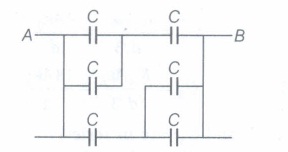
Therefore equivalent capacitance,
Ceq = [2 C series C] II [C series 2C]
\(=2\left[\frac{2 C \times C}{2 C+C}\right]=\frac{4 C}{3}\)
13.
(i) L = 0.048H
(ii) R = 11ohm
(iii) \(\frac { P }{ P' } =\frac { 500 }{ 1600 } =0.31\)
14.
Power of motor,
P = 1 hp = 746 watt.
Electric energy consumed for running a motor for the month of November,
E = 746 x 5 x 30 Wh
= \(\frac{746 \times 5 \times 30}{1000} \ \ kWh\)
Bill of electricity
= \(\frac{746 \times 5 \times 30}{1000}\times 1.50\)
= Rs. 167.85
15.
\(Here,{ N }_{ 1 }=400, \ { N }_{ 2 }=700\)
\( I_{ 1 }=3.5A \ \phi =300 \times { 10 }^{ -6 }{ Tm }^{ 2 }\)
\({ \phi }_{ 2 }=900 \times { 10 }^{ -6 }{ Tm }^{ 2 }\)
\(M=\frac { { N }_{ 2 }{ \phi }_{ 2 } }{ I_{ 1 } } =\frac { 700 \times 90 \times { 10 }^{ -6 } }{ 3.5 } =1.8 \times { 10 }^{ -2 }H\)
\({ L }_{ 1 }=\frac { { N }_{ 1 }{ \phi }_{ 1 } }{ I_{ 1 } } =\frac { 400 \times 300 \times { 10 }^{ -6 } }{ 3.5 } =3.43 \times { 10 }^{ -2 }H\)
\({ e }_{ 2 }=M(\frac { dI_{ 1 } }{ dt } )=1.8 \times { 10 }^{ -2 } \times (0.5)\)
\(=9 \times { 10 }^{ -3 }V\)
16.
\(8 \times { 10 }^{ -5 }Wb;8 \times { 10 }^{ -3 }Wb\)
\(Here,n=100,L=20mH=20 \times { 10 }^{ -3 }H;\)
\( i=4 \ mA=4 \times { 10 }^{ -3 }A\)
Magnetic flux through the cross section of coil
\(Here,n=100,L=20mH=20 \times { 10 }^{ -3 }H;\)
\(Li=20 \times { 10 }^{ -3 } \times 4 \times { 10 }^{ -3 }=8 \times { 10 }^{ -5 }Wb\)
\(Total \ magnetic \ flu \times =nLi=100 \times 8 \times { 10 }^{ -5 }\)
\(=8 \times { 10 }^{ -3 }Wb\)
17.
(a)
clockwise.
18.
(a)
Diamagnetic
19.
(c)
move towards the wire
20.
(a)
10 Ω
21.
(a)
For metallic conductors at low temperature.
22.
(b)
the inverse square law is not exactly true.
23.
(c)
dielectric strength
24.
(b)
9.42 \(\Omega\)
25.
(b)
2V
26.
(c)
212 \(\Omega\)
27.
(a)
diamagnetic
28.
(c)
2.6 x 10⁵ NC-1, 1.3 x 10⁵ NC-1
29.
(c)
The third charge is in unstable equilibrium
30.
(a)
2R/3
31.
(c)
\(\gamma \) -rays
32.
Let us consider a loop ABCD in a uniform magnetic field of strength B. and Let the current through the loop be I.


Consider force on arm AB and force
on arm CD.
The net torque is given by -
Where A is the area of the loop
Now,
The magnetic moment of the loop.
Therefore
This is the expression for the torque acting on a current-carrying loop placed in a magnetic field.
(b) In a radial magnetic field, two sides of the rectangular coil remain perpendicular and other two ides remain parallel to magnetic field lines in all position of the coil.
33.
(a) Electric flux through an area is the product of magnitude of area and the component of electric field vector normal to it.
\(\phi_{\mathrm{E}}=\Delta S(E \cos \theta)=\vec{E} \cdot \Delta \vec{S}\)
Its SI unit is NC-1 m2
(b) Electric field intensity due to a thin infinite plane sheet charge: Consider a thin infinite sheet of charge with uniform surface charge density a. To calculate electric field at a point P distant r from the sheet we imagine a symmetrical Gaussian surface in such a way that the point charge lies on it. Here we assume a cylinder of cross-sectional area A and length 2r with its axis perpendicular to the sheet.
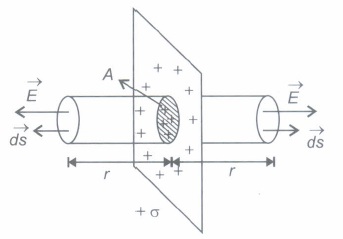
Flux through the curved surface of the cylinder,
\(\phi_{1}=\int \vec{E} \cdot \overrightarrow{d s}=0 \left(\because \theta=90^{\circ}\right)\)
Total flux through plane faces of the cylinder,
\(\phi_{2}=2 \int \vec{E} \cdot \overrightarrow{d s}=2 E A \left(\because \theta=0^{\circ}\right)\)
Net flux through the Gaussian surface is
\(\phi=\phi_{1}+\phi_{2}=2 E A\)
Net charge enclosed by the Gaussian surface is
\(Q=\sigma A\)
According to the Gauss's theorem, \(\phi=\frac{Q}{\varepsilon_{0}}\)
\(\therefore \phi=\frac{\sigma A}{\varepsilon_{0}}\)
From equations (i) and (ii), we get
\(2 E A=\frac{\sigma A}{\varepsilon_{0}} \Rightarrow E=\frac{\sigma}{2 \varepsilon_{0}}\)
(c) For positively charged sheet, the electric field is directed away from the sheet.
For negatively charged sheet, the electric field is directed towards the plane sheet.
34.
Max induced emf = 0.603 V
Average induced emf = 0 V
Max current in the coil = 0.0603 A
Average power loss = 0.018 W
(Power comes from the external rotor)
Radius of the circular coil, r = 8 cm = 0.08 m
Area of the coil, A = πr2 = π × (0.08)2 m2
Number of turns on the coil, N = 20
Angular speed, ω = 50 rad/s
Magnetic field strength, B = 3 × 10⁻² T
Resistance of the loop, R = 10 Ω
Maximum induced emf is given as:
e = Nω AB
= 20 × 50 × π × (0.08)2 × 3 × 10−2
= 0.603 V
The maximum emf induced in the coil is 0.603 V.
Over a full cycle, the average emf induced in the coil is zero.
Maximum current is given as:
\(I=\frac{e}{R}\)
\(=\frac{0.603}{10}-0.0603A\)
Average power loss due to joule heating:
\(P=\frac{eI}{2}\)
\(=\frac{0.603\times 0.0603}{2}=0.018W\)
The current induced in the coil produces a torque opposing the rotation of the coil. The rotor is an external agent. It must supply a torque to counter this torque in order to keep the coil rotating uniformly. Hence, dissipated power comes from the external rotor.
35.
Given, q = ± 5 \(\mu\)C = ± 5 x 10⁻⁶ C,
2 I = 5mm = 5 x 10⁻³ m
x = OX = OY = 10 cm
= 10 x 10-2 m
Ex = ?
and Ey =?
Dipole moment,
p = q x 2l
= 5 x 10-6C x 5 x 10-3 m
= 25 x 10-9 C-m
(i) Now, find out the electric field at point X on the axial line of dipole
\(E_{y}=\frac{2 p x}{4 \pi \varepsilon_{0}\left(x^{2}-l^{2}\right)^{2}}\) along BX produced
Since l << x, therefore
\(E_{X}=\frac{2 p}{4 \pi \varepsilon_{0} x^{3}}\)
\(=\frac{2 \times 25 \times 10^{-9} \times 9 \times 10^{9}}{\left(10 \times 10^{-2}\right)^{3}}\)
= 4.5 x 10⁵ NC-1
(ii) Now, find out the electric field at point Y on equatorial line of dipole
\(\mathbf{E}_{\gamma}=\frac{\mathbf{p}}{4 \pi \varepsilon_{0}\left(x^{2}+l^{2}\right)^{3 / 2}}\) along a line parallel to BA
Since,l << x, therefore \(E_{Y}=\frac{P}{4 \pi \varepsilon_{0} x^{3}}\)
\(\therefore \ E_{Y}=\frac{25 \times 10^{-9} \times 9 \times 10^{9}}{\left(10 \times 10^{-2}\right)^{3}}\)
= 2.25 x10⁵ NC-1 , along a line parallel to BA.
36.
To draw maximum current from a series L-C-R circuit, the circuit at particular frequency
XL = XC.
V = \({{1}\over{2\pi\sqrt{LC}}}={{1}\over{2\times314\sqrt{8\times 2\times {10}^{-6}}}}=39.80\) Hz
This frequency is known as the series resonance frequency.
I0 = \({ { {E}_{0} }\over{ R } }={ {200 }\over{100 } }=2A\)
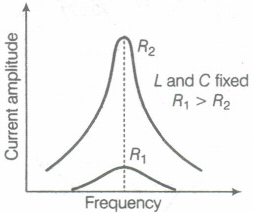
Sharpness of resonance It is defined as the ratio of the voltage developed across the inductance (L) or capacitance (C) at resonance to the voltage developed across the resistance (R).
Q = \({ { 1 }\over{ R } }=\sqrt{ { { L }\over{ C } } }\)
It may also be defined as the ratio of resonance angular frequency to the bandwidth of the circuit
Q = \({ { {\omega}_{r} }\over{ 2 \triangle \omega } }\)
Circuit become more selective if the resonance is more sharp, maximum current is more, the circuit is close to resonance for smaller range of \((2\triangle \omega)\) of frequencies. Thus, the tuning of the circuit will be good.
37.
Principle: It works on the principle of mutual induction.
Working: When an alternating voltage is applied to the primary, the resulting current produces an alternating magnetic flux which links the secondary and induces an emf in it. We consider an ideal transformer in which the primary has negligible resistance and all the flux in the core links with both primary and secondary windings. Let cp be the flux in each turn in the core at a time due to current in the primary when a voltage Vp is applied to it.
\({ V }_{ s }={ E }_{ s }={ N }_{ s }\frac { d\phi }{ dt } \)
The alternating flux also induces an emf, called back emf in the primary given by
\({ V }_{ p }={ E }_{ p }=-{ N }_{ p }\frac { d\phi }{ dt } \)
But \({ E }_{ p }={ V }_{ p }\)
and \({ E }_{ s }={ V }_{ s }\)
So,
\({ V }_{ s }=-{ N }_{ s }\frac { d\phi }{ dt }\)
\( \\ { V }_{ p }=-{ N }_{ p }\frac { d\phi }{ dt } \)
\(\frac { { V }_{ s } }{ { V }_{ p } } =\frac { { N }_{ s } }{ { N }_{ p } } \)
For a step-up transformer, \(\frac { { V }_{ s } }{ { V }_{ p } } >1\)
So,
\(\frac { { V }_{ s } }{ { V }_{ p } } >1\)
(ii) Sources of energy loss in transformer (any two) Flux leakage / Joule's loss in the resistance of windings / Loss due to eddy currents / Hysteresis loss / Humming loss.
(iii) A step-up transformer steps up the voltage while it steps down the current. So the input and output power remain the same (provided there is no loss). Hence there is no violation of the principle of energy conservation.
38.
Here, the mass of the proton
\(m=1.6\times { 10 }^{ -24 }g\)
\(=1.6\times { 10 }^{ -27 }kg\)
Charge on proton
\(e=1.6\times { 10 }^{ -19 }C\)
\({ E }_{ y }=400V/cm=4\times { 10 }^{ 4 }V/m,x=5cm=0.05m\)
\({ v }_{ x }=2.5\times { 10 }^{ 8 }cm/s=2.5\times { 10 }^{ 6 }m/s.\)
\(t=\frac { x }{ { v }_{ x } } =\frac { 0.05 }{ 2.5\times { 10 }^{ 6 } } =2\times { 10 }^{ -8 }s\)
\({ F }_{ y }=e{ E }_{ y }\)
\({ F }_{ y }=(1.6\times { 10 }^{ -19 })\times (4\times { 10 }^{ 4 })N\)
\({ a }_{ y }=\frac { { F }_{ y } }{ m } =\frac { 1.6\times { 10 }^{ -19 }\times 4\times { 10 }^{ 4 } }{ 1.6\times { 10 }^{ -27 } } \)
\({ a }_{ y }=4\times { 10 }^{ 12 }m/{ s }^{ 2 }\)
\({ u }_{ y }=0,{ a }_{ y }=4\times { 10 }^{ 12 }m/{ m }^{ 2 },t=2\times { 10 }^{ -8 }s,y=?\)
39.
Let \(\sigma\) be the surface charge density of capacitor plates.
for mica \(E_1={\sigma\over K_1\epsilon_0}\)
and for fibre \(E_2={\sigma\over K_2\epsilon_o}\) or \({E_1\over E_2}={K_2\over K_1}\)
As \(E_s=6.4\times 10^6V/m\)
\(E_1={K_2\over K_1}\times E_2={2.5\over 8}\times 6.4\times 10^6=2\times 10^6V/m\)
Maximum voltage or capacitor
\(V=E_1d_1+E_2d_2=2\times 10^3+3.2\times 10^3=5200V\)

12th Standard CBSE Syllabus & Materials
12th Standard CBSE
CBSE 12th Computer Science Python Revision Tour I - New Previous year Question Papers Study Material - QB365 Set A
NEW12th Standard CBSE
CBSE 12th Business Studies Planning Important Questions And Answers Study Material - QB365 Set A
NEW12th Standard CBSE
CBSE 12th Business Studies Business Environment Important Questions And Answers Study Material - QB365 Set A
NEW12th Standard CBSE
CBSE 12th Business Studies Principles of Management Important Questions And Answers Study Material - QB365 Set A



NCERT Books

Syllabus

Exam Pattern

Sample Question Papers

Previous year Question Papers

Important Notes

MCQ Practice test

NCERT Exemplers

Case study Questions

Image Based Questions

Passage based Questions

HOT Questions

Value Based Questions

Model Questions Papers
NCERT ( Book Back ) Questions

Assertion and Reason
Important Questions And Answers

CBSE 12th Standard CBSE Subjects
CBSE Standards








