
 100% FREE ACCESS
12th Standard CBSE Syllabus & Materials
12th Standard CBSE
CBSE 12th Economics Government Budget and the Economy Previous year Question Papers Study Material - QB365 Set A
NEW12th Standard CBSE
CBSE 12th Computer Science Interface Python with MySQL - New Previous year Question Papers Study Material - QB365 Set A
NEW12th Standard CBSE
CBSE 12th Computer Science Database Concept - New Previous year Question Papers Study Material - QB365 Set A
NEW12th Standard CBSE
CBSE 12th Computer Science Data Communication - New Previous year Question Papers Study Material - QB365 Set A
NEW12th Standard CBSE
CBSE 12th Computer Science Data Structures - New Previous year Question Papers Study Material - QB365 Set A
NEW12th Standard CBSE
CBSE 12th Computer Science Functions - New Previous year Question Papers Study Material - QB365 Set A

Published on: 25/10/2025
Download CBSE Class 12th Standard CBSE Physics question papers, sample papers, important questions, and previous year solved papers in PDF format. Get free study materials, NCERT solutions, and exam preparation resources for Class 12th Standard CBSE Physics
Questions + Answers key
Take MCQ Physics Test
1.
An aeroplane is flying horizontally from west to east with a velocity of 900 kml/hour. Calculate the potential difference developed between the ends of its wings having a span of 20 m. The horizontal component of the Earth's magnetic field is 5 x 10⁻⁴ T and the angle of dip is 30°.
2.
A 1.0 m long metallic rod is rotated with an angular frequency of 400 rad s–1 about an axis normal to the rod passing through its one end. The other end of the rod is in contact with a circular metallic ring. A constant and uniform magnetic field of 0.5 T parallel to the axis exists everywhere. Calculate the emf developed between the centre and the ring.
3.
(i) State Kirchhoff's rules.
(ii) A battery of 10 V and negligible internal resistance is connected across the diagonally opposite corners of a cubical network consisting of 12 resistors each of 1Ω resistance. Use Kirchhoff s rules to determine
(a) the equivalent resistance of the network and
(b) the total current in the network
4.
Derive the relation between current density j and potential difference V across a current carrying conductor of length l area of cross-section A and the number density n of free electrons.
5.
Define relaxation time of the free electrons drifting in a conductor. How is it related to the drift velocity of free electrons? Use this relation to deduce the expression for the electrical resistivity of the material.
6.
The magnetic flux through a coil perpendicular to its plane is varying according to the relation \(\phi =\left( 5{ t }^{ 3 }+4{ t }^{ 2 }+2t-5 \right) Wb\). Calculate the induced current through the coil at t = 2s, if the resistance of the coil is \(10\Omega .\)
7.
A silver wire has a resistance of 2.1\(\Omega\) at 27.5oC and a resistance of 2.7\(\Omega\) at 100oC. Determine the temperature coefficient of resistivity of silver.
8.
(i) Obtain the formula for the power loss (i.e. power dissipated) in a conductor of resistance R, carrying a current.
(ii) Two heating elements of resistances R1 and R2 when operated at a constant supply of voltage V, consume powers P1 and P2, respectively. Deduce the expressions for the power of their combination when they are in turn, connected in
(a) series and
(b) parallel across their same voltage supply.
9.
(i) Define mutual inductance and write its S.l. unit.
(ii) Derive an expression for the mutual inductance of two long co-axial solenoids of same length wound one over the other.
(iii) In an experiment, two coils C1 and C2 are placed close to each other. Find out the expression for the emf induced the coil cl due to a change in the current through the coil C2.
10.
Describe briefly, with the help of a labelled diagram, the basic elements of an A.C. generator. State its underlying principle. Show diagrammatically how an alternating emf is generated by a loop of wire rotating in a magnetic field. Write the expression for the instantaneous value of the emf induced in the rotating loop
11.
Deduce Ohm's law from the concept of a conductor of drift velocity.
12.
Define electromagnetic induction, magnetic flux linked with a given area and magnetic induction. What are their units? When is magnetic flux taken (i) positive and (ii) negative.
13.
A potential difference of 200 V is maintained across a conductor of resistance 100Ω. The number of electrons passing through it in 1s is
1.25 x 10¹⁹
2.5 x 10¹⁸
1.25 x 10¹⁸
2.5 x 10¹⁶
14.
In a coil of self-induction 5 H, the rate of change of current is 2 As-1. Then emf induced in the coil is
10V
-10V
5V
-5V
15.
A potential difference of 100 V is applied to the ends of a copper wire one metre long. What is the average drift velocity of electrons?
(given. σ = 5.81 x 10⁷ Ω-1or ncu = 8.5 x 1028 m-3)
0.43 ms -1
0.83 ms -1
0.52 ms-1
0.95 ms-1
16.
Kirchhoff's current law is consequence of conservation of
energy
momentum
charge
mass
17.
The dimensional formula of resistance is
[ML2 T-2 A-2]
[M2 L2 T3 A-2]
[ML2 T-3 A-2]
[ML3 T-3 A-3]
18.
An electron moves along the line PQ which lies in the same plane as a circular loop of conducting wire as shown in figure. What will be the direction of the induced current in the loop?
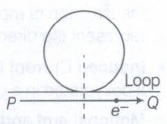
Anti-clockwise
Clockwise
Alternating
Non-current will be induced
19.
A 50 turns circular coil has a radius of 3 cm, it is kept in a magnetic field acting normal to the area of the coil. The magnetic field B increased from 0.10 T to 0.35 T in 2 ms-1, The average induced emf in the coil is
1.77V
17.7V
177V
0.177V
20.
If a medium of relative permeability \(\mu\)r had been present instead of air, the mutual inductance would be
\(M=\mu_{r} \mu_{0} n_{1} n_{2} \pi r_{1} l\)
\(M=\mu_{0} n_{1} n_{2} \pi r_{1}^{2} l\)
\(M=\mu_{r} n_{1} n_{2} \pi r_{1}^{2} l\)
\(M=\mu_{r} \mu_{0} n_{1} n_{2} \pi r_{1}^{2} l\)
21.
Current in the coil is larger
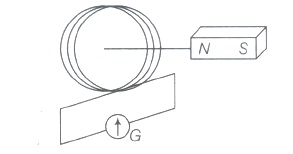
when the magnet is pushed towards the coil faster
when the magnet is pulled away the coil faster
Both (a) and (b)
Neither (a) nor (b)
22.
What is the resistance between A and B in the fig.
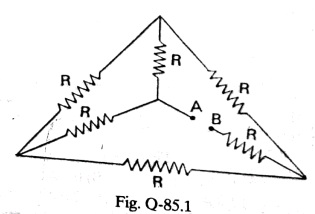
R/2
R
2R
3R
23.
The magnetic flux linked with a coil is \(\phi \) = (3t-2t+1) milliweber. The e.m.f. induced in the coil at t = 1sec is
4V
4\(\times\)10-3V
6V
4\(\times\)103V
24.
Assertion (A) : When number of turns in a coil doubled, coefficient of self inductance of the coil becomes four times.
Reason (R) : Coefficient of self inductance is proportional to the square of number of turns.
Codes:
(a) Both A and R are true and R is the correct explanation of A
(b) Both A and R are true but R is NOT the correct explanation of A
(c) A is true but R is false
(d) A is false and R is also false
25.
Assertion (A) : When two coils are wound on each other, the mutual induction between the coils is maximum.
Reason (R) : Mutual induction does not depend on the orientation of the coils.
Codes:
(a) Both A and R are true and R is the correct explanation of A
(b) Both A and R are true but R is NOT the correct explanation of A
(c) A is true but R is false
(d) A is false and R is also false
26.
Assertion: Two bulbs of same wattage, one having a carbon filament and the other having a metallic filament are connected in series. Metallic bulbs will glow more brightly than carbon filament bulb.
Reason: Carbon is a semiconductor.
Codes:
(a) Both A and R are true and R is the correct explanation of A
(b) Both A and R are true but R is NOT the correct explanation of A
(c) A is true but R is false
(d) A is false and R is also false
27.
Assertion: The average thermal velocity of the electrons in a conductor is zero.
Reason: Direction of motion of electrons are randomly oriented.
Codes:
(a) Both A and R are true and R is the correct explanation of A
(b) Both A and R are true but R is NOT the correct explanation of A
(c) A is true but R is false
(d) A is false and R is also false
1.
Given: v = 900 km h-1 = 250 ms-1; l = 20 m Bv (vertical component of B)
= 5 x 10⁻⁴ sin 30°
= 2.5 x 10⁻⁴ T [∵ s, = B sin \(\delta\)]
∴ Induced emf = e = B/v
= 2.5 x 10-4 x 20 x 250 V
= 1.44 V
2.
Length of the rod, l = 1 m
Angular frequency,ω = 400 rad/s
Magnetic field strength, B = 0.5 T
One end of the rod has zero linear velocity, while the other end has a linear velocity of lω.
Average linear velocity of the rod,

Emf developed between the centre and the ring,

Hence, the emf developed between the centre and the ring is 100 V.
3.
Let I1 and I2 be the currents in two cells with emfs, E1 and E2 and internal resistances, r1 and r2
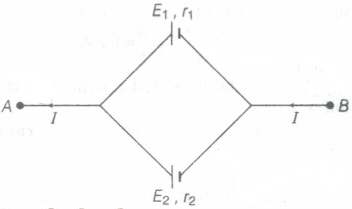
So, I = I1 + I2
Now, let V be the potential difference between the points, A and B. Since, the first cell is connected between the points A and B
V = potential difference across first cell
V = E1-I1r1 or I1=\(\frac { { E }_{ 1 }-V }{ { r }_{ 1 } } \)
Now, the second cell is also connected between the points, A and B. So,
I2 = \(\frac { { E }_{ 2 }-V }{ { r }_{ 2 } } \)
Thus, substituting for I1 and I2
\(I=\frac { { E }_{ 1 }-V }{ { r }_{ 1 } } +\frac { { E }_{ 2 }-V }{ { r }_{ 2 } } \)
or \(I=\left( \frac { { E }_{ 1 } }{ { r }_{ 1 } } +\frac { E_{ 2 } }{ { r }_{ 2 } } \right) -V\left( \frac { 1 }{ { r }_{ 1 } } +\frac { 1 }{ { r }_{ 2 } } \right) \)
\(V=\left( \frac { { E }_{ 1 }{ r }_{ 2 }+{ E }_{ 2 }{ r }_{ 1 } }{ { r }_{ 1 }+{ r }_{ 2 } } \right) -I\left( \frac { { r }_{ 1 }{ r }_{ 2 } }{ { r }_{ 1 }+{ r }_{ 2 } } \right) \) ........(i)
If E is effective emf and r, the effective internal resistance of the parallel combination of the two cells, then
V = E - Ir ..............(ii)
Comparing Eqs. (i) and (ii), we get
(i) \(E=\frac { { E }_{ 1 }{ r }_{ 2 }+{ E }_{ 2 }{ r }_{ 1 } }{ { r }_{ 1 }+{ r }_{ 2 } } \)
This is equivalent emf of the combination.
(ii)\(\frac { { r }_{ 1 }{ r }_{ 2 } }{ { r }_{ 1 }+{ r }_{ 2 } } \)
This is equivalent resistance of the combination.
(iii) the potential difference between the points A and B is
V = E - Ir
4.
The current in the conductor having length l1 cross-sectional area A and number density n is
I = neAvd ...........(i)
Electric field inside the wire is given by
E = V/l ...............(ii)
If relaxation time is ፒ, the drift speed
\({ v }_{ d }=\frac { e\tau E }{ m } \)
where, m = mass of electron
ፒ = relaxation charge
e = electronic charge
E = electric field.
\(I=\frac { ne^{ 2 }\tau }{ m } AE\) .........(ii)
From Eqs. (ii) and (iii). we get
\(\frac { ne^{ 2 }\tau AV }{ ml } \Rightarrow J=\frac { 1 }{ A } =\frac { ne^{ 2 }\tau V }{ ml } \).
5.
Relaxation time (\(\tau\) ): The average time interval between two successive collisions for the free electrons drifting within a conductor (due to the action of the applied electric field), is called relaxation time.
Relation
\(v_d=(-eE\tau)/m\)
Since \(i=-n\ e A\ v_d\)
\(=ne^2 \ A\ \tau\ V/ml\)
\(\therefore V/i=ml/(ne_2\ A\ \tau)=pl/A\)
\(\therefore p=m/(ne^2\tau )\)
6.
Given \(\phi =5{ t }^{ 3 }+4{ t }^{ 2 }+2t-5,\quad t=2s,\)
\(R=10\Omega \)
\(\therefore \) Magnitude of induced e.m.f.
\(e=\left| e \right| =\frac { d\phi }{ dt } \)
or \(e=\frac { d }{ dt } \left[ 5{ t }^{ 3 }+4{ t }^{ 2 }+2t-5 \right] \)
\(=15{ t }^{ 2 }+8t+2\)
\(=15\times 4+8\times 2+2\)
or \(e=78V\)
\(\therefore \) \(I=\frac { e }{ R } =\frac { 78 }{ 10 } =7.8A\)
7.
Temperature, T1 = 27.5°C
Resistance of the silver wire at T1, R1 = 2.1 Ω
Temperature, T2 = 100°C
Resistance of the silver wire at T2, R2 = 2.7 Ω
Temperature coefficient of silver = α
It is related with temperature and resistance as
\(\alpha=\frac{R_{2}-R_{1}}{R_{2}\left(T_{2}-T_{1}\right)}\)
\(=\frac{2.7-2.1}{2.1(100-27.5)}=0.0039^{\circ} \mathrm{C}^{-1}\)
Therefore, the temperature coefficient of silver is 0.0039°C−1.
8.
(ii) To deduce the expression for the power of the combination, first find the equivalent resistance of the combination in the given conditions.
\(\because \ P_{1}=\frac{V^{2}}{R_{1}} \Rightarrow R_{1}=\frac{V^{2}}{P_{1}}\)
and \(P_{2}=\frac{V^{2}}{R_{2}} \Rightarrow R_{2}=\frac{V^{2}}{P_{2}}\)
(a) In series combination,
\(R_{s}=R_{1}+R_{2}=\frac{V^{2}}{P_{1}}+\frac{V^{2}}{P_{2}}\)
\(\Rightarrow \ R_{s}=V^{2}\left(\frac{1}{P_{1}}+\frac{1}{P_{2}}\right)=V^{2}\left(\frac{P_{1}+P_{2}}{P_{1} P_{2}}\right)\)
Now, let the power of heating element in series combination be Ps.
\(\therefore \ P_{s}=\frac{V^{2}}{R_{1}+R_{2}}=\frac{V^{2}}{V^{2}\left(\frac{P_{1}+P_{2}}{P_{1} P_{2}}\right)}=\frac{P_{1} P_{2}}{P_{1}+P_{2}}\)
(b) In parallel combination,
\(\frac{1}{R_{p}}=\frac{1}{R_{1}}+\frac{1}{R_{2}}=\frac{1}{\frac{V^{2}}{P_{1}}}+\frac{1}{\frac{V^{2}}{P_{2}}}=\frac{P_{1}}{V^{2}}+\frac{P_{2}}{V^{2}}\)
\(\Rightarrow \ \frac{1}{R_{p}}=\frac{1}{V^{2}}\left(P_{1}+P_{2}\right)\)
Now, power consumption in parallel combination,
\(P_{p}=\frac{V^{2}}{R_{p}}=V^{2}\left(\frac{1}{R_{p}}\right)\)
\(\Rightarrow \ P_{p}=V^{2}\left[\frac{1}{V^{2}}\left(P_{1}+P_{2}\right)\right]\)
∴ Pp = P1 + P2
9.
(i) Mutual inductance, between the two coils is equals to the magnetic flux linked with one coil when a unit current is passed in the other coil.
Alternatively,
\(e=\frac { -MdI }{ dt } \)
Mutual inductance is equal to the induced emf set up in one coil when the rate of change of current flowing through the other coil is unity.
SI unit: henry, (weber ampere-1) or (volt second ampere-1).
(ii)
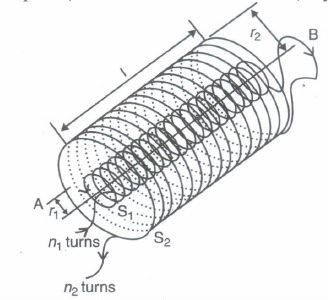
Let a current I2 flow through S2. This sets up a magnetic flux ф1 through each turn of the coil S1. Total flux linked with S1
N1ф1= M12 I2 ...(i)
where M12 is the mutual inductance between the two solenoids
Magnetic field due to the current I2 in S2 is μ0n2I2.
Therefore, resulting flux linked with S1
N1ф1=[(n1l)\({ \pi r }_{ 1 }^{ 2 }\)] (μ0n2I2) ....(ii)
Comparing (i) and (ii), we get
M12I2 =(n1l) (μ0n2I2)
M12 =μ0n2n1 \({ \pi r }_{ 1 }^{ 2 }\)l
(iii) Let a magnetic flux be (ф1) linked with coil C1 due to current (I2)in coil C2.
We have
ф1 ∝ I2
⇒ ф1 = MI2
∴ \(\frac { d{ \phi }_{ 1 } }{ dt } =M\frac { { dI }_{ 2 } }{ dt } \)
⇒ e= -M \(\frac { { dI }_{ 2 } }{ dt } \)
10.
It works on the principle of electromagnetic induction, i.e. when a coil continuously rotates in a magnetic field, the magnetic flux associated with it keeps on changing; thus an emf is induced in it.
(b) When the coil rotates in a magnetic field, its effective area i.e. A cos \(\theta \) , (i.e. area normal to the magnetic field) keeps on changing. Hence magnetic flux \(\phi \) = NBAcos S, keeps on changing.
(c) Let the coil be rotating with angular velocity 'm',
at any instant 't' when the normal to the plane of the coil makes an angle \(\theta \) with the magnetic field. Hence magnetic flux, 12 \(\phi \) = NBA cos mt, Therefore induced emf (e)
\(\epsilon =-\frac { d\phi }{ dt } \)
\(\Rightarrow \epsilon =NBA\omega sin\quad \omega t\)
Induced emf will be maximum when mt = 90° 12 Hence, max = NBA\(\omega \)
Direction of induced emf can be determined using Flemming's Right-hand rule. Alternatively: Statement of the above rule.
11.
Since drift velocity \({ v }_{ d }\) and current, I flowing in a conductor are related by the relation:
\({ v }_{ d }=\frac { I }{ neA } ....(1)\)
Also drift velocity in terms of average relaxation time τ is given by\(\)
\({ v }_{ d }=\frac { eE\tau }{ m } .......(2)\)
From (1) and (2), we have
\(\frac { eE\tau }{ m } =\frac { I }{ neA } \)
\(or \ \frac { E }{ I } =\frac { m }{ n{ e }^{ 2 }A\tau }\)
\(or \ \frac { V }{ lI } =\frac { m }{ n{ e }^{ 2 }A\tau }\)
\(or \ \frac { V }{ I } =\frac { ml }{ n{ e }^{ 2 }A\tau }........(3)\)
The R.H.S. of Eq(3) is constant
\(\frac { V }{ I } = \ Constant\)
This is Ohm′s law
\(But \ \frac { V }{ I } =R, \)the resistance of the conductorSo Eq(3) becomes
\(R=\frac { ml }{ n{ e }^{ 2 }A\tau }\)
\(But\quad R=\rho \frac { l }{ A }\)
\(\therefore \ \rho \frac { l }{ A } =\frac { ml }{ n{ e }^{ 2 }A\tau }\)
\( \rho =\frac { m }{ n{ e }^{ 2 }A\tau } \)
12.
Electromagnetic induction
Electromagnetic induction may be defined as the phenomenon of production of electric current (or e.m.f.) in a closed coil (or circuit), when magnetic flux linked with the coil (or circuit) is changed.
Magnetic flux \(\left( \phi \right) \). The total number of lines of induction passing normally through a given area is called magnetic flux. Consider a surface A. Take a small element of area dA. If \(\overrightarrow { B } \) makes an angle \(\theta \) with the area vector \(d\overrightarrow { A } \), then magnetic flux linked with area dA will be
\(d\phi =\overrightarrow { B } .d\overrightarrow { A } \)
(where area vector is a vector \(d\overrightarrow { A } \) having magnitude dA and direction normal to \(dA\))
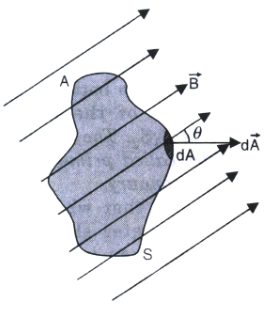
Total magnitude flux linked with the whole surface S will be
\(\phi =\int { \overrightarrow { B } .d\overrightarrow { A } } \)
If the surface is plane and having area S, then
\(\phi =\overrightarrow { B } .\overrightarrow { A } \)
or \(\phi =BA\cos { \theta } \) .....(1)
Units of \(\phi \)
If \(B=1T,A=1{ m }^{ 2 },\theta ={ 0 }^{ ° },then\quad \phi =1Wb.\)
Hence magnetic flux is said to be 1 weber (1Wb) if a magnetic field of 1 tesla is normal to the area of 1 \({ m }^{ 2 }.\)
So \(1Wb=1T{ m }^{ 2 }\)
Magnetic induction (B). It is defined as the magnetic flux associated per unit area.
i.e. \(B=\frac { \phi }{ A } \)
Units. In S.I. the unit of B is Wb \({ m }^{ 2 }\) or tesla (T).
Positive and negative flux
Since \(\phi =BA\cos { \theta } \)
So (I) \(If \ \theta >{ 90 }^{ ° },\phi =-ve\left( i.e. \ \phi \ is \ inward \ the \ surface \right) \)
(ii) \(If \ \theta <{ 90 }^{ ° },\phi =+ve\left( i.e. \ \phi \ is \ outward \ to \ the \ surface \right) \)
(iii) \(If \ \theta ={ 90 }^{ ° },\phi =BS\left( i.e. \ maximum \ flux \right) \)
Dimensional formula of \(\phi \)
\(\phi =BA\cos { \theta =\frac { FA }{ q\upsilon } \cos { \theta \left[ \therefore F=qB\upsilon \right] } } \)
\(=\frac { \left[ ML{ T }^{ -2 } \right] \left[ { L }^{ 2 } \right] }{ \left[ AT \right] \left[ L{ T }^{ -1 } \right] } \)
\(=\left[ M{ L }^{ 2 }{ T }^{ -2 }{ A }^{ -1 } \right] \)
13.
(a)
1.25 x 10¹⁹
14.
(b)
-10V
15.
(a)
0.43 ms -1
16.
(c)
charge
17.
(a)
[ML2 T-2 A-2]
18.
(a)
Anti-clockwise
19.
(b)
17.7V
20.
(d)
\(M=\mu_{r} \mu_{0} n_{1} n_{2} \pi r_{1}^{2} l\)
21.
(c)
Both (a) and (b)
22.
(c)
2R
23.
(b)
4\(\times\)10-3V
24.
(a): The coefficient of self inductance of the coil is given by \(L=\frac{\mu_{0} N^{2} A}{l}\)
where N is number of turns, 1 is length of the coil and
A is area of coil, so \(L \propto N^{2}\)
25.
(c): The manner in which the two coils are oriented, determines the coefficient of coupling between them \(\text { i.e., } K=\sqrt{\frac{M}{L_{1} L_{2}}}\), where L, and L2 are self-inductance of two coils. When the two coils are wound on each other, the coefficient of coupling is maximum and hence mutual inductance between the coil is maximum.
26.
(d): When two bulbs are connected in series, the resistance of the circuit increases and so the voltage in each decreases, hence the brightness and the temperature also decreases. Due to decrease in temperature, the resistance of the carbon filament will slightly increase while that of metal filament will decrease. Hence, carbon filament bulb will glow more brightly (P = i2R). Also carbon is not a semiconductor
27.
(a): In normal conductor, the direction of electrons are randomly oriented such that the total sum of their velocities is equal to zero.

12th Standard CBSE Syllabus & Materials
12th Standard CBSE
CBSE 12th Computer Science Python Revision Tour I - New Previous year Question Papers Study Material - QB365 Set A
NEW12th Standard CBSE
CBSE 12th Business Studies Planning Important Questions And Answers Study Material - QB365 Set A
NEW12th Standard CBSE
CBSE 12th Business Studies Business Environment Important Questions And Answers Study Material - QB365 Set A
NEW12th Standard CBSE
CBSE 12th Business Studies Principles of Management Important Questions And Answers Study Material - QB365 Set A



NCERT Books

Syllabus

Exam Pattern

Sample Question Papers

Previous year Question Papers

Important Notes

MCQ Practice test

NCERT Exemplers

Case study Questions

Image Based Questions

Passage based Questions

HOT Questions

Value Based Questions

Model Questions Papers
NCERT ( Book Back ) Questions

Assertion and Reason
Important Questions And Answers

CBSE 12th Standard CBSE Subjects
CBSE Standards








