
 100% FREE ACCESS
12th Standard CBSE Syllabus & Materials
12th Standard CBSE
CBSE 12th Economics Government Budget and the Economy Previous year Question Papers Study Material - QB365 Set A
NEW12th Standard CBSE
CBSE 12th Computer Science Interface Python with MySQL - New Previous year Question Papers Study Material - QB365 Set A
NEW12th Standard CBSE
CBSE 12th Computer Science Database Concept - New Previous year Question Papers Study Material - QB365 Set A
NEW12th Standard CBSE
CBSE 12th Computer Science Data Communication - New Previous year Question Papers Study Material - QB365 Set A
NEW12th Standard CBSE
CBSE 12th Computer Science Data Structures - New Previous year Question Papers Study Material - QB365 Set A
NEW12th Standard CBSE
CBSE 12th Computer Science Functions - New Previous year Question Papers Study Material - QB365 Set A

Published on: 25/10/2025
Download CBSE Class 12th Standard CBSE Physics question papers, sample papers, important questions, and previous year solved papers in PDF format. Get free study materials, NCERT solutions, and exam preparation resources for Class 12th Standard CBSE Physics
Questions + Answers key
Take MCQ Physics Test
1.
When a radioactive nucleus emits a β-particle, the mass number of the atom:
increases by one.
remains the same
decreases by one
decreases by four.
2.
Which of the following spectral series in hydrogen atom gives spectral line of 4860 \(\overset { \circ }{ A } \)?
Lyman
Balmer
Paschen
Brackett
3.
The stopping potential Vo for photoelectric emission from a metal surface is plotted along y-axis and frequency v of incident light along x-axis. A straight line is obtained as shown. Planck's constant is given by
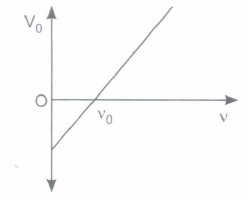
slope of the line
product of the slope of the line and charge on electron
intercept along y-axis divided by charge on the electron
product of the intercept along x-axis and mass of the electron
4.
A radioactive nucleus 81X237 emits three a-particles and one β-particle. The resultant nucleus will be
76Y225
78Y225
80Y229
83Y230
5.
What is the de-Broglie wavelength of the particle accelerated through a potential difference V? Given, \(h=6.63\times { 10 }^{ -34 }Js\)mass of a nucleon = \(1.66\times { 10 }^{ -27 }kg\)
\(\frac { 12.27 }{ \sqrt { V } } \overset { \circ }{ A } \)
\(\frac { 0.202 }{ \sqrt { V } } \overset { \circ }{ A } \)
\(\frac { 0.101 }{ \sqrt { V } } \overset { \circ }{ A } \)
\(\frac { 0.287 }{ \sqrt { V } } \overset { \circ }{ A } \)
6.
When a metallic is illuminated with radiation of wavelength \(\lambda \) , the stopping potential is V.If the same surface is illuminated with radiation of wavelength, \(2\lambda \) the stopping potential is V/4. The threshold wavelength for the metallic surface is
\(4\lambda \)
\(5\lambda \)
\(5\lambda /2\)
\(3\lambda \)
7.
The longest wavelength in Balmer series of hydrogen spectrum will be
\(6557\mathring { A } \)
\(1216\mathring { A } \)
\(4800\mathring { A } \)
\(5600\mathring { A } \)
8.
As an electron makes a transition from an excited state to the ground state of a hydrogen like atom/ion.
Its kinetic energy increases but potential energy and total energy decrease
Kinetic energy, potential energy and total energy decrease
Kinetic energy decreases, potential energy increases but total energy remains same
Kinetic energy and total energy decrease but potential energy increases
9.
Two photons, each of energy 2.5eV are simultaneously incident on the metal surface. If the work function of the metal is 4.5eV, then from the surface of metal
one electron will be emitted with energy 0.5eV
two electrons will be emitted with energy 0.25eV
more than two electrons will be emitted
not a single electron will be emitted.
10.
The de-Broglie wavelength of a photon is twice the de-Broglie wavelength of an electron.The speed of the electron is \({ v }_{ e }=\frac { c }{ 100 } \) Then
\(\frac { { E }_{ e } }{ { E }_{ p } } ={ 10 }^{ -4 }\)
\(\frac { { E }_{ e } }{ { E }_{ p } } ={ 10 }^{ -2 }\)
\(\frac { { p }_{ e } }{ { m }_{ e }c } ={ 10 }^{ -2 }\)
\(\frac { { p }_{ e } }{ { m }_{ e }c } ={ 10 }^{ -4 }\)
11.
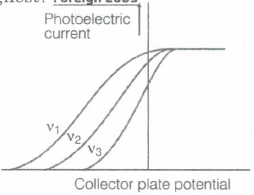
The given graph shows variation of photoelectric current with collector plate potential for different frequencies of incident radiation.
(i) Which physical parameter is kept constant for the three curves?
(ii) Which frequency (v1,v2 or v3) is the highest?
12.
A radioactive nucleus A undergoes a series of decays according to the following scheme
\(A\overset { \alpha }{ \longrightarrow } { A }_{ 1 }\overset { \beta }{ \longrightarrow } { A }_{ 2 }\overset { \alpha }{ \longrightarrow } { A }_{ 3 }\overset { \gamma }{ \longrightarrow } { A }_{ 4 }\)
The mass number and atomic number of A4 are 172 and 69, respectively. What are these numbers for A?
13.
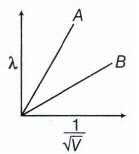
The two lines marked A and B in the given figure. Show a plot of de-Broglie wavelength \(\lambda \) versus \(\frac { 1 }{ \sqrt { V } } \), where V is the accelerating potential for two nuclei \(_{ 1 }^{ 2 }{ H }\) and \(_{ 1 }^{ 3 }{ H }\).
(i) What does the slope of the lines represent?
(ii) Identify, which of the lines corresponded to these nuclei.
14.
Two metals A and B have work functions 2 eV and 4 eV respectively, which metal has lower threshold wavelength for photoelectric effect?
15.
The frequency (v) of the incident radiation is greater than threshold frequency in\(\left( { v }_{ 0 } \right) \) a photocell. How will the stopping potential vary if frequency v is increased, keeping other factors constant?
16.
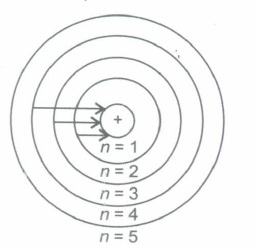
Using Bohr's postulates, obtain the expressions for (i) kinetic energy and (ii) potential energy of the electron in stationary state of hydrogen atom.
Draw the energy level diagram showing how the transitions between energy levels result in the appearance of Lyman series.
17.
(i) State Bohr's quantisatiori condition for I defining stsationary orbits. How does de-Broglie's hypothesis explain the stationary orbits?
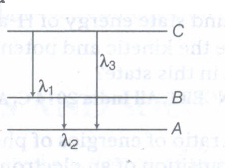
(ii) Find the relation between the three wavelengths \(\lambda \)1, \(\lambda \)2 and \(\lambda \)3 from the energy level diagram shown below.
18.
(i) Using Bohr's second postulate of quantisation of orbital angular momentum, show that the circumference of the electron in the nth orbital state in H-atom is n times the de-Broglie wavelength associated with it.
(ii) The electron in H-atom is initially in the third excited state. What is the maximum number of spectral lines which can be emitted when it finally moves to the ground state?
19.
A hydrogen atom rises from its n = 1 state to the n = 4 state by absorbing energy. If the potential energy of the atom in the n = 1 state be -13.6 e, then calculate
(a) potential energy in the n = 4 state,
(b) energy absorbed by the atom in transition,
(c) wavelength of the emitted radiation if the atom returns to its original state.
20.
A stopping potential of 0.82 volt is required to stop the emission of photoelectrons from the surface of a metal by light of wavelength.\(4000\overset { \circ }{ A } \)For light of wavelength, \(3000\overset { \circ }{ A } \) the stopping potential is 1.85 volt.Find the value of Plank's constant
\(\left[ 1eV=1.6\times { 10 }^{ -19 }J \right] \)
(ii) At stopping potential if the wavelength of light is kept fixed at \(4000\overset { \circ }{ A } \), but the intensity of light increased two times, will photoelectric current be obtained? Give reason for your answer.
21.
Photoelectrons are emitted from a metal surface when ultraviolet light of wavelength 300nm is incident on it. The minimum negative potential required to stop the emission of electrons is 0.54V. Calculate:
(i) the energy of the incident photons
(ii) the maximum kinetic energy of the photoelectrons emitted
(iii) the work function of the metal
Express all answers in eV.
\(Use\ h=6.63\times { 10 }^{ -34 }Js\)
22.
Pfund series of line spectrum of hydrogen atom belongs to _________ region.
23.
Stopping potential is __________ of intensity of incident radiation but proportional to __________ of the radiation.
24.
____________ is the minimum amount of energy required to cause photoelectric emission.
25.
One electron volt is the ___________ when accelerated through a _____________
26.
The velocity of photon in different media is.......
1.
(b)
remains the same
2.
(b)
Balmer
3.
(b)
product of the slope of the line and charge on electron
4.
(a)
76Y225
5.
(c)
\(\frac { 0.101 }{ \sqrt { V } } \overset { \circ }{ A } \)
6.
(a)
\(4\lambda \)
7.
(a)
\(6557\mathring { A } \)
8.
(a)
Its kinetic energy increases but potential energy and total energy decrease
9.
(d)
not a single electron will be emitted.
10.
(b)
\(\frac { { E }_{ e } }{ { E }_{ p } } ={ 10 }^{ -2 }\)
11.
(i) According to the laws of photoelectric emission, the photoelectric current depends on the intensity of incident light. The constant saturation value of photoelectric current reveals that intensity of incident light is constant.
(ii) Frequency VI is the highest among v1, v2 and v3 because higher the cut-off potential, higher will be the frequency of incident light.
12.
In α-decay, the atomic number decreases by 2 units and mass number decreases by 4 units. In ß-decay, the atomic number increases by I unit but mass number does not change. In y-decay, there is no change in atomic number and mass number.
Let the mass number and atomic number of A be X and Y, respectively.
So, \(_{ Y }{ A }^{ x }\overset { \alpha }{ \longrightarrow } _{ Y-2 }{ A_{ 1 } }^{ x-4 }\overset { \beta }{ \longrightarrow } _{ Y-2+1 }{ A_{ 2 } }^{ x-4 }\)
\(\ or\ _{ Y-1 }{ A }_{ 2 }^{ x-8 }\overset { \alpha }{ \longrightarrow } _{ Y-1-2 }{ A }_{ 3 }^{ x-4-4 }\)
\(\ or\ _{ Y-3 }{ A }_{ 3 }^{ x-8 }\overset { \gamma }{ \longrightarrow } _{ Y-3 }{ A }_{ 4 }^{ x-8 }\)
According to the question, the mass number and atomic number of A4 are 172 and 69.
∴ X - 8 = 172 ⇒ X = 172 + 8 = 180
Y - 3 = 69 ⇒ Y = 72
13.
de-Broglie wavelength of accelerating charged particle is given by
\(\lambda =\frac { h }{ \sqrt { 2mqV } } \Rightarrow \lambda \sqrt { V } =\frac { h }{ \sqrt { 2mq } } =constant\)
(i) The slope of the lines represent \(\frac { h }{ \sqrt { 2mq } } .\)
where, h is Planck's constant, q is the charge and m is the mass of charged particle.
(ii) 1H2 and 1H3 carry same charge (as they have same atomic number).
\(\therefore \ \lambda \sqrt { V } \propto \frac { 1 }{ \sqrt { m } } \)
The lighter mass i.e 1H2 is represented by line of greater slope i.e A and similarly 1H3 by line B.
14.
\(
\lambda_0=\frac{h c}{\phi_0} \quad\left[\because \phi_0=\frac{h c}{\lambda_0}\right] \\
\because \lambda_0 \propto \frac{1}{\phi_0}
\)
Metal B has lower threshold wavelength.
15.
We know that, \(\frac{1}{2} m v_{\max }^2=e V_0=h\left(v-v_0\right)\)
Here, the frequency of the incident radiation is greater than the threshold frequency. Therefore, the value of stopping potential (V0) increases with increase in frequency (v) of the incident radiation arid KE will also increases.
16.
The kinetic energy which is due to velocity.
From first postulate of Bohr's atom model, we have
\(
\frac{m v^{2}}{r} =\frac{k Z e^{2}}{r^{2}}
\)
\(\therefore \frac{1}{2} m v^{2} =\frac{1}{2} \frac{k Z e^{2}}{r}
\)
(i) The kinetic energy of the electron \(=\frac{1}{2} m v^{2}\)
\(=\frac{k Z e^{2}}{2 r}\) Potential due to the nucleus, at any point in the orbit in which electron is revolving \(=\frac{k Z e^{}}{2 r}\)
(ii) The potential energy of the electron = Potential x Charge
\(\therefore \quad \text { P.E. }=\frac{k Z e(-e)}{r}=-\frac{k Z e^{2}}{r}\)
The Lyman series is obtained when an electron jumps into first orbit (ni = 1) from any outer orbit (n2 = 2, 3, 4 ...)
17.
(i) According to Bohr's principle, electrons revolve in a stationary orbit of which energy and momentum are fixed. The momentum of electrons in the fixed orbit is given by \(\frac{n h}{2 \pi}\) (where, n = number of orbits)
According to de-Broglie's hypothesis, the electron is associated with wave character. Hence, a circular orbit can be taken to be a stationary energy state only if it contains an integral number of de-Broglie wavelengths, i.e. 2\(\pi\)r = n\(\lambda\)
(ii) According to question,
\(E_{B}-E_{C}=\frac{h c}{\lambda_{1}}\) ............(i)
\(E_{A}-E_{B}=\frac{h c}{\lambda_{2}}\) . ..........(ii)
\(E_{C}-E_{A}=\frac{-h c}{\lambda_{3}}\) ..............(iii)
On adding Eqs. (i), (ii) and (iii), we get EB - EC + EA - EB + EC - EA
\(=h c\left(\frac{1}{\lambda_{1}}+\frac{1}{\lambda_{2}}-\frac{1}{\lambda_{3}}\right)\)
\(\Rightarrow \quad \frac{1}{\lambda_{3}}=\frac{1}{\lambda_{1}}+\frac{1}{\lambda_{2}} \Rightarrow \lambda_{3}=\frac{\lambda_{1} \lambda_{2}}{\lambda_{1}+\lambda_{2}}\)
This is the required expression.
18.
(i) Bohr's second postulate states that the electron revolves around the nucleus in certain privileged orbit which satisfy certain quantum condition that angular momentum of an electron is an integral multiple of \(\cfrac { h }{ 2\pi } \), where h is Planck's constant. i.e \(L=mvr=\cfrac { nh }{ 2\pi } \)
Where, m = mass of electron, v = speed of electron and r = radius of orbit of electron.
\(\therefore\) Circumference of electron in nth orbit
= n \(\times\)de-Broglie wavelength associated with electron. \(\left[ \because \lambda =\cfrac { h }{ mv } \right] \)
(ii) Given, the electron in H-atom is initially in third excited state.
n = 4
And the total number of spectral lines of an atom that can exist is given by the relation
\(=\ \cfrac { n(n-1) }{ 2 } \)
Here, n = 4
So, number of spectral lines = \(\cfrac { 4(4-1) }{ 2 } =\cfrac { 4\times 3 }{ 2 } =6\)
Hence, when a H-atom moves from third excited state to ground state, it emits six spectral lines.
19.
\(-0.85 \ eV, \ 12.75 \ eV; \ 970\mathring { A } \)
\(Here,\ { E }_{ 1 }=-13.6\ eV;\ n=4,\ { E }_{ 4 }=?\)
\( (a) \ { E }_{ 4 }=-\frac { { E }_{ 1 } }{ { 4 }^{ 2 } } =\frac { -13.6eV }{ 16 } =-0.85eV\)
(b) Energy absorbed by the atom in transition from n = 1 to n = 4 is
\(\Delta E={ E }_{ 4 }-{ E }_{ 1 }=-0.85-(-13.6)\)
\( =12.75eV\)
\(\\ (c) \ \Delta E=\frac { hc }{ \lambda }\)
\(or \ \lambda =\frac { hc }{ \Delta E } =\frac { 6.6\times { 10 }^{ -34 }\times 3\times { 10 }^{ 8 } }{ 12.75\times 1.6\times { 10 }^{ -19 } } \)
\( =970\times { 10 }^{ -10 }m\)
\(970\mathring { A } \)
20.
\(Here, \ { \lambda }_{ 1 }=4000\overset { \circ }{ A } =4\times { 10 }^{ -7 }m;{ V }_{ 1 }=0.82V;\)
\({ \lambda }_{ 2 }=3000\overset { \circ }{ A } =3\times { 10 }^{ -7 }m;{ V }_{ 2 }=1.85V\)
\( As \ \frac { hc }{ { \lambda }_{ 1 } } ={ \phi }_{ 1 }+e{ V }_{ 1 } \ and \ \frac { hc }{ { \lambda }_{ 2 } } ={ \phi }_{ 1 }+e{ V }_{ 2 }\)
\(\therefore \ \frac { hc }{ { \lambda }_{ 2 } } -\frac { hc }{ { \lambda }_{ 1 } } =e\left( { V }_{ 2 }-{ V }_{ 1 } \right)\)
\( or \ hc\left( \frac { { \lambda }_{ 1 }-{ \lambda }_{ 2 } }{ { \lambda }_{ 1 }{ \lambda }_{ 2 } } \right) =e\left( { V }_{ 2 }-{ V }_{ 1 } \right) \)
\(or \ \ h=\frac { e\left( { V }_{ 2 }-{ V }_{ 1 } \right) { \lambda }_{ 1 }{ \lambda }_{ 2 } }{ \left( { \lambda }_{ 1 }-{ \lambda }_{ 2 } \right) c }\)
\( =\frac { \left( 1.6\times { 10 }^{ -19 } \right) \times \left( 1.85-0.82 \right) \times 4\times { 10 }^{ -7 }\times 3\times { 10 }^{ -7 } }{ \left( 4\times { 10 }^{ -7 }-3\times { 10 }^{ -7 } \right) \times 3\times { 10 }^{ 8 } }\)
\( =6.592\times { 10 }^{ -34 }Js\)
21.
\(Here,\lambda =300nm=300\times { 10 }^{ -9 }m\)
\(=3\times { 10 }^{ -7 }m,{ V }_{ 0 }=0.54V\)
(i) Energy of the incident photon,
\(E=\frac { hc }{ \lambda } =\frac { \left( 6.63\times { 10 }^{ -34 }Js \right) \times \left( 3\times { 10 }^{ 8 }m/s \right) }{ 3\times { 10 }^{ -7 } } =6.63\times { 10 }^{ -19 }J\)
\(=\frac { 6.63\times { 10 }^{ -19 } }{ 1.6\times { 10 }^{ -19 } } eV=4.14eV\)
(ii) Max. K.E. of emitted photoelectron is
\({ K }_{ max }=e{ V }_{ 0 }=e\times 54V=0.54eV\)
(iii) \({ As\ K }_{ max }=\frac { hc }{ \lambda } -{ \phi }_{ 0 }\ or{ \ \phi }_{ 0 }=\frac { hc }{ \lambda } -{ K }_{ max }\)
\(=4.14eV-0.54eV=3.6eV\)
22.
()
infrared
23.
()
independent, frequency
24.
()
Wok function
25.
()
energy acquired by an electron; a potential difference of 1 volt
26.
()
different

12th Standard CBSE Syllabus & Materials
12th Standard CBSE
CBSE 12th Computer Science Python Revision Tour I - New Previous year Question Papers Study Material - QB365 Set A
NEW12th Standard CBSE
CBSE 12th Business Studies Planning Important Questions And Answers Study Material - QB365 Set A
NEW12th Standard CBSE
CBSE 12th Business Studies Business Environment Important Questions And Answers Study Material - QB365 Set A
NEW12th Standard CBSE
CBSE 12th Business Studies Principles of Management Important Questions And Answers Study Material - QB365 Set A



NCERT Books

Syllabus

Exam Pattern

Sample Question Papers

Previous year Question Papers

Important Notes

MCQ Practice test

NCERT Exemplers

Case study Questions

Image Based Questions

Passage based Questions

HOT Questions

Value Based Questions

Model Questions Papers
NCERT ( Book Back ) Questions

Assertion and Reason
Important Questions And Answers

CBSE 12th Standard CBSE Subjects
CBSE Standards








