
 100% FREE ACCESS
12th Standard CBSE Syllabus & Materials
12th Standard CBSE
CBSE 12th Economics Government Budget and the Economy Previous year Question Papers Study Material - QB365 Set A
NEW12th Standard CBSE
CBSE 12th Computer Science Interface Python with MySQL - New Previous year Question Papers Study Material - QB365 Set A
NEW12th Standard CBSE
CBSE 12th Computer Science Database Concept - New Previous year Question Papers Study Material - QB365 Set A
NEW12th Standard CBSE
CBSE 12th Computer Science Data Communication - New Previous year Question Papers Study Material - QB365 Set A
NEW12th Standard CBSE
CBSE 12th Computer Science Data Structures - New Previous year Question Papers Study Material - QB365 Set A
NEW12th Standard CBSE
CBSE 12th Computer Science Functions - New Previous year Question Papers Study Material - QB365 Set A

Published on: 25/10/2025
Download CBSE Class 12th Standard CBSE Physics question papers, sample papers, important questions, and previous year solved papers in PDF format. Get free study materials, NCERT solutions, and exam preparation resources for Class 12th Standard CBSE Physics
Questions + Answers key
Take MCQ Physics Test
1.
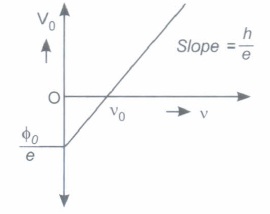
The slope of the stopping potential versus frequency graph for photoelectric effect is equal to
h
he
h/e
e
2.
The figure shows the variation of photocurrent with anode potential for a photosensitive surface for three different radiations. Let la, Ib and Ic be the intensities and va, vb and vc be the frequencies for the curves a, b and c respectively. Then the correct relation is
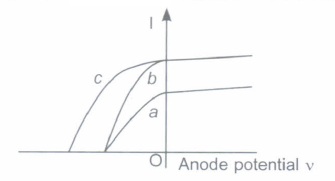
\( v_{a}=v_{b} \text { and } I_{a} \neq I_{b} \)
\(v_{a}=v_{c} \text { and } I_{a}=I_{c} \)
\(v_{a}=v_{b} \text { and } I_{a}=I_{b} \)
\(v_{b}=v_{c} \text { and } I_{b}=I_{c} \)
3.
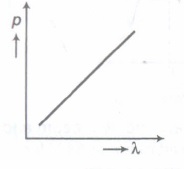
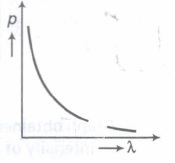
Which of the following figures represent the variation of particle momentum and the associated-de-Broglie wavelength?
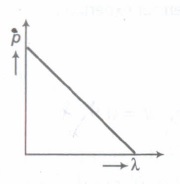
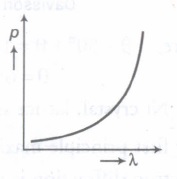
4.
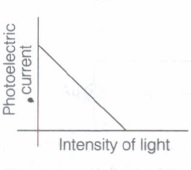
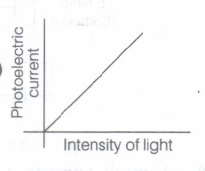
Variation of photoelectric current with intensity of light is
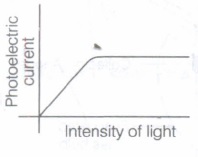
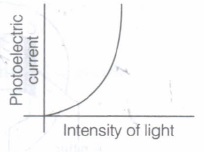
5.
The frequency and intensity of a light source are both doubled.Which of the following statement(s) is/are true?
The saturation photocurrent gets doubled.
The saturation photocurrent remains almost the same.
The maximum K.E. of the photoelectron is more than doubled.
The maximum K.E. of the photoelectron gets doubled
6.
Photoelectric effect supports the quantum nature of light because
there is minimum frequency of light below which no photoelectrons are emitted
the maximum K.E. of photoelectrons emitted depends only on the frequency of the incident light and on its intensity
even when metal surface is faintly illuminated, the photoelectrons leave the surface immediately
electric charge of photoelectron is quantised
7.
Choose the incorrect statement:
The velocity of photoelectrons is directly proportional to the square root of wavelength of light
The number of photoelectrons emitted depends upon the intensity of incident light
The velocity of photoelectrons is directly proportional to the frequency of incident light.
The velocity of photoelectrons is inversely proportional to square root of the frequency of the light.
8.
The de-Broglie wavelength of the tennis ball of mass 60g moving with a velocity of 10m/s is approximately: (Plank's constant h = \(h=6.63\times { 10 }^{ -34 }Js\)
\({ 10 }^{ -33 }m\)
\({ 10 }^{ -31 }m\)
\({ 10 }^{ -16 }m\)
\({ 10 }^{ -25 }m\)
9.
If the elctron frequency of light in a photoelectric experiment is doubled the stopping potential will
be doubled
be halved
become more than double
become less than double
10.
According to Einstein's photoelectric equation, the plot of the kinetic energy of the emitted photoelectrons from a metal verses the frequency of the incident radiation gives a straight line whose slope.
depends on the nature of the metal used
depends on the intensity of the radiation
depends both on the intensity of the radiation and the metal used
is the same for all metals and independent of the radiation.
11.
The threshold wavelength for a metal having work function \({ \phi }_{ 0 } \ is \ { \lambda }_{ 0 }\). What is the threshold wavelength for a metal whose work function is \({ \phi }_{ 0 }/2\)
\(4{ \lambda }_{ 0 }\)
\(2{ \lambda }_{ 0 }\)
\({ \lambda }_{ 0 }/2\)
\({ \lambda }_{ 0 }/4\)
12.
Which of the following has minimum stopping potential?
Blue
Yellow
Violet
Red
13.
A proton,a neutron, an electron and an \(\alpha \)-particle have the same energy.Then their de-Broglie wavelengths compare as
\(\lambda _{ p }=\lambda _{ n }>\lambda _{ c }>\lambda _{ \alpha }\)
\(\lambda _{ \alpha }<\lambda _= \lambda _{ n }>\lambda _{ c }\)
\(\lambda _{ e }<\lambda _=\lambda _{ n }>\lambda _{ \alpha }\)
\(\lambda _{ c }=\lambda =\lambda _{ n }=\lambda _{ \alpha }\)
14.
The work function for a certain metal is 4.2eV. Will this metal give photoelectric emission for incident radiation of wavelength 330 nm? Use, \(h=6.6\times { 10 }^{ -34 }Js\)
15.
What is the momentum of photon of energy 3 MeV in \(kg \ { ms }^{ -1 }\)
16.
The work function of copper is 4.0eV. If two photons, each of energy 2.5eV strike with some electrons of copper, will the emission be possible?
17.
Define photoelectric work function. How is it related to threshold frequency?
18.
The stopping potential in an experiment on a photoelectric effect is 1.5V. What is the maximum kinetic energy of the photoelectrons emitted?
19.
What are matter waves ? A proton and an alpha particle are accelerated through the same potential difference. Find the ratio of the de-Broglie wavelength associated with the proton to that with the alpha particle.
20.
Write Einstein's photoelectric equation and point out any two characteristic properties of photons on which this equation is based.
Briefly explain the three observed features which can be explained by this equation.
21.
The graphs, drawn here, are for the phenomenon of photoelectric effect.
.png)
.png)
(i) Identify which of the two characteristics (intensity/frequency) of incident light, is being kept constant in each case.
(ii) Name the quantity, corresponding to the, .png) mark, in each case.
mark, in each case.
(iii) Justify the existence of a 'threshold frequency' for a given photosensitive surface
22.
An electron, \(\alpha \) -particle and a proton have the same de-Broglie wavelengths. Which of
theseparticle has
(i) minimum kinetic energy?
(ii) maximum kinetic energy and why?
In what way has the wave nature of electron beam exploited in an electron microscope?
23.
What is the de-Broglie wavelength of
(a) a bullet of mass 0.040 kg travelling at the speed of 1.0 km/s?
(b) a ball of mass 0.060 kg moving at a speed of 1.0 m/s?
(c) a dust particle of mass \(1.0\times { 10 }^{ -9 }kg\) drifting with a speed of 2.2 m/s?
24.
Calculate the de-Broglie wavelength of an electron of kinetic energy 100 eV. Given \({ m }_{ e }=9.1\times { 10 }^{ -31 }kg,h=6.6\times { 10 }^{ -34 }Js\)
25.
The minimum light intensity that can be perceived by the eye is about \({ 10 }^{ -10 }{ Wm }^{ -2 }\)Find the number of photons of wavelength \(5.84\times { 10 }^{ -7 }m\)that must enter the pupil, of area \({ 10 }^{ -4 }{ m }^{ 2 }{ s }^{ -1 }\) for vision.
26.
The work function for cesium is 1.8eV. Light of \(4500\mathring { A } \) is incident on it. Calculate
(i) the maximum kinetic energy of the emitted photoelectron
(ii) maximum velocity of the emitted photoelectron
(iii) if the intensity of the incident light is doubled, then find the maximum kinetic energy of the emitted photoelectron
Given \(h=6.6\times { 10 }^{ -34 }Js,\ { m }_{ e }=9.1\times { 10 }^{ -31 }kg, \ c=3\times { 10 }^{ 8 }{ ms }^{ -1 }\)
27.
28.
According to Einstein, when a photon of light of frequency u or wavelength \(\lambda\) is incident on a photosensitive metal surface of work function \(\phi\)0w' here \(\phi\)0< hv (here, h is Planck's constant), then the emission of photoelectrons takes place. The maximum kinetic energy of the emitted photoelectrons is given by Kmax = hv - \(\phi\)0. If the frequency of the incident light is V0 called threshold frequency, the photoelectrons are emitted from metal without any kinetic energy. So hv0 = \(\phi\)
(i) A metal of work function 3·3 eV is illuminated by light of wavelength 300 nm. The maximum kinetic energy of photoelectrons emitted is (taking h = 6·6 x 10-34 Js)
| (a) 0.413 eV | (b) 0.825 eV | (c) 1.65 eV | (d) 1.32 eV |
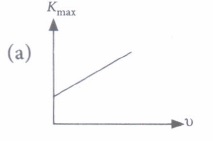
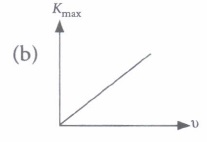
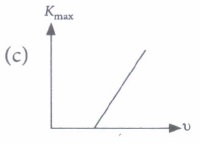
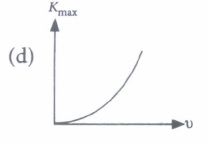
(ii) The variation of maximum kinetic energy (Kmax) of the emitted photoelectrons with frequency (v) of the incident radiations can be represented by
 |
 |
 |
 |
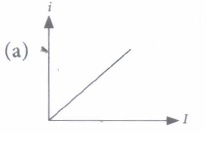
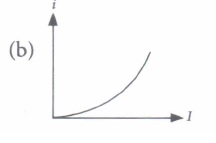
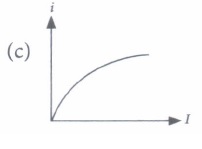
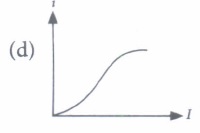
(iii) The variation of photoelectric current (i) with the intensity of the incident radiation (I) can be represented by
 |
 |
 |
 |
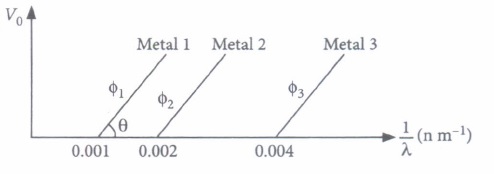
(iv) The graph between the stopping potential (V0) and \(\left(\frac{1}{\lambda}\right)\) is shown in the figure \(\phi_{1}, \phi_{2}, \phi_{3}\) 3 are work function. Which of the following options is correct?
\(\text { (a) } \phi_{1}: \phi_{2}: \phi_{3}=1: 2: 3\) |
| \(\text { (b) } \phi_{1}: \phi_{2}: \phi_{3}=4: 2: 1\) |
| \(\text { (c) } \phi_{1}: \phi_{2}: \phi_{3}=1: 2: 4\) |
| (d) Ultraviolet light can be used to emit photoelectrons from metal 2 and metal 3 only |
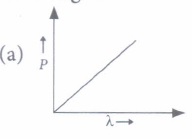
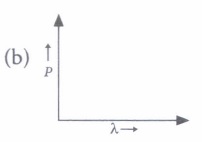
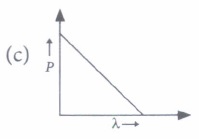
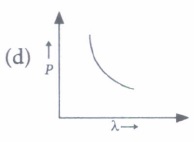
(v) Which of the following figures represent the variation of particle momentum and the associated de- Broglie wavelength?
 |
 |
 |
 |
29.
30.
Assertion (A) : Stopping potential depends upon the frequency of incident light but is independent of the intensity of the light.
Reason (R) : The maximum kinetic energy of the photoelectrons is proportional to stopping potential.
Codes:
(a) Both A and R are true and R is the correct explanation of A
(b) Both A and R are true but R is NOT the correct explanation of A
(c) A is true but R is false
(d) A is false and R is also false
1.
(c)
h/e
2.
(a)
\( v_{a}=v_{b} \text { and } I_{a} \neq I_{b} \)
3.
(b)
4.
(d)
5.
(a)
The saturation photocurrent gets doubled.
6.
(a)
there is minimum frequency of light below which no photoelectrons are emitted
7.
(a)
The velocity of photoelectrons is directly proportional to the square root of wavelength of light
8.
(a)
\({ 10 }^{ -33 }m\)
9.
(c)
become more than double
10.
(d)
is the same for all metals and independent of the radiation.
11.
(b)
\(2{ \lambda }_{ 0 }\)
12.
(d)
Red
13.
(b)
\(\lambda _{ \alpha }<\lambda _= \lambda _{ n }>\lambda _{ c }\)
14.
\({ v }_{ 0 }={ \phi }_{ 0 }/h=4.2\times 1.6\times { 10 }^{ -19 }/6.6\times { 10 }^{ -34 }\)
\(=6.72\times { 10 }^{ 15 }/6.6 \ Hz\)
\(v=c/\lambda =3\times { 10 }^{ 8 }/330\times { 10 }^{ -9 }=3\times { 10 }^{ 15 }/3.3Hz\)
\( =6\times { 10 }^{ 15 }/6.6Hz\)
As \(v<{ v }_{ 0 }\)therefore no photoelectric emission will take place.
15.
\(p=\frac{E}{c}=\frac{3 \times 1.6 \times 10^{-13}}{3 \times 10^8}=1.6 \times 10^{-21} \mathrm{kgms}^{-1}\)
16.
One photon can eject one photoelectron from the surface of a metal provided its energy is not less than the work function of the metal. Since each photon has energy less than the work function of copper, hence, the photoelectric emission is not possible.
17.
The work function of a metal is the minimum energy required by an electron to just escape from the metal surface so as to overcome the restraining forces at the surface.
The relation between work function \(\left(\phi_0\right)\) and threshold frequency \(\left(v_0\right) \text { is } \phi_0=h v_0\) where h is Plank's constant.
18.
\(M a x . K . E .=K_{\max }=e V_0=e \times 1.5 \mathrm{~V}=1.5 \mathrm{eV}\)
19.
1. Matter-wave is an important part of quantum physics.
2. It is said that all matter shows wave-like behavior
3. The wavelength (\(\lambda\)) of a matter-wave can be determined by is \(\lambda=\frac{h}{p}\)
where h represents Planck's constant, and p represents the traveling particle's momentum.
4. The matter wave is also called as de Broglie wave.
5. The matter-wave describes the relationship between momentum and wavelength
6. The wavelength is inversely proportional to the momentum (mass and velocity) of the particle
7. The smaller the wavelength of the matter wave, the faster the particle moves.
8. The De-Broglie wavelength increases as the particle become lighter.
\(V_{\mathrm{a}}=V_P=V\)
\(\therefore \quad \frac{\lambda_{p}}{\lambda_a}=\frac{\sqrt{2 m e V_a}}{\sqrt{2 m e V_p}}=\sqrt{\frac{V_a}{V_p}}=1\)
\(\therefore \quad \lambda_p: \lambda_a=1: 1\)
20.
Einstein's photoelectric equation
\(K_{\max }=\frac{1}{2} m v_{\max }^{2}=h v-\phi_{0}=h v-h v_{0}\)
The two characteristic properties of photon on which
the above equation is based are given below.
(i) A photon carries energy (hv).
(ii) One photon can eject only one electron irrespective of its energy
The following are the three observed basic features:
(i) The kinetic energy of photoelectron is independent of intensity of radiation. It depends on the frequency of radiation.
(ii) Kmax must be non-negative, i.e. photoelectric emission is possible only \(\text { if } h v>\phi_{0} ; v>v_{0}\) where is threshold frequency and \(\phi_{0}\) is work function.
(iii) The greater is the intensity of radiation the more are the numbers of photoelectrons
21.
(i) Graph 1; Intensity
Graph 2 Frequency
(ii) Graph 1 Saturation current
Graph 2 Stopping potential
(iii) For a given photo-sensitive surface electrons need a minimum energy to be emitted, this is called work function of the surface W.
\(\therefore\) Photons energy hv should be greater/equal to the work function.
\(hv\ge w\)
\(v\ge \frac { w }{ h } \)
\(\therefore\) Minimum frequency for photo emission
\(v_{ 0 }=\frac { w }{ h } \)
22.
de-Broglie matter wave equation,
\(\lambda =\frac { h }{ p } =\frac { h }{ \sqrt { 2mK } } \ \left[ \because K=\frac { { P }^{ 2 } }{ 2m } \right] \)
where K is kinetic energy and m is a mass of the particle.
\(K=\frac { { h }^{ 2 } }{ 2m{ \lambda }^{ 2 } } \) [ for same wavelength \( \lambda] \)
\(K\propto \frac { 1 }{ m }\)
\(\Rightarrow \ { K }_{ e }:{ K }_{ \alpha }:{ K }_{ p }=\frac { 1 }{ { m }_{ e } } :\frac { 1 }{ { m }_{ \alpha } } :\frac { 1 }{ { m }_{ p } } \)
where \({ m }_{ e },{ m }_{ p } \ and \ { m }_{ \alpha }\) are masses of electron, proton and \(\alpha \) -particle, respectively.
Also, \({ K }_{ e },k_{ p } \ and \ K_{ \alpha }\) are their respective kinetic energies.
\(\because \ m_{ \alpha }>m_{ p }>m_{ e }\)
\(\\ \Rightarrow m_{ \alpha }m_{ p }>m_{ e }m_{ \alpha }>m_{ e }m_{ p }\)
\(\\ { K }_{ e }>k_{ p }>K_{ \alpha }\)
(i) \(\alpha \) particle possess minimum kinetic energy
(ii) The electron has maximum kinetic energy. The magnifying power of an electron microscope is inversely related to the wavelength of radiation used. The Smaller wavelength of the electron beam in comparison to visible light increases the magnifying power of the microscope.
23.
(i) Given, mass of bullet, m = 0.040 kg
Speed of bullet, v = 1 km/s = 1 \(\times\) 103 m/s
de-Broglie wavelength,
\(\lambda=\frac{b}{m v}=\frac{6.63 \times 10^{-34}}{0.040 \times 1 \times 10^3}\)
= 1.66 \(\times\) 10-35 m
(ii) Mass of the ball, m = 0.060 kg and speed of the ball, v=1 m/s
\(\begin{aligned}
\lambda & =\frac{b}{m v}=\frac{6.63 \times 10^{-34}}{0.060 \times 1}
\end{aligned}\)
\(\begin{aligned}
=1.1 \times 10^{-32} \mathrm{~m}
\end{aligned}\)
(iii) Mass of a dust particle, m = 1 \(\times\) 10-9 kg and speed of the dust particle, v = 2.2 m/s
\(\lambda=\frac{b}{m v}=\frac{6.63 \times 10^{-34}}{1 \times 10^{-9} \times 2.2}\)
= 3.0 \(\times\) 10-25 m
24.
\(1.227\mathring { A } \quad \)
25.
\(3\times { 10 }^{ 4 }photons\)
26.
\(Here \ { \phi }_{ 0 }=1.8eV,\lambda =4500 \ A=4.5\times { 10 }^{ -7 }m\)
(i) Max K.E of emitted photoelectron is
\({ K }_{ max }=\frac { hc }{ \lambda } -{ \phi }_{ 0 }\)
\( =\frac { (6.6\times { 10 }^{ -34 })(3\times { 10 }^{ 8 }) }{ 4.5\times { 10 }^{ -7 } } -1.8\times 1.6\times { 10 }^{ -19 }\)
\( =4.4\times { 10 }^{ -19 }-2.88\times { 10 }^{ -19 }=1.52\times { 10 }^{ -19 }J\)
(ii)Max. velocity of emitted photoelectron
\({ v }_{ max }=\sqrt { \frac { { 2K }_{ max } }{ m } } =\sqrt { \frac { 2\times 1.52\times { 10 }^{ -19 } }{ 9.1\times { 10 }^{ -31 } } }\)
\( =5.78\times { 10 }^{ 5 }{ ms }^{ -1 }\)
(iii) The kinetic energy of the emitted photoelectron is an incident of the intensity of the incident light. Hence, if the intensity of incident light is doubled the max. K.E of the emitted photoelectron electrons remains unchanged.
27.
28.
(i) (b): \(K_{\max }=h v-\phi_{0}=\frac{h c}{\lambda}-\phi_{0}\)
\(=\frac{\left(6 \cdot 6 \times 10^{-34}\right) \times\left(3 \times 10^{8}\right)}{\left(300 \times 10^{-9}\right) \times\left(1 \cdot 6 \times 10^{-19}\right)}-3 \cdot 3\)
\(=4 \cdot 125 \times 3 \cdot 3=0 \cdot 825 \mathrm{eV}\)
(ii) (c) : \(K_{\max }=h v-\phi_{0}, \text { When } v=v_{0}, K_{\max }=0\)
\(\therefore \quad 0=h v_{0}-\phi_{0} \text { or } \phi_{0}=h v_{0}\)
If v < v0 then Kmax is negative, i.e., no photoelectric emission takes place. Thus, graph (c) is possible.
(iii) (a): Photoelectric current (i) is proportional to the intensity of the emission light. Thus, graph (a) is possible.
(iv) (c): From Einstein's photoelectric equation,
\(K_{\max }=e V_{0}=\frac{h c}{\lambda}-\phi\)
or \(V_{0}=\frac{h c}{e} \cdot \frac{1}{\lambda}-\frac{\phi}{e}\)
Graph of V0 versus \(\frac{1}{\lambda}\) is a straight line Slope of straight line,\(\tan \theta=\frac{h c}{e}\)
\(\text { At } V_{0}=0, \text { we have }\)
\(\phi_{1}: \phi_{2}: \phi_{3}=\frac{h c}{\lambda_{01}}: \frac{h c}{\lambda_{02}}: \frac{h c}{\lambda_{03}}\)
\(0.001 h c: 0.002 h c: 0.004 h c\)
\(\therefore 1: 2: 4\)
(v) (d): de-Broglie wavelength
\(\lambda=\frac{h}{p} i . e ., \lambda \propto \frac{1}{p}\)
So the graph between \(\lambda\) and P is of the type shown is option (d).
29.
30.
(b): Stopping potential is a measure of maximum kinetic energy of emitted photoelectron (eV0 = Kmax) and Kmax depends upon the frequency of incident light but is independent of intensity.

12th Standard CBSE Syllabus & Materials
12th Standard CBSE
CBSE 12th Computer Science Python Revision Tour I - New Previous year Question Papers Study Material - QB365 Set A
NEW12th Standard CBSE
CBSE 12th Business Studies Planning Important Questions And Answers Study Material - QB365 Set A
NEW12th Standard CBSE
CBSE 12th Business Studies Business Environment Important Questions And Answers Study Material - QB365 Set A
NEW12th Standard CBSE
CBSE 12th Business Studies Principles of Management Important Questions And Answers Study Material - QB365 Set A



NCERT Books

Syllabus

Exam Pattern

Sample Question Papers

Previous year Question Papers

Important Notes

MCQ Practice test

NCERT Exemplers

Case study Questions

Image Based Questions

Passage based Questions

HOT Questions

Value Based Questions

Model Questions Papers
NCERT ( Book Back ) Questions

Assertion and Reason
Important Questions And Answers

CBSE 12th Standard CBSE Subjects
CBSE Standards








