
 100% FREE ACCESS
12th Standard CBSE Syllabus & Materials
12th Standard CBSE
CBSE 12th Economics Government Budget and the Economy Previous year Question Papers Study Material - QB365 Set A
NEW12th Standard CBSE
CBSE 12th Computer Science Interface Python with MySQL - New Previous year Question Papers Study Material - QB365 Set A
NEW12th Standard CBSE
CBSE 12th Computer Science Database Concept - New Previous year Question Papers Study Material - QB365 Set A
NEW12th Standard CBSE
CBSE 12th Computer Science Data Communication - New Previous year Question Papers Study Material - QB365 Set A
NEW12th Standard CBSE
CBSE 12th Computer Science Data Structures - New Previous year Question Papers Study Material - QB365 Set A
NEW12th Standard CBSE
CBSE 12th Computer Science Functions - New Previous year Question Papers Study Material - QB365 Set A

Published on: 25/10/2025
Download CBSE Class 12th Standard CBSE Physics question papers, sample papers, important questions, and previous year solved papers in PDF format. Get free study materials, NCERT solutions, and exam preparation resources for Class 12th Standard CBSE Physics
Questions + Answers key
Take MCQ Physics Test
1.
(i) Explain with the help of a diagram the formation of depletion region and barrier potential in a p -n junction-
(ii) Draw the circuit diagram of' a half-wave rectifier and explain its working.
2.
Calculate the amount of heat produced per second when a bulb of 100 W, 220 V glows, assuming that only 20% of electric energy is converted into light. J = 4.2 J cal-1.
3.
A bar magnet made of steel has a magnetic moment of 2.5 Am2 and a mass of 6.6 g. If the density of steel is 7.9 x 10³ , find the intensity of magnetisation of magnet.
4.
A flat coil of 500 turns each of area \(50{ cm }^{ 2 }\) rotates in a uniform magnetic field of at an angular speed of 150 rad/sec. The coil has a resistance of \(5\Omega \) . The induced e.m.f. is applied to an external resistance of 10 ohm. Calculate the peak current through the resistance.
5.
The wavelength of \({ K }_{ \alpha }\) line for copper is \(1.36\mathring { A } \) . Calculate the ionisation potential of a K shell electron in copper.
6.
A lens forms a real image of an object. The distance of the object to the lens is 4 cm and the distance of the image from the lens is v cm. The given graph shows the variation of v with u.
(i) What is the nature of the lens?
(ii) Using this graph, find the focal length of this lens.
7.
The threshold frequency of a metal is \({ f }_{ 0 }\) When the light of frequency \({ 2f }_{ 0 }\) is incident on the metal plate, the maximum velocity of electrons emitted is \({ v }_{ 1 }\) When the frequency of the incident radiation is increased to, \({ 5f }_{ 0 }\) the maximum velocity of electrons emitted is \({ v }_{ 2}.\) Find the ratio of \({ v }_{ 1 }and{ v }_{ 2 }\)
8.
Use the mirror equation to deduce that:
(a) an object placed between f and 2f of a concave mirror produces a real image beyond 2f.
(b) a convex mirror always produces a virtual image independent of the location of the object.
(c) the virtual image produced by a convex mirror is always diminished in size and is located between the focus and the pole.
(d) an object placed between the pole and focus of a concave mirror produces a virtual and enlarged image.
[Note: This exercise helps you deduce algebraically properties of images that one obtains from explicit ray diagrams.]
9.
A small candle, 2.5 cm in size is placed at 27 cm in front of a concave mirror of radius of curvature 36 cm. At what distance from the mirror should a screen be placed in order to obtain a sharp image? Describe the nature and size of the image. If the candle is moved closer to the mirror, how would the screen have to be moved?
10.
(i) If f = 0.5 m for a glass lens, what is the power of the lens?
(ii) The radii of curvature of the faces of a double convex lens are 10 cm and 15 cm. Its focal length is 12 cm. What is the refractive index of glass?
(iii) A convex lens has 20 cm focal length in air. What is focal length in water? (Refractive index of air-water = 1.33, refractive index for air-glass = 1.5.)
11.
Write the function of a transformer, State its principle of working with the help of a diagram. Mention various energy losses in this device.
The primary coil of an ideal step up transformer has 100 turns and transformation ratio is also 100. The input voltage and power are respectively 220 V and 1100 W. Calculate
a. number of turns in secondary
b. current in primary
c. voltage across secondary
d. current in secondary
e. power in secondary
12.
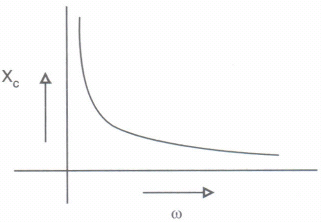
A dipole is made up of two charges + q and - q separated by a distance 2a. Derive an expression for the electric field E\(\overrightarrow{e}\) due to this dipole at a point distance r from the centre of the dipole on the equatorial plane. Draw the shape of the graph, between |Ee| and r when r > >a.
If this dipole were to be put in a uniform external electric field \(\overrightarrow{E}_e\) , obtain an expression for the torque acting on the dipole.
13.
An athlete peddles a stationary tricycle whose pedals are attached to a coil having 100 turns each of area 0.1 m2. The coil lying in XY plane is rotated in this plane at the rate of 50rpm about the Y-axis in a region where a uniform magnetic field \(\overset { \rightarrow }{ B } =\left( 0.01 \right) { k } \) tesla is present. Find the
(i) max. e.m.f.
(ii) average e.m.f. generated in the coil over one complete rotation.
1.
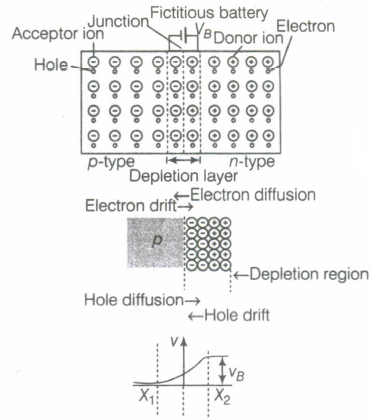
The small region in the vicinity of the junction which is depleted of free charge carriers and has e only immobile ions is called depletion region. The accumulation of negative charges in the p-region and positive charge in the n-region sets up a potential difference across the junction. This acts as a barrier and is called barrier potential VB.
(ii) .png)
Working
(a) During positive half cycle of input alternating voltage, the diode is forward biased and a current flows through the load resistor RL and we get an output voltage.
(b) During other negative half cycle of the input alternating voltage, the diode is reverse biased and it does not conduct (under break down region).
Hence, AC voltage can be rectified in the pulsating and unidirectional voltage.
2.
Electric energy consumed per second = 100 J
Heat produced = 80% = \(\frac{80}{100}\times 100\)
= 80 J = \(\frac{80}{4.2}\)
= 19.05 cal
3.
Here, M = 2.5 Am2, m = 6.6 g = 6.6 x 10⁻³ kg
\(\rho =7.9\times { 10 }^{ 3 }kg/{ m }^{ 3 },\)
\(V=\frac { m }{ \rho } =\frac { 6.6\times { 10 }^{ -3 } }{ 7.9\times { 10 }^{ 3 } } =0.835\times { 10 }^{ -6 }{ m }^{ 3 }\)
\(I=\frac { M }{ V } =\frac { 2.5 }{ 0.835\times { 10 }^{ -6 } } =3.0\times { 10 }^{ 6 }{ Am }^{ -1 }\)
4.
Here, \(N=500, \ A=50{ cm }^{ 2 }=50\times { 10 }^{ -4 }{ m }^{ 2 }\)
\(B=0.14Wb/{ m }^{ 2 },\omega =150rad/s,\)
\(R=5\Omega \quad { R }^{ ' }=10\Omega \quad { i }_{ 0 }=?\)
\({ e }_{ 0 }=NAB\omega =500\times 50\times { 10 }^{ -4 }\times 0.14\times 150\)
\(=52.5volt\)
As total resistance \(=R+{ R }^{ ' }=5+10=15\Omega \)
\(\therefore { \ i }_{ 0 }=\frac { { e }_{ 0 } }{ 15 } =\frac { 52.5 }{ 15 } =3.5A\)
5.
\(1.22\times { 10 }^{ 4 }V\)
6.
(i) As the lens forms a real iamge, it must be a convex lens.
(ii) From the graph, when u = 20 cm , we have v = 20 cm.
For the convex lens forming a real iamge, u is negative and v and f are positive.
U = -20 cm v = +20cm
Using this lens formula,
1/f = 1/v – 1/u = 1/20 – 1/-20 = 1/10 or f = + 10 cm
7.
As \({ f }_{ 0 }\) is the threshold frequency, so \({ { \phi }_{ 0 }=hf }_{ 0 }\)
Using Einstein's photoelectric equation, we have
\(\frac { 1 }{ 2 } { mv }_{ 1 }^{ 2 }=h\times 2{ f }_{ 0 }-{ hf }_{ 0 }={ hf }_{ 0 }\)
\(and \ { \frac { 1 }{ 2 } }{ mv }_{ 2 }^{ 2 }=h\times 5{ f }_{ 0 }-{ hf }_{ 0 }=4{ hf }_{ 0 }\)
\(\\ \frac { { v }_{ 1 }^{ 2 } }{ { v }_{ 2 }^{ 2 } } =\frac { 1 }{ 4 } \ or \ \frac { { v }_{ 1 } }{ { v }_{ 2 } } =\frac { 1 }{ 2 } \)
8.
(a) For a concave mirror, the focal length (f) is negative.
∴ f < 0
When the object is placed on the left side of the mirror, the object distance (u) is negative.
∴ u < 0
For image distance v, we can write the lens formula as:
\(\frac { 1 }{ v } -\frac { 1 }{ u } =\frac { 1 }{ f }\)
\(\frac { 1 }{ v } =\frac { 1 }{ f } -\frac { 1 }{ u } \) ....(1)
The object lies between f and 2f.
∴ 2f < u < f (∵ u and f are negative)
\(\frac { 1 }{ 2f } >\frac { 1 }{ u } >\frac { 1 }{ f } \)
\(-\frac { 1 }{ 2f } <-\frac { 1 }{ u } <\frac { 1 }{ f } \)
\(\frac { 1 }{ f } -\frac { 1 }{ 2f } <\frac { 1 }{ f } -\frac { 1 }{ u } <0\) ...(2)
Using equation (1), we get:
\(\frac { 1 }{ 2f } <\frac { 1 }{ v } \)
2f > v
-v > - 2f
Therefore, the image lies beyond 2f.
(b) For a convex mirror, the focal length (f) is positive.
∴ f > 0
When the object is placed on the left side of the mirror, the object distance (u) is negative.
∴ u < 0
For image distance v, we have the mirror formula:
\(\frac { 1 }{ v } +\frac { 1 }{ u } =\frac { 1 }{ f } \)
\(\frac { 1 }{ v } =\frac { 1 }{ f } -\frac { 1 }{ u } \quad \)
Using equation (2), we can conclude that:
\(\frac { 1 }{ v } \) < 0
v > 0
Thus, the image is formed on the back side of the mirror.
Hence, a convex mirror always produces a virtual image, regardless of the object distance.
(c) For a convex mirror, the focal length (f) is positive.
∴ f > 0
When the object is placed on the left side of the mirror, the object distance (u) is negative,
∴ u < 0
For image distance v, we have the mirror formula:
\(\frac { 1 }{ v } +\frac { 1 }{ u } =\frac { 1 }{ f } \)
\(\frac { 1 }{ v } =\frac { 1 }{ f } -\frac { 1 }{ u } \)
But we have u < 0
∴ \(\frac { 1 }{ v } >\frac { 1 }{ f } \)
v < f
Hence, the image formed is diminished and is located between the focus (f) and the pole.
(d) For a concave mirror, the focal length (f) is negative.
∴ f < 0
When the object is placed on the left side of the mirror, the object distance (u) is negative.
∴ u < 0
It is placed between the focus (f) and the pole.
∴ f > u > 0
\(\frac { 1 }{ f } <\frac { 1 }{ u } \)< 0
\(\frac { 1 }{ f } -\frac { 1 }{ u } \)< 0
For image distance v, we have the mirror formula:
\(\frac { 1 }{ v } +\frac { 1 }{ u } =\frac { 1 }{ f } \)
\(\frac { 1 }{ v } =\frac { 1 }{ f } -\frac { 1 }{ u } \)
∴\(\frac { 1 }{ v } \) < 0
v > 0
The image is formed on the right side of the mirror. Hence, it is a virtual image
For u < 0 and v > 0, we can write:
\(\frac { 1 }{ u } >\frac { 1 }{ v } \)
v > u
Magnification, m = \(\frac { u }{ v } \) > 1
Hence, the formed image is enlarged.
9.
Size of the candle, h = 2.5 cm
Image size = h’
Object distance, u = -27 cm
Radius of curvature of the concave mirror, R = -36 cm
\(f=\frac { R }{ 2 } =-18\)cm
Image distance = v
The image distance can be obtained using the mirror formula:
\(\frac { 1 }{ u } +\frac { 1 }{ v } =\frac { 1 }{ f } \)
\(\frac { 1 }{ v } =\frac { 1 }{ f } -\frac { 1 }{ u } \)
\(\frac { 1 }{ -18 } =\frac { 1 }{ -27 } =\frac { -3+2 }{ 54 } =-\frac { 1 }{ 54 } \)
∴ v = -54 cm
Therefore, the screen should be placed 54 cm away from the mirror to obtain a sharp image.
The magnification of the image is given as:
\(m=\frac { { h }^{ ' } }{ h } =-\frac { v }{ u } \)
\(\therefore { h }^{ ' }=-\frac { v }{ u } \times h\)
\(=-\left( \frac { -54 }{ -27 } \right) \times 2.5=-5\)cm
The height of the candle’s image is 5 cm. The negative sign indicates that the image is inverted and real.
If the candle is moved closer to the mirror, then the screen will have to be moved away from the mirror in order to obtain the image.
10.
(i) Power = +2 dioptre.
(ii) Here, we have f = +12 cm, R1 = +10 cm, R2 = -15 cm.
Refractive index of air is taken as unity.
We use the lens formula. The sign convention has to be applied for f, R1 and R2.
Substituting the values, we have
\(\frac { 1 }{ 12 } =(n-1)\left( \frac { 1 }{ 10 } -\frac { 1 }{ 15 } \right) \)
This gives n = 1.5.
(iii) For a glass lens in air, n2 = 1.5, n1 = 1, f = +20 cm. Hence, the lens formula gives
\(\frac { 1 }{ 20 } =0.5\left( \frac { 1 }{ { R }_{ 1 } } -\frac { 1 }{ { R }_{ 2 } } \right) \)
For the same glass lens in water, n2 = 1.5, n1 = 1.33. Therefore \(\frac { 1.33 }{ f } =(1.5-1.33)\left[ \frac { 1 }{ { R }_{ 1 } } -\frac { 1 }{ { R }_{ 2 } } \right] \)
Combining these two equations, we find f = + 78.2 cm.
11.
There are number of energy losses in a transformer. Copper losses due to Joule's heating produced across the resistance of primary and secondary coils. It can be reduced by using copper wires.
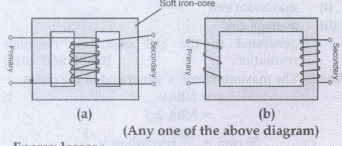
Hysteresis losses due to repeated magnetisation and demagnetization of the core of transformer. It is minimised by using soft iron core, as area of hysteresis loop for soft iron is small and hence energy loss also becomes small.
Iron losses due to eddy currents produced in soft iron core. It is minimised by using laminated iron core.
Flux losses due to flux leakage or incomplete flux linkage and can be minimised by proper coupling of primary and secondary coils.
Here, Np = 100, \({ { {N}_{s} }\over{ {N}_{p} } }=100\)
\({\epsilon}_{i}={\epsilon}_{p}=220V,{P}_{I}=1100\ W\)
Np = 100 \(\therefore\) Ns = 10000
\({I}_{p}={{{P}_{I}}\over{{\epsilon}_{p}}}={{1100}\over{220}}=5A\)
\({\epsilon}_{s}={{{N}_{s}}\over{{N}_{p}}}\times{\epsilon}_{r}=100\times 220=22000 \ V\)
\({I}_{s}={{{P}_{0}}\over{{\epsilon}_{s}}}={{1100}\over{22000}}={{1}\over{20}}A\) \((\because {P}_{0}={P}_{1})\)
Ps = P0 = PI = 1100 W
12.
The magnitudes of the electric fields due to the two charges + q and - q are given by
\(E_{+q} = \frac{q}{4\pi\epsilon_0}\frac{1}{r^2+2a^2}\)
\(E_{-q} = \frac{q}{4\pi\epsilon_0}\frac{1}{r^2+2a^2}\)
and both are equal The directions of E+q and E-q are as shown in fig. Clearly, the components normal to the dipole axis cancel away. The components along the dipole axis add up. The total electric field is opposite to \(\hat{p}\) . We have
E = - (E+q+ E-q) cos \(\theta\) \(\hat{p}\)
\(= \frac{-2qa}{4\pi\epsilon_0(r^2+a^2)^\frac{3}{2}} \hat{p}\)
At large diatances (r > > a), this reduces to
\(= \frac{-2qa}{4\pi\epsilon_0(r^3)} \hat{p}\) (r > > a)
Thus, the graph takes the form as shown below:
.png)
Electric dipole of charges +q and -q separated by distance 2a is shown in figure. It is placed in uniform electric field at an angle \(\theta\) with it.
.png)
Torque on dipole= force x perpendicular distance
= qE x 2a sin\(\theta\)
= 2 qa E sin \(\theta\)
= pEsin \(\theta\)
\(\overrightarrow\tau = \overrightarrow{p}\times\overrightarrow{E}\)
13.
\(Here, \ N=100, \ A=0.1{ m }^{ 2 }, \ v=50 \ rpm=\frac { 5 }{ 6 } rps\)
\(\overset { \rightarrow }{ B } =\left( 0.01 \right) { k } T,i.e.,\ B=0.01\ T \ along \ z-axis\)
\(\\ { e }_{ 0 }=NAB\omega =100\times 0.1\times 0.01\times 2\pi \times \frac { 5 }{ 6 } =0.52V\)
(ii) As the e.m.f. generated varies sinusoidally with time, so the average e.m.f. generated in the coil-over one complete revolution is zero.

12th Standard CBSE Syllabus & Materials
12th Standard CBSE
CBSE 12th Computer Science Python Revision Tour I - New Previous year Question Papers Study Material - QB365 Set A
NEW12th Standard CBSE
CBSE 12th Business Studies Planning Important Questions And Answers Study Material - QB365 Set A
NEW12th Standard CBSE
CBSE 12th Business Studies Business Environment Important Questions And Answers Study Material - QB365 Set A
NEW12th Standard CBSE
CBSE 12th Business Studies Principles of Management Important Questions And Answers Study Material - QB365 Set A



NCERT Books

Syllabus

Exam Pattern

Sample Question Papers

Previous year Question Papers

Important Notes

MCQ Practice test

NCERT Exemplers

Case study Questions

Image Based Questions

Passage based Questions

HOT Questions

Value Based Questions

Model Questions Papers
NCERT ( Book Back ) Questions

Assertion and Reason
Important Questions And Answers

CBSE 12th Standard CBSE Subjects
CBSE Standards








