
 100% FREE ACCESS
12th Standard CBSE Syllabus & Materials
12th Standard CBSE
CBSE 12th Economics Government Budget and the Economy Previous year Question Papers Study Material - QB365 Set A
NEW12th Standard CBSE
CBSE 12th Computer Science Interface Python with MySQL - New Previous year Question Papers Study Material - QB365 Set A
NEW12th Standard CBSE
CBSE 12th Computer Science Database Concept - New Previous year Question Papers Study Material - QB365 Set A
NEW12th Standard CBSE
CBSE 12th Computer Science Data Communication - New Previous year Question Papers Study Material - QB365 Set A
NEW12th Standard CBSE
CBSE 12th Computer Science Data Structures - New Previous year Question Papers Study Material - QB365 Set A
NEW12th Standard CBSE
CBSE 12th Computer Science Functions - New Previous year Question Papers Study Material - QB365 Set A

Published on: 25/10/2025
Download CBSE Class 12th Standard CBSE Physics question papers, sample papers, important questions, and previous year solved papers in PDF format. Get free study materials, NCERT solutions, and exam preparation resources for Class 12th Standard CBSE Physics
Questions + Answers key
Take MCQ Physics Test
1.
A semiconductor has equal electron and hole concentration of \(6\times 10^{ 8 }/m^{ 3 }\) . On doping with certain impurity, electron concentration increases to \(9\times 10^{ 12 }/m^{ 3 }\) .
(i) Identify the new semiconductor obtained after doping.
(ii) Calculate the new hole concentration.
(iii) How does the energy gap vary with doping?
2.
What do you understand by conservation of charge?
3.
If the circuit is connected to high-frequency supply (240 V, 10 kHz). Hence explain statement that at very high frequency, inductor in circuit nearly amounts to open circuit.How does an inductor behave in a d.c circuit after the steady state?
4.
A coil of 200 turns has a cross-sectional area 900mm2 It carries a current of 2 ampere. The plane of the coil is perpendicular to a uniform magnetic field of 0.5T. Calculate (i) the magnetic moment of the coil and (ii) the torque acting on the coil.
5.
An electron and alpha particle and proton have same kinetic energy , which have shortest De-broglie wavelength?
6.
The refractive index of water is 4/3. Obtain the value of the semivertical angle of the cone within which the entire outside view would be confined for a fish under water. Draw an appropriate ray diagram
7.
An electron beam is deflected in a given field. Identify whether an electric field or a magnetic field in the following cases?
8.
A charged Particle q is shot towards another charged particle Q which is fixed , with a speed v. It approaches Q up to a closet distance r and then returns, If q were given a speed 2 v the n find the closet distance of approach.
9.
Define the term magnetic declination
10.
Draw a sketch of a plane electromagnetic wave propagating along the z-direction. Depict clearly the directions of electric and magnetic fields varying sinusoidally with z.
11.
In filling the gasoline tank of an airplane, the metal nozzle of hose from the gasoline truck is always carefully connected to the metal of the airplane by a wire, before the nozzle is inserted in the tank. Explain, why?
12.
When electrons drift in a metals from lower to higher potential, does it mean that all the free electrons of the metal are moving in the same direction?
13.
Define dielectric strength of a medium. What is its values for vacuum.
14.
What is the net charge on a charged capacitor?
15.
For a short magnetic dipole, intensity at any point an axial line is same as intensity at same distance on equatorial line. Is it true ?
16.
When a transistor is used as an oscillator, why is it necessary to feed back energy to \(L-C\) circuit?
17.
How does the drift velocity of electrons in a metal conductor vary with the increase in temperature?
18.
If \(\oint _{ s }^{ }{ E.ds } =0\) over a surface, then
the electric field inside the surface and on it is zero
the electric field inside the surface is necessarily uniorm
the number of flux lines entering the surface must be equal to the number of flux lines leaving it
all charges must necessarily be outside the surface
19.
A particle of mass m and charge q is accelerated through a potential difference V to a velocity \(\vec { \upsilon } \) towards south. The particle enters a region with both a magnetic field \(\vec { B } \) (pointing eastwards) and electric field \(\vec { E } \) (pointing downwards). The particle travels with a constant velocity through this region. The potential difference V through this region should be equal to
E/B
E/qB
2 mE/qB
\(m{ E }^{ 2 }/2q{ B }^{ 2 }\)
20.
An electron moving in a circular orbit of radius r makes n rotations per second. The magnetic field produced at the centre has magnitude
zero
\(\frac { { \mu }_{ 0 }{ n }^{ 2 }e }{ r } \)
\(\frac { { \mu }_{ 0 }{ n }e }{ 2r } \)
\(\frac { { \mu }_{ 0 }{ n }e }{ 2\pi r } \)
21.
The binding energies per nucleon of \(_{ 3 }{ { Li }^{ 7 } }\ and\ _{ 2 }{ { He }^{ 4 } }\) nuclei are 5.60 MeV and 7.06 MeV respectively. In the nucleon reaction \(_{ 3 }{ { Li }^{ 7 } }+_{ 1 }{ { H }^{ 1 } }\longrightarrow _{ 2 }{ { He }^{ 4 } }+_{ 2 }{ { He }^{ 4 } }+Q\) the value of energy Q released is
19.6 MeV
- 2.4 MeV
8.4 MeV
17.3 MeV
22.
Hole is
an anti-particle of electron
a vacancy created when an electron leaves a covalent bond
absence of free electron
an artificially created particle
23.
Electric field intensity (E) due to an electric dipole varies with distance (r) of the point from the centre of dipole as:
\(E\alpha {1\over r}\)
\(E\alpha{1\over r^4}\)
\(E\alpha{1\over r^2}\)
\(E\alpha {1\over r^3}\)
24.
According to Einstein's photoelectric equation, the plot of the kinetic energy of the emitted photoelectrons from a metal verses the frequency of the incident radiation gives a straight line whose slope.
depends on the nature of the metal used
depends on the intensity of the radiation
depends both on the intensity of the radiation and the metal used
is the same for all metals and independent of the radiation.
25.
The linear magnification of a concave mirror is
always positive
always negative
positive or negative depending upon the position of the object
cannot say
26.
The energy of the e.m waves is of the order of 15 KeV. To which part of the spectrum does it belong?
\(use \ h=6.64\times { 10 }^{ -14 }Js\)
Gamma rays
x-rays
Infrared rays
Ultraviolet rays
27.
SI unit of magnetic flux is
henry
weber
coulomb
volt
28.
(i) If f = 0.5 m for a glass lens, what is the power of the lens?
(ii) The radii of curvature of the faces of a double convex lens are 10 cm and 15 cm. Its focal length is 12 cm. What is the refractive index of glass?
(iii) A convex lens has 20 cm focal length in air. What is focal length in water? (Refractive index of air-water = 1.33, refractive index for air-glass = 1.5.)
29.
Suppose while sitting in a parked car, you notice a jogger approaching towards you in the side view mirror of R = 2 m. If the jogger is running at a speed of 5 m s-1, how fast the image of the jogger appear to move when the jogger is (a) 39 m, (b) 29 m, (c) 19 m, and (d) 9 m away.
30.
(i) Derive an expression for the force between two long parallel current carrying conductors.
(ii) Use this expression to define SI unit of current.
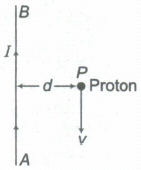
(iii) A long straight wire AB carries a current I. A proton P travels with a speed v, parallel to the wire at a distance d from it in a direction opposite to the current as shown in the figure. What is the force experienced by the proton and what is its direction?
31.
(a) A point object is placed in front of a double convex lens (of refractive index n =n2/n1 with respect air) with its spherical faces of radii of curvature R1 and R2.. Show the path of rays due to surface to obtain the formation of the real image of the object.
Hence obtain the lens maker's formula for a thin lens.
(b) A double convex lens having both faces of the same radius of curvature has refractive index 1.55. Find out the radius of curvature of the lens required to get the focal length of 20 cm.
32.
A parallel plate capacitor contains a mica sheet of thickness \(d_1=10^{-3}m\) and one fibre sheet of thickness \(d_2=0.5\times 10^{-3}m.\) Values of K for mica and fibre are 8 and 2.5 respectively. Fibre breaks down in electric field of \(6.4\times 10^6Vm^{-1}\). What maximum voltage can be applied to the capacitor?
33.
If 10% of the energy supplied to an incandescent light bulb is radiated as visible light, how many visible light photons are emitted by 200-watt bulb? Assume wavelength of all visible photons to be \(5000\overset { \circ }{ A } \)Given \(h=6.63\times { 10 }^{ -34 }Js\)
34.
An avarage induced e.m.f. of 0.4V appears in a coil when current in it is changed from 10A in one direction to 10A in opposite direction in 0.40 second. Find the coefficient of the coil.
35.
Three essential elements of every communication system are:----------------
1.
(i) n-type
(ii) \(4\times 10^{ 4 }/m^{ 3 }\)
(iii) Energy gap decreases with doping
Here,
\({ n }_{ i }=6\times 10^{ 8 }m^{ -3 };{ n }_{ e }=9\times 10^{ 12 }m^{ -3 }\)
\( { n }_{ h }=\frac { { n }_{ i }^{ 2 } }{ { n }_{ e } } =\frac { \left( 6\times 10^{ 8 } \right) ^{ 2 } }{ 9\times 10^{ 12 } } =4\times 10^{ 4 }m^{ -3 }\)
As, after doping, \({ n }_{ e }>{ n }_{ h }\) so the new semiconductors is n-type. Energy gap decreases with doping.
2.
The law of conservation of charge states that the total charge in an isolated system remains constant.
The electric charge can neither be produced nor destroyed. This law has been found to be true for all events as well as for those at nuclear and atomic levels. In other words, there is no exception to the law. Like the law of conservation of energy, the law of conservation of charge is also a universal law.
Examples (i) When a glass rod is rubbed with silk the charges developed on the glass rod and the piece of silk are equal and opposite.
(ii) Charge is conserved in all chemical and nuclear reactions.
3.
For the high frequency
\(\omega =2\pi \times { 10 }^{ -4 }rad\quad s^{ -1 }\)
\({ I }_{ 0 }=\frac { \sqrt { 2 } \times 240 }{ \sqrt { { 10 }^{ 4 }+{ \left( 0.5 \right) }^{ 2 }\times 4{ \pi }^{ 2 }\times { 10 }^{ 8 } } } =1.1\times { 10 }^{ -2 }A\)
Term from R is negligible in the above denominator
\(tan\phi =\frac { 2\pi \times { 10 }^{ 4 }\times 0.5 }{ 100 } =100\pi \)
\(\phi ={ 89 }^{ \circ }{ 48 }^{ \prime }={ 89.8 }^{ \circ}\) which is close to \({ \pi }/{ 2 }\ (i.e.{ 90 }^{ \circ })\)
In a d.c. circuit (after steady state) \(\omega =0\), so here L acts like a pure conductor.
4.
(i) 36 x 10-2 Am2
(ii) 18 x 10-2Nm
5.
Alpha particles due to its largest mass
6.
Clearly , the fish can see the outside view of the cone with semi vertical angle
But \(\mu \) = 1.sin ic
or 1/3 = 1/ sin ic
or sin ic = 3/4 = 0.75
\(\theta\)/2 =ic = sin-1 (0.75 ) = 48.60
7.
(i) The trajectory of the beam is a parabola and its K.E changes.
(ii) The trajectory of the beam is circular and its K.E. remains the same. Justify your answer.
8.
q \(\rightarrow\)_______Q
1/2 mv2 = kQq/r
Or, v2 a1/r
Or, r a 1/v2
Or, r' = r/4
9.
Magnetic declination The angle between geographical meridian and magnetic meridian any place of the earth is known as magnetic declination \(\left( \alpha \right) \) at that place of the earth.
10.
The direction of propagation of the electromagnetic wave is perpendicular to both electric field vector E and magnetic field vector B, i.e. In the direction of E x B.
This can be seen by the diagram given below.
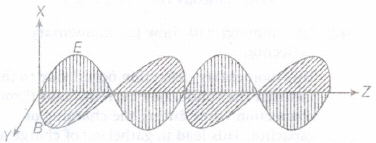
Here, electromagnetic wave is along the Z-direction which is given by the cross product of E and B
11.
Since the airplane and the gasoline truck usually have wheels with rubber tires, they are insulated from the ground. further, the service ramps are usually made of concrete and are not necessarily good conductors to the earth. Therefore, inspite of grounding metallic ropes, the airplane and the truck could remain charged.
A spark may jump and ignite the explosive gasoline when the metal nozzle is brought near the airplane. The connection of metal of the airplane and the nozzle of the hose with a wire avoids any unbalances of charge and hence the risk of gasoline.
12.
Yes, all the free electron drift in the same direction.
13.
The maximum electric field that a dielectric medium can withstand without breaking down of its insulating property is called dielectric strength. Its value for vacuum is infinity.
14.
Zero, because one plate has positive charge and the other carriers an equal negative charge.
15.
No, the statement is not true. Infact, at a given distance from the centre of magnet, intensity on axial line is twice the intensity on equatorial line.
16.
This is done in order to compensate for loss of energy due to resistance in L-C oscillatory circuit and hence to produce undamped electromagnetic waves or carriers waves.
17.
With the increase in temperature, the drift velocity of free electrons in a metal conductor decreases due to increase in collision frequency of free electrons with the atom/ions of the conductor.
18.
(c)
the number of flux lines entering the surface must be equal to the number of flux lines leaving it
19.
(d)
\(m{ E }^{ 2 }/2q{ B }^{ 2 }\)
20.
(c)
\(\frac { { \mu }_{ 0 }{ n }e }{ 2r } \)
21.
(d)
17.3 MeV
22.
(b)
a vacancy created when an electron leaves a covalent bond
23.
(d)
\(E\alpha {1\over r^3}\)
24.
(d)
is the same for all metals and independent of the radiation.
25.
(c)
positive or negative depending upon the position of the object
26.
(b)
x-rays
27.
(b)
weber
28.
(i) Power = +2 dioptre.
(ii) Here, we have f = +12 cm, R1 = +10 cm, R2 = -15 cm.
Refractive index of air is taken as unity.
We use the lens formula. The sign convention has to be applied for f, R1 and R2.
Substituting the values, we have
\(\frac { 1 }{ 12 } =(n-1)\left( \frac { 1 }{ 10 } -\frac { 1 }{ 15 } \right) \)
This gives n = 1.5.
(iii) For a glass lens in air, n2 = 1.5, n1 = 1, f = +20 cm. Hence, the lens formula gives
\(\frac { 1 }{ 20 } =0.5\left( \frac { 1 }{ { R }_{ 1 } } -\frac { 1 }{ { R }_{ 2 } } \right) \)
For the same glass lens in water, n2 = 1.5, n1 = 1.33. Therefore \(\frac { 1.33 }{ f } =(1.5-1.33)\left[ \frac { 1 }{ { R }_{ 1 } } -\frac { 1 }{ { R }_{ 2 } } \right] \)
Combining these two equations, we find f = + 78.2 cm.
29.
From the mirror equation, Eq., we get \(v=\frac{f u}{u-f}\)
For convex mirror, since \(R=2 \mathrm{~m}, f=1 \mathrm{~m}\). Then for \(u=-39 \mathrm{~m}, v=\frac{(-39) \times 1}{-39-1}=\frac{39}{40} \mathrm{~m}\)
Since the jogger moves at a constant speed of \(5 \mathrm{~m} \mathrm{~s}^{-1}\), after 1 s the position of the image v (for \(u=-39+5=-34)\) is (34 / 35) m.
The shift in the position of image in 1 s is \(\frac{39}{40}-\frac{34}{35}=\frac{1365-1360}{1400}=\frac{5}{1400}=\frac{1}{280} \mathrm{~m}\)
Therefore, the average speed of the image when the jogger is between 39 m and 34 m from the mirror, is (1/280) m s–1 Similarly, it can be seen that for u = –29 m, –19 m and –9 m, the speed with which the image appears to move is
\(\frac{1}{150} \mathrm{~m} \mathrm{~s}^{-1}, \frac{1}{60} \mathrm{~ms}^{-1} \text { and } \frac{1}{10} \mathrm{~ms}^{-1} \text {, respectively. }\)
Although the jogger has been moving with a constant speed, the speed of his/her image appears to increase substantially as he/she moves closer to the mirror. This phenomenon can be noticed by any person sitting in a stationary car or a bus. In case of moving vehicles, a similar phenomenon could be observed if the vehicle in the rear is moving closer with a constant speed.
30.
(ii) As, \(\frac{F}{L}=\frac{\mu_0}{4\pi}.\frac{2 I_1 I_2}{r}\)
\(I_1=I_2=I A, r=1 m\)
\(\frac{F}{L}=2\times10^{-7} Nm^{-1}\)
(iii) Here, magnetic field due to the current carrying conductor at a distance d from it is
given by
\(B=\frac{\mu_0}{4\pi} \frac{2I}{d}\)
∴ Force on proton,
F = (e) (v) B sin 90°
⇒ F = evB
\(F=ev(\frac{\mu_0}{4\pi}\frac{2I}{d})\)
\(F=\frac{\mu_0}{4\pi}.\frac{2Iev}{d}\)
The proton is directed perpendicular to straight conductor and away from it.
31.
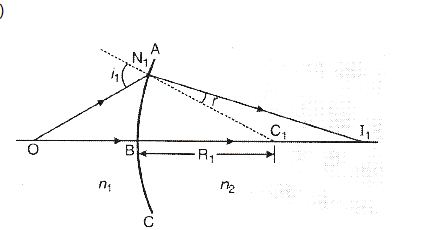
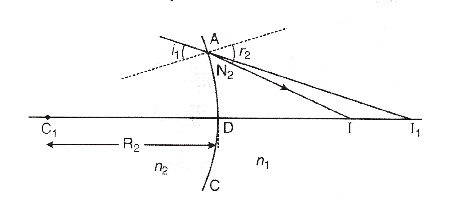
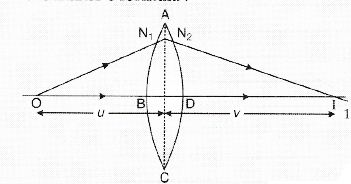
The first refracting ABC forms the image I1 of the object O. The image I1 acts as virtual object for the second refracting surface ADC, which forms the real image I as shown in the diagram
For refraction at ABC
\(\frac { { n }_{ 2 } }{ { v }_{ 1 } } -\frac { { n }_{ 1 } }{ u } =\frac { { n }_{ 2 }-{ n }_{ 1 } }{ { R }_{ 1 } } \)
For refraction at ADC
\(\frac { { n }_{ 1 } }{ v } -\frac { { n }_{ 2 } }{ { v }_{ 1 } } =\frac { { n }_{ 1 }-{ n }_{ 2 } }{ { R }_{ 2 } } \)
Adding equation (i) and equation (ii)
\(\frac { { n }_{ 1 } }{ v } -\frac { { n }_{ 2 } }{ u } =\left( { n }_{ 2 }-{ n }_{ 1 } \right) \left( \frac { 1 }{ { R }_{ 1 } } -\frac { 1 }{ { R }_{ 2 } } \right) \)
\(\frac { 1 }{ v } -\frac { 1 }{ u } =\left( \frac { { n }_{ 2 } }{ { n }_{ 1 } } -1 \right) \left( \frac { 1 }{ { R }_{ 1 } } -\frac { 1 }{ { R }_{ 2 } } \right) \)
We know, If \(u=\infty ,v=f\)
\(\frac { 1 }{ v } -\frac { 1 }{ u } =\frac { 1 }{ f } \)
\(\frac { 1 }{ f } =\left( \frac { { n }_{ 2 } }{ { n }_{ 1 } } -1 \right) \frac { 1 }{ { R }_{ 1 } } -\frac { 1 }{ { R }_{ 2 } } \)
\(\frac { 1 }{ f } =\left( { \mu }_{ 21 }-1 \right) \left( \frac { 1 }{ { R }_{ 1 } } -\frac { 1 }{ { R }_{ 2 } } \right) \)
\(\frac { 1 }{ f } =\left( { \mu }_{ 21 }-1 \right) \left( \frac { 1 }{ { R }_{ 1 } } -\frac { 1 }{ { R }_{ 2 } } \right) \)
\(\frac { 1 }{ f } =\left( 1.55-1 \right) \left( \frac { 1 }{ R } -\frac { 1 }{ -R } \right) \)
\(=0.55\times \frac { 2 }{ R } \)
\(R=0.55\times 2\times 20=22 \ cm\)
32.
Let \(\sigma\) be the surface charge density of capacitor plates.
for mica \(E_1={\sigma\over K_1\epsilon_0}\)
and for fibre \(E_2={\sigma\over K_2\epsilon_o}\) or \({E_1\over E_2}={K_2\over K_1}\)
As \(E_s=6.4\times 10^6V/m\)
\(E_1={K_2\over K_1}\times E_2={2.5\over 8}\times 6.4\times 10^6=2\times 10^6V/m\)
Maximum voltage or capacitor
\(V=E_1d_1+E_2d_2=2\times 10^3+3.2\times 10^3=5200V\)
33.
\(Here,\lambda =5000\overset { \circ }{ A } =5\times { 10 }^{ -7 }m;\)
Energy of one photon,
\(E=\frac { hc }{ \lambda } =\frac { \left( 6.63\times { 10 }^{ -34 } \right) \left( 3\times { 10 }^{ 8 } \right) }{ 5\times { 10 }^{ -7 } } =3.96\times { 10 }^{ -19 }J\)
A 200 W bulb supplies 200 J of energy per second.Energy emitted by lamp per second as visible light,
\({ E }_{ 1 }=200\times \frac { 10 }{ 100 } =20J{ s }^{ -1 }\)
Number of photons emitted per second as visible light.
\(N=\frac { { E }_{ 1 } }{ E } =\frac { 20 }{ 3.96\times { 10 }^{ -19 } } =5.05\times { 10 }^{ 19 }\)
34.
Here, e = 0.4 V,
dI = 10-(-10) = 20A, dt = 0.40s; L = ?
From e = L dI/dt, \(L=\frac { e\quad dt }{ dI } =\frac { 0.4\times 0.4 }{ 20 } =8\times { 10 }^{ -3 }H\)
35.
()
Transmitter, Communication channel and Receiver.

12th Standard CBSE Syllabus & Materials
12th Standard CBSE
CBSE 12th Computer Science Python Revision Tour I - New Previous year Question Papers Study Material - QB365 Set A
NEW12th Standard CBSE
CBSE 12th Business Studies Planning Important Questions And Answers Study Material - QB365 Set A
NEW12th Standard CBSE
CBSE 12th Business Studies Business Environment Important Questions And Answers Study Material - QB365 Set A
NEW12th Standard CBSE
CBSE 12th Business Studies Principles of Management Important Questions And Answers Study Material - QB365 Set A



NCERT Books

Syllabus

Exam Pattern

Sample Question Papers

Previous year Question Papers

Important Notes

MCQ Practice test

NCERT Exemplers

Case study Questions

Image Based Questions

Passage based Questions

HOT Questions

Value Based Questions

Model Questions Papers
NCERT ( Book Back ) Questions

Assertion and Reason
Important Questions And Answers

CBSE 12th Standard CBSE Subjects
CBSE Standards








