
 100% FREE ACCESS
12th Standard CBSE Syllabus & Materials
12th Standard CBSE
CBSE 12th Economics Government Budget and the Economy Previous year Question Papers Study Material - QB365 Set A
NEW12th Standard CBSE
CBSE 12th Computer Science Interface Python with MySQL - New Previous year Question Papers Study Material - QB365 Set A
NEW12th Standard CBSE
CBSE 12th Computer Science Database Concept - New Previous year Question Papers Study Material - QB365 Set A
NEW12th Standard CBSE
CBSE 12th Computer Science Data Communication - New Previous year Question Papers Study Material - QB365 Set A
NEW12th Standard CBSE
CBSE 12th Computer Science Data Structures - New Previous year Question Papers Study Material - QB365 Set A
NEW12th Standard CBSE
CBSE 12th Computer Science Functions - New Previous year Question Papers Study Material - QB365 Set A

Published on: 25/10/2025
Download CBSE Class 12th Standard CBSE Physics question papers, sample papers, important questions, and previous year solved papers in PDF format. Get free study materials, NCERT solutions, and exam preparation resources for Class 12th Standard CBSE Physics
Questions + Answers key
Take MCQ Physics Test
1.
A radioactive nucleus emits a beta particle. The parent and daughter nuclei are
isotopes
isotones
isomers
isobars
2.
When a β-particle is emitted from a nucleus then its neutron-proton ratio
increases
decreases
remains unchanged.
may increase or decrease depending upon the nucleus.
3.
The ionisation energy of hydrogen atom is 13.6 eV. Following Bohr's theory the energy corresponding to a transition between 3rd and 4th orbits is
3.40 eV
1.51 eV
0.85 eV
0.66 eV
4.
A proton, a neutron, an electron and an a-particle have same energy. Then their de Broglie wavelengths compare as
\( \lambda_{p}=\lambda_{n}>\lambda_{e}>\lambda_{\alpha} \)
\(\lambda_{\alpha}<\lambda_{p}=\lambda_{n}<\lambda_{e} \)
\(\lambda_{e}<\lambda_{p}=\lambda_{n}>\lambda_{\alpha} \)
\( \lambda_{e}=\lambda_{p}=\lambda_{n}=\lambda_{\alpha} \)
5.
A 220 V AC supply is connected between points A and B (figure). What will be the potential difference V across the capacitor?
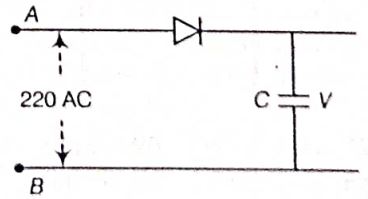
220 V
110 V
0 V
\(220 \sqrt{2} \mathrm{~V}\)
6.
A sample of a radioactive element has a mass of 10 g at an instant t = 0. The approximate mass of this element in the sample after two mean lives is
1.35 g
2.50 g
3.70 g
6.30 g
7.
After how many days will \(\frac { 1 }{ 20 } th\) of the radio active element remain behind, if half life of the element is 6.931 days
23.03 days
25.12 days
29.96 days
27.72 days
8.
Given that light of wavelength 10,000 \(\overset { \circ }{ A } \)has an energy equal to 1.23eV. When light of wavelength 5000\(\overset { \circ }{ A } \) and intensity I0 falls on a photosensitive plate of photocell, the saturation current is \(0.43\times { 10 }^{ -6 }A\) and the stopping potential is 1.36V Then the work function is
0.43eV
1.10eV
1.36eV
2.72eV
9.
Monochromatic light of frequency f1 incident on a photocell and the stopping potential is found to be V1. What is the new stopping potential of the cell if it radiated by monochromatic light of frequency f2?
\({ V }_{ 1 }-\frac { h }{ e } ({ f }_{ 2 }-{ f }_{ 1 })\)
\({ V }_{ 1 }+\frac { h }{ e } ({ f }_{ 2 }+{ f }_{ 1 })\)
\({ V }_{ 1 }-\frac { h }{ e } ({ f }_{ 2 }+{ f }_{ 1 })\)
\({ V }_{ 1 }+\frac { h }{ e } ({ f }_{ 2 }-{ f }_{ 1 })\)
10.
A p-type semiconductor is obtained by doping silicon with
germanium
gallium
bismuth
Phosphorus
11.
A silicon p-n junction diode is connected to a resistor R and a battery of voltage VB through milliammeter (mA) as shown in figure. The knee voltage for this junction diode is VN = 0.7 V. The p-n junction diode requires a minimum current of 1m. A to attain a value higher than the knee point on the J- V characteristics of this junction diode. Assuming that the voltage V across the junction is independent of the current above the knee point. A p-n junction is the basic building block of many semiconductor devices like diodes. Important process occurring during the formation of a p-n junction are diffusion and drift. In an n-type semiconductor concentration of electrons is more as compared to holes. In a p-type semiconductor concentration of holes is more as compared to electrons.
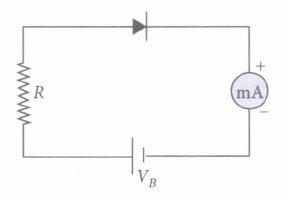
(i) If VB = 5 V, the maximum value of R so that the voltage V is above the knee point voltage is
| (a) 40 \(\Omega\) | (b) 4.3 \(\Omega\) | (c) 5.0 \(\Omega\) | (d) 5.7 \(\Omega\) |
(ii) If VB = 5 V, the value of R in order to establish a current to 6 mA in the circuit is
| (a) 833 \(\Omega\) | (b) 717 \(\Omega\) | (c) 950 \(\Omega\) | (d) 733 \(\Omega\) |
(iii) If VB = 6 V, the power dissipated in the resistor R, when a current of 6 mA flows in the circuit is
| (a) 30.2 mW | (b) 30.8 mW | (c) 31.2 mW | (d) 31.8 mW |
(iv) When the diode is reverse biased with a voltage of 6 V and Vbi = 0.63 V. Calculate the total potential.
| (a) 9.27 V | (b) 6.63 V | (c) 5.27 V | (d) 0.63 V |
(v) Which of the below mentioned statement is false regarding a p-n junction diode?
| (a) Diodes are uncontrolled devices. | (b) Diodes are rectifying devices. |
| (c) Diodes are unidirectional devices. | (d) Diodes have three terminals |
12.
The nucleus was first discovered in 1911 by Lord Rutherford and his associates by experiments on scattering of a-particles by atoms. He found that the scattering results could be explained, if atoms consist of a small, central, massive and positive core surrounded by orbiting electrons. The experimental results indicated that the size of the nucleus is of the order of 10-14m and is thus 10000 times smaller than the size of atom.
(i) Ratio of mass of nucleus with mass of atom is approximately
| (a) 1 | (b) 10 | (c) 103 | (d) 1010 |
(ii) Masses of nuclei of hydrogen, deuterium and tritium are in ratio
| (a) 1:2:3 | (b) 1:1:1 | (c) 1:1:2 | (d) 1:2:4 |
(iii) Nuclides with same neutron number but different atomic number are
| (a) isobars | (b) isotopes | (c) isotones | (d) none of these |
(iv) If R is the radius and A is the mass number, then log R versus log A graph will be
| (a) a straight line | (b) aparabola | (c) anellipse | (d) none of these |
(v) The ratio of the nuclear radii of the gold isotope \({ }_{79}^{197} \mathrm{Au}\) and silver isotope \({ }_{47}^{107} \mathrm{Au}\) is
| (a) 1.23 | (b) 0.216 | (c) 2.13 | (d) 3.46 |
13.
The spectral series of hydrogen atom were accounted for by Bohr using the relation \(\bar{v}=R\left(\frac{1}{n_{1}^{2}}-\frac{1}{n_{2}^{2}}\right)\),
where R = Rydberg constant = 1.097 x 10⁷ m.
Lyman series is obtained when an electron jumps to first orbit from any subsequent orbit. Similarly, Balmer series is obtained when an electron jumps to 2nd orbit from any subsequent orbit, Paschen series is obtained when an electron jumps to 3rd orbit from any subsequent orbit. Whereas Lyman series lies in U.V. region, Balmer series is in visible region and Paschen series lies in infrared region. Series limit is obtained when n2 = \(\infty\)
(i) The wavelength of first spectral line of Lyman series is
| (a) 1215.4 \(\dot A\) | (b) 1215.4 crn | (c) 1215.4 m | (d) 1215.4 mm |
(ii) The wavelength limit of Lyman series is
| (a) 1215.4 \(\dot A\) | (b) 511.9 \(\dot A\) | (c) 951.6 \(\dot A\) | (d) 911.6 \(\dot A\) |
(iii) The frequency of first spectral line of Balmer series is
| (a) 1.097 x 10⁷ Hz | (b) 4.57 x 10¹⁴ Hz | (c) 4.57 x 10¹⁵ Hz | (d) 4.57 x 10¹⁶ Hz |
(iv) Which of the following transitions in hydrogen atoms emit photons of highest frequency?
| (a) n = 1 to n = 2 | (b) n = 2 to n = 6 | (c) n = 6 to n = 2 | (d) n = 2 to n = 1 |
(v) The ratio of minimum to maximum wavelength in Balmer series is
| (a) 5:9 | (b) 5:36 | (c) 1:4 | (d) 3: 4 |
14.
The photon picture of electromagnetic radiations and the characteristic properties of photons are as follows:In the interaction of radiation with matter, radiation behaves as if it is made of particles like photons. Each photon has energy \(E(=h v=h c / \lambda)\) and momentum \(p\left(=\frac{h v}{c}=\frac{h}{\lambda}\right)\) where h is Planck's constant, v and A are the frequency and wavelength of radiation and c is the velocity of light. The photon energy is independent of the intensity of radiations. All the photons emitted from a source of radiations travel through space with the same speed c. The frequency of photon gives the radiation, a definite energy (or colour) which does not change when photon travels through different media. Photons are not deflected by electric and magnetic fields. This shows that photons are electrically neutral.
(i) Which one among the following shows particle nature of light?
| (a) Photoelectric effect | (b) Interference | (c) Refraction | (d) Polarization |
(ii) Which of the following statements about photon is incorrect?
| (a) Photons exert no pressure | (b) Momentum of photon is \(\frac{h v}{c}\) |
| (c) Rest mass of photon is zero | (d) Energy of photon is hv |
(iii) The rest mass of photon is
| \(\text { (a) } \frac{h v}{c}\) | \(\text { (b) } \frac{h v}{c^{2}}\) | \(\text { (c) } \frac{h v}{\lambda}\) | (d) zero |
(iv) In a photon-particle collision (such as photon-electron collision), which of the following may not be conserved?
| (a) Total energy | (b) Number of photons | (c) Total momentum | (d) Both (a) and (b) |
(v) 'n' photons of wavelengt '\(\lambda\)' are absorbed by a black body of mass 'm'. The momentum gained by the body is
| \(\text { (a) } \frac{h}{m \lambda}\) | \(\text { (b) } \frac{m n h}{\lambda}\) | \(\text { (c) } \frac{n h}{m \lambda}\) | \(\text { (d) } \frac{n h}{\lambda}\) |
15.
16.
17.
18.
19.
20.
21.
22.
Assertion (A) : The resistivity of a semiconductor increases with temperature.
Reason (R) : The atoms of a semiconductor vibrate with larger amplitude at higher temperatures thereby increasing its resistivity.
Codes:
(a) Both A and R are true and R is the correct explanation of A
(b) Both A and R are true but R is NOT the correct explanation of A
(c) A is true but R is false
(d) A is false and R is also false
23.
Assertion (A) : Laser is used to measure distant object like moon.
Reason (R) : They are highly coherent source of light
Codes:
(a) Both A and R are true and R is the correct explanation of A
(b) Both A and R are true but R is NOT the correct explanation of A
(c) A is true but R is false
(d) A is false and R is also false
24.
Assertion (A) : Stopping potential depends upon the frequency of incident light but is independent of the intensity of the light.
Reason (R) : The maximum kinetic energy of the photoelectrons is proportional to stopping potential.
Codes:
(a) Both A and R are true and R is the correct explanation of A
(b) Both A and R are true but R is NOT the correct explanation of A
(c) A is true but R is false
(d) A is false and R is also false
1.
(d)
isobars
2.
(b)
decreases
3.
(d)
0.66 eV
4.
(b)
\(\lambda_{\alpha}<\lambda_{p}=\lambda_{n}<\lambda_{e} \)
5.
(d)
\(220 \sqrt{2} \mathrm{~V}\)
6.
(a)
1.35 g
7.
(c)
29.96 days
8.
(b)
1.10eV
9.
(d)
\({ V }_{ 1 }+\frac { h }{ e } ({ f }_{ 2 }-{ f }_{ 1 })\)
10.
(b)
gallium
11.
(i) (b) : Voltage drop across R.
\(V_{R}=V_{B}-V_{N}=5-0.7=4.3 \mathrm{~V}\)
Here, Imin = 1 x 10⁻³ A
\(R_{\max }=\frac{V_{R}}{I_{\min }}=\frac{4.3}{1 \times 10^{-3}}=4.3 \times 10^{3} \Omega=4.3 \mathrm{k} \Omega\)
(ii) (b) : \(I=6 \mathrm{~mA}=6 \times 10^{-3} \mathrm{~A}\)
\(\begin{array}{l} V_{R}=V_{B}-V_{N}=5-0.7=4.3 \mathrm{~V} \\ R=\frac{V_{R}}{I}=\frac{4.3}{6 \times 10^{-3}}=717 \Omega \end{array}\)
(iii)(d) : Here, VB = 6 V; VN = 0.7V,
\(V_{R}=6-0.7=5.3 \mathrm{~V}\)
Power dissipated in R = l x VR
= (6 x 10-3) x 5.3 = 31.8 x 10⁻³ W
= 31.8 mW
(iv) (b) : Vt = Vbi + VR = 0.63 + 6 = 6.63 V
(v) (d) : Diode is two terminal device, anode and cathode are the two terminals.
12.
(i) (a) : As nearly 99.9% mass of atom is in nucleus.
\(\therefore \quad \frac{\text { Mass of nucleus }}{\text { Mass of atom }}=\frac{99.9}{100}=0.99 \approx 1\)
(ii) (a): Since, the nuclei of deuterium and tritium are isotopes of hydrogen, they must contain only one proton each. But the masses of the nuclei of hydrogen, deuterium and tritium are in the ration of 1 : 2 : 3,because of presence of neutral matter in deuterium and tritium nuclei.
(iii) (c)
(iv) (a) : \(R=R_{0} A^{1 / 3}\)
\(\log R=\log R_{0}+\frac{1}{3} \log A\)
On comparing the above equation of straight line; y = mx + c. So, the graph between log A and log R is a straight line also.
(v) (a): Here, A1 = 197 and A2 = 107
\(\therefore \quad \frac{R_{1}}{R_{2}}=\left(\frac{A_{1}}{A_{2}}\right)^{1 / 3}=\left(\frac{197}{107}\right)^{1 / 3}=1.225 \simeq 1.23\)
13.
(i) (a) : From, \(\bar{v}-\frac{1}{\lambda}-R\left(\frac{1}{n_{1}^{2}}-\frac{1}{n_{2}^{2}}\right)\)
n1 = 1, n2 = 2 for first spectral line of Lyman series,
\(\frac{1}{\lambda}=1.097 \times 10^{7}\left(\frac{1}{1^{2}}-\frac{1}{2^{2}}\right)=\frac{3 \times 1.097 \times 10^{7}}{4} \mathrm{~m}^{-1}\)
\(\lambda=\frac{4 \times 10^{-7} \mathrm{~m}}{3 \times 1.097}=\frac{4000}{3 \times 1.097} \dot A=1215.4 \dot A\)
(ii) (d): For wavelength limit, we put \(n_{2}=\infty\)
\(\therefore \quad \frac{1}{\lambda}=1.097 \times 10^{7}\left(\frac{1}{1^{2}}-\frac{1}{\infty}\right)\)
\(\lambda=\frac{1}{1.097 \times 10^{7}} \mathrm{~m}=\frac{1000}{1.097} \dot A=911.6 \dot A\)
(iii) (b): For first line of Balmer series, n1 = 2, n2 = 3
\(\bar{v}=\frac{1}{\lambda}=R\left(\frac{1}{n_{1}^{2}}-\frac{1}{n_{2}^{2}}\right)\)
\(v=\frac{c}{\lambda}=R c\left(\frac{1}{n_{1}^{2}}-\frac{1}{n_{2}^{2}}\right)\)
\(=1.097 \times 10^{7} \times 3 \times 10^{8}\left(\frac{1}{2^{2}}-\frac{1}{3^{2}}\right)\)
\(=1.097 \times 3 \times 10^{15} \times \frac{5}{36}=4.57 \times 10^{14} \mathrm{~Hz}\)
(iv) (d): \(h v_{2 \rightarrow 1}=-13.6\left(\frac{1}{2^{2}}-\frac{1}{1^{2}}\right) \mathrm{eV}=10.2 \mathrm{eV}\)
Emission is n = 2 \(\rightarrow\) n = 1 i.e., higher n to lower n.Transition from lower to higher levels are absorption lines.
\(-13.6\left(\frac{1}{6^{2}}-\frac{1}{2^{2}}\right)=+13.6 \times \frac{2}{9}\)
This is \(
(v) (a): \(\frac{1}{\lambda_{\max }}=R\left[\frac{1}{2^{2}}-\frac{1}{3^{2}}\right]=\frac{5 R}{36}\)
\(\frac{1}{\lambda_{\min }}=R\left[\frac{1}{2^{2}}-\frac{1}{\infty}\right]=\frac{R}{4} \Rightarrow \frac{\lambda_{\min }}{\lambda_{\max }}=\frac{5 R}{36} \times \frac{4}{R}=\frac{5}{9}\)
14.
(i) (a): Particle nature of light was established by photoelectric effect.
(ii) (a): Photons move with velocity of light and have energy hv. Therefore, they also exert pressure.
(iii) (d): The rest mass of photon is zero.
(iv) (b): In a photon-particle collision, (such as photon electron collision), the total energy and total momentum are conserved. However, the number of photons may not be conserved in photon-particle collision. The photon may be absorbed or a new photon may be created.
(v) (d): Energy of n photons \(E=\frac{n h c}{\lambda}\)
Momentum gam. ed by the body, \(p=\frac{E}{c}=\frac{n h c}{\lambda c}=\frac{n h}{\lambda}\)
15.
16.
17.
18.
19.
20.
21.
22.
(d) : With the increase of temperature, the average energy exchanged in a collision increases and so more valence electrons can cross the energy gap, thereby increasing the electron-hole pairs. As in a semiconductor, conduction occurs mainly through electron-hole pairs, so conductivity increases with increase of temperature. Which in turn implies that the resistivity of a semiconductor decreases with rise in temperature.
23.
(a): As laser is highly monochromatic and highly coherent, we can send as a laser beam to the moon, from where it comes back reflected without much loss of intensity. That's why the large distances can be measured accurately with the help of laser.
24.
(b): Stopping potential is a measure of maximum kinetic energy of emitted photoelectron (eV0 = Kmax) and Kmax depends upon the frequency of incident light but is independent of intensity.

12th Standard CBSE Syllabus & Materials
12th Standard CBSE
CBSE 12th Computer Science Python Revision Tour I - New Previous year Question Papers Study Material - QB365 Set A
NEW12th Standard CBSE
CBSE 12th Business Studies Planning Important Questions And Answers Study Material - QB365 Set A
NEW12th Standard CBSE
CBSE 12th Business Studies Business Environment Important Questions And Answers Study Material - QB365 Set A
NEW12th Standard CBSE
CBSE 12th Business Studies Principles of Management Important Questions And Answers Study Material - QB365 Set A



NCERT Books

Syllabus

Exam Pattern

Sample Question Papers

Previous year Question Papers

Important Notes

MCQ Practice test

NCERT Exemplers

Case study Questions

Image Based Questions

Passage based Questions

HOT Questions

Value Based Questions

Model Questions Papers
NCERT ( Book Back ) Questions

Assertion and Reason
Important Questions And Answers

CBSE 12th Standard CBSE Subjects
CBSE Standards








