
 100% FREE ACCESS
12th Standard CBSE Syllabus & Materials
12th Standard CBSE
CBSE 12th Economics Government Budget and the Economy Previous year Question Papers Study Material - QB365 Set A
NEW12th Standard CBSE
CBSE 12th Computer Science Interface Python with MySQL - New Previous year Question Papers Study Material - QB365 Set A
NEW12th Standard CBSE
CBSE 12th Computer Science Database Concept - New Previous year Question Papers Study Material - QB365 Set A
NEW12th Standard CBSE
CBSE 12th Computer Science Data Communication - New Previous year Question Papers Study Material - QB365 Set A
NEW12th Standard CBSE
CBSE 12th Computer Science Data Structures - New Previous year Question Papers Study Material - QB365 Set A
NEW12th Standard CBSE
CBSE 12th Computer Science Functions - New Previous year Question Papers Study Material - QB365 Set A

Published on: 25/10/2025
Download CBSE Class 12th Standard CBSE Physics question papers, sample papers, important questions, and previous year solved papers in PDF format. Get free study materials, NCERT solutions, and exam preparation resources for Class 12th Standard CBSE Physics
Questions + Answers key
Take MCQ Physics Test
1.
(i) How is a photodiode fabricated?
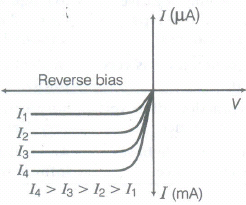
(ii) Briefly explain its working. Draw its V-I characteristics for two different intensities of illumination.
2.
Distinguish between a conductor, a semiconductor and an insulator on the basis of energy band diagrams.
3.
Monochromatic light of frequency is\(5.0\times { 10 }^{ 14 }Hz\) produced by a laser. The power emitted is \(3.0\times { 10 }^{ -3 }W\) Estimate the number of photons emitted per second on an average by the source.
4.
At what speed must an electron revolve around the nucleus of hydrogen atom so that it may not be pulled into the nucleus by electrostatic attraction? Given, mass of electron \(=9.1\times { 10 }^{ -31 }\), radius of orbit \(=0.5\times { 10 }^{ -10 }m\) and \(e=1.6\times { 10 }^{ -19 }C\).
5.
(a) Define the term decay constant and half life of a radioactive sample. Derive the relation connecting the two.
(b) How many disintegrations per second will occur in one gram of 92U238, if its half-life against alpha decay is \(1.42\times { 10 }^{ 17 }s\) ?
6.
What is the de Broglie wavelength associated with
(a) an electron moving with a speed of 5.4 x 10⁶m/s
(b)a ball of mass 150g travelling at 30.0m/s?
7.
During a nuclear fusion reaction :
a heavy nucleus breaks into two fragments by itself
a light nucleus bombarded by thermal neutrons breaks up
a heavy nucleus bombarded by thermal neutrons breaks up
two light nuclei combine to give a heavier nucleus and possibly other products
8.
The half life of radium is about 1600 years. Of 100 g of radium existing now, 25 g will remain unchanged after
2400 yrs
3200 yrs
4800 yrs
6400 yrs
9.
What happens during regulation action of a zener diode?
The current in and voltage across the zener remains fixed.
The current through the series Resisitance \((R_{ 3 })\) changes
The zener resistanceis constant
The resistance offered by the Zener changes
10.
The conductivity of a semiconductor increases with increase in temperature because
number density of free current carriers increases
relaxation time increases
both number density of carriers and relaxation time increase
number density of carriers increases, relaxation time decreases but effect of decrease in relaxation time is much less than increase in number density
11.
When a forward bias is applied to p-n junctions it
raises the potential barrier
reduces the majority carrier to zero
lower the potential barrier
None of these
12.
Which type of semiconductor is obtained by mixing arsenic with silicon?
\(n-type\)
\(p-type\)
Both
None
13.
n - type semiconductor is obtained when
germanium is doped with arsenic
germanium is doped with indium
germanium is doped with aluminium
silicon is doped with indium
14.
In intrinsic semiconductor at room temperature, the number of electrons and holes are
equal
zero
unequal
infinite
15.
In good conductorsof electricity the type of bonding that exists is
ionic
vander waals
covalent
metallic
16.
The de-Broglie wavelength of a photon is twice the de-Broglie wavelength of an electron.The speed of the electron is \({ v }_{ e }=\frac { c }{ 100 } \) Then
\(\frac { { E }_{ e } }{ { E }_{ p } } ={ 10 }^{ -4 }\)
\(\frac { { E }_{ e } }{ { E }_{ p } } ={ 10 }^{ -2 }\)
\(\frac { { p }_{ e } }{ { m }_{ e }c } ={ 10 }^{ -2 }\)
\(\frac { { p }_{ e } }{ { m }_{ e }c } ={ 10 }^{ -4 }\)
17.
Draw the circuit diagram of an illuminated photodiode in reverse bias. How is photodiode used to measure light intensity?
18.
Write two characteristic features to distinguish between n-type and p-type semiconductors.
19.
Explain the term stopping potential and a threshold frequency.
20.
An increase in the frequency of the incident light increases the velocity with which photoelectron is ejected. Explain how?
21.
Show that Bohr's second postulate "The electron revolves around the nucleus only in certain fixed orbits without radiating energy" can be explained on the basis of de-Broglie hypothesis of wave nature of electron.
22.
Does the stopping potential in photoelectric emission depend upon the intensity of the incident radiation in a photocell? Comment on it.
23.
Define threshold frequency. Is it a constant quantity for a metal surface? Comment.
24.
The stopping potential in an experiment on a photoelectric effect is 1.5V. What is the maximum kinetic energy of the photoelectrons emitted?
25.
What is the value of Rydberg constant?
26.
Why did Thomson atom model fail?
27.
Work function of a metal is the minimum amount of energy required by an electron to just escape from the metal surface without any kinetic energy. The expression for work function of metal is
\({ \phi }_{ 0 }={ hv }_{ 0 }=hc/{ \lambda }_{ 0 }\)
where h is Plank's constant;v0 is the threshold wavelength and c is the velocity of light in vacuum.
(i) Why different metals has different work function?
(ii) What is the threshold wavelength of the incident radiation for a metal surface whose work function is 1.2 eV. Given \(h=6.63\times { 10 }^{ -34 }Js;\)\(1eV=1.6\times { 10 }^{ -19 }J\)
(iii) What do you learn from this study?
28.
Photoelectrons are emitted from a metal surface when ultraviolet light of wavelength 300nm is incident on it. The minimum negative potential required to stop the emission of electrons is 0.54V. Calculate:
(i) the energy of the incident photons
(ii) the maximum kinetic energy of the photoelectrons emitted
(iii) the work function of the metal
Express all answers in eV.
\(Use\ h=6.63\times { 10 }^{ -34 }Js\)
1.
(a) A photodiode is fabricated by allowing light to fall on a diode through a transparent window. It is fabricated such that the generation of e-n pairs take place near the depletion region.
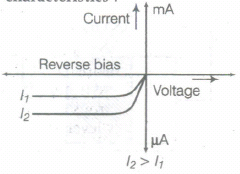
2.
.png)
(a) metals, (b) insulators and (c) semiconductors
Two distinguishing features:
(i) In conductors, the valence band and conduction band tend to overlap (or nearly overlap) while in insulators they are separated by a large energy gap and in semiconductors they are separated by a smaJ1'ep.ergygap.
(ii) The conduction band, of a conductor, has a large number of electrons available for electrical conduction. However the conduction band of insulators is almost empty while that of the semiconductor has only a (very) small number of such electrons available for electrical conduction.
.png)
3.
\(9.1\times { 10 }^{ 15 }\)
4.
\(2.25\times { 10 }^{ 6 }m{ s }^{ -1 }\)
5.
\(1.23\times { 10 }^{ 4 }{ s }^{ -1 }\)
6.
(a) For the electron:
Mass m = 9.11 x 10⁻³¹ kg, speed v = 5.4 x 10⁶ m/s. Then, momentum
p = m v = 9.11 x 10⁻³¹ (kg) x 5.4 x 10⁶ (m/s)
p = 4.92 x 10⁻²⁴ kg m/s
de Broglie wavelength,\(\lambda\) = h/p
\(=\frac{6.63 \times 10^{-34} \mathrm{Js}}{4.92 \times 10^{-24} \mathrm{~kg} \mathrm{~m} / \mathrm{s}}\)
\(\lambda=0.135 \mathrm{nm}\)
(b) For the ball:
Mass m’ = 0.150 kg, speed v’ = 30.0 m/s.
Then momentum p’ = m’ v ’ = 0.150 (kg) x 30.0 (m/s)
p ’= 4.50 kg m/s
de Broglie wavelength \(\lambda\)’ = h/p’.
\(=\frac{6.63 \times 10^{\pm 34} \mathrm{Js}}{4.50 \times \mathrm{kg} \mathrm{m} / \mathrm{s}}\)
\(\lambda^{\prime}=1.47 \times 10^{-34} \mathrm{~m}\)
The de Broglie wavelength of electron is comparable with X-ray wavelengths. However, for the ball it is about 10–19 times the size of the proton, quite beyond experimental measurement.
7.
(d)
two light nuclei combine to give a heavier nucleus and possibly other products
8.
(b)
3200 yrs
9.
(b)
The current through the series Resisitance \((R_{ 3 })\) changes
10.
(d)
number density of carriers increases, relaxation time decreases but effect of decrease in relaxation time is much less than increase in number density
11.
(b)
reduces the majority carrier to zero
12.
13.
(a)
germanium is doped with arsenic
14.
equal
15.
(d)
metallic
16.
(b)
\(\frac { { E }_{ e } }{ { E }_{ p } } ={ 10 }^{ -2 }\)
17.
Circuit diagram of an illuminated photodiode:
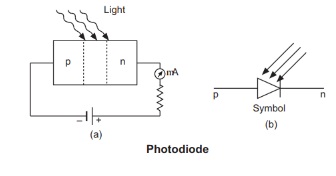
Explanation:
The magnitude of the photocurrent depends on the intensity of incident light (photocurrent is proportional to incident light intensity). Thus photodiode can be used to measure light intensity.
18.
(i) In n-type semiconductor, the semiconductor is doped with pentavalent impurity. The electrons are majority carriers and holes are minority carriers or ne >> nh , (ne = number density of electrons, nh = number density of holes).
In energy band diagram of n-type semiconductor, the donor energy level ED is slightly below the bottom of conduction band Ec and thus. the electron can move to conduction band, even with small supply of energy.

(ii) In p-type semiconductor, the semiconductor is doped with trivalent impurity. The holes are the majority carriers and electrons are the minority carriers, i.e. nb >> ne . In energy band diagram of p-type, the acceptor energy level EA is slightly above the top of valence band EV .
Thus, even with small supply of energy, electron from valence band can jump to level E4 and ionise the acceptor, negatively.
19.
It is the minimum negative potential given to the anode in a photocell for which the photoelectric current becomes zero. If \({ v }_{ 0 }\) is the stopping potential, then maximum K.E. of emitted photoelectron is
\({ \left( K.E \right) }_{ max }={ eV }_{ 0 }=hv-{ \phi }_{ 0 }\)
\(V_{ 0 }=\frac { hv }{ e } -\frac { { \phi }_{ 0 } }{ e } \)
Threshold frequency It is the minimum frequency of the incident radiation for which just emission of photoelectrons takes place from a metal surface without any K.E. If \(V_{ 0 }\)is the threshold frequency, then using Einstein's photoelectric equation
\(0={ hv }_{ 0 }-{ \phi }_{ 0 }\quad or\quad V_{ 0 }=\frac { { \phi }_{ 0 } }{ h } \)
20.
In photoelectric emission, \(\frac { 1 }{ 2 } { mv }^{ 2 }=hv-{ \phi }_{ 0 }\)
The increase in frequency v of the incident photon. Since the work function \({ \phi }_{ 0 }\)of a given photosensitive surface being fixed, therefore the kinetic energy of the photoelectron increases with increase in the frequency of incident light due to it, the velocity v of photoelectrons increases.
21.
When an electron of mass m is confined to move on a line of length l with velocity v, the de-Broglie wavelength \(\lambda \) associated with electron is \(\lambda =\frac { h }{ mv } =\frac { h }{ p } \ \ or \ \ p=\frac { h }{ \lambda } =\frac { h }{ { 2l }/{ n } } =\frac { nh }{ 2l } \)
When electron revolves in a circular orbit of radius r; then \(2l=2\pi r\)
\( \ \therefore \ \ p=\frac { nh }{ 2\pi r } \\ \ \ or \ \ p\times r=\frac { nh }{ 2\pi } \)
i.e., angular momentum \((p\times r)\) of electron is integral multiple of \({ h }/{ 2\pi }\) . This is Bohr's quantization condition of angular momentum.
22.
No, the stopping potential does not depend upon the intensity of incident radiations but depends on the nature of photosensitive surfaces and frequency of the incident radiation.
23.
For a given metal, there exists certain minimum frequency of the incident radiation below which no emission of photoelectrons takes place. This frequency is called threshold frequency. It is a constant quantity for a given metal surface.
24.
\(M a x . K . E .=K_{\max }=e V_0=e \times 1.5 \mathrm{~V}=1.5 \mathrm{eV}\)
25.
\(R=1.097 \times 10^7 \mathrm{~m}^{-1}\)
26.
This model could not explain scattering of \(\alpha\) particle through large angles.
27.
Work function of metal depends upon the amount of restraining forces acting on the electrons to be ejected.In different metals, the amount of restraining forces on the electrons to be ejected is different.Hence, work function for different metals is different.
Here,
\({ \phi }_{ 0 }=1.2eV=1.2\times 1.6\times { 10 }^{ -19 }J\)
\( As \ { \phi }_{ 0 }=\frac { hc }{ { \lambda }_{ 0 } } \ or \ { \lambda }_{ 0 }=\frac { hc }{ { \phi }_{ 0 } } =\frac { \left( 6.63\times { 10 }^{ -34 } \right) \times \left( 3\times { 10 }^{ 8 } \right) }{ 1.2\times 1.6\times { 10 }^{ -19 } } =1037\times { 10 }^{ -19 }m=1037nm\)
(iii) Work function of metal required to the minimum energy required by an electron to escape from the metal. In day-to-day life, we find that we can purchase something only when we have money, which is at least equal to or more than that price. Thus to purchase comforts of life, we have to work hard and earn money by fair means.
28.
\(Here,\lambda =300nm=300\times { 10 }^{ -9 }m\)
\(=3\times { 10 }^{ -7 }m,{ V }_{ 0 }=0.54V\)
(i) Energy of the incident photon,
\(E=\frac { hc }{ \lambda } =\frac { \left( 6.63\times { 10 }^{ -34 }Js \right) \times \left( 3\times { 10 }^{ 8 }m/s \right) }{ 3\times { 10 }^{ -7 } } =6.63\times { 10 }^{ -19 }J\)
\(=\frac { 6.63\times { 10 }^{ -19 } }{ 1.6\times { 10 }^{ -19 } } eV=4.14eV\)
(ii) Max. K.E. of emitted photoelectron is
\({ K }_{ max }=e{ V }_{ 0 }=e\times 54V=0.54eV\)
(iii) \({ As\ K }_{ max }=\frac { hc }{ \lambda } -{ \phi }_{ 0 }\ or{ \ \phi }_{ 0 }=\frac { hc }{ \lambda } -{ K }_{ max }\)
\(=4.14eV-0.54eV=3.6eV\)

12th Standard CBSE Syllabus & Materials
12th Standard CBSE
CBSE 12th Computer Science Python Revision Tour I - New Previous year Question Papers Study Material - QB365 Set A
NEW12th Standard CBSE
CBSE 12th Business Studies Planning Important Questions And Answers Study Material - QB365 Set A
NEW12th Standard CBSE
CBSE 12th Business Studies Business Environment Important Questions And Answers Study Material - QB365 Set A
NEW12th Standard CBSE
CBSE 12th Business Studies Principles of Management Important Questions And Answers Study Material - QB365 Set A



NCERT Books

Syllabus

Exam Pattern

Sample Question Papers

Previous year Question Papers

Important Notes

MCQ Practice test

NCERT Exemplers

Case study Questions

Image Based Questions

Passage based Questions

HOT Questions

Value Based Questions

Model Questions Papers
NCERT ( Book Back ) Questions

Assertion and Reason
Important Questions And Answers

CBSE 12th Standard CBSE Subjects
CBSE Standards








