
 100% FREE ACCESS
12th Standard CBSE Syllabus & Materials
12th Standard CBSE
CBSE 12th Economics Government Budget and the Economy Previous year Question Papers Study Material - QB365 Set A
NEW12th Standard CBSE
CBSE 12th Computer Science Interface Python with MySQL - New Previous year Question Papers Study Material - QB365 Set A
NEW12th Standard CBSE
CBSE 12th Computer Science Database Concept - New Previous year Question Papers Study Material - QB365 Set A
NEW12th Standard CBSE
CBSE 12th Computer Science Data Communication - New Previous year Question Papers Study Material - QB365 Set A
NEW12th Standard CBSE
CBSE 12th Computer Science Data Structures - New Previous year Question Papers Study Material - QB365 Set A
NEW12th Standard CBSE
CBSE 12th Computer Science Functions - New Previous year Question Papers Study Material - QB365 Set A

Published on: 25/10/2025
Download CBSE Class 12th Standard CBSE Physics question papers, sample papers, important questions, and previous year solved papers in PDF format. Get free study materials, NCERT solutions, and exam preparation resources for Class 12th Standard CBSE Physics
Questions + Answers key
Take MCQ Physics Test
1.
Write two properties of superconductor magnets. Where do they find their application?
2.
A horizontal straight wire 10 m long extending from east to west is falling with a speed of 50 m s–1, at right angles to the horizontal component of the earth’s magnetic field, 0.30 x 10- 4 Wb m-2.
(a) What is the instantaneous value of the emf induced in the wire?
(b) What is the direction of the emf?
(c) Which end of the wire is at the higher electrical potential?
3.
An infinite line charge produces a field of 9 × 10⁴ N/C at a distance of 2 cm. Calculate the linear charge density.
4.
A closely wound solenoid of 800 turns and area of cross section 2.5 × 10⁻⁴ m2 carries a current of 3.0 A. Explain the sense in which the solenoid acts like a bar magnet. What is its associated magnetic moment?
5.
An alternating current of 1.5 mA and angular frequency \(\omega =300\) radian/sec flows through \(10\ k\Omega \) resistor and a \(0.50\ \mu \ F\) capacitor in series. Find the r.m.s voltage across the capacitor and impedance of the circuit.
6.
An aeroplane is travelling west at the speed of 500 m/s. What is the voltage difference between the ends of the wings 25 m long, if the earth's magnetic field at the location has a magnitude of \(5 \times { 10 }^{ -4 }T\) and dip angle is \({ 30 }^{ \circ }\)?
7.
What is the net power absorbed by each circuit over a complete cycle? Explain your answer.
8.
An electron experiences a force (1.6 x 10 -16 N) \(\hat{\mathbf{i}}\) in an electric field E. The electric field E is
\(\left(10 \times 10^3 \frac{\mathrm{N}}{\mathrm{C}}\right) \hat{\mathbf{i}}\)
-\(\left(10 \times 10^3 \frac{\mathrm{N}}{\mathrm{C}}\right) \hat{\mathbf{i}}\)
\(\)\(\)\(\)\(\)\(\left(10 \times 10^-3 \frac{\mathrm{N}}{\mathrm{C}}\right) \hat{\mathbf{i}}\)
- \(\left(10 \times 10^-3 \frac{\mathrm{N}}{\mathrm{C}}\right) \hat{\mathbf{i}}\)
9.
What is the value of inductance L for which the current is maximum in a series LCR-circuit with C = 10 μF and ω = 1000 S-1?
100 mH
1 mH
10 mH
cannot be calculated unless R is known
10.
If coil is open, then L and R becomes
infinity, zero
zero, infinity
infinity, infinity
zero, zero
11.
A loop, made of straight edges has six corners at A (0, 0, 0), B (L, 0, 0), C (L, L, 0), D(0, L, 0), E (0, L, L) and F (0, 0, L). A magnetic field \(B={ B }_{ 0 }\left( \hat { i } +\hat { k } \right) T\) is present in the region. The flux passing through the loop ABCDEFA (in that order) is.
\({ B }_{ 0 }{ L }^{ 2 }Wb\)
\(2{ B }_{ 0 }{ L }^{ 2 }Wb\)
\(\sqrt { 2 } { B }_{ 0 }{ L }^{ 2 }Wb\)
\(4{ B }_{ 0 }{ L }^{ 2 }Wb.\)
12.
A magnetic needle suspended parallel to a magnetic field requires \(\sqrt{3}\) J of work to turn it through 60°. The torque needed to maintain the needle in this position will be
2\(\sqrt{3}\) J
3 J
\(\sqrt{3}\) J
\(\frac{3}{2} \mathrm{~J}\)
13.
Two similar spheres having +Q and -Q charges are kept at a certain distance. F force acts between the two. If at the middle of two spheres, another similar sphere having +Q charge is kept, then it experiences a force in magnitude and direction as
zero having no direction.
SF towards +Q charge.
SF towards -Q charge.
4F towards +Q charge
14.
In R-L-C series circuit with C = 1.00 nF two values of R are
(i) R = 100 \(\Omega\)and
(ii) R = 200 \(\Omega\) For the source applied with Vm = 100 V. Resonant frequency is
1 x 10³ rad/s
1 x 10⁶ rad/s
1.56 x 10⁶ rad/s
1.75 x 10³ rad/s
15.
The magnitude of the induced emf in a circuit is equal to the time rate of change of magnetic flux through the circuit, is statment of
Fleming's right hand rule
Fleming's left hand rule
Felming's third law
Faraday's law of electromagnetic induction
16.
The self-inductance of a coil is 2 mH. The rate of flow of current in it is 103 A/S. The induced electromotive force in the coil is
1V
2V
3V
4V
17.
Ferromagnetism show their properties due to
filled inner subshells
vacant inner subshells
partially filled inner subshells
all the subshells equally filled
18.
A bar magnet of length 3 cm has points A and B along axis at a distance of 24 cm and 48 cm on the opposite ends. Ratio of magnetic fields at these points will be
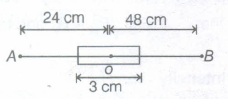
8
3
4
1/2 \(\sqrt{2}\)
19.
At a place angle of dip is 30°. If horizontal component of earth's magnetic field is H, then the total intensity of magnetic field will be
H / 2
2H / \(\sqrt{3}\)
H \(\sqrt{3/2}\)
2 H
20.
An object of mass 1kg contains 4 x 10²⁰ atoms. If one electron is removed from every atom of the solid, the charge gained by the solid of 1g is _______
2.8 C
6.4 x 10⁻² C
3.6 x 10⁻³ C
9.2 x 10⁻⁴ C
21.
An alternating current generator has an internal resistance Rg and an internal reactance Xg. It is used to supply power to a passive load consisting of a resistance Rg and a reactance XL. For maximum power to be delivered from the generator to the load, the value of XL is equal to
zero
Xg
-Xg
Rg
22.
A 44 mH inductor is connected to 220 V, 50 Hz AC supply. Determine the rms value of the current in the circuit. What is the net power absorbed over a complete cycle? Explain.
23.
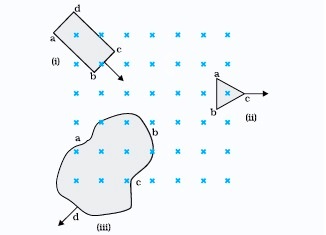
In the figure shows planar loops of different shapes moving out of or into a region of a magnetic field which is directed normal to the plane of the loop away from the reader. Determine the direction of induced current in each loop using Lenz’s law.
24.
A short bar magnet placed with its axis at 30º with a uniform external magnetic field of 0.25 T experiences a torque of magnitude equal to 4.5 x 10⁻² J. What is the magnitude of magnetic moment of the magnet?
25.
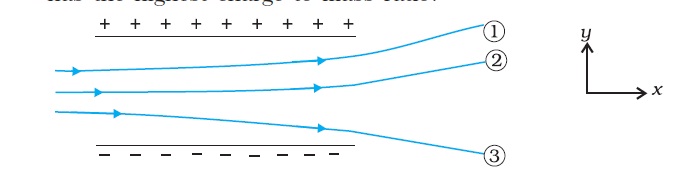
The Figure shows tracks of three charged particles in a uniform electrostatic field. Give the signs of the three charges. Which particle has the highest charge to mass ratio?
26.
(a) The peak voltage of an AC supply is 300 V. What is its rms voltage?
(b) The rms value of current in an AC circuit is 10 A. What is the peak current?
27.
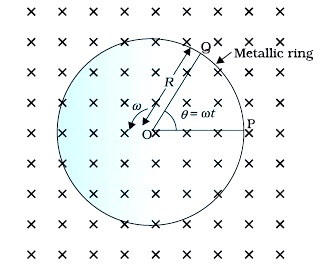
A metallic rod of 1 m length is rotated with a frequency of 50 rev/s, with one end hinged at the centre and the other end at the circumference of a circular metallic ring of radius 1 m, about an axis passing through the centre and perpendicular to the plane of the ring (Fig). A constant and uniform magnetic field of 1 T parallel to the axis is present everywhere. What is the emf between the centre and the metallic ring?
28.
A uniformly charged conducting sphere of diameter 2.4 m has a surface charge density of 80.0 μC/m2.
(a) Find the charge on the sphere.
(b) What is the total electric flux leaving the surface of the sphere?
29.
Let an alternating source of emf E= E0sin \(\omega\)t is connected to a circuit having a pure inductance L. If I is the value of instantaneous current in the circuit, then I = I0 \(\sin \left(\omega t-\frac{\pi}{2}\right)\) . The inductive reactance, XL = \(\omega\)L limits the current in a purely inductive circuit.
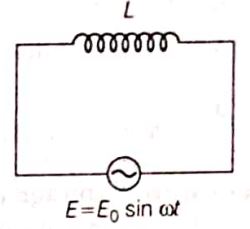
Answer the following questions based on above passage.
(i) What is the phase difference between E and I?
(ii) Draw the phasor diagram of the circuit containing pure inductor and connected to an AC voltage E = E0 sin \(\omega\)t.
(iii) What is the maximum value of current when inductance of 3H is connected to 150 V - 50 Hz supply?
(iv) A 200 Hz AC is flowing in 15 mH coil. What is the value of reactance?
30.
A magnetic dipole is an arrangement of two magnetic poles of equal and opposite strengths, + m and - m separated by a small distance. The positive pole strength is north pole and the negative pole strength is south pole. A magnetic dipole is characterised by its magnetic dipole moment, M = m (2l), where 2l is the distance between two poles. It is similar to electric dipole moment in electrostatics.
(i) A bar magnet use dipole moment M. When it is bent to form a semicircular arc, then find its dipole moment.
(ii) The arrangement of two bar magnets each of dipole moment M is shown in figure.
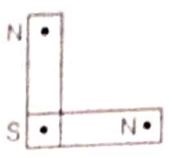
What will be the resultant dipole moment?
(iii) What is the direction of magnetic moment of a magnetic dipole?
(iv) How is the magnetic pole is different from a charge?
1.
The properties of superconductor magnets are:
(i) perfect conductivity, and
(ii) perfect diamagnetism
\({ (i.e., } \left.\chi_{m}=-1, \mu_{r}=0\right)\)
Superconducting magnets are used for running magnetically levitated superfast trains.
2.
Given, velocity of straight wire,
v = 5m/s
Horizontal component of the earth's magnetic field,
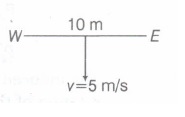
Length of the wire, \(\mathrm{I}=10 \mathrm{~m}\)
Falling speed of the wire, \(v=5.0 \mathrm{~m} / \mathrm{s}\)
Magnetic field strength, \(B=0.3 \times 10^{-4} \mathrm{~Wb} \mathrm{~m}^{-2}\)
(a) Emf induced in the wire,
\( e=B l v \)
\(=0.3 \times 10^{-4} \times 5 \times 10 =1.5 \times 10^{-3} V\)
(b) Using Fleming's right-hand rule, it can be inferred that the direction of the induced emf is from West to East.
(c) The eastern end of the wire is at a higher potential.
3.
Here, E = 9 \(\times\)104 N/C, r = 2 cm = 2 \(\times\)10-2 m and \(\lambda\)= ?
As, \(E=\frac{\lambda}{2\pi \varepsilon _{0}r}\Rightarrow \lambda =2\pi \varepsilon _{0}rE\)
\(=\frac{1}{2\times 9\times 10^{9}}\times 2\times 10^{-2}\times 9\times 10^{4}=10^{-7}Cm^{-1}\)
4.
Number of turns in the solenoid, n = 800
Area of cross-section, A = 2.5 × 10⁻⁴ m2
Current in the solenoid, I = 3.0 A
A current-carrying solenoid behaves like a bar magnet because a magnetic field develops along its axis, i.e., along with its length.
The magnetic moment associated with the given current-carrying solenoid is calculated as:
M = n I A
= 800 x 3 x 2.5 x 10-4
= 0.6 J T-1
5.
Here, \(I_{ v }=1.5 \ mA=1.5\times 10^{ -3 }A,\)
\(\omega =300 \ rad/s, \ R=10 \ k\Omega =10^{ 4 }\Omega\)
\(C=0.5\mu F=0.5\times 10^{ -6 }F\)
\(X_{ C }=\frac { 1 }{ \omega C } =\frac { 1 }{ 300\times 0.5\times 10^{ -6 } } =\frac { 10^{ 6 } }{ 150 } \)
\(=\frac { 20 }{ 3 } \times 10^{ 3 }\Omega\)
\(Z=\sqrt { R^{ 2 }+X^{ 2 }_{ C } } =\sqrt { 10^{ 8 }+\frac { 4 }{ 9 } \times 10^{ 8 } } \)
\(=10^{ 4 }\sqrt { \frac { 13 }{ 9 } } =1.20\times 10^{ 4 }\Omega \)
rms voltage across the capacitor
\(=I_{ v }X_{ C }=1.5\times 10^{ -3 }\times \frac { 20 }{ 3 } \times 10^{ 3 }=10volt\)
6.
\(Here,\upsilon =500m/s \ \ e=? \ l=25m\)
\(R=5 \times { 10 }^{ -4 }T, \ \delta ={ 30 }^{ \circ }\)
\(e=Bl\upsilon =Vl\upsilon =(R \ sin \ \delta )l\upsilon \)
\(=5 \times { 10 }^{ -4 }sin{ 30 }^{ \circ } \times 25 \times 500=3.125 \ V\)
7.
In the inductive circuit,
Rms value of current, I = 15.92 A
Rms value of voltage, V = 220 V
Hence, the net power absorbed can be obtained by the relation,
P = VI cos Φ
Where,
Φ = Phase difference between V and I
For a pure inductive circuit, the phase difference between alternating voltage and current is 90° i.e., Φ= 90°.
Hence, P = 0 i.e., the net power is zero.
In the capacitive circuit,
Rms value of current, I = 2.49 A
Rms value of voltage, V = 110 V
Hence, the net power absorbed can ve obtained as:
P = VI Cos Φ
For a pure capacitive circuit, the phase difference between alternating voltage and current is 90° i.e., Φ= 90°.
Hence, P = 0 i.e., the net power is zero.
8.
(a)
\(\left(10 \times 10^3 \frac{\mathrm{N}}{\mathrm{C}}\right) \hat{\mathbf{i}}\)
9.
(a)
100 mH
10.
(b)
zero, infinity
11.
(b)
\(2{ B }_{ 0 }{ L }^{ 2 }Wb\)
12.
(b)
3 J
13.
(c)
SF towards -Q charge.
14.
(a)
1 x 10³ rad/s
15.
(d)
Faraday's law of electromagnetic induction
16.
(b)
2V
17.
(c)
partially filled inner subshells
18.
(a)
8
19.
(b)
2H / \(\sqrt{3}\)
20.
(b)
6.4 x 10⁻² C
21.
(c)
-Xg
22.
Given, inductance, L = 44 mH = 44 x 10-3H, Vrms = 220V
Frequency of inductor, V = 50 Hz
Inductive reactance, XL = 2\(\pi\)VL
= 2 x 3.14 x 50 x 44 x I0-3 = 13.82 \(\Omega\)
The rms value of current in the circuit,
\(I_{\mathrm{rms}}=\frac{V_{\mathrm{rms}}}{X_{L}}=\frac{220}{13.82}=15.9 \mathrm{~A}\)
Power absorbed, F = Vrms Irms cos Φ
For pure inductive circuit, Φ = 90\(\unicode{xb0} \)
\(\therefore\) P = 0
Thus, power spent in one half cycle is retrieved in the other half cycle.
23.
(i) The magnetic flux through the rectangular loop abcd increases, due to the motion of the loop into the region of magnetic field, The induced current must flow along the path bcdab so that it opposes the increasing flux.
(ii) Due to the outward motion, magnetic flux through the triangular loop abc decreases due to which the induced current flows along bacb, so as to oppose the change in flux.
(iii) As the magnetic flux decreases due to motion of the irregular shaped loop abcd out of the region of magnetic field, the induced current flows along cdabc, so as to oppose change in flux. Note that there are no induced current as long as the loops are completely inside or outside the region of the magnetic field
24.
Magnetic field strength, B = 0.25 T
Torque on the bar magnet, T = 4.5 x 10⁻² J
The angle between the bar magnet and the external magnetic field, θ = 30°
Torque is related to magnetic moment (M) as:
\(T=M B \sin \theta \therefore M=\frac{T}{B \sin \theta}\)
\(=\frac{4.5 \times 10^{-2}}{0.25 \times \sin 30^{\circ}}=0.36 J T^{-1}\)
Hence, the magnetic moment of the magnet is 0.36 J T-1.
25.
Opposite charges attract each other and same charges repel each other. It can be observed that particles 1 and 2 both move towards the positively charged plate and repel away from the negatively charged plate. Hence, these two particles are negatively charged. It can also be observed that particle 3 moves towards the negatively charged plate and repels away from the positively charged plate. Hence, particle 3 is positively charged.
The charge to mass ratio (emf) is directly proportional to the displacement or amount of deflection for a given velocity. Since the deflection of particle 3 is the maximum, it has the highest charge to mass ratio.
26.
a) Given: The peak voltage of supply is 100 V.
The rms voltage is give as,
v m = 2 ×V
Where, the peak value of supply voltage is v m and its rms value is V.
By substituting the given values in the above equation, we get
300= 2 ×V V= 300 2 =212.1 V
Thus, the value of rms voltage is 212.1V.
b) Given: The rms current in an ac circuit is 10 A.
The peak current in the circuit is given as,i m = 2 ×I
Where, the peak current in an ac circuit is i m and its rms value is I.
By substituting the given values in the above equation, we get
i m = 2 ×10 =14.1 A
Thus, the value of peak current in the given ac circuit is 14.1 A.
27.
Method I
As the rod is rotated, free electrons in the rod move towards the outer end due to Lorentz force and get distributed over the ring. Thus, the resulting separation of charges produces an emf across the ends of the rod. At a certain value of emf, there is no more flow of electrons and a steady state is reached. the magnitude of the emf generated across a length dr of the rod as it moves at right angles to the magnetic field is given by
dε = Bv dr . Hence,
\(\varepsilon = \int \mathrm{~d} \varepsilon=\int_0^R B v \mathrm{~d} r=\int_0^R B \omega r \mathrm{~d} r=\frac{B \omega R^2}{2}\)
Note that we have used v = ω r. This gives
\(\varepsilon=\frac{1}{2} \times 1.0 \times 2 \pi \times 50 \times\left(1^{2}\right)\)
= 157 V
Method II
To calculate the emf, we can imagine a closed loop OP\(\mathcal{Q}\) in which point O and P are connected with a resistor R and O\(\mathcal{Q}\) is the rotating rod. The potential difference across the resistor is then equal to the induced emf and equals B x (rate of change of area of loop). If θ is the angle between the rod and the radius of the circle at P at time t, the area of the sector OP\(\mathcal{Q}\) is given by
\(\pi R^{2} \times \frac{\theta}{2 \pi}=\frac{1}{2} R^{2} \theta\)
where R is the radius of the circle. Hence, the induced emf is
\(\varepsilon=B \times \frac{\mathrm{d}}{\mathrm{d} t}\left[\frac{1}{2} R^{2} \theta\right]=\frac{1}{2} B R^{2} \frac{\mathrm{d} \theta}{\mathrm{d} t}=\frac{B \omega R^{2}}{2}\)
\(\text { [Note: } \left.\frac{\mathrm{d} \theta}{\mathrm{d} t}=\omega=2 \pi v\right]\)
This expression is identical to the expression obtained by Method I and we get the same value of ε.
28.
Given, \(R=\frac{D}{2}=\frac{2.4}{2}=1.2 m\)
and \(\sigma =80.0 \quad \mu C/m^{2}\)
(i) Charge on sphere, q = 4\(\pi\)R2 . \(\sigma\)
\(=4\times 3.14\times (1.2)^{2}\times 80=1446.912 \quad \mu C\)
=1.45 \(\times\)10-3C
(ii) Electric flux, \(\phi=\frac{q}{\varepsilon_{0}}=\frac{1.45\times 10^{-3}}{8.854\times 10^{-12}}\)
= 0.1637 \(\times\)109 = 1.637 \(\times\)108 N-m2/C
29.
(i) The phase difference berween E and I is \(\frac{\pi}{2}\). the voltage E leads the current I by phase angle \(\frac{\pi}{2}\).
(ii) The phasor diagram is given by
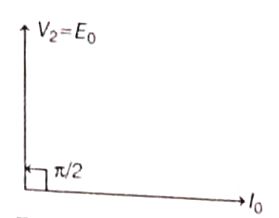
(iii) L = 3 H, Erms = 150 V, f = 50 Hz
\(I_0=\frac{E_0}{X_L}=\frac{\sqrt{2} E_{\mathrm{mms}}}{2 \pi f L}=\frac{\sqrt{2} \times 150}{2 \pi \times 50 \times 3}=0.225 \mathrm{~A}\)
(iv) f = 200 Hz, L = 15 mH = 15 \(\times\)10-3 H
\(\therefore\) Inductive reactance, XL = \(\omega\)L = 2\(\pi\)fL
= 2 \(\pi\) \(\times\)200 \(\times\)15 \(\times\)10-3 = 18.84 \(\Omega\)
30.
(i) Dipole moment of bar magnet = M = m . l
When it is bent into semi-circular wire then,
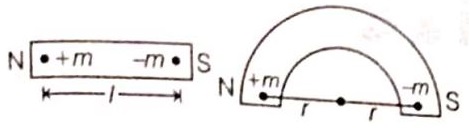
Radius of semi-circle, \(r=\frac{l}{\pi}\)
\(\therefore\) Distance between the two poles is l' = 2r = \(\frac{2l}{\pi}\)
\(\therefore\) Dipole moment of semi-circle is \(M^{\prime}=m \cdot l^{\prime}=\frac{2 m l}{\pi}=\frac{2 M}{\pi}\)
(ii) The dipole moment vector for the arrangement is shown below,
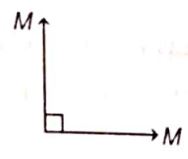
\(\therefore\) The resultant dipole moment is given by
\(M^{\prime}=\sqrt{M^2+M^2}=\sqrt{2} M\)
(iii) The direction of magnetic dipole moment is from south pole to north pole of a magnetic dipole.
(iv) Unlike a electric charge, an isolated magnetic pole (either north or south pole) do not exist.

12th Standard CBSE Syllabus & Materials
12th Standard CBSE
CBSE 12th Computer Science Python Revision Tour I - New Previous year Question Papers Study Material - QB365 Set A
NEW12th Standard CBSE
CBSE 12th Business Studies Planning Important Questions And Answers Study Material - QB365 Set A
NEW12th Standard CBSE
CBSE 12th Business Studies Business Environment Important Questions And Answers Study Material - QB365 Set A
NEW12th Standard CBSE
CBSE 12th Business Studies Principles of Management Important Questions And Answers Study Material - QB365 Set A



NCERT Books

Syllabus

Exam Pattern

Sample Question Papers

Previous year Question Papers

Important Notes

MCQ Practice test

NCERT Exemplers

Case study Questions

Image Based Questions

Passage based Questions

HOT Questions

Value Based Questions

Model Questions Papers
NCERT ( Book Back ) Questions

Assertion and Reason
Important Questions And Answers

CBSE 12th Standard CBSE Subjects
CBSE Standards








