
 100% FREE ACCESS
12th Standard CBSE Syllabus & Materials
12th Standard CBSE
CBSE 12th Economics Government Budget and the Economy Previous year Question Papers Study Material - QB365 Set A
NEW12th Standard CBSE
CBSE 12th Computer Science Interface Python with MySQL - New Previous year Question Papers Study Material - QB365 Set A
NEW12th Standard CBSE
CBSE 12th Computer Science Database Concept - New Previous year Question Papers Study Material - QB365 Set A
NEW12th Standard CBSE
CBSE 12th Computer Science Data Communication - New Previous year Question Papers Study Material - QB365 Set A
NEW12th Standard CBSE
CBSE 12th Computer Science Data Structures - New Previous year Question Papers Study Material - QB365 Set A
NEW12th Standard CBSE
CBSE 12th Computer Science Functions - New Previous year Question Papers Study Material - QB365 Set A

Published on: 25/10/2025
Download CBSE Class 12th Standard CBSE Physics question papers, sample papers, important questions, and previous year solved papers in PDF format. Get free study materials, NCERT solutions, and exam preparation resources for Class 12th Standard CBSE Physics
Questions + Answers key
Take MCQ Physics Test
1.
A man with normal near point (25 cm) reads a book with small print using a magnifying glass: a thin convex lens of focal length 5 cm.
(a) What is the closest and the farthest distance at which he should keep the lens from the page so that he can read the book when viewing through the magnifying glass?
(b) What is the maximum and the minimum angular magnification (magnifying power) possible using the above simple microscope?
2.
While working on class X project based on magnetism, Bala and Rama in their project work calculate the value of earth's magnetic field and submitted it to their Physics teacher Mr. Santosh for verification. Their Physics teacher Mr. Santosh corrected their mistakes suggested certain reference books to read.
(i) What values did Mr. Santosh exhibit towards his students? Mention any two.
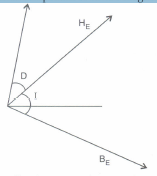
(ii) Mention the three magnetic elements required to calculate the value of the earth's magnetic field. and draw a neat diagram to explain them.
3.
A charge of 8 mC is located at the origin. Calculate the work done in taking a small charge of -2\(\times\)10-9C from a point P (0, 0, 3 cm) to a point Q(0, 4 cm, 0) via a point R(0, 6 cm, 9 cm).
4.
(i) Name the three elements of the earth's magnetic field.
(ii) Where on the surface of the earth is the vertical component of the earth's magnetic field zero?
5.
The following table gives the values of the angle of deviation, for different values of the angle of incidence, for a triangular prism.
| Angle of incidence | 33° | 38° | 42° | 52° | 60° | 71° |
| Angle of deviation | 60° | 50° | 46° | 40° | 43° | 50° |
(i) For what value of the angle of incidence, is the angle of emergence likely to be equal to the angle of incidence itself?
(ii) Draw a ray diagram, showing the passage of a ray of light through this prism, when the angle of incidence has the above value.
6.
A ring of radius R carries a uniformly distributed charge + Q. A point charge - q is placed on the axis of the ring at a distance 2R from the centre of the ring and released from rest. Will the particle execute simple harmonic motion along the axis of the ring?
7.
Name em waves are used in telecommunication.
8.
Plot a graph showing the variation of resistivity of a conductor with temperature.
9.
A charged particle is moving on a circular path of radius R in a uniform magnetic field under the Lorentz force F. How much work is done by the force in one round? Is the momentum of the particle changing?
10.
Why are pole pieces of galvanometer made concave ?
11.
Three materials A, B and C have electrical conductivities \(\sigma, \ 2 \ \sigma \ \ and \ \ 2 \ \sigma\) respectively. Their number densities of free electrons are 2 n, n and 2 n respectively. For which material is an average collision time of free electrons maximum?
12.
A figure divided into squares each of size 1 mm2 is being viewed at a distance of 8 cm through a converging lens of focal length 12 cm.
(i) What is the magnification produced by the lens?
(ii) How much is the area of each square in the virtual image?
13.
A magnetic compass needle of magnetic moment 60 Am2 is placed at a place. The needle points towards the geographical north. Using the data given below, find the value of declination at that place. Horizontal component of earth's magnetic field = 40 x 10-6 Wb m-2 and torque experienced by the needle = 1.2 x 10⁻³ Nm.
14.
An electric dipole of length 2 cm, when placed with its axis making an angle of 60° with a uniform electric field, experiences a torque of 8\(\sqrt{3}\) N-m. Calculate the potential energy of the dipole, if it has a charge of ± 4 nC.
15.
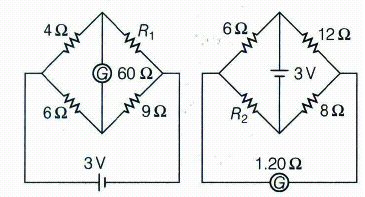
Figure shows two circuits each having a galvanometer and a battery of 3 V. When the galvanometer in each arrangement do not show any deflection, obtain the ratio R1/R2.
16.
Equal charges each of 20\(\mu C\) are placed at x = 0,2,4,8,16 cm on X-axis. Find the force experienced by the charge at x = 2 cm.
17.
Which of the following has negative temperature coefficient of resistivity?
Metal
Metal and semiconductor
Semiconductor
Metal and alloy
18.
The direction of induced current in the loop abc is
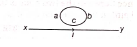
along abc if I decreases
along acb if I increases
along abc if I is constant
along abc if I increases
19.
The astronomical telescope consists of objective and eyepiece. The focal length of the objective is
equal to the of the eyepiece.
shorter than that of eyepiece
greater than that of eyepiece
five times shorter than that of eyepiece
20.
Curie law XT = constant, relating magnetic susceptibility (X) and absolute temperature (T) of magnetic substance is obeyed by
all magnetic substances.
paramagnetic substances.
diamagnetic substances.
ferromagnetic substances.
21.
What is the net force on the rectangular coil?
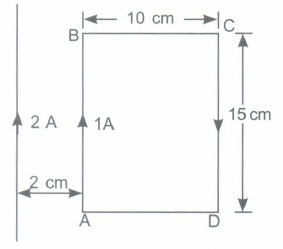
25 x 10-7 N towards wire.
25 x 10-7 N away from wire
35 x 10-7 N towards wire
35 x 10-7 N away from wire.
22.
The magnitude of electric field intensity E is such that, an electron placed in it would experience an electrical force equal to its weight is given by
mge
mg/e
e/mg
e2g/m2
23.
Relation between focal length (f) and radius of curvature (R) of a spherical mirror is
R = f/2
f = 3R
f = R/2
f = R/4
24.
A potential difference of 100 V is applied to the ends of a copper wire one metre long. What is the average drift velocity of electrons?
(given. σ = 5.81 x 10⁷ Ω-1or ncu = 8.5 x 1028 m-3)
0.43 ms -1
0.83 ms -1
0.52 ms-1
0.95 ms-1
25.
The dispersive powers of glasses of lenses used in an achromatic pair are in the ratio 5 : 3. If the focal length of the concave lens' is 15 ern, then the nature and focal length of the other lens would be
convex, 9 cm
concave, 9 cm
convex, 25 cm
concave, 25 cm
26.
The electric field strength due to a circular loop of charge of radius R and linear density of charge ⋋ at its centre is proportional to
⋋R
⋋/R
⋋/R2
None of the above
27.
If there were only one type of charge in the universe, then
\(\oint _{ s }^{ }{ \overrightarrow { E } .\overrightarrow { ds } } \neq 0\) on any surface
\(\oint _{ s }^{ }{ \overrightarrow { E } .\overrightarrow { ds } } = 0\) if the charge is outside the surface
\(\oint _{ s }^{ }{ \overrightarrow { E } .\overrightarrow { ds } } \) could not be defined
\(\oint _{ s }^{ }{ \overrightarrow { E } .\overrightarrow { ds } } ={q\over \epsilon_o}\) if charges of magnitude q were inside the surface
28.
A current of 5 A is flowing through a circular coil of diameter 14 cm having 100 turns. The magnetic dipole moment associated with this coil is :
\(0.077{ Am }^{ 2 }\)
\(0.77{ Am }^{ 2 }\)
\(7.7{ Am }^{ 2 }\)
\(77{ Am }^{ 2 }\)
29.
An astronomical telescope is an optical instrument which is used for observing distinct images of heavenly bodies libe stars, planets etc. It consists of two lenses. In normal adjustment of telescope, the final image is formed at infinity. Magnifying power of an astronomical telescope in normal adjustment is defined as the ratio of the angle subtended at the eye by the angle subtended at the eye by the final image to the angle subtended at the eye, by the object directly, when the final image and the object both lie at infinite distance from the eye. It is given by,\(m=\frac{f_{0}}{f_{e}}\) To increase magnifying power of an astronomical telescope in normal adjustment, focal length of objective lens should be large and focal length of eye lens should be small.
(i) An astronomical telescope of magnifying power 7 consists of the two thin lenses 40 cm apart, in normal adjustment. The focal lengths of the lenses are
| (a) 5cm,35cm | (b) 7cm,35cm | (c) 17cm,35cm | (d) 5cm,30cm |
(ii) An astronomical telescope has a magnifying power of 10. In normal adjustment, distance between the objective and eye piece is 22 cm. The focal length of objective lens is
| (a) 25 cm | (b) 10 cm | (c) 15 cm | (d) 20 cm |
(iii) In astronomical telescope compare to eye piece, objective lens has
| (a) negative focal length | (b) zero focal length | (c) small focal length | (d) large focal length |
(iv) To see stars, use
| (a) simple microscope | (b) compound microscope |
| (c) endoscope | (d) astronomical telescope |
(v) For large magnifying power of astronomical telescope
| \((a) f_{v}< |
\((b) f_{v}=f_{\mathrm{e}}\) | \((c) f_{o}>>f_{\mathrm{e}}\) | (d) none of these |
30.
In 1909, Robert Millikan was the first to find the charge of an electron in his now-famous oil-drop experiment. In that experiment, tiny oil drops were sprayed into a uniform electric field between a horizontal pair of oppositely charged plates. The drops were observed with a magnifying eyepiece, and the electric field was adjusted so that the upward force on some negatively charged oil drops was just sufficient to balance the downward force of gravity. That is, when suspended, upward force qE just equaled Mg. Millikan accurately measured the charges on many oil drops and found the values to be whole number multiples of 1.6 x 10⁻¹⁹ C the charge of the electron. For this, he won the Nobel prize.
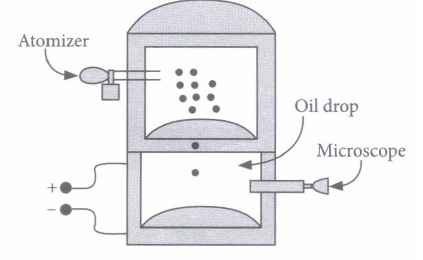
(i) If a drop of mass 1.08 x 10⁻¹⁴ kg remains stationary in an electric field of 1.68 x 10⁵ N C-I, then the charge of this drop is
| (a) 6.40 x 10⁻¹⁹ C | (b) 3.2 x 10⁻¹⁹ C |
| (c) 1.6 X 10⁻¹⁹ C | (d) 4.8 x 10⁻¹⁹ C |
(ii) Extra electrons on this particular oil drop (given the presently known charge of the electron) are
| (a) 4 | (b) 3 | (c) 5 | (d) 8 |
(iii) A negatively charged oil drop is prevented from falling under gravity by applying a vertical electric field 100 V m-1.If the mass of the drop is 1.6 X 10⁻³ g, the number of electrons carried by the drop is (g= 10 m s-2)
| (a) 1018 | (b) 1015 | (c) 1012 | (d) 109 |
(iv) The important conclusion given by Millikan's experiment about the charge is
| (a) charge is never quantized | (b) charge has no definite value |
| (c) charge is quantized | (d) charge on oil drop always increases. |
(v) If in Millikan's oil drop experiment, charges on drops are found to be \(8 \mu \mathrm{C}, 12 \mu \mathrm{C}, 20 \mu \mathrm{C}\) then quanta of charge is
| \(\text { (a) } 8 \mu \mathrm{C}\) | \(\text { (b) } 20 \mu \mathrm{C}\) | \(\text { (c) } 12 \mu \mathrm{C}\) | \(\text { (d) } 4 \mu \mathrm{C}\) |
31.
Assertion(A) : Electric force between two charges always acts along the line joining the two charges
Reason (R) : Electric force is a conservative force.
(a) Both Assertion and Reason are true and Reason is the correct explanation of Assertion.
(b) Both Assertion and Reason are true but Reason is not the correct explanation of Assertion.
(c) Assertion is true but Reason is false.
(d) Assertion is false but Reason is true.
32.
Assertion (A) : Optical fibers are used to transmit light without any loss in its intensity over distance of several kilometers.
Reason (R) : Optical fibers are very thick and all the light is passed through it without any loss.
Codes:
(a) Both A and R are true and R is the correct explanation of A
(b) Both A and R are true but R is NOT the correct explanation of A
(c) A is true but R is false
(d) A is false and R is also false
33.
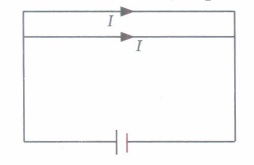
Assertion (A) : When two long parallel wires, hanging freely are connected in parallel to a battery, they come closer to each other.
Reason (R) : Wires carrying current in opposite direction repel each other.
Codes:
(a) Both A and R are true and R is the correct explanation of A
(b) Both A and R are true but R is NOT the correct explanation of A
(c) A is true but R is false
(d) A is false and R is also false
34.
Assertion (A) : No work is done in taking a positive charge from one point to other inside a positively charged metallic sphere while outside the sphere work is done in taking the charge toward the sphere.
Reason (R) : Inside the sphere electric potential is same at each potential, but outside it is different for different points.
Codes:
(a) Both A and R are true and R is the correct explanation of A
(b) Both A and R are true but R is NOT the correct explanation of A
(c) A is true but R is false
(d) A is false and R is also false
1.
(a) Focal length of the magnifying glass, f = 5 cm
Least distance of distance vision, d = 25 cm
Closest object distance = u
Image distance, v = -d = -25 cm
According to the lens formula, we have:
\( \frac{1}{f}=\frac{1}{v}-\frac{1}{u} \)
\(\frac{1}{u}=\frac{1}{v}-\frac{1}{f} \)
\(=\frac{1}{-25}-\frac{1}{5}=\frac{-5-1}{25}=-\frac{6}{25} \)
\(\therefore u=-\frac{25}{6}=-4.167 \mathrm{~cm} \)
Hence, the closest distance at which the person can read the book is 4.167 cm.
For the object at the farthest distant (u’), the image distance (v′) = ∞
According to the lens formula, we have:
\( \frac{1}{f}=\frac{1}{\mathrm{v}^{\prime}}-\frac{1}{\mathrm{u}^{\prime}} \)
\(\frac{1}{\mathrm{u}}=\frac{1}{\infty}-\frac{1}{5}=-\frac{1}{5} \)
\(\therefore \mathrm{u}^{\prime}=-5 \mathrm{~cm}\)
Hence, the farthest distance at which the person can read the book is 5 cm.
(b) Maximum angular magnification is given by the relation:
\( \alpha_{\max }=\frac{d}{|u|} \)
\(=\frac{25}{\frac{25}{6}}=6 \)
Minimum angular magnification is given by the relation:
\( \alpha_{\min }=\frac{d}{|u \prime|} \)
\(=\frac{25}{5}=5\)
2.
(i) Honesty, helpfulness, responsible behaviour towards students and concern for the students to create interest in the subject.
(ii) Magnetic declination, magnetic inclination and horizontal component of earth's magnetic field.
3.
Charge located at the origin, q = 8 mC = 8 x 10⁻³ C
The magnitude of the charge taken from the point P to R and then to Q, q1 = 2 x 10⁻⁹ C
Here OP= d1= 3 cm = 3 x 10⁻² m
OQ = d2= 4 cm = 4 x 10⁻² m
Potential at the point P, V1 \(=\frac{q}{4 \pi \epsilon_{0} d_{1}}\)
Potential at the point Q, V1 \(=\frac{q}{4 \pi \epsilon_{0} d_{1}}\)
The work done (W) is independent of the path
Therefore, W = q1[V1 – V2]
\(=V_{2}=q_{1}\left[\frac{q}{4 \pi \epsilon_{0} d_{2}}-\frac{q}{4 \pi \epsilon_{0} d_{1}}\right]\)
\(=V_{2}=\frac{q q_{1}}{4 \pi \epsilon_{0}}\left[\frac{1}{d_{2}}-\frac{1}{d_{1}}\right]\)
Where, \(\frac{1}{4 \pi \epsilon_{0}}=9 \times 10^{9} \mathrm{Nm}^{2} \mathrm{C}^{-2}\)
Therefore,
\(W=9 \times 10^{9} \times 8 \times 10^{-3} \times\left(-2 \times 10^{-9}\right)\left[\frac{1}{4 \times 10^{-2}}-\frac{1}{3 \times 10^{-2}}\right]\)
= -144 x 10-3 x (-100/12)
= 1.2 Joule
Therefore, the work done during the process is 1.2 J
4.
(i) (a) Declination (D), (b) Angle of dip or angle of inclination (I), (c) Horizontal component of earth's field (HE)
(ii) At the equator
5.
(i) i = 52\(\unicode{xb0} \), when prism is adjusted at an angle of minimum deviation, then angle of incidence is equal to the angle of emergence.
Hence, r = 0
This ray pass unrefracted at AC interface and reaches AB interface. Here, we can see angle of incidence becomes 30\(\unicode{xb0} \).
Thus, applying snell's law, \(\frac{\sin 30^{\circ}}{\sin e}=\frac{\mu_{a}}{\mu_{g}}=\frac{1}{\sqrt{3}}\)
\(\sin e=\sqrt{3} \times \sin 30^{\circ}=\frac{\sqrt{3}}{2}\)
Thus, e = 60\(\unicode{xb0} \)
6.
Yes, but motion is simple harmonic only when charge - q is not very far from the centre of ring on its axis. Otherwise motion is periodic, but not simple harmonic in nature.
7.
Micro waves
8.
The resistivity of a metallic conductor is given by
ρ = ρ0[1 + ∝(T-T0)]
Where, ρ0 = Resistivity at reference temperature
T0 = Reference temperature
∝ = Coefficient of resistivity
From the above relation, we can say that the graph between resistivity of a conductor with temperature is straight line. But, at temperatures much lower than 273 K ( i.e. 0°C), the graph deviates considerably from a straight line as shown in the figure.

9.
When a charged particle moving on a circular path of radius R in a uniform magnetic field, the Lorentz magnetic force F (= qvB) acting on the particle, provides the required centripetal force for its circular motion. It means the Lerentz force acts along the radius towards the centre of circular path. While moving on a circular path, the small displacement \(\overset { \rightarrow }{ dr } \) of the charged particle is always perpendicular to Lerentz force, i.e., \(\theta ={ 90 }^{ o }\) , therefore work done
\(dW=\overset { \rightarrow }{ F } .\overset { \rightarrow }{ dr } =F\quad dr\quad cos{ 90 }^{ o }=0.\)
Since the velocity of the charged particle, moving on a circular path is acting tangentially to the path whose direction is changing continuously in circular motion of the particle, therefore the momentum of the particle is changing.
10.
To have a uniform, strong and radial magnetic field.
11.
Conductivity \(\sigma =\frac{1}{\rho}=\frac{ne^2 \tau}{m}\)
Relaxation time, \(\tau = \frac{m\sigma}{ne^2}, i.e., \tau \propto \frac{\sigma}{n}\)
\(\therefore \tau_A:\tau_B:\tau_C = \frac{\sigma}{2n}:\frac{2\sigma}{n}:\frac{2\sigma}{2n}= \frac{\sigma}{2n}:\frac{2\sigma}{n}:\frac{\sigma}{n}\)
Thus, \(\tau_B>\tau_C>\tau_A.\) So average collision time for material B is maximum.
12.
Given: u = -8 cm,f = +12 cm
\(\because \frac{1}{v}=\frac{1}{f}+\frac{1}{u}=\frac{1}{12}-\frac{1}{8} \Rightarrow v=-24 \mathrm{~cm}
\)
\((i) m=\frac{v}{u}=\frac{-24}{-8}=3
\)
\((ii) A_{o}=1 \mathrm{~mm}^{2}\)
∵ Areal magnification \(=\frac{A_{I}}{A_{o}}=m^{2}\)
\(\Rightarrow A_{I}=A_{o} \times m^{2}=1 \mathrm{~mm}^{2} \times(3)^{2}=9 \mathrm{~mm}^{2}\)
∴ The area of each square in the virtual image is equal to 9 mm2.
13.
Given: \(
M=60 \mathrm{Am}^{2}, B_{H}=40 \times 10^{-6} \mathrm{Wbm}^{-2}, \tau=1.2 \times
10^{-3} \mathrm{Nm}
\)
\(\Rightarrow \sin \theta=\frac{\tau}{M B_{H}}=\frac{1.2 \times 10^{-3}}{60 \times 40 \times 10^{-6}}=0.5 \Rightarrow \theta=30^{\circ}\)
14.
Here, length, 2a = 2 cm = 2 x 10⁻² m,
9 = 60°,\(\tau\) = 8.\(\sqrt{3}\) Nm
Charge, Q = 4nC = 4 x 10⁻⁹ C, U = ?
As we know that, = \(\tau\) Q(2a) E sin \(\theta\)
\(\Rightarrow\)Electric field,
\(E=\frac{\tau}{Q(2 a) \sin \theta}=\frac{8 \sqrt{3}}{4 \times 10^{-9} \times 2 \times 10^{-2} \times \sin 60^{\circ}} \mathrm{N} / \mathrm{C}\)
\(\therefore\) Potential energy,U = - pE cos\(\theta\) = - Q(2a) E cos\(\theta\)
\(=-4 \times 10^{-9} \times 2 \times 10^{-2} \times \frac{8 \sqrt{3} \times \cos 60^{\circ}}{4 \times 10^{-9} \times 2 \times 10^{-2} \times \sin 60^{\circ}}\)
\(=-\frac{8 \sqrt{3}}{\sqrt{3}}=-8 \mathrm{~J}\)
15.
Current sensitivity of a galvanometer is defined as the deflection in galvanometer per unit current. Its SI unit is radian/ampere.
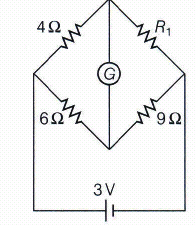
For balanced Wheatstone bridge, there will be no deflection in the galvanometer
\(\frac { 4 }{ { R }_{ 1 } } =\frac { 6 }{ 9 } \Rightarrow { R }_{ 1 }=\frac { 4\times 9 }{ 6 } =6\Omega \)
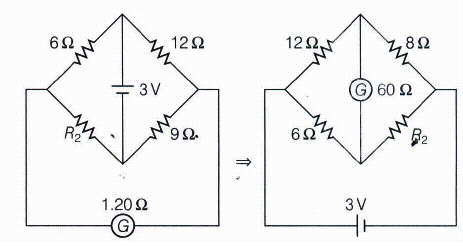
For the equivalent circuit, when the Wheatstone bridge is balanced, there will be no deflection in the galvanometer
\(\therefore \frac { 12 }{ 8 } =\frac { 6 }{ { R }_{ 2 } } \Rightarrow { R }_{ 2 }=\frac { 6\times 8 }{ 12 } =4\Omega \\ \therefore \frac { { R }_{ 1 } }{ { R }_{ 2 } } =\frac { 6 }{ 4 } =\frac { 3 }{ 2 } \)
16.
Force on charge at x = 2 cm due to charge at x = 0 m and x = 4 cm are equal and opposite. They cancel.
Net force on charge at x = 2 cm is resultant of repulsive forces due to two charges at x = 8 cm and x = 16 cm.
\(F={q\times q\over 4\pi\epsilon_o}\times[{1\over(0.08-0.02)^2}+{1\over (0.16-0.02)^2}]\)
\(F={9\times10^9(20\times10^{-6})^2}{[{1\over (0.06)^2}+{1\over (0.14)^2}]}\)
\(F=1.2\times 10^3N\)
17.
(c)
Semiconductor
18.
(c)
along abc if I is constant
19.
(c)
greater than that of eyepiece
20.
(b)
paramagnetic substances.
21.
(a)
25 x 10-7 N towards wire.
22.
(b)
mg/e
23.
(c)
f = R/2
24.
(a)
0.43 ms -1
25.
(a)
convex, 9 cm
26.
(d)
None of the above
27.
(b)
\(\oint _{ s }^{ }{ \overrightarrow { E } .\overrightarrow { ds } } = 0\) if the charge is outside the surface
28.
(c)
\(7.7{ Am }^{ 2 }\)
29.
(i) (a): \(m=\frac{f_{o}}{f_{e}}=7\)
\(f_{o}=7 f_{e}\)
In normal adjustment, distance between the lenses
\(f_{o}+f_{e}=40 \)
\(7 f_{0}+f_{e}=40 \Rightarrow f_{e}=\frac{40}{8}=5 \mathrm{~cm} \)
\(f_{o}=7 f_{e}=7 \times 5=35 \mathrm{~cm}\)
(ii) (d): \(m=-10 ; L=22 \mathrm{~cm}\)
\(\text { As } m=\frac{-f_{o}}{f_{e}} \Rightarrow-10=-\frac{f_{o}}{f_{e}}\)
\(f_{o}=10 f_{\mathrm{e}} \)
\(\text { As } L=f_{o}+f_{e} \)
\(22=10 f_{e}+f_{e}=11 f_{e} \)
\(\text { or } f_{e}=\frac{22}{11}=2 \mathrm{~cm}\)
\(f_{o}=10 f_{e}=20 \mathrm{~cm}\)
(iii) (d): Objective lens has larger focal length than eye-piece.
(iv) (d): Astronomial telescope is used to see stars, sun etc.
(v) (c) :f0>>fe
30.
(i) (a): As, \(q E=m g \Rightarrow q=\frac{1.08 \times 10^{-14} \times 9.8}{1.68 \times 10^{5}}\)
\(=6.4 \times 10^{-19} \mathrm{C}\)
(ii) (a): \(q=n e \text { or } \Rightarrow n=\frac{6.4 \times 10^{-19}}{1.6 \times 10^{-19}}=4\)
(iii) (c) : For the drop to be stationary,
Force on the drop due to electric field = Weight of the drop
qE=mg
\(q=\frac{m g}{E}=\frac{1.6 \times 10^{-6} \times 10}{100}=1.6 \times 10^{-7} \mathrm{C}\)
Number of electrons carried by the drop is
\(n=\frac{q}{e}=\frac{1.6 \times 10^{-7} \mathrm{C}}{1.6 \times 10^{-19} \mathrm{C}}=10^{12}\)
(iv) (c)
(v) (d): Millikan's experiment confirmed that the charges are quantized, i.e., charges are small integer multiples of the base value which is charge on electron. The charges on the drops are found to be multiple of 4. Hence, the quanta of charge is 4 \(\mu \)C.
31.
(b) Both Assertion and Reason are true but Reason is not the correct explanation of Assertion.
32.
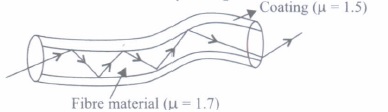
(c): Optical fiber is extremely thin (radius of few microns) and long strand of very fine quality glass or quartz. When light is incident at a small angle at one end, it gets refracted into the strands (or fibres) and incident on the interface of the fibres and the coating. The angle of incidence being greater than the critical angle, the ray of light undergoes total internal reflections. It suffers the internal reflection again and again, till the angle of incidence remains greater than the critical angle for fibre material with respect to coating. Due to successive total internal reflection there is no loss of intensity in optical fibres.
33.
(b): The wires are parallel to each other but the direction of current in it is in same direction so they attract each other. If the current in the wires is in opposite direction then wires repel each other. When the currents are in opposite directions, the magnetic forces are reversed and the wires repels each other
34.
(a): Inside the charged metallic sphere every point is at the same electric potential, hence \(W=q \Delta V=0\). But outside the sphere, there exists a potential gradient at every point, hence \(\dot{W} \neq 0\).

12th Standard CBSE Syllabus & Materials
12th Standard CBSE
CBSE 12th Computer Science Python Revision Tour I - New Previous year Question Papers Study Material - QB365 Set A
NEW12th Standard CBSE
CBSE 12th Business Studies Planning Important Questions And Answers Study Material - QB365 Set A
NEW12th Standard CBSE
CBSE 12th Business Studies Business Environment Important Questions And Answers Study Material - QB365 Set A
NEW12th Standard CBSE
CBSE 12th Business Studies Principles of Management Important Questions And Answers Study Material - QB365 Set A



NCERT Books

Syllabus

Exam Pattern

Sample Question Papers

Previous year Question Papers

Important Notes

MCQ Practice test

NCERT Exemplers

Case study Questions

Image Based Questions

Passage based Questions

HOT Questions

Value Based Questions

Model Questions Papers
NCERT ( Book Back ) Questions

Assertion and Reason
Important Questions And Answers

CBSE 12th Standard CBSE Subjects
CBSE Standards








