
 100% FREE ACCESS
12th Standard CBSE Syllabus & Materials
12th Standard CBSE
CBSE 12th Economics Government Budget and the Economy Previous year Question Papers Study Material - QB365 Set A
NEW12th Standard CBSE
CBSE 12th Computer Science Interface Python with MySQL - New Previous year Question Papers Study Material - QB365 Set A
NEW12th Standard CBSE
CBSE 12th Computer Science Database Concept - New Previous year Question Papers Study Material - QB365 Set A
NEW12th Standard CBSE
CBSE 12th Computer Science Data Communication - New Previous year Question Papers Study Material - QB365 Set A
NEW12th Standard CBSE
CBSE 12th Computer Science Data Structures - New Previous year Question Papers Study Material - QB365 Set A
NEW12th Standard CBSE
CBSE 12th Computer Science Functions - New Previous year Question Papers Study Material - QB365 Set A

Published on: 25/10/2025
Download CBSE Class 12th Standard CBSE Physics question papers, sample papers, important questions, and previous year solved papers in PDF format. Get free study materials, NCERT solutions, and exam preparation resources for Class 12th Standard CBSE Physics
Questions + Answers key
Take MCQ Physics Test
1.
Careful measurement of the electric field at the surface of a black box indicates that the net outward flux through the surface of the box is 8.0 × 10³ Nm2/C.
(a) What is the net charge inside the box?
(b) If the net outward flux through the surface of the box were zero, could you conclude that there were no charges inside the box? Why or Why not?
2.
A parallel combination of three resistors take a current of 7.5 A from a 30 V supply. If the two resistors are \(10 \ \Omega\) and \(12 \ \Omega\), find the third one.
3.
Can two balls having same kind of charge on them attract each other? Explain.
4.
Define electric field intensity. Write its SI unit. Write the magnitude and direction of electric field intensity due to an electric dipole of length 2a at the mid-point of the line joining the two charges.
5.
The storage battery of a car has an emf of 12 V. If the internal resistance of the battery is 0.4\(\Omega \), what is the maximum current that can be drawn from the battery?
6.
How much is the dipole moment of non-polar molecule?
7.
(a) Define electric flux. Write its SI units.
(b) Using Gauss's law, prove that the electric field at a point due to a uniformly charged infinite plane sheet is independent of the distance from it.
(c) How is the field directed if
(i) the sheet is positively charged,
(ii) negatively charged?
8.
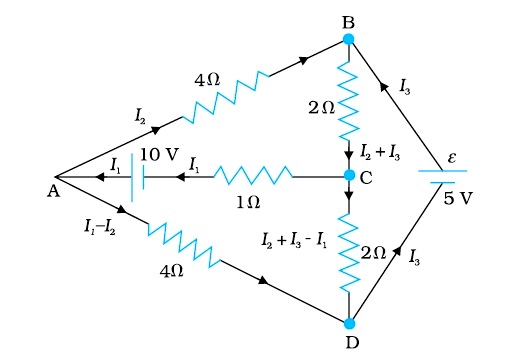
Determine the current in each branch of the network shown in Figure.
9.
Two large metal plates each of area 1m2 are placed facing each other at a distance of 5cm and carry equal and opposite charges on their faces. If the electric field between the plates is 1000 NC-1, find the charge on each plate.
10.
Three point charges, each of charge q are placed on vertices of a triangle ABC, with AB= AC = 5L, BC = 6L. The electrostatic potential at midpoint of side BC will be
\(\frac{11}{48} \frac{q}{\pi \varepsilon_0 L}\)
\(\frac{8 q}{36 \pi \varepsilon_0 L}\)
\(\frac{5 q}{24 \pi \varepsilon_0 L}\)
\(\frac{1}{16} \frac{q}{\pi \varepsilon_0 L}\)
11.
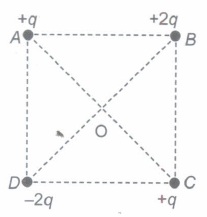
Four charges are arranged at the comers of a square ABCD, as shown. The force on the charge kept at the centre O is
zero
along the diagonal AC
along the diagonal BD
perpendicular to side AB
12.
The resistance of a 10 m long wire is 10Ω. Its length is increased by 25%by stretching the wire uniformly. The resistance of wire will change to
12.5 Ω
14.5 Ω
15.6 Ω
16.6 Ω
13.
The length of a conductor is halved. Its conductance will be:
halved
unchanged
doubled
quadrupled
14.
The nuclear charge(Ze) is non-uniformly distributed within a nucleus of radius R. The charge density p(r) [charge per unit volumne is dependent only on the radial distance r from the centre of the nucleus as shown in figure.The electric field is only along the radial direction.
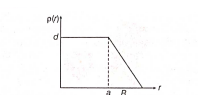
(i) The electric field at r= R is
(a) independent of a
(b) directly proportional to a
(c) directly proportional to \(a^2\)
(d) inversely proportional to a
(ii) Net charge on given system is
\(\text { (a) } Q=\int \rho_r\left(4 \pi r^2\right) d r\)
\(\text { (b) } Q=\int \rho_r\left(\pi r^2\right) d r\)
\(\text { (c) } Q=\int \rho_r \frac{r^2}{2} d r\)
\(\text { (d) } Q=\int \rho_r\left(4 \pi r^2\right)\)
(iii) For a =0, the value d (maximum value ofp as shown in the figure) is
\(\text { (a) } \frac{3 Z e^2}{4 \pi R^3}\)
\(\text { (b) } \frac{3 Z e}{\pi R^3}\)
\(\text { (c) } \frac{4 Z e}{3 \pi R^3}\)
\(\text { (d) } \frac{Z}{3 \pi R^3}\)
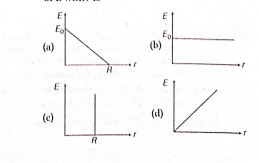
(iv) The correct graph representing the variation of E with r is
(v) The electricfield within the nucleus is generally observed to be linearly dependent on r. This implies
(a) a =0
\(\text { (b) } a=\frac{R}{2}\)
(c) a= R
\(\text { (d) } a=\frac{2 R}{3}\)
15.
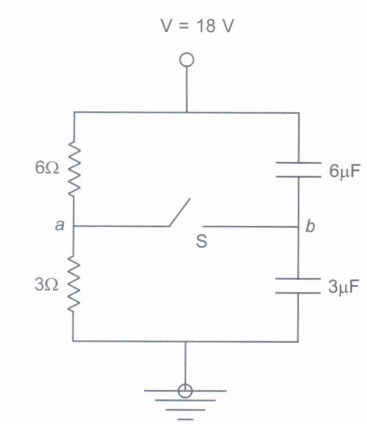
(i) What is the potential difference between points a and b when switch S is open?
(ii) What are the potentials at points a and b when switch is closed?
(iii) How much charge will flow through capacitor of capacitance 6 IlF as soon as the switch S is closed?
16.
Electrostatic potential energy of a system of point charges is defined as the total amount of work done in bringing the different charges to their respective positions from infinitely charge mutual separations. The work is stored in the system of two point charges in the form of electrostatic potential energy U of the system. Electric potential difference between any points A and B in an electric field is the amount of work done in moving a unit positive test charge from A to B along any path agents the electrostatic force
\(V_{B}-V_{A}=\frac{W_{A B}}{q_{0}}=\int \mid \vec{E} \cdot d l\)
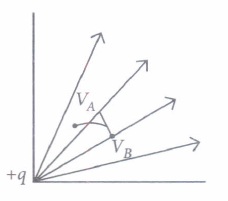
(i) A test charge is moved from lower potential point to a higher potential point. The potential energy of test charge will
| (a) remain the same | (b) increase |
| (c) decrease | (d) become zero |
(ii) Which of the following statement is not true?
| (a) Electrostatic force is a conservative force. |
| (b) Potential energy of charge q at a point is the work done per unit charge in bringing a charge from any point to infinity |
| (c) Spring force and gravitational force are conservative force. |
| (d) Both (a) and (c). |
(iii) Work done in moving a charge from one point to another inside a uniformly charged conducting sphere is
| (a) always zero | (b) non-zero | (c) maybe zero | (d) none of these |
(iv) The work done in bringing a unit positive charge from infinite distance to a point at distance x from a positive charge Q is W. Then the potential \(\phi\) at that point is
| \(\text { (a) } \frac{W Q}{x}\) | (b) W | \(\text { (c) } \frac{W}{x}\) | (d) WQ |
(v) If \(1 \mu C\) charge is shifted from A to B and it is found that work done by an external force is \(40 \mu \mathrm{J}\). In doing so against electrostatics force, the potential difference VA- VB is
| (a) 40 V | (b) -40 V | (c) 20 V | (d) -60 V |
17.
18.
Assertion : A deuteron and an alpha-particle are placed in an electric field. If F1 and F2 be the forces acting on them and a1 and a2 be their accelerations respectively then, a1 = a2.
Reason : Forces will be same in electric field.
Codes:
(a) Both Assertion and Reason are correct and the Reason is a correct explanation of the Assertion.
(b) Both Assertion and Reason are correct but Reason is not a correct explanation of the Assertion.
(c) Assertion is correct, Reason is incorrect
(d) Both Assertion and Reason are correct.
1.
Net outward flux through the surface of the box, Φ = 8.0 × 10³ N m2/C
For a body containing net charge q, flux is given by the relation,
\(\phi=\frac{q}{\epsilon_{0}}\)
∈0 = Permittivity of free space
= 8.854 × 10⁻¹² N−1C2 m−2
q = ∈0Φ
= 8.854 × 10−12 × 8.0 × 103
= 7.08 × 10−8
= 0.07 μC
Therefore, the net charge inside the box is 0.07 μC.
(b) No
Net flux piercing out through a body depends on the net charge contained in the body. If net flux is zero, then it can be inferred that net charge inside the body is zero. The body may have equal amount of positive and negative charges.
2.
Rp = 30 / 7.5 = \(4 \ \Omega\)
\(\frac{1}{R_p}=\frac{1}{R_1}+\frac{1}{R_2}+\frac{1}{R_3}\)
or \(\frac{1}{4}=\frac{1}{10}+\frac{1}{12}+\frac{1}{R_3}\)
or \(\frac{1}{R_3}=\frac{1}{4}-(\frac{1}{10}+\frac{1}{12})=\frac{4}{60}=\frac{1}{15}\)
or R3 = \(15 \ \Omega\)
3.
Yes, two balls having same kind of charge can attract each other if charge possessed by one ball is very large as compared to that on the other ball because when two charged balls are placed near each other, they induced opposite charges on the faces of each other. On the ball having small amount of charge, very large amount of induced charge is produced, two balls get attracted towards each other.
4.
Electric field intensity at a point is the electric force experienced by a unit positive charge placed at the point.
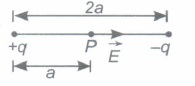
Its SI unit is NC-1 or Vm-1.
\(E_{P}=\frac{1}{4 \pi \varepsilon_{0}}\left(\frac{2 q}{a^{2}}\right) \Rightarrow \vec{E}_{P}=-\frac{\vec{p}}{4 \pi \varepsilon_{0} a^{3}}\)
It is in the direction opposite to the direction of dipole moment (i.e. from + ve to -ve charge).
5.
Emf of the battery, E = 12 V
Internal resistance of the battery, r = 0.4 Ω
Maximum current drawn from the battery = I
According to Ohm’s law,
E = Ir
\(I=\frac{E}{r}\)
\(=\frac{12}{0.4}=30 A\)
The maximum current drawn from the given battery is 30 A.
6.
Zero
7.
(a) Electric flux through an area is the product of magnitude of area and the component of electric field vector normal to it.
\(\phi_{\mathrm{E}}=\Delta S(E \cos \theta)=\vec{E} \cdot \Delta \vec{S}\)
Its SI unit is NC-1 m2
(b) Electric field intensity due to a thin infinite plane sheet charge: Consider a thin infinite sheet of charge with uniform surface charge density a. To calculate electric field at a point P distant r from the sheet we imagine a symmetrical Gaussian surface in such a way that the point charge lies on it. Here we assume a cylinder of cross-sectional area A and length 2r with its axis perpendicular to the sheet.
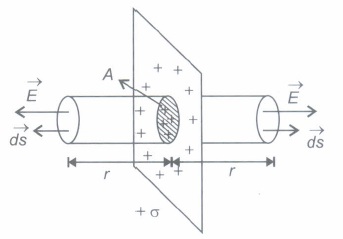
Flux through the curved surface of the cylinder,
\(\phi_{1}=\int \vec{E} \cdot \overrightarrow{d s}=0 \left(\because \theta=90^{\circ}\right)\)
Total flux through plane faces of the cylinder,
\(\phi_{2}=2 \int \vec{E} \cdot \overrightarrow{d s}=2 E A \left(\because \theta=0^{\circ}\right)\)
Net flux through the Gaussian surface is
\(\phi=\phi_{1}+\phi_{2}=2 E A\)
Net charge enclosed by the Gaussian surface is
\(Q=\sigma A\)
According to the Gauss's theorem, \(\phi=\frac{Q}{\varepsilon_{0}}\)
\(\therefore \phi=\frac{\sigma A}{\varepsilon_{0}}\)
From equations (i) and (ii), we get
\(2 E A=\frac{\sigma A}{\varepsilon_{0}} \Rightarrow E=\frac{\sigma}{2 \varepsilon_{0}}\)
(c) For positively charged sheet, the electric field is directed away from the sheet.
For negatively charged sheet, the electric field is directed towards the plane sheet.
8.
Each branch of the network is assigned an unknown current to be determined by the application of Kirchhoff’s rules. To reduce the number of unknowns at the outset, the first rule of Kirchhoff is used at every junction to assign the unknown current in each branch. We then have three unknowns I1, I2 and I3 which can be found by applying the second rule of Kirchhoff to three different closed loops. Kirchhoff’s second rule for the closed loop ADCA gives,
10 - 4(I1 - I2) + 2(I2 + I3 - I1) - I1 = 0
that is, 7I1 - 6I2 - 2I3 = 10
For the closed loop ABCA, we get
10 - 4I2 - 2 (I2 + I3) - I1 = 0
that is, I1 + 6I2 + 2I3 = 10
For the closed loop BCDEB, we get
5 - 2 (I2 + I3) - 2 (I2 + I3 - I1) = 0
that is, 2I1 - 4I2 - 4I3 = -5
Equations (3.61 a, b, c) are three simultaneous equations in three unknowns. These can be solved by the usual method to give
\(I_1=2.5 \mathrm{~A}, \quad I_2=\frac{5}{8} \mathrm{~A}, \quad I_3=1 \frac{7}{8} \quad \mathrm{~A}\)
The currents in the various branches of the network are
\(\mathrm{AB}: \frac{5}{8} \mathrm{~A}, \quad \mathrm{CA}: 2 \frac{1}{2} \mathrm{~A}, \quad \mathrm{DEB}: 1 \frac{7}{8} \mathrm{~A}\)
\(\mathrm{AD}: 1 \frac{7}{8} \mathrm{~A}, \quad \mathrm{CD}: 0 \mathrm{~A}, \quad \mathrm{BC}: 2 \frac{1}{2} \mathrm{~A}\)
It is easily verified that Kirchhoff’s second rule applied to the remaining closed loops does not provide any additional independent equation, that is, the above values of currents satisfy the second rule for every closed loop of the network. For example, the total voltage drop over the closed loop BADEB
\(5 \mathrm{~V}+\left(\frac{5}{8} \times 4\right) \mathrm{V}-\left(\frac{15}{8} \times 4\right) \mathrm{V}\)
equal to zero, as required by Kirchhoff’s second rule.
9.
Here A = 1m2, d = 5 cm, q =?
E = 1000 NC-1
From \(E={\sigma\over\epsilon_o}={q/A\over \epsilon_o}\)
\(q=A\epsilon_oE=1\times (8.85\times 10^{-12})\times 1000\)
\(=8.85\times 10^{-9}C\)
10.
(a)
\(\frac{11}{48} \frac{q}{\pi \varepsilon_0 L}\)
11.
(c)
along the diagonal BD
12.
(c)
15.6 Ω
13.
(c)
doubled
14.
(i) a
(ii) a
(iii) b
(iv) d
(v) c
15.
(i)
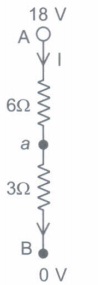
\(\because\) 6\(\Omega\) and 3\(\Omega\) are connected in series
Req = 6 + 3
= 9\(\Omega\)
\(\therefore \ \mathrm{I}=\frac{\mathrm{P} \cdot \mathrm{D} .}{\mathrm{R}_{e q}}\)
\(=\frac{18-0}{9}\)
= 2A
\(\therefore\) VA - Va = 6I
18 - 6 x 2 = V a
\(\therefore\) Va = 6V ..........(i)
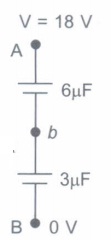
6\(\mu\)F and 3\(\mu\)F capacitors are in series.
\(\therefore \ C_{e q}=\frac{6 \times 3}{6+3}\)
= 2\(\mu\) F
\(\therefore\) Charge on 6\(\mu\)F = Charge on 3\(\mu\)F = Charge withdrawn
\(\therefore\) Q = Ceq x P.D.
= 2 x 10-6 x 18
= 36 x 10-6 C = 36 \(\mu\)F
\(\therefore\) Potential difference across 6\(\mu\)F is given by
\(18-\mathrm{V}_{b}=\frac{\mathrm{Q}}{6 \times 10^{-6}}\)
\(18-\frac{36 \times 10^{-6}}{6 \times 10^{-6}}=\mathrm{V}_{b}\)
\(\Rightarrow\)Vb = 12V
\(\therefore\) Vab = 12 - 6 = 6V
(ii) When switch S is closed then
\(\text { (P.D.) }_{6 \Omega}=\text { (P.D.) }_{6 \mu \mathrm{F}} \text { and }(\mathrm{P} . \mathrm{D} .)_{3 \Omega}=(\mathrm{P.D} .)_{3 \mu \mathrm{F}}\) as 6\(\Omega\) resistor and 6\(\mu\)F capacitor are in parallel and, 3\(\Omega\) resistor and 3\(\mu\)F capacitor are in parallel.
\(\therefore\) Va = Vb = 6V (using eq. (i) in part (a))
(iii) When switch is closed, P.D. across capacitor of capacitance 6\(\mu\)F is = 18 - 6 = 12V
\(\therefore\) Electric charge stored after closing S in it is
Q = CV = 6 x 10-6 x 12 = 72\(\mu\)C
\(\therefore\) Charge that will flow through capacitor and is equal to = 72 - 36 = 36\(\mu\)C.
16.
(i) (c)
(ii) (b)
(iii) (a): Since, E = 0 inside the conductor and has no tangential component on the surface, no work is done in moving a small test charge within the conductor and on its surface.
(iv) (b): The work done in bringing unit positive charge from infinity to a point which is at a distance x from the positive charge Q is defined as the potential at the given point due to the charge Q. Therefore
\(\phi=W\)
(v) (b): \(W_{\text {ext }}=q_{0} \Delta V\)
\(\left(W_{A B}\right)_{\mathrm{ext}}=q\left(V_{B}-V_{A}\right)\)
\(40 \mu \mathrm{J}=1 \mu \mathrm{C}\left(V_{B}-V_{A}\right)\)
\(V_{A}-V_{B}=-40 \mathrm{~V}\)
17.
18.
(c) Assertion is correct, Reason is incorrect.

12th Standard CBSE Syllabus & Materials
12th Standard CBSE
CBSE 12th Computer Science Python Revision Tour I - New Previous year Question Papers Study Material - QB365 Set A
NEW12th Standard CBSE
CBSE 12th Business Studies Planning Important Questions And Answers Study Material - QB365 Set A
NEW12th Standard CBSE
CBSE 12th Business Studies Business Environment Important Questions And Answers Study Material - QB365 Set A
NEW12th Standard CBSE
CBSE 12th Business Studies Principles of Management Important Questions And Answers Study Material - QB365 Set A



NCERT Books

Syllabus

Exam Pattern

Sample Question Papers

Previous year Question Papers

Important Notes

MCQ Practice test

NCERT Exemplers

Case study Questions

Image Based Questions

Passage based Questions

HOT Questions

Value Based Questions

Model Questions Papers
NCERT ( Book Back ) Questions

Assertion and Reason
Important Questions And Answers

CBSE 12th Standard CBSE Subjects
CBSE Standards








