
 100% FREE ACCESS
12th Standard CBSE Syllabus & Materials
12th Standard CBSE
CBSE 12th Economics Government Budget and the Economy Previous year Question Papers Study Material - QB365 Set A
NEW12th Standard CBSE
CBSE 12th Computer Science Interface Python with MySQL - New Previous year Question Papers Study Material - QB365 Set A
NEW12th Standard CBSE
CBSE 12th Computer Science Database Concept - New Previous year Question Papers Study Material - QB365 Set A
NEW12th Standard CBSE
CBSE 12th Computer Science Data Communication - New Previous year Question Papers Study Material - QB365 Set A
NEW12th Standard CBSE
CBSE 12th Computer Science Data Structures - New Previous year Question Papers Study Material - QB365 Set A
NEW12th Standard CBSE
CBSE 12th Computer Science Functions - New Previous year Question Papers Study Material - QB365 Set A

Published on: 25/10/2025
Download CBSE Class 12th Standard CBSE Physics question papers, sample papers, important questions, and previous year solved papers in PDF format. Get free study materials, NCERT solutions, and exam preparation resources for Class 12th Standard CBSE Physics
Questions + Answers key
Take MCQ Physics Test
1.
Two point charges 4\(\mu\)C and + 1 \(\mu\)C areseparated by a distance of 2 m in air. Find the point on the line joining charges at which the net electric field of the system is zero.
2.
Define electric flux. Write its SI unit. Gauss' law in electrostatics is true for any closed surface, no matter what its shape or size is. Justify this statement with the help of a suitable example.
Use Gauss' law to prove that the electric field inside a uniformly charged spherical shell is zero.
3.
Define the term resistivity and write its S.I. unit. Derive the expression for the resistivity in terms of number density of free electrons and relaxation time.
4.
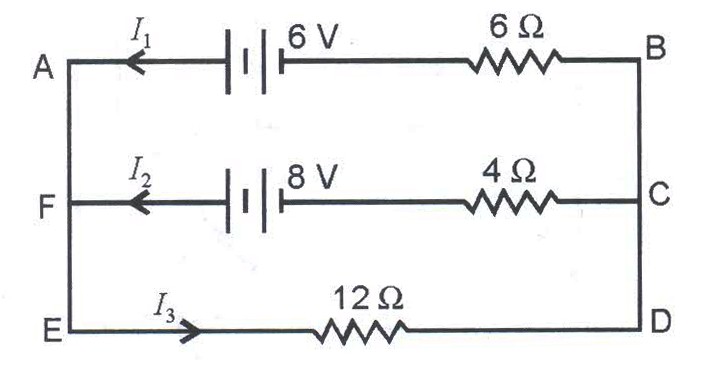
In the network shown here find the following:
(a) Current I1, I2 and I3
(b)Terminal potential difference of each battery.
Consider 6\(\Omega\) to be the internal resistance of 6V battery and 4\(\Omega\)to be internal resistance of 8V battery
5.
Why can a Gaussian surface not pass through any discrete charge?
6.
Ordinary rubber is an insulator. But the special rubber tyres of aircrafts are made slightly conducting. Why is this necessary?
7.
Two insulated charged copper spheres A and B of identical size have charges qA and qB respectively. A third sphere C of the same size but uncharged is brought in contact with the first and then in contact with the second and finally removed from both. What are the new charges on A and B?
8.
A battery of emf E and internal resistance, r, when connected an external resistance of 12 n produces a current of 0.5 A. When connected across a resistance of 25Ω, it produces a current of 0.25 A. Determine (i) the emf and (ii) the internal resistance of the cell.
9.
The circular arc is shown in the figure given below, has a uniform charge per unit length of 1 x 10⁻⁸C/m. Find the potential at the centre O of the arc.

10.
Two +ve charge of 0.2\(\mu C\) and 0.01\(\mu C\) are placed 10cm apart.Calculate the work done if reducing the distance to 5cm.
11.
Two point charges \(+4\mu C\) and \(-6\mu C\) are separated by a distance of 20cm in air. At what point on the line joining the two charges is the electric potential zero?
12.
An electric dipole is held in a uniform electric field.
(i) Using suitable diagram, show that it does not undergo any translatory motion, and
(ii) derive an expression for the torque acting on it and specify its direction.
13.
An electric dipole with dipole moment 4 × 10⁻⁹ C m is aligned at 30° with the direction of a uniform electric field of magnitude 5 × 10⁴ N/C. Calculate the magnitude of the torque acting on the dipole.
14.
Two capacitors of \(2\mu F \ and \ 3\mu F\) are joined in series. The outer plate of the first capacitor is at 100 V and outer plate of second capacitor is earthed. Find out the potential and charge of the inner plate of each capacitor.
15.
The potential difference across the terminals of a battery is 9.0 V, when a current of 3.5 A flows through it from its negative terminal to the positive terminal. When a current of 2 A flows through it in the opposite direction, the terminal potential difference is 12 V. Find the internal resistance and emf of the battery.
16.
Estimate the average drift speed of conduction electrons in a copper wire of cross-sectional area 2.5 x 10⁻⁷ m2 carrying a current of 2.7 A. assume the density of conduction electrons to be 9 x 1028 m-3.
17.
The number density of free electrons in a copper conductor estimated is \(8.5\times { 10 }^{ 28 }{ m }^{ -3 }\). How long does an electron take in drifting from one end of a wire 3.0m long to its other end? The area of cross-section of the wire is \(2.0\times { 10 }^{ -6 }{ m }^{ 2 }\) and it is carrying a current of 3.0 A.
18.
Check that the ratio ke2/Gmemp is dimensionless. Look up a table of physical constants and determine the value of this ratio. What does the ratio signify?
19.
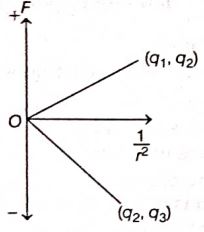
The Coulomb force (F) versus (1/r2) graphs for two pairs of point charges (q1 and q2) and (q2 and q3) are shown in figure. The charge q2 is positive and has least magnitude, then
q1 > q2 > q3
q1 > q3 > q2
q3 > q2 > q1
q3 > q1 > q2
20.
Temperature dependence of resistivity p(T) of semiconductors, insulators and metals is significantly based on the following factors:
number of charge carriers can change with temperature T
time interval between two successive collisions is independent on T.
length of material can be a function of T.
mass of carriers is a function of T
21.
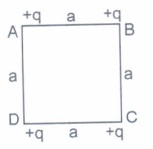
Four equal charges q are placed at the four corners A, B, C, D of a square of length a. The magnitude of the force on the charge at B will be
\(\frac{3 q^{2}}{4 \pi \varepsilon_{0} a^{2}}\)
\(\frac{4 q^{2}}{4 \pi \varepsilon_{0} a^{2}}\)
\(\frac{(1+2 \sqrt{2}) q^{2}}{2 \times 4 \pi \varepsilon_{0} a^{2}}\)
\(\frac{\left(\frac{2+1}{\sqrt{2}}\right)^{q^{2}}}{4 \pi \varepsilon_{0} a^{2}}\)
22.
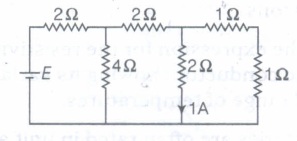
The emf of the battery shown in figure is
12 V
13 V
16 V
18 V
23.
2 mA current is flowing in the wire of potentiometer of 5m long and 5 Ω resistance. The potential gradient is
2 x 10⁻³ V/m
2.5 x 10⁻² V/m
1.6 x 10⁻³ V/m
2.3 x 10⁻³ V/m
24.
The resistance of a 10 m long wire is 10Ω. Its length is increased by 25%by stretching the wire uniformly. The resistance of wire will change to
12.5 Ω
14.5 Ω
15.6 Ω
16.6 Ω
25.
In an electric field E, the torque acting on a dipole moment p is
p·E
p x E
zero
E x p
26.
If the air between two electric charges is replaced by a medium of dielectric constant K, then the force between them
increase K times
becomes zero
decrease K times
None
27.
A drop of oil density ρ and radius r carries a charge q when placed in an electric field E, it moves upwards with a velocity v.
If ρ0 is the density of air, η be the viscosity the air, then which of the following forces is dire ed upwards?
6πηrv
qE
4/3 πr2(ρ-ρ0)rvg
None of these
28.
According to Ohm's law, the current flowing through a conductor is directly proportional to the potential difference across the ends of the conductor i.e \(I \propto V \Rightarrow \frac{V}{I}=R\) where R is resistance of the conductor Electrical resistance of a conductor is the obstruction posed by the conductor to the flow of electric current through it. It depends upon length, area of cross-section, nature of material and temperature of the conductor We can write \(R \propto \frac{l}{A} \text { or } R=\rho \frac{l}{A}\) where \(\rho\) is electrical resistivity of the material of the conductor.
(i) Dimensions of electric resistance is
| \(\text { (a) }\left[\mathrm{ML}^{2} \mathrm{~T}^{-2} \mathrm{~A}^{-2}\right]\) | \(\text { (b) }\left[M L^{2} T^{-3} A^{-2}\right]\) | \(\text { (c) }\left[\mathrm{M}^{-1} \mathrm{~L}^{-2} \mathrm{~T}^{-1} \mathrm{~A}\right]\) | \(\text { (d) }\left[M^{-1} L^{2} T^{2} A^{-1}\right]\) |
(ii) If \(1 \mu \mathrm{A}\) current flows through a conductor when potential difference of2 volt is applied across its ends, then the resistance of the conductor is
| \(\text { (a) } 2 \times 10^{6} \Omega\) | \(\text { (b) } 3 \times 10^{5} \Omega\) | \(\text { (c) } 1.5 \times 10^{5} \Omega\) | \(\text { (d) } 5 \times 10^{7} \Omega\) |
(iii) Specific resistance of a wire depends upon
| (a) length | (b) cross-sectional area | (c) mass | (d) none of these |
(iv) The slope of the graph between potential difference and current through a conductor is
| (a) a straight line | (b) curve |
| (c) first curve then straight line | (d) first straight line then curve |
(v) The resistivity of the material of a wire 1.0 m long, 0.4 mm in diameter and having a resistance of 2.0 ohm is
| \(\text { (a) } 1.57 \times 10^{-6} \Omega \mathrm{m}\) | \(\text { (b) } 5.25 \times 10^{-7} \Omega \mathrm{m}\) | \(\text { (c) } 7.12 \times 10^{-5} \Omega \mathrm{m}\) | \(\text { (d) } 2.55 \times 10^{-7} \Omega \mathrm{m}\) |
29.
Coulomb's law states that the electrostatic force of attraction or repulsion acting between two stationary point charges is given by
\(F=\frac{1}{4 \pi \varepsilon_{0}} \frac{q_{1} q_{2}}{r^{2}}\)
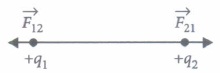
where F denotes the force between two charges q1 and q2 separated by a distance r in free space, Eo is a constant known as permittivity of free space. Free space is vacuum and may be taken to be air practically.
If free space is replaced by a medium, then Eo is replaced by (Eok) or (EoEr)where k is known as dielectric constant or relative permittivity.
(i) In coulomb's law, F = \(k \frac{q_{1} q_{2}}{r^{2}}\), then on which of the following factors does the proportionality constant k depends?
| (a) Electrostatic force acting between the two charges |
| (b) Nature of the medium between the two charges |
| (c) Magnitude of the two charges |
| (d) Distance between the two charges |
(ii) Dimensional formula for the permittivity constant Eo of free space is
| \(\text { (a) }\left[\mathrm{ML}^{-3} \mathrm{~T}^{4} \mathrm{~A}^{2}\right]\) | \(\text { (b) }\left[M^{-1} L^{3} T^{2} A^{2}\right]\) |
| \(\text { (c) }\left[\mathrm{M}^{-1} \mathrm{~L}^{-3} \mathrm{~T}^{4} \mathrm{~A}^{2}\right]\) | \(\text { (d) }\left[M L^{-3} T^{4} A^{-2}\right]\) |
(iii) The force of repulsion between two charges of 1 C each, kept 1 m apart in vaccum is
| \(\text { (a) } \frac{1}{9 \times 10^{9}} \mathrm{~N}\) | \(\text { (b) }\left[M^{-1} L^{3} T^{2} A^{2}\right]\) |
| \(\text { (c) } 9 \times 10^{7} \mathrm{~N}\) | \(\text { (d) } \frac{1}{9 \times 10^{12}} \mathrm{~N}\) |
(iv) Two identical charges repel each other with a force equal to 10 mgwt when they are 0.6 m apart in air. (g = 10 ms-2). The value of each charge is
| (a) 2 mC | (b) 2 x10⁻⁷ mC | (c) 2 nC | (d) 2\(\mu \)C |
(v) Coulomb's law for the force between electric charges most closely resembles with
| (a) law of conservation of energy | (b) Newton's law of gravitation |
| (c) Newton's 2nd law of motion | (d) law of conservation of charge |
1.
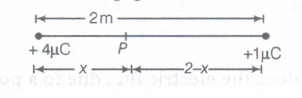
Let the net electric field be zero at point P at a distance x from charge +4\(\mu\)C, then
\(\frac{1}{4 \pi \varepsilon_{0}} \frac{4 \times 10^{-6}}{x^{2}}-\frac{1 \times 10^{-6} \times 1}{4 \pi \varepsilon_{0} \times(2-x)^{2}}=0\)
\(\Rightarrow \ \frac{4}{x^{2}}=\frac{1}{(2-x)^{2}}\)
\(\Rightarrow \ \frac{2}{x}=\frac{1}{2-x}\)
\(\Rightarrow\) x = 4-2x
\(\Rightarrow \ x=\frac{4}{3} \mathrm{~m}\)
2.
E lectric flux over an area in an electric field represents the total number of electric field lines crossing the area. The SI unit of electric flux is Nm2C-1.
According to Gauss' law in electrostatics, the surface integral of electrostatic field E produced by any sources over any dosed surface S enclosing a volume V in vacuum, i.e. total electric flux over the closed surface S in vacuum, is 1/ Eo times the total charge (q) contained inside S, i.e.
\({ \phi }_{ E }=\underset { S }{ \oint } E.dS={ {q }\over{ { \epsilon}_{ 0} } }\)
Gauss' law in electrostatics is true for an closed surface, no matter what its shape or size is.
So in order to justify the above statement, suppose in isolated positive charge q is situated at the centre O of a sphere of radius r. According to Coulomb's law, electric field intensity at any point P on the surface of the sphere is
E = \({ { q }\over{ 4\pi{\epsilon}_{0} } }{ { \hat{r} }\over{ {r}^{2} } }\)
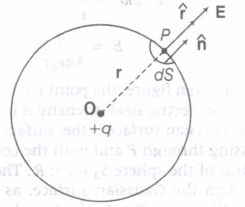
where, \(\hat{r}\) is unit vector directed from O to P. Consider a small area element dS of the sphere around P. Let it be represented by the vector \(dS+\hat{r}.dS.\)
where, n is unit vector along out drawn normal to the area element.
\(\therefore\) Electric flux over the area element.
\(d{\phi}_{E}=E.dS\)
= \(\left({ {q }\over{ 4\pi{\epsilon}_{0} } }.{ {\hat{r} }\over{ {r}^{2} } } \right).(\hat{n}.dS)\)
E.dS = \({ { q }\over{ 4\pi{\epsilon}_{0} } }.{{dS}\over{{r}^{2}}}.\hat{r}.\hat{n}\)
As normal to a surface of every point is along the radius vector at that point, therefore, \(\hat{r}.\hat{n}=1\)
E.dS = \({ { q}\over{ 4\pi{\epsilon}_{0}} }.{ {dS }\over{{r}^{2} } }\)
Integrating over the closed surface area of the sphere, we get total normal electric flux over the entire sphere,
\({\phi}_{E}\underset{S}{\oint}E.dS={{q}\over{4\pi{\epsilon}_{0}{r}^{2}}}\underset{S}{\oint}dS={{q}\over{4\pi{\epsilon}_{0}{r}^{2}}}\times total\ area\)
or surface of sphere.= \({{q}\over{4\pi{\epsilon}_{0}{r}^{2}}}(4\pi{r}^{2})\)
= \({{q}\over{{\epsilon}_{0}}}\)
Hence, \(\oint_{S}E.dS={{q}\over{{\epsilon}_{0}}},\) which proves Gauss' theorem.
Electric field inside a uniformly charged spherical shell.
According to Gauss' theorem
\(\oint_{S}E.dS=\oint_{S}E\ \hat{n}.dS={{q}\over{{\epsilon}_{0}}}\)
or \(E\oint_{s}{dS}={{q}\over{{\epsilon}_{0}}}\)
\(\therefore\) \(E.2\pi{r}^{2}={{q}\over{{\epsilon}_{0}}}\)
\(\Rightarrow\) E = \({{q}\over{4\pi{\epsilon}_{0}}{r}^{2}}\) ...(i)
In the given figure, the point P where we have to find the electric field intensity is inside the shell. The Gaussian surface is the surface of a sphere S2 passing through P and with the centre at O. The radius of the sphere S2 is
r < R. The electric flux through the Gaussian surface, as calculated in Eq. (i), i.e. E X \(4\pi {r}^{2}\). As, charge inside a spherical shell is zero, the Gaussian surface encloses no charge. The Gauss' theorem gives
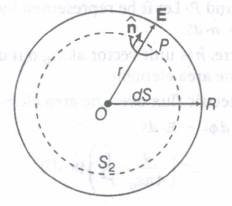
\(E\times4\pi\ {r}^{2}={{q}\over{{\epsilon}_{0}}}=0\)
\(\therefore\) E = 0 for r < R .
Hence, the field due to a uniformly charged spherical shell is zero at all points inside the shell.
3.
Since drift velocity \({ v }_{ d }\) and current, I flowing in a conductor are related by the relation:
\({ v }_{ d }=\frac { I }{ neA } ......(1)\)
Also drift velocity in terms of average relaxation time τ is given by
\({ v }_{ d }=\frac { eE\tau }{ m } .....(2)\)
From (1) and (2), we have
\(\frac { eE\tau }{ m } =\frac { I }{ neA }\)
\( \\ or\quad \frac { E }{ I } =\frac { m }{ n{ e }^{ 2 }A\tau } \)
\(or\quad \frac { V }{ lI } =\frac { m }{ n{ e }^{ 2 }A\tau }\)
\(or\quad \frac { V }{ I } =\frac { ml }{ n{ e }^{ 2 }A\tau } .......(3)\)
The R.H.S. of Eq(3) is constant
\(\frac { V }{ I } = \ Constant\)
This is Ohm′s law
\((But \ \frac { V }{ I } =R,\ \)the resistance of the conductor)
So Equation (3) becomes
\(R=\frac { ml }{ n{ e }^{ 2 }A\tau }\)
\(But\quad R=\rho \frac { l }{ A } \)
\(\therefore \quad \rho \frac { l }{ A } =\frac { ml }{ n{ e }^{ 2 }A\tau }\)
\(\rho =\frac { m }{ n{ e }^{ 2 }A\tau } )\)
4.
I1 = 0
I2 = 1/2 A
I3 = 1/2 A
5.
Because the electric field due to a system of discrete charges is not defined at the location of any charge.
6.
During landing or take off, the tyres of aircrafts get charged due to the friction between tyres and ground. In case, the tyres are slightly conducting, the charge developed on the tyres will not stay on them and it finds its way to the earth.
7.
When sphere C is brought in contact with A, then charge on sphere C,
\(q_C=\frac{q_A+0}{2}=\frac{q_A}{2}\)
and new charge on sphere A,
\(q_A^{\prime}=\frac{q_A}{2}\)
When sphere C is brought in contact with B, then charge on sphere C,
\( q_C^{\prime}=\frac{q_C+q_B}{2}=\frac{\frac{q_A}{2}+q_B}{2} \\ =\frac{q_A+2 q_B}{4} \)
\(\therefore\) New charge on sphere B,
\(q_B^{\prime}=\frac{q_A+2 q_B}{4}\)
8.
\(R_2=12\Omega, I_2=0.5A\)
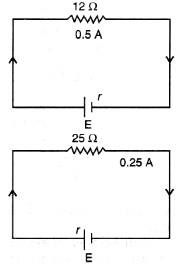
\(R_2=25\Omega, I_2=0.025A\)
\(E=I(R+r)\)
\(E=I_1(R_1+r)\)
\(\therefore\) \(E=0.5(12+r)\)
\(=6+.5r\)
\(E=I_2(R+r)\)
\(E=0.25(25+r)\)
\(=6.25+.25r\)
From eqns. (1) & (2)
\(6+0.5r=6.25+.25r\)
\(\Rightarrow\ \ \ \ 0.5r-0.25r=6.25-6.0r\)
\(\Rightarrow\ \ \ 0.25r=0.25\)
\(\Rightarrow \ \ \ \ r=1\Omega\)
\(E=6+0.5\times 1\)
\(E=6.5 \ V\)
9.
Potential at the centre,
\(V=\frac{1}{4 \pi \Sigma 0}\left(\frac{q}{r}\right)\)
\(=9 \times 10^{9} \times 10^{-8} \times \frac{60}{360} \times 2 \pi r\)
\(=9 \times 10^{+9} \times 10^{-8} \times \frac{2 \times 3.14 \times 2}{6}=188.4 \mathrm{~V}\)
10.
\(1.8\times 10^{-4}J\)
11.
Given: \(q_{1}=4 \mu \mathrm{C}=4 \times 10^{-6} \mathrm{C}\)
\(q_{2}=-6 \mu \mathrm{C}=-6 \times 10^{-6} \mathrm{C}, r=20 \mathrm{~cm}\)
Let the electric potential be zero at a point P, a distance x (in cm) from q1 Then
\(\frac{1}{4 \pi \varepsilon_{0}} \cdot \frac{q_{1}}{x}+\frac{1}{4 \pi \varepsilon_{0}} \frac{q_{2}}{(r-x)}=0\)
\( \therefore \frac{4}{x} =-\frac{(-6)}{(20-x)} \)
\(\Rightarrow 4(20-x=6 x \)
\(x =8 \mathrm{~cm}\)
i.e. 8 cm from 4 μC charge.
12.
\(
\text { (i) Force on }+q, \ \overrightarrow{F_{B}}=+q \vec{E}
\)
\( { Force on }-q, \ \overrightarrow{F_{A}}=-q \vec{E}
\)
As forces are equal in magnitude and opposite in direction, therefore, net force = 0.
Thus, no translatory motion.
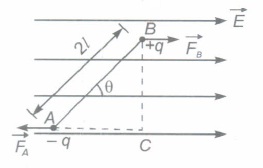
\(\text { (ii) } \tau=F \times\) perpendicular distance between \(\overrightarrow{F_{A}} \text { and }\overrightarrow{F_{B}}\)
\(\tau=F(2 l \sin \theta)=q E 2 l \sin \theta\)
\(\vec{\tau}=\vec{p} \times \vec{E}\) \((\because \vec{p}=q \overrightarrow{2 l})\)
13.
Given, p = 4 \(\times\)10-9 C-m, E = 5 \(\times\) 104,
\(\theta\) = 30°
\(\therefore\) \(\tau\) = pE sin \(\theta\)
= 4 \(\times\)10-9 \(\times\)5 \(\times\)104 \(\times\)sin 30°
\(=4\times 10^{-9}\times 5\times 10^{4}\times \frac{1}{2}\) [\(\because\)sin 30° =\(\frac{1}{2}\)]
= 10 \(\times\)10-5 = 10-4 N-m
14.
We find V1 = 600 Volt and V2 = 400 Volt. As outer plate of first capacitor is at 1000 volt, its inner plate must be at 1000 - 600 = 400 Volt
Further, as outer plate of second capacitor is earthed, i.e., at zero potential, therefore inner plate of second capacitor must be at
400 - 0 = 400 Volt
Charge on inner plate of each condenser q= \(C_1V_1=(2\times 10^{-6})\times 600=1.2\times 10^{-3}C\)
15.
When current flows through the battery from its negative to positive terminal, (i.e., current is drawn from battery) then
V = \(\epsilon - Ir \ \ or \ \ 9.0 = \epsilon - 3.5 r\) .....(i)
When current flows through the battery from its positive to negative terminal (i.e., battery is charged). then
\(V = \epsilon + Ir \ \ or \ \ 12 = \epsilon - 2r\) ........(ii)
On solving (i) and (ii), we get;
r = \(2 \ \Omega\) and \(\epsilon\) = 16 V
16.
vd = \(\frac{I}{nAe}\)
= \(\frac{2.7}{(9\times10^{28})\times(2.5\times10^{-7})\times(1.6\times10^{-19})}\)
= 0.75 x 10⁻³ ms-1
= 0.75 mms-1
17.
Number density of free electrons in a copper conductor, n = 8.5 x 1028 m-3 Length of the copper wire, l = 3.0 m
Area of cross-section of the wire, A = 2.0 x 10⁻⁶ m2
Current carried by the wire, I = 3.0 A, which is given by the relation,
I = nAeVd
Where,
e = Electric charge = 1.6 x 10⁻¹⁹ C
Vd = Drift velocity = \(\frac{\text { Length of the wire (l) }}{\text { Time taken to cover l(t) }}\)
\(I=n A e \frac{l}{t}\)
\(t=n A e \frac{l}{I}\)
\(=\frac{3 \times 8.5 \times 10^{28} \times 2 \times 10^{-6} \times 1.6 \times 10^{-19}}{3.0}\)
\(=2.7 \times 10^{4} s\)
Therefore, the time taken by an electron to drift from one end of the wire to the other is 2.7 x 10⁴ s.
18.
Since \({ F }_{ e }=-\frac { { ke }^{ 2 } }{ { r }^{ 2 } } \)
So \({ ke }^{ 2 }={ -F }_{ e }{ r }^{ 2 }\)
And \({ F }_{ G }=-G\frac { { m }_{ p }{ m }_{ e } }{ { r }^{ 2 } } \)
So \({ Gm }_{ p }{ m }_{ e }={ -F }_{ G }{ r }^{ 2 }\)
So dimensions of \(\frac { { ke }^{ 2 } }{ { Gm }_{ e }{ m }_{ p } } =\frac { { F }_{ e }{ r }^{ 2 } }{ { F }_{ G }{ r }^{ 2 } } =\frac { { F }_{ e } }{ { F }_{ G } } \)
\(=\frac { { [MLT }^{ -2 }] }{ { [MLT }^{ -2 }] } =[{ M }^{ 0 }{ L }^{ 0 }{ T }^{ 0 }]\)
= No dimensions
The value of \(\frac { { ke }^{ 2 } }{ { Gm }_{ e }{ m }_{ p } } \)
\(=\frac { 9\times { 10 }^{ 9 }\times (1.6\times { 10 }^{ -19 })^{ 2 } }{ 6.67\times { 10 }^{ -11 }(1.67\times { 10 }^{ -27 })(9.1\times { 10 }^{ -31 }) } \)
\(=2.9\times { 10 }^{ 39 }\)
From Eq. (1) and (2), we have
\(\left| \frac { { F }_{ e } }{ { F }_{ G } } \right| =\frac { { ke }^{ 2 } }{ { Gm }_{ p }{ m }_{ e } } =2.9\times { 10 }^{ 39 }\)
The ratio of the two forces shows that electrical forces are enormously stronger than the gravitational forces.
19.
(d)
q3 > q1 > q2
20.
(a)
number of charge carriers can change with temperature T
21.
(c)
\(\frac{(1+2 \sqrt{2}) q^{2}}{2 \times 4 \pi \varepsilon_{0} a^{2}}\)
22.
(b)
13 V
23.
(a)
2 x 10⁻³ V/m
24.
(c)
15.6 Ω
25.
(b)
p x E
26.
(c)
decrease K times
27.
(b)
qE
28.
(i) (b)
(ii) (a): \(R=\frac{V}{I}=\frac{2}{10^{-6}}=2 \times 10^{6} \Omega\)
(iii) (d): Specific resistance depends upon the nature of material and is independent of mass and dimensions of the material
(iv) (a)
(v) (d): l = 1.0 m; D = 0.4 mm = 4 x 10⁻⁴m
\(R=2 \Omega\)
\(A=\frac{\pi D^{2}}{4}=\frac{\pi \times\left(4 \times 10^{-4}\right)^{2}}{4}=4 \pi \times 10^{-8} \mathrm{~m}^{2}\)
Now, \(\rho=\frac{R A}{l}=\frac{2 \times 4 \pi \times 10^{-8}}{1}=2.55 \times 10^{-7} \Omega \mathrm{m}\)
29.
(i) (b): The proportionality constant k depends on the nature of the medium between the two charges.
(ii) (c): \({ As, }\left[\varepsilon_{0}\right]=\frac{1}{4 \pi F} \cdot \frac{q_{1} q_{2}}{r^{2}} =\frac{[\mathrm{AT}]^{2}}{\left[\mathrm{M} \mathrm{L} \mathrm{T}^{-2}\right]\left[\mathrm{L}^{2}\right]} \)
\(=\left\lfloor\mathrm{M}^{-1} \mathrm{~L}^{-3} \mathrm{~T}^{4} \mathrm{~A}^{2}\right]\)
(iii) (b)
(iv) (d): \(F=\frac{1}{4 \pi \varepsilon_{0}} \frac{q_{1} q_{2}}{d^{2}}\)
\(\therefore\left(10 \times 10^{-3}\right) \times 10=\frac{\left(9 \times 10^{9}\right) \times q^{2}}{(0.6)^{2}}\)
\(\text { or } \ q^{2}=\frac{10^{-1} \times 0.36}{9 \times 10^{9}}=4 \times 10^{-12}\)
\(\text { or } \ q=2 \times 10^{-6} \mathrm{C}=2 \mu \mathrm{C}\)
(v) (b)

12th Standard CBSE Syllabus & Materials
12th Standard CBSE
CBSE 12th Computer Science Python Revision Tour I - New Previous year Question Papers Study Material - QB365 Set A
NEW12th Standard CBSE
CBSE 12th Business Studies Planning Important Questions And Answers Study Material - QB365 Set A
NEW12th Standard CBSE
CBSE 12th Business Studies Business Environment Important Questions And Answers Study Material - QB365 Set A
NEW12th Standard CBSE
CBSE 12th Business Studies Principles of Management Important Questions And Answers Study Material - QB365 Set A



NCERT Books

Syllabus

Exam Pattern

Sample Question Papers

Previous year Question Papers

Important Notes

MCQ Practice test

NCERT Exemplers

Case study Questions

Image Based Questions

Passage based Questions

HOT Questions

Value Based Questions

Model Questions Papers
NCERT ( Book Back ) Questions

Assertion and Reason
Important Questions And Answers

CBSE 12th Standard CBSE Subjects
CBSE Standards








