
 100% FREE ACCESS
12th Standard CBSE Syllabus & Materials
12th Standard CBSE
CBSE 12th Economics Government Budget and the Economy Previous year Question Papers Study Material - QB365 Set A
NEW12th Standard CBSE
CBSE 12th Computer Science Interface Python with MySQL - New Previous year Question Papers Study Material - QB365 Set A
NEW12th Standard CBSE
CBSE 12th Computer Science Database Concept - New Previous year Question Papers Study Material - QB365 Set A
NEW12th Standard CBSE
CBSE 12th Computer Science Data Communication - New Previous year Question Papers Study Material - QB365 Set A
NEW12th Standard CBSE
CBSE 12th Computer Science Data Structures - New Previous year Question Papers Study Material - QB365 Set A
NEW12th Standard CBSE
CBSE 12th Computer Science Functions - New Previous year Question Papers Study Material - QB365 Set A

Published on: 25/10/2025
Download CBSE Class 12th Standard CBSE Physics question papers, sample papers, important questions, and previous year solved papers in PDF format. Get free study materials, NCERT solutions, and exam preparation resources for Class 12th Standard CBSE Physics
Questions + Answers key
Take MCQ Physics Test
1.
What is the net flux of the uniform electric field through a cube of side 20 cm oriented so that its faces are parallel to the coordinate planes ?
2.
A 12pF capacitor is connected to a 50V battery. How much electrostatic energy is stored in the capacitor?
3.
A system has two charges qA = 2.5 x 10⁻⁷ C and qB = –2.5 x 10⁻⁷ C located at points A: (0, 0, –15 cm) and B: (0,0, +15 cm), respectively. What are the total charge and electric dipole moment of the system?
4.
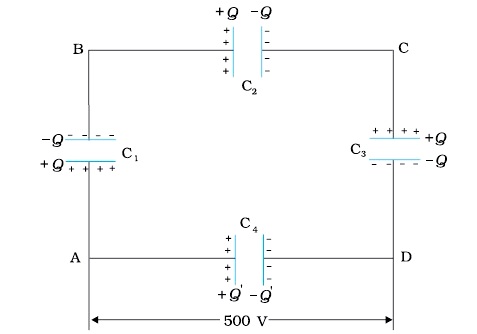
A network of four 10 μF capacitors is connected to a 500 V supply, as shown in Fig. Determine
(a) the equivalent capacitance of the network and
(b) the charge on each capacitor.
(Note, the charge on a capacitor is the charge on the plate with higher potential, equal and opposite to the charge on the plate with lower potential)
5.
Which of the following is not a unit of electrostatic potential?
Volt
Joule / coulomb
Newton / Coulomb
Newton - metre / Coulomb
6.
A charge q is placed at the centre of the line joining two equal charges Q and Q. The system of the three charges will be ill equilibrium, if q is equal to
-Q /2
-Q/ 4
+Q/ 4
+Q/ 2
7.
The unit of electric dipole moment is:
CM
Cm2
C2m
C2m2
8.
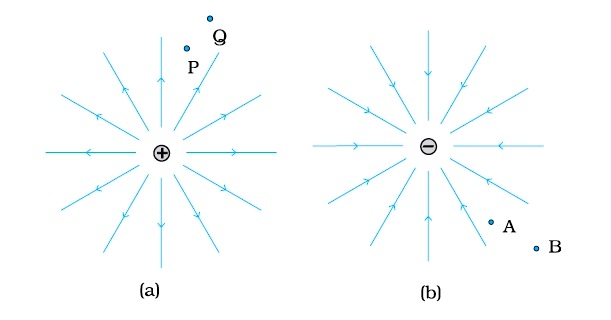
Figures (a) and (b) show the field lines of a positive and negative point charge respectively
(a) Give the signs of the potential difference VP – VQ; VB – VA.
(b) Give the sign of the potential energy difference of a small negative charge between the points Q and P; A and B.
(c) Give the sign of the work done by the field in moving a small positive charge from Q to P.
(d) Give the sign of the work done by the external agency in moving a small negative charge from B to A.
(e) Does the kinetic energy of a small negative charge increase or decrease in going from B to A?
9.
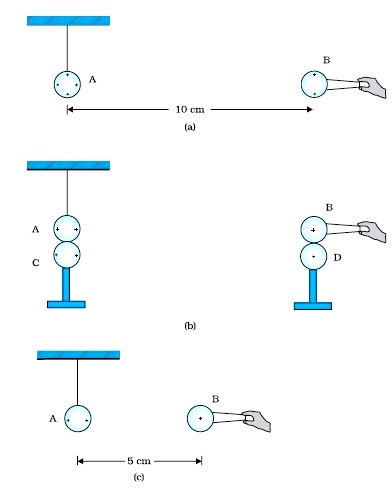
A charged metallic sphere A is suspended by a nylon thread. Another charged metallic sphere B held by an insulating handle is brought close to A such that the distance between their centres is 10 cm, as shown in Fig. (a). The resulting repulsion of A is noted (for example, by shining a beam of light and measuring the deflection of its shadow on a screen). Spheres A and B are touched by uncharged spheres C and D respectively, as shown in Fig. (b). C and D are then removed and B is brought closer to A to a distance of 5.0 cm between their centres, as shown in Fig. (c). What is the expected repulsion of A on the basis of Coulomb’s law? Spheres A and C and spheres B and D have identical sizes. Ignore the sizes of A and B in comparison to the separation between their centres.
10.
Assertion : Faraday’s laws are consequence of conservation of energy.
Reason : In a purely resistive ac circuit, the current legs behind the emf in phase.
Codes:
(a) If both Assertion and Reason are correct and the Reason is a correct explanation of the Assertion.
(b) If both Assertion and Reason are correct but Reason is not a correct explanation of the Assertion.
(c) If the Assertion is correct but Reason is incorrect.
(d) If both the Assertion and Reason are incorrect.
11.
Assertion : Four point charges q1, q2, q3 and q4 are as shown in figure. The flux over the shown Gaussian surface depends only on charges q1 and q2.

Reason : Electric field at all points on Gaussian surface depends only on charges q1 and q2.
(a) Both Assertion and Reason are correct and the Reason is a correct explanation of the Assertion.
(b) Both Assertion and Reason are correct but Reason is not a correct explanation of the Assertion.
(c) Assertion is correct, Reason is incorrect
(d) Both Assertion and Reason are correct.
12.
13.
Assertion (A) : A point charge is lying at the centre of a cube of each side. The electric flux emanating from each surface of the cube is \(\frac{1}{6}^{\text {th }}\) of total flux.
Reason (R) : According to Gauss theorem, total electric flux through a closed surface enclosing a charge is equal to \(1 / \varepsilon_{0}\) times the magnitude of the charge enclosed.
Codes:
(a) Both A and R are true and R is the correct explanation of A
(b) Both A and R are true but R is NOT the correct explanation of A
(c) A is true but R is false
(d) A is false and R is also false
14.

(I) In a parallel plate capacitor, the capacitance increases from 4μF to 80μF on introducing a dielectric medium between the plates. What is the dielectric constant of the medium?
(a) 10
(b) 20
(c) 50
(d) 100
(ii) A parallel plate capacitor with air between the plates has a capacitance of 8 pF. The separation between the plates is now reduced by half and the space between them is filled with a medium of dielectric constant 5. Calculate the value of capacitance of the capacitor in the second case.
(a) 8pF
(b) 10pF
(c) 80pF
(d) 100pF
(iii) A dielectric introduced between the plates of a parallel plate condenser
(a) decreases the electric field between the plates
(b) increases the capacity of the condenser
(c) increases the charge stored in the condenser
(d) increases the capacity of the condenser
(iv) A parallel plate capacitor of capacitance 1 pF has separation between the plates is d. When the distance of separation becomes 2d and wax of dielectric constant x is inserted in it the capacitance becomes 2 pF. What is the value of x?
(a) 2
(b) 4
(c) 6
(d) 8
15.
A Faraday cage or Faraday shield is an enclosure made of a conducting material. The fields within a conductor cancel out with any external fields,so the electric field within the enclosure is zero. These Faraday cages act as big hollow conductors. You can put things to shield them from electrical fields. Any electrical shocks the cage receives, pass harmlessly around the outside of the cage.
(i) Which of the following material can be used to make a Faraday cage?
(a) Plastic (b) Glass (c) Copper (d) Wood
(ii) Example of a real-world Faraday cage is
(a) car (b) plastic box (c) lightning rod (d) metal rod
(iii) What is the electrical force inside a Faraday cage, when it is struck by lightning?
(a) The same as the lightning
(b) Half that of the lightning
(c) Zero
(d) A quarter of the lightning
(iv) An isolated point charge +q is placed inside the Faraday cage. Its surface must have charge equal to
(a) zero (b) + q (c) - q (d) + 2q
(v) A point charge of 2 C is placed at centre of Faraday cage in the shape of cube with surface of 9 cm edge. The number of electric field lines passing through the cube normally wiil be
(a) 1.9 \(\times\)105 N-m2/C, entering the surface
(b) 1.9 \(\times\)105 N-m2/C, leaving the surface
(c) 2.01\(\times\)1011 N-m2/C, leaving the surface
(d) 2.01 \(\times\)105 N-m2/C, entering the surface
1.
As we know that, the number of field lines entering in the cube is the same as that the number of field lines leaving the cube So, no flux is remained on the cube and hence, the net flux over the cube is zero.
2.
Given,
Capacitance of the capacitor, C = 12pF = 12 x 10-12 F
Potential difference, V = 50 V
Electrostatic energy stored in the capacitor is given by the relation,
\(\mathrm{E}=\frac{1}{2} \mathrm{CV}^{2}=\frac{1}{2} \times 12 \times 10^{-12} \mathrm{\times}(50)^{2} \mathrm{~J}=1.5 \times 10^{-8} \mathrm{~J}\)
Therefore, the electrostatic energy stored in the capacitor is 1.5 x 10⁻⁸ J. was disconnected.
3.
Given, p= 4 X10⁻⁹ C-m, E= 5 x10⁴,
\( \theta =30^{\circ} \)
\(\therefore \ \tau =p E^2 \sin \theta \)
\(=4 \times 10^{-4} \times 5 \times 10^4 \times \sin 30^{\circ} \)
\(=4 \times 10^{-4} \times 5 \times 10^4 \times \frac{1}{2} \quad\left[\because \sin 30^{\circ}=\frac{1}{2}\right] \)
\(=10 \times 10^{-4}=10^{-4} \mathrm{~N}-\mathrm{m}\)
4.
(a) In the given network, C1, C2 and C3 are connected in series. The effective capacitance C′ of these three capacitors is given by
\(\frac{1}{C^{\prime}}=\frac{1}{C_{1}}+\frac{1}{C_{2}}+\frac{1}{C_{3}}\)
For C1 = C2 = C3 = 10 μF, C′ = (10/3) μF. The network has C′ and C4 connected in parallel. Thus, the equivalent capacitance C of the network is
\(C=C^{\prime}+C_{4}=\left(\frac{10}{3}+10\right) \mu F=13.3 \mu \mathrm{F}\)
(b) Clearly, from the figure, the charge on each of the capacitors, C1, C2 and C3 is the same, say Q. Let the charge on C4 be Q′. Now, since the potential difference across AB is Q/C1, across BC is Q/C2, across CD is Q/C3 , we have
\(\frac{Q}{C_{1}}+\frac{Q}{C_{2}}+\frac{Q}{C_{3}}=500 \mathrm{~V}\)
Also, Q′/C4 = 500 V.
This gives for the given value of the capacitances
\(Q=500 \mathrm{~V} \times \frac{10}{3} \mu \mathrm{F}=1.7 \times 10^{-3} \mathrm{C}\) and
Q′ = 500 V x 10 μF = 5.0 x10⁻³ C
5.
(c)
Newton / Coulomb
6.
(b)
-Q/ 4
7.
(a)
CM
8.
(a) As \(V \propto \frac{1}{r}, V_{P}>V_{Q^{}}\) Thus, (VP – VQ) is positive. Also VB is less negative than VA . Thus, VB > VA or (VB – VA) is positive.
(b) A small negative charge will be attracted towards positive charge. The negative charge moves from higher potential energy to lower potential energy. Therefore the sign of potential energy difference of a small negative charge between Q and P is positive. Similarly, (P.E.)A > (P.E.)B and hence sign of potential energy differences is positive.
(c) In moving a small positive charge from Q to P, work has to be done by an external agency against the electric field. Therefore, work done by the field is negative.
(d) In moving a small negative charge from B to A work has to be done by the external agency. It is positive.
(e) Due to force of repulsion on the negative charge, velocity decreases and hence the kinetic energy decreases in going from B to A.
9.
Let the original charge on sphere A be q and that on B be q′. At a distance r between their centres, the magnitude of the electrostatic force on each is given by
\(F=\frac{1}{4 \pi \varepsilon_{0}} \frac{q q^{\prime}}{r^{2}}\)
neglecting the sizes of spheres A and B in comparison to r. When an identical but uncharged sphere C touches A, the charges redistribute on A and C and, by symmetry, each sphere carries a charge q/2. Similarly, after D touches B, the redistributed charge on each is q′/2. Now, if the separation between A and B is halved, the magnitude of the electrostatic force on each is
\(F^{\prime}=\frac{1}{4 \pi \varepsilon_{0}} \frac{(q / 2)\left(q^{\prime} / 2\right)}{(r / 2)^{2}}=\frac{1}{4 \pi \varepsilon_{0}} \frac{\left(q q^{\prime}\right)}{r^{2}}=F\)
Thus the electrostatic force on A, due to B, remains unaltered.
10.
(c) If the Assertion is correct but Reason is incorrect.
Explanation:
In purely resistive circuit, the current and emf are in the same phase.
11.
(d) Both Assertion and Reason are correct.
Explanation:
Electric field at any point depends on presence of all charges.
12.
13.
(b): The electric flux through the cube \(\phi=q / \varepsilon_{0}\)
A cube has six faces of equal area. Therefore, electric flux through each face = \(\frac{1}{6} \phi=\frac{1}{6}\left(q / \varepsilon_{0}\right)\).
14.
15.
(i) (c), (ii) (a), (iii) (c), (iv) (b)
(v) (c) According to Gauss' law, electric flux,
\(\phi=\frac{q}{\varepsilon _{0}}=\frac{2}{8.86\times 10^{-12}}=2.01\times 10^{11}N-m^{2} /C\)
(leaving the surface)

12th Standard CBSE Syllabus & Materials
12th Standard CBSE
CBSE 12th Computer Science Python Revision Tour I - New Previous year Question Papers Study Material - QB365 Set A
NEW12th Standard CBSE
CBSE 12th Business Studies Planning Important Questions And Answers Study Material - QB365 Set A
NEW12th Standard CBSE
CBSE 12th Business Studies Business Environment Important Questions And Answers Study Material - QB365 Set A
NEW12th Standard CBSE
CBSE 12th Business Studies Principles of Management Important Questions And Answers Study Material - QB365 Set A



NCERT Books

Syllabus

Exam Pattern

Sample Question Papers

Previous year Question Papers

Important Notes

MCQ Practice test

NCERT Exemplers

Case study Questions

Image Based Questions

Passage based Questions

HOT Questions

Value Based Questions

Model Questions Papers
NCERT ( Book Back ) Questions

Assertion and Reason
Important Questions And Answers

CBSE 12th Standard CBSE Subjects
CBSE Standards








