
 100% FREE ACCESS
12th Standard CBSE Syllabus & Materials
12th Standard CBSE
CBSE 12th Economics Government Budget and the Economy Previous year Question Papers Study Material - QB365 Set A
NEW12th Standard CBSE
CBSE 12th Computer Science Interface Python with MySQL - New Previous year Question Papers Study Material - QB365 Set A
NEW12th Standard CBSE
CBSE 12th Computer Science Database Concept - New Previous year Question Papers Study Material - QB365 Set A
NEW12th Standard CBSE
CBSE 12th Computer Science Data Communication - New Previous year Question Papers Study Material - QB365 Set A
NEW12th Standard CBSE
CBSE 12th Computer Science Data Structures - New Previous year Question Papers Study Material - QB365 Set A
NEW12th Standard CBSE
CBSE 12th Computer Science Functions - New Previous year Question Papers Study Material - QB365 Set A

Published on: 25/10/2025
Download CBSE Class 12th Standard CBSE Physics question papers, sample papers, important questions, and previous year solved papers in PDF format. Get free study materials, NCERT solutions, and exam preparation resources for Class 12th Standard CBSE Physics
Questions + Answers key
Take MCQ Physics Test
1.
State Gauss's theorem in electrostatics. Prove that no electric field exists inside a hollow charged sphere.
2.
Define the term 'electric dipole moment'. Is it a scalar or vector?
Deduce an expression for the electric field at a point on the equatorial plane of an electric dipole of length 2a.
3.
Derive the expression for the torque \(\tau \) acting on a rectangular current loop of area A placed in a uniform magnetic field B. Show that \(\overrightarrow { \tau } =\overrightarrow { m } \times \overrightarrow { B } \) where \(\overrightarrow { m } \) is the magnetic moment of the current loop given by \(\overrightarrow { m } =I\overrightarrow { A } \)
4.
A galvanometer coil has a resistance of 15 Ω and the metre shows full scale deflection for a current of 4 mA. How will you convert the metre into an ammeter of range 0 to 6 A?
5.
A coil of 200 turns has a cross-sectional area 900mm2 It carries a current of 2 ampere. The plane of the coil is perpendicular to a uniform magnetic field of 0.5T. Calculate (i) the magnetic moment of the coil and (ii) the torque acting on the coil.
6.
Deduce the expression for the electric field E due to a system of two charges\(q_1 \text { and } q_2\) with position vectors \(r_1 \text { and } r_2\) at a point r with respect to a common origin.
7.
Why does a charged glass rod attract a piece of paper?
8.
A solenoid of length 0.5 m has a radius of 1 cm and is made up of 500 turns. It carries a current of 5 A. What is the magnitude of the magnetic field inside the solenoid ?
9.
Write the expression for Lorentz magnetic force on a particle of charge q moving with velocity V in a magnetic field B. Show that no work is done by this force on the charged particle.
10.
What is magnetic flux density? Define its units and give its dimensions.
11.
When a glass rod is rubbed with silk, it
gains electrons from silk.
gives electrons to silk
gains protons from silk
gives protons to silk.
12.
A force of 2.25 N acts on a chrage of 15 x 10-4 C. The intensity of electric field at that point is
150 NC-1
15 NC-1
1500 NC -1
1.5 NC-1
13.
A circular coil carrying current behaves as a
bar magnet
horse shoe magnet
magnetic shell
solenoid
14.
The magnetic field at a perpendicular distance of 2 cm from an infinite straight current carrying conductor is 2x10⁻⁶ T. The current in the wire is
0.1 A
0.2 A
0.4 A
0.8 A
15.
(i) State the underlying principle of a moving coil galvanometer.
(ii) Define the terms (a) voltage sensitivity and (b) current sensitivity of a galvanometer.
16.
(a) Use Gauss's theorem to find the electric field due to a uniformly charged infinitely large plane thin sheet with surface.
(b) An infinitely large thin plane sheet has a uniform surface charge density +σ. Obtain the expression for the amount of work done in bringing a point charge q from infinity to a point, distant r, in front of the charged plane sheet.
17.
(i) Derive an expression for the force between two long parallel current carrying conductors.
(ii) Use this expression to define SI unit of current.
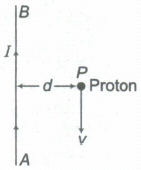
(iii) A long straight wire AB carries a current I. A proton P travels with a speed v, parallel to the wire at a distance d from it in a direction opposite to the current as shown in the figure. What is the force experienced by the proton and what is its direction?
18.
State Biot-Savart law giving the mathematical expression for it. Use this law to derive the expression. Use this law to derive the expression for the magnetic field due to a circular coil carrying current at a point along its axis. How does a circular loop carrying current behave as a magnet?
19.
The path of a charged particle in magnetic field depends upon angle between velocity and magnetic field.If velocity \(\vec{v}\) is at angle \(\theta\) to \(\vec{B}\) component of velocity parallel to magnetic field \((v \cos \theta)\) remains constant and component of velocity perpendicular to magnetic field \((v \sin \theta)\) is responsible for circular motion, thus the charge particle moves in a helical path.
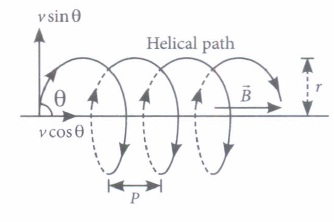
The plane of the circle is perpendicular to the magnetic field and the axis of the helix is parallel to the magnetic field. The charged particle. moves along helical path touching the line parallel to the magnetic field passing through the starting point after each rotation.
Radius of circular path is \(r=\frac{m v \sin \theta}{1 v_{q} B}\)
Hence the resultant path of the charged particle will be a helix, with its axis along the direction of \(\vec{B}\) as shown in figure.
(i) When a positively charged particle enters into a uniform magnetic field with uniform velocity, its trajectory can be (i) a straight line (ii) a circle (iii) a helix.
| (a) (i) only | (b) (i) or (ii) |
| (c) (i) or (iii) | (d) anyone of (i), (ii) and (iii) |
(ii) Two charged particles A and B having the same charge, mass and speed enter into a magnetic field in such a way that the initial path of A makes an angle of 30° and that of B makes an angle of 90° with the field. Then the trajectory of
| (a) B will have smaller radius of curvature than that of A |
| (b) both will have the same curvature |
| (c) A will have smaller radius of curvature than that of B |
| (d) both will move along the direction of their original velocities. |
(iii) An electron having momentum 2.4 x 10⁻²³kg m/ s enters a region of uniform magnetic field of 0.15 T. The field vector makes an angle of 30° with the initial velocity vector of the electron. The radius of the helical path of the electron in the field shall be
| (a) 2 mm | (b) 1 mm | \(\text { (c) } \frac{\sqrt{3}}{2} \mathrm{~mm}\) | (d) 0.5 mm |
(iv) The magnetic field in a certain region of space is given by \(\vec{B}=8.35 \times 10^{-2} \hat{i}\) T. A proton is shot into the field with velocity \(\vec{v}=\left(2 \times 10^{5} \hat{i}+4 \times 10^{5} \hat{j}\right) \mathrm{m} / \mathrm{s}\) The proton follows a helical path in the field. The distance moved by proton in the x-direction during the period of one revolution in the yz-plane will be
(Mass of proton = 1.67 x 10⁻²⁷kg)
| (a) 0.053 m | (b) 0.136 m | (c) 0.157 m | (d) 0.236 m |
(v) The frequency of revolution of the particle is
| \(\text { (a) } \frac{m}{q B}\) | \(\text { (b) } \cdot \frac{q B}{2 \pi m}\) | \(\text { (c) } \frac{2 \pi R}{v \cos \theta}\) | \(\text { (d) } \frac{2 \pi R}{v \sin \theta}\) |
20.
Assertion(A) : Electric force between two charges always acts along the line joining the two charges
Reason (R) : Electric force is a conservative force.
(a) Both Assertion and Reason are true and Reason is the correct explanation of Assertion.
(b) Both Assertion and Reason are true but Reason is not the correct explanation of Assertion.
(c) Assertion is true but Reason is false.
(d) Assertion is false but Reason is true.
21.
Assertion (A) : A solenoid tends to expand, when a current passes through it.
Reason (R) : Two straight parallel metallic wires carrying current in same direction repel each other.
Codes:
(a) Both A and R are true and R is the correct explanation of A
(b) Both A and R are true but R is NOT the correct explanation of A
(c) A is true but R is false
(d) A is false and R is also false
1.
According to the Gauss's theorem, the total electric flux through a closed surface is \(\frac{1}{\varepsilon_{0}}\) times the magnitude of net charge enclosed by the surface. Consider a hollow charged sphere.
Take a point inside the sphere where electric field is to be calculated. Draw a Gaussian surface of radius r having point P on its surface.
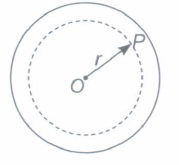
Now, \(\phi=\oint_{S} \vec{E} \cdot \vec{d} s=E \oint_{S} d s=E .4 \pi r^{2}\)
According to the Gauss's theorem,
\(E .4 \pi r^{2}=\frac{q}{\varepsilon_{0}}(\because q=0)\)
\(\therefore E=0\)
2.
Electric dipole moment is a measurement of the strength of electric dipole. It is given by \(\vec{p}=q(\overrightarrow{2 a})\) cm, where \(\vec{p}\) is the electric dipole moment and 2a is the separation between the charges. It is a vector quantity directed from negative to positive charge on the line joining them.
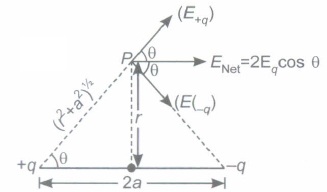
Let the dipole be made of two equal and opposite charges +q and -q, separated by 2a. Consider a point P at a distance r from the mid-point. Field at P due to each charge will be of equal magnitude \(\left|\vec{E}_{\pm q}\right|=\frac{k q}{\left(r^{2}+a^{2}\right)}\) pointing as shown.
Resolving electric fields due to two charges. We can see that Y-axis components get cancelled out.
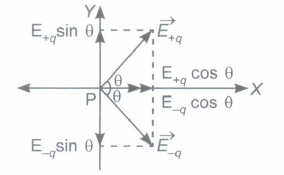
∴ Net field at P,E = 2Eq cos θ
\( E= \frac{2 k q}{\left(r^{2}+a^{2}\right)} \cdot \frac{a}{\left(r^{2}+a^{2}\right)^{1 / 2}} \)
\(= \frac{2 a q k}{\left(r^{2}+a^{2}\right)^{3 / 2}}=\frac{k p}{\left(r^{2}+a^{2}\right)^{3 / 2}} \)
\(\left(\because \cos \theta=\frac{a}{\left(r^{2}+a^{2}\right)^{1 / 2}}\right)\)
(pointing anti-parallel to dipole moment)
If r >> a, i.e. a2 can be neglected in comparison to r2.
\(\therefore \ E=\frac{k p}{r^{3}}\) (anti-parallel to \(\vec{p}\))
3.
The force, on a wire of length I,carrying a current I, in a magneticfield \(\overrightarrow { B } \) is given by \(\overrightarrow { F } =\left( \overrightarrow { l } \times \overrightarrow { B } \right) \) For a rectangular loop, places as shown, in a magnetic field \(\overrightarrow { B } \)
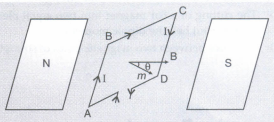
|Force on arm BCI = IForce on arm DAI = l/Bsin \(\alpha\)
Where \(\alpha\)=angle between side BC and \(\overrightarrow { B } \)
These two forces add up to zero as they are collinear (along the axis of the coil) and act in opposite directions
|Force on arm ABI = IForce on arm CDI = IbB
These two equal and opposite forces are not collinear. The perpendicular distance between their lines of action is, as shown
\(2\times\frac{a}{2}sin\theta=a sin\theta\)
Torque acting on the coil, has a magnitude \(\tau \) where
\(\tau \)=(lbB)x(a sin \(\theta\))=IAB sin \(\theta\) (A=ab=Area of the coil)
In vector form, \(\overrightarrow { \tau } =\overrightarrow { A } \times \overrightarrow { B } \)
But \(I\overrightarrow { A } \)=\(\overrightarrow { m } \), as given
\(\overrightarrow { \tau } =\overrightarrow { m } \times \overrightarrow { B } \)
4.
Resistance of the galvanometer coil, G = 15 Ω
Current for which the galvanometer shows full scale deflection,
= 4 mA = 4 x 10⁻³ A
Range of the ammeter is 0, which needs to be converted to 6 A.
Current, I = 6 A
A shunt resistor of resistance S is to be connected in parallel with the galvanometer to convert it into an ammeter. The value of S is given as:
\(S=\frac{I_{g} G}{I-I_{g}}\)
\(=\frac{4 \times 10^{-3} \times 15}{6-4 \times 10^{-3}}\)
\(S=\frac{6 \times 10^{-2}}{6-0.004}=\frac{0.06}{5.996}\)
\(\approx 0.01 \Omega=10 \mathrm{~m} \Omega\)
Hence, a 10 mΩ shunt resistor is to be connected in parallel with the galvanometer.
5.
(i) 36 x 10-2 Am2
(ii) 18 x 10-2Nm
6.
\(\begin{aligned}
& \mathrm{E}_i=\lim _{q_0 \rightarrow 0} \frac{\mathbf{F}_i}{q_0}=\lim _{q_0 \rightarrow 0}\left[\frac{1}{q_0}\left(\frac{1}{4 \pi \varepsilon_0} \cdot \frac{q_i q_0}{r_i^2} \hat{\mathbf{r}}_i\right)\right] \\
& \mathrm{E}_i=\frac{1}{4 \pi \varepsilon_0} \cdot \frac{q_i}{r_i^2} \hat{\mathbf{r}}_i
\end{aligned}\)..............(i)
If E is eletric ficld at point P due to the system of charges, then by principle of superposition of electric fields, \(\mathrm{E}=\mathrm{E}_1+\mathrm{E}_2+\mathrm{E}_3+\cdots+\mathrm{E}_n=\sum_{i=1}^n \mathrm{E}_i\)
Using Eq. (i), we get \(\mathrm{E}=\sum_{i=1}^n \frac{1}{4 \pi \varepsilon_0} \cdot \frac{q_i}{r_i^2} \hat{r}_i\)
or \(\mathrm{E}=\frac{1}{4 \pi \varepsilon_0} \sum_{i=1}^n \frac{q_i}{r_i^2} \hat{\mathbf{r}}_i\)
\(\therefore\) E is a vector quantity.
7.
Paper is a dielectric, so when a positively charged glass rod is brought near it, atoms of paper get polarised, with centre of negative charge of atoms coming closer to the glass rod.
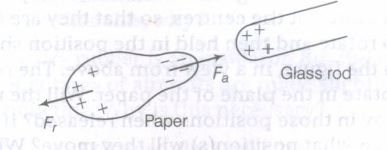
Therefore, force of attraction Fa between glass rod and piece of paper becomes greater than the force of repulsion Fr between the glass rod and the piece of paper. This results in attraction of the piece of paper towards the glass rod.
8.
Given, total number of turns, N = 500
Length of solenoid, l = 0.5 m
Current, I = 5 A
Radius, r = 1 cm = 10-2 m
Here, \(\begin{aligned} \frac{l}{r} & =\frac{0.5}{10^{-2}}=50 \Rightarrow l>>r \\ \end{aligned}\)
\(\begin{aligned} \therefore B & =\mu_0 n I=\frac{\mu_0 N I}{l} \\ \end{aligned}\)
\(\begin{aligned} =4 \pi \times 10^{-7} \times \frac{500}{0.5} \times 5 \end{aligned}\)
= 6.28 \(\times\) 10-3 T
9.
Lorentz magnetic force on a moving charged particle in the magnetic field is
\(\overset { \rightarrow }{ F } =q\left( \overset { \rightarrow }{ v } \times \overset { \rightarrow }{ B } \right) \)
This force is acting perpendicular to the plane containing \(\overset { \rightarrow }{ v } \) and \(\overset { \rightarrow }{ B } \) , and is directed as given by Right Hand rule. Since work done,
\(\overset { \rightarrow }{ W } =\overset { \rightarrow }{ F } .\overset { \rightarrow }{ s } =Fscos\theta ,\)
where is displacement of charged particle in magnetic field. Here, angle \(\theta ={ 90 }^{ o }\) , so
W = Fs cos 90o
= 0.
10.
Magnetic flux density at a point in a magnetic field means magnetic field induction at that point. It is defined as the force experienced by a unit charge while moving with a unit velocity, perpendicular to the direction of magnetic field at that point. Force experienced by the charged particle having charge q moving with velocity \(\overset { \rightarrow }{ v } \) through a magnetic field \(\overset { \rightarrow }{ B } \) is given by
\( \left| \overset { \rightarrow }{ F } \right| =q\left| \overset { \rightarrow }{ v } \times \overset { \rightarrow }{ B } \right| =qvBsin\theta\)
\(or \ B=\frac { F }{ qvsin\theta } \)
The SI unit of B is tesla, where 1 tesla is the magnetic flux density at a point if 1 coulomb charge while moving with a velocity of 1 ms-1, perpendicular to a magnetic field experiences a force of 1 N at that point.
The dimensional formula of B
\(=\frac { \left[ { MLT }^{ -2 } \right] }{ \left[ AT \right] \left[ { LT }^{ -1 } \right] } =\left[ { ML }^{ o }{ T }^{ -2 }{ A }^{ -1 } \right] \)
11.
(b)
gives electrons to silk
12.
(c)
1500 NC -1
13.
(c)
magnetic shell
14.
(b)
0.2 A
15.
(a) Moving coil galvanometer is an instrument used for detection and measurement of small currents. Moving coil galvanometer works on the principle that when a current-carrying coil is placed in magnetic field it experiences a torque.
(b) (i) Voltage sensitivity is defined as the deflection produced in the galvanometer when a unit voltage is applied across the two terminals of the galvanometer:
Vs = NBA/KR
(ii) Current sensitivity is defined as the deflection produced in the galvanometer when a limit current flow through the galvanometer:
Is = NBA/K
where N is number of turned in coil, B is the magnetic field, A is the area of the coil, K is the restoring torque per limit twist.
16.
Electric field intensity due to a thin infinite plane sheet charge: Consider a thin infinite sheet of charge with uniform surface charge density a. To calculate electric field at a point P distant r from the sheet we imagine a symmetrical Gaussian surface in such a way that the point charge lies on it. Here we assume a cylinder of cross-sectional area A and length 2r with its axis perpendicular to the sheet.
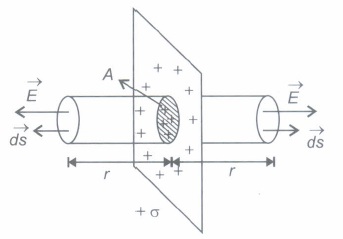
Flux through the curved surface of the cylinder,
\(\phi_{1}=\int \vec{E} \cdot \overrightarrow{d s}=0 \left(\because \theta=90^{\circ}\right)\)
Total flux through plane faces of the cylinder,
\(\phi_{2}=2 \int \vec{E} \cdot \overrightarrow{d s}=2 E A \left(\because \theta=0^{\circ}\right)\)
Net flux through the Gaussian surface is
\(\phi=\phi_{1}+\phi_{2}=2 E A\)
Net charge enclosed by the Gaussian surface is
\(Q=\sigma A\)
According to the Gauss's theorem, \(\phi=\frac{Q}{\varepsilon_{0}}\)
\(\therefore \phi=\frac{\sigma A}{\varepsilon_{0}}\)
From equations (i) and (ii), we get
\(2 E A=\frac{\sigma A}{\varepsilon_{0}} \Rightarrow E=\frac{\sigma}{2 \varepsilon_{0}}\)
(b)
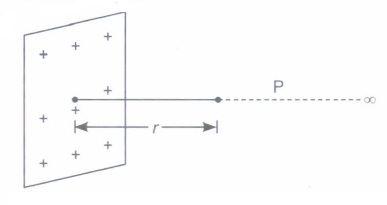
Work done in bringing a charge from ∞ to given point P is given by
\(
W =q \int_{r=\infty}^{r} \vec{E} \cdot \overrightarrow{d r}=q \int_{\infty}^{r}\left(\frac{\sigma}{2 \varepsilon_{0}} d r\right)
\)
\(=q \cdot \frac{\sigma}{2 \varepsilon_{0}} \int_{r=\infty}^{r} d r
\)
\(W =\frac{q \cdot \sigma}{2 \varepsilon_{0}}[r-\infty]=\frac{\infty}{2 \varepsilon_{0}}[r-\infty]=\infty\)
17.
(ii) As, \(\frac{F}{L}=\frac{\mu_0}{4\pi}.\frac{2 I_1 I_2}{r}\)
\(I_1=I_2=I A, r=1 m\)
\(\frac{F}{L}=2\times10^{-7} Nm^{-1}\)
(iii) Here, magnetic field due to the current carrying conductor at a distance d from it is
given by
\(B=\frac{\mu_0}{4\pi} \frac{2I}{d}\)
∴ Force on proton,
F = (e) (v) B sin 90°
⇒ F = evB
\(F=ev(\frac{\mu_0}{4\pi}\frac{2I}{d})\)
\(F=\frac{\mu_0}{4\pi}.\frac{2Iev}{d}\)
The proton is directed perpendicular to straight conductor and away from it.
18.
Statement for Biot-Savart Law: The magnitude of magnetic field \(d\overrightarrow { B } \) due to current element is directly proportional to the current I, the elements length \(\left| dl \right| \) and inversely proportional to the square of the distance r of the field point. Its direction is perpendicular to the plane containing \(\overrightarrow { dl } \)and \(\overrightarrow{r}\).
\(d\overrightarrow B\alpha\frac{I\overrightarrow dl \times \overrightarrow r}{r^{ 3}}\)
Or \(d\overrightarrow B=\frac {\mu_0}{4 \pi}\frac{I\overrightarrow dl \times \overrightarrow r}{r^{ 3}}\)
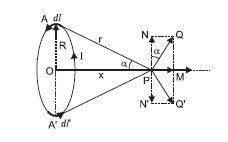
The magnetic field due to \(\overrightarrow {dl}\) is given by Biot Savart law as
\(dB=\frac {\mu_0}{4\pi}.\frac { I\left| \overrightarrow { dl } \times \overrightarrow { r } \right| }{ { r }^{ 3 } } \)
Now dBx= Db Cos \(\theta\) = \(\frac { \mu _{ 0 } }{ 4\pi } .\frac { Idl }{ \left( { x }^{ 2 }+{ R }^{ 2 } \right) } \cos { \theta } \)
\(=\frac { \mu _{ 0 } }{ 4\pi } .\frac { Idl }{ \left( { x }^{ 2 }+{ R }^{ 2 } \right) } \frac { R }{ \left( { x }^{ 2 }+{ R }^{ 2 } \right) ^{ 1/2 } } \)
So, \({ B }_{ x }=\int { dB_{ s }=\frac { { \mu }_{ 0 } }{ 4\pi } } \frac { IR }{ \left( { x }^{ 2 }+{ R }^{ 2 } \right) ^{ 3/2 } } \int { dl } \)
\(=\frac { { \mu }_{ 0 }IR^{ 2 } }{ 2\left( { x }^{ 2 }+{ R }^{ 2 } \right) ^{ 3/2 } } \)
(The y-components, of the field, add up to zero,due to symmetry)
\(\therefore\)Magnetic field at P due to a circular loop
\(=B={ B }_{ x }\overrightarrow { i } =\frac { { \mu }_{ 0 }IR^{ 2 } }{ 2\left( { x }^{ 2 }+{ R }^{ 2 } \right) ^{ 3/2 } } \overrightarrow { i } \)
Explanation: A circular current loop produces magnetic field and its magnetic moment is the product of current and its area \(\overrightarrow M=\overrightarrow {LA}\)
19.
(i) (d)
(ii) (a): Using \(q v B \sin \theta=\frac{m v^{2}}{r}\)
\(r \propto \frac{1}{\sin \theta}\) for the same values of m, v, q and B
\(\therefore \frac{r_{A}}{r_{B}}=\frac{\sin 90^{\circ}}{\sin 30^{\circ}}=2 \text { or } r_{A}=2 r_{B} \text { or } r_{B}<r_{A}\)
(iii) (d): The radius of the helical path of the electron in the uniform magnetic field is
\(r=\frac{m v_{\perp}}{e B}=\frac{m v \sin \theta}{e B}=\frac{\left(2.4 \times 10^{-23} \mathrm{~kg} \mathrm{~m} / \mathrm{s}\right) \times \sin 30^{\circ}}{\left(1.6 \times 10^{-19} \mathrm{C}\right) \times 0.15 \mathrm{~T}}\)
\(=5 \times 10^{-4} \mathrm{~m}=0.5 \times 10^{-3} \mathrm{~m}=0.5 \mathrm{~mm}\)
(iv) (c): Here \(\vec{B}=8.35 \times 10^{-2} \hat{i} \mathrm{~T}\)
\(\vec{v}=2 \times 10^{5} \hat{i}+4 \times 10^{5} \hat{j} \mathrm{~m} / \mathrm{s}, m=1.67 \times 10^{-27} \mathrm{~kg}\)
Pitch of the helix (i.e., the linear distance moved along the magnetic field in one rotation) is given by
Pitch of the helix \(=\frac{2 \pi m v_{\|}}{q B}\)
\(=\frac{2 \times 3.14 \times 1.67 \times 10^{-27} \times 2 \times 10^{5}}{1.6 \times 10^{-19} \times 8.35 \times 10^{-2}}=0.157 \mathrm{~m}\)
(v) (b): Period of revolution
\(T=\frac{2 \pi R}{v \sin \theta} \Rightarrow T=\frac{2 \pi\left(\frac{m v \sin \theta}{q B}\right)}{v \sin \theta} \Rightarrow T=\frac{2 \pi m}{q B}\)
\(\therefore \text { Frequency, } v=\frac{1}{T}=\frac{q B}{2 \pi m}\)
20.
(b) Both Assertion and Reason are true but Reason is not the correct explanation of Assertion.
21.
(d) : When current flows through a solenoid, the currents in the various turns of the solenoid are parallel and in the same direction. Since the currents flowing through parallel wires· in the same direction lead to force of attraction between them, the turns of the solenoid will also attract each other and as a result. she solenoid tends to contract

12th Standard CBSE Syllabus & Materials
12th Standard CBSE
CBSE 12th Computer Science Python Revision Tour I - New Previous year Question Papers Study Material - QB365 Set A
NEW12th Standard CBSE
CBSE 12th Business Studies Planning Important Questions And Answers Study Material - QB365 Set A
NEW12th Standard CBSE
CBSE 12th Business Studies Business Environment Important Questions And Answers Study Material - QB365 Set A
NEW12th Standard CBSE
CBSE 12th Business Studies Principles of Management Important Questions And Answers Study Material - QB365 Set A



NCERT Books

Syllabus

Exam Pattern

Sample Question Papers

Previous year Question Papers

Important Notes

MCQ Practice test

NCERT Exemplers

Case study Questions

Image Based Questions

Passage based Questions

HOT Questions

Value Based Questions

Model Questions Papers
NCERT ( Book Back ) Questions

Assertion and Reason
Important Questions And Answers

CBSE 12th Standard CBSE Subjects
CBSE Standards








