
 100% FREE ACCESS
12th Standard CBSE Syllabus & Materials
12th Standard CBSE
CBSE 12th Economics Government Budget and the Economy Previous year Question Papers Study Material - QB365 Set A
NEW12th Standard CBSE
CBSE 12th Computer Science Interface Python with MySQL - New Previous year Question Papers Study Material - QB365 Set A
NEW12th Standard CBSE
CBSE 12th Computer Science Database Concept - New Previous year Question Papers Study Material - QB365 Set A
NEW12th Standard CBSE
CBSE 12th Computer Science Data Communication - New Previous year Question Papers Study Material - QB365 Set A
NEW12th Standard CBSE
CBSE 12th Computer Science Data Structures - New Previous year Question Papers Study Material - QB365 Set A
NEW12th Standard CBSE
CBSE 12th Computer Science Functions - New Previous year Question Papers Study Material - QB365 Set A

Published on: 25/10/2025
Download CBSE Class 12th Standard CBSE Physics question papers, sample papers, important questions, and previous year solved papers in PDF format. Get free study materials, NCERT solutions, and exam preparation resources for Class 12th Standard CBSE Physics
Questions + Answers key
Take MCQ Physics Test
1.
Two charges of +25 x 10-9C and - 25x 10-9 C are placed 6 m apart. Find the electric field at a point 4 m from the centre of the electric dipole
(i) on axial line
(ii) on equatorial line
2.
(a) Explain the meaning of the statement ‘electric charge of a body is quantised’.
(b) Why can one ignore quantisation of electric charge when dealing with macroscopic i.e., large scale charges?
3.
A circular coil of wire consisting of 100 turns, each of radius 8.0 cm carries a current of 0.40 A. What is the magnitude of the magnetic field B at the centre of the coil?
4.
What is magnetic flux density? Define its units and give its dimensions.
5.
A galvanometer coil has a resistance of 12 Ω and the metre shows full scale deflection for a current of 3 mA. How will you convert the metre into a voltmeter of range 0 to 18 V ?
6.
A charge Q is placed at the centre of a cube. The electric flux through one if its face is
\(\frac{Q}{\varepsilon_0}\)
\(\frac{Q}{6 \varepsilon_0}\)
\(\frac{Q}{8 \varepsilon_0}\)
\(\frac{Q}{3 \varepsilon_0}\)
7.
In an electric field E, the torque acting on a dipole moment p is
p·E
p x E
zero
E x p
8.
A coil of wire has an area of 600 sq. cm and has 500 turns. If it carries 1.5 A current, its magnetic dipole moment is
5 Am2
15 Am2
30 Am2
45 Am2
9.
The magnetic field at a perpendicular distance of 2 cm from an infinite straight current carrying conductor is 2x10⁻⁶ T. The current in the wire is
0.1 A
0.2 A
0.4 A
0.8 A
10.
(a) Use Gauss's theorem to find the electric field due to a uniformly charged infinitely large plane thin sheet with surface.
(b) An infinitely large thin plane sheet has a uniform surface charge density +σ. Obtain the expression for the amount of work done in bringing a point charge q from infinity to a point, distant r, in front of the charged plane sheet.
11.
State Biot-Savart law giving the mathematical expression for it. Use this law to derive the expression. Use this law to derive the expression for the magnetic field due to a circular coil carrying current at a point along its axis. How does a circular loop carrying current behave as a magnet?
12.
(i) Explain giving reasons, the basic difference in converting a galvanometer into
(a) a voltmeter and
(b) an ammeter
(ii) Two long straight parallel conductors carrying steady currents I1 and I2 are separated by a distance d. Explain briefly, with the help of a suitable diagram, how the magnetic field due to one conductor acts on the other. Hence, deduce the expression for the force acting between the two conductors. Mention the nature of this force.
13.
Explain using a labelled diagram, the principle and working of a moving coil galvanometer. What is the function of
(i) uniform radial magnetic field
(ii) soft iron core?
Also, define the terms
(iii) current sensitivity and
(iv) voltage sensitivity of a galvanometer.
Why does increasing the current sensitivity not necessarily increase voltage sensitivity?
14.
A galvanometer having a coil resistance of 100 Ω gives full scale deflection when a current of 1mA passes through it. Calculate the value of resistance required to convert it into an ammeter of range 0-1 A.
15.
Define the term 'electric dipole moment'. Is it a scalar or vector?
Deduce an expression for the electric field at a point on the equatorial plane of an electric dipole of length 2a.
16.
An electric dipole with dipole moment 4 × 10⁻⁹ C m is aligned at 30° with the direction of a uniform electric field of magnitude 5 × 10⁴ N/C. Calculate the magnitude of the torque acting on the dipole.
17.
Derive the expression for the torque \(\tau \) acting on a rectangular current loop of area A placed in a uniform magnetic field B. Show that \(\overrightarrow { \tau } =\overrightarrow { m } \times \overrightarrow { B } \) where \(\overrightarrow { m } \) is the magnetic moment of the current loop given by \(\overrightarrow { m } =I\overrightarrow { A } \)
18.
(i) Write an expression for the force experienced by a charge q moving with a velocity v in a magnetic field B. Use this expression to define the unit of magnetic field.
(ii) Obtain an expression for the force experienced by a current carrying wire in a magnetic field.
19.
Assertion (A) : When the observation point lies along the length of the current element, magnetic field is zero.
Reason (R): Magnetic field close to current element is zero.
Codes:
(a) Both A and R are true and R is the correct explanation of A
(b) Both A and R are true but R is NOT the correct explanation of A
(c) A is true but R is false
(d) A is false and R is also false
20.
Assertion (A) : Charging is due to transfer of electrons.
Reason (R) : Mass of a body decreases slightly when it is negatively charged.
Codes:
(a) Both A and R are true and R is the correct explanation of A
(b) Both A and R are true but R is NOT the correct explanation of A
(c) A is true but R is false
(d) A is false and R is also false
1.
Here, q = 25 x 10-9C, 2a = 6m, r = 4 m,
p = q(2a)= 25 x 10-9 x 6 =1.5 x 10⁻⁷ c-m
(i) Now, \(E_{\text {axial }}=\frac{1}{4 \pi \varepsilon_{0}} \cdot \frac{2 p r}{\left(r^{2}-a^{2}\right)^{2}}\)
\(=\frac{9 \times 10^{9} \times 2 \times 1.5 \times 10^{-7} \times 4}{\left(4^{2}-3^{2}\right)^{2}}=\frac{2700 \times 4}{49}\)
= 220.4 NC -1
(ii) \(\therefore E_{\text {equatorial }}=\frac{1}{4 \pi \varepsilon_{0}} \cdot \frac{p}{\left(r^{2}+a^{2}\right)^{3 / 2}}\)
\(=\frac{9 \times 10^{9} \times 1.5 \times 10^{-7}}{\left(4^{2}+3^{2}\right)^{3 / 2}}=\frac{1350}{125}=\) 10.8 NC-1
2.
(a) Electric charge of a body is quantized. This means that only integral (1, 2, …., n) number of electrons can be transferred from one body to the other. Charges are not transferred in fraction. Hence, a body possesses total charge only in integral multiples of electric charge
(b) In macroscopic or large scale charges, the charges used are huge as compared to the magnitude of electric charge. Hence, quantization of electric charge is of no use on macroscopic scale. Therefore, it is ignored and it is considered that electric charge is continuous.
3.
Here, n = 100, r = 8 cm = 8 \(\times\)10-2m and I = 0.40 A
\(\therefore\) Magnetic field B at the centre,
\(\begin{aligned} B=\frac{\mu_0}{4 \pi} \cdot \frac{2 \pi I n}{r} & =\frac{10^{-7} \times 2 \times 3.14 \times 0.40 \times 100}{8 \times 10^{-2}} \\ \end{aligned}\)
\(\begin{aligned} =3.1 \times 10^{-4} \mathrm{~T} \end{aligned}\)
4.
Magnetic flux density at a point in a magnetic field means magnetic field induction at that point. It is defined as the force experienced by a unit charge while moving with a unit velocity, perpendicular to the direction of magnetic field at that point. Force experienced by the charged particle having charge q moving with velocity \(\overset { \rightarrow }{ v } \) through a magnetic field \(\overset { \rightarrow }{ B } \) is given by
\( \left| \overset { \rightarrow }{ F } \right| =q\left| \overset { \rightarrow }{ v } \times \overset { \rightarrow }{ B } \right| =qvBsin\theta\)
\(or \ B=\frac { F }{ qvsin\theta } \)
The SI unit of B is tesla, where 1 tesla is the magnetic flux density at a point if 1 coulomb charge while moving with a velocity of 1 ms-1, perpendicular to a magnetic field experiences a force of 1 N at that point.
The dimensional formula of B
\(=\frac { \left[ { MLT }^{ -2 } \right] }{ \left[ AT \right] \left[ { LT }^{ -1 } \right] } =\left[ { ML }^{ o }{ T }^{ -2 }{ A }^{ -1 } \right] \)
5.
Resistance of the galvanometer coil, G = 12 Ω
Current for which there is full scale deflection, Ig = 3 mA = 3 x 10⁻³ A
Range of the voltmeter is 0, which needs to be converted to 18 V.
therefore, V = 18 V
Let a resistor of resistance R be connected in series with the galvanometer to convert it into a voltmeter. This resistance is given as:
\(R=\frac{V}{I_{\mathrm{g}}}-\mathrm{G}\)
\(=\frac{18}{3 \times 10^{-3}}-12=6000-12=5988 \Omega\)
Hence, a resistor of resistance 5998 Ω is to be connected in series with the galvanometer.
6.
(b)
\(\frac{Q}{6 \varepsilon_0}\)
7.
(b)
p x E
8.
(d)
45 Am2
9.
(b)
0.2 A
10.
Electric field intensity due to a thin infinite plane sheet charge: Consider a thin infinite sheet of charge with uniform surface charge density a. To calculate electric field at a point P distant r from the sheet we imagine a symmetrical Gaussian surface in such a way that the point charge lies on it. Here we assume a cylinder of cross-sectional area A and length 2r with its axis perpendicular to the sheet.
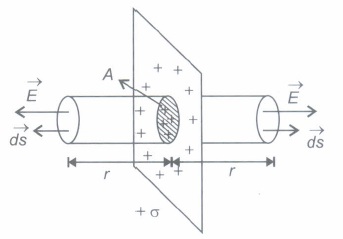
Flux through the curved surface of the cylinder,
\(\phi_{1}=\int \vec{E} \cdot \overrightarrow{d s}=0 \left(\because \theta=90^{\circ}\right)\)
Total flux through plane faces of the cylinder,
\(\phi_{2}=2 \int \vec{E} \cdot \overrightarrow{d s}=2 E A \left(\because \theta=0^{\circ}\right)\)
Net flux through the Gaussian surface is
\(\phi=\phi_{1}+\phi_{2}=2 E A\)
Net charge enclosed by the Gaussian surface is
\(Q=\sigma A\)
According to the Gauss's theorem, \(\phi=\frac{Q}{\varepsilon_{0}}\)
\(\therefore \phi=\frac{\sigma A}{\varepsilon_{0}}\)
From equations (i) and (ii), we get
\(2 E A=\frac{\sigma A}{\varepsilon_{0}} \Rightarrow E=\frac{\sigma}{2 \varepsilon_{0}}\)
(b)
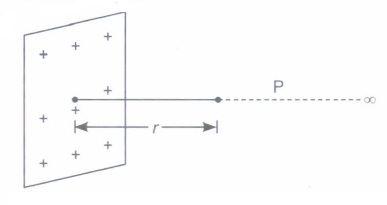
Work done in bringing a charge from ∞ to given point P is given by
\(
W =q \int_{r=\infty}^{r} \vec{E} \cdot \overrightarrow{d r}=q \int_{\infty}^{r}\left(\frac{\sigma}{2 \varepsilon_{0}} d r\right)
\)
\(=q \cdot \frac{\sigma}{2 \varepsilon_{0}} \int_{r=\infty}^{r} d r
\)
\(W =\frac{q \cdot \sigma}{2 \varepsilon_{0}}[r-\infty]=\frac{\infty}{2 \varepsilon_{0}}[r-\infty]=\infty\)
11.
Statement for Biot-Savart Law: The magnitude of magnetic field \(d\overrightarrow { B } \) due to current element is directly proportional to the current I, the elements length \(\left| dl \right| \) and inversely proportional to the square of the distance r of the field point. Its direction is perpendicular to the plane containing \(\overrightarrow { dl } \)and \(\overrightarrow{r}\).
\(d\overrightarrow B\alpha\frac{I\overrightarrow dl \times \overrightarrow r}{r^{ 3}}\)
Or \(d\overrightarrow B=\frac {\mu_0}{4 \pi}\frac{I\overrightarrow dl \times \overrightarrow r}{r^{ 3}}\)
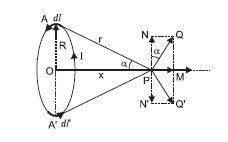
The magnetic field due to \(\overrightarrow {dl}\) is given by Biot Savart law as
\(dB=\frac {\mu_0}{4\pi}.\frac { I\left| \overrightarrow { dl } \times \overrightarrow { r } \right| }{ { r }^{ 3 } } \)
Now dBx= Db Cos \(\theta\) = \(\frac { \mu _{ 0 } }{ 4\pi } .\frac { Idl }{ \left( { x }^{ 2 }+{ R }^{ 2 } \right) } \cos { \theta } \)
\(=\frac { \mu _{ 0 } }{ 4\pi } .\frac { Idl }{ \left( { x }^{ 2 }+{ R }^{ 2 } \right) } \frac { R }{ \left( { x }^{ 2 }+{ R }^{ 2 } \right) ^{ 1/2 } } \)
So, \({ B }_{ x }=\int { dB_{ s }=\frac { { \mu }_{ 0 } }{ 4\pi } } \frac { IR }{ \left( { x }^{ 2 }+{ R }^{ 2 } \right) ^{ 3/2 } } \int { dl } \)
\(=\frac { { \mu }_{ 0 }IR^{ 2 } }{ 2\left( { x }^{ 2 }+{ R }^{ 2 } \right) ^{ 3/2 } } \)
(The y-components, of the field, add up to zero,due to symmetry)
\(\therefore\)Magnetic field at P due to a circular loop
\(=B={ B }_{ x }\overrightarrow { i } =\frac { { \mu }_{ 0 }IR^{ 2 } }{ 2\left( { x }^{ 2 }+{ R }^{ 2 } \right) ^{ 3/2 } } \overrightarrow { i } \)
Explanation: A circular current loop produces magnetic field and its magnetic moment is the product of current and its area \(\overrightarrow M=\overrightarrow {LA}\)
12.
(i) A galvanometer of range Ig and resistance G1 can be converted into
(a) a voltmeter of range V, by connecting a high resistance R in series with galvanometer whose value is given by
\(R=\frac { V }{ { I }_{ g } } -G\)
(b) an ammeter of range I, by connecting a very low resistance (shunt) in parallel with galvanometer whose value is given by
\(S=\frac { { I }_{ g }G }{ I-{ I }_{ g } } -G\)
Thus, the nature of force is attractive.
When direction of flow of current is in opposite direction, the nature of force becomes repulsive.
13.
Current sensitivity, \({ I }_{ s }=\frac { NAB }{ k } \) and
Voltage sensitivity, \(V_{ s }=\frac { NAB }{ kR } \)
Since, the resistance of the coil may vary, it implies an increase in current sensitivity may not necessarily increase voltage sensitivity.
Thus, the trajectory of both the particles will be same.
14.
\(\text { Given: } G=100 \Omega ; I_{\mathrm{g}}=10^{-3} \mathrm{~A} ; I=1 \mathrm{~A} ; S=?\)
\(\therefore \ S=\frac{1_{g} G}{I-I_{g}}=\frac{10^{-3} \times 100}{1-10^{-3}}=0.1 \Omega\)
15.
Electric dipole moment is a measurement of the strength of electric dipole. It is given by \(\vec{p}=q(\overrightarrow{2 a})\) cm, where \(\vec{p}\) is the electric dipole moment and 2a is the separation between the charges. It is a vector quantity directed from negative to positive charge on the line joining them.
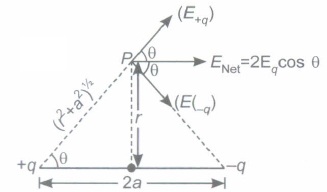
Let the dipole be made of two equal and opposite charges +q and -q, separated by 2a. Consider a point P at a distance r from the mid-point. Field at P due to each charge will be of equal magnitude \(\left|\vec{E}_{\pm q}\right|=\frac{k q}{\left(r^{2}+a^{2}\right)}\) pointing as shown.
Resolving electric fields due to two charges. We can see that Y-axis components get cancelled out.
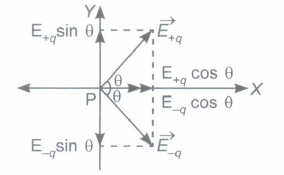
∴ Net field at P,E = 2Eq cos θ
\( E= \frac{2 k q}{\left(r^{2}+a^{2}\right)} \cdot \frac{a}{\left(r^{2}+a^{2}\right)^{1 / 2}} \)
\(= \frac{2 a q k}{\left(r^{2}+a^{2}\right)^{3 / 2}}=\frac{k p}{\left(r^{2}+a^{2}\right)^{3 / 2}} \)
\(\left(\because \cos \theta=\frac{a}{\left(r^{2}+a^{2}\right)^{1 / 2}}\right)\)
(pointing anti-parallel to dipole moment)
If r >> a, i.e. a2 can be neglected in comparison to r2.
\(\therefore \ E=\frac{k p}{r^{3}}\) (anti-parallel to \(\vec{p}\))
16.
Given, p = 4 \(\times\)10-9 C-m, E = 5 \(\times\) 104,
\(\theta\) = 30°
\(\therefore\) \(\tau\) = pE sin \(\theta\)
= 4 \(\times\)10-9 \(\times\)5 \(\times\)104 \(\times\)sin 30°
\(=4\times 10^{-9}\times 5\times 10^{4}\times \frac{1}{2}\) [\(\because\)sin 30° =\(\frac{1}{2}\)]
= 10 \(\times\)10-5 = 10-4 N-m
17.
The force, on a wire of length I,carrying a current I, in a magneticfield \(\overrightarrow { B } \) is given by \(\overrightarrow { F } =\left( \overrightarrow { l } \times \overrightarrow { B } \right) \) For a rectangular loop, places as shown, in a magnetic field \(\overrightarrow { B } \)
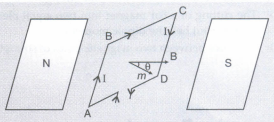
|Force on arm BCI = IForce on arm DAI = l/Bsin \(\alpha\)
Where \(\alpha\)=angle between side BC and \(\overrightarrow { B } \)
These two forces add up to zero as they are collinear (along the axis of the coil) and act in opposite directions
|Force on arm ABI = IForce on arm CDI = IbB
These two equal and opposite forces are not collinear. The perpendicular distance between their lines of action is, as shown
\(2\times\frac{a}{2}sin\theta=a sin\theta\)
Torque acting on the coil, has a magnitude \(\tau \) where
\(\tau \)=(lbB)x(a sin \(\theta\))=IAB sin \(\theta\) (A=ab=Area of the coil)
In vector form, \(\overrightarrow { \tau } =\overrightarrow { A } \times \overrightarrow { B } \)
But \(I\overrightarrow { A } \)=\(\overrightarrow { m } \), as given
\(\overrightarrow { \tau } =\overrightarrow { m } \times \overrightarrow { B } \)
18.
(i) The required expression for the face is
F = q (v x B) = q vB sinθ
Expression for magnetic field is,
\(\overrightarrow F=q(\overrightarrow v \times \overrightarrow B)\)
If \(\overrightarrow v\) and \(\overrightarrow B\) both are normal to each other, then
F = qvB.
Now if q = 1, v = 1, then F = B
Hence, the magnetic field at a point is equal to the force which a unit charge experiences when it enters with unit velocity in a direction normal to the direction of the magnetic field at that point. In S.I system, unit of magnetic field is weber/metre-2 (Wbm-2)or tesla (T) or newton per ampere per metre (NA-1m-1).
(ii) Consider the segment of a conductor given in below figure.
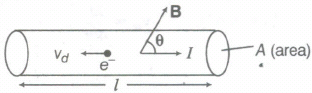
Let the number of electrons per unit volume of the conductor is n; the drift speed of electron inside the conductor is Vd and the magnetic field is B.
Then, Lorentz magnetic force, f = -e(Vd х B)
∴ Force on all the mobile electrons of the conductor F = f.nAl = -nAle(Vd х B)
or F = l(l х B) = IlB sinθ
This is the expression for the force experienced by current carrying wire.
19.
(c): Since \(d B \propto \sin \theta\) where \(\theta\) is angle between the direction of the flow of current and the line joining the elementary portion to the observation point which is zero in this case, so the magnetic field is also zero (because \(\sin \theta\) is equal to zero).
20.
(c): A body becomes negatively charged only when some electrons are transferred to the body i.e. the body gains some electrons. Hence its mass increases slightly. Mass of a body decreases only when body gives some electrons to some other body.

12th Standard CBSE Syllabus & Materials
12th Standard CBSE
CBSE 12th Computer Science Python Revision Tour I - New Previous year Question Papers Study Material - QB365 Set A
NEW12th Standard CBSE
CBSE 12th Business Studies Planning Important Questions And Answers Study Material - QB365 Set A
NEW12th Standard CBSE
CBSE 12th Business Studies Business Environment Important Questions And Answers Study Material - QB365 Set A
NEW12th Standard CBSE
CBSE 12th Business Studies Principles of Management Important Questions And Answers Study Material - QB365 Set A



NCERT Books

Syllabus

Exam Pattern

Sample Question Papers

Previous year Question Papers

Important Notes

MCQ Practice test

NCERT Exemplers

Case study Questions

Image Based Questions

Passage based Questions

HOT Questions

Value Based Questions

Model Questions Papers
NCERT ( Book Back ) Questions

Assertion and Reason
Important Questions And Answers

CBSE 12th Standard CBSE Subjects
CBSE Standards








