
 100% FREE ACCESS
12th Standard CBSE Syllabus & Materials
12th Standard CBSE
CBSE 12th Economics Government Budget and the Economy Previous year Question Papers Study Material - QB365 Set A
NEW12th Standard CBSE
CBSE 12th Computer Science Interface Python with MySQL - New Previous year Question Papers Study Material - QB365 Set A
NEW12th Standard CBSE
CBSE 12th Computer Science Database Concept - New Previous year Question Papers Study Material - QB365 Set A
NEW12th Standard CBSE
CBSE 12th Computer Science Data Communication - New Previous year Question Papers Study Material - QB365 Set A
NEW12th Standard CBSE
CBSE 12th Computer Science Data Structures - New Previous year Question Papers Study Material - QB365 Set A
NEW12th Standard CBSE
CBSE 12th Computer Science Functions - New Previous year Question Papers Study Material - QB365 Set A

Published on: 25/10/2025
Download CBSE Class 12th Standard CBSE Physics question papers, sample papers, important questions, and previous year solved papers in PDF format. Get free study materials, NCERT solutions, and exam preparation resources for Class 12th Standard CBSE Physics
Questions + Answers key
Take MCQ Physics Test
1.
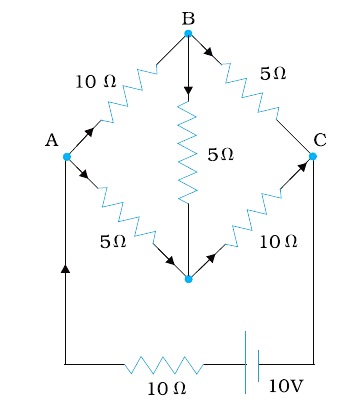
Determine the current in each branch of the network shown in Figure
2.
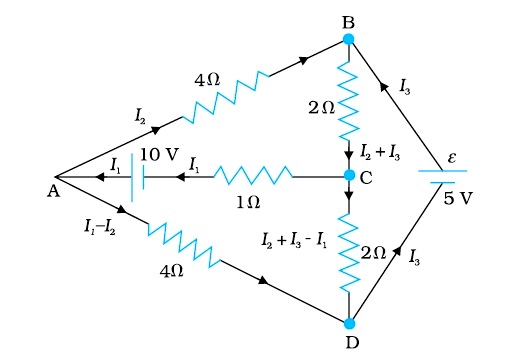
Determine the current in each branch of the network shown in Figure.
3.
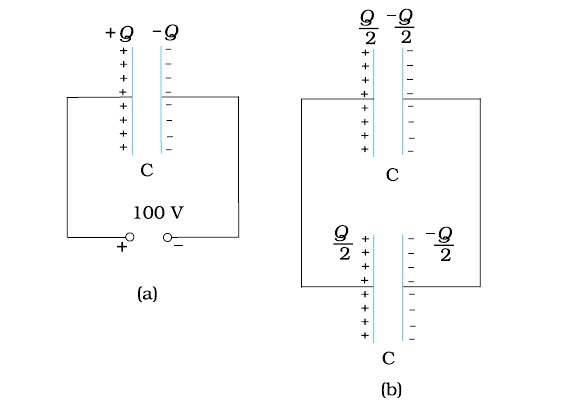
(a) A 900 pF capacitor is charged by 100 V battery [Fig(a)]. How much electrostatic energy is stored by the capacitor?
(b) The capacitor is disconnected from the battery and connected to another 900 pF capacitor [Fig.b)]. What is the electrostatic energy stored by the system?
4.
Two charges 3 x 10⁻⁸ C and –2 x 10⁻⁸ C are located 15 cm apart. At what point on the line joining the two charges is the electric potential zero? Take the potential at infinity to be zero.
5.
Consider a uniform electric field E = 3 x 10³ \(\hat{i}\) N/C.
(a) What is the flux of this field through a square of 10 cm on a side whose plane is parallel to the yz plane?
(b) What is the flux through the same square if the normal to its plane makes a 60° angle with the x-axis?
6.
A system has two charges qA = 2.5 x 10⁻⁷ C and qB = –2.5 x 10⁻⁷ C located at points A: (0, 0, –15 cm) and B: (0,0, +15 cm), respectively. What are the total charge and electric dipole moment of the system?
7.
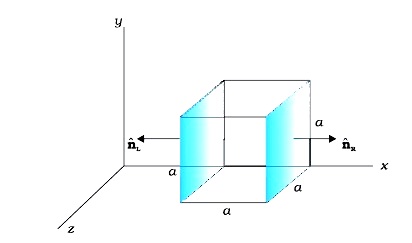
The electric field components in Fig are Ex = \(\alpha \)x1/2, Ey = Ez = 0, in which \(\alpha \) = 800 N/C m1/2. Calculate (a) the flux through the cube, and (b) the charge within the cube. Assume that a = 0.1 m.
8.
Three capacitors of capacitance 2pF, 3pF and 4pF are connected in parallel.
(a) What is the total capacitance of the combination?
(b) Determine the charge on each capacitor, if the combination is connected to a 100 V supply.
9.
A heating element using nichrome connected to a 230 V supply draws an initial current of 3.2 A which settles after a few seconds to a steady value of 2.8 A. What is the steady temperature of the heating element if the room temperature is \({ 27.0 }^{ \circ }C\)? Temperature coefficient of resistance of nichrome averaged over the temperature range involved is \(1.70\times { 10 }^{ -4\circ }{ C }^{ -1 }\)?
10.
An electric toaster uses nichrome for its heating element. When a negligibly small current passes through it, its resistance at room temperature (27.0 °C) is found to be 75.3 Ω. When the toaster is connected to a 230 V supply, the current settles, after a few seconds, to a steady value of 2.68 A. What is the steady temperature of the nichrome element? The temperature coefficient of resistance of nichrome averaged over the temperature range involved, is 1.70 x 10⁻⁴ °C-1.
11.
(a) Determine the electrostatic potential energy of a system consisting of two charges 7 μC and –2 μC (and with no external field) placed at (–9 cm, 0, 0) and (9 cm, 0, 0) respectively.
(b) How much work is required to separate the two charges infinitely away from each other?
(c) Suppose that the same system of charges is now placed in an external electric field E = A (1/r 2); A = 9 x 10⁵ NC-1 m2. What would the electrostatic energy of the configuration be?
12.
A conducting sphere of radius 10 cm has an unknown charge. If the electric field 20 cm from the centre of the sphere is 1.5 x 10³ N/C and points radially inwards, what is the net charge on the sphere ?
13.
A point charge of 2.0 μC is at the centre of a cubic Gaussian surface 9.0 cm on edge. What is the net electric flux through the surface?
14.
The number density of free electrons in a copper conductor estimated is \(8.5\times { 10 }^{ 28 }{ m }^{ -3 }\). How long does an electron take in drifting from one end of a wire 3.0m long to its other end? The area of cross-section of the wire is \(2.0\times { 10 }^{ -6 }{ m }^{ 2 }\) and it is carrying a current of 3.0 A.
1.
Current flowing through various branches of the circuit is represented in the given figure.
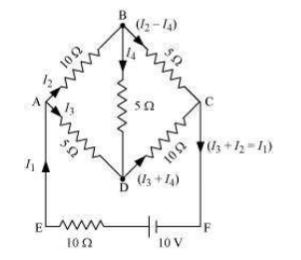
I1 = Current flowing through the outer circuit
I2 = Current flowing through branch AB
I3 = Current flowing through branch AD
I2 - I4 = Current flowing through branch BC
I3 + I4 = Current flowing through branch CD
I4 = Current flowing through branch BD
For the closed circuit ABDA, potential is zero i.e.,
10I2 + 5I4 - 5I3 = 0
2I2 + I4 - I3 = 0
I3 = 2I2 + I4 … (1)
For the closed circuit BCDB, potential is zero i.e.,
5(I2 - I4) - 10(I3 + I4) - 5I4 = 0
5I2 + 5I4 - 10I3 - 10I4 - 5I4 = 0
5I2 - 10I3 - 20I4 = 0
I2 = 2I3 + 4I4 … (2)
For the closed circuit ABCFEA, potential is zero i.e.,
-10 + 10 (I1) + 10(I2) + 5(I2 - I4) = 0
10 = 15I2 + 10I1 - 5I4
3I2 + 2I1 - I4 = 2 … (3)
From equations (1) and (2), we obtain
I3 = 2(2I3 + 4I4) + I4
I3 = 4I3 + 8I4 + I4
- 3I3 = 9I4
- 3I4 = + I3 … (4)
Putting equation (4) in equation (1), we obtain
I3 = 2I2 + I4
- 4I4 = 2I2
I2 = - 2I4 … (5)
It is evident from the given figure that,
I1 = I3 + I2 … (6)
Putting equation (6) in equation (1), we obtain
3I2 +2(I3 + I2) - I4 = 2
5I2 + 2I3 - I4 = 2 … (7)
Putting equations (4) and (5) in equation (7), we obtain
5(- 2 I4) + 2(- 3 I4) - I4 = 2
- 10I4 - 6I4 - I4 = 2
17I4 = - 2
\(I_{4}=-\frac{2}{17} A\)
Equation (4) reduces to
I3 = - 3(I4)
\(=-3\left(-\frac{2}{17}\right)=\frac{6}{17} A\)
\(I_{2}=-2\left(I_{4}\right)\)
\(=-2\left(-\frac{2}{17}\right)=\frac{4}{17} A\)
\(I_{2}-I_{4}=\frac{4}{17}-\left(-\frac{2}{17}\right)=\frac{6}{17} A\)
\(I_{3}+I_{4}=\frac{6}{17}+\left(-\frac{2}{17}\right)=\frac{4}{17} A\)
\(I_{1}=I_{3}+I_{2}\)
\(=\frac{6}{17}+\frac{4}{17}=\frac{10}{17} A\)
Therefore, current in branch \(A B=\frac{4}{17} A\)
In branch BC \(=\frac{6}{17} A\)
In branch CD = \(-\frac{4}{17} A\)
In branch AD = \(\frac{6}{17} A\)
In branch BD = \(\left(-\frac{2}{17}\right) A\)
Total current = \(\frac{4}{17}+\frac{6}{17}+\frac{-4}{17}+\frac{6}{17}+\frac{-2}{17}=\frac{10}{17} A\)
2.
Each branch of the network is assigned an unknown current to be determined by the application of Kirchhoff’s rules. To reduce the number of unknowns at the outset, the first rule of Kirchhoff is used at every junction to assign the unknown current in each branch. We then have three unknowns I1, I2 and I3 which can be found by applying the second rule of Kirchhoff to three different closed loops. Kirchhoff’s second rule for the closed loop ADCA gives,
10 - 4(I1 - I2) + 2(I2 + I3 - I1) - I1 = 0
that is, 7I1 - 6I2 - 2I3 = 10
For the closed loop ABCA, we get
10 - 4I2 - 2 (I2 + I3) - I1 = 0
that is, I1 + 6I2 + 2I3 = 10
For the closed loop BCDEB, we get
5 - 2 (I2 + I3) - 2 (I2 + I3 - I1) = 0
that is, 2I1 - 4I2 - 4I3 = -5
Equations (3.61 a, b, c) are three simultaneous equations in three unknowns. These can be solved by the usual method to give
\(I_1=2.5 \mathrm{~A}, \quad I_2=\frac{5}{8} \mathrm{~A}, \quad I_3=1 \frac{7}{8} \quad \mathrm{~A}\)
The currents in the various branches of the network are
\(\mathrm{AB}: \frac{5}{8} \mathrm{~A}, \quad \mathrm{CA}: 2 \frac{1}{2} \mathrm{~A}, \quad \mathrm{DEB}: 1 \frac{7}{8} \mathrm{~A}\)
\(\mathrm{AD}: 1 \frac{7}{8} \mathrm{~A}, \quad \mathrm{CD}: 0 \mathrm{~A}, \quad \mathrm{BC}: 2 \frac{1}{2} \mathrm{~A}\)
It is easily verified that Kirchhoff’s second rule applied to the remaining closed loops does not provide any additional independent equation, that is, the above values of currents satisfy the second rule for every closed loop of the network. For example, the total voltage drop over the closed loop BADEB
\(5 \mathrm{~V}+\left(\frac{5}{8} \times 4\right) \mathrm{V}-\left(\frac{15}{8} \times 4\right) \mathrm{V}\)
equal to zero, as required by Kirchhoff’s second rule.
3.
(a) The charge on the capacitor is
Q = CV = 900 x 10–12 F x 100 V = 9 x 10⁻⁸ C
The energy stored by the capacitor is
= (1/2) CV2 = (1/2) QV
= (1/2) x 9 x 10–8C x 100 V = 4.5 x 10⁻⁶ J
(b) In the steady situation, the two capacitors have their positive plates at the same potential, and their negative plates at the same potential. Let the common potential difference be V′. The charge on each capacitor is then Q′ = CV′. By charge conservation, Q′ = Q/2. This implies V′ = V/2. The total energy of the system
\(=2 \times \frac{1}{2} Q^{\prime} V^{\prime}=\frac{1}{4} Q V=2.25 \times 10^{-6} \mathrm{~J}\)
Thus in going from (a) to (b), though no charge is lost; the final energy is only half the initial energy.
There is a transient period before the system settles to the situation (b). During this period, a transient current flows from the first capacitor to the second. Energy is lost during this time in the form of heat and electromagnetic radiation
4.
Let us take the origin O at the location of the positive charge. The line joining the two charges is taken to be the x-axis; the negative charge is taken to be on the right side of the origin

Let P be the required point on the x-axis where the potential is zero. If x is the x-coordinate of P, obviously x must be positive. (There is no possibility of potentials due to the two charges adding up to zero for x < 0.) If x lies between O and A, we have
\(\frac{1}{4 \pi \varepsilon_{0}}\left[\frac{3 \times 10^{-8}}{x \times 10^{-2}}-\frac{2 \times 10^{-8}}{(15-x) \times 10^{-2}}\right]=0\)
where x is in cm. That is,
\(\frac{3}{x}-\frac{2}{15-x}=0\)
which gives x = 9 cm
If x lies on the extended line OA, the required condition is
\(\frac{3}{x}-\frac{2}{x-15}=0\)
which gives
x = 45 cm
Thus, electric potential is zero at 9 cm and 45 cm away from the positive charge on the side of the negative charge. Note that the formula for potential used in the calculation required choosing potential to be zero at infinity.
5.
Electric field, E = 3 \(\times\)103 \(\hat{i}\)N/C, i.e. electric field is directed towards X-axis (due to involvement of \(\hat{i}\)).
(i) As the surface is in YZ-plane, so the area vector (normal to the square) is along X-axis.
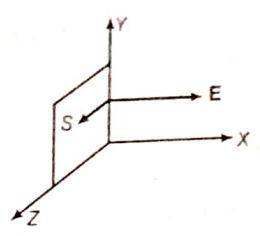
Area, S = 10 \(\times\) 10 = 100 cm2 = 10-2m2
Area vector, S = 10-2 \(\hat{i}\)m2
Using the formula of electric flux,
\(\phi\)= E.S = ES cos \(\theta\)
=ES [\(\because\) angle between E and S is 0\(\circ\)]
= 3 \(\times\)103 \(\times\)10-2 = 30 N-m2/C
(ii) Now, the area vector makes an angle of 60\(\circ\)with X-axis.
E=3\(\times\)103 \(\hat{i}\) N/C
S = 100 cm2 = 10-2 m2, \(\theta\)= 60\(\circ\)
Using the formula of electric flux,
\(\phi\)= E.S
\(\Rightarrow\) \(\phi\)=ES cos \(\theta\)= 3 \(\times\)103 \(\times\)10-2 cos 60\(\circ\)
= 3 \(\times\)10 \(\times\)\(\frac{1}{2}\)=15 N-m2/C
6.
Given, p= 4 X10⁻⁹ C-m, E= 5 x10⁴,
\( \theta =30^{\circ} \)
\(\therefore \ \tau =p E^2 \sin \theta \)
\(=4 \times 10^{-4} \times 5 \times 10^4 \times \sin 30^{\circ} \)
\(=4 \times 10^{-4} \times 5 \times 10^4 \times \frac{1}{2} \quad\left[\because \sin 30^{\circ}=\frac{1}{2}\right] \)
\(=10 \times 10^{-4}=10^{-4} \mathrm{~N}-\mathrm{m}\)
7.
Since the electric field has only an x component, for faces perpendicular to x direction, the angle between E and ΔS is ± \(\pi \)/2. Therefore, the flux φ = E.ΔS is separately zero for each face of the cube except the two shaded ones. Now the magnitude of the electric field at the left face is
EL = \(\alpha\)x1/2 = \(\alpha\)a1/2
(x = a at the left face).
The magnitude of electric field at the right face is
ER = \(\alpha\)x1/2 = \(\alpha\)(2a)1/2
(x = 2a at the right face
The corresponding fluxes are
φL= EL . ΔS = ΔS EL. \(\hat{n}\) L = EL ΔS cosθ = –EL ΔS, since θ = 180°
= – ELa2
φR = ER . ΔS = ER ΔS cosθ = ER ΔS, since θ = 0°
= ERa2
Net flux through the cube
= φR + φL = ERa2 – ELa2 = a2 (ER – EL) = \(\alpha\)a2 [(2a)1/2 – a1/2]
= \(\alpha\)a5/2 ( \(\sqrt{2}\)– 1)
= 800 (0.1)5/2 ( \(\sqrt{2}\) – 1)
= 1.05 N m2 C–1
(b) We can use Gauss’s law to find the total charge q inside the cube. We have φ = q / ε0 or q = φε0. Therefore,
q = 1.05 x 8.854 x 10–12 C = 9.27 x 10⁻¹² C.
8.
(1) Given, C1 = 2pF, C2 = 3pF and C3 = 4pF.
Equivalent capacitance for the parallel combination is given by Ceq .
Therefore, Ceq = C1 + C2 + C3 = 2 + 3 + 4 = 9pF
Hence, the total capacitance of the combination is 9pF.
(2) Supply voltage, V = 100V
The three capacitors are having the same voltage, V = 100v
q = VC
where,
q = charge
C = capacitance of the capacitor
V = potential difference
for capacitance, c = 2pF
q = 100 x 2 = 200pC = 2 x 10⁻¹⁰C
for capacitance, c = 3pF
q = 100 x 3 = 300pC = 3 x 10⁻¹⁰C
for capacitance, c = 4pF
q = 100 x 4 = 400pC = 4 x 10⁻¹⁰ C
9.
Given, potential difference = 230 V
Initial current at 27°C = I27°C = 3.2 A
Final current at t°C = It°C = 2.8 A
Room temperature = 27°C
Temperature coefficient of resistance, \(\alpha=1.70 \times 10^{-4}{ }^{\circ} \mathrm{C}^{-1}\)
Resistance at 27°C, R27°C\(=\frac{V}{I_{27^{\circ} \mathrm{C}}}=\frac{230}{3.2}=\frac{2300}{32} \Omega\)
Resistance at t°C, Rt°C = \(\frac{V}{I_{t^{\circ} \mathrm{C}}}=\frac{230}{2.8}=\frac{2300}{28} \Omega\)
Temperature coefficient of resistance
\(\begin{aligned} \alpha & =\frac{R_t-R_{27}}{R_{27}(t-27)} \end{aligned}\)
\(\begin{aligned} \Rightarrow 1.70 \times 10^{-4} & =\frac{\frac{2300}{28}-\frac{2300}{32}}{\frac{2300}{32}(t-27)} \\ \end{aligned}\)
\(\begin{aligned} \text { or } \quad t-27 & =\frac{82.143-71.875}{71.875 \times 1.70 \times 10^{-4}}=840.347 \end{aligned}\)
or t = 840.3 + 27 = 867.3 °C
Thus, the steady temperature of heating element is 867.3 °C
10.
When the current through the element is very small, heating effects can be ignored and the temperature T1 of the element is the same as room temperature. When the toaster is connected to the supply, its initial current will be slightly higher than its steady value of 2.68 A. But due to heating effect of the current, the temperature will rise. This will cause an increase in resistance and a slight decrease in current. In a few seconds, a steady state will be reached when temperature will rise no further, and both the resistance of the element and the current drawn will achieve steady values. The resistance R2 at the steady temperature T2 is
\(R_{2}=\frac{230 \mathrm{~V}}{2.68 \mathrm{~A}}=85.8 \Omega\)
Using the relation
R2 = R1 [1 + α (T2 - T1)]
with α = 1.70 x 10⁻⁴ °C-1, we get
\(T_{2}-T_{1}=\frac{(85.8-75.3)}{(75.3) \times 1.70 \times 10^{-4}}=820^{\circ} \mathrm{C}\)
that is, T2 = (820 + 27.0) °C = 847 °C
Thus, the steady temperature of the heating element (when heating effect due to the current equals heat loss to the surroundings) is 847 °C.
11.
(a) \(U=\frac{1}{4 \pi \varepsilon_{0}} \frac{q_{1} q_{2}}{r}=9 \times 10^{9} \times \frac{7 \times(-2) \times 10^{-12}}{0.18}=-0.7 \mathrm{~J}\)
(b) W = U2 – U1 = 0 – U = 0 – (–0.7) = 0.7 J.
(c) The mutual interaction energy of the two charges remains unchanged. In addition, there is the energy of interaction of the two charges with the external electric field. We find
\(q_{1} V\left(\mathbf{r}_{1}\right)+q_{2} V\left(\mathbf{r}_{2}\right)=A \frac{7 \mu \mathrm{C}}{0.09 \mathrm{~m}}+A \frac{-2 \mu \mathrm{C}}{0.09 \mathrm{~m}}\)
and the net electrostatic energy is
\(q_{1} V\left(\mathbf{r}_{1}\right)+q_{2} V\left(\mathbf{r}_{2}\right)+\frac{q_{1} q_{2}}{4 \pi \varepsilon_{0} r_{12}}=A \frac{7 \mu C}{0.09 m}+A \frac{-2 \mu C}{0.09 m}-0.7 \mathrm{~J}\)
= 70 − 20 − 0.7 = 49.3 J
12.
Let the value of unknown charge be q.
Electric field at 20 cm away, E = 1.5 \(\times\) 103 N/C
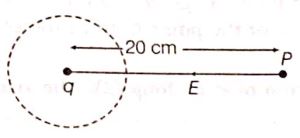
From the formula, electric field,
\(\begin{aligned} E & =\frac{1}{4 \pi \varepsilon_0} \cdot \frac{q}{r^2} \end{aligned}\)
\(\begin{aligned} \Rightarrow 1.5 \times 10^3 & =\frac{9 \times 10^9 \times \mathrm{q}}{\left(20 \times 10^{-2}\right)^2} \\ \end{aligned}\)
\(\begin{aligned} \therefore \quad q =\frac{1.5 \times 10^3 \times 20 \times 20 \times 10^{-4}}{9 \times 10^9} \\ \end{aligned}\)
\(\begin{aligned} & =6.67 \times 10^{-9} \mathrm{C} \end{aligned}\)
As the electric field is radially inwards which shows that the nature of unknown charge q is negative
\(\begin{aligned} & \mathrm{E}_i=\lim _{q_0 \rightarrow 0} \frac{\mathrm{F}_i}{q_0}=\lim _{q_0 \rightarrow 0}\left[\frac{1}{q_0}\left(\frac{1}{4 \pi \varepsilon_0} \cdot \frac{q_i q_0}{r_i^2} \hat{\mathrm{r}}_i\right)\right] \\ \end{aligned}\)
\(\begin{aligned} & \mathrm{E}_i=\frac{1}{4 \pi \varepsilon_0} \cdot \frac{q_i}{r_i^2} \hat{\mathrm{r}}_i \end{aligned}\)
If E is electric field at point P due to the system of charges, then by principle of superposition of electric fields, E = E1 + E2 + E3 + ... + En = \( \sum_{i=1}^{n}E_{i}\)
Using Eq. (i), we get \(\mathrm{E}=\sum_{i=1}^n \frac{1}{4 \pi \varepsilon_0} \cdot \frac{q_i}{r_i^2} \hat{\mathbf{r}}_i\)
or \(\mathrm{E}=\frac{1}{4 \pi \varepsilon_0} \sum_{i=1}^n \frac{q_i}{r_i^2} \hat{\mathbf{r}}_i\)
\(\therefore\) E is a vector quantity.
13.
Let us consider a charge q is placed at the centre of a cubic Gaussian surface. As per the question,
q = 2 \(\mu\)C = 2 \(\times\)10-6 C
Length of edge = 9 cm
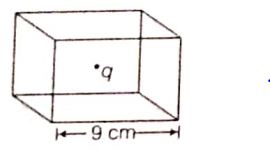
According to Gauss' theorem, the net electric flux (\(\phi\)) through the surface is given by
\(\phi=\frac{q}{\varepsilon_{0}}=\frac{2\times 10^{-6}}{8.854\times 10^{-12}} \)
= 2.26 \(\times\)105 N-m2 /C
Thus, the net electric flux through the surface is 2.26 \(\times\)105 N-m2/C.
14.
Number density of free electrons in a copper conductor, n = 8.5 x 1028 m-3 Length of the copper wire, l = 3.0 m
Area of cross-section of the wire, A = 2.0 x 10⁻⁶ m2
Current carried by the wire, I = 3.0 A, which is given by the relation,
I = nAeVd
Where,
e = Electric charge = 1.6 x 10⁻¹⁹ C
Vd = Drift velocity = \(\frac{\text { Length of the wire (l) }}{\text { Time taken to cover l(t) }}\)
\(I=n A e \frac{l}{t}\)
\(t=n A e \frac{l}{I}\)
\(=\frac{3 \times 8.5 \times 10^{28} \times 2 \times 10^{-6} \times 1.6 \times 10^{-19}}{3.0}\)
\(=2.7 \times 10^{4} s\)
Therefore, the time taken by an electron to drift from one end of the wire to the other is 2.7 x 10⁴ s.

12th Standard CBSE Syllabus & Materials
12th Standard CBSE
CBSE 12th Computer Science Python Revision Tour I - New Previous year Question Papers Study Material - QB365 Set A
NEW12th Standard CBSE
CBSE 12th Business Studies Planning Important Questions And Answers Study Material - QB365 Set A
NEW12th Standard CBSE
CBSE 12th Business Studies Business Environment Important Questions And Answers Study Material - QB365 Set A
NEW12th Standard CBSE
CBSE 12th Business Studies Principles of Management Important Questions And Answers Study Material - QB365 Set A



NCERT Books

Syllabus

Exam Pattern

Sample Question Papers

Previous year Question Papers

Important Notes

MCQ Practice test

NCERT Exemplers

Case study Questions

Image Based Questions

Passage based Questions

HOT Questions

Value Based Questions

Model Questions Papers
NCERT ( Book Back ) Questions

Assertion and Reason
Important Questions And Answers

CBSE 12th Standard CBSE Subjects
CBSE Standards








