
 100% FREE ACCESS
12th Standard CBSE Syllabus & Materials
12th Standard CBSE
CBSE 12th Economics Government Budget and the Economy Previous year Question Papers Study Material - QB365 Set A
NEW12th Standard CBSE
CBSE 12th Computer Science Interface Python with MySQL - New Previous year Question Papers Study Material - QB365 Set A
NEW12th Standard CBSE
CBSE 12th Computer Science Database Concept - New Previous year Question Papers Study Material - QB365 Set A
NEW12th Standard CBSE
CBSE 12th Computer Science Data Communication - New Previous year Question Papers Study Material - QB365 Set A
NEW12th Standard CBSE
CBSE 12th Computer Science Data Structures - New Previous year Question Papers Study Material - QB365 Set A
NEW12th Standard CBSE
CBSE 12th Computer Science Functions - New Previous year Question Papers Study Material - QB365 Set A

Published on: 25/10/2025
Download CBSE Class 12th Standard CBSE Physics question papers, sample papers, important questions, and previous year solved papers in PDF format. Get free study materials, NCERT solutions, and exam preparation resources for Class 12th Standard CBSE Physics
Questions + Answers key
Take MCQ Physics Test
1.
An electric dipole with dipole moment 4x10⁻⁹C-m is aligned at 30° with the direction of a uniform electric field of magnitude 5 x10⁻⁴ N/C. Calculate the maynitude of the torque acting on the dipole.
2.
What is the net flux of the uniform electric field through a cube of side 20 cm oriented so that its faces are parallel to the coordinate planes ?
3.
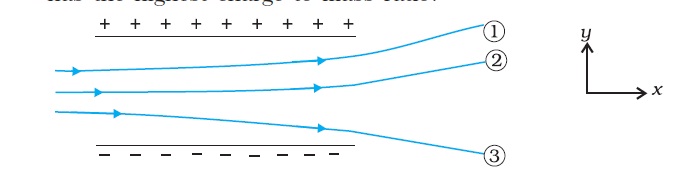
The Figure shows tracks of three charged particles in a uniform electrostatic field. Give the signs of the three charges. Which particle has the highest charge to mass ratio?
4.
An infinite line charge produces a field of 9 × 10⁴ N/C at a distance of 2 cm. Calculate the linear charge density.
5.
A conducting sphere of radius 10 cm has an unknown charge. If the electric field 20 cm from the centre of the sphere is 1.5 x 10³ N/C and points radially inwards, what is the net charge on the sphere ?
6.
A charge q is placed at the centre of the line joining two equal charges Q and Q. The system of the three charges will be ill equilibrium, if q is equal to
-Q /2
-Q/ 4
+Q/ 4
+Q/ 2
7.
Two charges + 1 \(\mu\) Cand +4\(\mu\) C are situated at a distance in air. The ratio of the forces acting on them is
1 : 4
4 : 1
1 : 1
1 : 16
8.
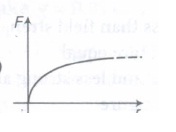
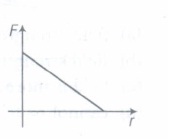
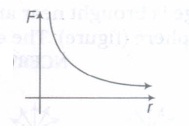
Force between two charges varies with distance between them as
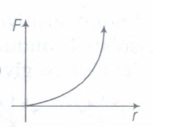
9.
SI unit of electrical permittivity is
N-m 2C-2
Am -2
NC-1
C2N-1m-2
10.
Number of electrons present in a negative charge of 8 C is ____________
5 x10¹⁹
2.5 x 10¹⁹
12.8 x 10¹⁹
1.6 x 10¹⁹
11.
In 1909, Robert Millikan was the first to find the charge of an electron in his now-famous oil-drop experiment. In that experiment, tiny oil drops were sprayed into a uniform electric field between a horizontal pair of oppositely charged plates. The drops were observed with a magnifying eyepiece, and the electric field was adjusted so that the upward force on some negatively charged oil drops was just sufficient to balance the downward force of gravity. That is, when suspended, upward force qE just equaled Mg. Millikan accurately measured the charges on many oil drops and found the values to be whole number multiples of 1.6 x 10⁻¹⁹ C the charge of the electron. For this, he won the Nobel prize.
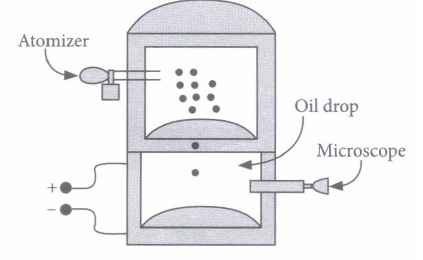
(i) If a drop of mass 1.08 x 10⁻¹⁴ kg remains stationary in an electric field of 1.68 x 10⁵ N C-I, then the charge of this drop is
| (a) 6.40 x 10⁻¹⁹ C | (b) 3.2 x 10⁻¹⁹ C |
| (c) 1.6 X 10⁻¹⁹ C | (d) 4.8 x 10⁻¹⁹ C |
(ii) Extra electrons on this particular oil drop (given the presently known charge of the electron) are
| (a) 4 | (b) 3 | (c) 5 | (d) 8 |
(iii) A negatively charged oil drop is prevented from falling under gravity by applying a vertical electric field 100 V m-1.If the mass of the drop is 1.6 X 10⁻³ g, the number of electrons carried by the drop is (g= 10 m s-2)
| (a) 1018 | (b) 1015 | (c) 1012 | (d) 109 |
(iv) The important conclusion given by Millikan's experiment about the charge is
| (a) charge is never quantized | (b) charge has no definite value |
| (c) charge is quantized | (d) charge on oil drop always increases. |
(v) If in Millikan's oil drop experiment, charges on drops are found to be \(8 \mu \mathrm{C}, 12 \mu \mathrm{C}, 20 \mu \mathrm{C}\) then quanta of charge is
| \(\text { (a) } 8 \mu \mathrm{C}\) | \(\text { (b) } 20 \mu \mathrm{C}\) | \(\text { (c) } 12 \mu \mathrm{C}\) | \(\text { (d) } 4 \mu \mathrm{C}\) |
12.
When a charged particle is placed in an electric field, it experiences an electrical force. If this is the only force on the particle, it must be the net force. The net force will cause the particle to accelerate according to Newton's second law. So
\(\vec{F}_{e}=q \vec{E}=m \vec{a}\)
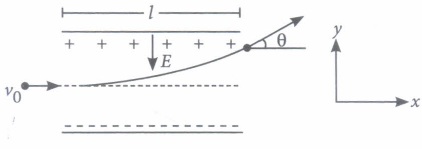
If \(\vec{E}\) is uniform, then \(\vec{a}\) is constant and \(\vec{a}=q \vec{E} / m\). If the particle has a positive charge, its acceleration is in the direction of the field. If the particle has a negative charge, its acceleration is in the direction opposite to the electric field. Since the acceleration is constant, the kinematic equations can be used.
(i) An electron of mass m, charge e falls through a distance h metre in a uniform electric field E. Then time of fall,
| \(\text { (a) } t=\sqrt{\frac{2 h m}{e E}}\) | \(\text { (b) } t=\frac{2 h m}{e E}\) | \(\text { (c) } t=\sqrt{\frac{2 e E}{h m}}\) | \(\text { (d) } t=\frac{2 e E}{h m}\) |
(ii) An electron moving with a constant velocity v along X-axis enters a uniform electric field applied along Y-axis. Then the electron moves.
| (a) with uniform acceleration along Y-axis | (b) without any acceleration along Y-axis |
| (c) in a trajectory represented as y = ax2 | (d) in a trajectory represented as y = ax |
(iii) Two equal and opposite charges of masses ml and m2 are accelerated in an uniform electric field through the same distance. What is the ratio of their accelerations if their ratio of masses is \(\frac{m_{1}}{m_{2}}=0.5 ?\)
| \(\text { (a) } \frac{a_{1}}{a_{2}}=2\) | \(\text { (b) } \frac{a_{1}}{a_{2}}=0.5\) | \(\text { (c) } \frac{a_{1}}{a_{2}}=3\) | \(\text { (d) } \frac{a_{1}}{a_{2}}=1\) |
(iv) A particle of mass m carrying charge q is kept at rest in a uniform electric field E and then released. The kinetic energy gained by the particle, when it moves through a distance y is
| \(\text { (a) } \frac{1}{2} q E y^{2}\) | \(\text { (b) } q E y\) | \(\text { (c) } q E y^{2}\) | \(\text { (d) } q E^{2} y\) |
(v) A charged particle is free to move in an electric field. It will travel
| (a) always along a line of force |
| (b) along a line of force, if its initial velocity is zero |
| (c) along a line of force, if it has some initial velocity in the direction of an acute angle with the line of force |
| (d) none of these. |
1.
Here , q = 25 x10-9C, 2a =6 m, r=4 m,
p=q(2a)= 25x10-9x 6 = 1.5 x10⁻⁷ C-m
i) \( E_{\text {axil }}=\frac{1}{4 \pi \varepsilon_0} \cdot \frac{2 p r}{\left(r^2-a^2\right)^2} \)i
Now, \(=\frac{9 \times 10^9 \times 2 \times 1.5 \times 10^{-7} \times 4}{\left(4^2-3^2\right)^2}=\frac{2700 \times 4}{49} \)
\(=220.4 \mathrm{NC}^{-1} \)
ii)\( \therefore E_{\text {equitorial }}=\frac{1}{4 \pi \varepsilon_0} \cdot \frac{p}{\left(r^2+a^2\right)^{3 / 2}} =\frac{9 \times 10^9 \times 1.5 \times 10^{-7}}{\left(4^2+3^2\right)^{3 / 2}}=\frac{1350}{125}=10.8 \mathrm{~N} \mathrm{C}^{-1} \)
2.
As we know that, the number of field lines entering in the cube is the same as that the number of field lines leaving the cube So, no flux is remained on the cube and hence, the net flux over the cube is zero.
3.
Opposite charges attract each other and same charges repel each other. It can be observed that particles 1 and 2 both move towards the positively charged plate and repel away from the negatively charged plate. Hence, these two particles are negatively charged. It can also be observed that particle 3 moves towards the negatively charged plate and repels away from the positively charged plate. Hence, particle 3 is positively charged.
The charge to mass ratio (emf) is directly proportional to the displacement or amount of deflection for a given velocity. Since the deflection of particle 3 is the maximum, it has the highest charge to mass ratio.
4.
Here, E = 9 \(\times\)104 N/C, r = 2 cm = 2 \(\times\)10-2 m and \(\lambda\)= ?
As, \(E=\frac{\lambda}{2\pi \varepsilon _{0}r}\Rightarrow \lambda =2\pi \varepsilon _{0}rE\)
\(=\frac{1}{2\times 9\times 10^{9}}\times 2\times 10^{-2}\times 9\times 10^{4}=10^{-7}Cm^{-1}\)
5.
Let the value of unknown charge be q.
Electric field at 20 cm away, E = 1.5 \(\times\) 103 N/C
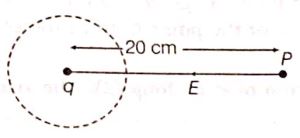
From the formula, electric field,
\(\begin{aligned} E & =\frac{1}{4 \pi \varepsilon_0} \cdot \frac{q}{r^2} \end{aligned}\)
\(\begin{aligned} \Rightarrow 1.5 \times 10^3 & =\frac{9 \times 10^9 \times \mathrm{q}}{\left(20 \times 10^{-2}\right)^2} \\ \end{aligned}\)
\(\begin{aligned} \therefore \quad q =\frac{1.5 \times 10^3 \times 20 \times 20 \times 10^{-4}}{9 \times 10^9} \\ \end{aligned}\)
\(\begin{aligned} & =6.67 \times 10^{-9} \mathrm{C} \end{aligned}\)
As the electric field is radially inwards which shows that the nature of unknown charge q is negative
\(\begin{aligned} & \mathrm{E}_i=\lim _{q_0 \rightarrow 0} \frac{\mathrm{F}_i}{q_0}=\lim _{q_0 \rightarrow 0}\left[\frac{1}{q_0}\left(\frac{1}{4 \pi \varepsilon_0} \cdot \frac{q_i q_0}{r_i^2} \hat{\mathrm{r}}_i\right)\right] \\ \end{aligned}\)
\(\begin{aligned} & \mathrm{E}_i=\frac{1}{4 \pi \varepsilon_0} \cdot \frac{q_i}{r_i^2} \hat{\mathrm{r}}_i \end{aligned}\)
If E is electric field at point P due to the system of charges, then by principle of superposition of electric fields, E = E1 + E2 + E3 + ... + En = \( \sum_{i=1}^{n}E_{i}\)
Using Eq. (i), we get \(\mathrm{E}=\sum_{i=1}^n \frac{1}{4 \pi \varepsilon_0} \cdot \frac{q_i}{r_i^2} \hat{\mathbf{r}}_i\)
or \(\mathrm{E}=\frac{1}{4 \pi \varepsilon_0} \sum_{i=1}^n \frac{q_i}{r_i^2} \hat{\mathbf{r}}_i\)
\(\therefore\) E is a vector quantity.
6.
(b)
-Q/ 4
7.
(c)
1 : 1
8.
(c)
9.
(d)
C2N-1m-2
10.
(a)
5 x10¹⁹
11.
(i) (a): As, \(q E=m g \Rightarrow q=\frac{1.08 \times 10^{-14} \times 9.8}{1.68 \times 10^{5}}\)
\(=6.4 \times 10^{-19} \mathrm{C}\)
(ii) (a): \(q=n e \text { or } \Rightarrow n=\frac{6.4 \times 10^{-19}}{1.6 \times 10^{-19}}=4\)
(iii) (c) : For the drop to be stationary,
Force on the drop due to electric field = Weight of the drop
qE=mg
\(q=\frac{m g}{E}=\frac{1.6 \times 10^{-6} \times 10}{100}=1.6 \times 10^{-7} \mathrm{C}\)
Number of electrons carried by the drop is
\(n=\frac{q}{e}=\frac{1.6 \times 10^{-7} \mathrm{C}}{1.6 \times 10^{-19} \mathrm{C}}=10^{12}\)
(iv) (c)
(v) (d): Millikan's experiment confirmed that the charges are quantized, i.e., charges are small integer multiples of the base value which is charge on electron. The charges on the drops are found to be multiple of 4. Hence, the quanta of charge is 4 \(\mu \)C.
12.
(i) (a): From Newton's law
\(F=m \vec{a} \text { or } q E=m \vec{a} \Rightarrow a=\frac{q E}{m}=\frac{e E}{m}\)
Using, \(s=u t+\frac{1}{2} a t^{2}\)
\(\therefore \quad h=0+\frac{1}{2} \times \frac{e E}{m} t^{2} \Rightarrow t=\sqrt{\frac{2 h m}{e E}}\)
(ii) (c)
(iii) (b): Force is same in magnitude for both.
\(\therefore \quad m_{1} a_{1}=m_{2} a_{2}\)
\(\frac{a_{1}}{b_{2}}=\frac{m_{2}}{m_{1}}=\frac{1}{0.5}=2\)
(iv) (b): Here \(u=0 ; a=\frac{q E}{m} ; s=y\)
Using, \(v^{2}-u^{2}=2 a s \Rightarrow v^{2}=2 \frac{q E}{m} y\)
\(\therefore \quad \mathrm{K.E.}=\frac{1}{2} m v^{2}=q E y\)
(v) (b): If charge particle is put at rest in electric field, then it will move along line of force.

12th Standard CBSE Syllabus & Materials
12th Standard CBSE
CBSE 12th Computer Science Python Revision Tour I - New Previous year Question Papers Study Material - QB365 Set A
NEW12th Standard CBSE
CBSE 12th Business Studies Planning Important Questions And Answers Study Material - QB365 Set A
NEW12th Standard CBSE
CBSE 12th Business Studies Business Environment Important Questions And Answers Study Material - QB365 Set A
NEW12th Standard CBSE
CBSE 12th Business Studies Principles of Management Important Questions And Answers Study Material - QB365 Set A



NCERT Books

Syllabus

Exam Pattern

Sample Question Papers

Previous year Question Papers

Important Notes

MCQ Practice test

NCERT Exemplers

Case study Questions

Image Based Questions

Passage based Questions

HOT Questions

Value Based Questions

Model Questions Papers
NCERT ( Book Back ) Questions

Assertion and Reason
Important Questions And Answers

CBSE 12th Standard CBSE Subjects
CBSE Standards








