
 100% FREE ACCESS
12th Standard CBSE Syllabus & Materials
12th Standard CBSE
CBSE 12th Economics Government Budget and the Economy Previous year Question Papers Study Material - QB365 Set A
NEW12th Standard CBSE
CBSE 12th Computer Science Interface Python with MySQL - New Previous year Question Papers Study Material - QB365 Set A
NEW12th Standard CBSE
CBSE 12th Computer Science Database Concept - New Previous year Question Papers Study Material - QB365 Set A
NEW12th Standard CBSE
CBSE 12th Computer Science Data Communication - New Previous year Question Papers Study Material - QB365 Set A
NEW12th Standard CBSE
CBSE 12th Computer Science Data Structures - New Previous year Question Papers Study Material - QB365 Set A
NEW12th Standard CBSE
CBSE 12th Computer Science Functions - New Previous year Question Papers Study Material - QB365 Set A

Published on: 25/10/2025
Download CBSE Class 12th Standard CBSE Physics question papers, sample papers, important questions, and previous year solved papers in PDF format. Get free study materials, NCERT solutions, and exam preparation resources for Class 12th Standard CBSE Physics
Questions + Answers key
Take MCQ Physics Test
1.
Transformer A has a primary voltage Ep and a secondary voltage Es. Transformer B has twice the number of turns on both its primary and secondary coils compared with transformer A If the primary voltage on transformer B is 2Ep, what is its secondary voltage? Explain briefly.
2.
What are permanent magnets? Give one example.
3.
In a series L-C-R circuit connected to an AC source of variable frequency and voltage \(V\ =\ { V }_{ m }\ sin\ \omega t\), draw a plot showing the variation of current I with angular frequency \(\omega \), for two different values of resistance R1and R2(R1>R2). Write the condition under which the phenomenon of resistance occurs. For which value of the resistance out of the two curves, a sharper resonance is produced? Define Q-factor of the circuit and give its significance.
4.
A uniform magnetic field B is set up along the positive X-axis. A particle of charge q and mass m moving with a velocity v enters the field at the origin in XY-plane such that it has velocity components both along and perpendicular to the magnetic field B. Trace, giving reason, the trajectory followed by the particle. Find out the expression for the distance moved by the particle along the magnetic field in one rotation.
5.
A motor runs at 220 V. The resistance of the armature is 11 ohm. If the back emf produced is 198 V, when at full speed, then calculate the current through armature, when
(i) motor is just switched on and
(ii) motor is at full speed.
6.
State the condition under which resonance occurs in LCR circuit?
7.
A jet plane is travelling west at 450 m/s. If the horizontal component of earth's magnetic field at that place is \(4 \times { 10 }^{ -4 }\) T and the angle of dip is \({ 30 }^{ \circ }\), find the e.m.f. induced between the ends of wings having a span of 30 m.
8.
Figures ahead show three different orientations of a circuit coil taking in the magnetic field between the poles of a horse-shoe magnet.
(a) Determine the directions of induced current in the coil if the rotation is anticlockwise as viewed by the reader.
(b) In which orientation during rotation (with uniform angular speed) is the induced e.m.f. greatest?
9.
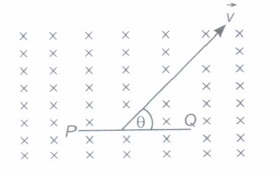
A rod PQ of length I is moved in uniform magnetic field \(\vec{B}\) as shown. What will be the emf induced in it?
10.
A 40 Ohm resistor is connected across a 15 V variable frequency electronic oscillator. Find the current through the resistor when the frequency is (a) 100 Hz and (b) 100 kHz. What is the current if the 40 Ohm resistor is replaced by a 2 mH inductor?
11.
In a series LCR circuit, obtain the conditions under which
(i) the impedance of the circuit is minimum, and
(ii) wattless current flows in the circuit.
12.
Is there a strong magnet inside the earth responsible for earth's magnetism ? If there is a magnet, what is its inclination w.r.t. to north-south direction ?
13.
Alternating current through pure inductor and pure capacitor is wattless. Why?
14.
Which physical quantity has the unit Wb/m2? Is it a scalar or a vector quantity?
15.
The inductance of a coil is 0.25H. Calculate its inductive reactance in a.c. of frequency 50 Hz.
16.
What causes sparking in the switches when light is put off ?
17.
A series CR circuit with R= 200 \(\Omega\) and C=(50/\(\pi \)) \(\mu\)F is connected across an AC source of peak voltage Eo =100V and frequency V= 50 Hz. Calculate (i) impedance of the circuit (Z), (ii) phase angle (0) and (iii) voltage across the resistor
18.
(i) Explain the meaning of the term mutual inductance. Consider two concentric circular coils, one of the radius r1 and the other of radius r2(r1 < r2) placed coaxially with centres coinciding with each other. Obtain the expression for the mutual inductance of the arrangement.
(ii) A rectangular coil of area A, having number of turns N is rotated at f revolutions per second in a uniform magnetic field B, the field being perpendicular to the coil. Prove that the maximum emf induced in the coil is 2πfNBA.
19.
Derive an expression for the impedance of a series LCR circuit connected to an AC supply of variable frequency.
Plot a graph showing variation of current with the frequency of the applied voltage. Explain briefly how the phenomenon of resonance in the circuit can be used in the tuning mechanism of a radio or a TV set.
20.
A cycle wheel has 12 metallic spokes, each 0.2 m long. It makes 60 revolutions in 1 minute in a plane normal to earth's magnetic field of 0.4\(\times\)104 T. Calculate the induced e.m.f. between the axle and rim of the wheel.
21.
Alternating current cannot be measured by de ammeter, because
ac cannot pass through ac ammeter
ac charges direction
average value of current of complete cycle is zero
ac ammeter will get damaged
22.
In an LCR-series ac circuit, the voltage across each of the component L, C and R is 50 V. The voltage across the LC-combination will be
50 V
\(50 \sqrt{2} \mathrm{~V}\)
100 V
zero
23.
A loop, made of straight edges has six corners at A (0, 0, 0), B (L, 0, 0), C (L, L, 0), D(0, L, 0), E (0, L, L) and F (0, 0, L). A magnetic field \(B={ B }_{ 0 }\left( \hat { i } +\hat { k } \right) T\) is present in the region. The flux passing through the loop ABCDEFA (in that order) is.
\({ B }_{ 0 }{ L }^{ 2 }Wb\)
\(2{ B }_{ 0 }{ L }^{ 2 }Wb\)
\(\sqrt { 2 } { B }_{ 0 }{ L }^{ 2 }Wb\)
\(4{ B }_{ 0 }{ L }^{ 2 }Wb.\)
24.
An electron is projected along the axis of a circular conductor carrying the same current. Electron will experIence
a force along the axis.
a force perpendicular to the axis
a force at an angle of 4° with axis
no force experienced.
25.
A polygon shaped wire is inscribed in a circle of radius R. The magnetic induction at the centre of polygon, when current flows through the wire is
\(\frac{\mu_{0} n I}{2 \pi R} \tan \left(\frac{2 \pi}{n}\right)\)
\(\frac{\mu_{0} n I}{2 \pi R} \tan \left(\frac{4 \pi}{n}\right)\)
\(\frac{\mu_{0} n I}{2 \pi R} \tan \left(\frac{\pi}{n}\right)\)
\(\frac{\mu_{0} n I}{2 \pi R} \tan \left(\frac{\pi}{n^{2}}\right)\)
26.
A square of side L metres lies in the xy-plane in a region, where the magnetic field is given by B \(=B_{0}(2 \hat{\mathbf{i}}+3 \hat{\mathbf{j}}+4 \hat{\mathbf{k}}) \mathrm{T}\), where Bo is constant. The magnitude of flux passing through the square is
\(2 B_{0} L^{2} \mathrm{~Wb}\)
\(3 B_{0} L^{2} \mathrm{~Wb}\)
\(4 B_{0} L^{2} \mathrm{~Wb}\)
\(\sqrt{29} B_{0} L^{2} \mathrm{~Wb}\)
27.
The output of a step-down transformer is measured to be 24V when connected to a 12 watt light blub. The value of the peak current is
\(1/\sqrt { 2 } A\)
\(\sqrt { 2 } A\)
2 A
\(2\sqrt { 2 } A\)
1.
Given, NpB = 2NpA NsB = 2NsA, EpB = 2EpA
As we know, \(\frac{N_{s}}{N_{p}}=\frac{E_{s}}{E_{p}}\)
For transformer B, \(\frac{N_{s B}}{N_{p B}}=\frac{2 N_{s A}}{2 N_{p A}}=\frac{E_{s B}}{E_{p B}}\)
\(\Rightarrow \quad \frac{E_{s B}}{E_{p B}}=\frac{E_{s B}}{2 E_{p A}}=\frac{E_{s A}}{E_{p A}}\)
\(\Rightarrow \quad E_{s B}=2 E_{s A}\)
\(\therefore\) Secondary voltage on transformer B is equal to the twice of secondary voltage on transformer A.
2.
Substance, which at room temperature, retain their ferromagnetic property for a long period of time are called permanent magnets. Iron, cobalt, steel and Nickel.
3.
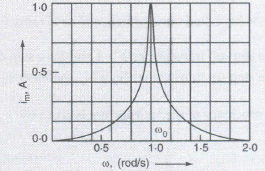
Figure shows the variation of Im with \(\omega \) in a L-C-R series circuit for two values of resistance R1 and R2(R1>R2).
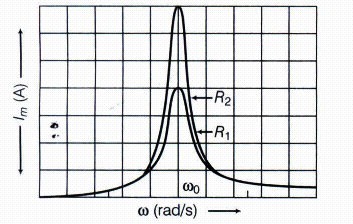
The condition for resources in the L-C-R circuit is,
XL = XC
\({ \omega }_{ 0 }L\ =\ \frac { 1 }{ { \omega }_{ 0 }C } \Rightarrow { \omega }_{ 0 }^{ 2 }=\frac { I }{ LC } \Rightarrow { \omega }_{ 0 }=\frac { 1 }{ \sqrt { LC } } \)
We see that, the current amplitude is maximum at the resonance frequency \({ \omega }_{ 0 }\) .
Since, \({ I }_{ m }=\frac { { V }_{ m } }{ R } \) ar resonance, the current amplitude for case R2
is sharper to that for case R1.
Quality factor or simply the Q-factor of a resonant L-C-R circuit is defined as the ratio of voltage drop across the capacitor (or inductor) to that of applied voltage.
It is given by \(Q=\frac { 1 }{ R } \sqrt { \frac { L }{ C } } \)
The Q-factor determines the sharpness of the resonance curve and if the resonance is less sharp, not only the maximum current becomes less, but also the circuit will be closed to the resonance for a larger range \(\triangle \omega \) frequencies and the tuning of the circuit will not be good. So, less sharp the resonance, less in the selectivity of the circuit while higher is the Q, sharper is the resonance curve and lesser will be loss in energy of the circuit.
4.
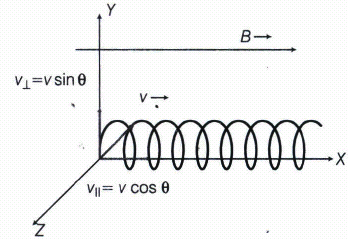
The path of the charged particle will be helix. As, the charge moves linearly in the direction of the magnetic field with velocity v \(\cos { \theta } \) and also describe the circular path due to velocity v \(\sin { \theta } \)
Time taken by the charge to complete one circular rotation,
\(T=\frac { 2\pi r }{ { v }_{ \bot } } \) ......(i)
\(\Rightarrow\) \(\\ f=q{ v }_{ \bot }B\)
and \(\\ \frac { m{ { v }^{ 2 } }_{ \bot } }{ r } =q{ v }_{ \bot }B\)
\(\Rightarrow \ \frac{v_{\perp} m}{q B}=r\) .....(ii)
From Eqs. (i) and (ii), we get
\(\Rightarrow T=\frac { 2\pi { v }_{ \bot }m }{ qB.{ v }_{ \bot } } =\frac { 2\pi m }{ Bq }\)
Distance moved by the particle along the magnetic field in one rotation (pitch of the helix path)
\(={ v }_{ || }\times T \ (\because { v }_{ || }={ v }_{ parallel })\)
\(\\ =v\cos { \theta \times \frac { 2\pi m }{ Bq } } \)
\(\\ p=\frac { 2\pi mv\cos { \theta } }{ qB } \\ \\\)
5.
Here, \(V=220 \ V, \ R=11\Omega , \ E=198V\)
Current at full speed \(I=\frac { V-E }{ R } \)
\(=\frac { 220-198 }{ 11 } =\frac { 22 }{ 11 } =2A\)
When motor is just switched on, \(E=0\)
\(\therefore d I=\frac { V }{ R } =\frac { 220 }{ 11 } =20 \ A\)
6.
In LCR circuit, resonance occurs, when \({ X }_{ L }={ X }_{ C }or{ V }_{ L }={ V }_{ C }.\) The resonance frequency is \({ v }_{ r }=\frac { 1 }{ 2\pi \sqrt { LC } } .\)
7.
e = 3.12 V
\({ Here,\upsilon =450m/s,H=4 \times { 10 }^{ -4 }T, }\)
\( \delta ={ 30 }^{ \circ },l=30m\)
A jet plane flying horizontally intercepts vertical component (V) of earth's magnetic field.
\(\therefore B=V=H \ tan\delta =4 \times { 10 }^{ -4 }tan{ 30 }^{ \circ }\)
\(=\frac { 4 \times { 10 }^{ -4 } }{ \sqrt { 3 } } T\)
\( e=B/\upsilon\)
\(e=\frac { 4 }{ \sqrt { 3 } } \times { 10 }^{ -4 } \times 30 \times 450 \ V=3.12 \ volt\)
8.
(a) (i) Induced current along abcda (Using FLH Rule).
(ii) Induced current along same direction i.e. abcda
(iii) Induced current zero (the loop is normal to the field lines.)
(b) Induced e.m.f. greatest (loop is parallel to field).
-S.png)
-S.png)
-S.png)
9.
e = Blv sin θ
10.
With resistor, current is same both for 100 Hz and 100 kHz. With inductor, the current is 11.9 A and 11.9 mA respectively
11.
Impedance of series LCR circuit is given by \(Z=\sqrt { { R }^{ 2 }+({ X }_{ L }-{ X }_{ C })^{ 2 } } \)
or For Z to be minimum, \({ X }_{ L }={ X }_{ e }(or\omega =\frac { 1 }{ \sqrt { LC } } )\)
For wattless current to flow, circuit should not have any ohmic resitance R = 0
Alternatively : Power = \({ V }_{ rms }{ I }_{ rms }cos\phi \)
\(\phi ={ 90 }^{ 0 }=\frac { \pi }{ 2 } \)
Power = 0
12.
Actually there is no permanent strong magnet inside the earth responsible for earth's magnetism, Dr. Gilbert considered a fictitious strong magnet inside the earth, whose magnetic axis is inclined roughly 11.3o west of axis of rotation of earth, which is along geographic north and geographic south.
13.
Through pure inductor or pure capacitor, phase diff.between alternating voltage and alternating current is \({ 90 }^{ \circ }.\) Therefore, power factor, \(cos\phi =cos{ 90 }^{ \circ }=0.\)
Hence the current is said to be wattless.
14.
Wb/m2 is the SI unit of magnetic field induction B, which is a vector quantity.
15.
\(X_L=\omega L=2 \pi \nu L=2 \pi \times 50 \times 0.25\)
\(=25 \pi \mathrm{ohm}\)
16.
Large induced e.m.f. at break causes the sparking.
17.
\(R =200 \Omega \)
\(C =\frac{50}{\pi} \times 10^{-6} \mathrm{~F} \)
\(E_0 =100 \mathrm{~V} \)
\( f =50 \mathrm{~Hz} \)
i) Capacitive reactance, Xc \(=\frac{1}{\omega C}=\frac{1}{2 \pi f C}\)
\( =\frac{1}{2 \times 3.14 \times 50 \times \frac{50}{\pi} \times 10^{-6}} \)
\(=\frac{10^6}{2 \times 2500}=\frac{10^6}{5000}=\frac{1000000}{5000}=200 \Omega \)
\(Z =\sqrt{X_C^2+R^2}=\sqrt{(200)^2+(200)^2} \)
\(=\sqrt{40000+40000}=\sqrt{80000}=2 \sqrt{2} \times 100 =200 \sqrt{2} \Omega \)
ii) Phase angle, \(\begin{aligned} \phi & =\tan ^{-1}\left(\frac{X_c}{R}\right)=\tan ^{-1}\left(\frac{200}{200}\right) =\tan ^{-1}(\mathrm{l})=45^{\circ} \end{aligned}\)
iii) \( V_R=I R=\frac{E_0 / \sqrt{2}}{Z} \times R=\frac{100}{\sqrt{2} \times 200 \sqrt{2}} \times 200=50 \mathrm{~V}\)
18.
(i) Whenever the current passing through a coil or circuit changes, the magnetic flux linked with a neighbouring coil or circuit will also change. Hence, an emf will be induced in the neighboring coil or circuit. This phenomenon is called 'mutual induction'. According to question, let the current in big coil of radius r2 be I1 so, magnetic field at point O due to this coil will be \(\frac { { \mu }_{ 0 }{ I }_{ I } }{ { 2r }_{ 2 } } .\)
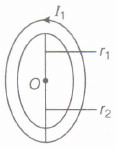
Change in magnetic flux in the coil of radius r1 is
\(\phi =BA=\frac { { \mu }_{ 0 }{ I }_{ 1 } }{ { 2r }_{ 2 } } \times { \pi r }_{ 1 }^{ 2 }\)
Mutual inductance,
\(M=\frac { \phi }{ { I }_{ 1 } } =\frac { { \mu }_{ 0 }{ I }_{ 1 }{ \pi r }_{ 1 }^{ 2 } }{ { 2r }_{ 2 }\times { I }_{ 1 } } =\frac { { \mu }_{ 0 }{ I }_{ 1 }{ \pi r }_{ 1 }^{ 2 } }{ { 2r }_{ 2 } } \)
This is the required expression.
(ii) According to the question, if the coil rotates with an angular velocity of 00 and N turns through an angle \(\theta \) in time t, thus \(\theta =\omega t\)
∴ \(\phi =BAcos\theta =BAcos\omega t\)
As the coil rotates, the magnetic flux linked with it changes. An induced emf Js set up in the coil which is given by
\(e=\frac { -d\phi }{ dt } =\frac { -d }{ dt } (BAcos\omega t)\)
\(=BA\omega sin\omega t\)
For N number of turns, \(e=NBA\omega sin\omega t\)
For maximum value of emf \(\omega t\) must be equals to 90°.
So, maximum emf induced is =\(NBA\omega \)
i.e.\(e=NBA2\pi f\) \(\left[ \because \omega =e=2\pi f \right] \)
19.
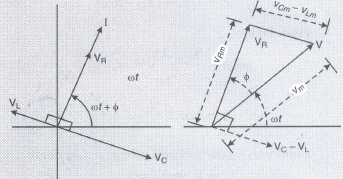
Let VL, VR, Vc and V represent the voltage across the inductor, resistor, capacitor and the source respectively. VR is parallel to I. Vc is pi/2 behind I and VL is pi/2 ahead of I.
Clearly,
\(={ i }_{ 0 }^{ 2 }[{ R }^{ 2 }+({ X }_{ L }-{ X }_{ C })^{ 2 }]\)
\({ i }_{ o }=\frac { { V }_{ 0 } }{ \sqrt { { R }^{ 2 }+({ X }_{ L }-{ X }_{ C })^{ 2 } } } \)
\(Impedence=\frac { { V }_{ 0 } }{ { i }_{ 0 } } =\sqrt { { R }^{ 2 }+({ X }_{ L }-{ X }_{ C })^{ 2 } } \)
\(\\ =\sqrt { { R }^{ 2 }+\left( \omega L-\frac { 1 }{ \omega C } \right) ^{ 2 } } \)
The capacitance of a capacitor in the tuning circuit is varied such that the resonant frequency of the circuit becomes nearly equal to the frequency of the radio signal to be received. When this happens, the amplitude of the current becomes maximum in the receiving circuit.
20.
Here, n = 12, l = 0.2 m.
\(v=60rpm=\frac { 60 }{ 60 } =1rps\)
\(B=0.4\times { 10 }^{ -4 }T, \ e=?\)
\(v=r\omega =r(2\pi v)=2\pi vl\)
\(=2\times 3.14\times 1\times 0.2=1.256 \ { ms }^{ -1 }\)
As the spoke rotates about the axle, therefore linear velocity of each spoke at the axle v1= 0. And linear velocity of each spoke at the rim, v2 = 1.256 m/s.
Average velocity of spoke = \(=\frac { v_{ 1 }+{ v }_{ 2 } }{ 2 } =\frac { 0+1.256 }{ 2 } =0.628\ m/s\)
As well spokes are in parallel, therefore, e.m.f. induced between two ends of every spoke = e = Bvl = 0.4\(\times\)10-4 \(\times\) 0.628\(\times\)0.2 = 5\(\times\)10-6 V
21.
(a)
ac cannot pass through ac ammeter
22.
(d)
zero
23.
(b)
\(2{ B }_{ 0 }{ L }^{ 2 }Wb\)
24.
(d)
no force experienced.
25.
(c)
\(\frac{\mu_{0} n I}{2 \pi R} \tan \left(\frac{\pi}{n}\right)\)
26.
(c)
\(4 B_{0} L^{2} \mathrm{~Wb}\)
27.
(a)
\(1/\sqrt { 2 } A\)

12th Standard CBSE Syllabus & Materials
12th Standard CBSE
CBSE 12th Computer Science Python Revision Tour I - New Previous year Question Papers Study Material - QB365 Set A
NEW12th Standard CBSE
CBSE 12th Business Studies Planning Important Questions And Answers Study Material - QB365 Set A
NEW12th Standard CBSE
CBSE 12th Business Studies Business Environment Important Questions And Answers Study Material - QB365 Set A
NEW12th Standard CBSE
CBSE 12th Business Studies Principles of Management Important Questions And Answers Study Material - QB365 Set A



NCERT Books

Syllabus

Exam Pattern

Sample Question Papers

Previous year Question Papers

Important Notes

MCQ Practice test

NCERT Exemplers

Case study Questions

Image Based Questions

Passage based Questions

HOT Questions

Value Based Questions

Model Questions Papers
NCERT ( Book Back ) Questions

Assertion and Reason
Important Questions And Answers

CBSE 12th Standard CBSE Subjects
CBSE Standards








