
 100% FREE ACCESS
12th Standard CBSE Syllabus & Materials
12th Standard CBSE
CBSE 12th Economics Government Budget and the Economy Previous year Question Papers Study Material - QB365 Set A
NEW12th Standard CBSE
CBSE 12th Computer Science Interface Python with MySQL - New Previous year Question Papers Study Material - QB365 Set A
NEW12th Standard CBSE
CBSE 12th Computer Science Database Concept - New Previous year Question Papers Study Material - QB365 Set A
NEW12th Standard CBSE
CBSE 12th Computer Science Data Communication - New Previous year Question Papers Study Material - QB365 Set A
NEW12th Standard CBSE
CBSE 12th Computer Science Data Structures - New Previous year Question Papers Study Material - QB365 Set A
NEW12th Standard CBSE
CBSE 12th Computer Science Functions - New Previous year Question Papers Study Material - QB365 Set A

Published on: 25/10/2025
Download CBSE Class 12th Standard CBSE Physics question papers, sample papers, important questions, and previous year solved papers in PDF format. Get free study materials, NCERT solutions, and exam preparation resources for Class 12th Standard CBSE Physics
Questions + Answers key
Take MCQ Physics Test
1.
A square loop of side 10 cm and resistance 0.5 Ω is placed vertically in the east-west plane. A uniform magnetic field of 0.10 T is set up across the plane in the north-east direction. The magnetic field is decreased to zero in 0.70 s at a steady rate. Determine the magnitudes of induced emf and current during this time-interval.
2.
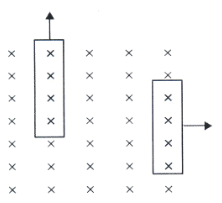
A rectangular wire loop of sides 8 cm and 2 cm with a small cut is moving out of a region of uniform magnetic field of magnitude 0.3 T directed normal to the loop. What is the emf developed across the cut if the velocity of the loop is 1 cm s–1 in a direction normal to the
(a) longer side,
(b) shorter side of the loop? For how long does the induced voltage last in each case?
3.
Does current induced in a coil depend on its resistance?
4.
When current in a coil changes with time, how is the back e.m.f. induced in the coil related to it?
5.
A wheel with 10 metallic spokes each 0.5 m long is rotated with a speed of 120 rev/min in a plane normal to the horizontal component of earth’s magnetic field HE at a place. If H = 0.4 G at the place, what is the induced emf between the axle and the rim of the wheel? Note that 1 G = 10-4 T.
6.
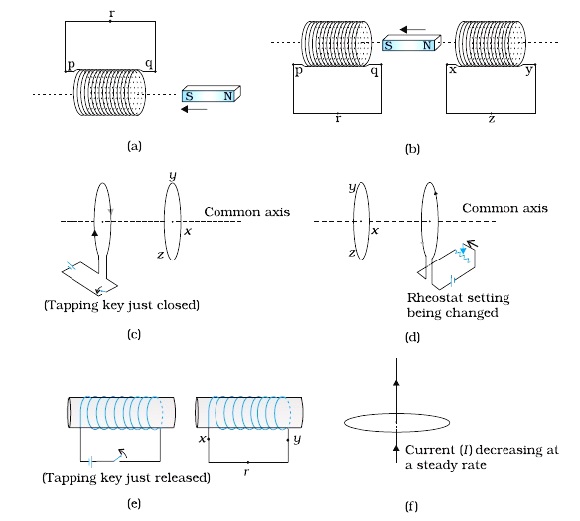
Predict the direction of induced current in the situations described by the following Figs (a) to (f ).
7.
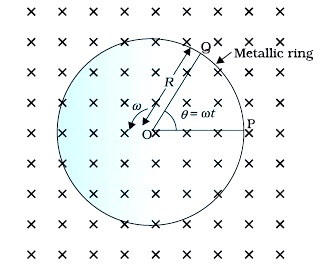
A metallic rod of 1 m length is rotated with a frequency of 50 rev/s, with one end hinged at the centre and the other end at the circumference of a circular metallic ring of radius 1 m, about an axis passing through the centre and perpendicular to the plane of the ring (Fig). A constant and uniform magnetic field of 1 T parallel to the axis is present everywhere. What is the emf between the centre and the metallic ring?
8.
(a) A closed loop is held stationary in the magnetic field between the north and south poles of two permanent magnets held fixed. Can we hope to generate current in the loop by using very strong magnets?
(b) A closed loop moves normal to the constant electric field between the plates of a large capacitor. Is a current induced in the loop
(i) when it is wholly inside the region between the capacitor plates
(ii) when it is partially outside the plates of the capacitor? The electric field is normal to the plane of the loop.
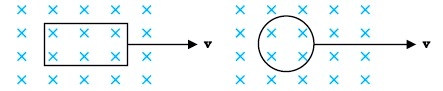
(c) A rectangular loop and a circular loop are moving out of a uniform magnetic field region (Fig. 6.8) to a field-free region with a constant velocity v. In which loop do you expect the induced emf to be constant during the passage out of the field region? The field is normal to the loops.
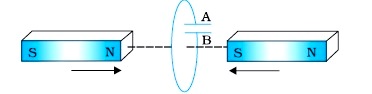
(d) Predict the polarity of the capacitor in the situation described by Fig.
9.
A circular coil of radius 10 cm, 500 turns and resistance 2 Ω is placed with its plane perpendicular to the horizontal component of the earth’s magnetic field. It is rotated about its vertical diameter through 180° in 0.25 s. Estimate the magnitudes of the emf and current induced in the coil. Horizontal component of the earth’s magnetic field at the place is 3.0 x 10⁻⁵ T.
10.
State Lenz's law and illustrate it with experiment.
11.
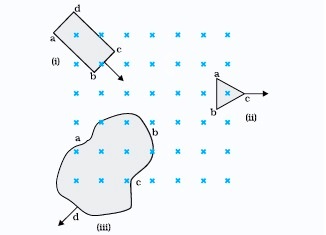
In the figure shows planar loops of different shapes moving out of or into a region of a magnetic field which is directed normal to the plane of the loop away from the reader. Determine the direction of induced current in each loop using Lenz’s law.
12.
A cylindrical bar magnet is kept along the axis of a circular coil. Will there be a current induced in the coil if the magnet is rotated about its axis? Give reasons.
13.
Does Lenz's law violet the principle of energy conservation ?
14.
What is the basic cause of induced e.m.f.?
15.
The induced e.m.f. is sometimes called back e.m.f. Why ?
16.
When is magnetic flux linked with a coil held in a magnetic field zero ?
17.
Name the S.I. units of magnetic flux and magnetic induction.
18.
A train is moving with uniform speed from north to south. Will any induced e.m.f. appear across the ends of its axle ? Will the answer be affected if train moves from east to west ?
19.
Two straight and parallel wires A and B are being brought towards each other. If current in A be i, what will be the direction of induced current in B? If A and B are being taken away from each other, then ?
20.
A vertical metallic pole falls down through the plane of magnetic meridian. Will any e.m.f. be induced between its ends ?
21.
Does change in magnetic flux induce e.m.f. or current ?
22.
A coil intercepts a magnetic flux of \(0.2\times { 10 }^{ -2 }\) Wb in 0.1 s. What is the emf induced in the coil ?
23.
What is the relation between weber and Maxwell ?
24.
What is the dimensional formula of magnetic flux ?
25.
When is the magnetic flux crossing a given surface area held in a magnetic field maximum?
1.
The angle \(\theta\) made by the area vector of the coil with the magnetic field is 45° . From Eq. (6.1), the initial magnetic flux is
\(\phi\) = BA cos \(\theta\)
\(\begin{aligned} =\frac{0.1 \times 10^{-2}}{\sqrt{2}} \mathrm{Wb} \end{aligned}\)
Final flux, Fmin = 0
The change in flux is brought about in 0.70 s. From Eq. (6.3), the magnitude of the induced emf is given by
\(\varepsilon=\frac{\left|\Delta \Phi_B\right|}{\Delta t}=\frac{|(\Phi-0)|}{\Delta t}=\frac{10^{-3}}{\sqrt{2} \times 0.7}=1.0 \mathrm{mV}\)
And the magnitude of the current is
\(I=\frac{e}{R}=\frac{10^{-3} \mathrm{~V}}{0.5 \Omega}=2 \mathrm{~mA}\)
Note that the earth’s magnetic field also produces a flux through the loop. But it is a steady field (which does not change within the time span of the experiment) and hence does not induce any emf.
2.
A) Step 1: Find the emf developed in the loop
Formula Used: \(\mathrm{e}=\mathrm{BIV}\)
Strength of magnetic field, \(B=0.3 \mathrm{~T}\)
Velocity of the loop, \(v=1 \mathrm{~cm} / \mathrm{s}=0.01 \mathrm{~m} / \mathrm{s}\)
emf developed in the loop is given as:
\( \mathrm{e}=\mathrm{Blv} \)
\(=0.3 \times 0.08 \times 0.01=2.4 \times 10^{-4} \mathrm{~V}\)
Step 2: Find the time taken to travel.
Formula Used: \(\mathrm{t}=\frac{\text { Distance travelled }}{\text { Velocity }}\)
Time taken to travel along the width, \(\mathrm{t}=\frac{\text { Distance travelled }}{\text { Velocity }}=\frac{\mathrm{bv}}{\mathrm{v}}\)
\(=\frac{0.02}{0.01}=2 \mathrm{~s}\)
Final answer : \(\mathrm{e}=2.4 \times 10^{-4} \mathrm{v}\)
\(\mathrm{t}=2 \mathrm{~s}\)
B) Step 1: Find the emf developed in the loop emf developed, e = BIv
\(e=0.3 \times 0.02 \times 0.01 \)
\(e=0.6 \times 10^{-4} V\)
Step 2: Find the time taken to travel.
Time taken to travel along the length, \(\mathrm{t}=\frac{\text { Distance travelle }}{\text { Velocity }}=\frac{\mathrm{d}}{\mathrm{v}}\)
\(\mathrm{t}=\frac{0.08}{0.01}=8 \mathrm{~s}\)
Hence, the induced voltage is \(0.6 \times 10^{-4} \mathrm{~V}\) which lasts for 8 s .
Final answer: \(\mathrm{e}=0.6 \times 10^{-4} \mathrm{~V}\)
\(\mathrm{t}=8 \mathrm{~s}\)
3.
Yes, current induced, \(I=\frac { N }{ R } \frac { d\phi }{ dt } \)
4.
The back emf in the coil opposes the change in the current as per Lenz's law.
5.
Induced emf = (1/2)\(\omega\)BR2
= (1/2) \(\times\)4\(\pi\)\(\times\)0.4\(\times\)10-4 \(\times\)(0.5)2
= 6.28 \(\times\)10-5 V
The number of spokes is immaterial because the emf’s across the spokes are in parallel.
6.
The direction of the induced current in a closed loop is given by Lenz’s law. The given pairs of figures show the direction of the induced current when the North pole of a bar magnet is moved towards and away from a closed loop respectively.
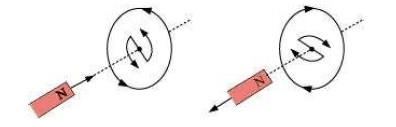
Using Lenz’s rule, the direction of the induced current in the given situations can be predicted as follows:
(a) The direction of the induced current is along qrpq.
(b) The direction of the induced current is along prqp.
(c) The direction of the induced current is along yzxy.
(d) The direction of the induced current is along zyxz.
(e) The direction of the induced current is along xryx.
(f) No current is induced since the field lines are lying in the plane of the closed loop.
7.
Method I
As the rod is rotated, free electrons in the rod move towards the outer end due to Lorentz force and get distributed over the ring. Thus, the resulting separation of charges produces an emf across the ends of the rod. At a certain value of emf, there is no more flow of electrons and a steady state is reached. the magnitude of the emf generated across a length dr of the rod as it moves at right angles to the magnetic field is given by
dε = Bv dr . Hence,
\(\varepsilon = \int \mathrm{~d} \varepsilon=\int_0^R B v \mathrm{~d} r=\int_0^R B \omega r \mathrm{~d} r=\frac{B \omega R^2}{2}\)
Note that we have used v = ω r. This gives
\(\varepsilon=\frac{1}{2} \times 1.0 \times 2 \pi \times 50 \times\left(1^{2}\right)\)
= 157 V
Method II
To calculate the emf, we can imagine a closed loop OP\(\mathcal{Q}\) in which point O and P are connected with a resistor R and O\(\mathcal{Q}\) is the rotating rod. The potential difference across the resistor is then equal to the induced emf and equals B x (rate of change of area of loop). If θ is the angle between the rod and the radius of the circle at P at time t, the area of the sector OP\(\mathcal{Q}\) is given by
\(\pi R^{2} \times \frac{\theta}{2 \pi}=\frac{1}{2} R^{2} \theta\)
where R is the radius of the circle. Hence, the induced emf is
\(\varepsilon=B \times \frac{\mathrm{d}}{\mathrm{d} t}\left[\frac{1}{2} R^{2} \theta\right]=\frac{1}{2} B R^{2} \frac{\mathrm{d} \theta}{\mathrm{d} t}=\frac{B \omega R^{2}}{2}\)
\(\text { [Note: } \left.\frac{\mathrm{d} \theta}{\mathrm{d} t}=\omega=2 \pi v\right]\)
This expression is identical to the expression obtained by Method I and we get the same value of ε.
8.
(a) No. However strong the magnet may be, current can be induced only by changing the magnetic flux through the loop.
(b) No current is induced in either case. Current can not be induced by changing the electric flux.
(c) The induced emf is expected to be constant only in the case of the rectangular loop. In the case of circular loop, the rate of change of area of the loop during its passage out of the field region is not constant, hence induced emf will vary accordingly.
(d) The polarity of plate ‘A’ will be positive with respect to plate ‘B’ in the capacitor.
9.
Initial flux through the coil,
ΦB (initial) = BA cos θ
= 3.0 x 10⁻⁵ x (π x 10–2) x cos 0º
= 3π x 10–7 Wb
Final flux after the rotation,
ΦB (final) = 3.0 x 10⁻⁵ x (π x 10–2) x cos 180°
= –3π x 10–7 Wb
Therefore, estimated value of the induced emf is,
\(\varepsilon=N \frac{\Delta \Phi}{\Delta t}\)
= 500 x (6π x 10–7)/0.25
= 3.8 x 10⁻³ V
I = ε/R = 1.9 x 10⁻³ A
Note that the magnitudes of ε and I are the estimated values. Their instantaneous values are different and depend upon the speed of rotation at the particular instant.
10.
Lenz's law. It states that the direction of induced current (or e.m.f.) is such that it always opposes the cause producing it. This law gives the direction of an induced current in terms of the cause of the current. An induced current in a coil is always due to change of magnetic flux linking the coil. The induced current will have its own associated magnetic flux of induced current will be such as to oppose the change of the primary magnetic flux.
Experimental verification of Lenz's law:
Let us connect the two ends of a coil of few turns to a cell C and a galvanometer G through a two-way key having terminals 1, 2 and 3 as shown in Fig. Put the plug between gap 1 and 2, the current in the upper face of the coil is in anticlockwise direction of N-pole is produced on this upper face. Let the galvanometer shows deflection to the right side. Now remove the key from gaps 1 and 2 and insert between 2 and 3, so the cell C is cut off. Bring N-pole of a bar magnet towards the upper face of the coil, the deflection produced in the galvanometer is again towards right. It means that the upper face of the coil becomes N-pole and repels the incoming magnet. Now take the magnet away from the coil, the deflection in the galvanometer is now towards left i.e. S-pole is formed at the upper end of the coil and it attracts the N-pole of the magnet.
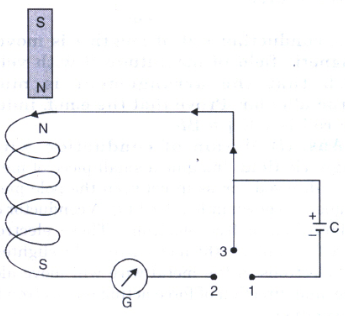
Thus we find that whether the magnet is taken towards or away from the coil, the direction of induced e.m.f. is such that it always opposes the motion of the magnet as predicted by Lenz's law.
11.
(i) The magnetic flux through the rectangular loop abcd increases, due to the motion of the loop into the region of magnetic field, The induced current must flow along the path bcdab so that it opposes the increasing flux.
(ii) Due to the outward motion, magnetic flux through the triangular loop abc decreases due to which the induced current flows along bacb, so as to oppose the change in flux.
(iii) As the magnetic flux decreases due to motion of the irregular shaped loop abcd out of the region of magnetic field, the induced current flows along cdabc, so as to oppose change in flux. Note that there are no induced current as long as the loops are completely inside or outside the region of the magnetic field
12.
No because, \(\Phi=N B A=\text { constant }\)
\(\therefore e=\frac{d \Phi}{d t}=0 ; i=0\)
13.
No, Lenz's law does not violate this principle.
14.
Change in magnetic flux linked with the circuit.
15.
This is because induced e.m.f. opposes the current due to the actual source e.m.f.
16.
When plane of coil is along the field.
17.
Weber, Tesla.
18.
Yes, it will appear as the train is intercepting vertical component of earth's magnetic field. No, answer is not affected.
19.
In the first case, induced current in B will be opposite to i, so that A and B repel eachother and the operation of bringing them closer is opposed. Similarly, in the second case, induced current in B will be in the direction of i.
20.
No, because the pole intercepts neither H nor V.
21.
Due to change in magnetic flux, e.m.f. is always induced, but induced current will flow only when tghe circuit is complete.
22.
\(|e|=\frac{d \Phi}{d t}=\frac{0.2 \times 10^{-2}}{0.1}=0.02 \quad V\)
23.
1 weber = 108 Maxwell
24.
\(\Phi=B A \cos \Phi=\left(\frac{F}{I l}\right) A=\frac{M L T^{-2}}{A L} \cdot L^2\)
\(=\left[M L^2 T^{-2} A^{-1}\right]\)
25.
The magnetic flux is maximum when area is held perpendicular to the direction of magnetic field.

12th Standard CBSE Syllabus & Materials
12th Standard CBSE
CBSE 12th Computer Science Python Revision Tour I - New Previous year Question Papers Study Material - QB365 Set A
NEW12th Standard CBSE
CBSE 12th Business Studies Planning Important Questions And Answers Study Material - QB365 Set A
NEW12th Standard CBSE
CBSE 12th Business Studies Business Environment Important Questions And Answers Study Material - QB365 Set A
NEW12th Standard CBSE
CBSE 12th Business Studies Principles of Management Important Questions And Answers Study Material - QB365 Set A



NCERT Books

Syllabus

Exam Pattern

Sample Question Papers

Previous year Question Papers

Important Notes

MCQ Practice test

NCERT Exemplers

Case study Questions

Image Based Questions

Passage based Questions

HOT Questions

Value Based Questions

Model Questions Papers
NCERT ( Book Back ) Questions

Assertion and Reason
Important Questions And Answers

CBSE 12th Standard CBSE Subjects
CBSE Standards








