
 100% FREE ACCESS
12th Standard CBSE Syllabus & Materials
12th Standard CBSE
CBSE 12th Economics Government Budget and the Economy Previous year Question Papers Study Material - QB365 Set A
NEW12th Standard CBSE
CBSE 12th Computer Science Interface Python with MySQL - New Previous year Question Papers Study Material - QB365 Set A
NEW12th Standard CBSE
CBSE 12th Computer Science Database Concept - New Previous year Question Papers Study Material - QB365 Set A
NEW12th Standard CBSE
CBSE 12th Computer Science Data Communication - New Previous year Question Papers Study Material - QB365 Set A
NEW12th Standard CBSE
CBSE 12th Computer Science Data Structures - New Previous year Question Papers Study Material - QB365 Set A
NEW12th Standard CBSE
CBSE 12th Computer Science Functions - New Previous year Question Papers Study Material - QB365 Set A

Published on: 25/10/2025
Download CBSE Class 12th Standard CBSE Physics question papers, sample papers, important questions, and previous year solved papers in PDF format. Get free study materials, NCERT solutions, and exam preparation resources for Class 12th Standard CBSE Physics
Questions + Answers key
Take MCQ Physics Test
1.
What is Coulomb's law of magnetic force?
2.
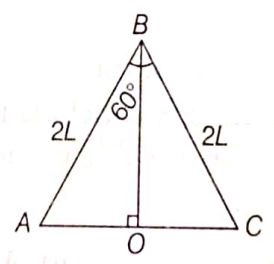
A thin bar magnet of length 4L is bent at the mid-point, so that the angle between them is 60°. Find the new length of the bar magnet.
3.
Consider a short magnetic dipole of magnetic length 20 cm. Find its geometric length.
4.
Show that the rate of change of magnetic flux has the same units as induced e.m.f.
5.
Are eddy currents useful or harmful ?
6.
How does self inductance of a solenoid change when number of turns is double keeping other parameters same?
7.
Why is induced emf called back e.m.f. ?
8.
The value of angle of dip is zero at the magnetic equator because on it
V and Hare equal
the values of V and Hare zero
the value of V is zero
the value ofH is zero
9.
At a place angle of dip is 30°. If horizontal component of earth's magnetic field is H, then the total intensity of magnetic field will be
H / 2
2H / \(\sqrt{3}\)
H \(\sqrt{3/2}\)
2 H
10.
Gauss's law for magnetism is
the net magnetic flux through any closed surface is B. \(\triangle\)S
the net magnetic flux through any closed surface is E. \(\triangle\)S
the net magnetic flux through any closed surface is zero
Both (a) and (c)
11.
Work done in rotating a bar magnet from 0 to angle \(120\unicode{xb0} \) is
\(\frac{1}{2}\) MB
\(\frac{3}{2}\) MB
MB
\(\frac{2}{3}\) MB
12.
The intensity of magnetic field at a point X on the axis of a small magnet is equal to the field intensity at another point Y on equatorial axis. The ratio of distance of X and Y from the centre of the magnet will be
(2) - 3
(2) - 1/3
2 3
2 1/3
13.
A large magnet is broken into two pieces so that their lengths are in the ratio 2 : 1. The pole strengths of the two pieces will have ratio.
2: 1
1: 2
4: 1
1: 1
14.
The peak value of alternating e.m.f. in a generator is given by e0 =
NAB
NAB \(\omega\)
NAB v
none of these
15.
A wire of length 2m moves with a speed of 5m/s perpendicular to a magnetic field of induction 0.1 Wb/m2. The e.m.f. induced in the wire is
1 V
10 V
5 V
2 V
16.
When number of turns of a soleniod is doubled, its self inductance becomes k times, where k =
2
1
8
4
17.
Which one is not an application of eddy currents?
Magnetic brakes
speedometers
Induction furnace
Transformers
18.
(i) Define self-inductance. Write its SI units.
(ii) Derive the expression for self-inductance of a long solenoid of lengthl, cross-sectional area A having N number of turns.
19.
(a) Obtain the expression for the magnetic energy stored in a solenoid in terms of magnetic field B, area A and length l of the solenoid.
(b) How does this magnetic energy compare with the electrostatic energy stored in a capacitor?
20.
A solenoid having 5000 turns/m carries a current of 2A. An aluminium ring at temperature 300K inside the solenoid provides the core.
(a) If the magnetisation I is 2 x 10⁻² A/m, find the susceptibility of aluminium at 300 K.
(b) If temperature of the aluminium ring is 320 K, what will be the magnetisation?
21.
A circular coil of 16 turns and radius 10 cm carrying a current of 0.75 A rests with its plane normal to an external field of magnitude 5.0 x 10⁻² T. The coil is free to turn about an axis in its plane perpendicular to the field direction. When the coil is turned slightly and released, it oscillates about its stable equilibrium with a frequency of 2.0 s-1. What is the moment of inertia of the coil about its axis of rotation?
22.
A solenoid has a core of a material with relative permeability 400. The windings of the solenoid are insulated from the core and carry a current of 2A. If the number of turns is 1000 per metre, calculate (a) H, (b) M, (c) B and (d) the magnetising current Im.
23.
(a) A series LCR circuit is connected to an a.c. source of variable frequency. Draw a suitable phasor diagram to deduce the expressions for the amplitude of the current and phase angle.
(b) Obtain the condition at resonance. Draw a plot showing the variation of current with the frequency of a.c. source for two resistances R1 and R2 (R1 > R2). Hence define the quality factor, Q and write its role in the tuning of the circuit.
1.
Coulomb's law of magnetic force is inversely proportional to the squared distance between the magnetic poles and directly proportional to the product of magnetic poles.
2.
On bending the bar magnet, the length of the bar magnet,
\(A C=A O+O C=2 L \sin \left(\frac{60^{\circ}}{2}\right)+2 L \sin \left(\frac{60^{\circ}}{2}\right)\)
\(=4 L \sin 30^{\circ}=4 L \times \frac{1}{2}=2 L\)
3.
Geometric length of a magnet is \(\frac{6}{5}\) times its magnetic length.
\(\therefore\) Geometric length = \(\frac{6}{5}\) x 20
= 24 cm
4.
Induced e.m.f., \(e=V=\frac { work }{ charge } =\frac { M{ L }^{ 2 }{ T }^{ -2 } }{ AT } \)
\(=[{ M }^{ 1 }{ L }^{ 2 }{ T }^{ -3 }{ A }^{ -1 }]\)
Rate of change of magnetic flux\(=\frac { d\Phi }{ dt } =\frac { BA }{ t } \)
\(=\frac { FA }{ q\upsilon t } =\frac { { (MLT }^{ -2 })({ L }^{ 2 }) }{ (AT)({ L }T^{ -1 })(T) } \ (\because F=Bq\upsilon )\\ \ \ =[{ M }^{ 1 }{ L }^{ 2 }T^{ -3 }A^{ -1 }]\)
Both have the same units/dimensions.
5.
They are both, useful and harmful.
6.
\(\text {As } L \propto N^2 \text {, }\)
when N is double, L becomes four times.
7.
Induced emf is called back emf as it opposes the growth as well as decay of current in the circuit.
8.
(c)
the value of V is zero
9.
(b)
2H / \(\sqrt{3}\)
10.
(c)
the net magnetic flux through any closed surface is zero
11.
(b)
\(\frac{3}{2}\) MB
12.
(d)
2 1/3
13.
(d)
1: 1
14.
(b)
NAB \(\omega\)
15.
(a)
1 V
16.
(d)
4
17.
(d)
Transformers
18.
(i) The self inductance is defined on the magnetic flux linked with the coil when unit current flows through it. The self inductance is defined as the emf induced in the coil, when the rate of change of current in the coil is 1 ampere/second. The SI unit of self inductance is henry (H).
(ii) The self-inductance of a solenoid is defined as the magnetic flux to current ratio via the solenoid. It is given by,
\(\mathrm{L}=\frac{\phi}{I}\)
Total number of turns in the solenoid,
\(\mathrm{N}=\mathrm{nl}\)
The magnetic field inside the long solenoid, \(B=\mu_0 n i\)
Flux through one turn, \(\phi_1=B A=\mu_0 n i A\)
Thus, total flux through N turns,
\(\phi_t=N \phi_1=n l \times \mu_0 n i A=\mu_0 n^2 l A i\)
Using \(\phi_t=L i\)
where L is the self-inductance of the coil.
\(\therefore \mu_0 n^2 l A i=L i \)
\(\mathrm{~L}=\mu_0 n^2 A l\)
19.
(a) From Eq, the magnetic energy is
\(U_{B}=\frac{1}{2} L I^{2}\)
\(=\frac{1}{2} L\left(\frac{B}{\mu_{0} n}\right)^{2} \ \left(\text { since } B=\mu_{0} n I, \text { for a solenoid }\right)\)
\(=\frac{1}{2}\left(\mu_{0} n^{2} A l\right)\left(\frac{B}{\mu_{0} n}\right)^{2}\) [from Eq.]
\(=\frac{1}{2{\mu }_{0}}{B}^{2}Al\)
(b) The magnetic energy per unit volume is,
\({U}_{B}=\frac{{U}_{B}}{V}\) (where V is volume that contains flux)
\(=\frac{{U}_{B}}{Al}\)
\(=\frac{{B}^{2}}{2{\mu }_{0}}\)
We have already obtained the relation for the electrostatic energy stored per unit volume in a parallel plate capacitor.
\({U}_{E}=\frac{1}{2}{\epsilon }_{0}{E}^{2}\)
In both the cases energy is proportional to the square of the field strength. Equation have been derived for special cases: a solenoid and a parallel plate capacitor, respectively. But they are general and valid for any region of space in which a magnetic field or/and an electric field exist.
20.
(a) Here, H = I = 5000 x 2 = 104 A/m
and I = XH
\(\therefore\) \(\chi=\frac{I}{H}\)
\(=\frac{2 \times 10^{-2}}{10^{4}}=2 \times 10^{-6}\)
(b) According to Curie law.
\(x=\frac{c}{T}\)
\(\Rightarrow \quad \frac{\chi_{2}}{\chi_{1}}=\frac{T_{2}}{T_{1}}\)
\(\chi_{2}=\frac{T_{2}}{T_{1}} \chi_{1}=\frac{320}{300} \times 2 \times 10^{-6}\)
= 2.13 x 10⁻⁶
\(\therefore\) Magnetisation at 320 K,
I = X2H = 2.13 x 10-6 x 104
= 2.13 x 10⁻²A/m
21.
Number of turns in the circular coil, N = 16
Radius of the coil, r = 10 cm = 0.1 m
Cross-section of the coil, A = \(\pi r\)2 = n x (0.1)2 m2
Current in the coil, I = 0.75 A
Magnetic field strength, B = 5.0 x 10⁻² T
Frequency of oscillations of the coil, v = 2.0 s-1
∴ Magnetic moment, M = NIA = N I \(\pi r^{2}\) 16 x 0.75 x n x (0.1)2
= 0.377 J T- 1
Frequency is given by the relation:
\(v=\frac{1}{2 \pi} \sqrt{\frac{M B}{I}}\)
Where,
I = Moment of inertia of the coil
Rearranging the above formula, we get:
\(\therefore I=\frac{M B}{4 \pi^{2} v^{2}}\)
\(=\frac{0.377 \times 5 \times 10^{-2}}{4 \pi^{2} \times(2)^{2}}\)
= 1.2 x 10⁻⁴ kg m2
Hence, the moment of inertia of the coil about its axis of rotation is 1.19\times 10-4 kg m2.
22.
(a) The field H is dependent of the material of the core, and is
H = nI = 1000 x 2.0 = 2 x 10³ A/m.
(b) The magnetic field B is given by
B = μr μ0 H
= 400 x 4π x 10-7 (N/A2) x 2 x 103 (A/m)
= 1.0 T
(c) Magnetisation is given by
M = (B - μ0 H)/ μ0
= (μr μ0 H - μ0 H) / μ0 = (μr – 1)H = 399 x H
\(\cong\)8 \(\times\)105 A/m
d) The magnetising current IM is the additional current that needs to be passed through the windings of the solenoid in the absence of the core which would give a B value as in the presence of the core. Thus B = μr n (I + IM). Using I = 2A, B = 1 T, we get IM = 794 A.
23.
(a) 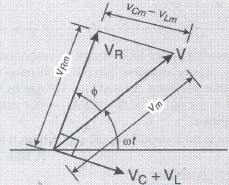
From the phesor diagram
\(\overrightarrow { V } =\ \overrightarrow { { V }_{ L } } +\overrightarrow { { V }_{ R } } +\overrightarrow { { V }_{ C } } \)
\({ V }_{ m }=\sqrt { [{ R }^{ 2 }+({ X }_{ C }-{ X }_{ L }{ ) }^{ 2 }] } \)
\(\Rightarrow { I }_{ m }=\frac { { V }_{ m } }{ \sqrt { [{ R }^{ 2 }+({ X }_{ C }-{ X }_{ L }{ ) }^{ 2 }] } } \)
From the figure tan \(\theta\) =\(\frac{V_Cm-V_Lm}{V_Rm}\)
\(=\frac{I_m(X_C-X_L)}{I_{m}R}\)
\(\theta=tan^{-1}(\frac{X_C-X_L}{R})\)
(b) At resonance, Im is maximum.
\(\Rightarrow\) XL = XC,
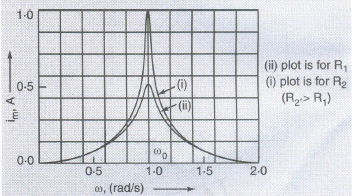
Quality factor of LCR circuit is defined as= \(\frac{{\omega}_{o}}{2\triangle\omega}\)
=\(\frac{{\omega}_{o}L}{R}\)
A larger value of quality factor corresponds to a sharper resonance.

12th Standard CBSE Syllabus & Materials
12th Standard CBSE
CBSE 12th Computer Science Python Revision Tour I - New Previous year Question Papers Study Material - QB365 Set A
NEW12th Standard CBSE
CBSE 12th Business Studies Planning Important Questions And Answers Study Material - QB365 Set A
NEW12th Standard CBSE
CBSE 12th Business Studies Business Environment Important Questions And Answers Study Material - QB365 Set A
NEW12th Standard CBSE
CBSE 12th Business Studies Principles of Management Important Questions And Answers Study Material - QB365 Set A



NCERT Books

Syllabus

Exam Pattern

Sample Question Papers

Previous year Question Papers

Important Notes

MCQ Practice test

NCERT Exemplers

Case study Questions

Image Based Questions

Passage based Questions

HOT Questions

Value Based Questions

Model Questions Papers
NCERT ( Book Back ) Questions

Assertion and Reason
Important Questions And Answers

CBSE 12th Standard CBSE Subjects
CBSE Standards








