
 100% FREE ACCESS
12th Standard CBSE Syllabus & Materials
12th Standard CBSE
CBSE 12th Economics Government Budget and the Economy Previous year Question Papers Study Material - QB365 Set A
NEW12th Standard CBSE
CBSE 12th Computer Science Interface Python with MySQL - New Previous year Question Papers Study Material - QB365 Set A
NEW12th Standard CBSE
CBSE 12th Computer Science Database Concept - New Previous year Question Papers Study Material - QB365 Set A
NEW12th Standard CBSE
CBSE 12th Computer Science Data Communication - New Previous year Question Papers Study Material - QB365 Set A
NEW12th Standard CBSE
CBSE 12th Computer Science Data Structures - New Previous year Question Papers Study Material - QB365 Set A
NEW12th Standard CBSE
CBSE 12th Computer Science Functions - New Previous year Question Papers Study Material - QB365 Set A

Published on: 25/10/2025
Download CBSE Class 12th Standard CBSE Physics question papers, sample papers, important questions, and previous year solved papers in PDF format. Get free study materials, NCERT solutions, and exam preparation resources for Class 12th Standard CBSE Physics
Questions + Answers key
Take MCQ Physics Test
1.
A charged 30\(\mu \)F capacitor is connected to a 27mH inductor. What is the angular frequency of free oscillations of the circuit?
2.
What is the net power absorbed by each circuit over a complete cycle? Explain your answer.
3.
When current in a coil changes with time, how is the back e.m.f. induced in the coil related to it?
4.
(i) Define self-inductance. Write its SI unit.
(ii) A long solenoid with 15 turns per cm has a small loop of area 2.0 cm2 placed inside normal to the axis. If the current carried by the solenoid changes steadily from 2.0 A to 4.0 A in 0.1 s, what is the induced emf in the loop while the current is changing?
5.
The inductance of a coil is 0.25H. Calculate its inductive reactance in a.c. of frequency 50 Hz.
6.
Why does a metallic piece become very hot when it is surrounded by a coil carrying high frequency alternating current?
7.
What is the relation between weber and Maxwell ?
8.
What is the dimensional formula of magnetic flux ?
9.
When is the magnetic flux crossing a given surface area held in a magnetic field maximum?
10.
The average value of a.c. voltage E = E0 sin \(\omega\)t over the time interval t = 0 to t = \(\pi /\omega \) is
\(-2{ E }_{ 0 }/\pi \)
\({ E }_{ 0 }/\pi \)
\(\frac { 2{ E }_{ 0 } }{ \pi } \)
zero
11.
The resistance of a coil for direct current is 10ohm. When a.c. is sent through the same coil, its resistance would be
10\(\omega\)
> 10ohm
< 10ohm
cannot say
12.
The peak value of 220 V a.c. is
220V
\(\frac { 220 }{ \sqrt { 2 } } V\)
440V
\(220\sqrt { 2 } V\)
13.
Choose the wrong statement:
When ever the amount of magnetic flux linked with a circuit changes, an e.m.f. is induced in the circuit.
The induced e.m.f. lasts so long as the change in magnetic flux continues
Large the amount of magnetic flux linked with a circuit, greater is the e.m.f. induced in it.
The direction of induced e.m.f. is given by Lenz's Llaw.
14.
The cause of induced e.m.f. is
magnetic flux
magnetic field
area
change in magnetic flux
15.
SI unit of magnetic flux is
henry
weber
coulomb
volt
16.
In the relation \(\phi \) = BA cos \(\theta \), \(\theta \) is angle........
which normal to surface area makes with the direction of magnetic field
which magnetic field makes with the surface
which is never constant
none of the above
17.
A resistor of 200 Ω and a capacitor of 15.0 μF are connected in series to a 220 V, 50 Hz ac source. (a) Calculate the current in the circuit; (b) Calculate the voltage (rms) across the resistor and the capacitor. Is the algebraic sum of these voltages more than the source voltage? If yes, resolve the paradox.
18.
Draw a labelled diagram of a step-down transformer. State the principle of its working.
Express the turn ratio in terms of voltages.
Find the ratio of primary and secondary currents in terms of turn ratio in an ideal transformer.
How much current is drawn by the primary of a transformer Connected to 220 V supply when it delivers power to a 110 V-550 W refrigerator?
19.
Derive an expression for the impedance of a series LCR circuit connected to an AC supply of variable frequency.
Plot a graph showing variation of current with the frequency of the applied voltage. Explain briefly how the phenomenon of resonance in the circuit can be used in the tuning mechanism of a radio or a TV set.
20.
If the effective value of current in 50Hz a.c.circuit is 5.0 A, what is
(i) peak value of current
(ii) mean value of current over half a cycle
(iii) value of current 1/3000s after it was zero?
21.
Lenz's law states that the direction of induced current in a circuit is such that it opposes the change which produces it. Thus, if the magnetic flux linked with a closed circuit increases, the induced current flows in such a direction that magnetic flux is created in the opposite direction of the original magnetic flux. If the magnetic flux linked with the closed circuit decreases, the induced current flows in such a direction so as to create magnetic flux in the direction of the original flux.
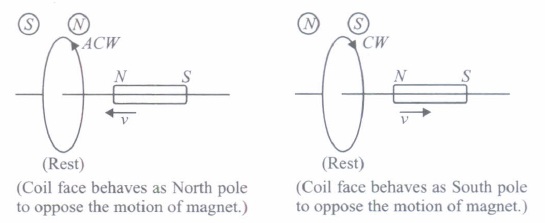
(i) Which of the following statements is correct?
| (a) The induced e.m.f is not in the direction opposing the change in magnetic flux so as to oppose the cause which produces it. |
| (b) The relative motion between the coil and magnet produces change in magnetic flux. |
| (c) Emf is induced only if the magnet is moved towards coil. |
| (d) Emf is induced only if the coil is moved towards magnet |
(ii) The polarity of induced emf is given by
| (a) Ampere's circuital law | (b) Biot-Savart law |
| (c) Lenz's law | (d) Fleming's right hand rule |
(iii) Lenz's law is a consequence of the law of conservation of
| (a) charge | (b) mass | (c) momentum | (d) energy |
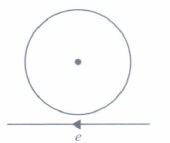
(iv) Near a circular loop of conducting wire as shown in the figure, an electron moves along a straight line. The direction of the induced current if any in the loop is
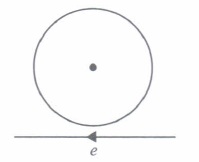
| (a) variable | (b) clockwise |
| (c) anticlockwise | (d) zero |
(v) Two identical circular coils A and B are kept in a horizontal tube side by side without touching each other. If the current in coil A increases with time, in response, the coil B.
| (a) is attracted by A | (c) is repelled |
| (c) is repelled | (d) rotates |
22.
Assertion (A) : When two coils are wound on each other, the mutual induction between the coils is maximum.
Reason (R) : Mutual induction does not depend on the orientation of the coils.
Codes:
(a) Both A and R are true and R is the correct explanation of A
(b) Both A and R are true but R is NOT the correct explanation of A
(c) A is true but R is false
(d) A is false and R is also false
1.
Capacitance, C = 30μF = 30 × 10−6F
Inductance, L = 27 mH = 27 × 10−3 H
Angular frequency is given as:
\({ \omega }_{ r }=\frac { 1 }{ \sqrt { LC } } =\frac { 1 }{ \sqrt { 27\times { 10 }^{ -3 }\times 30\times { 10 }^{ -6 } } } =\frac { { 10 }^{ 4 } }{ 9 } =1.1\times { 10 }^{ 3 }rad/s\)
Hence, the angular frequency of free oscillations of the circuit is 1.11 × 10³ rad/s.
2.
In the inductive circuit,
Rms value of current, I = 15.92 A
Rms value of voltage, V = 220 V
Hence, the net power absorbed can be obtained by the relation,
P = VI cos Φ
Where,
Φ = Phase difference between V and I
For a pure inductive circuit, the phase difference between alternating voltage and current is 90° i.e., Φ= 90°.
Hence, P = 0 i.e., the net power is zero.
In the capacitive circuit,
Rms value of current, I = 2.49 A
Rms value of voltage, V = 110 V
Hence, the net power absorbed can ve obtained as:
P = VI Cos Φ
For a pure capacitive circuit, the phase difference between alternating voltage and current is 90° i.e., Φ= 90°.
Hence, P = 0 i.e., the net power is zero.
3.
The back emf in the coil opposes the change in the current as per Lenz's law.
4.
Self-Inductance When the current in a coil is changed, a back emf is induced in the same coil. This phenomenon is called self-inductance. If Lis self-inductance of coil, then
\(N\phi \propto I\Rightarrow N\phi =LI\Rightarrow L=\frac { N\phi }{ I } \)
The SI unit of self-inductance is Henry (H).
(ii) Mutual inductance of solenoid coil system
\(M=\frac { { \mu }_{ 0 }{ N }_{ 1 }{ N }_{ 2 }{ A }_{ 2 } }{ l } \)
Here, N1 = 15, N2 = 1, l = 1cm = 10-2m,
A = 2.0cm2 = 20 x 10-4m2
∴ \(M=\frac { 4\pi \times { 10 }^{ -7 }\times 15\times 1\times 2.0\times { 10 }^{ -4 } }{ { 10 }^{ -2 } } \)
\(=120\pi \times { 10 }^{ -9 }H\)
Induced emf in the loop
\({ \varepsilon }_{ 2 }=M\frac { { \Delta I }_{ 1 } }{ { \Delta t } } (numerically)=20\pi \times { 10 }^{ -9 }\frac { \left( 4-2 \right) }{ 0.1 } \)
\(=120\times 3.14\times { 10 }^{ -9 }\times \frac { 2 }{ 0.1 } =7.5\times { 10 }^{ -6 }V=7.5\mu V\)
5.
\(X_L=\omega L=2 \pi \nu L=2 \pi \times 50 \times 0.25\)
\(=25 \pi \mathrm{ohm}\)
6.
High frequency alternating current passed through the coil surrounding the metal piece produces eddy currents in the metal piece. The eddy currents produce joule heating in the metal piece on account of its resistance.
7.
1 weber = 108 Maxwell
8.
\(\Phi=B A \cos \Phi=\left(\frac{F}{I l}\right) A=\frac{M L T^{-2}}{A L} \cdot L^2\)
\(=\left[M L^2 T^{-2} A^{-1}\right]\)
9.
The magnetic flux is maximum when area is held perpendicular to the direction of magnetic field.
10.
(c)
\(\frac { 2{ E }_{ 0 } }{ \pi } \)
11.
(b)
> 10ohm
12.
(d)
\(220\sqrt { 2 } V\)
13.
(c)
Large the amount of magnetic flux linked with a circuit, greater is the e.m.f. induced in it.
14.
(d)
change in magnetic flux
15.
(b)
weber
16.
(a)
which normal to surface area makes with the direction of magnetic field
17.
Given
R = 200Ω, C = 15.0μF = 15.0 x 10⁻⁶F
V = 220 V, ν = 50 Hz
(a) In order to calculate the current, we need the impedance of the circuit. It is
\(Z=\sqrt{R^{2}+X_{C}^{2}}=\sqrt{R^{2}+(2 \pi v C)^{-2}}\)
\(=\sqrt{(200 \Omega)^{2}+\left(2 \times 3.14 \times 50 \times 15.0 \times 10^{-6} \mathrm{~F}\right)^{-2}}\)
\(=\sqrt{(200 \Omega)^{2}+(212.3 \Omega)^{2}}\)
= 291.67Ω
Therefore, the current in the circuit is
\(I=\frac{V}{Z}=\frac{220 \mathrm{~V}}{291.5 \Omega}=0.755 \mathrm{~A}\)
(b) Since the current is the same throughout the circuit, we have
\(V_{R}=I R=(0.755 \mathrm{~A})(200 \Omega)=151 \mathrm{~V}\)
\(V_{C}=I X_{C}=(0.755 \mathrm{~A})(212.3 \Omega)=160.3 \mathrm{~V}\)
The algebraic sum of the two voltages, VR and VC is 311.3 V which is more than the source voltage of 220 V. How to resolve this paradox? As you have learnt in the text, the two voltages are not in the same phase. Therefore, they cannot be added like ordinary numbers. The two voltages are out of phase by ninety degrees. Therefore, the total of these voltages must be obtained using the Pythagorean theorem:
\(V_{R+C}=\sqrt{V_{R}^{2}+V_{C}^{2}}\)
= 220 V
Thus, if the phase difference between two voltages is properly taken into account, the total voltage across the resistor and the capacitor is equal to the voltage of the source.
18.
Step down transformer:
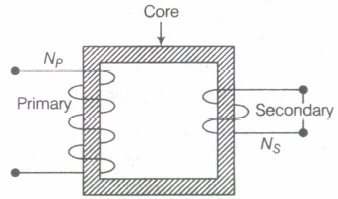
Principle: When the current flowing through the primary coil changes, an emf is induced in the secondary coil due to the change in magnetic flux linked with it i.e., it works on the principle of mutual induction. For step down transformer,
Ns < Np, hence \({\epsilon}_{s}<{\epsilon}_{p}\).
\({ { {\epsilon}_{s} }\over{ {\epsilon}_{p} } }={{{N}_{s}}\over{{N}_{p}}}\)
For an ideal transformer, Pin = Pout
\({\epsilon }_{p }{ I}_{p }={ \epsilon}_{s }{I }_{s }\Rightarrow{{{I}_{p}}\over{{I}_{s}}}={{{\epsilon}_{s}}\over{{\epsilon}_{p}}}={{{N}_{s}}\over{{N}_{p}}}\)
Pin = Pout = 550 W = \({\epsilon}_{p}{I}_{p}\) = 550
\(220\times{I}_{p}=550\Rightarrow{I}_{p}={{550}\over{220}}={{5}\over{2}}=2.5 \ A\)
19.
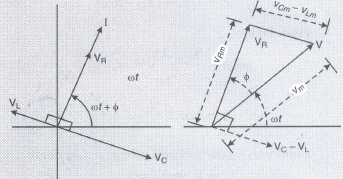
Let VL, VR, Vc and V represent the voltage across the inductor, resistor, capacitor and the source respectively. VR is parallel to I. Vc is pi/2 behind I and VL is pi/2 ahead of I.
Clearly,
\(={ i }_{ 0 }^{ 2 }[{ R }^{ 2 }+({ X }_{ L }-{ X }_{ C })^{ 2 }]\)
\({ i }_{ o }=\frac { { V }_{ 0 } }{ \sqrt { { R }^{ 2 }+({ X }_{ L }-{ X }_{ C })^{ 2 } } } \)
\(Impedence=\frac { { V }_{ 0 } }{ { i }_{ 0 } } =\sqrt { { R }^{ 2 }+({ X }_{ L }-{ X }_{ C })^{ 2 } } \)
\(\\ =\sqrt { { R }^{ 2 }+\left( \omega L-\frac { 1 }{ \omega C } \right) ^{ 2 } } \)
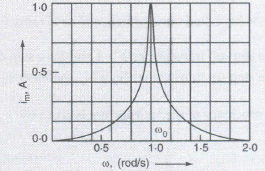
The capacitance of a capacitor in the tuning circuit is varied such that the resonant frequency of the circuit becomes nearly equal to the frequency of the radio signal to be received. When this happens, the amplitude of the current becomes maximum in the receiving circuit.
20.
\(Here, \ { I }_{ v }=5.0A, \ v=50Hz\)
\((i) \ { I }_{ 0 }=\sqrt { 2 } { I }_{ v }=1.414\times 5.0=7.07A\)
\((ii) \ { I }_{ m }=\frac { 2 }{ \pi } { I }_{ 0 }=\frac { 2 }{ 3.14 } \times 7.07=4.5A\)
\((iii) \ From \ I={ I }_{ 0 } \ sin \ \omega t={ I }_{ 0 }sin2\pi \ vt\)
\(=7.07sin2\pi \times 50\times \frac { 1 }{ 300 } =\frac { 7.07\sqrt { 3 } }{ 2 } =6.12A\)
21.
(i) (b): The relative motion between the coil and the magnet produces change in the magnetic flux in the coil. The induced emf is always in such a direction that it opposes the change in the flux.
(ii) (c)
(iii) (d)
(iv) (a): When an electron is moving from right to left, the flux linked with loop (which is going into the page) will first increase and then decrease as the electron passes by. So the induced current I, in the loop will be first clockwise and will change direction (i.e. will become anticlockwise) as the electron passes by.
(v) (c): When current in coil A increases with time, there will be a change of flux in coil B which will induce a current in B. Now, according to Lenz's law, the direction of induced current in B will be opposite to the direction of current in A. Thus, if two loops carry current in opposite direction they will repel each other.
22.
(c): The manner in which the two coils are oriented, determines the coefficient of coupling between them \(\text { i.e., } K=\sqrt{\frac{M}{L_{1} L_{2}}}\), where L, and L2 are self-inductance of two coils. When the two coils are wound on each other, the coefficient of coupling is maximum and hence mutual inductance between the coil is maximum.

12th Standard CBSE Syllabus & Materials
12th Standard CBSE
CBSE 12th Computer Science Python Revision Tour I - New Previous year Question Papers Study Material - QB365 Set A
NEW12th Standard CBSE
CBSE 12th Business Studies Planning Important Questions And Answers Study Material - QB365 Set A
NEW12th Standard CBSE
CBSE 12th Business Studies Business Environment Important Questions And Answers Study Material - QB365 Set A
NEW12th Standard CBSE
CBSE 12th Business Studies Principles of Management Important Questions And Answers Study Material - QB365 Set A



NCERT Books

Syllabus

Exam Pattern

Sample Question Papers

Previous year Question Papers

Important Notes

MCQ Practice test

NCERT Exemplers

Case study Questions

Image Based Questions

Passage based Questions

HOT Questions

Value Based Questions

Model Questions Papers
NCERT ( Book Back ) Questions

Assertion and Reason
Important Questions And Answers

CBSE 12th Standard CBSE Subjects
CBSE Standards








