
 100% FREE ACCESS
12th Standard CBSE Syllabus & Materials
12th Standard CBSE
CBSE 12th Economics Government Budget and the Economy Previous year Question Papers Study Material - QB365 Set A
NEW12th Standard CBSE
CBSE 12th Computer Science Interface Python with MySQL - New Previous year Question Papers Study Material - QB365 Set A
NEW12th Standard CBSE
CBSE 12th Computer Science Database Concept - New Previous year Question Papers Study Material - QB365 Set A
NEW12th Standard CBSE
CBSE 12th Computer Science Data Communication - New Previous year Question Papers Study Material - QB365 Set A
NEW12th Standard CBSE
CBSE 12th Computer Science Data Structures - New Previous year Question Papers Study Material - QB365 Set A
NEW12th Standard CBSE
CBSE 12th Computer Science Functions - New Previous year Question Papers Study Material - QB365 Set A

Published on: 25/10/2025
Download CBSE Class 12th Standard CBSE Physics question papers, sample papers, important questions, and previous year solved papers in PDF format. Get free study materials, NCERT solutions, and exam preparation resources for Class 12th Standard CBSE Physics
Questions + Answers key
Take MCQ Physics Test
1.
A ring of radius R carries a uniformly distributed charge + Q. A point charge - q is placed on the axis of the ring at a distance 2R from the centre of the ring and released from rest. Will the particle execute simple harmonic motion along the axis of the ring?
2.
Mention the pair of space and time varying E and B fields which would generate a plane em wave travelling in the z-direction?
3.
The above figure shows a horizontal solenoid connected to a battery and a switch. A copper ring is placed on a frictionless track near the solenoid, the axis of the ring being along the axis of the solenoid. What will happen to the ring as the switch is closed? Justify your answer
4.
A cylindrical metallic wire is stretched to increase its length by 5%. Calculate the percentage change in resistances.
5.
Under what conditions, power factor of an a.c. circuit is maximum?
6.
State whether the following statements are true or false giving reason in brief:
(a) The dimension of (h/e) is the same as that magnetic flux \(\Phi \).
(b) The dimensions of electric and magnetic flux are same.
(c) A coil of a metal wire is kept stationary in a non-uniform magnetic field. An e.m.f. is induced in the coil.
(d) An e.m.f. can be induced between the two ends of a straight copper wire when it is moved through a magnetic field.
7.
Electrostatic forces are much stronger than gravitational forces. Give one example.
8.
A thin spherical conducting shell of radius R has a charge q. A point charge Q is placed at the centre of the shell. Find (i) the charge density on the outer surface of the shell and (ii) the potential at a distance of (R/2) from the centre of the shell.
9.
State Gauss's theorem in electrostatics. Prove that no electric field exists inside a hollow charged sphere.
10.
What will happen, if the field were not uniform?
11.
The current flowing in the two coil of self-inductance \({ L }_{ 1 }=16\ mH\) and \({ L }_{ 2 }=12\ mH\) are increasing at the same rate. If the power supplied to the two coils are equal, find the ratio of
(i) induced voltages
(ii) the currents and
(iii) the energies stored in the coil at a given instant.
12.
Three capacitors of 1\(\mu F\), 2\(\mu F\) and 3\(\mu F\) are joined in series.
(i) How many times will the capacity become when they are joined in parallel?
(ii) Determine the charge supplied by the battery of 100 V to the maximum resultant capacitor among both the arrangement.
13.
A parallel plate capacitor has circular plates, each of radius 8 cm. It is being charged so that the electric field between the gap of two plates rises steadily at the rate of \({ 10 }^{ 13 }\quad V{ m }^{ -1 }{ s }^{ -1 }\) find the value of displacement current.
14.
A copper wire having a resistance of 0.02 \(\Omega \) per metre is used to wind a 500 turns solenoid of radius 2.0 cm and length 30 cm. What should be the emf of the solenoid would produce a magnetic field of 10-2 T, near the centre of the solenoid.
15.
A 300Ω resistor and a capacitor of (25/π) µF are connected in series to a 200 V-50 Hz AC source. The current in the circuit is
0.1 A
0.4 A
0.6 A
0.8 A
16.
An electric dipole of moment p is placed parallel to the uniform electrie tield. The amount of work done in rotating the dipole by 90° is
2pE
pE
pE/2
zero
17.
The condition under which a microwave over heats up a food item containing water molecules most efficiently is
The frequency of the microwaves must match the resonant frequency of the water molecules.
The frequency of the microwaves has no relation with natural frequency of the water molecules.
Microwaves are heat waves, so always produce heating.
Infrared waves produce heating in a microwave oven.
18.
A coil having 500 sq. loops of side 10 cm is placed normal to magnetic flux which increases at a rate of 1 T/s. The induced emf is
0.1 V
0.5 V
1V
5V
19.
If E is the electric field intensity of an electrostatic field, then the electrostatic energy density is proportional to
E
E2
1/E2
E3
20.
A parallel plate condenser is connected with the terminals of a battery. The distance between the plates is 6mm. If a glass plate (dielectric constant K = 9) of 4.5 mm is introduced between them, then the capacity will become
2 times.
the same.
3 times.
4 times
21.
There are two charges +1 μC and +5 μC. The ratio of the forces acting on them will be
1 : 5
1 : 1
5 : 1
1 : 25
22.
The length of 50 Ω resistance becomes twice by stretching. The new resistance is
25 Ω
50 Ω
100 Ω
200 Ω
23.
The Wheatstone bridge and its balance condition provide a practical method for determination of an
known resistance
unknown resistance
Both (a) and (b)
None of the above
24.
The resistance of a 10 m long wire is 10Ω. Its length is increased by 25%by stretching the wire uniformly. The resistance of wire will change to
12.5 Ω
14.5 Ω
15.6 Ω
16.6 Ω
25.
A particle of mass m and charge q is accelerated through a potential difference V to a velocity \(\vec { \upsilon } \) towards south. The particle enters a region with both a magnetic field \(\vec { B } \) (pointing eastwards) and electric field \(\vec { E } \) (pointing downwards). The particle travels with a constant velocity through this region. The potential difference V through this region should be equal to
E/B
E/qB
2 mE/qB
\(m{ E }^{ 2 }/2q{ B }^{ 2 }\)
26.
The resistance of a coil for direct current is 10ohm. When a.c. is sent through the same coil, its resistance would be
10\(\omega\)
> 10ohm
< 10ohm
cannot say
27.
In an electromagnetic wave, the average energy density due to magnetic field is.
\(8.85\times { 10 }^{ -30 }J{ m }^{ -3 }\)
\(4.42\times { 10 }^{ -30 }J{ m }^{ -3 }\\ \)
\(2.21\times { 10 }^{ -30 }J{ m }^{ -3 }\\ \)
\(6.63\times { 10 }^{ -30 }J{ m }^{ -3 }\)
28.
Out of the following, choose the correct relation
1henry = \(\frac{1\ volt}{1\ ampere}\)
1henry = \(\frac{1\ amp}{1\ volt}\)
1 henry = \(\frac{1volt}{1\ amp/sec}\)
1 henry = \(\frac{1volt}{1\ amp\ .\ sec}\)
29.
(i) State the underlying principle of a moving coil galvanometer.
(ii) Define the terms (a) voltage sensitivity and (b) current sensitivity of a galvanometer.
30.
(a) Deduce the expression for the potential energy of a system of two charges q1 and q2 located at \(\overrightarrow{\boldsymbol{r}}_{1}
\) and \(\overrightarrow{\boldsymbol{r}}_{2}
\) respectively in an external electric field.
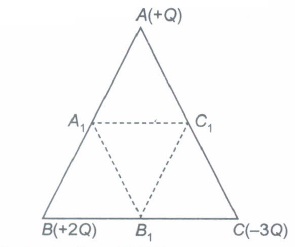
(b) Three point charges, +Q, + 2Q and -3Q are placed at the vertices of an equilateral triangle ABC of side I. If these charges are displaced to the mid-points A1, B1, and C1 respectively, find the amount of the work done in shifting the charges to the new locations.
31.
(a) Use Gauss's law to derive the expression for the electric field \((\vec{E})\) due to a straight uniformly charged infinite line of charge density λ C/m.
(b) Draw a graph to show the variation of E with perpendicular distance r from the line of charge.
(c) Find the work done in bringing a charge q from perpendicular distance \(r_{1} \text { to } r_{2}\left(r_{2}>r_{1}\right)\)
32.
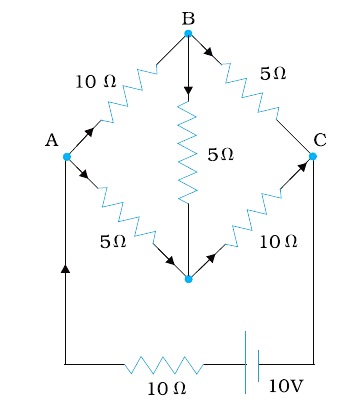
Determine the current in each branch of the network shown in Figure
33.
Draw a schematic diagram of a step-up transformer. Explain its working principle. Deduce the expression for the secondary to primary voltage in terms of the number of turns in the two coils. In an ideal transformer, how is this ratio related to the current in the two coils ?
How is the transformer used in large scale transmission and distribution of electrical energy over long distances ?
34.
A circuit containing 80 mH inductor and a \(60\mu F\) capacitor in series is connected to a 230 V, 50 Hz supply. The resistance in the circuit is negligible.
(i) Obtain the current amplitude and rms value.
(ii) Obtain tha rms value of potential drop across each element.
(iii) What is the average power transferred to inductor?
(iv) What is the average power transferred to capacitor?
(v) What is the total average power absorbed by the circuit?
35.
If one of the electrons of H2 molecules is removed, we get a hydrogen molecular ion H+2 . In the ground state of an H+2, the two protons are separated by roughly 1.5 \(\overset { o }{ A } \) and the electron is roughly 1\(\overset { o }{ A } \) from each proton. Determine the potential energy of the system. Specify your choice of the zero of potential energy.
36.
Two large metal plates each of area 1m2 are placed facing each other at a distance of 5cm and carry equal and opposite charges on their faces. If the electric field between the plates is 1000 NC-1, find the charge on each plate.
1.
Yes, but motion is simple harmonic only when charge - q is not very far from the centre of ring on its axis. Otherwise motion is periodic, but not simple harmonic in nature.
2.
Ex and by
3.
The Ring Moves a way From the Solenoid
4.
\(R = ρ L/A
\)
(i.e) 10.25%
5.
Power factor \(=\frac { R }{ Z } =\frac { R }{ \sqrt { { R }^{ 2 }+{ ({ X }_{ L }-{ X }_{ C }) }^{ 2 } } } \)
Max. value of power factor is 1, when Z = R
i.e., when \({ X }_{ L }={ X }_{ C },\) i.e ., at resonance, when the circuit is non-inductive.
6.
(a) True
\(\frac { h }{ e } =\frac { joule-sec }{ coulomb } =\frac { joule }{ ampere } \)
\( =magnetic\ flux\)
(b) False, for reason, see text.
(c) False. As magnetic flux does not change with time.
(d) true, as \(e=B\upsilon l\sin { \theta } .\)
7.
A charged glass rod can lift a piece of paper against the gravitational pull of earth on this piece.
8.
(i) Surface charge density,
\(\sigma=\frac{Q}{4 \pi R^2}\)
(ii) Potential at point P due to charge Q,
\(V_1=\frac{Q}{4 \pi \varepsilon_0(R / 2)}=\frac{2 Q}{4 \pi \varepsilon_0 R}\)
Due to spherical shell, potential at all point is same inside the shell and it is equal to potential at the centre of the shell.
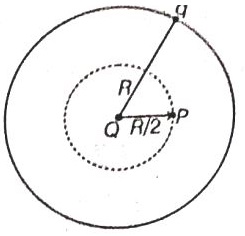
Potential at P due to sphere, \(V_2=\frac{q}{4 \pi \varepsilon_0 R}\)
So, net potential at P,
\(\begin{aligned}
V=\frac{2 Q}{4 \pi \varepsilon_0 R}+\frac{q}{4 \pi \varepsilon_0 R} \end{aligned}\)
\(\begin{aligned}
V=\frac{12}{4 \pi \varepsilon_0}\left(\frac{2 Q}{R}+\frac{q}{R}\right)
\end{aligned}\)
9.
According to the Gauss's theorem, the total electric flux through a closed surface is \(\frac{1}{\varepsilon_{0}}\) times the magnitude of net charge enclosed by the surface. Consider a hollow charged sphere.
Take a point inside the sphere where electric field is to be calculated. Draw a Gaussian surface of radius r having point P on its surface.
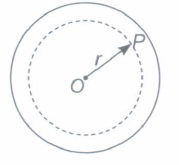
Now, \(\phi=\oint_{S} \vec{E} \cdot \vec{d} s=E \oint_{S} d s=E .4 \pi r^{2}\)
According to the Gauss's theorem,
\(E .4 \pi r^{2}=\frac{q}{\varepsilon_{0}}(\because q=0)\)
\(\therefore E=0\)
10.
If the field is non-uniform, the net force will be non-zero.
11.
(i) Induced emf (voltage) in a coil \(\varepsilon\)= - L dI/dt
\(\frac{\varepsilon_1}{\varepsilon_2}=\frac{\mathrm{L}_1 \frac{d \mathrm{I}}{d t}}{\mathrm{~L}_2 \frac{d \mathrm{I}}{d t}}=\frac{\mathrm{L}_1}{\mathrm{~L}_2}=\frac{4}{3}\)
(ii) Power supplied P = eI
As power is same for both coils
\(\begin{aligned} \varepsilon_1 \mathrm{I}_{\mathrm{I}} & =\varepsilon_2 \mathrm{I}_2 \\ \end{aligned}\)
\(\begin{aligned} \Rightarrow \quad \frac{\mathrm{I}_1}{\mathrm{I}_2} & =\frac{\varepsilon_2}{\varepsilon_1}=\frac{3}{4} \end{aligned}\)
(iii) Energy stored in a coil \(\mathrm{U}=\frac{1}{2} \mathrm{LI}^2\)
\(\therefore \frac{\mathrm{U}_1}{\mathrm{U}_2}=\frac{\frac{1}{2} \mathrm{~L}_1 \mathrm{I}_1^2}{\frac{1}{2} \mathrm{~L}_2 \mathrm{I}_2^2}=\frac{\mathrm{L}_1 \mathrm{I}_1^2}{\mathrm{~L}_2 \mathrm{I}_2^2}=\frac{3}{4}\)
12.
(i) Given, C1 = 1\(\mu F\) C2 = 2\(\mu F\) C3 = 3\(\mu F\)
The combined capacity (Cs) in series combination is given by
\(\frac { 1 }{ { C }_{ s } } =\frac { 1 }{ { C }_{ 1 } } +\frac { 1 }{ { C }_{ 2 } } +\frac { 1 }{ { C }_{ 3 } } =\frac { 1 }{ 1 } +\frac { 1 }{ 2 } +\frac { 1 }{ 3 } =\frac { 11 }{ 6 } \)
\(\Rightarrow { C }_{ s }=\frac { 6 }{ 11 } \mu F\)
The combined capacity (Cp) in parallel combination is given by
Cp = C1 + C2 +C3 = 1 + 2 + 3 = 6\(\mu F\)
\(\Rightarrow { C }_{ p }=11{ C }_{ s }\)
(ii) As, \({ \ C }_{ p }>{ C }_{ s }\)
\(\therefore \) The charge supplied by 100 V battery
\({ q }_{ p }={ C }_{ p }V=6\mu F\times 100=6\times { 10 }^{ -6 }\times 100\)
\(\\ { q }_{ p }=6\times { 10 }^{ -4 }C\)= 600 \(\mu\)C
13.
\(Here,\ r=8cm=8\times { 10 }^{ -2 }m\)
\(\frac { dE }{ dt } ={ 10 }^{ 13 }V{ m }^{ -1 }{ s }^{ -1 }\)
Displacement current.
\({ I }_{ D }={ \epsilon }_{ 0 }\frac { { d\phi }_{ E } }{ dt } { { \epsilon }_{ 0 } }\frac { d }{ dt } (EA)\)
\( ={ \epsilon }_{ 0 }A\frac { { d }E }{ dt } ={ { \epsilon }_{ 0 }\pi { r }^{ 2 } }\frac { dE }{ dt } \)
\( =(8.85\times { 10 }^{ -12 })\times 3.14\times ({ 8\times { 10 }^{ -2 }) }^{ 2 }\times { 10 }^{ 13 }\)
\( =1.78\ A\)
14.
Length of wire used,
\(L=2\pi r\times no.\quad of\quad turns\)
\(=2\pi \times (2\times { 10 }^{ -2 })\times 500\quad m\)
\( Resistancperunitlength=0.02\Omega { m }^{ -1 }\)
\( Totalresistanceofwire,\)
\( R=2\pi \times (2\times { 10 }^{ -2 })\times 500\times .02=0.4\pi \Omega \)
\( No.of \ turn \ sperunit \ length,\)
\(n=\frac { 500 }{ 30\times { 10 }^{ -2 } } =\frac { 5000 }{ 3 } { m }^{ -1 }\)
\(AsB={ \mu }_{ o }nI={ \mu }_{ o }\frac { n\varepsilon }{ R }\)
\( So\varepsilon =\frac { BR }{ { \mu }_{ o }n } =\frac { { 10 }^{ -2 }\times \left( 0.4\pi \right) }{ \left( 4\pi \times { 10 }^{ -7 } \right) \times \left( 5000/3 \right) } =6V\)
15.
(b)
0.4 A
16.
(b)
pE
17.
(a)
The frequency of the microwaves must match the resonant frequency of the water molecules.
18.
(d)
5V
19.
(b)
E2
20.
(c)
3 times.
21.
(b)
1 : 1
22.
(d)
200 Ω
23.
(b)
unknown resistance
24.
(c)
15.6 Ω
25.
(d)
\(m{ E }^{ 2 }/2q{ B }^{ 2 }\)
26.
(b)
> 10ohm
27.
(c)
\(2.21\times { 10 }^{ -30 }J{ m }^{ -3 }\\ \)
28.
(c)
1 henry = \(\frac{1volt}{1\ amp/sec}\)
29.
(a) Moving coil galvanometer is an instrument used for detection and measurement of small currents. Moving coil galvanometer works on the principle that when a current-carrying coil is placed in magnetic field it experiences a torque.
(b) (i) Voltage sensitivity is defined as the deflection produced in the galvanometer when a unit voltage is applied across the two terminals of the galvanometer:
Vs = NBA/KR
(ii) Current sensitivity is defined as the deflection produced in the galvanometer when a limit current flow through the galvanometer:
Is = NBA/K
where N is number of turned in coil, B is the magnetic field, A is the area of the coil, K is the restoring torque per limit twist.
30.
(a) Expression for the potential energy of a system of two point charges in an external field:
Work done in bringing the charge q1from infinity to r1 ,
Work done \(={ q }_{ 1 }V\left( { r }_{ 1 } \right) \)
Work done in bringing the charge qz from infinity to r2 .
Work done against the external electric field
\(={ q }_{ 2 }V\left( { r }_{ 2 } \right) \)
Work done = work done against the external electric field + Work done on q2 against the field due to q1
\(={ q }_{ 2 }V\left( { r }_{ 2 } \right) +\frac { { q }_{ 1 }{ q }_{ 2 } }{ 4\pi { \varepsilon }_{ 0 }{ r }_{ 12 } } \)
Potential energy of the system = the total work done in assembling the configuration
\(={ q }_{ 1 }V\left( { r }_{ 1 } \right) +{ q }_{ 2 }V\left( { r }_{ 2 } \right) +\frac { { q }_{ 1 }{ q }_{ 2 } }{ 4\pi { \varepsilon }_{ 0 }{ r }_{ 12 } } \)
(b) Electrostatic potential energy of the systems of charges corresponding to initial configuration is
\(U_{i}=\frac{2 k Q^{2}}{l}-\frac{3 k Q^{2}}{l}-\frac{6 k Q^{2}}{l}=-\frac{7 k Q^{2}}{l}\)
Electrostatic potential energy of the system of charges corresponding to final configuration is
\(U_{f}=\frac{4 k Q^{2}}{l}-\frac{6 k Q^{2}}{l}-\frac{12 k Q^{2}}{l}=-\frac{14 k Q^{2}}{l}\)
The amount of work done in shifting the charges to new locations is
\(W=U_{f}-U_{i}\)
\(=-\frac{14 k Q^{2}}{l}-\left(-7 \frac{k Q^{2}}{l}\right)=-\frac{7 k Q^{2}}{l}\)
31.
(a) Electric field intensity due to infinitely long charged straight wire: Consider a linear charge distribution with charge density A. We imagine a symmetrical Gaussian surface around length I of this distribution in such a way that the point P where we have to calculate electric field lies on it.
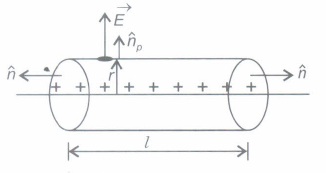
Electric flux through the circular faces of this Gaussian surface is zero.
\(
\phi_{s}=\int \vec{E} \cdot \overrightarrow{d s}=\text { E.ds } \cos 90^{\circ}=0
\left(\because \theta=90^{\circ}\right)
\)
Electric flux through the curved surface is given by
\(
\phi_{c s}=\oint \vec{E} \cdot \overrightarrow{d s}=\oint E \cdot d s
\)
\(\phi_{c s}=E \oint d s=E(2 \pi r l) \ \left(\because \theta=0^{\circ}\right)
\)
Net flux through the Gaussian surface is given by
\(\phi_{E}=\phi_{s}+\phi_{c s}=E(2 \pi r l)...(i)\)
According to the Gauss's theorem
\(\phi_{E}=\frac{q}{\varepsilon_{0}}=\frac{\lambda l}{\varepsilon_{0}} \ (\because q=\lambda l) \ \ldots(i i)\)
From equations (i) and (ii), we get
\(E=\frac{\lambda}{2 \pi \varepsilon_{0} r} \Rightarrow E \propto \frac{1}{r}\)
(b)
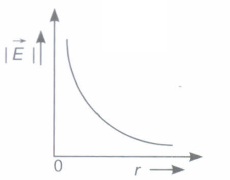
(c) Work done in moving a charge 'q' through a small displacement \(\overrightarrow{d r}\) is given by
\(
d W =\vec{F} \cdot d \vec{r}=q \vec{E} \cdot \overrightarrow{d r}
\)
\(d W =q E d r \cos \theta\left(\theta=0^{\circ} \text { and } \cos 0^{\circ}=1\right)
\)
\(d W =q \times \frac{\lambda}{2 \pi \varepsilon_{0} r} d r
\)
\(E =\frac{\lambda}{2 \pi \varepsilon_{0} r}\)
Work done in moving the given charge from rl to \(r_{2}\left(r_{2}>r_{1}\right)\)
\(
W=\int_{r_{1}}^{r_{2}} d W=\frac{\lambda q}{2 \pi \varepsilon_{0}} \int_{r_{1}}^{r_{2}} \frac{d r}{r}
\)
\(W=\frac{\lambda q}{2 \pi \varepsilon_{0}}\left[\log _{e} r_{2}-\log _{e} r_{1}\right]
\)
\(W=\frac{\lambda q}{2 \pi \varepsilon_{0}} \log _{e} \frac{r_{2}}{r_{1}}
\)
32.
Current flowing through various branches of the circuit is represented in the given figure.
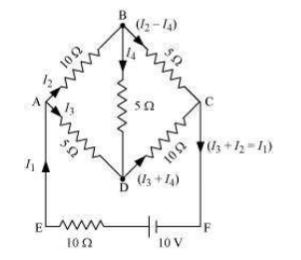
I1 = Current flowing through the outer circuit
I2 = Current flowing through branch AB
I3 = Current flowing through branch AD
I2 - I4 = Current flowing through branch BC
I3 + I4 = Current flowing through branch CD
I4 = Current flowing through branch BD
For the closed circuit ABDA, potential is zero i.e.,
10I2 + 5I4 - 5I3 = 0
2I2 + I4 - I3 = 0
I3 = 2I2 + I4 … (1)
For the closed circuit BCDB, potential is zero i.e.,
5(I2 - I4) - 10(I3 + I4) - 5I4 = 0
5I2 + 5I4 - 10I3 - 10I4 - 5I4 = 0
5I2 - 10I3 - 20I4 = 0
I2 = 2I3 + 4I4 … (2)
For the closed circuit ABCFEA, potential is zero i.e.,
-10 + 10 (I1) + 10(I2) + 5(I2 - I4) = 0
10 = 15I2 + 10I1 - 5I4
3I2 + 2I1 - I4 = 2 … (3)
From equations (1) and (2), we obtain
I3 = 2(2I3 + 4I4) + I4
I3 = 4I3 + 8I4 + I4
- 3I3 = 9I4
- 3I4 = + I3 … (4)
Putting equation (4) in equation (1), we obtain
I3 = 2I2 + I4
- 4I4 = 2I2
I2 = - 2I4 … (5)
It is evident from the given figure that,
I1 = I3 + I2 … (6)
Putting equation (6) in equation (1), we obtain
3I2 +2(I3 + I2) - I4 = 2
5I2 + 2I3 - I4 = 2 … (7)
Putting equations (4) and (5) in equation (7), we obtain
5(- 2 I4) + 2(- 3 I4) - I4 = 2
- 10I4 - 6I4 - I4 = 2
17I4 = - 2
\(I_{4}=-\frac{2}{17} A\)
Equation (4) reduces to
I3 = - 3(I4)
\(=-3\left(-\frac{2}{17}\right)=\frac{6}{17} A\)
\(I_{2}=-2\left(I_{4}\right)\)
\(=-2\left(-\frac{2}{17}\right)=\frac{4}{17} A\)
\(I_{2}-I_{4}=\frac{4}{17}-\left(-\frac{2}{17}\right)=\frac{6}{17} A\)
\(I_{3}+I_{4}=\frac{6}{17}+\left(-\frac{2}{17}\right)=\frac{4}{17} A\)
\(I_{1}=I_{3}+I_{2}\)
\(=\frac{6}{17}+\frac{4}{17}=\frac{10}{17} A\)
Therefore, current in branch \(A B=\frac{4}{17} A\)
In branch BC \(=\frac{6}{17} A\)
In branch CD = \(-\frac{4}{17} A\)
In branch AD = \(\frac{6}{17} A\)
In branch BD = \(\left(-\frac{2}{17}\right) A\)
Total current = \(\frac{4}{17}+\frac{6}{17}+\frac{-4}{17}+\frac{6}{17}+\frac{-2}{17}=\frac{10}{17} A\)
33.
Principle: When an alternating voltage is applied to the primary, the resulting current produces an alternating magnetic flux which links the secondary and induces an emf in it (mutual induction).
Derivation :
The induced emf or voltages Es. in the secondary, with Ns, turns, is
\({ E }_{ s }=\frac { -{ N }_{ s }d\phi }{ dt } \)
The alternating flux also induces an emf, called back emf, in the primary. This is
\({ \varepsilon }_{ p }=\frac { -{ N }_{ p }d\phi }{ dt } \)
But
\({ \varepsilon }_{ s }={ V }_{ s }>{ \varepsilon }_{ p }={ V }_{ p }\)
therefore,
\({ V }_{ s }=\frac { -{ N }_{ s }d\phi }{ dt } \quad and\quad { V }_{ p }=\frac { -{ N }_{ p }d\phi }{ dt } \)
Hence
\(\frac { { V }_{ s } }{ { V }_{ p } } =\frac { { N }_{ s } }{ { N }_{ p } } \)
If the transformer is assumed to be 100% efficient (no energy losses), the power input is equal to the power output,
\(\frac { { V }_{ s } }{ { V }_{ p } } =\frac { { N }_{ s } }{ { N }_{ p } } =\frac { { I }_{ p } }{ { I }_{ s } } \)
The large-scale transmission and distribution of electrical energy over long distances are done with the use of transformers. The voltage output of the generator is stepped-up (so that current is reduced and consequently, the 12 R loss is cut down). It is then transmitted over long distances to an area sub-station near the consumers. There the voltage is stepped down. It is further stepped down at distributing sub-stations and utility poles before a power supply of 240 V reaches our homes.
34.
Given,
\(L=80mH=80\times { 10 }^{ -3 }H, \ R=0, \ v=50Hz\)
\(C=60\mu F=60\times { 10 }^{ -6 }F,\)
\(\omega =2\pi v=100\pi \ rad/s \)
\({ V }_{ rms }=230 \ V,\)
and \(\\ { V }_{ 0 }=\sqrt { 2{ V }_{ rms } } =\sqrt { 2 } \times 230V\)
(i) I0 = ? and Irms = ?
\(\begin{aligned} \Rightarrow I_0 & =\frac{V_0}{Z}=\frac{V_0}{\left|\omega L-\frac{1}{\omega C}\right|} \\ \end{aligned}\)
\(\begin{aligned} & =\frac{230 \sqrt{2}}{\left|100 \pi \times 80 \times 10^{-3}-\frac{1}{100 \pi \times 60 \times 10^{-6}}\right|} \\ \end{aligned}\)
\(\begin{aligned} =\frac{230 \sqrt{2}}{\left|8 \pi-\frac{1000}{6 \pi}\right|}=-11.63 \mathrm{~A} \\ \end{aligned}\)
\(\begin{aligned} I_{\mathrm{rms}} & =\frac{I_0}{\sqrt{2}}=\frac{-11.63}{\sqrt{2}}=8.23 \mathrm{~A} \end{aligned}\)
(ii) For L, VL = Irms \(\omega \)L = 8.23 \(\times\) 100\(\pi\)\(\times\)80 \(\times\)10-3
= 206.84 V
For C, \(V_C=I_{\mathrm{rms}} \frac{1}{\omega C}=8.23 \times \frac{1}{100 \pi \times 60 \times 10^{-6}}\)
= 436.84 V
Since, voltage across L and C are 180° out of phase, therefore they are subtracted.
Thus, applied rms voltage = 436.84 - 206.84
= 230.0 V
(iii) Average power transferred per cycle by source to inductor is always zero because of phase difference of \(\pi\)/2 between voltage and current through inductor.
(iv) Average power transferred per cycle by source to inductor is always zero because of phase difference of \(\pi\)/2 between voltage and current through inductor
(v) \(\therefore\) Total average power absorbed by the circuit is also zero.
35.
There are two protons p1 and p2 with an electron e.
Distance between two protons id given by
r1 = 1.5\(\overset { o }{ A } \) = 1.5 x 10⁻¹⁰ m

Distance between proton p1 and electron e is given by
r2 = 1 \(\overset { o }{ A } \)
= 1 x 10⁻¹⁰ m
Distance between proton p2 and electron e is given by
r3 = 1\(\overset { o }{ A } \)
=1 x10⁻¹⁰ m
The total potential energy of the system,
\(U=\frac { 1 }{ { 4\pi \varepsilon }_{ 0 } } .\left[ \frac { { q }_{ p1 }{ q }_{ p2 } }{ { r }_{ 1 } } +\frac { { q }_{ p1 }{ q }_{ e } }{ { r }_{ 2 } } +\frac { { q }_{ p2 }{ q }_{ e } }{ { r }_{ 13 } } \right] \)......(i)
Given qp1 = qp2
= 1.6 x10⁻¹⁹ C
and qe= -1.6 x10⁻¹⁹ C
Putting these values in Eq.(i), we get
\(U=9 \times 10^{9}\left[\frac{1.6 \times 10^{-19} \times 1.6 \times 10^{-19}}{1.5 \times 10^{-10} \cdots}\right.\) \(+\frac{\left(1.6 \times 10^{-19}\right) \times\left(-1.6 \times 10^{-19}\right)}{10^{-10}}\) \(\left.+\frac{1.6 \times 10^{-19} \times\left(-1.6 \times 10^{-19}\right)}{10^{-10}}\right]\)
\(=\frac{9 \times 10^{9} \times 1.6 \times 1.6 \times 10^{-38}}{10^{-10}}\left[\frac{1}{1.5}-1-1\right]\)
= -30.72 x 10⁻¹⁹ J
\(=\frac{-30.72 \times 10^{-19}}{1.6 \times 10^{-19}} \mathrm{eV}=-19.2 \mathrm{eV}\)
Here, we use that potential energy at infinity is zero.
36.
Here A = 1m2, d = 5 cm, q =?
E = 1000 NC-1
From \(E={\sigma\over\epsilon_o}={q/A\over \epsilon_o}\)
\(q=A\epsilon_oE=1\times (8.85\times 10^{-12})\times 1000\)
\(=8.85\times 10^{-9}C\)

12th Standard CBSE Syllabus & Materials
12th Standard CBSE
CBSE 12th Computer Science Python Revision Tour I - New Previous year Question Papers Study Material - QB365 Set A
NEW12th Standard CBSE
CBSE 12th Business Studies Planning Important Questions And Answers Study Material - QB365 Set A
NEW12th Standard CBSE
CBSE 12th Business Studies Business Environment Important Questions And Answers Study Material - QB365 Set A
NEW12th Standard CBSE
CBSE 12th Business Studies Principles of Management Important Questions And Answers Study Material - QB365 Set A



NCERT Books

Syllabus

Exam Pattern

Sample Question Papers

Previous year Question Papers

Important Notes

MCQ Practice test

NCERT Exemplers

Case study Questions

Image Based Questions

Passage based Questions

HOT Questions

Value Based Questions

Model Questions Papers
NCERT ( Book Back ) Questions

Assertion and Reason
Important Questions And Answers

CBSE 12th Standard CBSE Subjects
CBSE Standards








