
 100% FREE ACCESS
12th Standard CBSE Syllabus & Materials
12th Standard CBSE
CBSE 12th Economics Government Budget and the Economy Previous year Question Papers Study Material - QB365 Set A
NEW12th Standard CBSE
CBSE 12th Computer Science Interface Python with MySQL - New Previous year Question Papers Study Material - QB365 Set A
NEW12th Standard CBSE
CBSE 12th Computer Science Database Concept - New Previous year Question Papers Study Material - QB365 Set A
NEW12th Standard CBSE
CBSE 12th Computer Science Data Communication - New Previous year Question Papers Study Material - QB365 Set A
NEW12th Standard CBSE
CBSE 12th Computer Science Data Structures - New Previous year Question Papers Study Material - QB365 Set A
NEW12th Standard CBSE
CBSE 12th Computer Science Functions - New Previous year Question Papers Study Material - QB365 Set A

Published on: 25/10/2025
Download CBSE Class 12th Standard CBSE Physics question papers, sample papers, important questions, and previous year solved papers in PDF format. Get free study materials, NCERT solutions, and exam preparation resources for Class 12th Standard CBSE Physics
Questions + Answers key
Take MCQ Physics Test
1.
The impedance of a series L-C-R circuit is
\(R+X_L+X_C\)
\(\sqrt{\frac{1}{X_C^2}+\frac{1}{X_L^2}+R^2}\)
\(\sqrt{X_L^2-X_C^2+R^2}\)
\(\sqrt{R^2+\left(X_L-X_C\right)^2}\)
2.
In a circuit, the phase difference between the alternating current and the source voltage is π/ 2 Which of the following cannot be the element(s) of the circuit?
Only C
Only L
L and R
L or C
3.
Which of the following has maximum penetrating power?
Ultraviolet radiation
Microwaves
\(\gamma \text { -rays }\)
Radio waves
4.
A coil of resistance 400Ω is placed in a magnetic field. If the magnetic flux Φ linked with the coil varies with times t (see) as Φ = 50t2 + 4, the current in the coil at t = 2 sec is
0.5 A
0.1 A
2 A
1 A
5.
A diamagnetic material in a magnetic field moves
perpendicular to the field
from weaker to stronger parts
from stronger to weaker parts.
in random direction.
6.
Lines of force, due to earth's horizontal magnetic field, are
elliptical
curved lines
concentric circles
parallel and straight
7.
What is not possible in a transformer?
Eddy current
Direct current
Alternating current
Induced current
8.
The frequency of a.c. generated depends on
speed of rotation of coil
amplitude of a.c
size of coil
all the above
9.
Out of the following options which one can be used in produce a propagating electromagnetic wave?
A charge moving at constant velocity
A stationary charge
A chargeless particle
An accelerating charge
10.
A stationary charge produces only an electrostatic field while a charge in uniform motion produces a magnetic field, that does not change with time. An oscillating charge is an example of accelerating charge. It produces an oscillating magnetic field, which in turruproduces an oscillating electric fields and so on. The oscillating electric and magnetic fields regenerate each other as a wave which propagates through space.
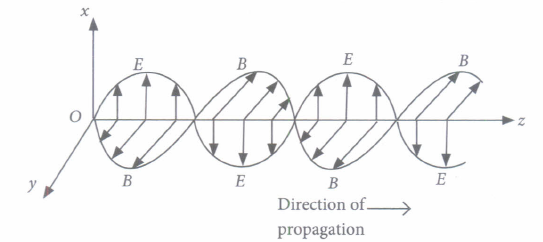
(i) Magnetic field in a plane electromagnetic wave is given by \(\vec{B}=B_{0} \sin (k x+\omega t) \hat{j} \mathrm{~T}\) Expression for corresponding electric field will be (Where C is speed of light.)
| \((a) \vec{E}=-B_{0} c \sin (k x+\omega t) \hat{k} \mathrm{~V} / \mathrm{m}\) | \((b) \vec{E}=B_{0} c \sin (k x-\omega t) \hat{k} \mathrm{~V} / \mathrm{m}\) |
| \((c) \vec{E}=\frac{B_{0}}{c} \sin (k x+\omega t) \hat{k} \mathrm{~V} / \mathrm{m}\) | \((d) \vec{E}=B_{0} c \sin (k x+\omega t) \hat{k} \mathrm{~V} / \mathrm{m}\) |
(ii) The electric field component of a monochromatic radiation is given by \(\vec{E}=2 E_{0} \hat{i} \cos k z \cos \omega t\) .Its magnetic field \(\vec{B}\) is then given by
| \((a) \frac{2 E_{0}}{c} \hat{j} \cos k z \cos \omega t\) | \((b) \frac{2 E_{0}}{c} \hat{j} \sin k z \cos \omega t\) |
| \((c) \frac{2 E_{0}}{c} \hat{j} \sin k z \sin \omega t\) | \((d) -\frac{2 E_{0}}{c} \hat{j} \sin k z \sin \omega t\) |
(iii) A plane em wave of frequency 25 MHz travels in a free space along x-direction. At a particular point in space and time, \(E=(6.3 \hat{j}) \mathrm{V} / \mathrm{m}\) What is magnetic field at that time?
| \((a) 0.095 \mu \mathrm{T}\) | \((b) 0.124 \mu \mathrm{T}\) | \((c) 0.089 \mu \mathrm{T}\) | \((d) 0.021 \mu \mathrm{T}\) |
(iv) A plane electromagnetic wave travelling along the x-direction has a wavelength of 3 mm. The variation in the electric field occurs in the y-direction with an amplitude 66 V m-1. The equations for the electric and magnetic fields as a function of x and t are respectively
| \((a) E_{y}=33 \cos \pi \times 10^{11}\left(t-\frac{x}{c}\right), B_{z}=1.1 \times 10^{-7} \cos \pi \times 10^{11}\left(t-\frac{x}{c}\right)\) |
| \((b) E_{y}=11 \cos 2 \pi \times 10^{11}\left(t-\frac{x}{c}\right), \quad B_{y}=11 \times 10^{-7} \cos 2 \pi \times 10^{11}\left(t-\frac{x}{c}\right)\) |
| \((c) E_{x}=33 \cos \pi \times 10^{11}\left(t-\frac{x}{c}\right), \quad B_{x}=11 \times 10^{-7} \cos \pi \times 10^{11}\left(t-\frac{x}{c}\right)\) |
| \((d) E_{y}=66 \cos 2 \pi \times 10^{11}\left(t-\frac{x}{c}\right), \quad B_{z}=2.2 \times 10^{-7} \cos 2 \pi \times 10^{11}\left(t-\frac{x}{c}\right)\) |
(v) A plane electromagnetic wave travels in free space along x-axis. At a particular point in space, the electric field along y-axis is 9.3 V m-1. The magnetic induction (B) along z-axis is
| (a) 3.1 x 10⁻⁸ T | (b) 3 x 10⁻⁵ T | (c) 3 x 10⁻⁶ T | (d) 9.3 x 10⁻⁶ T |
11.
A transformer is an electrical device which is used for changing the a.c. voltages. It is based on the phenomenon of mutual induction i.e. whenever the amount of magnetic flux linked with a coil changes, an e.m.f is induced in the neighbouring coil. For. an ideal transformer, the resistances of the primary and secondary windings are negligible.
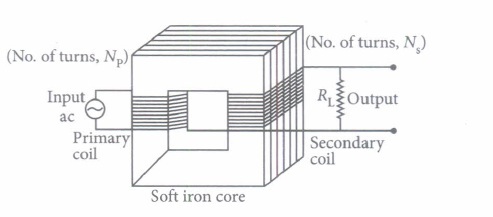
It can be shown that \(\frac{E_{s}}{E_{p}}=\frac{I_{p}}{I_{s}}=\frac{n_{s}}{n_{p}}=k\)
where the symbols have their standard meanings.
For a step up transformer \(n_{s}>n_{p} ; E_{s}>E_{p} ; k>1 ; \quad \therefore I_{s}
For a step down transformer \(n_{s}
The above relations are on the assumptions that efficiency of transformer is 100%.
lentlac ,effciency \(\eta=\frac{\text { output power }}{\text { intput power }}=\frac{E_{s} I_{s}}{E_{p} I_{p}}\)
(i) Which of the following quantity remains constant in an ideal transformer?
| (a) Current | (b) Voltage | (c) Power | (d) All of these |
(ii) Transformer is used to
| (a) convert ac to dc voltage | (b) convert de to ac voltage |
| (c) obtain desired dc power | (d) obtain desired ac voltage and current |
(iii) The number of turns in primary coil of a transformer is 20 and the number of turns in a secondary is 10. If the voltage across the primary is 220 ac V, what is the voltage across the secondary?
| (a) 100 ac V | (b) 120 ac V | (c) 110 ac V | (d) 220 ac V |
(iv) In a transformer the number of primary turns is four times that of the secondary turns. Its primary is connected to an a.c. source of voltage V. Then
| (a) current through its secondary is about four times that of the current through its primary |
| (b) voltage across its secondary is about four times that of the voltage across its primary. |
| (c) voltage across its secondary is about two times that of the voltage across its primary |
| (d) voltage across its secondary is about \(\frac{1}{2 \sqrt{2}}\) times that of the voltage across its primary |
(v) A transformer is used to light 100 W-110 V lamp from 220 V mains. If the main current is 0.5 A, the efficiency of the transformer is
| (a) 95% | (b) 99% | (c) 90% | (d) 96% |
12.
When a current I flows through a coil, flux linked with it is \(\phi=L I,\) where L is a constant known as self-inductance of the coil. Any change in current sets up an induced emf in the coil. Thus, self-inductance of a coil is the induced emf set up in it when the current passing through it changes at the unit rate. It is a measure of the opposition to the growth or the decay of current flowing through the coil. Also, value of self-inductance depends on the number of turns in the solenoid, its area of cross-section, and the relative permeability of its core material.
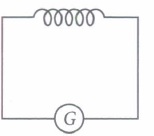
(I) The inductance in a coil plays the same role as
| (a) inertia in mechanics | (b) energy in mechanics |
| (c) momentum in mechanics | (d) force in mechanics |
(ii) A current of 2.5 A flows through a coil of inductance 5 H. The magnetic flux linked with the coil is
| (a) 0.5 Wb | (b) 12.5 Wb | (c) zero | (d) 2 Wb |
(iii) The inductance L of a solenoid depends upon its radius R as
| \(\text { (a) } L \propto R\) | \(\text { (b) } L \propto 1 / R\) | \(\text { (c) } L \propto R^{2}\) | \(\text { (d) } L \propto R^{3}\) |
(iv) The unit of self-inductance is
| (a) weber ampere | (b) weber-1 ampere | (c) ohm second | (d) farad |
(v) The induced e.m.f in a coil of 10 henry inductance in which current varies from 9 A to 4 A in 0.2 second is
| (a) 200 V | (b) 250 V | (c) 300 V | (d) 350 V |
13.
The field of a hollow wire with constant current is homageneous
Curves in the graph shown give, as functions of radius distance r, the magnitude B of the magnetic field inside and outside four long wires a, b, c and d, carrying currents that are uniformly distributed across the cross sections of the wires. Overlapping portions of the plots are indicated by double labels.
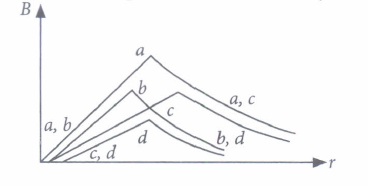
(i) Which wire has the greatest magnitude of the magnetic field on the surface?
| (a) a | (b) b | (c) c | (d) d |
(ii) The current density in a wire a is
| (a) greater than in wire c |
| (b) less than in wire |
| (c) equal to that in wire c |
| (d) not comparable to that of in wire c due to lack of information |
(iii) Which wire has the greatest radius?
| (a) a | (b) b | (c) c | (d) d |
(iv) A direct current I flows along the length of an infinitely long straight thin walled pipe, then the magnetic field is
| (a) uniform throughout the pipe but not zero |
| (b) zero only along the axis of the pipe |
| (c) zero at any point inside the pipe |
| (d) maximum at the centre and minimum at the edges |
(v) In a coaxial, straight cable, the central conductor and the outer conductor carry equal currents in opposite direction. The magnetic field is zero
| (a) outside the cable | (b) inside the inner conductor |
| (c) inside the outer conductor | (d) in between the two conductor. |
14.
Assertion : The electromagnetic wave is transverse in nature.
Reason : Electromagnetic wave propagates parallel to the direction of electric and magnetic fields.
Codes:
(a) If both Assertion and Reason are correct and the Reason is a correct explanation of the Assertion.
(b) If both Assertion and Reason are correct but Reason is not a correct explanation of the Assertion.
(c) If the Assertion is correct but Reason is incorrect.
(d) If both the Assertion and Reason are incorrect.
15.
16.
17.
18.
19.
Assertion (A) : Infrared waves sometimes referred as heat waves.
Reason (R) : Infrared waves heat up the earth surface
Codes:
(a) Both A and R are true and R is the correct explanation of A
(b) Both A and R are true but R is NOT the correct explanation of A
(c) A is true but R is false
(d) A is false and R is also false
20.
Assertion (A) : A bulb connected in series with a solenoid is connected to A.c. source. If a soft iron core is introduced in the solenoid, the bulb will glow brighter.
Reason (R) : On introducing soft iron core in the solenoid, the inductance decreases.
Codes:
(a) Both A and R are true and R is the correct explanation of A
(b) Both A and R are true but R is NOT the correct explanation of A
(c) A is true but R is false
(d) A is false and R is also false
21.
Assertion (A) : Step-down transformer increases the current.
Reason (R) : Transformer obeys the law of conservation of energy.
Codes:
(a) Both A and R are true and R is the correct explanation of A
(b) Both A and R are true but R is NOT the correct explanation of A
(c) A is true but R is false
(d) A is false and R is also false
22.
Assertion (A) : The true geographic north direction is found by using a compass needle.
Reason (R) : The magnetic meridian of the earth is along the axis of rotation of the earth.
Codes:
(a) Both A and R are true and R is the correct explanation of A
(b) Both A and R are true but R is NOT the correct explanation of A
(c) A is true but R is false
(d) A is false and R is also false
23.
Assertion (A) : Earth's magnetic field does not affect the working of a moving coil galvanometer.
Reason (R) : The earth's magnetic field is <Iuiteweak as compared to magnetic field produced in the moving coil galvanometer.
(a) Both A and R are true and R is the correct explanation of A
(b) Both A and R are true but Ris NOT the correct explanation of A
(c) A is true but R is false
(d) A is false and R is also false
1.
(d)
\(\sqrt{R^2+\left(X_L-X_C\right)^2}\)
2.
(c)
L and R
3.
(c)
\(\gamma \text { -rays }\)
4.
(a)
0.5 A
5.
(c)
from stronger to weaker parts.
6.
(d)
parallel and straight
7.
(b)
Direct current
8.
(a)
speed of rotation of coil
9.
(d)
An accelerating charge
10.
(i) (d): Given \(\vec{B}=B_{0} \sin (k x+\omega t) \hat{j} \mathrm{~T}\)
The relation between electric and magnetic field is,
\(c-\frac{E}{B} \text { or } E-c B\)
The electric field component is perpendicular to the direction of propagation and the direction of magnetic field. Therefore, the electric field component along z-axis is obtained as
\(\vec{E}=c B_{0} \sin (k x+\omega t) \hat{k} \mathrm{~V} / \mathrm{m}\)
(ii) (c): \(\frac{d E}{d z}=-\frac{d B}{d t}\)
\(\frac{d E}{d z}=-2 E_{0} k \sin k z \cos \omega t=-\frac{d B}{d t} \)
\(d B=+2 E_{0} k \sin k z \cos \omega t d t \)
\(B=+2 E_{0} k \sin k z \int \cos \omega t d t=+2 E_{0} \frac{k}{\omega} \sin k z \sin \omega t \)
\(\frac{E_{0}}{B_{0}}=\frac{\omega}{k}=c \)
\(B=\frac{2 E_{0}}{c} \sin k z \sin \omega t \ \therefore \ \vec{B}=\frac{2 E_{0}}{c} \sin k z \sin \omega t \hat{j}\)
E is along y-direction and the wave propagates along x-axis,
\(\therefore\) B should be in a direction perpendicular to both x-and y-axis
(iii) (d): Here, \(E=6.3 \hat{j} ; c=3 \times 10^{8} \mathrm{~m} / \mathrm{s}\)
The magnitude of B is
\(B_{z}=\frac{E}{c}=\frac{6.3}{3 \times 10^{8}}=2.1 \times 10^{-8} \mathrm{~T}=0.021 \mu \mathrm{T}\)
(iv) (d): Here, \(E_{0}=66 \mathrm{Vm}^{-1}, E_{y}=66 \cos \omega\left(t-\frac{x}{c}\right)\)
\(\lambda=3 \mathrm{~mm}=3 \times 10^{-3} \mathrm{~m}, k=\frac{2 \pi}{\lambda} \)
\(\frac{\omega}{k}=c \Rightarrow \omega=c k=3 \times 10^{8} \times \frac{2 \pi}{3 \times 10^{-3}} \)
\(\text {or } \ \omega=2 \pi \times 10^{11} \)
\(\therefore \quad E_{y}=66 \cos 2 \pi \times 10^{11}\left(t-\frac{x}{c}\right) \)
\(B_{z}=\frac{E_{y}}{c}=\left(\frac{66}{3 \times 10^{8}}\right) \cos 2 \pi \times 10^{11}\left(t-\frac{x}{c}\right) \)
\(=2.2 \times 10^{-7} \cos 2 \pi \times 10^{11}\left(t-\frac{x}{c}\right)\)
(v) (a): At a particular point, E = 9.3 V m-1
\(\therefore\) Magnetic iel at the same point \(=\frac{9.3}{3 \times 10^{8}}\)
= 3.1 x 10⁻⁸ T
11.
(i) (c) :In an ideal transformer, there is no power loss. The efficiency of an ideal transformer is \(\eta=1(i . e\) 100%) i.e. input power = output power.
(ii) (d): Transformer is used to obtain desired ac voltage and current.
(iii) (c): For a transformer \(\frac{V_{s}}{V_{p}}=\frac{N_{s}}{N_{p}}\)
where Ndenotes number of turns and V = voltage
\(\therefore \frac{V_{s}}{220}=\frac{10}{20} \quad \therefore V_{s}=110 \mathrm{ac} \mathrm{V}\)
(iv) (a): In a transformer the primary and secondary currents are related by
\(I_{s}=\left(\frac{N_{p}}{N_{s}}\right) I_{p}\)
and the voltages are related by
\(V_{s}=\left(\frac{N_{s}}{N_{p}}\right) V_{p}\)
where subscripts p and s refer to the primary and secondary of the transformer
Here, \(V_{p}=V, \frac{N_{p}}{N_{s}}=4 \quad \therefore \quad I_{s}=4 I_{p}\)
and \(V_{s}=\left(\frac{1}{4}\right) V=\frac{V}{4}\)
(v) (c): The efficiency of the transformer is \(\eta=\frac{\text { Output power }\left(P_{\text {out }}\right)}{\text { Input power }\left(P_{\text {in }}\right)} \times 100\)
Here, \(P_{\text {out }}=100 \mathrm{~W}, P_{\text {in }}=(220 \mathrm{~V})(0.5 \mathrm{~A})=110 \mathrm{~W}\)
\(\therefore \quad \eta=\frac{100 \mathrm{~W}}{110 \mathrm{~W}} \times 100 \approx 90 \%\)
12.
(i) (a) :The inductance in a coil plays the same role as inertia in mechanics
(ii) (b) : Here, I = 2.5 A, L = 5 H
Magnetic flux linked with the coil is \(\phi_{B}=L I=(5 \mathrm{H})(2.5 \mathrm{~A})=12.5 \mathrm{~Wb}\)
(iii) (c) : The inductance of a solenoid is \(L=\mu_{0} n^{2} A l\)
where A is the area of cross-section of the solenoid, I its length and n is the number of turns per unit length.
As \(A=\pi R^{2}\) where R is the radius of the solenoid.
\(\therefore \ L=\mu_{0} n^{2} \pi R^{2} l \Rightarrow L \propto R^{2}\)
(iv) (c) : The magnitude of induced emf is \(|\varepsilon|=L \frac{d I}{d t} \Rightarrow L=\frac{|\varepsilon| d t}{d I}\)
or \(L=\frac{\text { volt } \times \text { second }}{\text { ampere }}=\text { ohm second }\)
(v) (b) : Here L = 10 henry I1 = 9 A, I2 = 4 A
and \(\Delta t=0.2 \text { second }\)
Then induced e.m.f.
\(\varepsilon_{1}=-L \frac{d I}{d t}=-L \frac{\left(I_{2}-I_{1}\right)}{\Delta t}=\frac{-10 \times(4-9)}{0.2}=\frac{50}{0.2}=250 \mathrm{~V}\)
13.
(i) (a): It can be seen that slop of curve for wire a is greater than wire c.
(ii) (b): Inside the wire
The field of a hollow wire with constant current is homageneous
\(\text { i.e., slope } \propto \frac{I}{\pi R^{2}} \text { , }\) Current density
(iii) (c) : Wire c has the greatest radius.
(iv) (c)
(v) (a)
14.
(c) If the Assertion is correct but Reason is incorrect.
Explanation:
This electromagnetic wave contains sinusoidally time varying electric and magnetic field which act perpendicular to each other as well as at right angle to the direction of propagation of waves, so electromagnetic waves are transverse in nature. Electromagnetic wave propagate in the perpendicular direction to both fields.
15.
16.
17.
18.
19.
(b): Infrared waves are sometimes called heat waves. This is because water molecules present in most materials readily absorb infrared waves. After absorption, their thermal motion increases, that is, they heat up and heat their surroundings.
20.
(d): On introducing soft iron core, the bulb will glow dimmer. This is because on introducing soft iron core in the solenoid, its inductance L increases, the inductive reactance \(X_{I}=\omega L\) increases and hence the current through the bulb decreases
21.
(b): If there is no loss of energy in transformer, then instantaneous output power is equal to instantaneous input power. From this we get \(\frac{e_{s}}{e_{p}}=\frac{I_{p}}{I_{s}}\) So in step up transformer voltage illlcreases by decreasing the current. Similarly, step-down transformer decreases the voltage by increasing current. Therefore transformer simply transforms the voltage and current, obeying the law of conservation of energy.
22.
(d): From the compass we are able to know the direction of the magnetic poles. The north of compass points towards the magnetic south pole.
If we know the magnetic declination at that particular place (which is angle between geographic meridian and magnetic meridian) we can easily find out the true geographic north-south direction.
Imaginary lines drawn along the earth's surface in the direction of the horizontal component of the magnetic field of the earth at all points passing through the north and south magnetic poles. This is similar to the longitudes of the earth, which pass through the geographic north and south poles.
23.
(a): The field magnet used in a moving coil galvanometer is very strong. The earth's magnetic field is quite weak as compared to the magnetic field produced by the field magnet. Practically the coil rotates under the effect of the strong magnetic field due to the field magnet and the weak magnetic field due to the earth does not affect the working of the moving coil galvanometer.

12th Standard CBSE Syllabus & Materials
12th Standard CBSE
CBSE 12th Computer Science Python Revision Tour I - New Previous year Question Papers Study Material - QB365 Set A
NEW12th Standard CBSE
CBSE 12th Business Studies Planning Important Questions And Answers Study Material - QB365 Set A
NEW12th Standard CBSE
CBSE 12th Business Studies Business Environment Important Questions And Answers Study Material - QB365 Set A
NEW12th Standard CBSE
CBSE 12th Business Studies Principles of Management Important Questions And Answers Study Material - QB365 Set A



NCERT Books

Syllabus

Exam Pattern

Sample Question Papers

Previous year Question Papers

Important Notes

MCQ Practice test

NCERT Exemplers

Case study Questions

Image Based Questions

Passage based Questions

HOT Questions

Value Based Questions

Model Questions Papers
NCERT ( Book Back ) Questions

Assertion and Reason
Important Questions And Answers

CBSE 12th Standard CBSE Subjects
CBSE Standards








