
 100% FREE ACCESS
12th Standard CBSE Syllabus & Materials
12th Standard CBSE
CBSE 12th Economics Government Budget and the Economy Previous year Question Papers Study Material - QB365 Set A
NEW12th Standard CBSE
CBSE 12th Computer Science Interface Python with MySQL - New Previous year Question Papers Study Material - QB365 Set A
NEW12th Standard CBSE
CBSE 12th Computer Science Database Concept - New Previous year Question Papers Study Material - QB365 Set A
NEW12th Standard CBSE
CBSE 12th Computer Science Data Communication - New Previous year Question Papers Study Material - QB365 Set A
NEW12th Standard CBSE
CBSE 12th Computer Science Data Structures - New Previous year Question Papers Study Material - QB365 Set A
NEW12th Standard CBSE
CBSE 12th Computer Science Functions - New Previous year Question Papers Study Material - QB365 Set A

Published on: 25/10/2025
Download CBSE Class 12th Standard CBSE Physics question papers, sample papers, important questions, and previous year solved papers in PDF format. Get free study materials, NCERT solutions, and exam preparation resources for Class 12th Standard CBSE Physics
Questions + Answers key
Take MCQ Physics Test
1.
The potential barrier of germanium diode is
0.1 V ,
0.3 V
0.5 V
0.7 V
2.
The interference is produced by two waves of intensity ratio 16 : 9. The ratio of maximum and minimum intensities in interference pattern is
4:3
49:1
25:7
256:81
3.
Huygens' principle of secondary wavelets may be used to
find the velocity of light in vacuum.
explain the particle's behaviour of light
find the new position of a wavefront
explain photoelectric effect
4.
A 15.0 \(\mu\)F capacitor is connected to a 220 V,50 Hz source. The capacitive reactance is
220 \(\Omega\)
215 \(\Omega\)
212 \(\Omega\)
204 \(\Omega\)
5.
The magnifying power of a microscope with an objective of 5 mm focal length is 400. The length of its tube is 20 cm. Then, the focal length of the eye-piece is
200 cm
160 cm
2.5 cm
0.1 cm
6.
One dioptre is the power of a lens of focal length
1 cm
1 m
-1 cm
-1 m
7.
Optical fibres are based on the phenomenon of
reflection
refraction
dispersion
total internal reflection
8.
What is the refractive index of a medium in which light travels with a speed of \(2\times 10^{ 8 } \ m/s\) ?
3/2
2/3
1
none of these
9.
The relation between focal length \(f\) and radius of curvature \(R\) of a spherical mirror is
\(f=R\)
\(f=R/2\)
\(f=2 R\)
none of these
10.
Which type of semiconductor is obtained by mixing arsenic with silicon?
\(n-type\)
\(p-type\)
Both
None
11.
The source of electromagnetic waves can be a charge
moving with a constant velocity
moving in a circular orbit
at rest
falling in an electric field.
12.
Explain two advantages of a reflecting telescope over a refracting telescope.
13.
The current in a circuit containing a capacitor is 0.15A.What is the displacement current and where does it exist?
14.
How much average power over a complete cycle does an a.c.source supply to a capacitor.
15.
Define the term self-inductance of a coil.Write its SI unit.
16.
Determine refractive index of a substance if critical angle is \(45°\).
17.
What is doping?
18.
A 15.0 µF capacitor is connected to a 220 V, 50 Hz source. Find the capacitive reactance and the current (rms and peak) in the circuit. If the frequency is doubled, what happens to the capacitive reactance and the current?
19.
What is the focal length of a convex lens of focal length 30cm in contact with a concave lens of focal length 20cm? Is the system a converging or a diverging lens? Ignore thickness of the lenses.
20.
In half wave rectification , what is the output frequency if the input frequency is 50 Hz. What is the output frequency of a full wave rectification for the same input frequency.
21.
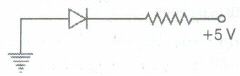
(i) In the following diagram, is the junction diode forward biased or reverse biased?
(ii) Draw the circuit diagram of a full wave rectifier and state how it works?
22.
Use Huygen's principle to show how a plane wavefront propagates from a denser to rarer medium. Hence, verify Snell's law of refraction.
23.
Name the parts of the electromagnetic spectrum which is
(a) suitable for radar system used in aircraft navigation
(b) used to treat muscular strain
(c) use as a diagnostic tool in medicine
Write in brief, how these waves can be produced.
24.
Calculate the refractive index of the material of an equilateral prism for which angle of minimum deviation is\(60°\).
25.
A radio can tune in to any station in the 7.5 MHz to 12 MHz band. What is the corresponding wavelength band?
26.
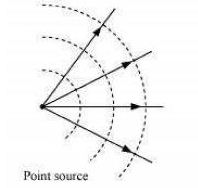
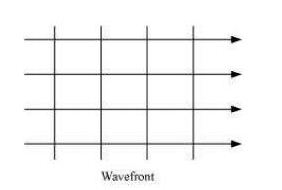
What is the shape of the wavefront in each of the following cases:
(a) Light diverging from a point source.
(b) Light emerging out of a convex lens when a point source is placed at its focus.
(c) The portion of the wavefront of light from a distant star intercepted by the Earth.
27.
In a plane electromagnetic wave, the electric field oscillates sinusoidally at a frequency of 2.0 x 10¹⁰ Hz and amplitude 48 V m–1.
(a) What is the wavelength of the wave?
(b) What is the amplitude of the oscillating magnetic field?
(c) Show that the average energy density of the E field equals the average energy density of the B field. [c = 3 x 10⁸ m s–1.]
28.
(i) If f = 0.5 m for a glass lens, what is the power of the lens?
(ii) The radii of curvature of the faces of a double convex lens are 10 cm and 15 cm. Its focal length is 12 cm. What is the refractive index of glass?
(iii) A convex lens has 20 cm focal length in air. What is focal length in water? (Refractive index of air-water = 1.33, refractive index for air-glass = 1.5.)
29.
(a) Draw a schematic arrangement for winding of primary and secondary coil in a transformer when the two coils are wound on top of each other.
(b) State the underlying principle of a transformer and obtain the expression for the ratio of secondary to primary voltage in terms of the
(i) number of secondary and primary windings and
(ii) primary and secondary currents.
(c) Write the main assumption involved in deriving the above relations.
(d) Write any two reasons due to which energy losses may occur in actual transformers.
30.
Monochromatic light of wavelength 589 nm is incident from air on a water surface. What are the wavelength, frequency, and speed of
(a) reflected and
(b) refracted light? Refractive index of water is 1.33 ?
31.
A sinusoidal voltage of peak value 283 V and frequency 50 Hz is applied to a series LCR circuit in which R = 3 Ω, L = 25.48 mH, and C = 796 μF. Find (a) the impedance of the circuit; (b) the phase difference between the voltage across the source and the current; (c) the power dissipated in the circuit; and (d) the power factor.
32.
Assertion (A) : Light can travel In vacuum whereas sound cannot do so.
Reason (R) : Light has an electromagnetic wave nature whereas sound is mechanical wave.
Codes:
(a) Both A and R are true and R is the correct explanation of A
(b) Both A and R are true but R is NOT the correct explanation of A
(c) A is true but R is false
(d) A is false and R is also false
33.
Assertion (A) : The diamond shines due to multiple total internal reflections.
Reason (R) : The critical angle for diamond is 24.4°.
Codes:
(a) Both A and R are true and R is the correct explanation of A
(b) Both A and R are true but R is NOT the correct explanation of A
(c) A is true but R is false
(d) A is false and R is also false
34.
Assertion (A) : When monochromatic light is incident on a surface separating two media, the reflected and refracted light both have the same frequency as the incident frequency.
Reason (R) : The frequency of monochromatic light depends on media.
Codes:
(a) Both A and R are true and R is the correct explanation of A
(b) Both A and R are true but R is NOT the correct explanation of A
(c) A is true but R is false
(d) A is false and R is also false
35.
Assertion (A) : Diamond behaves like an insulator.
Reason (R) : There is a large energy gap between valence band and conduction band of diamond.
Codes:
(a) Both A and R are true and R is the correct explanation of A
(b) Both A and R are true but R is NOT the correct explanation of A
(c) A is true but R is false
(d) A is false and R is also false
36.
37.
The lens maker's formula relates the focal length of a lens to the refractive index of the lens material and the radii of curvature of its two surfaces. This formula is called so because it is used by manufacturers to design lenses of
required focal length from a glass of given refractive index. If the object is placed at infinity, the image will be formed at focus for both double convex lens and double concave lens
Therefore, lens maker's formula is \(\frac{1}{f}=\left[\frac{\mu_{2}-\mu_{1}}{\mu_{1}}\right]\left[\frac{1}{R_{1}}-\frac{1}{R_{2}}\right]\)
When lens is placed in air, \(\mu\) 1 = 1 and \(\mu\)2 = \(\mu\). The lens maker formula takes the form \(\frac{1}{f}=(\mu-1)\left[\frac{1}{R_{1}}-\frac{1}{R_{2}}\right]\)
(i) The radius of curvature of each face of biconcave lens with refractive index 1.5 is 30 cm. The focal length of the lens in air is
| (a) 12 cm | (b) 10 cm | (c) 20 cm | (d) 30 cm |
(ii) The radii of curvature of the faces of a double convex lens are 10 cm and 1.5 cm. If focal length is 12 cm, then refractive index of glass is
| (a) 1.5 | (b) 1.78 | (c) 2.0 | (d) 2.52 |
(iii) An under-water swimmer cannot see very clearly even in absolutely clear water because of
| (a) absorption oflight in water | (b) scattering of light in water |
| (c) reduction of speed of light in water | (d) change in the focal length of eye-lens |
(iv) A thin lens of glass (\(\mu\) = 1.5) offocallength 10 cm is immersed in water (\(\mu\) = 1.33). The new focal length is
| (a) 20 cm | (b) 40 cm | (c) 48 cm | (d) 12 cm |
(v) An object is immersed in a fluid. In order that the object becomes invisible, it should
| (a) behave as a perfect reflector |
| (b) absorb all light falling on it |
| (c) have refractive index one |
| (d) have refractive index exactly matching with that of the surrounding fluid. |
1.
(b)
0.3 V
2.
(b)
49:1
3.
(c)
find the new position of a wavefront
4.
(c)
212 \(\Omega\)
5.
(c)
2.5 cm
6.
(b)
1 m
7.
(d)
total internal reflection
8.
(a)
3/2
9.
(b)
\(f=R/2\)
10.
11.
(b)
moving in a circular orbit
12.
Advantages of reflecting telescope over refracting telescope
(i) In reflecting telescope, image formed is free from chromatic aberration defect. So, it is sharper than image formed by a retracting type telescope.
(ii) A mirror is easier to produce with a large diameter, so that it can intercept rays crossing a large area and direct them to the eye-piece.
13.
Since, we know, Ic = Id = 0.15 A
14.
\(\text { Average power, } \vec{P}=V_{r m s} \times i_{r m s} \times \cos \phi\)
\(
\text { Where } \phi=90^{\circ} \\
\therefore \vec{P}=V_{r m s} \times i_{r m s} \times \cos 90^{\circ} \\
=0
\)
15.
Self-inductance is the property of a coil by virtue of which, the coil opposes any change in the strength of the current flowing through it by including an emf in itself.
Its SI unit is henry(H).
16.
\(here,\ C=45°,\mu =?\)
\(\mu =\frac { 1 }{ \sin { C } } =\frac { 1 }{ \sin { 45° } } =\frac { 1 }{ 1/\sqrt { 2 } } =\sqrt { 2 } \)
17.
Doping is a process of deliberate addition of a desirable impurity in a pure semiconductor to modify its properties in a controlled manner.
18.
The capacitive reactance is
\(X_{C}=\frac{1}{2 \pi v C}=\frac{1}{2 \pi(50 \mathrm{~Hz})\left(15.0 \times 10^{-6} \mathrm{~F}\right)}=212 \Omega\)
The rms current is
\(I=\frac{V}{X_{C}}=\frac{220 \mathrm{~V}}{212 \Omega}=1.04 \mathrm{~A}\)
The peak current is
\(i_{m}=\sqrt{2} I=(1.41)(1.04 A)=1.47 A\)
This current oscillates between +1.47A and -1.47 A, and is ahead of the voltage by π/2.
If the frequency is doubled, the capacitive reactance is halved and consequently, the current is doubled.
19.
Given, focal length of convex lens, f1 = 30 cm
Focal length of the concave lens, f2 = -20 cm
Using the formula of combination of lenses,
\(\frac{1}{f}=\frac{1}{f_{1}}+\frac{1}{f_{2}}=\frac{1}{30}-\frac{1}{20}=\frac{2-3}{60}=-\frac{1}{60}\)
\(\Rightarrow\) f = -60 cm
Since, the focal length of combination is negative in nature. so, the combination behaves like a diverging lens, i.e. as a concave lens.
20.
Given, input frequency = 50 Hz
For a half-wave rectifier, the output frequency is equal to the input frequency.
\(\therefore\) Output frequency = 50 Hz
For a full-wave rectifier, the output frequency is twice the input frequency.
\(\therefore\) Output frequency = 2 x 50 = 100 Hz.
21.
The given diagram shown below
.png)
The circuit above can be redrawn as follows
.png)
As the p-section is connected to negative terminal of the battery, the diode shown is reverse biased.
(ii) During the first half of input cycle, the upper end of the coil is at positive potential and lower end at negative potential. The function diode DI is forward biased and D2 in reverse biased. Current flows in output load in the
direction shown in figure. During the second half of input cycle, D2 is forward biased. In this way, current flows in the load in the single direction as shown in figure.
.png)
22.
According to Huygens' principle
(i) Each point on the given wavefront (called primary wavefront) is the source of a secondary disturbance (called secondary wavelets) and the wavelets emanating from these point spread out in all the directions with the speed of the wave.
(ii) A surface touching these secondary wavelets, tangentially in the forward direction at any instant gives the new wavefront at that instant. This is called secondary wavefront.
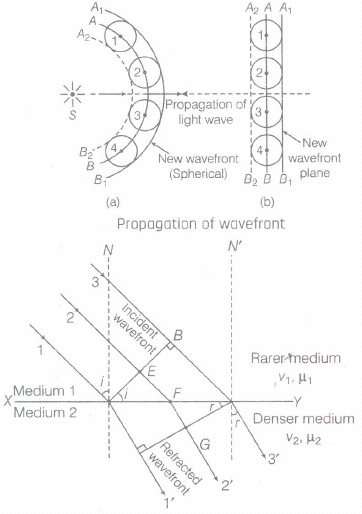
If v1, v2 are the speed of light into two mediums and t is the time taken by light to go from B to C or A to D or E to Gthrough F, then
\(t=\frac { EF }{ { v }_{ 1 } } +\frac { FG }{ { v }_{ 2 } } \)
In \(\triangle AFE \ \sin { i } =\frac { EF }{ AF } \)
In \(\triangle FGC \ \sin { r } =\frac { FG }{ FC } \ \Rightarrow \ t=\frac { AF\sin { i } }{ { v }_{ 1 } } +\frac { FC\sin { r } }{ { v }_{ 2 } } \)
\(\Rightarrow \ t=\frac { AC\sin { r } }{ { v }_{ 2 } } +AF\left( \frac { \sin { i } }{ { v }_{ 1 } } -\frac { \sin { r } }{ { v }_{ 2 } } \right) \)
For rays of light from the different parts on the incident wavefront, the values of AF are different. But light from different points of the incident wavefront should take the same time to reach the corresponding points on the refracted wavefront.
So, t should not depend on F. This is possible only,
If \(\frac { \sin { i } }{ { v }_{ 1 } } -\frac { \sin { r } }{ { v }_{ 2 } } =0 \ or \ \frac { \sin { i } }{ \sin { r } } =\frac { { v }_{ 1 } }{ { v }_{ 2 } } =0\)
Now, if c represents the speed of light in vacuum, then \({ \mu }_{ 1 }=\frac { c }{ { v }_{ 1 } } \ and \ \frac { c }{ { v }_{ 2 } } \) are known as the refractive index of medium 1 and medium 2 respectively.
Then, \({ \mu }_{ 1 }=\sin { i } \ and \ \sin { r } \ \Rightarrow \ \frac { \sin { i } }{ \sin { r } } \)
This is known as Snell's law of refraction.
23.
(i) Microwave
(ii) Infrared waves are used to treat muscular strain.
(iii) X-rays are used as a diagnostic tool in medicine. X-rays are produced by X-ray tubes or inner shell electrons.
24.
\(Here,\ A=60°,\mu =?\)
\( \mu =\frac { \sin { (A+{ \delta }_{ m } } )/2 }{ \sin { A/2 } } =\frac { \sin { \left( 60°+60° \right) /2 } }{ \sin { 60°/2 } }\)
\(=\frac { \sin { 60° } }{ \sin { 30° } } =\frac { \sqrt { 3 } /2 }{ 1/2 } =\sqrt { 3 }\)
25.
f1=7.5×10⁶ Hz
f2=12×106 Hz
λ1=c/f1=40 m
λ2=c/f2=25 m
So the range is 40m to 25m
26.
(a) The shape of the wavefront in case of a light diverging from a point source is spherical. The wavefront emanating from a point source is shown in the given figure.
(b) The shape of the wavefront in case of a light emerging out of a convex lens when a point source is placed at its focus is a parallel grid. This is shown in the given figure.
(c) The portion of the wavefront of light from a distant star intercepted by the Earth is a plane.
27.
Frequency of the electromagnetic wave, ν = 2.0 x 10¹⁰ Hz
Electric field amplitude, E0 = 48 V m−1
Speed of light, c = 3 x 10⁸ m/s
(a) Wavelength of a wave is given as:
\(\lambda=\frac{c}{v}\)
\(=\frac{3 \times 10^{8}}{2 \times 10^{10}}=0.015 \mathrm{~m}\)
(b) Magnetic field strength is given as:
\(B_{0}=\frac{E_{0}}{c}\)
\(=\frac{48}{3 \times 10^{8}}=1.6 \times 10^{-7} T\)
(c) Energy density of the electric field is given as:
\(U_{E}=\frac{1}{2} \in_{0} E^{2}\)
And, energy density of the magnetic field is given as:
\(U_{B}=\frac{1}{2 \mu_{0}} B^{2}\)
Where,
∈0 = Permittivity of free space
μ0 = Permeability of free space
We have the relation connecting E and B as:
E = cB … (1)
Where,
\(c=\frac{1}{\sqrt{\epsilon_{0} \mu_{0}}} \ldots \text { (2) }\)
Putting equation (2) in equation (1), we get
\(E=\frac{1}{\sqrt{\epsilon_{0} \mu_{0}}}\)
Squaring both sides, we get
\(E=\frac{1}{\epsilon_{0} \mu_{0}} B^{2}\)
\(\epsilon_{0} E^{2}=\frac{B^{2}}{\mu_{0}}\)
28.
(i) Power = +2 dioptre.
(ii) Here, we have f = +12 cm, R1 = +10 cm, R2 = -15 cm.
Refractive index of air is taken as unity.
We use the lens formula. The sign convention has to be applied for f, R1 and R2.
Substituting the values, we have
\(\frac { 1 }{ 12 } =(n-1)\left( \frac { 1 }{ 10 } -\frac { 1 }{ 15 } \right) \)
This gives n = 1.5.
(iii) For a glass lens in air, n2 = 1.5, n1 = 1, f = +20 cm. Hence, the lens formula gives
\(\frac { 1 }{ 20 } =0.5\left( \frac { 1 }{ { R }_{ 1 } } -\frac { 1 }{ { R }_{ 2 } } \right) \)
For the same glass lens in water, n2 = 1.5, n1 = 1.33. Therefore \(\frac { 1.33 }{ f } =(1.5-1.33)\left[ \frac { 1 }{ { R }_{ 1 } } -\frac { 1 }{ { R }_{ 2 } } \right] \)
Combining these two equations, we find f = + 78.2 cm.
29.
(a)
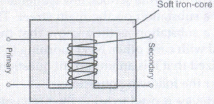
(b) Principle of a transformer: When alternating current flows through the primary coil, an emf is induced in the neighbouring (secondary) coil
Let \(\frac { d\phi }{ dt } \) be the rate of change of flux through each turn of the primary and the secondary coil
\(\frac { { \varepsilon }_{ 1 } }{ { \varepsilon }_{ 2 } } =-{ N }_{ 1 }\frac { d\phi }{ dt } /-{ N }_{ 2 }\frac { d\phi }{ dt } =\frac { { N }_{ 1 } }{ { N }_{ 2 } } \\ \frac { { V }_{ 1 } }{ { V }_{ 2 } } =\frac { { N }_{ 1 } }{ { N }_{ 2 } } \)
But for an ideal transformer,
\(\frac { { V }_{ 1 } }{ { V }_{ 2 } } =\frac { I_{ 2 } }{ I_{ 1 } } \)
From equation (1) and (2)
\(\frac { { V }_{ 1 } }{ { V }_{ 2 } } =\frac { N_{ 1 } }{ N_{ 2 } } =\frac { I_{ 2 } }{ I_{ 1 } } \)
(c) Main assumptions
(i) The primary resistance and current are small
(ii) The flux linked with the primary and secondary coils is same / there is no leakage of flux from the core.
(iii) Secondary current is small.
(d) Reason due to which energy loses may occur Flux leakage/Resistance of the coils/Eddy currents/Hysteresis.
30.
\(Here, \ \lambda =589 \ nm,\ c=3\times { 10 }^{ 8 }m/s, \ \mu =1.33\)
(a) For reflected light
\(wavelength,\ \lambda =589\quad nm=589\times { 10 }^{ -9 }m,\quad v=\frac { c }{ \lambda } =\frac { 3\times { 10 }^{ 8 } }{ 589\times { 10 }^{ -9 } } =5.09\times { 10 }^{ 14 }hertz\)
\(speed,\ v=c=3\times { 10 }^{ 8 }m/s\)
(b) For refracted light \( \lambda '=\frac { \lambda }{ \mu } =\frac { 589\times { 10 }^{ -9 } }{ 1.33 } =4.42\times { 10 }^{ -7 }m\)
As frequency remains unaffected on entering another medium,
\(\\ therefore,\quad v'=v=5.09\times { 10 }^{ 14 }hertz\)
\(speed, \ v'=\frac { c }{ \mu } =\frac { 3\times { 10 }^{ 8 } }{ 1.33 } =2.25\times { 10 }^{ 8 }m/s\)
31.
(a) To find the impedance of the circuit, we first calculate \(X_{\mathrm{L}}\) and \(X_{\mathrm{C}}\).
\( X_L=2 \pi v L \)
\(=2 \times 3.14 \times 50 \times 25.48 \times 10^{-3} \Omega=8 \Omega \)
\(X_c=\frac{1}{2 \pi v C} =\frac{1}{2 \times 3.14 \times 50 \times 796 \times 10^{-6}}=4 \Omega\)
Therefore.
\(Z =\sqrt{R^2+\left(X_L-X_C\right)^2}=\sqrt{3^2+(8-4)^2} =5 \Omega\)
\(Z =\sqrt{R^2+\left(X_L-X_C\right)^2}=\sqrt{3^2+(8-4)^2} =5 \Omega\)
(b) Phase difference, \(\phi=\tan ^{-1} \frac{X_C-X_L}{R}\)
\(=\tan ^{-1}\left(\frac{4-8}{3}\right)=-53.1^{\circ}\)
Since \(\phi\) is negative, the current in the circuit lags the voltage across the source.
(c) The power dissipated in the circuit is
\(P=I^2 R\)
Now, \(I=\frac{i_m}{\sqrt{2}}=\frac{1}{\sqrt{2}}\left(\frac{283}{5}\right)=40 \mathrm{~A}\)
Therefore, \(P=(40 \mathrm{~A})^2 \times 3 \Omega=4800 \mathrm{~W}\)
(d) Power factor \(=\cos \phi=\cos \left(-53.1^{\circ}\right)=0.6\)
32.
(a): Light being electromagnetic wave do not require any material medium for its propagation. Hence light can travel in vacuum. On the other hand sound is a mechanical wave and requires a material medium for its propagation. Hence sound cannot travel in vacuum.
33.
(b): The brilliance of diamond is due to total internal reflection of light. \(\mu\) for diamond is 2.42, so that critical angle for diamond air interface is C = 24.40 (from sinC = l/\(\mu\)). The diamond is cut suitable so that light entering the diamond from any face suffers multiple total internal reflections at the various faces and remains within the diamond. Hence the diamond sparkles.
34.
(c): The reflection and refraction of light occurs on account of interaction of light with the atoms of the surface of separation. These atoms can be regarded as oscillators. Light incident on the interface forces the atomic oscillators to oscillate with frequency of incident light. As frequency oflight emitted by these (charged). oscillators is equal to their own frequency of oscillation, therefore, reflected and refracted light have the same frequency as that of incident light.
35.
(a): In insulator, the forbidden energy gap is quite large. When electric field is applied to such a solid, the electron find it difficult to acquire such a large amount of energy. Thus no electron flow occurs.
36.
37.
(i) (d): Here, \(\mu=1.5 ; R_{1}=30 \mathrm{~cm}\)
R2 = -30 cm
\(\text { As } \frac{1}{f}=(\mu-1)\left[\frac{1}{R_{1}}-\frac{1}{R_{2}}\right] \)
\(=(1.5-1)\left[\frac{1}{30}-\frac{1}{-30}\right]=-0.5 \times \frac{2}{30}-\frac{-1}{30}\)
\(f=-30 \mathrm{~cm}\)
(ii) (a): Here, f= 12 cm ; R1 = 10 cm
R2 = -15 cm
\(\text { As } \frac{1}{f}=(\mu-1)\left[\frac{1}{R_{1}}-\frac{1}{R_{2}}\right] \)
\(\frac{1}{12}=(\mu-1)\left[\frac{1}{10}+\frac{1}{15}\right] \)
\(\mu=1.5\)
(iii) (d): The eye-lens is surrounded by a different medium than air. This will change the focal length of the eye-lens. The eye cannot accommodate all images as it would do in air.
(iv) (b): \(\frac{1}{f}=(1.5-1)\left(\frac{1}{R_{1}}-\frac{1}{R_{2}}\right)\)
\(\text { and } \frac{1}{f_{w}}=\left(\frac{1.5}{1.33}-1\right)\left(\frac{1}{R_{1}}-\frac{1}{R_{2}}\right) \)
\(\frac{f_{w}}{f}=\frac{0.5 \times 1.33}{0.17}=4 \)
\(f_{w}=4 f=4 \times 10=40 \mathrm{~cm}\)
(v) (d): If the refractive index of two media are same,the surface of separation does not produce refraction or reflection which helps in visibility.

12th Standard CBSE Syllabus & Materials
12th Standard CBSE
CBSE 12th Computer Science Python Revision Tour I - New Previous year Question Papers Study Material - QB365 Set A
NEW12th Standard CBSE
CBSE 12th Business Studies Planning Important Questions And Answers Study Material - QB365 Set A
NEW12th Standard CBSE
CBSE 12th Business Studies Business Environment Important Questions And Answers Study Material - QB365 Set A
NEW12th Standard CBSE
CBSE 12th Business Studies Principles of Management Important Questions And Answers Study Material - QB365 Set A



NCERT Books

Syllabus

Exam Pattern

Sample Question Papers

Previous year Question Papers

Important Notes

MCQ Practice test

NCERT Exemplers

Case study Questions

Image Based Questions

Passage based Questions

HOT Questions

Value Based Questions

Model Questions Papers
NCERT ( Book Back ) Questions

Assertion and Reason
Important Questions And Answers

CBSE 12th Standard CBSE Subjects
CBSE Standards








