
 100% FREE ACCESS
12th Standard CBSE Syllabus & Materials
12th Standard CBSE
CBSE 12th Economics Government Budget and the Economy Previous year Question Papers Study Material - QB365 Set A
NEW12th Standard CBSE
CBSE 12th Computer Science Interface Python with MySQL - New Previous year Question Papers Study Material - QB365 Set A
NEW12th Standard CBSE
CBSE 12th Computer Science Database Concept - New Previous year Question Papers Study Material - QB365 Set A
NEW12th Standard CBSE
CBSE 12th Computer Science Data Communication - New Previous year Question Papers Study Material - QB365 Set A
NEW12th Standard CBSE
CBSE 12th Computer Science Data Structures - New Previous year Question Papers Study Material - QB365 Set A
NEW12th Standard CBSE
CBSE 12th Computer Science Functions - New Previous year Question Papers Study Material - QB365 Set A

Published on: 25/10/2025
Download CBSE Class 12th Standard CBSE Physics question papers, sample papers, important questions, and previous year solved papers in PDF format. Get free study materials, NCERT solutions, and exam preparation resources for Class 12th Standard CBSE Physics
Questions + Answers key
Take MCQ Physics Test
1.
Suppose while sitting in a parked car, you notice a jogger approaching towards you in the side view mirror of R = 2 m. If the jogger is running at a speed of 5 m s-1, how fast the image of the jogger appear to move when the jogger is (a) 39 m, (b) 29 m, (c) 19 m, and (d) 9 m away.
2.
An object is placed at (i) 10 cm, (ii) 5 cm in front of a concave mirror of radius of curvature 15 cm. Find the position, nature, and magnification of the image in each case.
3.
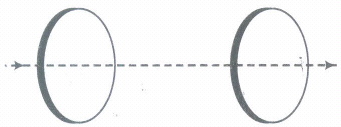
Figure shows a capacitor made of two circular plates each of radius 12 cm, and separated by 5.0 cm. The capacitor is being charged by an external source (not shown in the figure). The charging current is constant and equal to 0.15A.
(a) Calculate the capacitance and the rate of change of potential difference between the plates.
(b) Obtain the displacement current across the plates.
(c) Is Kirchhoff’s first rule (junction rule) valid at each plate of the capacitor? Explain.
4.
A beam of light travelling along x-axis is described by the magnetic field, \({ B }_{ z }=5\times { 10 }^{ -9 }T\sin { \omega \left( t-x/c \right) } \) Calculate the maximum electric and magnetic forces on a charge, i.e.alpha particle moving along y-axis with a speed of 3 x 10⁷ m/s, charge on electron = 1.6 x 10⁻¹⁹C
5.
A plane electromagnetic wave in the visible region is moving along z-direction. The frequency of the wave is 6 x 10¹⁴ Hz, and the electric field at any point is varying simusoidally with time with an amplitude of 2 V m-1. Calculate
(i) average energy density of the electric field and
(ii) average energy density of the magnetic field.
6.
The magnetic field in a plane electromagnetic wave is given by \(B=\left( 300\mu T \right) \sin { \left( 5.0\times { 10 }^{ -5 }{ s }^{ -1 } \right) } \left( t-x/c \right) \) Find (i) the maximum electric field and (ii) the average energy density corresponding to the electric field.
7.
What are the uses of electromagnetic waves?
8.
Suppose that the electric field part of an electromagnetic wave in vacuum is
E = [3.1 cos{1.8 y + (5.4 \(\times\)106t)}] \(\hat{i}\)
(i) What is the direction of propagation?
(ii) What is the wavelength \(\lambda \)?
(iii) What is the frequency \(v\) ?
(iv) What is the amplitude of the magnetic field part of the wave?
(v) Write an expression for the magnetic field part of the wave.
9.
Suppose that the electric field amplitude of an electromagnetic wave is E0 = 120 N/C and that its frequency is n = 50.0 MHz.
(a) Determine, B0 ,ω, k, and ⋌.
(b) Find expressions for E and B.
1.
From the mirror equation, Eq., we get \(v=\frac{f u}{u-f}\)
For convex mirror, since \(R=2 \mathrm{~m}, f=1 \mathrm{~m}\). Then for \(u=-39 \mathrm{~m}, v=\frac{(-39) \times 1}{-39-1}=\frac{39}{40} \mathrm{~m}\)
Since the jogger moves at a constant speed of \(5 \mathrm{~m} \mathrm{~s}^{-1}\), after 1 s the position of the image v (for \(u=-39+5=-34)\) is (34 / 35) m.
The shift in the position of image in 1 s is \(\frac{39}{40}-\frac{34}{35}=\frac{1365-1360}{1400}=\frac{5}{1400}=\frac{1}{280} \mathrm{~m}\)
Therefore, the average speed of the image when the jogger is between 39 m and 34 m from the mirror, is (1/280) m s–1 Similarly, it can be seen that for u = –29 m, –19 m and –9 m, the speed with which the image appears to move is
\(\frac{1}{150} \mathrm{~m} \mathrm{~s}^{-1}, \frac{1}{60} \mathrm{~ms}^{-1} \text { and } \frac{1}{10} \mathrm{~ms}^{-1} \text {, respectively. }\)
Although the jogger has been moving with a constant speed, the speed of his/her image appears to increase substantially as he/she moves closer to the mirror. This phenomenon can be noticed by any person sitting in a stationary car or a bus. In case of moving vehicles, a similar phenomenon could be observed if the vehicle in the rear is moving closer with a constant speed.
2.
The focal length f = -15/2 cm = -7.5 cm
(i) The object distance u = -10 cm. Then Eq gives
\(\frac { 1 }{ v } +\frac { 1 }{ 10 } =\frac { 1 }{ -7.5 } \)
or \(v=\frac { 10\times 7.5 }{ -2.5 } =-30\) cm
The image is 30 cm from the mirror on the same side as the object
Also, magnification m = \(\frac { v }{ u } =-\frac { (-30) }{ (-10) } =-3\)
The image is magnified, real and inverted.
(ii) The object distance u = -5 cm. Then from Eq
\(\frac { 1 }{ v } +\frac { 1 }{ -5 } =\frac { 1 }{ -7.5 } \)
or \(v=\frac { 5\times 7.5 }{ (7.5-5) } =15\) cm
This image is formed at 15 cm behind the mirror. It is a virtual image.
Magnification m = 15 \(-\frac { v }{ u } =-\frac { 15 }{ (-5) } =3\)
The image is magnified, virtual and erect.
3.
A) Step 1: Find capacitance between the two plates. Formula used: \(C=\frac{\varepsilon_0 A}{d}\)
Given, Distance between the plates, d=5 cm=0.05m
Radius of each circular plate,
r = 12cm = 0.12m
Now, area of each plate, A=πr2
A = 3.14 (0.12)2 = 0.045216 m2
Capacitance between two plates,
\(C=\frac{\varepsilon_0 A}{d}\)
Here, ϵ0 = permittivity of free space =8.85 × 10⁻¹²C2/Nm2
C=8.85×10−12× 0.045216/0.05
C = 8.0032×10⁻¹²
Step 2: Find change of potential difference between the two plates. Formula used: q = CV
Given, charging current, I=0.15A
Charge on each plate, q=CV
Where, V = Potential difference across the plates
Differentiating both sides with respect to time (t), we get,
\(\begin{array}{rlr} \Rightarrow \quad \frac{d q}{d t} & =C \cdot \frac{d V}{d t} \end{array}\)
\(\begin{array}{rlr} \Rightarrow \quad I & =C \cdot \frac{d V}{d t} \end{array}\) \(\left[\because \frac{d q}{d t}=I\right]\)
\(\begin{array}{rlr} \Rightarrow \quad \frac{d V}{d t} & =\frac{I}{C}=\frac{0.15}{8.0032
\times 10^{-12}} \end{array}\)
Step 2 : Find change of potential difference between teh two plates.
Formula used: q = CV
dV/dt= 1.87 × 10¹⁰V/s
The rate of change of potential difference between the plates is 1.87×10¹⁰V/s
Final answer : C=8.0032×10−12,1.87×1010V/s
B) Formula used: id=ϵ0(dϕEdt)
Given, charging current or conduction current, I=0.15 A
The displacement current across the plates, id=ϵ0(dϕE/dt)
Using Gauss's law, electric flux ϕE=qϵ0
id=ϵ0(1dq/ϵ0dt)=dq/dt
id=dqdt = conduction current =0.15A
Hence, the displacement current, id is 0.15 A.
Final answer : 0.15 A.
C) Kirchhoff’s first rule (junction rule):
It states that at a junction in an electrical circuit, the sum of currents flowing into the junction is equal to the sum of currents flowing out of the junction.
Kirchhoff’s first rule is valid at each plate of the capacitor provided that we consider the current to be the sum of both conduction and displacement currents.
4.
Here, Maximum magnetic field,
B0 = 5 x 10⁻⁹T;
charge on alpha particle, q = + 2e
= 2 x 1.6 x 10-19 = 3.2 x 10⁻¹⁹C,
v = 3 x 10⁷ ms-1
Maximum electric field,
E0 = cB0 = (3 x 108) x (5 x 10-19) = 150 Vm-1
Maximum force on alpha particle due to electric field = q x E0 = (3.2 x 10-19) x 150
= 4.80 x 10⁻¹⁷ N
Force on alpha particle due to magnetic field = qvB0 = (3.2 x 10⁻¹⁹) x ( 3 x 107) x (5 x 10-9)
= 4.80 x 10⁻¹⁹ N
5.
Here, v = 6 x 10¹⁴ Hz, E0 = 2 V m-1
(i) Average energy density of the electric field
\({ u }_{ E }=\frac { 1 }{ 4 } { \epsilon }_{ 0 }{ E }_{ 0 }^{ 2 }=\frac { 1 }{ 4 } \times \left( 8.85\times { 10 }^{ -12 } \right) \times { 2 }^{ 2 }\)
\(=8.85\times { 10 }^{ -12 }J{ m }^{ -3 }\)
(ii) Average energy density of magnetic field
\({ u }_{ B }=\frac { { B }_{ 0 }^{ 2 } }{ 4{ \mu }_{ 0 } } =\frac { 1 }{ 4 } \frac { { \left( { E }_{ 0 }/c \right) }^{ 2 } }{ { \mu }_{ 0 } } =\frac { 1 }{ 4 } \frac { { E }_{ 0 }^{ 2 } }{ 4{ \mu }_{ 0 }{ c }^{ 2 } } \)
\(=\frac { 1 }{ 4 } \times \frac { { 2 }^{ 2 } }{ \left( 4\pi \times { 10 }^{ -7 } \right) \times { \left( 3\times { 10 }^{ 8 } \right) ^{ 2 } } } \)
\(=8.85\times { 10 }^{ -12 }J{ m }^{ -3 }\)
6.
Here, \({ B }_{ 0 }=300\mu T=3\times { 10 }^{ -4 }T\)
(i) Maximum value of electric field, \({ E }_{ 0 }=c{ B }_{ 0 }\)
\(\therefore { E }_{ 0 }=\left( 3\times { 10 }^{ 8 } \right) \times \left( 3\times { 10 }^{ -4 } \right) =9\times { 10 }^{ 4 }V{ m }^{ -1 }\)
(ii) Average energy density corresponding to electric field is
\({ u }_{ E }=\frac { 1 }{ 4 } { \epsilon }_{ 0 }{ E }_{ 0 }^{ 2 }=\frac { 1 }{ 4 } \times \left( 8.85\times { 10 }^{ -12 } \right) \times \left( 9\times { 10 }^{ 4 } \right) ^{ 2 }\)
\(=19.91\times { 10 }^{ -4 }=1.99\times { 10 }^{ -3 }J{ m }^{ -3 }\)
7.
Uses of electromagnetic waves
Following are some important uses of electromagnetic waves:
1. Radio waves. Radio waves are electromagnetic waves and are used in radio and television communication systems.
2. Microwaves. Microwaves are used in radar and other communication systems.
3. Infrared radiations. Infrared rays are used in:
(a) solar water heater and solar cooker.
(b) weather forecasting
(c) taking photographs during fog, smoke etc.
(d) dehydrating fruits.
(e) the treatment of muscular strain.
(f) greenhouse to keep the plants warm.
4. Ultraviolet rays. ultraviolet rays are used:
(a) for checking mineral samples by making use of its property of causing fluorescence and also used for the study of molecular structure.
(b) for sterilizing the surgical instruments because U.V.-rays destroy bacteria.
(c) in food preservations
(d) in detection of invisible writing
5. X-rays. X-rays are used:
(a) in surgery
(b) in radiotherapy.
(c) in medical diagnosis to detect the fracture in bones etc.
(d) in detective departments to detect gold, diamond etc concealed in bags etc without opening them.
(e) in scientific research to study the crystal structure etc.
6. \(\gamma \)-rays. Gamma rays are used to get information of structure of atomic nucleus.
8.
(i) The given equation signifies that the electromagnetic wave is moving along Y-axis and also in negative direction, so it moves in - \(\hat{j}\) direction.
(ii) The electric part of electromagnetic wave in vacuum.
E = [3.1 cos{1.8 y + (5.4 \(\times\)106 t)}] \(\hat{i}\)
Comparing with standard equation,
E = E0 cos (ky + \(\omega\)t), we get
Angular frequency, \(\omega\) = 5.4 \(\times\)106 rad/s
Wave number, k = 1.8 rad/m
The amplitude of the electric field part of the wave,
E0 = 3.1 N/C
\(\begin{array}{rlrl} \lambda & =\frac{2 \pi}{k}=\frac{2 \pi}{1.8}=3.491 \mathrm{~m} \end{array}\)
\(\begin{array}{rlrl} \Rightarrow & \lambda =3.5 \mathrm{~m} \end{array}\)
(iii) Angular frequency, \(\omega\) = 2\(\pi\)v
\(v=\frac{\omega}{2 \pi}=\frac{5.4 \times 10^6 \times 7}{2 \times 22}\)
= 0.86 \(\times\)106 Hz
(iv) As, \(c=\frac{E_0}{B_0}\)
Amplitude of magnetic field,
\(\begin{aligned} B_0 & =\frac{E_0}{c}=\frac{3.1}{3 \times 10^8} \end{aligned}\)
\(\begin{aligned} =1.03 \times 10^{-8} \mathrm{~T} \end{aligned}\)
(v) Expression for the magnetic field part of wave,
B = B0 cos (ky + \(\omega\)t) \(\hat{k}\)
B = 1.03 \(\times\)10-8 cos (1.8 y + 5.4 \(\times\)106 t) \(\hat{k}\)
9.
Given, amplitude of an electromagnetic wave,
E0 = 120 N/C
Frequency of wave, v = 50 MHz = 50 \(\times\) 106 Hz
(i) Speed of light in vacuum, \(c=\frac{E_0}{B_0}\)
\(\begin{aligned} B_0=\frac{E_0}{c}= & \frac{120}{3 \times 10^8}=40 \times 10^{-8} \end{aligned}\)
= 400 \(\times\) 10-9 T = 400 nT
Angular frequency of electromagnetic wave,
\(\omega=2 \pi \nu=2 \times 3.14 \times 50 \times 10^6\)
\(\omega=3.14 \times 10^8 \mathrm{rad} / \mathrm{s}\)
Wave number of electromagnetic wave,
\(k=\frac{\omega}{c}=\frac{3.14 \times 10^8}{3 \times 10^8}=1.05 \mathrm{rad} / \mathrm{m}\)
Wavelength of electromagnetic wave,
\(\lambda=\frac{c}{v}=\frac{3 \times 10^8}{50 \times 10^6}=6.00 \mathrm{~m}\)
(ii) Expression of electric field, E = E0 sin (kx - \(\omega\)t)
E = 120 sin (1.05x - 3.14 \(\times\)108 t)
Expression of magnetic field B,
B = B0 sin (kx - \(\omega\)t)
E = 120 sin (kx - \(\omega\)t)
B = 4 \(\times\)10-7 sin (1.05x - 3.14 \(\times\) 108 t)

12th Standard CBSE Syllabus & Materials
12th Standard CBSE
CBSE 12th Computer Science Python Revision Tour I - New Previous year Question Papers Study Material - QB365 Set A
NEW12th Standard CBSE
CBSE 12th Business Studies Planning Important Questions And Answers Study Material - QB365 Set A
NEW12th Standard CBSE
CBSE 12th Business Studies Business Environment Important Questions And Answers Study Material - QB365 Set A
NEW12th Standard CBSE
CBSE 12th Business Studies Principles of Management Important Questions And Answers Study Material - QB365 Set A



NCERT Books

Syllabus

Exam Pattern

Sample Question Papers

Previous year Question Papers

Important Notes

MCQ Practice test

NCERT Exemplers

Case study Questions

Image Based Questions

Passage based Questions

HOT Questions

Value Based Questions

Model Questions Papers
NCERT ( Book Back ) Questions

Assertion and Reason
Important Questions And Answers

CBSE 12th Standard CBSE Subjects
CBSE Standards








