
 100% FREE ACCESS
12th Standard CBSE Syllabus & Materials
12th Standard CBSE
CBSE 12th Economics Government Budget and the Economy Previous year Question Papers Study Material - QB365 Set A
NEW12th Standard CBSE
CBSE 12th Computer Science Interface Python with MySQL - New Previous year Question Papers Study Material - QB365 Set A
NEW12th Standard CBSE
CBSE 12th Computer Science Database Concept - New Previous year Question Papers Study Material - QB365 Set A
NEW12th Standard CBSE
CBSE 12th Computer Science Data Communication - New Previous year Question Papers Study Material - QB365 Set A
NEW12th Standard CBSE
CBSE 12th Computer Science Data Structures - New Previous year Question Papers Study Material - QB365 Set A
NEW12th Standard CBSE
CBSE 12th Computer Science Functions - New Previous year Question Papers Study Material - QB365 Set A

Published on: 25/10/2025
Download CBSE Class 12th Standard CBSE Physics question papers, sample papers, important questions, and previous year solved papers in PDF format. Get free study materials, NCERT solutions, and exam preparation resources for Class 12th Standard CBSE Physics
Questions + Answers key
Take MCQ Physics Test
1.
The magnetic susceptibility of \(\chi\) of a given material is -0.5. Identify the magnetic material.
2.
Two similar coils are placed mutually perpendicular such that their centres coincide. At centre, what will be the ratio of the magnitudes of magnetic fields due to one coil and the resultant magnetic field?
3.
The plates in a parallel plate capacitor are separated by a distance d with air as the medium between the plates. In order to increase the capacity by 66% a dielectric slab of dielectric constant 5 is introduced between the plates. What is the thickness of dielectric slab?
4.
(a) In the electron drift speed is estimated to be only a few mm s-1 for currents in the range of a few amperes? How then is current established almost the instant a circuit is closed?
(b) The electron drift arises due to the force experienced by electrons in the electric field inside the conductor. But force should cause acceleration. Why then do the electrons acquire a steady average drift speed?
(c) If the electron drift speed is so small, and the electron’s charge is small, how can we still obtain large amounts of current in a conductor?
(d) When electrons drift in a metal from lower to higher potential, does it mean that all the ‘free' electrons of the metal are moving in the same direction?
(e) Are the paths of electrons straight lines between successive collisions (with the positive ions of the metal) in the
(i) absence of electric field,
(ii) presence of electric field?
5.
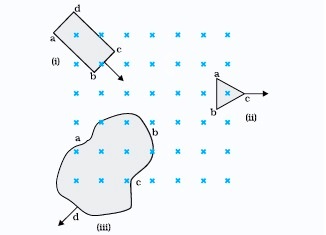
In the figure shows planar loops of different shapes moving out of or into a region of a magnetic field which is directed normal to the plane of the loop away from the reader. Determine the direction of induced current in each loop using Lenz’s law.
6.
Automobile ignition failure occurs in damp weather. Explain, why?
7.
(a) An electrostatic field line is a continuous curve. That is, a field line cannot have sudden breaks. Why not?
(b) Explain why two field lines never cross each other at any point?
8.
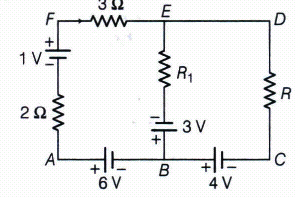
Use Kirchhoff's rules to determine the potential difference between the points A and D. When no current flows in the arm BE of the electric network shown in the figure below.
9.
A heater joined in series with a 100 watt bulb is connected to the mains. If the 100 watt bulb is replaced by a 50 watt bulb, then will the heater now give more heat, less heat or same heat? Why?
10.
A solenoid of length 0.5 m has a radius of 1 cm and is made up of 500 turns. It carries a current of 5 A. What is the magnitude of the magnetic field inside the solenoid ?
11.
A spherical conducting shell of inner radius r1 and outer radius r 2 has a charge Q:
(a) A charge q is placed at the centre of the shell. What is the surface charge density on the inner and outer surfaces of the shell?
(b) Is the electric field in a cavity zero even if the shell is not spherical, but has any irregular shape? Explain.
12.
Three capacitors each of capacitance 9 pF are connected in series.
(a) What is the total capacitance of the combination?
(b) What is the potential difference across each capacitor, if the combination is connected to a 120 V supply?
13.
Two point charges \(+4\mu C\) and \(-6\mu C\) are separated by a distance of 20cm in air. At what point on the line joining the two charges is the electric potential zero?
14.
The equivalent capacitance of the combination between A and B in the given figure is 15 \(\mu F\). Calculate the capacitance of capacitor C.

15.
Two identical cells of e.m.f 1.5V each joined in parallel provide supply to an external circuit consisting of two resistors of 17\(\Omega\) each joined in parallel. A very high resistance voltmeter reads the terminal voltage of the cells to be 1.4V. What is the internal resistance of each cell?
16.
What are eddy currents? How are they produced?
Describe briefly three main useful applications of eddy currents.
17.
A solenoid having 5000 turns/m carries a current of 2A. An aluminium ring at temperature 300K inside the solenoid provides the core.
(a) If the magnetisation I is 2 x 10⁻² A/m, find the susceptibility of aluminium at 300 K.
(b) If temperature of the aluminium ring is 320 K, what will be the magnetisation?
18.
(i) Two straight long parallel conductors carry currents I1 and I2 in the same direction. Deduce the expression for the force per unit length between them. Depict the pattern of magnetic. field lines around them.
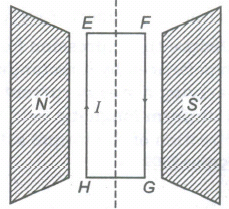
(ii) A rectangular current carrying loop EFGH is kept in a uniform magnetic field as shown in the figure.
(a) What is the direction of the magnetic moment of the current loop?
(b) What is the torque acting on the loop maximum and zero?
19.
A rectanglar loop of area 20cm 30cm is held in a magnetic field of 0.3 T with its plan inclined at
(i) \({ 30 }^{ \circ }\) to the field
(ii) parallel to the field. Find magnetic flux linked with the coil in each case.
20.
An LC circuit a 20 mH inductor and a \(50\mu F\) capacitor with an initial charge of 10 mC. The resistance of the circuit is negligible. Let the instant the circuit is closed be t = 0.
(a) What is the total energy stored initially? IS it conserved during LC oscillations?
(b) What is the natural frequency of the circuit?
(c) At what time is the energy stored
(i) completely electrical (i.e., stored in the capacitor)?
(ii) completely magnetic (i.e., stored in the inductor).
(d) At what times is the total energy shared equally between the inductor and the capacitor?
(e) If a resistor is inserted in the circuit, how much energy is eventually dissipated as heat?
21.
A voltage signal is described by \(V =V_0 \text { for } 0 \leq t \leq \frac{T}{2} =0 \text { for } \frac{T}{2} \leq t \leq T\) for a cycle. Its rms value is
\(\frac{V_0}{\sqrt{2}}\)
\(V_0\)
\(\frac{V_0}{2}\)
\(\sqrt{2} V_0\)
22.
A diamagnetic material in a magnetic field moves
perpendicular to the field
from weaker to stronger parts
from stronger to weaker parts.
in random direction.
23.
Electric field of a system of charges does not depend on
position of charges forming the system
distance of point (at which fieldis being observed) from the charges forming system
value of test charge used to find out the field
separation of charges forming the system
24.
The intensity of magnetic field at a point X on the axis of a small magnet is equal to the field intensity at another point Y on equatorial axis. The ratio of distance of X and Y from the centre of the magnet will be
(2) - 3
(2) - 1/3
2 3
2 1/3
25.
Charge on a body is q1 and it is used to charge another body by induction. Charge on second body is found to be q2 after charging. Then
\(\frac{q_{1}}{q_{2}}=1\)
\(\frac{q_{1}}{q_{2}}<1\)
\(\frac{q_{1}}{q_{2}} \leq 1\)
\(\frac{q_{1}}{q_{2}} \geq 1\)
26.
Five cells each of internal resistance 0.2Ω and e.m.f. 2V are connected in series with a resistance of 4Ω.The current through the external resistance is:
0.2A
0.5A
1A
2A
27.
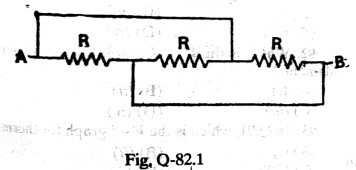
What is the resistance across A and B in the fig
3R
R
R/3
None of the above
28.
The equivalent resistance of n resistors each of same resistance when connected in parallel is Rp. If they are connected in series, the equivalent resistance will be:
Rp/n2
Rp/n
nRp
n2Rp
29.
An induced of reactance 1 and a resistor of 2 are connected in series to the terminals of a 6V(rms) a.c. source. The power dissipated in the circuit is
8 W
12 W
14.4 W
18 W
30.
A battery of 12V is connected to primary of a transformer with turns ratio ns/np= 10. Voltage across secondary would by
120 V
1.3 V
12 V
Zero
31.
Charge on a body which carries 200 excess electrons is
\(-3.2\times 10^{-18}C\)
\(9\times10^{-9}Nm^2C^{-2}\)
\(3.2\times 10^{-17}C\)
\(3.2\times 10^{-17}C\)
32.
If a copper wire carries a direct current, the magnetic field associated with the current will be
only outside the wire
only inside the wire
both inside and outside the wire
neither inside nor outside the wire
33.
When an electric dipole is held at an angle in a uniform electric field, the net force F and torque \(\tau\) on the dipole are
F = 0, \(\tau=0\)
\(F\ne 0,\tau\ne 0\)
F = 0, \(\tau\ne0\)
\(F\ne0,\tau=0\)
34.
At a particular point, electric field depends upon
Source charge Q only
test charge qo only
both Q and q0
neither Q nor qo
35.
Amount of charge induced in a circuit of resistance R is given by
\(dQ=(d\phi )\times R\)
\(dQ=\frac { d\phi }{ R } \)
\(dQ={ R }^{ 2 }d\phi \)
\(dQ=\frac { d\phi }{ R^{ 2 } } \)
1.
Substances having (small) negative value (-0.5) of magnetic susceptibility \(\chi_m\) are diamagnetic.
2.
Ratio = \(\frac{B_{1}}{\sqrt{B_{1}^{2}+B_{2}^{2}}}=\frac{1}{\sqrt{2}}\)
3.
\(\frac{\Delta C}{C}=\frac{C^{\prime}-C}{C}=\frac{K C-C}{C}\)
4.
(a) Electric field is established throughout the circuit, almost instantly (with the speed of light) causing at every point a local electron drift. Establishment of a current does not have to wait for electrons from one end of the conductor travelling to the other end. However, it does take a little while for the current to reach its steady value.
(b) Each ‘free’ electron does accelerate, increasing its drift speed until it collides with a positive ion of the metal. It loses its drift speed after collision but starts to accelerate and increases its drift speed again only to suffer a collision again and so on. On the average, therefore, electrons acquire only a drift speed.
(c) Simple, because the electron number density is enormous, ~1029 m-3.
(d) By no means. The drift velocity is superposed over the large random velocities of electrons.
(e) In the absence of electric field, the paths are straight lines; in the presence of electric field, the paths are, in general, curved.
5.
(i) The magnetic flux through the rectangular loop abcd increases, due to the motion of the loop into the region of magnetic field, The induced current must flow along the path bcdab so that it opposes the increasing flux.
(ii) Due to the outward motion, magnetic flux through the triangular loop abc decreases due to which the induced current flows along bacb, so as to oppose the change in flux.
(iii) As the magnetic flux decreases due to motion of the irregular shaped loop abcd out of the region of magnetic field, the induced current flows along cdabc, so as to oppose change in flux. Note that there are no induced current as long as the loops are completely inside or outside the region of the magnetic field
6.
The insulating porcelain of the spark plugs accumulates a film of dirt.
The surface dirt is hygroscopic and picks up moisture from the air. Therefore, in humid weather, the insulating porcelain of the plugs becomes quasi-conductor. This allows an appreciable proportion of the spark to leak across the surface of the plug instead of discharging across the gap.
7.
(a) An electrostatic field line is a continuous curve because a charge experiences a continuous force when traced in an electrostatic field. The field line cannot have sudden breaks because the charge moves continuously and does not jump from one point to the other.
(b) The tangent to a line of electric field at any point gives the direction of the electric field at that point. If any two lines of electric field cross each other, then at the intersection point, there would be two tangents and hence two directions for electric field, which is not possible. Hence, the electric field lines do not cross each other
8.
Applying Kirchhoff's loop rule for loop ABEFA
6 + 3 + R1 \(\times\) 0 - 3I1 + 1 - 2I1 = 0
or 10 - 5I1 = 0
or I1 = 2A
For loop BCDEB,
4 - I1 . R + R1 \(\times\) 0 - 3 = 0
or 1 - 2R = 0
\(\therefore \quad R=\frac{1}{2} \Omega\)
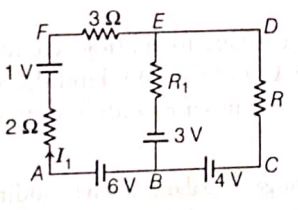
Potential difference between A and D through path
ABCD is 6 + 4 - I1 R = VAD \(\Rightarrow \quad 10-2 \times \frac{1}{2}=V_{A D}\)
\(\therefore\) VAD = 9 V
9.
Resistance of 50 watt bulb is more than that of 100 watt bulb. When 100 watt bulb is replaced by 50 watt bulb, connected in series with heater, the resistance of circuit increases and hence current decreases. \(H \propto I^2\) As , therefore the heater will now give less heat.
10.
Given, total number of turns, N = 500
Length of solenoid, l = 0.5 m
Current, I = 5 A
Radius, r = 1 cm = 10-2 m
Here, \(\begin{aligned} \frac{l}{r} & =\frac{0.5}{10^{-2}}=50 \Rightarrow l>>r \\ \end{aligned}\)
\(\begin{aligned} \therefore B & =\mu_0 n I=\frac{\mu_0 N I}{l} \\ \end{aligned}\)
\(\begin{aligned} =4 \pi \times 10^{-7} \times \frac{500}{0.5} \times 5 \end{aligned}\)
= 6.28 \(\times\) 10-3 T
11.
(a) When a charge +q is held at the centre of the shell, it will induce a charge -q on the inner surface of the shell of radius r and the charge +q on the outer surface of the outer shell.
Surface charge density on the inner surface of shell,
As total charge on the outer surface of the outer shell = Q + q
12.
There are three capacitors cach of capacitance 9 pF.
\(\therefore\) C1 = C2 = C3 = 9 pF
and voltage, V = 120 V
(i) The total capcitance in series combination,
\(\frac{1}{C_{s}}=\frac{1}{C_{1}}+\frac{1}{C_{2}}+\frac{1}{C_{3}}=\frac{1}{9}+\frac{1}{9}+\frac{1}{9}\)
\(\Rightarrow \frac{1}{C_{s}}=\frac{3}{9} \Rightarrow C_{s}=3 pF\)
(ii) Let the charge across the system be q and potentials across C1, C2 and C3 be V1, V2 and V3, respectively.
Charge, q = Cs. V = 3 \(\times\)120 = 360 pC
Potential difference across C1,
\(V_{1}=\frac{q}{C_{1}}=\frac{360}{9}=40 V\)
Potential difference across C2,
\(V_{2}=\frac{q}{C_{2}}=\frac{360}{9}=40 V\)
Potential difference across C3,
\(V_{3}=\frac{q}{C_{3}}=\frac{360}{9}=40 V\)
Thus, the potential difference across each capacitor is 40 V.
13.
Given: \(q_{1}=4 \mu \mathrm{C}=4 \times 10^{-6} \mathrm{C}\)
\(q_{2}=-6 \mu \mathrm{C}=-6 \times 10^{-6} \mathrm{C}, r=20 \mathrm{~cm}\)
Let the electric potential be zero at a point P, a distance x (in cm) from q1 Then
\(\frac{1}{4 \pi \varepsilon_{0}} \cdot \frac{q_{1}}{x}+\frac{1}{4 \pi \varepsilon_{0}} \frac{q_{2}}{(r-x)}=0\)
\( \therefore \frac{4}{x} =-\frac{(-6)}{(20-x)} \)
\(\Rightarrow 4(20-x=6 x \)
\(x =8 \mathrm{~cm}\)
i.e. 8 cm from 4 μC charge.
14.
\(60\mu F\)
15.
1.2\(\Omega\)
16.
Eddy currents: The induced circulating current produced in bulk piece of conductor, when subjected to a changing magnetic flux is called eddy current.
Applications:
(i) Magnetic braking in trains: In some electrically powered trains, strong electromagnets are situated above the rails. When these magnets are activated, eddy currents are induced in the rails. These currents oppose the motion of the train. Due to the absence of mechanical linkage, the breaking effect is strong.
(ii) Electromagnetic damping: Certain galvanometers have fixed core made of non-magnet metallic materials. When the coil of galvanometer oscillates, eddy currents generated on the core oppose its motion. As a result, the coil comes to rest quickly.
(iii) Electric power meters: The shiny metal disc in the electric power meter rotates due to the eddy currents. Electric currents are induced in the disc by magnetic fields produced by sinusoidally varying current (i.e. ac) in the coil.
17.
(a) Here, H = I = 5000 x 2 = 104 A/m
and I = XH
\(\therefore\) \(\chi=\frac{I}{H}\)
\(=\frac{2 \times 10^{-2}}{10^{4}}=2 \times 10^{-6}\)
(b) According to Curie law.
\(x=\frac{c}{T}\)
\(\Rightarrow \quad \frac{\chi_{2}}{\chi_{1}}=\frac{T_{2}}{T_{1}}\)
\(\chi_{2}=\frac{T_{2}}{T_{1}} \chi_{1}=\frac{320}{300} \times 2 \times 10^{-6}\)
= 2.13 x 10⁻⁶
\(\therefore\) Magnetisation at 320 K,
I = X2H = 2.13 x 10-6 x 104
= 2.13 x 10⁻²A/m
18.
(ii) (a) Perpendicular to the plane of the paper and directed inward.
(b) When angle between area vector of coil and magnetic field is 90°, then maximum torque experienced by the coil. When \(\theta\) = 0° or 180°, then torque will be minimum, i.e. zero.
19.
\(Here,\ A=20\times 30cm^{ 2 }\)
\(=600\times { 10 }^{ -4 }{ m }^{ 2 }=6\times { 10 }^{ -2 }{ m }^{ 2 }\ B=0.3T\)
\({ \theta }_{ 1 }=\left( { 90 }^{ \circ }-{ 30 }^{ \circ } \right) =60^{ \circ };\quad { \theta }_{ 2 }={ 90 }^{ \circ }-{ 0 }^{ \circ }={ 90 }^{ \circ }\)
\({ \phi }_{ 1 }=BA \ cos{ \theta }_{ 1 }=0.3\times 6\times { 10 }^{ -2 }cos \ { 60 }^{ \circ } \ =0.9\times { 10 }^{ -2 }Wb\)
\({ \phi }_{ 2 }=BA \ cos \ { \theta }_{ 2 }=0.3\times 6\times { 10 }^{ -2 }cos \ { 90 }^{ \circ }=Zero\)
20.
(a) 1.0 J, yes
(b) \(\omega \) = 103 rad s-1, v = 159 Hz
(c) 1.0 J
21.
(a)
\(\frac{V_0}{\sqrt{2}}\)
22.
(c)
from stronger to weaker parts.
23.
(c)
value of test charge used to find out the field
24.
(d)
2 1/3
25.
(d)
\(\frac{q_{1}}{q_{2}} \geq 1\)
26.
(d)
2A
27.
(c)
R/3
28.
(d)
n2Rp
29.
(c)
14.4 W
30.
(d)
Zero
31.
(c)
\(3.2\times 10^{-17}C\)
32.
(a)
only outside the wire
33.
(c)
F = 0, \(\tau\ne0\)
34.
(a)
Source charge Q only
35.
(b)
\(dQ=\frac { d\phi }{ R } \)

12th Standard CBSE Syllabus & Materials
12th Standard CBSE
CBSE 12th Computer Science Python Revision Tour I - New Previous year Question Papers Study Material - QB365 Set A
NEW12th Standard CBSE
CBSE 12th Business Studies Planning Important Questions And Answers Study Material - QB365 Set A
NEW12th Standard CBSE
CBSE 12th Business Studies Business Environment Important Questions And Answers Study Material - QB365 Set A
NEW12th Standard CBSE
CBSE 12th Business Studies Principles of Management Important Questions And Answers Study Material - QB365 Set A



NCERT Books

Syllabus

Exam Pattern

Sample Question Papers

Previous year Question Papers

Important Notes

MCQ Practice test

NCERT Exemplers

Case study Questions

Image Based Questions

Passage based Questions

HOT Questions

Value Based Questions

Model Questions Papers
NCERT ( Book Back ) Questions

Assertion and Reason
Important Questions And Answers

CBSE 12th Standard CBSE Subjects
CBSE Standards








