
 100% FREE ACCESS
12th Standard CBSE Syllabus & Materials
12th Standard CBSE
CBSE 12th Economics Government Budget and the Economy Previous year Question Papers Study Material - QB365 Set A
NEW12th Standard CBSE
CBSE 12th Computer Science Interface Python with MySQL - New Previous year Question Papers Study Material - QB365 Set A
NEW12th Standard CBSE
CBSE 12th Computer Science Database Concept - New Previous year Question Papers Study Material - QB365 Set A
NEW12th Standard CBSE
CBSE 12th Computer Science Data Communication - New Previous year Question Papers Study Material - QB365 Set A
NEW12th Standard CBSE
CBSE 12th Computer Science Data Structures - New Previous year Question Papers Study Material - QB365 Set A
NEW12th Standard CBSE
CBSE 12th Computer Science Functions - New Previous year Question Papers Study Material - QB365 Set A

Published on: 25/10/2025
Download CBSE Class 12th Standard CBSE Physics question papers, sample papers, important questions, and previous year solved papers in PDF format. Get free study materials, NCERT solutions, and exam preparation resources for Class 12th Standard CBSE Physics
Questions + Answers key
Take MCQ Physics Test
1.
A screen is placed 90cm from an object. The image of the object on the screen is formed by a convex lens at two different locations separated by 20cm. Determine the focal length of the lens.
2.
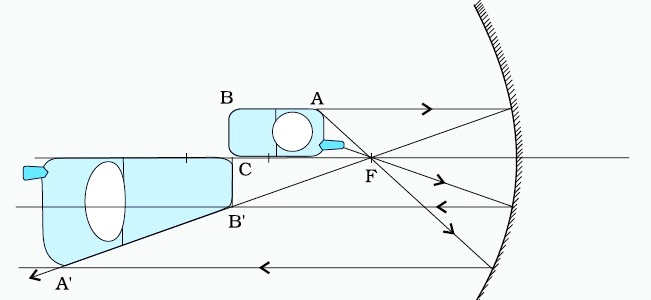
A mobile phone lies along the principal axis of a concave mirror, as shown in Fig. Show by suitable diagram, the formation of its image. Explain why the magnification is not uniform. Will the distortion of image depend on the location of the phone with respect to the mirror?
3.
C,Si and Ge have same lattice structure. Why is C insulator while Si and Ge intrinsic semiconductor?
4.
What is the composition of materials used in the fuse wire?
5.
Why is the wave nature of matter not more apparent to our daily observations?
6.
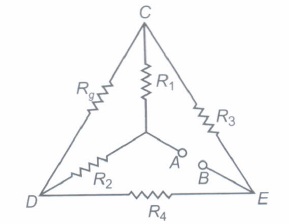
(i) Calculate the equivalent resistance of the given electrical network between points A and B.
(ii) Also calculate the current through CD and ACB, if a 10 V dc source is connected between A and B, and the value of R is assumed as 2 Ω.
7.
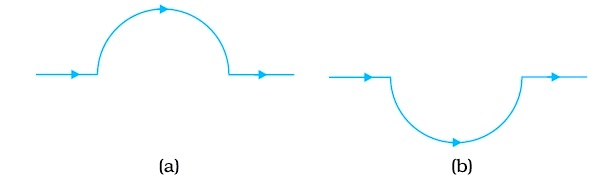
A straight wire carrying a current of 12 A is bent into a semi-circular arc of radius 2.0 cm as shown in Fig (a). Consider the magnetic field B at the centre of the arc.
(a) What is the magnetic field due to the straight segments?
(b) In what way the contribution to B from the semicircle differs from that of a circular loop and in what way does it resemble?
(c) Would your answer be different if the wire were bent into a semi-circular arc of the same radius but in the opposite way as shown in Fig.(b)?
8.
Figures (a) and (b) show the field lines of a positive and negative point charge respectively
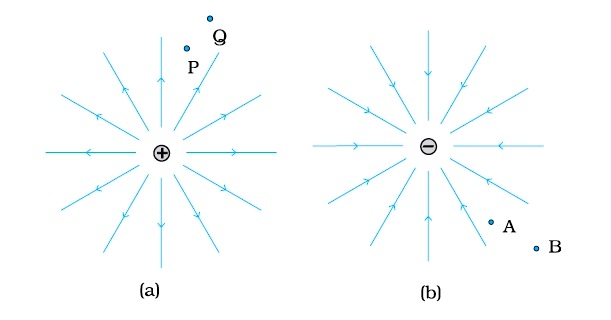
(a) Give the signs of the potential difference VP – VQ; VB – VA.
(b) Give the sign of the potential energy difference of a small negative charge between the points Q and P; A and B.
(c) Give the sign of the work done by the field in moving a small positive charge from Q to P.
(d) Give the sign of the work done by the external agency in moving a small negative charge from B to A.
(e) Does the kinetic energy of a small negative charge increase or decrease in going from B to A?
9.
According to the classical electromagnetic theory, calculate the initial frequency of the light emitted by the electron revolving around a proton in hydrogen atom.
10.
Two concentric circular coils, one of small radius r1 and the other of large radius r2, such that r1 << r2, are placed co-axially with centres coinciding. Obtain the mutual inductance of the arrangement.
11.
Assuming that protons and neutrons have equal masses; calculate how many times nuclear matter is denser than water. Take mass of a nucleon \(1.67\times { 10 }^{ -27 }kg\) and \({ R }_{ 0 }=1.2\times { 10 }^{ -15 }m\).
12.
The amplitude of the magnetic field part of a harmonic electromagnetic wave in vacuum is B0 = 510 nT. What is the amplitude of the electric field part of the wave?
13.
If a p-n junction diode is reverse biased.
the potential barrier is lowered
the potential barrier rermainsunaffected.
the potential barrier is raised
the current is mainly due to majority charge carriers.
14.
A coil of N turns is placed in a magnetic field B such that B is perpendicular to the plane of the coil. B changes with time as B = B0 cos\(\left(\frac{2 \pi}{T} t\right)\) , where T is time period. The magnitude of emf induced in the coil will be maximum at
Here, n = 1, 2, 3, 4, ...
\(t=\frac{n T}{8}\)
\(t=\frac{n T}{4}\)
\(t=\frac{n T}{2}\)
No option is correct.
15.
Which of the following spectral series in hydrogen atom gives spectral line of 4860 \(\overset { \circ }{ A } \)?
Lyman
Balmer
Paschen
Brackett
16.
A transformer is used to light a 100 W and 110 V lamp from a 220 V mains. If the main current is 0.5A, the efficiency of the transformer is approximately
30%
50%
90%
10%
17.
A 25 cm long solenoid has radius 2 ern and 500 total number of turns. It carries a current of 15 A. If it is equivalent to a magnet of the same size and magnetisation \(\overline{\mathbf{M}} \text { , then }|\overline{\mathbf{M}}| \text { is }\)
\(3 \pi \mathbf{A m}^{-1}\)
\(\mathbf{3 0 0 0 0} \pi \mathbf{A m}^{-1}\)
300 Am-1
30000 Am-1
18.
An electron is projected along the axis of a circular conductor carrying the same current. Electron will experIence
a force along the axis.
a force perpendicular to the axis
a force at an angle of 4° with axis
no force experienced.
19.
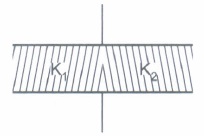
A parallel plate capacitor with air as medium between the plates has a capacitance of 10 μF. The area of capacitor is divided into two equal halves and filled with two media having dielectric constant k1 = 2 and k2 = 4 as shown in the figure. The capacitance of the system will now be
10 μF
20 μF
30 μF
40 μF
20.
Gauss's law will be invalid if
there is magnetic monopoles
the inverse square law is not exactly true.
the velocity of light is not a universal constant.
none of these
21.
The de-Broglie wavelength of an electron in first Bohr's orbit is
equal to \(\frac{1}{4}\) of circumferenceof orbit
equal to \(\frac{1}{2}\)of circumference of orbit
equal to twice of circumference of orbit
equal to the circumference of orbit
22.
The permitivity of vacuum is
1
more than 1
less than 1 but not zero
Zero
23.
A physicist works in a laboratory where the magnetic field is 2T. She wears a necklace enclosing area 0.01m2 in such a way that the plane of the necklace is normal to the field and is having a resistance R = 0.01\(\Omega \). Because of power failure, the field decays to 1 T in time 10-3 s. Then what is the total heat produced in her necklace?
10 J
20 J
30 J
40 J
24.
Two circular coils 1 and 2 are made from the same wire but the radius of the Ist coil twice that of the 2nd coil. What potential difference ratio should be applied across them so that the magnetic field at their centres is the same?
2
3
4
6
25.
The ratio of de-Broglie wavelength of molecules of hydrogen and helium in two gas jars kept separately at temperature of \(27°C\)and \(127°C\)
\(\frac { 2 }{ \sqrt { 3 } } \)
\(2/3\)
\(\frac { \sqrt { 3 } }{ 8 } \)
\(\sqrt { \frac { 8 }{ 3 } } \)
26.
A and B are two metals with threshold frequencies \(1.8\times { 10 }^{ 14 }Hz\)and \(2.2\times { 10 }^{ 14 }Hz\)Two identical photons of energy 0.825 eV each are incident on them. Then photoelectrons are emitted in (take \(h=6.63\times { 10 }^{ -34 }J/s\)
B alone
A alone
neither A nor B
both A and B
27.
The longest wavelength in Balmer series of hydrogen spectrum will be
\(6557\mathring { A } \)
\(1216\mathring { A } \)
\(4800\mathring { A } \)
\(5600\mathring { A } \)
28.
If \({ u }_{ E },{ u }_{ m }\) are the energy density of electromagnetic wave due to electric and magnetic field vectors, \({ E }_{ rms },{ B }_{ rms }\) are the rms value of electric and magnetic field vectors in an electromagnetic wave. then the total energy density of a sinusoidal electromagnetic wave is
\({ u }_{ E }\)
\({ u }_{ E }{ +u }_{ m }\)
\(\frac { 1 }{ 2 } { \epsilon }_{ 0 }{ E }_{ rms }^{ 2 }+\frac { { E }_{ rms }^{ 2 } }{ { 2\mu }_{ 0 } } \)
\(\frac { 1 }{ 2 } { \epsilon }_{ 0 }{ E }_{ 0 }^{ 2 }+\frac { 1 }{ 2 } \frac { { E }_{ 0 }^{ 2 } }{ { \mu }_{ 0 } } \)
29.
(a) For circuits used for transporting electric power, a low power factor implies large power loss in transmission. Explain.
(b) Power factor can often be improved by the use of a capacitor of appropriate capacitance in the circuit. Explain
30.
(a) calculate the potential at a point P due to a charge of \(4\times 10^{-7}C\) located 9 cm away.
(b) Hence obtain the work done in bringing a charge of \(2\times 10^{-9}C\) from infinity to the point P. Does the answer depend on the path along which the charge is brought?
31.
A compound microscope is an optical instrument used for observing highly magnified images of tiny objects. Magnifying power of a compound microscope is defined as the ratio of the angle subtended at the eye by the final image to the angle subtended at the eye by the object, when both the final image and the object are situated at the least distance of distinct vision from the eye. It can be given that:\(m=m_{e} \times m_{o}\) where me is magnification
produced by eye lens and mo is magnification produced by objective lens. Consider a compound microscope that consists of an objective lens of focal length 2.0 cm and an eyepiece of focal length 6.25 cm separated by a distance of 15 cm.
(i) The object distance for eye-piece, so that final image is formed at the least distance of distinct vision, will be
| (a) 3.45 cm | (b) 5.cm | (c) 1.29 cm | (d) 2.59 cm |
(ii) How far from the objective should an object be placed in order to obtain the condition described in part(i)?
| (a) 4.5 cm | (b) 2.5 cm | (c) 1.5 cm | (d) 3.0 cm |
(iii) What is the magnifying power of the microscope in case ofleast distinct vision?
| (a) 20 | (b) 30 | (c) 40 | (d) 10 |
(iv) The intermediate image formed by the objective of a compound microscope is
| (a) real, inverted and magnified | (b) real, erect, and magnified |
| (c) virtual, erect and magnified | (d) virtual, inverted and magnified |
(v) The magnifying power of a compound microscope increases with
| (a) the focal length of objective lens is increased and that of eye lens is decreased |
| (b) the focal length of eye lens is increased and that of objective lens is decreased |
| (c) focal lengths of both objects and eye-piece are increased |
| (d) focal lengths of both objects and eye-piece are decreased. |
32.
The electron mobility characterises how quickly an electron can move through a metal of semiconductor when pulled by an electric field. There is an analogous quality for holes, called hole mobility. A block of pure silicon at 300 K has a length of 10 cm and an area of 1.0 cm2. A battery of emf 2 V is connected across it. The mobility of electron is 0.14 m2 y-1 s-1 and their number density is 1.5 x 10¹⁶ m-3. The mobility of holes is 0.05 m2 y-1 s-1.
(i) The electron current is
| (a) 6.72 x 10⁻⁴ A | (b) 6.72 x 10⁻⁵ A | (c) 6.72 x 10⁻⁶ A | (d) 6.72 x 10⁻⁷ A |
(ii) The hole current is
| (a) 2.0 x 10⁻⁷ A | (b) 2.2 x 10⁻⁷ A | (c) 2.4 X 10⁻⁷ A | (d) 2.6 x 10⁻⁷ A |
(iii) The number density of donor atoms which are to be added up to pure silicon semiconductor to produce an n-type semiconductor of conductivity 6.4 \(\Omega\)-1 cm-1 is approximately (neglect the contribution of holes to conductivity)
| (a) 3 x 10²² m-3 | (b) 3 x 10²³ m-3 | (c) 3 x 1024 m-3 | (d) 3 x 10²¹ m-3 |
(iv) When the given silicon semiconductor is doped with indium, the hole concentration increases to 4.5 x 10²³ m-3. The electron concentration in doped silicon is
| (a) 3 x 10⁹ m-3 | (b) 4 x 10⁹ m-3 | (c) 5 x 10⁹ m-3 | (d) 6 x 10⁹ m-3 |
(v) Pick out the statement which is not correct.
| (a) At a low temperature, the resistance of a semiconductor is very high. |
| (b) Movement of holes is restricted to the valence band only |
| (c) Width of the depletion region increases as the forward bias voltage increases in case of a p- n junction diode. |
| (d) In a forward bias condition, the diode heavily conducts |
1.
Distance between the image (screen) and the object, D = 90 cm
Distance between two locations of the convex lens, d = 20 cm
Focal length of the lens = f
Focal length is related to d and D as:
f = \(\frac { { D }^{ 2 }-{ d }^{ 2 } }{ 4D } \)
= \(\frac { { (90) }^{ 2 }-({ 20) }^{ 2 } }{ 4\times 90 } =\frac { 770 }{ 36 } =21.3\) cm
Therefore, the focal length of the convex lens is 21.39 cm.
2.
The ray diagram for the formation of the image of the phone is shown in Fig. The image of the part which is on the plane perpendicular to principal axis will be on the same plane. It will be of the same size, i.e., B'C = BC. You can yourself realise why the image is distorted.
3.
The 4 bonding electrons of C, Si or Ge lie, respectively, in the second, third and fourth orbit. Hence, energy required to take out an electron from these atoms (i.e., ionisation energy Eg) will be least for Ge, followed by Si and highest for C. Hence, number of free electrons for conduction in Ge and Si are significant but negligibly small for C.
4.
63% tin + 37% lead.
5.
De-Broglie wavelength associated with a body of mass m, moving with velocity v is given by.\(\lambda =\frac { h }{ mv } \).
Since the mass of the objects used in our daily life is very large, hence the de-Broglie wavelength associated with them is quite small and is not visible. Hence the wave nature of matter is not more apparent to our daily observations.
6.
(i) The given circuit can be redrawn as shown in the figure.
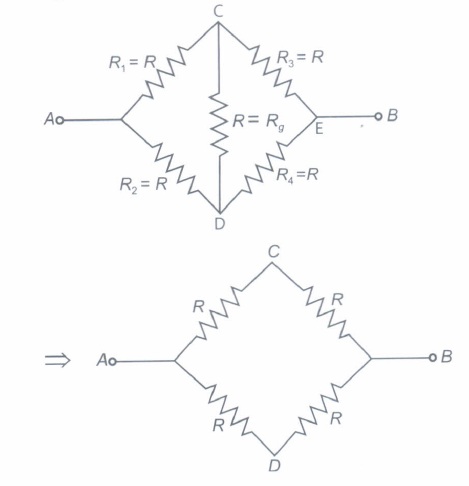
As \(\frac{R_{1}}{R_{2}}=\frac{R_{3}}{R_{4}}\)
The circuit is a balanced wheatstone bridge.
\(\therefore \ V_{C}=V_{D} \text { and } I_{C D}=0\)
Hence, an equivalent circuit is redrawn as shown.
Thus, \(R_{A B}=\frac{(2 R)(2 R)}{4 R}=R \Omega\)
(ii) Being a balanced wheatstone bridge, lCD = 0
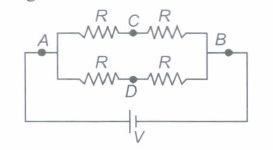
Given: \( R=2 \Omega, V_{A B}=10 \mathrm{~V} \)
\(R_{A C B}=4 \Omega \)
\(I_{A C B}=\frac{10}{4}=2.5 \mathrm{~A}\)
7.
(a) dl and r for each element of the straight segments are parallel. Therefore, dl x r = 0. Straight segments do not contribute to |B|.
(b) For all segments of the semicircular arc, dl x r are all parallel to each other (into the plane of the paper). All such contributions add up in magnitude. Hence direction of B for a semicircular arc is given by the right-hand rule and magnitude is half that of a circular loop. Thus B is 1.9 x 10⁻⁴ T normal to the plane of the paper going into it.
(c) Same magnitude of B but opposite in direction to that in (b).
8.
(a) As \(V \propto \frac{1}{r}, V_{P}>V_{Q^{}}\) Thus, (VP – VQ) is positive. Also VB is less negative than VA . Thus, VB > VA or (VB – VA) is positive.
(b) A small negative charge will be attracted towards positive charge. The negative charge moves from higher potential energy to lower potential energy. Therefore the sign of potential energy difference of a small negative charge between Q and P is positive. Similarly, (P.E.)A > (P.E.)B and hence sign of potential energy differences is positive.
(c) In moving a small positive charge from Q to P, work has to be done by an external agency against the electric field. Therefore, work done by the field is negative.
(d) In moving a small negative charge from B to A work has to be done by the external agency. It is positive.
(e) Due to force of repulsion on the negative charge, velocity decreases and hence the kinetic energy decreases in going from B to A.
9.
we know that velocity of electron moving around a proton in hydrogen atom in an orbit of radius 5.3 × 10⁻¹¹ m is 2.2 × 10⁻⁶ m/s. Thus, the frequency of the electron moving around the proton is
\(v=\frac{v}{2 \pi r}=\frac{2.2 \times 10^{6} \mathrm{~m} \mathrm{~s}^{-1}}{2 \pi\left(5.3 \times 10^{-11} \mathrm{~m}\right)}\)
\(\approx \) 6.6 × 10¹⁵ Hz
According to the classical electromagnetic theory we know that the frequency of the electromagnetic waves emitted by the revolving electrons is equal to the frequency of its revolution around the nucleus. Thus the initial frequency of the light emitted is 6.6 × 10¹⁵ Hz.
10.
Let a current I2 flow through the outer circular coil. The field at the centre of the coil is B2 = μ0I2 / 2r2. Since the other co-axially placed coil has a very small radius, B2 may be considered constant over its cross-sectional area. Hence,
\(\Phi_{1}=\pi r_{1}^{2} B_{2}\)
\(=\frac{\mu_{0} \pi r_{1}^{2}}{2 r_{2}} I_{2}\)
= M12 I2
Thus,
\(M_{12}=\frac{\mu_{0} \pi r_{1}^{2}}{2 r_{2}}\)
From Eq
\(M_{12}=M_{21}=\frac{\mu_{0} \pi r_{1}^{2}}{2 r_{2}}\)
Note that we calculated M12 from an approximate value of Φ1, assuming the magnetic field B2 to be uniform over the area πr12. However, we can accept this value because r1 << r2.
11.
Density of nucleus (of water)
\(\rho =\frac { 3m }{ 4\pi { R }_{ 0 }^{ 3 } } =\frac { 3\times 1.67\times { 10 }^{ -27 } }{ 4\times \frac { 22 }{ 7 } { \left( 1.2\times { 10 }^{ -15 } \right) }^{ 3 } }\)
\(=\frac { 7\times 3\times 1.67\times { 10 }^{ 18 } }{ 88\times 1.2\times 1.2\times 1.2 } =2.307{ \times 10 }^{ 17 }kg/{ m }^{ 3 }\)
Density of water, \({ \rho \prime =10 }^{ 3 }kg/{ m }^{ 3 }\)
\(\therefore \quad \frac { \rho }{ \rho \prime } =\frac { 2.307\times { 10 }^{ 17 } }{ { 10 }^{ 3 } } =2.307\times { 10 }^{ 14 }\)
12.
Given, amplitude of the magnetic field part of harmonic electromagnetic wave,
B0 = 510 nT = 510 \(\times\)10-9 T
Speed of light in a vacuum, c = 3 × 10⁸ m/s
Amplitude of electric field of the electromagnetic wave is given by the relation,
E = cB0
= 3 × 108 × 510 × 10−9 = 153 N/C
Therefore, the electric field part of the wave is 153 N/C.
13.
(c)
the potential barrier is raised
14.
(d)
No option is correct.
15.
(b)
Balmer
16.
(c)
90%
17.
(d)
30000 Am-1
18.
(d)
no force experienced.
19.
(c)
30 μF
20.
(b)
the inverse square law is not exactly true.
21.
(d)
equal to the circumference of orbit
22.
(c)
less than 1 but not zero
23.
(a)
10 J
24.
(c)
4
25.
(d)
\(\sqrt { \frac { 8 }{ 3 } } \)
26.
(b)
A alone
27.
(a)
\(6557\mathring { A } \)
28.
(b)
\({ u }_{ E }{ +u }_{ m }\)
29.
(a) We know that P = I V cos\(\phi \) where cos\(\phi \) is the power factor. To supply a given power at a given voltage, if cos\(\phi \) is small, we have to increase current accordingly. But this will lead to large power loss (I2R) in transmission.
(b) Suppose in a circuit, current I lags the voltage by an angle \(\phi \). Then power factor \(\phi \) = R/Z.
We can improve the power factor (tending to 1) by making Z tend to R. Let us understand, with the help of a phasor diagram.
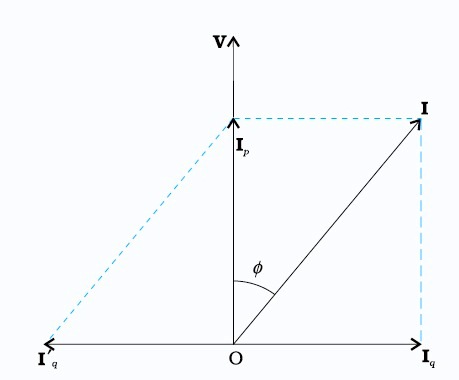
how this can be achieved. Let us resolve I into two components. Ip along the applied voltage V and Iq perpendicular to the applied voltage. Iq as you have learnt in Section 7.7, is called the wattless component since corresponding to this component of current, there is no power loss. IP is known as the power component because it is in phase with the voltage and corresponds to power loss in the circuit.
It’s clear from this analysis that if we want to improve power factor, we must completely neutralize the lagging wattless current Iq by an equal leading wattless current I'q. This can be done by connecting a capacitor of appropriate value in parallel so that Iq and I′q cancel each other and P is effectively Ip V.
30.
\(V=\frac{1}{4 \pi \varepsilon_{0}} \frac{Q}{r}=9 \times 10^{9} \mathrm{Nm}^{2} \mathrm{C}^{-2} \times \frac{4 \times 10^{-7} \mathrm{C}}{0.09 \mathrm{~m}}\)
= 4 x 10⁴ V
(b) W = qV = 2 x 10−9C x 4 x 104 V
= 8 x 10⁻⁵ J
No, work done will be path independent. Any arbitrary infinitesimal path can be resolved into two perpendicular displacements: One along r and another perpendicular to r. The work done corresponding to the later will be zero.
31.
(i) (b): Here, \(f_{0}=2.0, f_{e}=6.25 \mathrm{~cm}, u_{0}=?\)
When the final image is obtained at the least distance of distinct vision:
Ve = - 25 cm
\(\text {As } \frac{1}{v_{e}}-\frac{1}{u_{e}}=\frac{1}{f_{e}} \)
\(\therefore \ \frac{1}{u_{e}}=\frac{1}{v_{e}}-\frac{1}{f_{e}}=\frac{1}{-25}-\frac{1}{6.25} \)
\(=\frac{-1-4}{25}=\frac{-5}{25}=-\frac{1}{5} \)
\(\text {or } u_{e}=-5 \mathrm{~cm}\)
(ii) (b): Distance between objective and eye-piece = 15cm
\(\therefore\) Distance of the image from objective is
\(v_{0}=15-5=10 \mathrm{~cm} \)
\(\therefore \quad \frac{1}{u_{0}}=\frac{1}{v_{0}}-\frac{1}{f_{0}}=\frac{1}{10}-\frac{1}{2}=\frac{1-5}{10}=-\frac{2}{5} \)
\(\text {or } \ u_{0}=-\frac{5}{2}=-2.5 \mathrm{~cm}\)
\(\therefore\) Distance of object from objective = 2.5 cm
(iii) (a): Magnifying power
\(m=m_{0} \times m_{e}=\frac{v_{0}}{u_{0}}\left(1+\frac{D}{f_{e}}\right)=\frac{10}{2.5}\left(1+\frac{25}{6.25}\right)=20\)
(iv) (a): The intermediate image formed, by the objective of a compound microscope is real, inverted and magnified.
(v) (d)
32.
(i) (d): \(E=\frac{V}{l}=\frac{2}{0.1}=20 \mathrm{~V} / \mathrm{m} ;\)
\(A=1.0 \mathrm{~cm}^{2}=1.0 \times 10^{-4} \mathrm{~m}^{2}\)
\(\begin{array}{l}
v_{e}=\mu_{e} E=0.14 \times 20=2.8 \mathrm{~m} \mathrm{~s}^{-1} \\
I_{e}=n_{e} A e v_{e}
\end{array}\)
\(\begin{array}{l}
=\left(1.5 \times 10^{16}\right) \times\left(1.0 \times 10^{-4}\right) \times\left(1.6 \times 10^{-19}\right) \times 2.8 \\
=6.72 \times 10^{-7} \mathrm{~A}
\end{array}\)
(ii) (c): In a pure semiconductor,
\(n_{e}=n_{h}=1.5 \times 10^{16} \mathrm{~m}^{-3}\)
\(\begin{array}{l}
v_{h}=\mu_{h} \times E=0.05 \times 20=1.0 \mathrm{~ms}^{-1} \\
I_{h}=n_{h} \mathrm{Aev}_{h}
\end{array}\)
\(\begin{array}{l}
=\left(1.5 \times 10^{16}\right) \times\left(1.0 \times 10^{-4}\right) \times\left(1.6 \times 10^{-19}\right) \times 1.0 \\
=2.4 \times 10^{-7} \mathrm{~A}
\end{array}\)
(iii) (a): \(\sigma=e n_{e} m_{e}\)
\(\text { or } n_{e}=\frac{\sigma}{e \mu_{e}}=\frac{6.4 \times 10^{2}}{\left(1.6 \times 10^{-19}\right) \times 0.14}\)
\(=3.14 \times 10^{22} \approx 3 \times 10^{22} \mathrm{~m}^{-3}\)
(iv) (c): \(n_{e}=\frac{n_{i}^{2}}{n_{h}}=\frac{\left(1.5 \times 10^{16}\right)^{2}}{4.5 \times 10^{22}}=5 \times 10^{9} \mathrm{~m}^{-3}\)
(v) (c): In case of a p-n junction diode, width of the depletion region decreases as the forward bias voltage increases.

12th Standard CBSE Syllabus & Materials
12th Standard CBSE
CBSE 12th Computer Science Python Revision Tour I - New Previous year Question Papers Study Material - QB365 Set A
NEW12th Standard CBSE
CBSE 12th Business Studies Planning Important Questions And Answers Study Material - QB365 Set A
NEW12th Standard CBSE
CBSE 12th Business Studies Business Environment Important Questions And Answers Study Material - QB365 Set A
NEW12th Standard CBSE
CBSE 12th Business Studies Principles of Management Important Questions And Answers Study Material - QB365 Set A



NCERT Books

Syllabus

Exam Pattern

Sample Question Papers

Previous year Question Papers

Important Notes

MCQ Practice test

NCERT Exemplers

Case study Questions

Image Based Questions

Passage based Questions

HOT Questions

Value Based Questions

Model Questions Papers
NCERT ( Book Back ) Questions

Assertion and Reason
Important Questions And Answers

CBSE 12th Standard CBSE Subjects
CBSE Standards








