
 100% FREE ACCESS
12th Standard CBSE Syllabus & Materials
12th Standard CBSE
CBSE 12th Economics Government Budget and the Economy Previous year Question Papers Study Material - QB365 Set A
NEW12th Standard CBSE
CBSE 12th Computer Science Interface Python with MySQL - New Previous year Question Papers Study Material - QB365 Set A
NEW12th Standard CBSE
CBSE 12th Computer Science Database Concept - New Previous year Question Papers Study Material - QB365 Set A
NEW12th Standard CBSE
CBSE 12th Computer Science Data Communication - New Previous year Question Papers Study Material - QB365 Set A
NEW12th Standard CBSE
CBSE 12th Computer Science Data Structures - New Previous year Question Papers Study Material - QB365 Set A
NEW12th Standard CBSE
CBSE 12th Computer Science Functions - New Previous year Question Papers Study Material - QB365 Set A

Published on: 25/10/2025
Download CBSE Class 12th Standard CBSE Physics question papers, sample papers, important questions, and previous year solved papers in PDF format. Get free study materials, NCERT solutions, and exam preparation resources for Class 12th Standard CBSE Physics
Questions + Answers key
Take MCQ Physics Test
1.
Given bellow shows a series LCR circuit connected to a variable frequency 230 V source. L = 5.0 H, C = 80μF, R = 40 Ω.
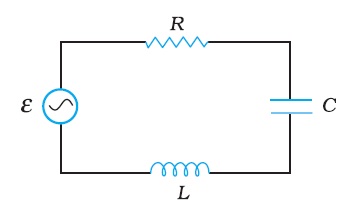
(a) Determine the source frequency which drives the circuit in resonance.
(b) Obtain the impedance of the circuit and the amplitude of current at the resonating frequency.
(c) Determine the rms potential drops across the three elements of the circuit. Show that the potential drop across the LC combination is zero at the resonating frequency.
2.
Answer the following questions:
(a) The angle subtended at the eye by an object is equal to the angle subtended at the eye by the virtual image produced by a magnifying glass. In what sense then does a magnifying glass provide angular magnification?
(b) In viewing through a magnifying glass, one usually positions one’s eyes very close to the lens. Does angular magnification change if the eye is moved back?
(c) Magnifying power of a simple microscope is inversely proportional to the focal length of the lens. What then stops us from using a convex lens of smaller and smaller focal length and achieving greater and greater magnifying power?
(d) Why must both the objective and the eyepiece of a compound microscope have short focal lengths?
(e) When viewing through a compound microscope, our eyes should be positioned not on the eyepiece but a short distance away from it for best viewing. Why? How much should be that short distance between the eye and eyepiece?
3.
A 600 pF capacitor is charged by a 200 V supply. It is then disconnected from the supply and is connected to another uncharged 600 pF capacitor. How much electrostatic energy is lost in the process?
4.
A long straight wire in the horizontal plane carries a current of 50 A in north to south direction. Give the magnitude and direction of B at a point 2.5 m east of the wire.
5.
Figures (a) and (b) show the field lines of a positive and negative point charge respectively
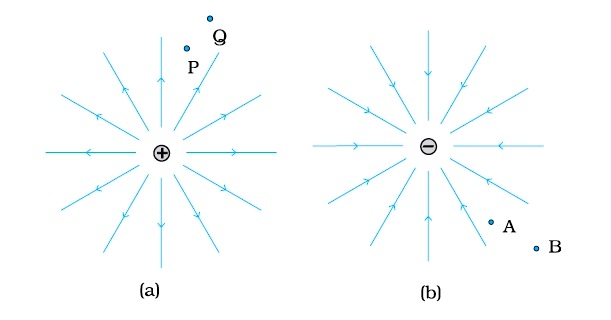
(a) Give the signs of the potential difference VP – VQ; VB – VA.
(b) Give the sign of the potential energy difference of a small negative charge between the points Q and P; A and B.
(c) Give the sign of the work done by the field in moving a small positive charge from Q to P.
(d) Give the sign of the work done by the external agency in moving a small negative charge from B to A.
(e) Does the kinetic energy of a small negative charge increase or decrease in going from B to A?
6.
(a) The size of the atom in Thomson’s model is ______ the atomic size in Rutherford’s model. (much greater than/no different from/much less than.)
(b) In the ground state of ________ electrons are in stable equilibrium, while in .......... electrons always experience a net force. (Thomson’s model/ Rutherford’s model).
(c) A classical atom based on _________ is doomed to collapse. (Thomson’s model/ Rutherford’s model.
(d) An atom has a nearly continuous mass distribution in a _______ but has a highly non-uniform mass distribution in ______ (Thomson’s model/ Rutherford’s model)
(e) The positively charged part of the atom possesses most of the mass in ________ (Rutherford’s model/both the models.)
7.
Find the binding energy per nucleon of 20Ca40 nucleus. Given, mN (20Ca40) =39.962589 u, mn = 1.008665 u and mp = 1.007825 u.
(Take, 1 amu \(\left.=\frac{931}{c^2} \mathrm{MeV}\right)\)
8.
A plane electromagnetic wave travels in vacuum along z-direction. What can you say about the directions of its electric and magnetic field vectors? If the frequency of the wave is 30 MHz, what is its wavelength?
9.
Temperature dependence of resistivity \(\rho (T)\) of semiconductors, insulators and metals is significantly based on the following factors:
(a) number of charge carriers can change with temperature T.
(b) time interval between two successive collisions can depend on T.
(c) length of material can be a function of T.
(d) mass of carriers is a function of T.
10.
Two metals A and B have work functions 2 eV and 5 eV respectively. Which metal has lower threshold wavelength?
11.
The image of an object formed by a lens on the screen is not in sharp focus. Suggest a method to get the clear focussing of the image on the screen without disturbing the position of the object, the lens or the screen.
12.
A screen is placed 90cm from an object. The image of the object on the screen is formed by a convex lens at two different locations separated by 20cm. Determine the focal length of the lens.
13.
The storage battery of a car has an emf of 12 V. If the internal resistance of the battery is 0.4\(\Omega \), what is the maximum current that can be drawn from the battery?
14.
Suppose a pure Si crystal has \(5\times 10^{ 28 }\) atmos \(m^{ -3 }\). It is doped by ppm concentration of pentavalent As. Calculate the number of electrons and holes. Given that \({ n }_{ i }=1.5\times { 10 }^{ 16 }m^{ 3 }\)
15.
A straight conducting rod of length I and mass m is suspended in a horizontal plane by a pair of flexible strings in a magnetic field of magnitude B. To remove the tension in the supporting strings, the magnitude of the current in the wire is
\(\frac{m g B}{l}\)
\(\frac{m g l}{B}\)
\(\frac{m g}{l B}\)
\(\frac{l B}{m g}\)
16.
The figure shows the variation of photocurrent with anode potential for a photosensitive surface for three different radiations. Let la, Ib and Ic be the intensities and va, vb and vc be the frequencies for the curves a, b and c respectively. Then the correct relation is
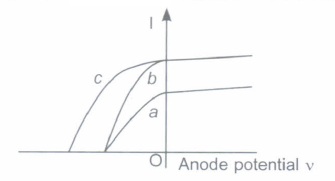
\( v_{a}=v_{b} \text { and } I_{a} \neq I_{b} \)
\(v_{a}=v_{c} \text { and } I_{a}=I_{c} \)
\(v_{a}=v_{b} \text { and } I_{a}=I_{b} \)
\(v_{b}=v_{c} \text { and } I_{b}=I_{c} \)
17.
The peak value of ac voltage on a 220 V mains is
\(200 \sqrt{2} \mathrm{~V}\)
\(230 \sqrt{2} \mathrm{~V}\)
\(220 \sqrt{2} \mathrm{~V}\)
\(240 \sqrt{2} \mathrm{~V}\)
18.
An electron is projected along the axis of a circular conductor carrying the same current. Electron will experIence
a force along the axis.
a force perpendicular to the axis
a force at an angle of 4° with axis
no force experienced.
19.
A current carrying closed loop of an irregular shape lying in more than one plane when placed in uniform magnetic field, the force acting on it
will be more in the plane where its larger position is covered.
is zero.
is infinite.
mayor may not be zero.
20.
Advantage of reflecting telescopes are
no chromatic aberration
parabolic reflecting surfaces are used
weighs of mirror are much less than a lens of equivalent optical quality
All of the above
21.
The de-Broglie wavelength of an electron in first Bohr's orbit is
equal to \(\frac{1}{4}\) of circumferenceof orbit
equal to \(\frac{1}{2}\)of circumference of orbit
equal to twice of circumference of orbit
equal to the circumference of orbit
22.
Balmer formula is valid for
hydrogen
singly ionised helium
doubly ionised lithium
All of the above
23.
Radius of a hollow sphere is R and a charge q is placed at the centre of hollow sphere. If the radius of sphere becomes half and charge also becomes half, then the value of emergent total flux from the surface of sphere is
\(4 q / \varepsilon_{0}\)
\(2 q / \varepsilon_{0}\)
\(q / 2 \varepsilon_{0}\)
\(q / \varepsilon_{0}\)
24.
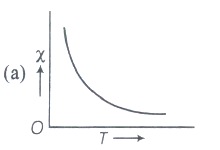
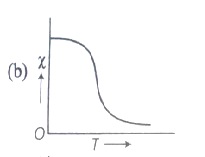
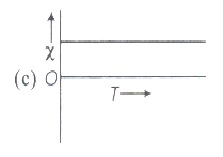
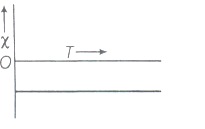
The variation of magnetic susceptibility (x) with temperature for a diamagnetic substance is best represented by figure
25.
When placed in a uniform field, a dipole experiences
Only a net force
Only a torque
Both a net force and a torque
Neither a net force nor a torque
26.
A soap bubble is given a positive charge. Its radius will
Increaese
Decrease
Remains changed
Oscillate
27.
A circular coil expands radially in a region of magnetic field and no electromotive force is produced in the coil. This can be because
the magentic field is constant
the magnetic field is in the same plane as the circular coil and it may or may not vary
the magnetic field has a perpendicular componet whose magnitude is decreasing suitably
there is a constant magnetic field in the perpendicular direction.
28.
The de-Broglie wavelength of the tennis ball of mass 60g moving with a velocity of 10m/s is approximately: (Plank's constant h = \(h=6.63\times { 10 }^{ -34 }Js\)
\({ 10 }^{ -33 }m\)
\({ 10 }^{ -31 }m\)
\({ 10 }^{ -16 }m\)
\({ 10 }^{ -25 }m\)
29.
When a forward bias is applied to p-n junctions it
raises the potential barrier
reduces the majority carrier to zero
lower the potential barrier
None of these
30.
During the propagation of electromagnetic waves in a medium
electric energy density is equal to the magnetic energy density
both electric and magnetic energy density are zero
electric energy density is doubled off the magnetic energy density
electric energy density is half of the magnetic energy density
31.
32.
A convex or converging lens is thicker at the centre than at the edges. It converges a parallel beam of light on refraction through it. It has a real focus. Convex lens is of three types:
(i) Double convex lens
(ii) Plano-convex lens
(iii) Concavo-convex lens. Concave lens is thinner at the centre than at the edges. It diverges a parallel beam of light on refraction through it. It has a virtual focus.
(i) A point object 0 is placed at a distance of 0.3 m from a convex lens (focal length 0.2 m) cut into two halves each of which is displaced by 0.0005 m as shown in figure.What will be the location of the image?
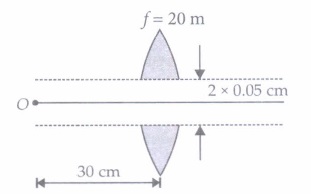
| (a) 30 cm right of lens | (b) 60 ern right of lens |
| (c) 70 ern left of lens | (d) 40 cm left oflens |
(ii) Two thin lenses are in contact and the focal length of the combination is 80 cm. If the focal length of one lens is 20 cm, the focal length of the other would be
| (a) -26.7 cm | (b) 60 crn |
| (c) 80 cm | (d) 20 cm |
(iii) A spherical air bubble is embedded in a piece of glass. For a ray of light passing through the bubble, it behaves like a
| (a) converging lens | (b) diverging lens |
| (c) plano-converging lens | (d) plano-diverging lens |
(iv) Lens used in magnifying glass is
| (a) Concave lens | (b) Convex lens | (c) Both (a) and (b) | (d) None of the above |
(v) The magnification of an image by a convex lens is positive only when the object is placed
| (a) at its focus F | (b) between F and 2F |
| (c) at 2F | (d) between F and optical centre |
1.
Given that the Inductance of the inductor in the circuit is, L = 5.0 H
Given that the Capacitance of the capacitor in the circuit is , C = 80 μH = 80 x 10 - 6 F
Given that Resistance of the resistor in the circuit, R = 40 Ω
Value of Potential of the variable voltage supply, V = 230 V
(a) We know that the Resonance angular frequency can be obtained by the following relation :
\(\omega_{r}=\frac{1}{\sqrt{L C}} \omega_{r}=\frac{1}{\sqrt{5 x 80 x 10-6}} \omega_{r}=\frac{10^{3}}{20}=50 \mathrm{rad} / \mathrm{sec}\)
Thus, the circuit encounters resonance at a frequency of 50 rad/s.
(b) We know that the Impedance of the circuit can be calculated by the following relation :
\(Z=\sqrt{R^{2}+\left(X_{L}-X_{C}\right)^{2}}\)
At resonant condition,
X L = X C
Z = R = 40 Ω
At resonating frequency amplitude of the current can be given by the following relation :
\(I_{0}=\frac{V_{0}}{Z}\)
where,
V 0 = peak voltage = \(\sqrt{2} V\)
Therefore,
\(I_{0}=\frac{\sqrt{2 V}}{Z}=\frac{\sqrt{2} \times 230}{40}=8.13 \mathrm{~A}\)
Thus, at resonant condition, the impedance of the circuit is calculated to be 40 Ω and the amplitude of the current is found to be 8.13 A
c) rms potential drop across the inductor in the circuit,
( V L ) rms = I x ω r L
Where,
\(I_{r m s}=\frac{I_{0}}{\sqrt{2}}=\frac{\sqrt{2} V}{\sqrt{2} Z}=\frac{230}{40}=\frac{23}{4} A\)
Therefore, ( V L ) rms
\(\frac{23}{4} \times 50 \times 5=1437.5 \mathrm{~V}\)
We know that the Potential drop across the capacitor can be calculated with the following relation :
\(\left(V_{c}\right)_{r m s}=I \times \frac{1}{\omega_{r} C}=\frac{23}{4} \times \frac{1}{50 \times 80 \times 10^{-6}}=1437.5 V\)
We know that the Potential drop across the resistor can be calculated with the following relation :
\(\left(V_{R}\right)_{r m s}=I R=\frac{23}{4} \times 40=230 \mathrm{~V}\)
Now, Potential drop across the LC connection can be obtained by the following relation :
V L C = I ( X L − X C )
At resonant condition,
X L = X C
V L C = 0
Therefore, it has been proved from the above equation that the potential drop across the LC connection is equal to zero at a frequency at which resonance occurs.
2.
(a) Though the image size is bigger than the object, the angular size of the image is equal to the angular size of the object. A magnifying glass helps one see the objects placed closer than the least distance of distinct vision (i.e., 25 cm). A closer object causes a larger angular size. A magnifying glass provides angular magnification. Without magnification, the object cannot be placed closer to the eye. With magnification, the object can be placed much closer to the eye.
(b) Yes, the angular magnification changes. When the distance between the eye and a magnifying glass is increased, the angular magnification decreases a little. This is because the angle subtended at the eye is slightly less than the angle subtended at the lens. Image distance does not have any effect on angular magnification.
(c) The focal length of a convex lens cannot be decreased by a greater amount. This is because making lenses having very small focal lengths is not easy. Spherical and chromatic aberrations are produced by a convex lens having a very small focal length.
(d) The angular magnification produced by the eyepiece of a compound microscope is \(\left[ \left( \frac { 25 }{ { f }_{ e } } \right) +1 \right] \)
Where,
fe = Focal length of the eyepiece
It can be inferred that if fe is small, then angular magnification of the eyepiece will be large.
The angular magnification of the objective lens of a compound microscope is given as \(\frac { 1 }{ (|{ u }_{ o }|{ f }_{ o }) } \)
Where,
uo = Object distance for the objective lens
fo = Focal length of the objective
The magnification is large when uo > fo. In the case of a microscope, the object is kept close to the objective lens. Hence, the object distance is very little. Since uo is small, fo will be even smaller. Therefore, fe and fo are both small in the given condition.
(e) When we place our eyes too close to the eyepiece of a compound microscope, we are unable to collect much refracted light. As a result, the field of view decreases substantially. Hence, the clarity of the image gets blurred.
The best position of the eye for viewing through a compound microscope is at the eye-ring attached to the eyepiece. The precise location of the eye depends on the separation between the objective lens and the eyepiece.
3.
Given, C1 = C2 = 600 pF
= 600 \(\times\)10-12F
= 6 \(\times\)10-10 F
V1 = 200 V, V2 = 0
\(\begin{aligned} \therefore \text { Energy lost } & =\frac{C_1 C_2\left(V_1-V_2\right)^2}{2\left(C_1+C_2\right)} \\ \end{aligned}\)
\(\begin{aligned} =\frac{\left(6 \times 10^{-10}\right)^2(200-0)^2}{2 \times 12 \times 10^{-10}} \end{aligned}\)
= 6 \(\times\)10-6 J
4.
Current in the wire, I = 50 A
A point is 2.5 m away from the East of the wire.
∴ Magnitude of the distance of the point from the wire, r = 2.5 m.
Magnitude of the magnetic field at that point is given by the relation, B \(=\frac{\mu_{0} 2 I}{4 \pi r}\)
Where,
μ0 = Permeability of free space = 4π x 10–7 T m A–1
\(B=\frac{4 \pi \times 10^{-7} \times 2 \times 50}{4 \pi \times 2.5}\)
= 4 x 10 -6 T
The point is located normal to the wire length at a distance of 2.5 m. The direction of the current in the wire is vertically downward. Hence, according to the Maxwell’s right hand thumb rule, the direction of the magnetic field at the given point is vertically upward.
5.
(a) As \(V \propto \frac{1}{r}, V_{P}>V_{Q^{}}\) Thus, (VP – VQ) is positive. Also VB is less negative than VA . Thus, VB > VA or (VB – VA) is positive.
(b) A small negative charge will be attracted towards positive charge. The negative charge moves from higher potential energy to lower potential energy. Therefore the sign of potential energy difference of a small negative charge between Q and P is positive. Similarly, (P.E.)A > (P.E.)B and hence sign of potential energy differences is positive.
(c) In moving a small positive charge from Q to P, work has to be done by an external agency against the electric field. Therefore, work done by the field is negative.
(d) In moving a small negative charge from B to A work has to be done by the external agency. It is positive.
(e) Due to force of repulsion on the negative charge, velocity decreases and hence the kinetic energy decreases in going from B to A.
6.
(a) The sizes of the atoms taken in Thomson’s model and Rutherford’s model have the same order of magnitude.
(b) In the ground state of Thomson’s model, the electrons are in stable equilibrium. However, in Rutherford’s model, the electrons always experience a net force.
(c) A classical atom based on Rutherford’s model is doomed to collapse.
(d) An atom has a nearly continuous mass distribution in Thomson’s model, but has a highly non-uniform mass distribution in Rutherford’s model.
(e) The positively charged part of the atom possesses most of the mass in both the models.
7.
In a nuclues of 20Ca40,
Number of protons = 20
Number of neutrons = 40 - 20 = 20
Total mass of 20 protons and 20 neutrons
= 20mp + 20 mn = 20(mp + mn)
= 20(1.007825+1.008665) = 40.3298 u
Mass defect, \(\triangle m\) = 40.3298 - 39.962589 = 0.367211 u
Total binding energy = \(\Delta m \times c^2 \times \frac{931}{c^2} \mathrm{MeV}\)
= \(\Delta\)m \(\times\) 931 MeV
= 0.367211 \(\times\) 931
= 341.873441 MeV
Eb per nucleon, Ebn = \(\frac{341.873441}{40}\)
= 8.547 MeV/nucleon
8.
It is given that a plane electromagnetic wave travels in vacuum along z-direction and the frequency of the electromagnetic wave is 30MHz.
We can say that electric field and magnetic field will be in x-plane because the electromagnetic wave travels along the z-direction and both fields are mutually perpendicular to each other.
The formula of the wavelength of a wave is,
λ=c/ν
Substitute the values in the above expression,
λ=(3×10⁸)/(30×106)=10m.
Thus, the value of wavelength is 10 m and the direction of electric and magnetic fields will be in x-y plane.
9.
Resistivity of a conductor \(\rho =\frac { m }{ { ne }^{ 2 }\tau } \)
So as temperature changes n and \(\tau \) changes.
10.
Metal with work function 5 eV has lower threshold wavelength, i.e. metal B.
11.
The image of an object formed by a lens can be brought to a sharp focus on a unfixed screen by changing the focal length of the lens by any of the following methods:
(i) By placing another lens of suitable focal length in contact with the previous lens.
(ii) By immersing the given lens in a liquid of appropriate refractive index.
12.
Distance between the image (screen) and the object, D = 90 cm
Distance between two locations of the convex lens, d = 20 cm
Focal length of the lens = f
Focal length is related to d and D as:
f = \(\frac { { D }^{ 2 }-{ d }^{ 2 } }{ 4D } \)
= \(\frac { { (90) }^{ 2 }-({ 20) }^{ 2 } }{ 4\times 90 } =\frac { 770 }{ 36 } =21.3\) cm
Therefore, the focal length of the convex lens is 21.39 cm.
13.
Emf of the battery, E = 12 V
Internal resistance of the battery, r = 0.4 Ω
Maximum current drawn from the battery = I
According to Ohm’s law,
E = Ir
\(I=\frac{E}{r}\)
\(=\frac{12}{0.4}=30 A\)
The maximum current drawn from the given battery is 30 A.
14.
Note that thermally generated electrons (ni ~1016m–3) are negligibly small as compared to those produced by doping.
Therefore, ne \(\approx\) ND
Since ne nh = \(n_{i}^{2}\) , The number of holes
nh = (2.25 x 1032 ) / (5 x10²²)
= ~ 4.5 x 10⁹ m–3
15.
(c)
\(\frac{m g}{l B}\)
16.
(a)
\( v_{a}=v_{b} \text { and } I_{a} \neq I_{b} \)
17.
(c)
\(220 \sqrt{2} \mathrm{~V}\)
18.
(d)
no force experienced.
19.
(b)
is zero.
20.
(d)
All of the above
21.
(d)
equal to the circumference of orbit
22.
(d)
All of the above
23.
(c)
\(q / 2 \varepsilon_{0}\)
24.
(d)
25.
(b)
Only a torque
26.
(a)
Increaese
27.
(b)
the magnetic field is in the same plane as the circular coil and it may or may not vary
28.
(a)
\({ 10 }^{ -33 }m\)
29.
(b)
reduces the majority carrier to zero
30.
(a)
electric energy density is equal to the magnetic energy density
31.
32.
(i) (b): Each half lens will form an image in the same plane. The optic axes of the lenses are displaced
\(\frac{1}{v}-\frac{1}{(-30)}=\frac{1}{20} ; v=60 \mathrm{~cm}\)
(ii) (a): Here \(f_{1}=20 \mathrm{~cm} ; f_{2}=?\)
F= 80 cm
\(\text { As } \frac{1}{f_{1}}+\frac{1}{f_{2}}=\frac{1}{F} \Rightarrow \frac{1}{f_{2}}=\frac{1}{F}-\frac{1}{f_{1}}\)
\(\frac{1}{f_{2}}=\frac{1}{80}-\frac{1}{20}=\frac{-3}{80}\)
\(f_{2}=\frac{-80}{3}=-26.7 \mathrm{~cm}\)
(iii) (b): The bubble behaves libe a diverging lens
(iv) (b): Convex lens is used in magnifying glass.
(v) (d)

12th Standard CBSE Syllabus & Materials
12th Standard CBSE
CBSE 12th Computer Science Python Revision Tour I - New Previous year Question Papers Study Material - QB365 Set A
NEW12th Standard CBSE
CBSE 12th Business Studies Planning Important Questions And Answers Study Material - QB365 Set A
NEW12th Standard CBSE
CBSE 12th Business Studies Business Environment Important Questions And Answers Study Material - QB365 Set A
NEW12th Standard CBSE
CBSE 12th Business Studies Principles of Management Important Questions And Answers Study Material - QB365 Set A



NCERT Books

Syllabus

Exam Pattern

Sample Question Papers

Previous year Question Papers

Important Notes

MCQ Practice test

NCERT Exemplers

Case study Questions

Image Based Questions

Passage based Questions

HOT Questions

Value Based Questions

Model Questions Papers
NCERT ( Book Back ) Questions

Assertion and Reason
Important Questions And Answers

CBSE 12th Standard CBSE Subjects
CBSE Standards








