
 100% FREE ACCESS
12th Standard CBSE Syllabus & Materials
12th Standard CBSE
CBSE 12th Economics Government Budget and the Economy Previous year Question Papers Study Material - QB365 Set A
NEW12th Standard CBSE
CBSE 12th Computer Science Interface Python with MySQL - New Previous year Question Papers Study Material - QB365 Set A
NEW12th Standard CBSE
CBSE 12th Computer Science Database Concept - New Previous year Question Papers Study Material - QB365 Set A
NEW12th Standard CBSE
CBSE 12th Computer Science Data Communication - New Previous year Question Papers Study Material - QB365 Set A
NEW12th Standard CBSE
CBSE 12th Computer Science Data Structures - New Previous year Question Papers Study Material - QB365 Set A
NEW12th Standard CBSE
CBSE 12th Computer Science Functions - New Previous year Question Papers Study Material - QB365 Set A

Published on: 25/10/2025
Download CBSE Class 12th Standard CBSE Physics question papers, sample papers, important questions, and previous year solved papers in PDF format. Get free study materials, NCERT solutions, and exam preparation resources for Class 12th Standard CBSE Physics
Questions + Answers key
Take MCQ Physics Test
1.
Two metal spheres A and B of radius rand 2r, whose centres are separated by a distance of 6r, are given charge Q each and are at potential V1 and V2. Find the ratio of V1/V2. These spheres are connected to each other with the help of a connecting wire keeping the separation unchanged, what is the amount of charge that will flow through the wire?
2.
Calculate the electrostatic potential energy of a system of three point charges q1, q2 and q3 located respectively at \(\vec{r}_{1}, \vec{r}_{2} \text { and } \vec{r}_{3}\) with respect to a common origin O.
3.
The image obtained with a convex lens is erect and its length is four times the length of the object. If the focal length of the lens is 20 cm, calculate the object and image distances.
4.
An electric dipole of dipole moment \(\overset { \rightarrow }{ p } \) is placed in a uniform electric field \(\overset { \rightarrow }{ E } \) obtain the expression for the torque \(\overset { \rightarrow }{ t } \) experienced by the dipole. Identify two pairs of a perpendicular vector in the expression.
5.
A beam of light of wavelength 600 nm from a distant source falls on a single slit 1.00 mm wide and the resulting diffraction pattern is observed on a screen 2m away. What is the distance between the first dark fringes of either side of the central fringe.
6.
A Young's double slit arrangement produced interference fringes for sodium light \((\lambda =5890\mathring { A } )\) that are 0.20 apart. What is the angular separation if the entire arrangement is immersed in water (refractive index of water = 4/3)?
7.
Kirchhoff's junction rule is a reflection of
(a) conservation of current density vector.
(b) conservation of charge
(c) the fact that the momentum with which a charged particle approaches a junction is unchanged as the charged particle leaves the junction.
(d) the fact that there is no accumulation of charges at a junction.
8.
A dc supply of 120V is connected to a large resistance X. A voltmeter of resistance 10k\(\Omega\)placed in series in the circuit reads 4V. What is the value of X? What so you think is the purpose in using a voltmeter instead of an ammeter to determine the large resistance X?
9.
A convex lens of focal length 25 cm is placed coaxially in contact with a concave lens of focal length 20 cm. Determine the power of the combination. Will the system be converging or diverging in nature'?
10.
(i) What is the relation between critical angle and refractive index of a meterial ?
(ii) Does critical angle depend on the colour of light ? Explain
11.
When a slab of insulating material 4 mm thick is introduced between the plates of a parallel plate capacitor, it is found that the distance between the plates has to be increased by 3.2 mm to restore the capacity to its original value. Calculate dielectric constant of the material.
12.
In a parallel plate capacitor with air between the plates, each plate has an area of 6\(\times\)10-3m2 and the distance between the plates is 3 mm. Calculate the capacitance if this capacitor. If this capacitor is connected to a 100 V supply, what is the charge on each plate of the capacitor?
13.
A compound microscope consists of an objective lens of focal length 2.0 cm and an eye -piece of focal length 6.25 cm separated by a distance should an object be placed in order to obtain the final image at (a) the least distance of distinct vision (25 cm), (b) infinity ? What is the magnifying power of the microscope in each case ?
14.
Two point charges A and B of value +\(5\mu C\) and \(+6\mu C\)are kept 12 cm apart in air. Calculate the work done when charge B is moved by 2cm towards charge A.
15.
The ratio of maximum and minimum intensities of two sources is 4 : 1.The ratio of their amplitudes is
1 : 81
3 : 1
1 : 9
1 : 16
16.
An electric dipole of length lcm is placed with the axis making an angle of 30° to an electric field of strength 104 N/C. If it experiences a torque of 10 \(\sqrt{2}\)Nm, the potential energy of the dipole is
0.245 J
2.45
24.5 J
245.0 J
17.
Two charges 3 x 10⁻⁸ C and - 2 x 10⁻⁸ C located 15 cm apart. At what point on the line joining the two charges is the electric potential zero?
9 cm
45 cm
18 cm
Both (a) and (b)
18.
The capacitance of a spherical conductor is 1 \(\mu\)F Its radius is
1.11 m
10 m
9 km
1.11 cm
19.
A parallel plate air capacitor has a capacitance 18\(\mu\)F. If the distance between the plates is tripled and a dielectric medium is introduced, the capacitance becomes 72 \(\mu\)F. The dielectric constant of the medium is
4
9
12
2
20.
A steady current is set up in a metallic wire of non uniform cross-section. How is the speed of flow v of electrons is related to the area of cross-section A?
v is independent of A
v \(\propto \) A-1
v \(\propto \) A
v \(\propto \) A2
21.
According to the Kirchhoff's law the sum of the products of current and resistance as well as emfs in a closed loop is:
greater than zero
zero
less than zero
determained by the emf
22.
Refractive index of glass w.r.t. water is 9/8. What is the speed of light in water? Given speed of light in glass is \(2\times 10^{ 8 } \ m/s\) .
\(2\times 10^{ 8 } \ m/s\)
\(3\times 10^{ 8 } \ m/s\)
\(2.25\times 10^{ 8 } \ m/s\)
none of these
23.
A ray of light falls on a transparent slab of \(\mu =1.0\) . If reflected and refracted rays are mutually perpendicular, what is the angle of incidence?
\(45°\)
\(60°\)
\(30°\)
\(90°\)
24.
Force \(\overrightarrow { F } \) acting on a test charge qo in a uniform electric field \(\overrightarrow { E } \) is
\(\overrightarrow { F } =q_{ o }\overrightarrow { E } \)
\(\overrightarrow { F } =\frac { \overrightarrow { E } }{ q_{ o } } \)
\(\overrightarrow { F } =\frac { \overrightarrow { q_o } }{\overrightarrow { E } } \)
\(\overrightarrow { F } =q_{ o }^{ 2 }\overrightarrow { E } \)
25.
Electric field due to an electric dipole is
spherically symmetric
cylindrically symmetric
asymmetric
none of the above
26.
At a particular point, electric field depends upon
Source charge Q only
test charge qo only
both Q and q0
neither Q nor qo
27.
Assertion (A) : To observe diffraction of light the size of obstacle aperture should be of the order of 10m.
Reason (R) : 10m is the order of wavelength of visible light
(a) Both A and R are true and R is the correct explanation of A.
(b) Both A and R are true but R is not the correct explanation of A.
(c) A is true but R is false.
(d) A is false but R is true.
28.
Assertion (A) : In interference all the fringes are of same width.
Reason (R) : In interference fringe width is independent of position of the fringe.
Codes:
(a) Both A and R are true and R is the correct explanation of A
(b) Both A and R are true but R is NOT the correct explanation of A
(c) A is true but R is false
(d) A is false and R is also false
1.
As we know \(V=\frac{k q}{r}\)
\( \therefore V_{1}=\frac{k Q}{r} ; V_{2}=\frac{k Q}{2 r} \)
\(\Rightarrow \frac{V_{1}}{V_{2}}=\frac{2}{1} \)
\(\because V_{1}>V_{2} \)
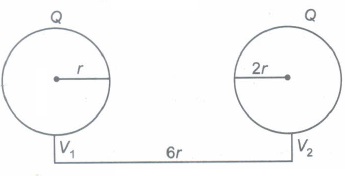
Since after connecting these two spheres, the potential of each sphere will be equal, i.e.
\( V_{1} =V_{2} \)
\(\therefore \frac{k Q_{1}^{\prime}}{r} =\frac{k Q_{2}^{\prime}}{2 r} \)
\(\therefore Q_{1}^{\prime} =\frac{Q_{2}^{\prime}}{2}\)
Electric charges are conserved.
\( \because \ Q+Q =Q_{1}^{\prime}+Q_{2}^{\prime} \)
\(2 Q =\frac{3 Q_{2}^{\prime}}{2} \Rightarrow Q_{2}^{\prime}=\frac{4}{3} Q\)
Charge following = \(Q_{2}^{\prime}-Q=\frac{4 Q}{3}-Q=\frac{Q}{3}\)
2.
Let us consider a system of three charges q1, q2 and q3 located at r1, r2 and r3 respectively. To bring q, first from infinity to r1, no work is required. Next we bring q2 from infinity to r2. As before, work done in this step is:
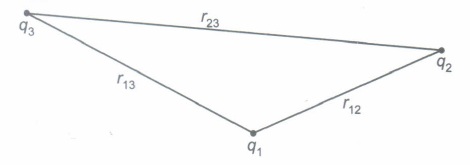
\(q_{2} V_{1}\left(r_{2}\right)=\frac{1}{4 \pi \varepsilon_{0}} \frac{q_{1} q_{2}}{r_{12}} \ ...(i)\)
The charges q1 and q2 produce a potential, which at any point P is given by
\(V_{1,2}=\frac{1}{4 \pi \varepsilon_{0}}\left(\frac{q_{1}}{r_{1 P}}+\frac{q_{2}}{r_{2 P}}\right)...(ii)\)
Work done next in bringing q3 from infinity to the point r3 is q3 times V1,2 at r3.
\(q_{3} V_{1,2}\left(r_{3}\right)=\frac{1}{4 \pi \varepsilon_{0}}\left(\frac{q_{1} q_{3}}{r_{13}}+\frac{q_{2} q_{3}}{r_{23}}\right)...(iii)\)
The total work done in assembling the charges at the given locations is obtained by adding the work done in different steps (i) and (iii).
\(U=\frac{1}{4 \pi \varepsilon_{0}}\left(\frac{q_{1} q_{2}}{r_{12}}+\frac{q_{1} q_{3}}{r_{13}}+\frac{q_{2} q_{3}}{r_{23}}\right)\)
3.
As magnification, m = \(\frac{I}{O}=\frac{v}{u} \Rightarrow I=4 \times\) length of object
\(\Rightarrow \frac{I}{O}=4\Rightarrow \frac{v}{u}=4 \Rightarrow v=4 u\)
Using lens formula, \(\frac{1}{f}=\frac{1}{v}-\frac{1}{u}=\frac{1}{(-4 u)}-\frac{1}{(-u)}\)
\( \Rightarrow \frac{1}{f}=-\frac{1}{4 u}+\frac{1}{u} \Rightarrow \frac{1}{20}=\frac{4-1}{4 u}=\frac{3}{4 u} \)
\(\Rightarrow u=\frac{20 \times 3}{4}=15 \mathrm{~cm} \)
⇒ v = 4u = 15 x 4 = 60 cm
Distance of the object, u = 15 cm
Distance of the image, v = 60 cm
The image is on the same side of the object.
4.
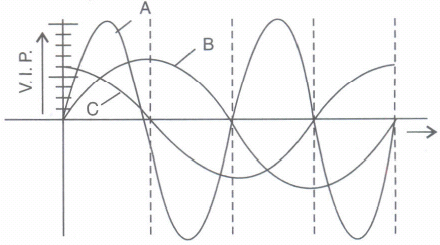
The force on charge +q is + q \(\overset { \rightarrow }{ E } \) and on charge -q is -q \(\overset { \rightarrow }{ E } \). These, two parallel forces, acting in the opposite direction, constitute a couple resulting in the torque 't
Magnitude of torque = qE x 2a sin
= 2qaE sin 9
Therefore, \(\overset { \rightarrow }{ t } =\overset { \rightarrow }{ p } \times\overset { \rightarrow }{ E } \)
where \(\overset { \rightarrow }{ p } =2q\overset { \rightarrow }{ a } \)
Two pairs of perpendicular vectors in expression are given below :
(i) \(\overset { \rightarrow }{ t } \) is perpendicular to \(\overset { \rightarrow }{ p } \)
(ii) \(\overset { \rightarrow }{ t } \) is perpendicular to \(\overset { \rightarrow }{ E } \)
5.
Position of minima due to diffraction at a single slit is given by
\( a\sin { \theta =n\lambda } \)
\( \therefore \ \sin { \theta } =\frac { n\lambda }{ a } =\frac { 1\times600\times{ 10 }^{ -9 } }{ 1.0\times{ 10 }^{ -3 } } \)
\( =6\times{ 10 }^{ -4 }m\)
\(For \ small\theta ,\ \sin { \theta } \simeq \ \theta =6\times{ 10 }^{ -4 } \ radian \)
Let y be the distance of first minima on either side of central maxima, then
\( \theta =\frac { y }{ D } \)
\(or \ y=\theta D=6\times{ 10 }^{ -4 }\times2=12\times{ 10 }^{ -4 }m \)
So the distance between first dark fringes on either side of central maxima is
\(2y=2\times12\times{ 10 }^{ -4 }=24\times{ 10 }^{ -4 }m=2.4mm\)
6.
\(Here,\lambda =5890\mathring { A } ,\mu =\frac { 4 }{ 3 } \)
\( d\theta ={ 0.20 }^{ \circ },d\theta '=?\)
\( Angular \ width,d\theta =\frac { \lambda }{ d } (in \ air)\)
\(In \ denser \ medium,\lambda \ is \ reduced \ to \ \lambda ' \ by \ relation\)
\(\ \frac { \lambda }{ \lambda ' } =\mu \)
\( The \ angular \ width \ is \ given \ by \ d\theta '=\frac { \lambda ' }{ d } \ in \ denser \ medium.\)
\( Hence\ \frac { d\theta ' }{ d\theta } =\frac { \lambda '/d }{ \lambda /d } =\frac { \lambda ' }{ \lambda } =\frac { 1 }{ \mu }\)
\(ord d\theta '=\frac { d\theta }{ \mu } =\frac { 0.20 }{ 4/3 } ={ 0.15 }^{ \circ }\)
7.
Kirchhoff's law is based on conservation of charge and the fact that there is no accumulation of charges at a junction.
8.
Reading of voltmeter = 4 V, Resistance of voltmeter \(=10^{4} \Omega\)
Current drawn by the voltmeter, \(I=\frac{4}{10^{4}}=4 \times 10^{-4} \mathrm{~A}\)
Again, \(I=\frac{E}{X+10^{4}}\)
\(
\Rightarrow \left(X+10^{4}\right) I =E
\)
\(\therefore X I =E-I \times 10^{4}
\)
\(\Rightarrow X =\frac{E}{I}-10^{4}=\frac{120}{4 \times 10^{-4}}-10^{4}
\)
\(\therefore X =29 \times 10^{4} \Omega=290 \mathrm{k} \Omega
\)
9.
Given, focal length of convex lens,
f1 = + 25cm = + 0.25 m and focal length of concave lens, f2 = - 20. cm = - 0..20.m
Equivalent focal length of convex and concave
\(F=\frac { 1 }{ f_{ 1 } } +\frac { 1 }{ f_{ 2 } } =\frac { 1 }{ 25 } +\frac { 1 }{ -20 } =-\frac { 1 }{ 100 } \)
\(\therefore \) F = -100cm = -1m
Now the power of lens, P = \(\frac { 1 }{ f } \)
For convex lens P1 = \(\frac { 1 }{ f_{ 1 } } =\frac { 1 }{ 0.25 } \)
For convex lens P2 = \(\frac { 1 }{ f_{ 2 } } =\frac { 1 }{ -0.20 } \)
\(\frac { 1 }{ 0.25 } +\frac { 1 }{ -0.20 } =\frac { 100 }{ 25 } +\frac { 100 }{ -20 } \)
\(=\frac { 400-500 }{ 100 } =\frac { -100 }{ 100 } =-1D\)
Here, the focal length of the combination =100. cm = -1 m
Since the focal length is in negative, so the system will be diverging in nature.
10.
(i) Refractive index \((\mu )\frac { 1 }{ sin \ C } \) Where C is the critical angle
(ii) Since, refractive index depends upon the wavelength of light, the critical angle for a given pair of media is different for different wavelenghts (colours ) og light.
11.
Change i distance, x = t\((1-{1\over k})\)
12.
Given,
The area of plate of the capacitor, A = 6 x 10⁻³ m2
Distances between the plates, d = 3mm = 3 x 10⁻³ m
Voltage supplied, V = 100V
Capacitance of a parallel plate capacitor is given by, \(C=\frac{\epsilon \times A}{d}\)
Here,
ε = permittivity of free space = 8.854 x10⁻¹² N-1 m -2 C-2
\(C=\frac{8.854 \times 10^{-12} \times 6 \times 10^{-3}}{3 \times 10^{-3}}=17.81 \times 10^{-12} \mathrm{~F}=17.71 \mathrm{pF}\)
Therefore, each plate of the capacitor is having a charge of
q = VC = 100 x 17.81 x 10-12 C = 1.771 x 10⁻⁹ C
13.
20; 13.5 cm
14.
\(45\times \)10-2 J
15.
(b)
3 : 1
16.
(c)
24.5 J
17.
(d)
Both (a) and (b)
18.
(c)
9 km
19.
(c)
12
20.
(b)
v \(\propto \) A-1
21.
(b)
zero
22.
(c)
\(2.25\times 10^{ 8 } \ m/s\)
23.
(a)
\(45°\)
24.
(a)
\(\overrightarrow { F } =q_{ o }\overrightarrow { E } \)
25.
(b)
cylindrically symmetric
26.
(a)
Source charge Q only
27.
(a) Both A and R are true and R is the correct explanation of A.
28.
(a): As given in the expression \(\beta=\frac{D \lambda}{d}\), fringe width \(\beta\) is independent of n (position of fringe), hence all the fringes are of same width.

12th Standard CBSE Syllabus & Materials
12th Standard CBSE
CBSE 12th Computer Science Python Revision Tour I - New Previous year Question Papers Study Material - QB365 Set A
NEW12th Standard CBSE
CBSE 12th Business Studies Planning Important Questions And Answers Study Material - QB365 Set A
NEW12th Standard CBSE
CBSE 12th Business Studies Business Environment Important Questions And Answers Study Material - QB365 Set A
NEW12th Standard CBSE
CBSE 12th Business Studies Principles of Management Important Questions And Answers Study Material - QB365 Set A



NCERT Books

Syllabus

Exam Pattern

Sample Question Papers

Previous year Question Papers

Important Notes

MCQ Practice test

NCERT Exemplers

Case study Questions

Image Based Questions

Passage based Questions

HOT Questions

Value Based Questions

Model Questions Papers
NCERT ( Book Back ) Questions

Assertion and Reason
Important Questions And Answers

CBSE 12th Standard CBSE Subjects
CBSE Standards








