
 100% FREE ACCESS
12th Standard CBSE Syllabus & Materials
12th Standard CBSE
CBSE 12th Economics Government Budget and the Economy Previous year Question Papers Study Material - QB365 Set A
NEW12th Standard CBSE
CBSE 12th Computer Science Interface Python with MySQL - New Previous year Question Papers Study Material - QB365 Set A
NEW12th Standard CBSE
CBSE 12th Computer Science Database Concept - New Previous year Question Papers Study Material - QB365 Set A
NEW12th Standard CBSE
CBSE 12th Computer Science Data Communication - New Previous year Question Papers Study Material - QB365 Set A
NEW12th Standard CBSE
CBSE 12th Computer Science Data Structures - New Previous year Question Papers Study Material - QB365 Set A
NEW12th Standard CBSE
CBSE 12th Computer Science Functions - New Previous year Question Papers Study Material - QB365 Set A

Published on: 25/10/2025
Download CBSE Class 12th Standard CBSE Physics question papers, sample papers, important questions, and previous year solved papers in PDF format. Get free study materials, NCERT solutions, and exam preparation resources for Class 12th Standard CBSE Physics
Questions + Answers key
Take MCQ Physics Test
1.
Figures (a) and (b) show the field lines of a positive and negative point charge respectively
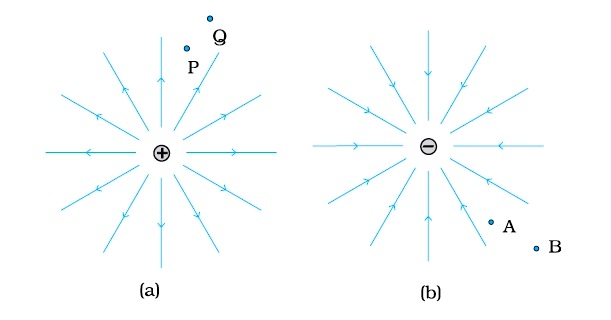
(a) Give the signs of the potential difference VP – VQ; VB – VA.
(b) Give the sign of the potential energy difference of a small negative charge between the points Q and P; A and B.
(c) Give the sign of the work done by the field in moving a small positive charge from Q to P.
(d) Give the sign of the work done by the external agency in moving a small negative charge from B to A.
(e) Does the kinetic energy of a small negative charge increase or decrease in going from B to A?
2.
A regular hexagon of side 10 cm has a charge 5\(\mu\) C at each of its vertices. Calculate the potential at the centre of the hexagon.
3.
A spherical conductor of radius 12 cm has a charge of 1.6 \(\times\)10 7C distributed uniformly on its surface. What is the electric field.
(a) inside the sphere
(b) just outside the sphere
(c) at point 18 cm from the centre of the sphere?
4.
A 12pF capacitor is connected to a 50V battery. How much electrostatic energy is stored in the capacitor?
5.
In a parallel plate capacitor with air between the plates, each plate has an area of 6\(\times\)10-3m2 and the distance between the plates is 3 mm. Calculate the capacitance if this capacitor. If this capacitor is connected to a 100 V supply, what is the charge on each plate of the capacitor?
6.
Three capacitors each of capacitance 9 pF are connected in series.
(a) What is the total capacitance of the combination?
(b) What is the potential difference across each capacitor, if the combination is connected to a 120 V supply?
7.
Electric field intensity (E) due to an electric dipole varies with distance (r) of the point from the centre of dipole as:
\(E\alpha {1\over r}\)
\(E\alpha{1\over r^4}\)
\(E\alpha{1\over r^2}\)
\(E\alpha {1\over r^3}\)
8.
Electric dipole moment is
scalar
neither scalar vector
a vector directed from -q to +q
a vector directed from +q to -q
9.
Electric field due to a single charge is
asymmetric
cylindrically symmetric
spherically symmetric
None of the above
10.
The SI unit of electric field intensity is
N
N/C
C/m2
N/m2
11.
At a particular point, electric field depends upon
Source charge Q only
test charge qo only
both Q and q0
neither Q nor qo
12.
Potential difference (\(\Delta\)V) between two points A and B separated by a distance x, in a uniform electric field E is given by \(\Delta V=-E x\),where x is measured parallel to the field lines. If a charge qo moves from P to Q, the changein potential energy \((\Delta U)\) is given as \(\Delta U=q_{0} \Delta V .\) A proton is released from rest in uniform electric field of magnitude \(4.0 \times 10^{8} \mathrm{Vm}^{-1}\) directed along the positive X-axis. The proton undergoes a displacement of 0.25 m in the direction of E.
Mass of a proton = 1.66 x 10⁻²⁷ kg and charge of proton = 1.6 x10⁻¹⁹ C
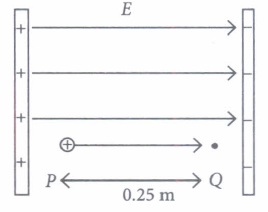
(i) The change in electric potential of the proton between the points A and B is
| \(\text { (a) }-1 \times 10^{8} \mathrm{~V}\) | \(\text { (b) } 1 \times 10^{8} \mathrm{~V}\) |
| \(\text { (c) } 6.4 \times 10^{-19} \mathrm{~V}\) | \(\text { (d) }-6.4 \times 10^{-19} \mathrm{~V}\) |
(ii) The change in electric potential energy of the proton for displacement from A to B is
| \(\text { (a) } 1.6 \times 10^{11} \mathrm{~J}\) | \(\text { (b) } 0.5 \times 10^{23} \mathrm{~J}\) |
| \(\text { (c) }-1.6 \times 10^{-11} \mathrm{~J}\) | \(\text { (d) } 3.2 \times 10^{22} \mathrm{~J}\) |
(iii) The mutual electrostatic potential energy between two protons which are at a distance of 9 x 10-15 m, in \({ }_{92} \mathrm{U}^{235}\) nucleus is
| \(\text { (a) } 1.56 \times 10^{-14} \mathrm{~J}\) | \(\text { (b) } 5.5 \times 10^{-14} \mathrm{~J}\) |
| \(\text { (c) } 2.56 \times 10^{-14} \mathrm{~J}\) | \(\text { (d) } 4.56 \times 10^{-14} \mathrm{~J}\) |
(iv) If a system consists of two charges 4 mC and -3mC with no external field placed at (-5 em, 0, 0) and (5 em, 0, 0) respectively. The amount of work required to separate the two charges infinitely away from each other is
| (a) -1.1 J | (b) 2 J |
| (c) 2.5 J | (d) 3 J |
(v) As the proton moves from P to Q, then
| (a) the potential energy of proton decreases | (b) the potential energy of proton increases |
| (c) the proton loses kinetic energy | (d) total energy of the proton increases |
13.
Electrostatic potential energy of a system of point charges is defined as the total amount of work done in bringing the different charges to their respective positions from infinitely charge mutual separations. The work is stored in the system of two point charges in the form of electrostatic potential energy U of the system. Electric potential difference between any points A and B in an electric field is the amount of work done in moving a unit positive test charge from A to B along any path agents the electrostatic force
\(V_{B}-V_{A}=\frac{W_{A B}}{q_{0}}=\int \mid \vec{E} \cdot d l\)
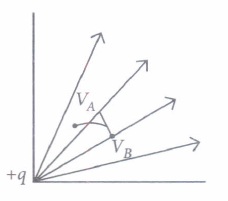
(i) A test charge is moved from lower potential point to a higher potential point. The potential energy of test charge will
| (a) remain the same | (b) increase |
| (c) decrease | (d) become zero |
(ii) Which of the following statement is not true?
| (a) Electrostatic force is a conservative force. |
| (b) Potential energy of charge q at a point is the work done per unit charge in bringing a charge from any point to infinity |
| (c) Spring force and gravitational force are conservative force. |
| (d) Both (a) and (c). |
(iii) Work done in moving a charge from one point to another inside a uniformly charged conducting sphere is
| (a) always zero | (b) non-zero | (c) maybe zero | (d) none of these |
(iv) The work done in bringing a unit positive charge from infinite distance to a point at distance x from a positive charge Q is W. Then the potential \(\phi\) at that point is
| \(\text { (a) } \frac{W Q}{x}\) | (b) W | \(\text { (c) } \frac{W}{x}\) | (d) WQ |
(v) If \(1 \mu C\) charge is shifted from A to B and it is found that work done by an external force is \(40 \mu \mathrm{J}\). In doing so against electrostatics force, the potential difference VA- VB is
| (a) 40 V | (b) -40 V | (c) 20 V | (d) -60 V |
1.
(a) As \(V \propto \frac{1}{r}, V_{P}>V_{Q^{}}\) Thus, (VP – VQ) is positive. Also VB is less negative than VA . Thus, VB > VA or (VB – VA) is positive.
(b) A small negative charge will be attracted towards positive charge. The negative charge moves from higher potential energy to lower potential energy. Therefore the sign of potential energy difference of a small negative charge between Q and P is positive. Similarly, (P.E.)A > (P.E.)B and hence sign of potential energy differences is positive.
(c) In moving a small positive charge from Q to P, work has to be done by an external agency against the electric field. Therefore, work done by the field is negative.
(d) In moving a small negative charge from B to A work has to be done by the external agency. It is positive.
(e) Due to force of repulsion on the negative charge, velocity decreases and hence the kinetic energy decreases in going from B to A.
2.
ABCDEF is a regular hexagon of side 10 cm each. At each corner, the charge q =5 \(\mu\)C is placed. O is the centre of the hexagon.
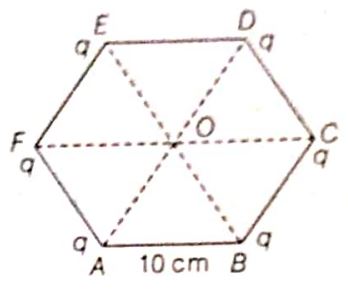
Given, AB = BC = CD = DE
= EF = FA = d = 10 cm
As, the hexagon has six equilateral triangles, so the distance of centre O from every vertex is 10 cm.
i.e. OA = OB = OC = OD
= OE = OF = d = 10 cm
\(\therefore\) Potential at point O = Sum of potentials at centre O due to individual point charge
i.e. VO = VA + VB + VC + VD + VE + VF
\(=\frac{1}{4\pi \varepsilon_{0}}.\left [ \frac{q}{OA}+\frac{q}{OB}+\frac{q}{OC}+\frac{q}{OD}+\frac{q}{OE}+\frac{q}{OF} \right ]\)
\(=\frac{1}{4\pi \varepsilon _{0}}.\frac{6q}{d}\) \(\left [ \because V=\frac{1}{4\pi \varepsilon _{0}.\frac{q}{r}} \right ]\)
Putting the values, we get
\(=9\times 10^{9}\times \frac{6\times 5 \times 10^{-6}}{10\times 10^{-2}}\)
= 2.7 \(\times\)106 V
3.
(1) Given,
Radius of spherical conductor, r = 12cm = 0.12m
Charge is distributed uniformly over the surface, q = 1.6 x 10⁻⁷ C.
The electric field inside a spherical conductor is zero.
(2) Electric field E, just outside the conductor is given by the relation
\(\mathrm{E}=\frac{1}{4 \pi \epsilon_{o}} \cdot \frac{q}{r^{2}}\)
Here, permittivity of free space and \(\frac{1}{4 \pi \epsilon_{o}}=9 \times 10^{9} \mathrm{Nm}^{2} \mathrm{C}^{-2}\)
Therefore,
\(\mathrm{E}=\frac{9 \times 10^{9} \times 1.6 \times 10^{-7}}{(0.12)^{2}}=10^{5} \mathrm{NC}^{-1}\)
Therefore, just outside the sphere the electric field is 4.4 x 10⁴ NC-1.
(3) From the centre of the sphere the electric field at a point 18m = E1.
From the centre of the sphere, the distance of point d = 18 cm = 0.18m
\(\mathrm{E}_{1}=\frac{1}{4 \pi \epsilon_{o}} \cdot \frac{q}{d^{2}}=\frac{9 \times 10^{9} \times 1.6 \times 10^{-7}}{\left(1.8 \times 10^{-2}\right)^{2}}=4.4 \times 10^{4} \mathrm{NC}^{-1}\)
So, from the centre of sphere the electric field at a point 18 cm away is 4.4 x 10⁴ NC-1.
4.
Given,
Capacitance of the capacitor, C = 12pF = 12 x 10-12 F
Potential difference, V = 50 V
Electrostatic energy stored in the capacitor is given by the relation,
\(\mathrm{E}=\frac{1}{2} \mathrm{CV}^{2}=\frac{1}{2} \times 12 \times 10^{-12} \mathrm{\times}(50)^{2} \mathrm{~J}=1.5 \times 10^{-8} \mathrm{~J}\)
Therefore, the electrostatic energy stored in the capacitor is 1.5 x 10⁻⁸ J. was disconnected.
5.
Given,
The area of plate of the capacitor, A = 6 x 10⁻³ m2
Distances between the plates, d = 3mm = 3 x 10⁻³ m
Voltage supplied, V = 100V
Capacitance of a parallel plate capacitor is given by, \(C=\frac{\epsilon \times A}{d}\)
Here,
ε = permittivity of free space = 8.854 x10⁻¹² N-1 m -2 C-2
\(C=\frac{8.854 \times 10^{-12} \times 6 \times 10^{-3}}{3 \times 10^{-3}}=17.81 \times 10^{-12} \mathrm{~F}=17.71 \mathrm{pF}\)
Therefore, each plate of the capacitor is having a charge of
q = VC = 100 x 17.81 x 10-12 C = 1.771 x 10⁻⁹ C
6.
There are three capacitors cach of capacitance 9 pF.
\(\therefore\) C1 = C2 = C3 = 9 pF
and voltage, V = 120 V
(i) The total capcitance in series combination,
\(\frac{1}{C_{s}}=\frac{1}{C_{1}}+\frac{1}{C_{2}}+\frac{1}{C_{3}}=\frac{1}{9}+\frac{1}{9}+\frac{1}{9}\)
\(\Rightarrow \frac{1}{C_{s}}=\frac{3}{9} \Rightarrow C_{s}=3 pF\)
(ii) Let the charge across the system be q and potentials across C1, C2 and C3 be V1, V2 and V3, respectively.
Charge, q = Cs. V = 3 \(\times\)120 = 360 pC
Potential difference across C1,
\(V_{1}=\frac{q}{C_{1}}=\frac{360}{9}=40 V\)
Potential difference across C2,
\(V_{2}=\frac{q}{C_{2}}=\frac{360}{9}=40 V\)
Potential difference across C3,
\(V_{3}=\frac{q}{C_{3}}=\frac{360}{9}=40 V\)
Thus, the potential difference across each capacitor is 40 V.
7.
(d)
\(E\alpha {1\over r^3}\)
8.
(c)
a vector directed from -q to +q
9.
(c)
spherically symmetric
10.
(b)
N/C
11.
(a)
Source charge Q only
12.
(i) (a) : As \(\Delta V=-E \Delta \psi=-\left(4.0 \times 10^{8} \mathrm{~V} / \mathrm{m}\right)(0.25 \mathrm{~m})\)= -108V
(ii) (c) : As \(\Delta U=q_{0} \Delta V=\left(1.6 \times 10^{-19}\right) \times\left(-1.0 \times 10^{8} \mathrm{~V}\right)\)= \(-1.6 \times 10^{-11} \mathrm{~V}\)
(iii) (c) : Here, \(q_{1}=q_{2}=1.6 \times 10^{-19} \mathrm{C}, r=9 \times 10^{-15} \mathrm{~m}\)
\(U=\frac{9 \times 10^{9} \times 1.6 \times 10^{-19} \times 1.6 \times 10^{-19}}{9 \times 10^{-15}}=2.56 \times 10^{-14} \mathrm{~J}\)
(iv) (a): Here, \(q_{1}=4 \mu \mathrm{C}, q_{2}=-3 \mu \mathrm{C}\)
r = 10 cm = 0.1 m
Electrostatic potential energy,
\(U=\frac{1}{4 \pi \varepsilon_{o}} \frac{q_{1} q_{2}}{r}=9 \times 10^{9} \times \frac{4 \times 10^{-6} \times(-3) \times 10^{-6}}{0.1}=-1.1 \mathrm{~J}\)
(v) (a) : As proton moves in the direction of the electric field, then its potential energy decreases.
13.
(i) (c)
(ii) (b)
(iii) (a): Since, E = 0 inside the conductor and has no tangential component on the surface, no work is done in moving a small test charge within the conductor and on its surface.
(iv) (b): The work done in bringing unit positive charge from infinity to a point which is at a distance x from the positive charge Q is defined as the potential at the given point due to the charge Q. Therefore
\(\phi=W\)
(v) (b): \(W_{\text {ext }}=q_{0} \Delta V\)
\(\left(W_{A B}\right)_{\mathrm{ext}}=q\left(V_{B}-V_{A}\right)\)
\(40 \mu \mathrm{J}=1 \mu \mathrm{C}\left(V_{B}-V_{A}\right)\)
\(V_{A}-V_{B}=-40 \mathrm{~V}\)

12th Standard CBSE Syllabus & Materials
12th Standard CBSE
CBSE 12th Computer Science Python Revision Tour I - New Previous year Question Papers Study Material - QB365 Set A
NEW12th Standard CBSE
CBSE 12th Business Studies Planning Important Questions And Answers Study Material - QB365 Set A
NEW12th Standard CBSE
CBSE 12th Business Studies Business Environment Important Questions And Answers Study Material - QB365 Set A
NEW12th Standard CBSE
CBSE 12th Business Studies Principles of Management Important Questions And Answers Study Material - QB365 Set A



NCERT Books

Syllabus

Exam Pattern

Sample Question Papers

Previous year Question Papers

Important Notes

MCQ Practice test

NCERT Exemplers

Case study Questions

Image Based Questions

Passage based Questions

HOT Questions

Value Based Questions

Model Questions Papers
NCERT ( Book Back ) Questions

Assertion and Reason
Important Questions And Answers

CBSE 12th Standard CBSE Subjects
CBSE Standards








