100% FREE ACCESS
12th Standard CBSE Syllabus & Materials
12th Standard CBSE
CBSE 12th Economics Government Budget and the Economy Previous year Question Papers Study Material - QB365 Set A
NEW12th Standard CBSE
CBSE 12th Computer Science Interface Python with MySQL - New Previous year Question Papers Study Material - QB365 Set A
NEW12th Standard CBSE
CBSE 12th Computer Science Database Concept - New Previous year Question Papers Study Material - QB365 Set A
NEW12th Standard CBSE
CBSE 12th Computer Science Data Communication - New Previous year Question Papers Study Material - QB365 Set A
NEW12th Standard CBSE
CBSE 12th Computer Science Data Structures - New Previous year Question Papers Study Material - QB365 Set A
NEW12th Standard CBSE
CBSE 12th Computer Science Functions - New Previous year Question Papers Study Material - QB365 Set A

Published on: 25/10/2025
Download CBSE Class 12th Standard CBSE Physics question papers, sample papers, important questions, and previous year solved papers in PDF format. Get free study materials, NCERT solutions, and exam preparation resources for Class 12th Standard CBSE Physics
Questions + Answers key
Take MCQ Physics Test
1.
The equivalent resistance between A and B of the network shown in figure is
3RΩ
(3/2)RΩ
2RΩ
(2/3)RΩ
2.
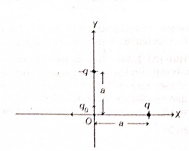
Three charges q1 -q and q0 are placed as shown in figure. The rnagnitude of the net force on the 1 charge q0 at point O is \(\left(\text { Take, } K=\frac{1}{4 \pi \varepsilon_0}\right)\)
0
\(\frac{2 K q q_0}{a^2}\)
\(\frac{\sqrt{2} K q q_0}{a^2}\)
\(\frac{1}{\sqrt{2}} \frac{K q q_0}{a^2}\)
3.
A conducting circular loop of radius r carries a constant current i. It is placed in a uniform magnetic field B, such that B is perpendicular to the plane of the loop. The magnetic force acting on the loop is
irB
2πriB
zero
πrib
4.
The radii of two metallic spheres A and Bare r1 and r2 respectively (r1 > r2). They are connected by a thin wire and the system is given a certain charge. The charge will be greater
on the surface of the sphere B.
on the surface of the sphere A.
equal on both.
zero on both.
5.
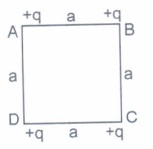
Four equal charges q are placed at the four corners A, B, C, D of a square of length a. The magnitude of the force on the charge at B will be
\(\frac{3 q^{2}}{4 \pi \varepsilon_{0} a^{2}}\)
\(\frac{4 q^{2}}{4 \pi \varepsilon_{0} a^{2}}\)
\(\frac{(1+2 \sqrt{2}) q^{2}}{2 \times 4 \pi \varepsilon_{0} a^{2}}\)
\(\frac{\left(\frac{2+1}{\sqrt{2}}\right)^{q^{2}}}{4 \pi \varepsilon_{0} a^{2}}\)
6.
The electrostatic potential of a uniformly charged thin spherical shell of charge Q and radius R at a distance r from the centre is
\(\frac{Q}{4 \pi \varepsilon_{0} r}\) for points outside and \(\frac{Q}{4 \pi \varepsilon_{0} R}\) for points inside the shell.
\(\frac{Q}{4 \pi \varepsilon_{0} R}\) for both points inside and outside the shell
zero for points outside and \(\frac{Q}{4 \pi \varepsilon_{0} R}\) for points inside the shell.
zero for both points inside and outside the shell
7.
In a system, 'n' electric dipole are placed in a closed surface. The value of emergent electric flux from enclosed surface is
\(\frac{q}{\varepsilon_{0}}\)
\(\frac{2 q}{\varepsilon_{0}}\)
\(-\frac{2 q}{\varepsilon_{0}}\)
zero
8.
According to the Kirchhoff's law the sum of the products of current and resistance as well as emfs in a closed loop is:
greater than zero
zero
less than zero
determained by the emf
9.
Two resistance when connected in parallel have equivalent resistance of 3\(\Omega\). When one of the resistance is burnt and broken, the net resistance is 12\(\Omega\). What is the resistance of the burnt resistor?
4\(\Omega\)
8\(\Omega\)
12\(\Omega\)
16\(\Omega\)
10.
A current of 5 A is flowing through a circular coil of diameter 14 cm having 100 turns. The magnetic dipole moment associated with this coil is :
\(0.077{ Am }^{ 2 }\)
\(0.77{ Am }^{ 2 }\)
\(7.7{ Am }^{ 2 }\)
\(77{ Am }^{ 2 }\)
11.
Whenever an electric current is passed through a conductor, it becomes hot after some time. The phenomenon of the production of heat in a resistor by the flow of an electric current through it is called heating effect of current or Joule heating. Thus, the electrical energy supplied by the source of emf is converted into heat. In purely resistive circuit, the energy expended by the source entirely appears as heat. But if the circuit has an active element like a motor, then a part of the energy supplied by the source goes to do useful work and the rest appears as heat. Joule's law of heating form the basis of various electrical appliances such as electric bulb, electric furnace,
electric press etc.
(i) Which of the following is a correct statement?
| (a) Heat produced in a conductor is independent of the current flowing |
| (b) Heat produced in a conductor varies inversely as the current flowing |
| (c) Heat produced in a conductor varies directly as the square of the current flowing |
| (d) Heat produced in a conductor varies inversely as the square of the current flowing |
(ii) If the coil of a heater is cut to half, what would happen to heat produced?
| (a) Doubled | (b) Halved | (c) Remains same | (d) Becomes four times |
(iii) A 25 Wand 100 Ware joined in series and connected to the mains. Which bulbs will glow brighter?
| (a) 100W | (b) 25 W |
| (c) both bulbs will glow brighter | (d) none will glow brighter |
(iv) A rigid container with thermally insulated wall contains a coil of resistance \(100 \Omega\) carrying current 1A. Change in its internal' energy after 5 min will be
| (a) 0 kJ | (b) 10 kJ | (c) 20 kJ | (d) 30 kJ |
(v) The heat emitted by a bulb of 1.90W in 1 min is
| (a) 100 J | (b) 1000 J | (c) 600 J | (d) 6000 J |
12.
Potential difference (\(\Delta\)V) between two points A and B separated by a distance x, in a uniform electric field E is given by \(\Delta V=-E x\),where x is measured parallel to the field lines. If a charge qo moves from P to Q, the changein potential energy \((\Delta U)\) is given as \(\Delta U=q_{0} \Delta V .\) A proton is released from rest in uniform electric field of magnitude \(4.0 \times 10^{8} \mathrm{Vm}^{-1}\) directed along the positive X-axis. The proton undergoes a displacement of 0.25 m in the direction of E.
Mass of a proton = 1.66 x 10⁻²⁷ kg and charge of proton = 1.6 x10⁻¹⁹ C
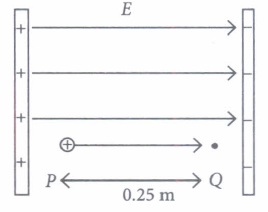
(i) The change in electric potential of the proton between the points A and B is
| \(\text { (a) }-1 \times 10^{8} \mathrm{~V}\) | \(\text { (b) } 1 \times 10^{8} \mathrm{~V}\) |
| \(\text { (c) } 6.4 \times 10^{-19} \mathrm{~V}\) | \(\text { (d) }-6.4 \times 10^{-19} \mathrm{~V}\) |
(ii) The change in electric potential energy of the proton for displacement from A to B is
| \(\text { (a) } 1.6 \times 10^{11} \mathrm{~J}\) | \(\text { (b) } 0.5 \times 10^{23} \mathrm{~J}\) |
| \(\text { (c) }-1.6 \times 10^{-11} \mathrm{~J}\) | \(\text { (d) } 3.2 \times 10^{22} \mathrm{~J}\) |
(iii) The mutual electrostatic potential energy between two protons which are at a distance of 9 x 10-15 m, in \({ }_{92} \mathrm{U}^{235}\) nucleus is
| \(\text { (a) } 1.56 \times 10^{-14} \mathrm{~J}\) | \(\text { (b) } 5.5 \times 10^{-14} \mathrm{~J}\) |
| \(\text { (c) } 2.56 \times 10^{-14} \mathrm{~J}\) | \(\text { (d) } 4.56 \times 10^{-14} \mathrm{~J}\) |
(iv) If a system consists of two charges 4 mC and -3mC with no external field placed at (-5 em, 0, 0) and (5 em, 0, 0) respectively. The amount of work required to separate the two charges infinitely away from each other is
| (a) -1.1 J | (b) 2 J |
| (c) 2.5 J | (d) 3 J |
(v) As the proton moves from P to Q, then
| (a) the potential energy of proton decreases | (b) the potential energy of proton increases |
| (c) the proton loses kinetic energy | (d) total energy of the proton increases |
13.
Gauss's law and Coulomb's law, although expressed in different forms, are equivalent ways of describing the relation between charge and electric field in static conditions. Gauss's law is \(\varepsilon_{0} \phi=q_{\text {encl }}\), when
qencl is the net charge inside an imaginary closed surface called Gaussian surface. \(\phi=\oint \vec{E} \cdot d \vec{A}\) gives the electric flux through the Gaussian surface. The two equations hold only when the net charge is in vacuum or air.
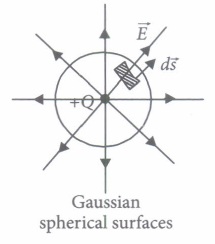
(I) If there is only one type of charge in the universe, then \((\vec{E} \rightarrow \text { Electric field, } d \vec{s} \rightarrow \text { Area vector })\)
| (a) \(\oint \vec{E} \cdot d \vec{s} \neq 0\) on any surface |
| (b) \(\oint \vec{E} \cdot d \vec{s}\) could not be defined |
| (c) \(\oint \vec{E} \cdot d \vec{s}=\infty\) if charge is inside |
| (d) \(\oint \vec{E} \cdot d \vec{s}=0\) if charge is outside, \(\oint \vec{E} \cdot d \vec{s}=\frac{q}{\varepsilon_{0}}\) if charge is inside |
(ii) What is the nature of Gaussian surface involved in Gauss law of electrostatic?
| (a) Magnetic | (b) Scalar | (c) Vector | (d) Electrical |
(iii) A charge 10 \(\mu \)C is placed at the centre of a hemisphere of radius R = 10 cm as shown. The electric flux through the hemisphere (in MKS units) is
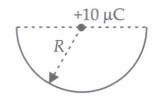
| (a) 20 x 105 | (b) 10 x 105 | (c) 6 x 10⁵ | (d) 2 x 10⁵ |
(iv) The electric flux through a closed surface area S enclosing charge Q is \(\phi\). If the surface area is doubled, then the flux is
| \(\text { (a) } 2 \phi\) | \(\text { (b) } \phi / 2\) | \(\text { (c) } \phi / 4\) | \(\text { (d) } \phi\) |
(v) A Gaussian surface encloses a dipole. 'The electric flux through this surface is
| \(\text { (a) } \frac{q}{\varepsilon_{0}}\) | \(\text { (b) } \frac{2 q}{\varepsilon_{0}}\) | \(\text { (c) } \frac{q}{2 \varepsilon_{0}}\) | (d) zero |
14.
Assertion : The energy of a charged particle moving in a uniform magnetic field remains constant.
Reason : Work done by the magnetic field on the charge is zero.
Codes:
A) Both A and R are true and R is the correct explanation of A
B) Both A and R are true but R is NOT the correct explanation of A
C) A is true but R is false
D) A is false and R is true
15.
16.
ASSERTION: Positive charge always moves from a higher potential point to a lower potential point.
REASON: Electric potential is a vector quantity
Codes:
A) If both assertion and reason are true and reason is the correct explanation of assertion.
B) If both assertion and reason are true and reason is not the correct explanation of assertion.
C) If assertion is true but reason is false.
D) If both assertion and reason are false.
E) If assertion is false but reason is true.
17.
18.
19.
Assertion (A) : When radius of a current carrying loop is doubled, its magnetic moment becomes four times.
Reason (R) : The magnetic moment of a current carrying loop is directly proportional to the area of the loop.
(a) Both Assertion and Reason are true and Reason is the correct explanation of Assertion.
(b) Both Assertion and Reason are true but Reason is not the correct explanation of Assertion.
(c) Assertion is true but Reason is false.
(d) Assertion is false but Reason is true.
20.
Assertion(A) : A positive point charge initially at rest in a uniform electric field starts moving along electric lines of force. (Neglect all other forces except electric forces).
Reason (R) : A point charge released from rest in an electric field always moves along the line of
force.
(a) Both Assertion and Reason are true and Reason is the correct explanation of Assertion.
(b) Both Assertion and Reason are true but Reason is not the correct explanation of Assertion.
(c) Assertion is true but Reason is false.
(d) Assertion is false but Reason is true.
21.
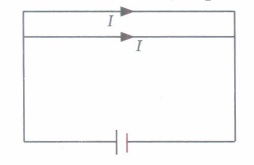
Assertion (A) : When two long parallel wires, hanging freely are connected in parallel to a battery, they come closer to each other.
Reason (R) : Wires carrying current in opposite direction repel each other.
Codes:
(a) Both A and R are true and R is the correct explanation of A
(b) Both A and R are true but R is NOT the correct explanation of A
(c) A is true but R is false
(d) A is false and R is also false
22.
Assertion (A) : Circuits containing capacitors should be handled cautiously even when there is no current.
Reason (R) : The capacitors are very delicate and so quickly breakdown.
Codes:
(a) Both A and R are true and R is the correct explanation of A
(b) Both A and R are true but R is NOT the correct explanation of A
(c) A is true but R is false
(d) A is false and R is also false
23.
Assertion (A) : A point charge is brought in an electric field. The field at a nearby point is increase, whatever be the nature of the charge.
Reason (R) : The electric field is independent of the nature of charge.
Codes:
(a) Both A and R are true and R is the correct explanation of A
(b) Both A and R are true but R is NOT the correct explanation of A
(c) A is true but R is false
(d) A is false and R is also false
1.
(c)
2RΩ
2.
(a)
0
3.
(c)
zero
4.
(b)
on the surface of the sphere A.
5.
(c)
\(\frac{(1+2 \sqrt{2}) q^{2}}{2 \times 4 \pi \varepsilon_{0} a^{2}}\)
6.
(a)
\(\frac{Q}{4 \pi \varepsilon_{0} r}\) for points outside and \(\frac{Q}{4 \pi \varepsilon_{0} R}\) for points inside the shell.
7.
(d)
zero
8.
(b)
zero
9.
(a)
4\(\Omega\)
10.
(c)
\(7.7{ Am }^{ 2 }\)
11.
(i) (c): According to Joule's law of heating, Heat produced in a conductor, H= I2Rt
where, I = Current flowing through the conductor
R = Resistance of the conductor
t = Time for which current flows through the conductor.
\(\therefore \quad H \propto I^{2}\)
(ii) (a): If the coil is cut into half, its resistance is also halved.
As \(H=\frac{V^{2}}{R} t \quad \therefore \quad H^{\prime}=2\)
(iii) (b): \(P=\frac{V^{2}}{R} \text { or } R=\frac{V^{2}}{P}\)
The bulbs are joined in series. Current in both the bulbs will same
\(\therefore\) The heat produced in them is given by H = I2Rt
or \(H \propto R \Rightarrow H \propto \frac{1}{P}\)
Therefore the bulb with low wattage or high resistance will glow brighter or we can say the 25 W bulb will glow brighter than the 100 W bulb.
(iv) (d): \(R=100 \Omega ; I=1 \mathrm{~A} ; t=5 \mathrm{~min} .=5 \times 60=300 \mathrm{~s}\)
change in internal energy = heat generated in coil
\(=I^{2} R t=\left((1)^{2} \times 100 \times 300\right) \mathrm{J}\)
= 30000 J = 30 kJ
(v) (d): Here, P = 100 W, t = 1 min = 60 s
Heat developed in time t
H = P x t = (100 W)( 60 s) = 6000 J
12.
(i) (a) : As \(\Delta V=-E \Delta \psi=-\left(4.0 \times 10^{8} \mathrm{~V} / \mathrm{m}\right)(0.25 \mathrm{~m})\)= -108V
(ii) (c) : As \(\Delta U=q_{0} \Delta V=\left(1.6 \times 10^{-19}\right) \times\left(-1.0 \times 10^{8} \mathrm{~V}\right)\)= \(-1.6 \times 10^{-11} \mathrm{~V}\)
(iii) (c) : Here, \(q_{1}=q_{2}=1.6 \times 10^{-19} \mathrm{C}, r=9 \times 10^{-15} \mathrm{~m}\)
\(U=\frac{9 \times 10^{9} \times 1.6 \times 10^{-19} \times 1.6 \times 10^{-19}}{9 \times 10^{-15}}=2.56 \times 10^{-14} \mathrm{~J}\)
(iv) (a): Here, \(q_{1}=4 \mu \mathrm{C}, q_{2}=-3 \mu \mathrm{C}\)
r = 10 cm = 0.1 m
Electrostatic potential energy,
\(U=\frac{1}{4 \pi \varepsilon_{o}} \frac{q_{1} q_{2}}{r}=9 \times 10^{9} \times \frac{4 \times 10^{-6} \times(-3) \times 10^{-6}}{0.1}=-1.1 \mathrm{~J}\)
(v) (a) : As proton moves in the direction of the electric field, then its potential energy decreases.
13.
(I) (d): If there is only one type of charge in the universe then it will produce electric field somehow. Hence Gauss's law is valid.
(ii) (c)
(iii) (c) : According to Gauss's theorem,
Electric flux through the sphere = \(\frac{q}{\varepsilon_{0}}\)
\(\therefore\) Electric flux through the hemisphere = \(\frac{1}{2} \frac{q}{\varepsilon_{0}}\)
= \(\frac{10 \times 10^{-6}}{2 \times 8.854 \times 10^{-12}}=0.56 \times 10^{6} \mathrm{~N} \mathrm{~m}^{2} \mathrm{C}^{-1}\)
\(\approx 0.6 \times 10^{6} \mathrm{Nm}^{2} \mathrm{C}^{-1}=6 \times 10^{5} \mathrm{~N} \mathrm{~m}^{2} \mathrm{C}^{-1}\)
(iv) (d): As flux is the total number of lines passing through the surface, for a given charge, it is always the charge enclosed \(Q / \varepsilon_{0}\).If area is doubled, the flux remains the same.
(v) (d): As net charge on a dipole is \((-q+q)=0\)
Thus, when a gaussian surface encloses a dipole, as per Gauss's theorem, electric flux through the surface,
\(\oint \vec{E} \cdot d \vec{S}=\frac{q}{\varepsilon_{0}}=0\)
14.
A) Both A and R are true and R is the correct explanation of A
15.
16.
17.
18.
19.
(a) Both Assertion and Reason are true and Reason is the correct explanation of Assertion.
20.
(c) If the field lines are curved, then the charged particle follows the straight line path along the direction of tangent drawn to electric field lines at its starting point.
21.
(b): The wires are parallel to each other but the direction of current in it is in same direction so they attract each other. If the current in the wires is in opposite direction then wires repel each other. When the currents are in opposite directions, the magnetic forces are reversed and the wires repels each other
22.
(c): A charged capacitor, after removing the battery, does not discharge itself. If this capacitor is touched by someone, he may feel shock due to large charge still present on the capacitor. Hence it should be handled cautiously otherwise this may cause asevere shock.
23.
(d): Electric field at the nearby point will be resultant of existing field and field due to the charge brought. It may increase or decrease if the charge is positive or negative depending on the position of the point with respect to the charge brought.

12th Standard CBSE Syllabus & Materials
12th Standard CBSE
CBSE 12th Computer Science Python Revision Tour I - New Previous year Question Papers Study Material - QB365 Set A
NEW12th Standard CBSE
CBSE 12th Business Studies Planning Important Questions And Answers Study Material - QB365 Set A
NEW12th Standard CBSE
CBSE 12th Business Studies Business Environment Important Questions And Answers Study Material - QB365 Set A
NEW12th Standard CBSE
CBSE 12th Business Studies Principles of Management Important Questions And Answers Study Material - QB365 Set A



NCERT Books

Syllabus

Exam Pattern

Sample Question Papers

Previous year Question Papers

Important Notes

MCQ Practice test

NCERT Exemplers

Case study Questions

Image Based Questions

Passage based Questions

HOT Questions

Value Based Questions

Model Questions Papers
NCERT ( Book Back ) Questions

Assertion and Reason
Important Questions And Answers

CBSE 12th Standard CBSE Subjects
CBSE Standards