
 100% FREE ACCESS
12th Standard CBSE Syllabus & Materials
12th Standard CBSE
CBSE 12th Economics Government Budget and the Economy Previous year Question Papers Study Material - QB365 Set A
NEW12th Standard CBSE
CBSE 12th Computer Science Interface Python with MySQL - New Previous year Question Papers Study Material - QB365 Set A
NEW12th Standard CBSE
CBSE 12th Computer Science Database Concept - New Previous year Question Papers Study Material - QB365 Set A
NEW12th Standard CBSE
CBSE 12th Computer Science Data Communication - New Previous year Question Papers Study Material - QB365 Set A
NEW12th Standard CBSE
CBSE 12th Computer Science Data Structures - New Previous year Question Papers Study Material - QB365 Set A
NEW12th Standard CBSE
CBSE 12th Computer Science Functions - New Previous year Question Papers Study Material - QB365 Set A

Published on: 25/10/2025
Download CBSE Class 12th Standard CBSE Physics question papers, sample papers, important questions, and previous year solved papers in PDF format. Get free study materials, NCERT solutions, and exam preparation resources for Class 12th Standard CBSE Physics
Questions + Answers key
Take MCQ Physics Test
1.
A short bar magnet has a magnetic moment of 0.48 J / T. Give the direction and magnitude of the magnetic field produced by the magnet at a distance of 10 cm from the centre of the magnet on
(i) the axis,
(ii) the equatorial lines (normal bisector) of the magnet.
2.
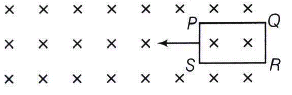
The closed loop PQRS of wire is moved into a uniform magnetic field at right angles to the plane of the paper as shown in the figure. Predict the direction of the induced current in the loop.
3.
A circular loop of radius 0.2 m carrying a current of 1 A is placed in a uniform magnetic field of 0.5 T. The magnetic field is perpendicular to the plane of the loop. What is the force experienced by the loop ?
4.
What are the points at which electric potential of a dipole has (i)maximum value (ii)minimum value?
5.
In a series LCR circuit, \({ V }_{ L }={ V }_{ C }\neq { V }_{ R }.\) What is the value of power factor?
6.
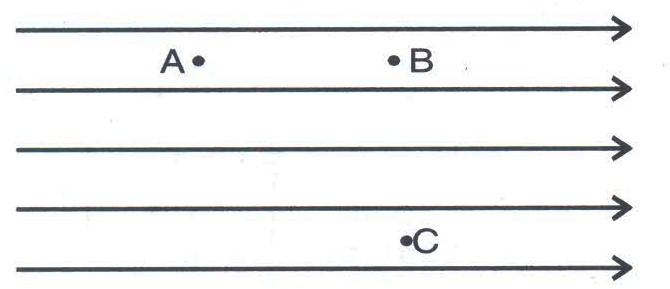
In a uniform electrostatic field of strength \(5\times{{10}^{5}}N/C\), what will be the potential difference between the points A and C as Shown?It is given that AC = 5cm and BC = 3cm.
7.
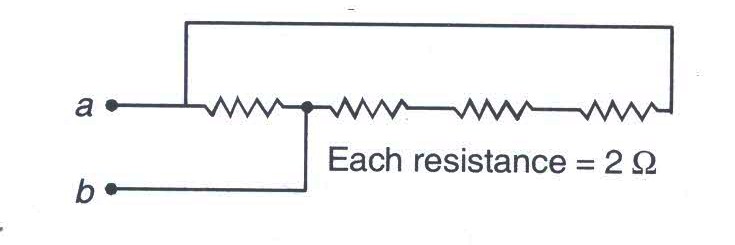
Calculate Rab in the following circuit:
8.
(i) State the principle on which AC generator works. Draw a labelled diagram and explain its working.
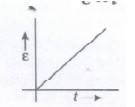
(ii) A conducting rod held horizontally along East-West direction is dropped from rest from a certain height near the Earth's surface. Why should there be an induced emf across the ends of the rod? Draw a plot showing the instantaneous variation of emf as a function of time from the instant it begins to fall.
9.
An electric toaster uses nichrome for its heating element. When a negligibly small current passes through it, its resistance at room temperature (27.0 °C) is found to be 75.3 Ω. When the toaster is connected to a 230 V supply, the current settles, after a few seconds, to a steady value of 2.68 A. What is the steady temperature of the nichrome element? The temperature coefficient of resistance of nichrome averaged over the temperature range involved, is 1.70 x 10⁻⁴ °C-1.
10.
A 15.0 µF capacitor is connected to a 220 V, 50 Hz source. Find the capacitive reactance and the current (rms and peak) in the circuit. If the frequency is doubled, what happens to the capacitive reactance and the current?
11.
A magnetic dipole is under the influence of two magnetic fields. The angle between the field directions is 60º, and one of the fields has a magnitude of 1.2 × 10⁻² T. If the dipole comes to stable equilibrium at an angle of 15º with this field, what is the magnitude of the other field?
12.
A closely wound solenoid of 800 turns and area of cross section 2.5 × 10⁻⁴ m2 carries a current of 3.0 A. Explain the sense in which the solenoid acts like a bar magnet. What is its associated magnetic moment?
13.
An electric field of 20 N/C exists along the X-axis in space. Calculate the potential difference (VB - VA) where the co-ordinates of A and B are given by (i )A (0,0); b (4m, 2m)
(ii) A (4m, 2m); B (6m, 5m)
14.
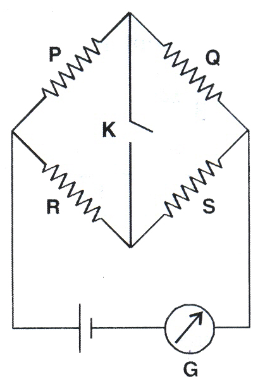
In a Wheatstone bridge experiment, a student by mistake connects key (K) in place of galvanometer and galvanometer (G) in place of the key (K). How will be the test for the balance of the bridge?
15.
A galvanometer coil has a resistance of 15 Ω and the metre shows full scale deflection for a current of 4 mA. How will you convert the metre into an ammeter of range 0 to 6 A?
16.
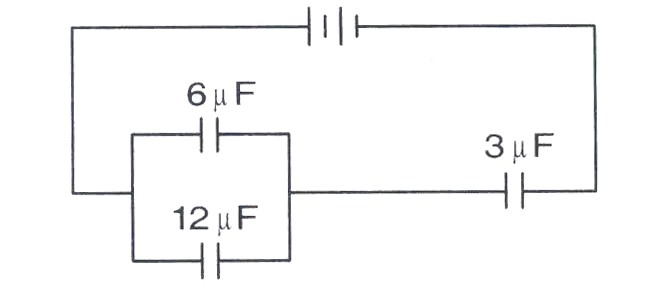
In the arrangement of capacitors shown here,the energy stored \(6\mu F\)capacitor is E. Find the following:
Energy stored in the \(12\mu F\) capacitor
Energy stored in the \(3\mu F\) capacitor
Total energy drawn from the battery.
17.
(a) Deduce the expression for the potential energy of a system of two charges q1 and q2 located at \(\overrightarrow{\boldsymbol{r}}_{1}
\) and \(\overrightarrow{\boldsymbol{r}}_{2}
\) respectively in an external electric field.
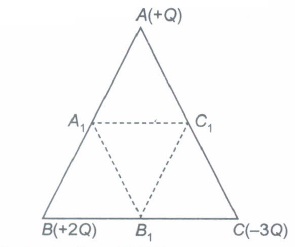
(b) Three point charges, +Q, + 2Q and -3Q are placed at the vertices of an equilateral triangle ABC of side I. If these charges are displaced to the mid-points A1, B1, and C1 respectively, find the amount of the work done in shifting the charges to the new locations.
18.
A long solenoid of radius 4 cm, length 400 cm carries a current of 3 A. The total number of turns is 100. Assuming ideal solenoid, find the flux passing through a circular surface having centre on axis of solenoid of radius 3 cm and is perpendicular to the axis of solenoid
(i) inside and
(ii) at the end of solenoid.
19.
A \(2\mu F\) capacitor, \(100 \ \Omega\) resistor and 8H inductor are connected in series with an
AC source.
What should be the frequency of the source such that current drawn in the circuit is maximum? What is this frequency called?
If the peak value of emf of the source is 200 V, find the maximum current.
Draw a graph showing variation of amplitude of circuit current with changing frequency of applied voltage in a series L-C-R circuit for two different values of resistance R1 and R2(R1>R2).
Define the term 'Sharpness of" Resonance'. Under what condition, does a circuit become more selective?
20.
(i) Explain giving reasons, the basic difference in converting a galvanometer into
(a) a voltmeter and
(b) an ammeter
(ii) Two long straight parallel conductors carrying steady currents I1 and I2 are separated by a distance d. Explain briefly, with the help of a suitable diagram, how the magnetic field due to one conductor acts on the other. Hence, deduce the expression for the force acting between the two conductors. Mention the nature of this force.
21.
Show that the resistance of a conductor is given by \(R=\frac { ml }{ n{ e }^{ 2 }A\tau } \)
22.
A coil of area 100 is kept at an angle of 30° with a magnetic field of 10 T. The magnetic field is reduced to zero in 10s. The induced emf in the coil is
5√3 V
50√3 V
5.0 V
50.0 V
23.
The direction of induced current is decided by
Lenz's law
Fleming's left hand rule
Biot-Savart's law
Ampere's law
24.
In a series L-C-R circuit, the capacitance Cis changed to 4C. To keep the resonant frequency same, the inductance must be changed by
2L
L/2
4L
L/4
25.
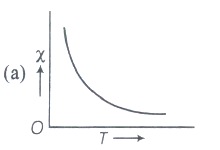
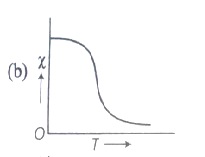
The variation of magnetic susceptibility (x) with temperature for a diamagnetic substance is best represented by figure
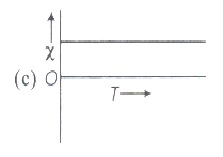
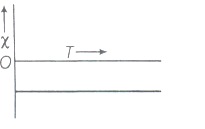
26.
Two magnets have the same length and the same pole strength. But one of the magnets has a small hole at its centre. Then,
both have equal magnetic moment
one with hole has small magnetic moment
one with hole has large magnetic moment
one with hole loses magnetism through the hole
27.
We have two resistors R1 and R2 By using them singly in series and parallel combination we can obtain four resistances of 3, 4, 12 and 16 ohms. The R1 and R2 are:
3, 4
4, 12
12,16
16, 3
28.
For higher sensitivity which of the following is essential for the potentiometer?
Higher emf of quxiliary battery
Higher resistivity of the wire
Larger length of the wire
None of the above
29.
Consider a region inside which there are various types of charges but the total charge is zero. At points outside the region
the electric field is necessarily zero
the electric field is due to the dipole moment of the charge distribution only
the dominant electric field is \(\alpha {1\over r^3}\) , for large r , where r is the distance from a origin in this region.
the work done to move a charged particle along a closed path, away from the region, will be zero.
30.
An electric charge + q moves with velocity \(\vec { \upsilon } =3\hat { i } +4\hat { j } +\hat { k } ,\) in an electromagnetic field give \(\vec { E } =3\hat { i } +\hat { j } +2\hat { k } ,\quad \vec { B } =\hat { i } +\hat { j } -3\hat { k } .\)They y-component of the force experienced by + q is
2 q
11 q
5 q
3 q
31.
A coil of wire has an area of 600 sq. cm and has 500 turns. If it carries 1.5 A current, its magnetic dipole moment is
5 Am2
15 Am2
30 Am2
45 Am2
32.
Electric field due to an electric dipole is
spherically symmetric
cylindrically symmetric
asymmetric
none of the above
33.
Q factor of resonance is given by
\(\frac { 1 }{ R } \sqrt { \frac { L }{ C } } \)
\(\frac { 1 }{ R } \sqrt { \frac { C }{ L } } \)
\(\frac { 1 }{ L } \sqrt { \frac { R }{ C } } \)
\(\frac { 1 }{ C } \sqrt { \frac { L }{ R } } \)
34.
A charged particle moving in a magnetic field experiences a force that is proportional to the strength of the magnetic field, the component of the velocity that is perpendicular to the magnetic field and the charge of the particle.
This force is given by \(\vec{F}=q(\vec{v} \times \vec{B})\) where q is the electric charge of the particle, v is the instantaneous velocity of the particle, and B is the magnetic field (in tesla).
The direction of force is determined by the rules of cross product of two vectors
Force is perpendicular to both velocity and magnetic field. Its direction is same as \(\vec{v} \times \vec{B}\) if q is positive and opposite of \(\vec{v} \times \vec{B}\) if q is negative
The force is always perpendicular to both the velocity of the particle and the magnetic field that created it. Because the magnetic force is always perpendicular to the motion, the magnetic field can do no work on an isolated charge. It can only do work indirectly, via the electric field generated by a changing magnetic field.
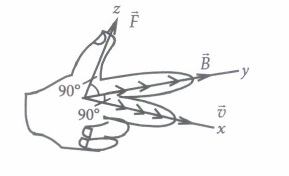
(I) When a magnetic field is applied on a stationary electron, it
| (a) remains stationary |
| (b) spins about its own axis |
| (c) moves in the direction of the field |
| (d) moves perpendicular to the direction of the field. |
(ii) A proton is projected with a uniform velocity v along the axis of a current carrying solenoid, then
| (a) the proton will be accelerated along the axis |
| (b) the proton path will be circular about the axis |
| (c) the proton moves along helical path |
| (d) the proton will continue to move with velocity v along the axis. |
(iii) A charged particle experiences magnetic force in the presence of magnetic field. Which of the following statement is correct?
| (a) The particle is stationary and magnetic field is perpendicular. |
| (b) The particle is moving and magnetic field is perpendicular to the velocity |
| (c) The particle is stationary and magnetic field is parallel |
| (d) The particle is moving and magnetic field is parallel to velocity |
(iv) A charge q moves with a velocity 2 ms-1 along x-axis in a uniform magnetic field \(\vec{B}=(\hat{i}+2 \hat{j}+3 \hat{k}) \mathrm{T}\) then charge will experience a force
| (a) in z-y plane | (b) along -yaxis | (c) along +z axis | (d) along -z axis |
(v) Moving charge will produce
| (a) electric field only | (b) magnetic field only |
| (c) both electric and magnetic field | (d) none ofthese. |
35.
According to Ohm's law, the current flowing through a conductor is directly proportional to the potential difference across the ends of the conductor i.e \(I \propto V \Rightarrow \frac{V}{I}=R\) where R is resistance of the conductor Electrical resistance of a conductor is the obstruction posed by the conductor to the flow of electric current through it. It depends upon length, area of cross-section, nature of material and temperature of the conductor We can write \(R \propto \frac{l}{A} \text { or } R=\rho \frac{l}{A}\) where \(\rho\) is electrical resistivity of the material of the conductor.
(i) Dimensions of electric resistance is
| \(\text { (a) }\left[\mathrm{ML}^{2} \mathrm{~T}^{-2} \mathrm{~A}^{-2}\right]\) | \(\text { (b) }\left[M L^{2} T^{-3} A^{-2}\right]\) | \(\text { (c) }\left[\mathrm{M}^{-1} \mathrm{~L}^{-2} \mathrm{~T}^{-1} \mathrm{~A}\right]\) | \(\text { (d) }\left[M^{-1} L^{2} T^{2} A^{-1}\right]\) |
(ii) If \(1 \mu \mathrm{A}\) current flows through a conductor when potential difference of2 volt is applied across its ends, then the resistance of the conductor is
| \(\text { (a) } 2 \times 10^{6} \Omega\) | \(\text { (b) } 3 \times 10^{5} \Omega\) | \(\text { (c) } 1.5 \times 10^{5} \Omega\) | \(\text { (d) } 5 \times 10^{7} \Omega\) |
(iii) Specific resistance of a wire depends upon
| (a) length | (b) cross-sectional area | (c) mass | (d) none of these |
(iv) The slope of the graph between potential difference and current through a conductor is
| (a) a straight line | (b) curve |
| (c) first curve then straight line | (d) first straight line then curve |
(v) The resistivity of the material of a wire 1.0 m long, 0.4 mm in diameter and having a resistance of 2.0 ohm is
| \(\text { (a) } 1.57 \times 10^{-6} \Omega \mathrm{m}\) | \(\text { (b) } 5.25 \times 10^{-7} \Omega \mathrm{m}\) | \(\text { (c) } 7.12 \times 10^{-5} \Omega \mathrm{m}\) | \(\text { (d) } 2.55 \times 10^{-7} \Omega \mathrm{m}\) |
36.
Assertion (A) Diamagnetic substances exhibit magnetism.
Reason (R) Diamagnetic materials do not have permanent magnetic dipole moment.
(a) Both Assertion and Reason are true and Reason is the correct explanation of Assertion.
(b) Both Assertion and Reason are true but Reason is not the correct explanation of Assertion.
(c) Assertion is true but Reason is false.
(d) Assertion is false but Reason is true
37.
Assertion (A) : Faraday's law are consequence of conservation of energy.
Reason (R) : The magnitude of the induced emf in a circuit is equal to the rate of change of magnetic flux linked with the circuit.
(a) Both Assertion and Reason are true and Reason is the correct explanation of Assertion.
(b) Both Assertion and Reason are true but Reason is not the correct explanation of Assertion.
(c) Assertion is true but Reason is false.
(d) Assertion is false but Reason is true.
38.
Assertion (A) : At resonance, LCR series circuit have a maximum current.
Reason (R) : At resonance, in LCR series circuit, the current and e.m.f are in phase with each other.
Codes:
(a) Both A and R are true and R is the correct explanation of A
(b) Both A and R are true but R is NOT the correct explanation of A
(c) A is true but R is false
(d) A is false and R is also false
39.
Assertion: The current flowing through a conductor is directly proportional to the drift velocity.
Reason: As the drift velocity increases the current following through the conductor decreases
Codes:
(a) Both A and R are true and R is the correct explanation of A
(b) Both A and R are true but R is NOT the correct explanation of A
(c) A is true but R is false
(d) A is false and R is also false
1.
(i) \(\begin{aligned} & \therefore B=\frac{\mu_0}{4 \pi} \frac{2 M}{d^3} \end{aligned}\)
\(\begin{aligned} \Rightarrow B=\frac{4 \pi \times 10^{-7} \times 2 \times 0.48}{4 \pi \times(0.1)^3}=0.96 \times 10^{-4} \mathrm{~T} \end{aligned}\)
\(\Rightarrow\) B = 0.96 G
The magnetic field is along the S-N direction.
(ii) \(\therefore B=\frac{\mu_0}{4 \pi} \times \frac{M}{d^3}=\frac{4 \pi \times 10^{-7} \times 0.48}{4 \pi \times(0.1)^3}=0.48 \mathrm{G}\)
The magnetic field is along the N-S direction.
2.
Since, magnetic flux increases, value of magnetic flux when the loop moves into a uniform magnetic field. So, the induced current should oppose this increased the value of magnetic flux. Thus, the flow will be from QPSRQ, i.e. anti-clockwise.
3.
The current carrying loop is equivalent to a magnetic dipole. The magnetic dipole does not experience any net force in a uniform magnetic field.
4.
(i) At axial points, the electric potential of a dipole has maximum positive or negative value.
(ii) At equatorial points, the electric potential of a dipole is zero.
5.
\(V_L=V_C ; X_L=X_C ; Z=R ; \cos \phi=\frac{R}{Z}=1\)
6.
As we know \( V_{A C} =-\int_{A}^{C} \vec{E} \cdot \overrightarrow{d l}=-E \int_{A}^{C} d l \cos \theta \)
\(=-5 \times 10^{5} \times \frac{5}{100} \times \frac{4}{5} \)
\( =-20 \times 10^{3} \mathrm{~V} \ \left(\because \int_{A}^{C} d l=A C=5 \mathrm{~cm}\right) \)
7.
1.5\(\Omega\)
8.
(i) Principle
An AC generator is based on the phenomenon of electromagnetic induction which states that whenever magnetic flux linked with a conductor (or coil) changes, an emf is induced in the coil.
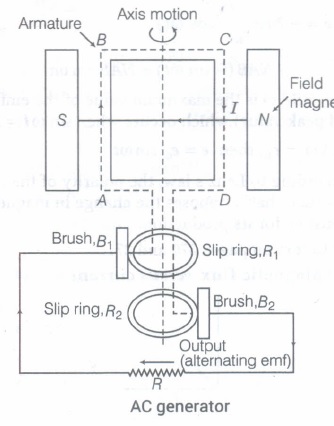
Working
As the armature of coil is rotated in the uniform magnetic field, angle \( \theta\) between the.field and normal to the coil changes continuously. Therefore, magnetic flux linked with the coil changes and an emf is induced in the coil. According to Fleming's right hand rule, current induced in AB is from A to B and it is from C to D in CD. In the external
circuit, current flows from B2 to B1. To calculate the magnitude of emf induced, suppose
A = area of each turn of the coil,
N = number of turns in the coil,
B = strength of magnetic field
and \( \theta\) = angle which normal to the coil makes with B at any instant t.
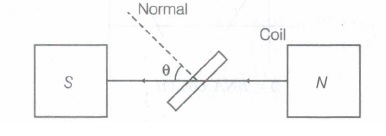
(ii) As the earth's magnetic field lines are cut by the falling rod, the change in magnetic flux takes place. This change in flux induces an emf across the ends of the rod.
Since, the rod is falling under gravity.
v = gt \([\because u=0]\)
Induced emf, \(\varepsilon=B l v \Rightarrow \varepsilon=B \lg t\)
\(\varepsilon \propto t \)
9.
When the current through the element is very small, heating effects can be ignored and the temperature T1 of the element is the same as room temperature. When the toaster is connected to the supply, its initial current will be slightly higher than its steady value of 2.68 A. But due to heating effect of the current, the temperature will rise. This will cause an increase in resistance and a slight decrease in current. In a few seconds, a steady state will be reached when temperature will rise no further, and both the resistance of the element and the current drawn will achieve steady values. The resistance R2 at the steady temperature T2 is
\(R_{2}=\frac{230 \mathrm{~V}}{2.68 \mathrm{~A}}=85.8 \Omega\)
Using the relation
R2 = R1 [1 + α (T2 - T1)]
with α = 1.70 x 10⁻⁴ °C-1, we get
\(T_{2}-T_{1}=\frac{(85.8-75.3)}{(75.3) \times 1.70 \times 10^{-4}}=820^{\circ} \mathrm{C}\)
that is, T2 = (820 + 27.0) °C = 847 °C
Thus, the steady temperature of the heating element (when heating effect due to the current equals heat loss to the surroundings) is 847 °C.
10.
The capacitive reactance is
\(X_{C}=\frac{1}{2 \pi v C}=\frac{1}{2 \pi(50 \mathrm{~Hz})\left(15.0 \times 10^{-6} \mathrm{~F}\right)}=212 \Omega\)
The rms current is
\(I=\frac{V}{X_{C}}=\frac{220 \mathrm{~V}}{212 \Omega}=1.04 \mathrm{~A}\)
The peak current is
\(i_{m}=\sqrt{2} I=(1.41)(1.04 A)=1.47 A\)
This current oscillates between +1.47A and -1.47 A, and is ahead of the voltage by π/2.
If the frequency is doubled, the capacitive reactance is halved and consequently, the current is doubled.
11.
Magnitude of one of the magnetic fields, B1 = 1.2 x 10⁻² T
Angle between the two fields, θ = 60°
At stable equilibrium, the angle between the dipole and field B1, θ1 = 15°
Let the magnitude of the other the other magnetic field be B2
Angle between the dipole and field B2, θ2 = θ − θ1 = 60° − 15° = 45°
At rotational equilibrium, the torques due to both the fields must balance each other. That is,
Torque due to field B1 = Torque due to field B2Torque due to field B1 = Torque due to field B2
⇒ MB1 sin θ1 = MB2 sin θ2
\(\Rightarrow \mathrm{B}_{2}=\frac{\mathrm{B}_{1} \times \sin \theta_{1}}{\sin \theta_{2}}\)
Where,
M = Magnetic moment of the dipole
Putting the values, we get,
\(\mathrm{B}_{2}=\frac{1.2 \times 10^{-2} \times \sin 15^{\circ}}{\sin 45^{\circ}}\)
= 4.39 x 10⁻³ T
Therefore, the magnitude of the other magnetic field is 4.39 x 10⁻³ T.
12.
Number of turns in the solenoid, n = 800
Area of cross-section, A = 2.5 × 10⁻⁴ m2
Current in the solenoid, I = 3.0 A
A current-carrying solenoid behaves like a bar magnet because a magnetic field develops along its axis, i.e., along with its length.
The magnetic moment associated with the given current-carrying solenoid is calculated as:
M = n I A
= 800 x 3 x 2.5 x 10-4
= 0.6 J T-1
13.
As the electric field is along X-axis, therefore, f
from \(E=-dV/dr\)
(i) dV = -E(dr) = - E(x2 - x1)
= - 20(4-0) = -80 V
(ii) dV = -20(\(x_2'-x_1'\))
= -20(6-4)
= -40 V
14.
In a balanced position of the bridge no current will flow in key (K) and hence a constant current will flow in the galvanometer and it will show a constant deflection even when the key K is pressed.
15.
Resistance of the galvanometer coil, G = 15 Ω
Current for which the galvanometer shows full scale deflection,
= 4 mA = 4 x 10⁻³ A
Range of the ammeter is 0, which needs to be converted to 6 A.
Current, I = 6 A
A shunt resistor of resistance S is to be connected in parallel with the galvanometer to convert it into an ammeter. The value of S is given as:
\(S=\frac{I_{g} G}{I-I_{g}}\)
\(=\frac{4 \times 10^{-3} \times 15}{6-4 \times 10^{-3}}\)
\(S=\frac{6 \times 10^{-2}}{6-0.004}=\frac{0.06}{5.996}\)
\(\approx 0.01 \Omega=10 \mathrm{~m} \Omega\)
Hence, a 10 mΩ shunt resistor is to be connected in parallel with the galvanometer.
16.
Energy stored in 6 μF capacitor = E
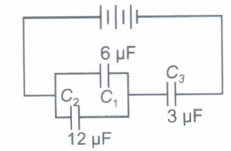
\( \therefore \ \frac{1}{2} C_{1} V_{1}^{2}=E \Rightarrow V_{1}^{2}=\frac{2 E}{C_{1}}=\frac{E}{3} \)
\(\because C_{1} \text { and } C_{2} \text { are in parallel, } \therefore V_{1}^{2}=V_{2}^{2}=\frac{E}{3} \)
Now, \(C_{12}=6+12=18 \mu \mathrm{F}\)
\( \therefore \text { Charge on } C_{12}=q_{12}=C_{12} . V_{12}=18 \times \sqrt{\frac{E}{3}} \)
\(\therefore \text { Charge on } C_{3}=q_{12}=18 \sqrt{\frac{E}{3}} \)
(a) Now, energy stored in 12 μF capacitor
\(=\frac{1}{2} C_{2} V_{1}^{2}=\frac{1}{2} \times 12 \times \frac{E}{3}=2 E\)
(b) Energy stored in 3 μF capacitor
\(=\frac{q_{3}^{2}}{2 C_{3}}=\frac{1}{2} \times\left(\frac{18}{3}\right)^{2} E=18 E\)
\((c) \because C_{e q}=\left(\frac{18 \times 3}{18+3}\right) \mu \mathrm{F}=\frac{18}{7} \mu \mathrm{F}, Q=18 \sqrt{\frac{E}{3}}\)
Energy drawn from the battery,
\(U=\frac{Q^{2}}{2 C_{e q}}=\frac{18 \times 18 \times E \times 7}{3 \times 18}=42 E\)
17.
(a) Expression for the potential energy of a system of two point charges in an external field:
Work done in bringing the charge q1from infinity to r1 ,
Work done \(={ q }_{ 1 }V\left( { r }_{ 1 } \right) \)
Work done in bringing the charge qz from infinity to r2 .
Work done against the external electric field
\(={ q }_{ 2 }V\left( { r }_{ 2 } \right) \)
Work done = work done against the external electric field + Work done on q2 against the field due to q1
\(={ q }_{ 2 }V\left( { r }_{ 2 } \right) +\frac { { q }_{ 1 }{ q }_{ 2 } }{ 4\pi { \varepsilon }_{ 0 }{ r }_{ 12 } } \)
Potential energy of the system = the total work done in assembling the configuration
\(={ q }_{ 1 }V\left( { r }_{ 1 } \right) +{ q }_{ 2 }V\left( { r }_{ 2 } \right) +\frac { { q }_{ 1 }{ q }_{ 2 } }{ 4\pi { \varepsilon }_{ 0 }{ r }_{ 12 } } \)
(b) Electrostatic potential energy of the systems of charges corresponding to initial configuration is
\(U_{i}=\frac{2 k Q^{2}}{l}-\frac{3 k Q^{2}}{l}-\frac{6 k Q^{2}}{l}=-\frac{7 k Q^{2}}{l}\)
Electrostatic potential energy of the system of charges corresponding to final configuration is
\(U_{f}=\frac{4 k Q^{2}}{l}-\frac{6 k Q^{2}}{l}-\frac{12 k Q^{2}}{l}=-\frac{14 k Q^{2}}{l}\)
The amount of work done in shifting the charges to new locations is
\(W=U_{f}-U_{i}\)
\(=-\frac{14 k Q^{2}}{l}-\left(-7 \frac{k Q^{2}}{l}\right)=-\frac{7 k Q^{2}}{l}\)
18.
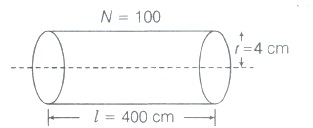
Number of turns per unit length is given by
\(n=\frac{N}{l}=\frac{100}{4}=25 \mathrm{turns} / \mathrm{m}\)
(i) Magnetic field of a solenoid at a point inside is
\(B=\mu_{0} n i\)
Area of cross-section of the solenoid, A = \(\pi {{r}_{1}}^{2}\) and \( \theta\) = 0° Magnetic flux,
\(\phi_{B}=B A \cos \theta\)
\(=\mu_{0} n i \pi r_{1}^{2} \cos 0^{\circ}\)
\(=4 \pi \times 10^{-7} \times 25 \times 3 \times \pi \times\left(3 \times 10^{-2}\right)^{2}\)
\(=0.27 \times 10^{-6} \mathrm{~Wb}\)
\(=0.27 \mu \mathrm{Wb}\)
(ii) At the end, magnetic field of solenoid is
\(B=\frac{1}{2} \mu_{0} n i\)
\(\therefore \quad \phi_{B}=\frac{0.27}{2}=0.135 \mu \mathrm{Wb}\)
19.
To draw maximum current from a series L-C-R circuit, the circuit at particular frequency
XL = XC.
V = \({{1}\over{2\pi\sqrt{LC}}}={{1}\over{2\times314\sqrt{8\times 2\times {10}^{-6}}}}=39.80\) Hz
This frequency is known as the series resonance frequency.
I0 = \({ { {E}_{0} }\over{ R } }={ {200 }\over{100 } }=2A\)
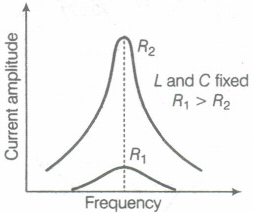
Sharpness of resonance It is defined as the ratio of the voltage developed across the inductance (L) or capacitance (C) at resonance to the voltage developed across the resistance (R).
Q = \({ { 1 }\over{ R } }=\sqrt{ { { L }\over{ C } } }\)
It may also be defined as the ratio of resonance angular frequency to the bandwidth of the circuit
Q = \({ { {\omega}_{r} }\over{ 2 \triangle \omega } }\)
Circuit become more selective if the resonance is more sharp, maximum current is more, the circuit is close to resonance for smaller range of \((2\triangle \omega)\) of frequencies. Thus, the tuning of the circuit will be good.
20.
(i) A galvanometer of range Ig and resistance G1 can be converted into
(a) a voltmeter of range V, by connecting a high resistance R in series with galvanometer whose value is given by
\(R=\frac { V }{ { I }_{ g } } -G\)
(b) an ammeter of range I, by connecting a very low resistance (shunt) in parallel with galvanometer whose value is given by
\(S=\frac { { I }_{ g }G }{ I-{ I }_{ g } } -G\)
Thus, the nature of force is attractive.
When direction of flow of current is in opposite direction, the nature of force becomes repulsive.
21.
Since drift velocity \({ v }_{ d }\) and current, I flowing in a conductor are related by the relation:
\({ v }_{ d }=\frac { I }{ neA }.........(1)\)
\(Also \ drift \ velocity \ in \ terms \ of \ average \ relaxation \ time \ \tau \ is \ given \ by\)
\({ v }_{ d }=\frac { eE\tau }{ m } .........(2)\)
\( From \ (1) \ and \ (2), \ we \ have\)
\( \frac { eE\tau }{ m } =\frac { I }{ neA }\)
\(or\quad \frac { E }{ I } =\frac { m }{ n{ e }^{ 2 }A\tau }\)
\( or \ \frac { V }{ lI } =\frac { m }{ n{ e }^{ 2 }A\tau } \)
\( or \ \frac { V }{ I } =\frac { ml }{ n{ e }^{ 2 }A\tau } ...........(3)\)
\( The \ R.H.S. \ of \ Eq(3) \ is \ constant\)
\( \frac { V }{ I } = \ Constant\)
\( This \ is \ Ohm's \ law\)
22.
(a)
5√3 V
23.
(a)
Lenz's law
24.
(d)
L/4
25.
(d)
26.
(b)
one with hole has small magnetic moment
27.
(b)
4, 12
28.
(c)
Larger length of the wire
29.
(c)
the dominant electric field is \(\alpha {1\over r^3}\) , for large r , where r is the distance from a origin in this region.
30.
(b)
11 q
31.
(d)
45 Am2
32.
(b)
cylindrically symmetric
33.
(a)
\(\frac { 1 }{ R } \sqrt { \frac { L }{ C } } \)
34.
(i) (a): For stationary electron, \(\vec{v}=0\)
\(\therefore\) Force on the electron is \(\vec{F}_{m}=-e(\vec{v} \times \vec{B})=0\)
(ii) (d): Force on the proton \(\vec{F}_{B}=e(\vec{v} \times \vec{B})\)
Since, \(\vec{v}\) is parallel to \(\vec{B}\)
\(\therefore \quad \vec{F}_{B} \doteq 0\)
Hence proton will continue to move with velocity v along the axis of solenoid.
(iii) (b): Magnetic force on the charged particle q is
\(\vec{F}_{m}=q(\vec{v} \times \vec{B}) \text { or } F_{m}=q v B \sin \theta\)
where \(\theta\) is the angle between \(\vec{v} \text { and } \vec{B}\)
Out of the given cases, only in case (b) it will experience the force while in other cases it will experience no force
(iv) (a) : \(\vec{F}=q(\vec{v} \times \vec{B})\)
\(=q[(2 \hat{i} \times(\hat{i}+2 \hat{j}+3 \hat{k})]=(4 q) \hat{k}-(6 q) \hat{j}\)
(v) (c): When an electric charge is moving both electric and magnetic fields are produced, whereas a static charge produces only electric field.
35.
(i) (b)
(ii) (a): \(R=\frac{V}{I}=\frac{2}{10^{-6}}=2 \times 10^{6} \Omega\)
(iii) (d): Specific resistance depends upon the nature of material and is independent of mass and dimensions of the material
(iv) (a)
(v) (d): l = 1.0 m; D = 0.4 mm = 4 x 10⁻⁴m
\(R=2 \Omega\)
\(A=\frac{\pi D^{2}}{4}=\frac{\pi \times\left(4 \times 10^{-4}\right)^{2}}{4}=4 \pi \times 10^{-8} \mathrm{~m}^{2}\)
Now, \(\rho=\frac{R A}{l}=\frac{2 \times 4 \pi \times 10^{-8}}{1}=2.55 \times 10^{-7} \Omega \mathrm{m}\)
36.
(a) Both Assertion and Reason are true and Reason is the correct explanation of Assertion.
37.
(b) Both Assertion and Reason are true but Reason is not the correct explanation of Assertion.
According to Faraday's law of the conservation mechanical energy into electrical energy is in accordance with the law of conservation of energy.
38.
(b): At resonance \(X_{L}=X_{C} \text { or } \omega L=\frac{1}{\omega C}\) Because of this impedance of LCR series circuit become equal to resistance of circuit \(\left(Z=\sqrt{R^{2}+\left(X_{L}-X_{C}\right)^{2}}\right)\).
Therefore from \(I=\frac{E}{Z}=\frac{E}{R},\) at resonance, current in LCR series circuit is maximum. Correspondingly phase angle is also equal to zero. Therefore emf and current are in phase in LCR series circuit.
39.
(c): Consider a conductor of length I and area of cross section A. Time taken by the free electrons to cross the conductor, t = l/vd.
Hence, current, \(I=\frac{q}{t}=\frac{A l \times n e}{l / v_{d}}\)
or, \(I=\text { Anev }_{d}\)
or, \(I \propto v_{d}\)
Thus current is directly proportional to drift velocity.

12th Standard CBSE Syllabus & Materials
12th Standard CBSE
CBSE 12th Computer Science Python Revision Tour I - New Previous year Question Papers Study Material - QB365 Set A
NEW12th Standard CBSE
CBSE 12th Business Studies Planning Important Questions And Answers Study Material - QB365 Set A
NEW12th Standard CBSE
CBSE 12th Business Studies Business Environment Important Questions And Answers Study Material - QB365 Set A
NEW12th Standard CBSE
CBSE 12th Business Studies Principles of Management Important Questions And Answers Study Material - QB365 Set A



NCERT Books

Syllabus

Exam Pattern

Sample Question Papers

Previous year Question Papers

Important Notes

MCQ Practice test

NCERT Exemplers

Case study Questions

Image Based Questions

Passage based Questions

HOT Questions

Value Based Questions

Model Questions Papers
NCERT ( Book Back ) Questions

Assertion and Reason
Important Questions And Answers

CBSE 12th Standard CBSE Subjects
CBSE Standards








