
 100% FREE ACCESS
12th Standard CBSE Syllabus & Materials
12th Standard CBSE
CBSE 12th Economics Government Budget and the Economy Previous year Question Papers Study Material - QB365 Set A
NEW12th Standard CBSE
CBSE 12th Computer Science Interface Python with MySQL - New Previous year Question Papers Study Material - QB365 Set A
NEW12th Standard CBSE
CBSE 12th Computer Science Database Concept - New Previous year Question Papers Study Material - QB365 Set A
NEW12th Standard CBSE
CBSE 12th Computer Science Data Communication - New Previous year Question Papers Study Material - QB365 Set A
NEW12th Standard CBSE
CBSE 12th Computer Science Data Structures - New Previous year Question Papers Study Material - QB365 Set A
NEW12th Standard CBSE
CBSE 12th Computer Science Functions - New Previous year Question Papers Study Material - QB365 Set A

Published on: 25/10/2025
Download CBSE Class 12th Standard CBSE Physics question papers, sample papers, important questions, and previous year solved papers in PDF format. Get free study materials, NCERT solutions, and exam preparation resources for Class 12th Standard CBSE Physics
Questions + Answers key
Take MCQ Physics Test
1.
(a) Obtain the expression for the magnetic energy stored in a solenoid in terms of magnetic field B, area A and length l of the solenoid.
(b) How does this magnetic energy compare with the electrostatic energy stored in a capacitor?
2.
(a) What happens if a bar magnet is cut into two pieces:
(i) transverse to its length,
(ii) along its length?
(b) A magnetised needle in a uniform magnetic field experiences a torque but no net force. An iron nail near a bar magnet, however, experiences a force of attraction in addition to a torque. Why?
(c) Must every magnetic configuration have a north pole and a south pole? What about the field due to a toroid?
(d) Two identical looking iron bars A and B are given, one of which is definitely known to be magnetised. (We do not know which one.) How would one ascertain whether or not both are magnetised? If only one is magnetised, how does one ascertain which one? [Use nothing else but the bars A and B.]
3.
A short bar magnet placed with its axis at 30º with an external field of 800 G experiences a torque of 0.016 Nm.
(a) What is the magnetic moment of the magnet?
(b) What is the work done in moving it from its most stable to most unstable position?
(c) The bar magnet is replaced by a solenoid of cross-sectional area 2 x 10⁻⁴ m2 and 1000 turns, but of the same magnetic moment. Determine the current flowing through the solenoid.
4.
A magnetic field \(\overrightarrow { B } \) is confined to a region \(r\le a\) and points out of the paper (the z-axis), \(r=0\) being the centre of the circular region. A charged ring (charge = Q) of radius b, \(b>a\) and mass m lies in the x-y plane with its centre at the origin. The ring is free to rotate and is at rest. The magnetic field is brought to zero in time \(\triangle t\). Find the angular velocity \(\omega \) of the ring after the field vanishes.
5.
A toroid has a core(non-ferromagnetic) of inner radius 25 cm and outer radius 26 cm, around which 3500 turns of wire are wound. If the current in the wire is 11A, that is the magnetic field
(a) outside the toroid,
(b) Inside the core of the toroid,
(c) in the empty space surrounded by the toroid?
6.
The permeability of a magnetic material is 0.9983. Name the type of magnetic materials it represents.
7.
The hysteresis curves used for making transformer cores and telephone diaphragms must be narrow. Why? What should other property be possessed by these materials?
8.
If the solenoid in Exercise 5.5 is free to turn about the vertical direction and a uniform horizontal magnetic field of 0.25 T is applied, what is the magnitude of torque on the solenoid when its axis makes an angle of 30° with the direction of applied field?
9.
Is there a strong magnet inside the earth responsible for earth's magnetism ? If there is a magnet, what is its inclination w.r.t. to north-south direction ?
10.
How does a current loop behave like a bar magnet?
11.
Two straight and parallel wires A and B are being brought towards each other. If current in A be i, what will be the direction of induced current in B? If A and B are being taken away from each other, then ?
12.
A coil intercepts a magnetic flux of \(0.2\times { 10 }^{ -2 }\) Wb in 0.1 s. What is the emf induced in the coil ?
13.
When is the magnetic flux crossing a given surface area held in a magnetic field maximum?
14.
(a) A Current carrying circular loop lies on a smooth horizontal plane. Can a uniform magnetic field be set up in such a manner that the loop turns around itself(i.e. turns about the vertical axis)?
(b) A current carrying circular loop is located in a uniform external magnetic field. If the loop is free to turn, what is it orientation of stable equilibrium? Show that in this orientation the flux of the total field (external field + field produced by the loop) is maximum.
(c) A loop of irregular shape carrying current is located in an external magnetic field. If the wire is flexible, why does it change to a circular shape?
15.
Essential difference between electrostatic shielding by a conducting shell and magnetostatic shielding is due to
electrostatic field lines cannot end on charges and conductors do not have free charges.
lines of B can also end but conductors cannot end them.
lines of B cannot end on any material and perfect shielding is not possible.
shells of high permeability materials cannot be used to divert lines of B from the interior region.
16.
If the number of turns in a coil becomes doubled, then it self-inductance will become
double
halved
four times
unchanged
17.
At a certain place, horizontal component is 1/\(\sqrt{3}\) times the vertical component. The angle of dip at this place is
zero
\(\pi/3\)
\(\pi/6\)
None of these
18.
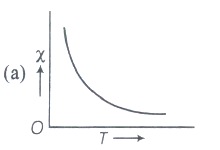
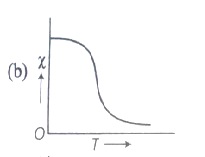
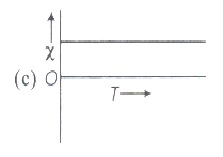
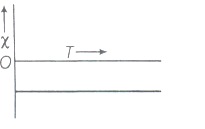
The variation of magnetic susceptibility (x) with temperature for a diamagnetic substance is best represented by figure
19.
A horizontal wire 0.1 m long carries a current of 5 A. Find the magnitude and direction of the magnetic field, which can support the weight of the wire. Given the mass of the wire is \(3\times { 10 }^{ -3 }kg/m\quad and\quad g=10{ ms }^{ -2 }.\)
\(6\times { 10 }^{ -3 }T,\) acting vertically upwards
\(6\times { 10 }^{ -3 }T,\) acting horizontally perpendicular to wire
\(6\times { 10 }^{ -2 }T,\) acting vertically downwards
\(6\times { 10 }^{ -2 }T,\) acting horizontally perpendicular to wire
20.
In a uniform magnetic field of induction B, a wire in the form of semicirclr of radius r rotates about the diameter of the circle with angulat frequency. The axis of rotation is perpendicular to the field. If the total resistance of the circuit is R, then the mean power generated per period of rotation is
\(\frac { B\pi { r }^{ 2 }\omega }{ 2R } \)
\(\frac { \left( B\pi { r }^{ 2 }\omega \right) ^{ 2 } }{ 8R } \)
\(\frac { \left( B\pi { r }\omega \right) ^{ 2 } }{ 2R } \)
\(\frac { \left( B\pi { r^{ 2 } }\omega \right) ^{ 2 } }{ 8R } \)
21.
A circular coil carrying current behaves as a
bar magnet
horse shoe magnet
magnetic shell
solenoid
22.
A positive charge is moving towards an observer. The direction of magnetic induction lines is
clockwise
anticlockwise
right
left
23.
Out of the following, choose the correct relation
1henry = \(\frac{1\ volt}{1\ ampere}\)
1henry = \(\frac{1\ amp}{1\ volt}\)
1 henry = \(\frac{1volt}{1\ amp/sec}\)
1 henry = \(\frac{1volt}{1\ amp\ .\ sec}\)
24.
Its working is based on the fact that when a current carrying coil is placed in a magnetic field, it experiences a torque. This torque tends to rotate the coil about its axis of suspension in such a way that the magnetic flux passing through the coil is maximum.
(i) A moving coil galvanometer is an instrument which
(a) is used to measure emf
(b) is used to measure potential difference
(c) is used to measure resistance
(d) is a deflection instrument which gives a deflection when a current flows through its coil
(ii) To make the field radial in a moving coil galvanometer.
(a) number of turns of coil is kept small
(b) magnet is taken in the form of horse-shoe
(c) poles are of very strong magnets
(d) poles are cylindrically cut
(iii) The deflection in a moving coil galvanometer is
(a) directly proportional to torsional constant of spring
(b) directly proportional to the number of turns in the coil
(c) inversely proportional to the area of the coil
(d) inversely proportional to the current in the coil
(iv) In a moving coil galvanometer, having a coil of N-turns of area A and carrying current I is placed in a radial field of strength B.
The torque acting on the coil is
(a) NA2B2I
(b) NABI2
(c) N2ABI
(d) NABI
(v) To increase the current sensitivity of a moving coil galvanometer, we should decrease
(a) strength of magnet
(b) torsional constant of spring
(c) number of turns in coil
(d) area of coil
25.
Mutual inductance is the phenomenon of inducing emf in a coil, due to a change of current in the neighbouring coil. The amount of mutual inductance that links one coil to another depends very much on the relative positioning of the two coils, their geometry and relative separation between them. Mutual inductance between the two coils increases \(\mu_{r}\) times if the coils are wound over an iron core of relative permeability \(\mu_{r}\).
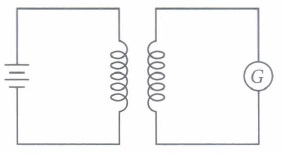
(I) A short solenoid of radius a, number of turns per unit length nI' and length L is kept coaxially inside a very long solenoid of radius b, numbdr of turns per unit length n2• What is the mutual inductance of the system?
| \(\text { (a) } \mu_{0} \pi b^{2} n_{1} n_{2} L\) | \(\text { (b) } \mu_{0} \pi a^{2} n_{1} n_{2} L^{2}\) | \(\text { (c) } \mu_{0} \pi a^{2} n_{1} n_{2} L\) | \(\text { (d) } \mu_{0} \pi b^{2} n_{1} n_{2} L^{2}\) |
(ii) If a change in current of 0.01 A in one coil produces a change in magnetic flux of 2 x l0-2 weber in another coil, then the mutual inductance between coils is
| (a) 0 | (b) 0.5 H | (c) 2 H | (d) 3 H |
(iii) Mutual inductance of two coils can be increased by
| (a) decreasing the number of turns in the coils |
| (b) increasing the number of turns in the coils |
| (c) winding the coils on wooden cores |
| (d) none of these |
(iv) When a sheet of iron is placed in between the two co-axial coils, then the mutual inductance between the coils will
| (a) increase | (b) decrease |
| (c) remains same | (d) cannot be predicted |
(v) The SI unit of mutual inductance is
| (a) ohm | (b) mho | (c) henry | (d) none of these |
26.
When the atomic dipoles are aligned partially or fully, there is a net magnetic moment in the direction of the field in any small volume of the material. The actual magnetic field inside material placed in magnetic field is the sum of the applied magnetic field and the magnetic field due to magnetisation. This field is called magnetic intensity (H).
\(H=\frac{B}{\mu_{0}}-M\)
where M is the magnetisation of the material, llo is the permittivity of vacuum and B is the total magnetic field. The measure that tells us how a magnetic material responds to an external field is given by a dimensionless quantity is appropriately called the magnetic susceptibility: for a certain class of magnetic materials, intensity of magnetisation is directly proportional to the magnetic intensity.
(i) Magnetization of a sample is
| (a) volume of sample per unit magnetic moment | (b) net magnetic moment per unit volume |
| (c) ratio of magnetic moment and pole strength | (d) ratio of pole strength to magnetic moment |
(ii) Identify the wrongly matched quantity and unit pair.
| (a) Pole strength | Am |
| (b) Magnetic susceptibility | dimensionless number |
| (c) Intensity of magnetisation | A m-1 |
| (d) Magnetic permeability | Henry m |
(iii) A bar magnet has length- 3 cm, cross-sectional area 2 cm2 and magnetic moment 3 A m2. The intensity of magnetisation of bar magnet is
| \(\text { (a) } 2 \times 10^{5} \mathrm{~A} / \mathrm{m}\) | \(\text { (b) } 3 \times 10^{5} \mathrm{~A} / \mathrm{m}\) |
| \(\text { (c) } 4 \times 10^{5} \mathrm{~A} / \mathrm{m}\) | \(\text { (d) } 5 \times 10^{5} \mathrm{~A} / \mathrm{m}\) |
(iv) A solenoid has core of a material with relative permeability 500 and its windings carry a current of 1 A. The number of turns of the solenoid is 500 per metre. The magnetization of the material is nearly
| \(\text { (a) } 2.5 \times 10^{3} \mathrm{Am}^{-1}\) | \(\text { (b) } 2.5 \times 10^{5} \mathrm{~A} \mathrm{~m}^{-1}\) |
| \(\text { (c) } 2.0 \times 10^{3} \mathrm{~A} \mathrm{~m}^{-1}\) | \(\text { (d) } 2.0 \times 10^{5} \mathrm{~A} \mathrm{~m}^{-1}\) |
(v) The relative permeability of iron is 6000. Its magnetic susceptibility is
| (a) 5999 | (b) 6001 |
| (c) 6000 x 10-7 | (d) 6000 x 107 |
27.
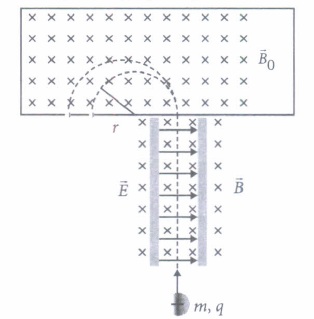
Various methods can be used to measure the mass of an atom. One possibility is through the use of a mass spectrometer. The basic feature of a Banbridge mass spectrometer is illustrated in figure. A particle carrying a charge +q is first sent through a velocity selector and comes out with velocity v = E/B.
The applied electric and magnetic fields satisfy the relation E = vB so that the trajectory of the particle is a straight line. Upon entering a region where a second magnetic field \(\vec{B}_{0}\) pointing into the page has been applied, the particle will move in a circular path with radius r and eventually strike the photographic plate.
(i) In mass spectrometer, the ions are sorted out in which of the following ways?
| (a) By accelerating them through electric field |
| (b) By accelerating them through magnetic field |
| (c) By accelerating them through electric and magnetic field |
| (d) By applying a high voltage |
(ii) Radius of particle in second magnetic field Bo is
| \(\text { (a) } \frac{2 m v}{q E_{0}}\) | \(\text { (b) } \frac{m v}{q E_{0}}\) | \(\text { (c) } \frac{m v}{q B_{0}}\) | \(\text { (d) } \frac{2 m E_{0} v}{q B_{0}}\) |
(iii) Which of the following will trace a circular trajectory wit largest radius?
| (a) Proton | (b) -\(\alpha\)particle | (c) Electron | (d) A particle with charge twice and mass thrice that of electron |
(iv) Mass of the particle in terms q, Bo, B,r and E is
| \(\text { (b) } \frac{q B_{0} B r}{E}\) | \(\text { (c) } \frac{q B r}{E B_{0}}\) | \(\text { (d) } \frac{q B r E}{B_{0}}\) |
(v) The particle comes out of velocity selector along a straight line, because
| (a) electric force is less than magnetic force | (b) electric force is greater than magnetic force |
| (c) electric and magnetic force balance each other | (d) can't say. |
28.
29.
Assertion (A) : An induced current is developed when the number of magnetic lines of force associated with conductor is changed.
Reason (R) : An induced current developJn a conductor moved in a direction parallel to the magnetic field.
Codes:
(a) Both A and R are true and R is the correct explanation of A
(b) Both A and R are true but R is NOT the correct explanation of A
(c) A is true but R is false
(d) A is false and R is also false
30.
Assertion (A) : At neutral point, a compass needle point out in any arbitrary direction.
Reason (R) : Magnetic field of earth is balanced by field due to magnets at the neutral points
Codes:
(a) Both A and R are true and R is the correct explanation of A
(b) Both A and R are true but R is NOT the correct explanation of A
(c) A is true but R is false
(d) A is false and R is also false
1.
(a) From Eq, the magnetic energy is
\(U_{B}=\frac{1}{2} L I^{2}\)
\(=\frac{1}{2} L\left(\frac{B}{\mu_{0} n}\right)^{2} \ \left(\text { since } B=\mu_{0} n I, \text { for a solenoid }\right)\)
\(=\frac{1}{2}\left(\mu_{0} n^{2} A l\right)\left(\frac{B}{\mu_{0} n}\right)^{2}\) [from Eq.]
\(=\frac{1}{2{\mu }_{0}}{B}^{2}Al\)
(b) The magnetic energy per unit volume is,
\({U}_{B}=\frac{{U}_{B}}{V}\) (where V is volume that contains flux)
\(=\frac{{U}_{B}}{Al}\)
\(=\frac{{B}^{2}}{2{\mu }_{0}}\)
We have already obtained the relation for the electrostatic energy stored per unit volume in a parallel plate capacitor.
\({U}_{E}=\frac{1}{2}{\epsilon }_{0}{E}^{2}\)
In both the cases energy is proportional to the square of the field strength. Equation have been derived for special cases: a solenoid and a parallel plate capacitor, respectively. But they are general and valid for any region of space in which a magnetic field or/and an electric field exist.
2.
(a) In either case, one gets two magnets, each with a north and south pole.
(b) No force if the field is uniform. The iron nail experiences a nonuniform field due to the bar magnet. There is induced magnetic moment in the nail, therefore, it experiences both force and torque. The net force is attractive because the induced south pole (say) in the nail is closer to the north pole of magnet than induced north pole.
(c) Not necessarily. True only if the source of the field has a net nonzero magnetic moment. This is not so for a toroid or even for a straight infinite conductor.
(d) Try to bring different ends of the bars closer. A repulsive force in some situation establishes that both are magnetised. If it is always attractive, then one of them is not magnetised. In a bar magnet the intensity of the magnetic field is the strongest at the two ends (poles) and weakest at the central region. This fact may be used to determine whether A or B is the magnet. In this case, to see which one of the two bars is a magnet, pick up one, (say, A) and lower one of its ends; first on one of the ends of the other (say, B), and then on the middle of B. If you notice that in the middle of B, A experiences no force, then B is magnetised. If you do not notice any change from the end to the middle of B, then A is magnetised.
3.
(a) From Eq. \(\tau \) = m B sin θ, θ = 30º, hence sinθ = 1/2.
Thus, 0.016 = m x (800 x 10-4 T) x (1/2)
m = 160 x 2/800 = 0.40 A m2
(b) From Eq. the most stable position is θ = 0º and the most unstable position is θ = 180º. Work done is given by
W = Um (θ = 180°) −Um (θ = 0°)
= 2 m B = 2 x 0.40 x 800 x 10-4 = 0.064 J
(c) From Eq. ms = NIA. From part (a), ms = 0.40 A m2
0.40 = 1000 x I x 2 x 10⁻⁴
I = 0.40 x 10⁴/(1000 x 2) = 2A
4.
Since magnetic field is brought to zero in time \(\triangle t\), the magnetic flux also reduces from maximum to zero and hence induced emf is produced in the ring.
Induced emf \(=E\left( 2\pi b \right) \) ........(i) \(\left[ \therefore \ V=Ed \right] \)
E is electric field generated around the ring.
Also induced emf = rate of change of magnetic field \(\times\) area
\(=\frac { B\pi { r }^{ 2 } }{ \triangle t } \) .......(ii)
From eqn. (i) and (ii), we have
\(2\pi bE=\frac { B\pi { a }^{ 2 } }{ 2\triangle t } \)
or \(bE=\frac { B{ a }^{ 2 } }{ 2\triangle t } \) .......(iii)
Torque acting on the ring
\(\tau =b\times force=bQE\)
Using eqn. (iii), we get
\(\tau =\frac { QB{ a }^{ 2 } }{ 2\left( \Delta t \right) } \)
If \(\Delta L\) is the change in angular momentum, then
\(\Delta L=\tau \times \Delta t=\frac { QB{ a }^{ 2 } }{ 2 } \)
Initial angular momentum = 0
Final angular momentum = \(m{ b }^{ 2 }\omega =\frac { QB{ a }^{ 2 } }{ 2 } \)
or \(\omega =\frac { QB{ a }^{ 2 } }{ 2m{ b }^{ 2 } } \)
5.
Inner radius of the toroid, r1 = 25 cm = 0.25 m
Outer radius of the toroid, r2 = 26 cm = 0.26 m
Number of turns on the coil, N = 3500
Current in the coil, I = 11 A
(a) Magnetic field outside a toroid is zero. It is non-zero only inside the core of a toroid.
(b) Magnetic field inside the core of a toroid is given by the relation,
\(\mathrm{B}=\frac{\mu_{0} \mathrm{NI}}{l}\)
Where,
µ0 = Permeability of free space = 4π x 10-7 T m A-1
l = length of toroid
\(=2 \pi\left[\frac{r_{1}+r_{2}}{2}\right]\)
= \(\pi\) ( 0.25 + 0.26)
= 0.51 \(\pi\)
\(\therefore B=\frac{4 \pi \times 10^{-7} \times 3500 \times 11}{051 \pi}\)
\(\approx\) 3.0 x 10⁻² T
(c) Magnetic field in the empty space surrounded by the toroid is zero.
6.
Diamagnetic.
7.
The hysteresis curves should be narrow, so that the energy dissipated and the heating will consequently be small.
The core materials must have the high resistivity to lower the eddy current losses.
8.
Magnetic field strength, B = 0.25 T
Magnetic moment, M = 0.6 T-1
The angle θ, between the axis of the solenoid and the direction of the applied field, is 30°.
Therefore, the torque acting on the solenoid is given as:
\(\tau\) = MB sinθ
= 0.6 x 0.25 sin30°
= 7.5 x 10⁻² J
9.
Actually there is no permanent strong magnet inside the earth responsible for earth's magnetism, Dr. Gilbert considered a fictitious strong magnet inside the earth, whose magnetic axis is inclined roughly 11.3o west of axis of rotation of earth, which is along geographic north and geographic south.
10.
A current loop behaves as a bar magnet because
(i) one face of current loop behaves as a south pole and the other face as north pole.
(ii) it possesses a magnetic dipole moment (M = IA) and
(iii) it experiences a torque in an external magnetic field, which tends to align the axis of the loop along the direction of magnetic field as bar magnet does.
11.
In the first case, induced current in B will be opposite to i, so that A and B repel eachother and the operation of bringing them closer is opposed. Similarly, in the second case, induced current in B will be in the direction of i.
12.
\(|e|=\frac{d \Phi}{d t}=\frac{0.2 \times 10^{-2}}{0.1}=0.02 \quad V\)
13.
The magnetic flux is maximum when area is held perpendicular to the direction of magnetic field.
14.
(a) No, because that would require \(\tau \) to be in the vertical direction. But \(\tau =IA\times B\), and since A of the horizontal loop is in the vertical direction, \(\tau \) would be in the plane of the loop for any B.
(b) Orientation of stable equilibrium is one where the are vector A of the loop is in the direction of external magnetic field. In this orientation, the magnetic field produced by the loop is in the same direction as external field, both normal to the plane of the loop, thus giving rise to maximum flux of the total field.
(c) It assumes circular shape with its plane normal to the field to maximize flux, since, for a given perimeter, a circle encloses greater areas than any other shape.
15.
(c)
lines of B cannot end on any material and perfect shielding is not possible.
16.
(c)
four times
17.
(b)
\(\pi/3\)
18.
(d)
19.
(b)
\(6\times { 10 }^{ -3 }T,\) acting horizontally perpendicular to wire
20.
(d)
\(\frac { \left( B\pi { r^{ 2 } }\omega \right) ^{ 2 } }{ 8R } \)
21.
(c)
magnetic shell
22.
(b)
anticlockwise
23.
(c)
1 henry = \(\frac{1volt}{1\ amp/sec}\)
24.
(i) (d) is a deflection instrument which gives a deflection when a current flows through its coil
(ii) (d) poles are cylindrically cut
(iii)(b) directly proportional to the number of turns in the coil
(iv)(d) NABI
(v) (b) torsional constant of spring
25.
(i) (c) :The mutual inductance ofthe system is \(M=\mu_{0} n_{1} n_{2} \pi a^{2} L\)
(ii) (c): Here \(\phi_{B}=2 \times 10^{-2} \mathrm{~Wb}, I=0.01 \mathrm{~A}\)
As \(\phi_{B}=M I\)
\(\therefore\) Mutual inductance between two coils is \(M=\frac{\phi_{B}}{I}=\frac{2 \times 10^{-2} \mathrm{~Wb}}{0.01 \mathrm{~A}}=2 \mathrm{H}\)
(iii) (b) : Mutual inductance of coils \(M=\frac{\mu_{0} \mu_{r} N_{1} N_{2} A}{l}\)
It is clear that mutual inductance of coils can be increased by increasing the number of turns in the coils.
(iv) (a) : We know that the mutual inductance depends (directly proportional) on the permeability of the medium surrounding the coils. When the permeability of the medium is increased by inserting a sheet of iron, then the mutual inductance between the coils also increases.
(v) (c)
26.
(i) (b)
(ii) (d): Magnetic permeability - Henry m-1
(iii) (d): Given, L= 3 cm, A = 2 cm2, M = 3 A m2
.Intensity of magnetisation \(=\frac{M}{l A}=\frac{3}{3 \times 10^{-2} \times 2 \times 10^{-4}}\)
\(=\frac{1}{2 \times 10^{-6}}=0.5 \times 10^{6}=5 \times 10^{5} \mathrm{~A} / \mathrm{m}\)
(iv) (b): Here, n = 500 turns/m
\(I=1 \mathrm{~A}, \mu_{-}=500\)
Magnetic intensity \(H=n I=500 \mathrm{~m}^{-1} \times 1 \mathrm{~A}=500 \mathrm{~A} \mathrm{~m}^{-1}\)
As \(\mu_{r}=1+\chi \quad \text { or } \chi=\left(\mu_{r}-1\right)\)
Magnetisation, M = XH
\(=\left(\mu_{r}-1\right) H=(500-1) \times 500 \mathrm{~A} \mathrm{~m}^{-1}\)
\(=2.495 \times 10^{5} \mathrm{~A} \mathrm{~m}^{-1} \approx 2.5 \times 10^{5} \mathrm{~A} \mathrm{~m}^{-1}\)
(v) (a): Relative permeability of iron \(\mu_{r}=6000\)
Magnetic susceptibility \(\chi_{m}=\mu_{r}-1=5999\)
27.
(i) (c): In mass spectrometer, the ions are sorted out by accelerating them through electric and magnetic field.
(ii) (c): As \(\frac{m v^{2}}{r}=q v B_{0} \therefore r=\frac{m v}{q B_{0}}\)
(iii) (b): As radius \(r \propto \frac{m}{q}\)
\(\therefore\) r will be maximum for \(\alpha\) - particle.
(iv) (b) : Here, \(r=\frac{m v}{q B_{0}} \text { or } m=\frac{r q B_{0}}{v}\)
As \(v=\frac{E}{B}, \therefore m=\frac{q B_{0} B r}{E}\)
(v) (c): From the relation v = E/B, it is clear electric and magnetic force balance each other.
28.
29.
(a): An induced current develop in a conductor cannot moved in a direction parallel to magnetic field. This is because when the conductor moved in a direction parallel to magnetic field, amount of flux linked with the conductor does not change. Thus the induced current develops only when conductor cuts the lines of magnetic force. The direction of flow of induced current can also be found by applying Fleming's right hand rule, when the direction of motion of conductor inside the magnetic field and the direction of magnetic field action on it are known.
30.
(a): A neutral point in the magnetic field of a bar magnet is that point, where the field due to magnet is completely neutralised by the horizontal component of earth's magnetic field. The net horizontal field is zero at such a point. If a compass needle is placed at such a point, it can stay in any position.

12th Standard CBSE Syllabus & Materials
12th Standard CBSE
CBSE 12th Computer Science Python Revision Tour I - New Previous year Question Papers Study Material - QB365 Set A
NEW12th Standard CBSE
CBSE 12th Business Studies Planning Important Questions And Answers Study Material - QB365 Set A
NEW12th Standard CBSE
CBSE 12th Business Studies Business Environment Important Questions And Answers Study Material - QB365 Set A
NEW12th Standard CBSE
CBSE 12th Business Studies Principles of Management Important Questions And Answers Study Material - QB365 Set A



NCERT Books

Syllabus

Exam Pattern

Sample Question Papers

Previous year Question Papers

Important Notes

MCQ Practice test

NCERT Exemplers

Case study Questions

Image Based Questions

Passage based Questions

HOT Questions

Value Based Questions

Model Questions Papers
NCERT ( Book Back ) Questions

Assertion and Reason
Important Questions And Answers

CBSE 12th Standard CBSE Subjects
CBSE Standards








