
 100% FREE ACCESS
12th Standard CBSE Syllabus & Materials
12th Standard CBSE
CBSE 12th Economics Government Budget and the Economy Previous year Question Papers Study Material - QB365 Set A
NEW12th Standard CBSE
CBSE 12th Computer Science Interface Python with MySQL - New Previous year Question Papers Study Material - QB365 Set A
NEW12th Standard CBSE
CBSE 12th Computer Science Database Concept - New Previous year Question Papers Study Material - QB365 Set A
NEW12th Standard CBSE
CBSE 12th Computer Science Data Communication - New Previous year Question Papers Study Material - QB365 Set A
NEW12th Standard CBSE
CBSE 12th Computer Science Data Structures - New Previous year Question Papers Study Material - QB365 Set A
NEW12th Standard CBSE
CBSE 12th Computer Science Functions - New Previous year Question Papers Study Material - QB365 Set A

Published on: 25/10/2025
Download CBSE Class 12th Standard CBSE Physics question papers, sample papers, important questions, and previous year solved papers in PDF format. Get free study materials, NCERT solutions, and exam preparation resources for Class 12th Standard CBSE Physics
Questions + Answers key
Take MCQ Physics Test
1.
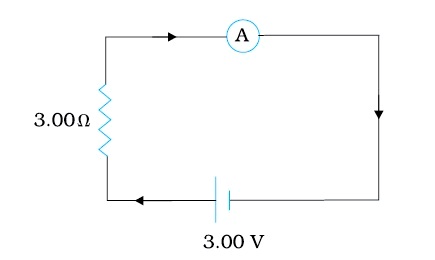
In the circuit the current is to be measured. What is the value of the current if the ammeter shown
(a) is a galvanometer with a resistance RG = 60.00 Ω;
(b) is a galvanometer described in (a) but converted to an ammeter by a shunt resistance rs = 0.02 Ω;
(c) is an ideal ammeter with zero resistance?
2.
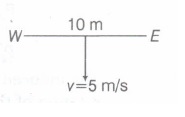
A horizontal straight wire 10 m long extending from east to west is falling with a speed of 50 m s–1, at right angles to the horizontal component of the earth’s magnetic field, 0.30 x 10- 4 Wb m-2.
(a) What is the instantaneous value of the emf induced in the wire?
(b) What is the direction of the emf?
(c) Which end of the wire is at the higher electrical potential?
3.
Current in a circuit falls from 5.0 A to 0.0 A in 0.1 s. If an average emf of 200 V induced, give an estimate of the self-inductance of the circuit.
4.
(a) What would you do to obtain a large deflection of the galvanometer?
(b) How would you demonstrate the presence of an induced current in the absence of a galvanometer?
5.
A closely wound solenoid of 800 turns and area of cross section 2.5 × 10⁻⁴ m2 carries a current of 3.0 A. Explain the sense in which the solenoid acts like a bar magnet. What is its associated magnetic moment?
6.
A square loop of side 10 cm and resistance 0.5 Ω is placed vertically in the east-west plane. A uniform magnetic field of 0.10 T is set up across the plane in the north-east direction. The magnetic field is decreased to zero in 0.70 s at a steady rate. Determine the magnitudes of induced emf and current during this time-interval.
7.
The horizontal component of the earth's magnetic field at a certain place is 3.0 x 10⁻⁵ T and the direction of the field is from geographic south to the geographic north. A very long straight conductor is carrying a steady current of 1 A. What is the force per unit length on it when it is placed on a horizontal table and the direction of current is (a) east to west (b) south to north ?
8.
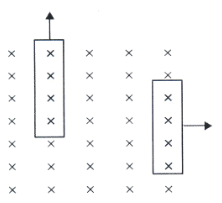
A rectangular wire loop of sides 8 cm and 2 cm with a small cut is moving out of a region of uniform magnetic field of magnitude 0.3 T directed normal to the loop. What is the emf developed across the cut if the velocity of the loop is 1 cm s–1 in a direction normal to the
(a) longer side,
(b) shorter side of the loop? For how long does the induced voltage last in each case?
9.
(i) A circular coil of 30 turns and radius 8.0 cm carrying a current of 6.0 A is suspended vertically in a uniform horizontal magnetic field of magnitude 1.0 T. The field lines make an angle of 60o with the normal of the coil. Calculate the magnitude of the counter torque that must be applied to prevent the coil from turning.
(ii) Would your answer change, if the circular coil were replaced by a planar coil of some irregular shape that encloses the same area? All other particulars are also unaltered.
10.
A circular coil of radius 10 cm, 500 turns and resistance 2 Ω is placed with its plane perpendicular to the horizontal component of the earth’s magnetic field. It is rotated about its vertical diameter through 180° in 0.25 s. Estimate the magnitudes of the emf and current induced in the coil. Horizontal component of the earth’s magnetic field at the place is 3.0 x 10⁻⁵ T.
11.
A closely wound solenoid of 2000 turns and area of cross-section 1.6 x 10⁻⁴ m2, carrying a current of 4.0 A, is suspended through its centre allowing it to turn in a horizontal plane.
(a) What is the magnetic moment associated with the solenoid?
(b) What is the force and torque on the solenoid if a uniform
horizontal magnetic field of 7.5 x 10⁻² T is set up at an angle of 30º with the axis of the solenoid?
12.
A bar magnet of magnetic moment 1.5 J T-1 lies aligned with the direction of a uniform magnetic field of 0.22 T.
(a) What is the amount of work required by an external torque to turn the magnet so as to align its magnetic moment:
(i) normal to the field direction,
(ii) opposite to the field direction?
(b) What is the torque on the magnet in cases (i) and (ii)?
13.
A solenoid has a core of a material with relative permeability 400. The windings of the solenoid are insulated from the core and carry a current of 2A. If the number of turns is 1000 per metre, calculate (a) H, (b) M, (c) B and (d) the magnetising current Im.
14.
In a chamber, a uniform magnetic field of 6.5 G (1 G = 10–4 T) is maintained. An electron is shot into the field with a speed of 4.8 x 10⁶ m s–1 normal to the field. Explain why the path of the electron is a circle. Determine the radius of the circular orbit. (e = 1.5 x 10⁻¹⁹ C, me = 9.1 x 10⁻³¹ kg)
1.
(a) Total resistance in the circuit is,
RG+3 = 63 Ω. Hence, I = 3 / 63 = 0.048 A.
(b) Resistance of the galvanometer converted to an ammeter is,
\(\frac{R_{G} r_{s}}{R_{G}+r_{s}}=\frac{60 \Omega \times 0.02 \Omega}{(60+0.02) \Omega}=0.02 \Omega\)
Total resistance in the circuit is,
0.02Ω + 3Ω = 3.02Ω . Hence, I = 3 / 3.02 = 0.99 A.
(c) For the ideal ammeter with zero resistance,
I = 3 / 3 = 1.00 A
2.
Given, velocity of straight wire,
v = 5m/s
Horizontal component of the earth's magnetic field,
Length of the wire, \(\mathrm{I}=10 \mathrm{~m}\)
Falling speed of the wire, \(v=5.0 \mathrm{~m} / \mathrm{s}\)
Magnetic field strength, \(B=0.3 \times 10^{-4} \mathrm{~Wb} \mathrm{~m}^{-2}\)
(a) Emf induced in the wire,
\( e=B l v \)
\(=0.3 \times 10^{-4} \times 5 \times 10 =1.5 \times 10^{-3} V\)
(b) Using Fleming's right-hand rule, it can be inferred that the direction of the induced emf is from West to East.
(c) The eastern end of the wire is at a higher potential.
3.
Initial current, I1 = 5.0 A
Final current, I2 = 0.0 A
Change in current dl = I-1- I-2 = 5A
Time taken for the change, t = 0.1 s
Average emf, e = 200 V
For self-inductance (L) of the coil, we have the relation for average emf as:
\(e=L\frac{di}{dt}\)
\(L=\frac{e}{\frac{di}{dt}}\)
\(=\frac{200}{\frac{5}{0.1}}=4H\)
Hence, the self induction of the coil is 4 H.
4.
(a) To obtain a large deflection, one or more of the following steps can be taken:
(i) Use a rod made of soft iron inside the coil C2 ,
(ii) Connect the coil to a powerful battery, and
(iii) Move the arrangement rapidly towards the test coil C1 .
(b) Replace the galvanometer by a small bulb, the kind one finds in a small torch light. The relative motion between the two coils will cause the bulb to glow and thus demonstrate the presence of an induced current. In experimental physics one must learn to innovate. Michael Faraday who is ranked as one of the best experimentalists ever, was legendary for his innovative skills.
5.
Number of turns in the solenoid, n = 800
Area of cross-section, A = 2.5 × 10⁻⁴ m2
Current in the solenoid, I = 3.0 A
A current-carrying solenoid behaves like a bar magnet because a magnetic field develops along its axis, i.e., along with its length.
The magnetic moment associated with the given current-carrying solenoid is calculated as:
M = n I A
= 800 x 3 x 2.5 x 10-4
= 0.6 J T-1
6.
The angle \(\theta\) made by the area vector of the coil with the magnetic field is 45° . From Eq. (6.1), the initial magnetic flux is
\(\phi\) = BA cos \(\theta\)
\(\begin{aligned} =\frac{0.1 \times 10^{-2}}{\sqrt{2}} \mathrm{Wb} \end{aligned}\)
Final flux, Fmin = 0
The change in flux is brought about in 0.70 s. From Eq. (6.3), the magnitude of the induced emf is given by
\(\varepsilon=\frac{\left|\Delta \Phi_B\right|}{\Delta t}=\frac{|(\Phi-0)|}{\Delta t}=\frac{10^{-3}}{\sqrt{2} \times 0.7}=1.0 \mathrm{mV}\)
And the magnitude of the current is
\(I=\frac{e}{R}=\frac{10^{-3} \mathrm{~V}}{0.5 \Omega}=2 \mathrm{~mA}\)
Note that the earth’s magnetic field also produces a flux through the loop. But it is a steady field (which does not change within the time span of the experiment) and hence does not induce any emf.
7.
F = Il x B
F = Il B sinθ
The force per unit length is
f = F / l = I B sinθ
(a) When the current is flowing from east to west,
θ = 90°
Hence,
f = I B
= 1 x 3x 10–5 = 3 x 10⁻⁵ N m–1
This is larger than the value 2 x 10⁻⁷ Nm–1 quoted in the definition of the ampere. Hence it is important to eliminate the effect of the earth’s magnetic field and other stray fields while standardising the ampere.
The direction of the force is downwards. This direction may be obtained by the directional property of cross product of vectors.
(b) When the current is flowing from south to north,
θ = 0o
f = 0
Hence there is no force on the conductor.
8.
A) Step 1: Find the emf developed in the loop
Formula Used: \(\mathrm{e}=\mathrm{BIV}\)
Strength of magnetic field, \(B=0.3 \mathrm{~T}\)
Velocity of the loop, \(v=1 \mathrm{~cm} / \mathrm{s}=0.01 \mathrm{~m} / \mathrm{s}\)
emf developed in the loop is given as:
\( \mathrm{e}=\mathrm{Blv} \)
\(=0.3 \times 0.08 \times 0.01=2.4 \times 10^{-4} \mathrm{~V}\)
Step 2: Find the time taken to travel.
Formula Used: \(\mathrm{t}=\frac{\text { Distance travelled }}{\text { Velocity }}\)
Time taken to travel along the width, \(\mathrm{t}=\frac{\text { Distance travelled }}{\text { Velocity }}=\frac{\mathrm{bv}}{\mathrm{v}}\)
\(=\frac{0.02}{0.01}=2 \mathrm{~s}\)
Final answer : \(\mathrm{e}=2.4 \times 10^{-4} \mathrm{v}\)
\(\mathrm{t}=2 \mathrm{~s}\)
B) Step 1: Find the emf developed in the loop emf developed, e = BIv
\(e=0.3 \times 0.02 \times 0.01 \)
\(e=0.6 \times 10^{-4} V\)
Step 2: Find the time taken to travel.
Time taken to travel along the length, \(\mathrm{t}=\frac{\text { Distance travelle }}{\text { Velocity }}=\frac{\mathrm{d}}{\mathrm{v}}\)
\(\mathrm{t}=\frac{0.08}{0.01}=8 \mathrm{~s}\)
Hence, the induced voltage is \(0.6 \times 10^{-4} \mathrm{~V}\) which lasts for 8 s .
Final answer: \(\mathrm{e}=0.6 \times 10^{-4} \mathrm{~V}\)
\(\mathrm{t}=8 \mathrm{~s}\)
9.
Here, N = 30, R = 8.0 cm = 8 \(\times\)10-2 m,
I = 6.0 A, \(\theta\)= 60° and B = 1.0 T
(i) The magnitude of the counter torque
= magnitude of the deflecting torque
= NAIB sin \(\theta\) = N .(\(\pi\)R2)IB sin \(\theta\)
= 30 \(\times\) 3.14 \(\times\) (8 \(\times\) 10-2)2 \(\times\) 6.0 \(\times\) 1.0 \(\times\) sin 60°
= 3.14 N.m
(ii) The answer would not change as area enclosed by the coil as well as all other particulars remain unaltered and the formula, \(\tau\) = NAIB sin \(\theta\) is true for planar coil for any shape.
10.
Initial flux through the coil,
ΦB (initial) = BA cos θ
= 3.0 x 10⁻⁵ x (π x 10–2) x cos 0º
= 3π x 10–7 Wb
Final flux after the rotation,
ΦB (final) = 3.0 x 10⁻⁵ x (π x 10–2) x cos 180°
= –3π x 10–7 Wb
Therefore, estimated value of the induced emf is,
\(\varepsilon=N \frac{\Delta \Phi}{\Delta t}\)
= 500 x (6π x 10–7)/0.25
= 3.8 x 10⁻³ V
I = ε/R = 1.9 x 10⁻³ A
Note that the magnitudes of ε and I are the estimated values. Their instantaneous values are different and depend upon the speed of rotation at the particular instant.
11.
Number of turns on the solenoid, n = 2000
Area of cross-section of the solenoid, A = 1.6 x 10⁻⁴ m2
Current in the solenoid, I = 4.0 A
(a) The magnetic moment along the axis of the solenoid is calculated as:
M = nAI
= 2000 x 4 x 1.6 x 10-4
= 1.28 Am2
(b) Magnetic field, B = 7.5 x 10⁻²
The angle between the magnetic field and the axis of the solenoid, θ = 30°
Torque, \(\tau\) = MB sinθ
=1.28 x 7.5 x 10-2 sin30°
= 0.048J
Since the magnetic field is uniform, the force on the solenoid is zero. The torque on the solenoid is 0.048 J
12.
(a) Magnetic moment, M = 1.5 J T-1
Magnetic field strength, B = 0.22 T
(i) Initial angle between the axis and the magnetic field, θ1 = 0°
Final angle between the axis and the magnetic field, θ2 = 90°
The work required to make the magnetic moment normal to the direction of the magnetic field is given as:
W = -MB (cosθ2 - cosθ1)
= -1.5 x 0.22(cos90°- cos0°)
= - 0.33 (0 - 1)
= 0.33 J
(ii) Initial angle between the axis and the magnetic field, θ1 = 0°
Final angle between the axis and the magnetic field, θ2 = 180°
The work required to make the magnetic moment opposite to the direction of the magnetic field is given as:
W = - MB (cosθ2 - cosθ1)
= -1.5 x 0.22 (cos180° - cos0°)
= - 0.33 (- 1 - 1)
= 0.66 J
(b) For case (i):
θ = θ2 = 90°
∴ Torque, \(\tau\) =MB sinθ
= MB sin 90°
= 0.33 J
The torque tends to align the magnitude moment vector along B.
For case (ii):
θ = θ2 = 180° ∴ Torque, \(\tau\) = MB sinθ
= MB sin180°
= 0
13.
(a) The field H is dependent of the material of the core, and is
H = nI = 1000 x 2.0 = 2 x 10³ A/m.
(b) The magnetic field B is given by
B = μr μ0 H
= 400 x 4π x 10-7 (N/A2) x 2 x 103 (A/m)
= 1.0 T
(c) Magnetisation is given by
M = (B - μ0 H)/ μ0
= (μr μ0 H - μ0 H) / μ0 = (μr – 1)H = 399 x H
\(\cong\)8 \(\times\)105 A/m
d) The magnetising current IM is the additional current that needs to be passed through the windings of the solenoid in the absence of the core which would give a B value as in the presence of the core. Thus B = μr n (I + IM). Using I = 2A, B = 1 T, we get IM = 794 A.
14.
Magnetic field strength, B = 6.5 G = 6.5 x 10⁻⁴ T
Speed of the electron, v = 4.8 x 10⁶ m/s
Charge on the electron, e = 1.6 x 10⁻¹⁹ C
Mass of the electron, me = 9.1 x 10⁻³¹ kg
Angle between the shot electron and magnetic field, θ = 90°
Magnetic force exerted on the electron in the magnetic field is given as:
F = evB sinθ
This force provides centripetal force to the moving electron. Hence, the electron starts moving in a circular path of radius r.
Hence, centripetal force exerted on the electron,
\(F_{c}=\frac{m v^{2}}{r}\)
In equilibrium, the centripetal force exerted on the electron is equal to the magnetic force i.e.,
FC = F
\(\frac{m v^{2}}{r}=e v B \sin \theta\)
\(r=\frac{m v}{B e \sin \theta}\)
\(=\frac{9.1 \times 10^{-31} \times 4.8 \times 10^{6}}{6.5 \times 10^{-4} \times 1.6 \times 10^{-19} \times \sin 90^{\circ}}\)
= 4.2 x 10 -2 m = 4.2 cm
Hence, the radius of the circular orbit of the electron is 4.2 cm.

12th Standard CBSE Syllabus & Materials
12th Standard CBSE
CBSE 12th Computer Science Python Revision Tour I - New Previous year Question Papers Study Material - QB365 Set A
NEW12th Standard CBSE
CBSE 12th Business Studies Planning Important Questions And Answers Study Material - QB365 Set A
NEW12th Standard CBSE
CBSE 12th Business Studies Business Environment Important Questions And Answers Study Material - QB365 Set A
NEW12th Standard CBSE
CBSE 12th Business Studies Principles of Management Important Questions And Answers Study Material - QB365 Set A



NCERT Books

Syllabus

Exam Pattern

Sample Question Papers

Previous year Question Papers

Important Notes

MCQ Practice test

NCERT Exemplers

Case study Questions

Image Based Questions

Passage based Questions

HOT Questions

Value Based Questions

Model Questions Papers
NCERT ( Book Back ) Questions

Assertion and Reason
Important Questions And Answers

CBSE 12th Standard CBSE Subjects
CBSE Standards








