
 100% FREE ACCESS
12th Standard CBSE Syllabus & Materials
12th Standard CBSE
CBSE 12th Economics Government Budget and the Economy Previous year Question Papers Study Material - QB365 Set A
NEW12th Standard CBSE
CBSE 12th Computer Science Interface Python with MySQL - New Previous year Question Papers Study Material - QB365 Set A
NEW12th Standard CBSE
CBSE 12th Computer Science Database Concept - New Previous year Question Papers Study Material - QB365 Set A
NEW12th Standard CBSE
CBSE 12th Computer Science Data Communication - New Previous year Question Papers Study Material - QB365 Set A
NEW12th Standard CBSE
CBSE 12th Computer Science Data Structures - New Previous year Question Papers Study Material - QB365 Set A
NEW12th Standard CBSE
CBSE 12th Computer Science Functions - New Previous year Question Papers Study Material - QB365 Set A

Published on: 25/10/2025
Download CBSE Class 12th Standard CBSE Physics question papers, sample papers, important questions, and previous year solved papers in PDF format. Get free study materials, NCERT solutions, and exam preparation resources for Class 12th Standard CBSE Physics
Questions + Answers key
Take MCQ Physics Test
1.
Obtain the frequency of revolution of the electron in its circular orbit. Does the answer depend on the speed of the electron? Explain.
2.
Find the expression for maximum energy of a charged particle accelerated by a cyclotron.
3.
How are materials classified according to their behaviour in magnetic field?
4.
Write two properties of superconductor magnets. Where do they find their application?
5.
How will you judge as to which of the two given similar magnets is stronger without using a third magnet?
6.
What is the magnitude of the axial fields due to a bar magnet of length 5 cm at a distance of 50cm from its mid-point. The magnetic moment of the bar magnet is 0.40 A-m2 .
7.
What is te magnitude of the equatorial and axial fields due to a bar magnet of length 5.0 cm at a distance of 50 cm from its mid-point? The magnetic moment of the bar magnet is \(0.40{ Am }^{ 2 }\)
8.
The magnetic susceptibility of \(\chi\) of a given material is -0.5. Identify the magnetic material.
9.
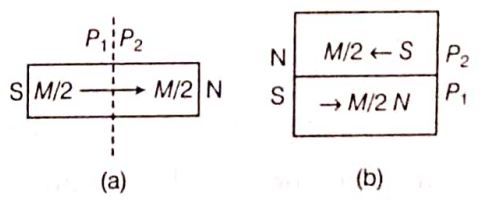
A bar magnet is cut into two equal parts as shown in the Fig. (a). One part is now kept over the other such that, the P2 is above P1 as shown in the Fig. (b).
If M is the magnetic moment of the original magnet, what would be the magnetic moment of new combination of magnets so formed?
10.
What is Coulomb's law of magnetic force?
11.
A short bar magnet placed with its axis at 30º with a uniform external magnetic field of 0.25 T experiences a torque of magnitude equal to 4.5 x 10⁻² J. What is the magnitude of magnetic moment of the magnet?
12.
A solenoid of length 0.5 m has a radius of 1 cm and is made up of 500 turns. It carries a current of 5 A. What is the magnitude of the magnetic field inside the solenoid ?
13.
State the principle of working of a cyclotron.
14.
In a solenoid carrying current, where is the magnetic field
(i) maximum
(ii) minimum and
(iii) half of the maximum value ?
15.
A magnet can be completely demagnetised by
breaking the magnet into small pieces
heating it slightly
dropping it into ice cold water
a reverse field of appropriate strength
16.
Curie temperature is the temperature above which
a ferromagnetic material becomes paramagnetic.
a ferromagnetic material becomes diamagnetic
a paramagnetic material becomes diamagnetic
a paramagnetic material becomes ferromagnetic
17.
A large magnet is broken into two pieces so that their lengths are in the ratio 2 : 1. The pole strengths of the two pieces will have ratio.
2: 1
1: 2
4: 1
1: 1
18.
A galvanometer of resistance \(25\Omega \) is connected to a battery of 2 volt along with a resistance in series. When the value of this resistance is \(3000\Omega ,\) a full scale deflection of 30 units is obtained in the galvanometer. In order to reduce this deflection 10 20 units, the resistance in series will be
\(4514\Omega \)
\(5413\Omega \)
\(2000\Omega \)
\(6000\Omega .\)
19.
The magnetic field at a perpendicular distance of 2 cm from an infinite straight current carrying conductor is 2x10⁻⁶ T. The current in the wire is
0.1 A
0.2 A
0.4 A
0.8 A
20.
The field of a hollow wire with constant current is homageneous
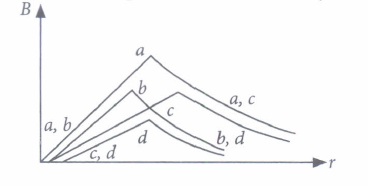
Curves in the graph shown give, as functions of radius distance r, the magnitude B of the magnetic field inside and outside four long wires a, b, c and d, carrying currents that are uniformly distributed across the cross sections of the wires. Overlapping portions of the plots are indicated by double labels.
(i) Which wire has the greatest magnitude of the magnetic field on the surface?
| (a) a | (b) b | (c) c | (d) d |
(ii) The current density in a wire a is
| (a) greater than in wire c |
| (b) less than in wire |
| (c) equal to that in wire c |
| (d) not comparable to that of in wire c due to lack of information |
(iii) Which wire has the greatest radius?
| (a) a | (b) b | (c) c | (d) d |
(iv) A direct current I flows along the length of an infinitely long straight thin walled pipe, then the magnetic field is
| (a) uniform throughout the pipe but not zero |
| (b) zero only along the axis of the pipe |
| (c) zero at any point inside the pipe |
| (d) maximum at the centre and minimum at the edges |
(v) In a coaxial, straight cable, the central conductor and the outer conductor carry equal currents in opposite direction. The magnetic field is zero
| (a) outside the cable | (b) inside the inner conductor |
| (c) inside the outer conductor | (d) in between the two conductor. |
21.
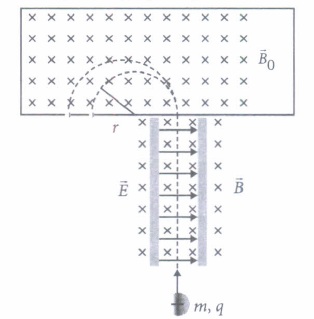
Various methods can be used to measure the mass of an atom. One possibility is through the use of a mass spectrometer. The basic feature of a Banbridge mass spectrometer is illustrated in figure. A particle carrying a charge +q is first sent through a velocity selector and comes out with velocity v = E/B.
The applied electric and magnetic fields satisfy the relation E = vB so that the trajectory of the particle is a straight line. Upon entering a region where a second magnetic field \(\vec{B}_{0}\) pointing into the page has been applied, the particle will move in a circular path with radius r and eventually strike the photographic plate.
(i) In mass spectrometer, the ions are sorted out in which of the following ways?
| (a) By accelerating them through electric field |
| (b) By accelerating them through magnetic field |
| (c) By accelerating them through electric and magnetic field |
| (d) By applying a high voltage |
(ii) Radius of particle in second magnetic field Bo is
| \(\text { (a) } \frac{2 m v}{q E_{0}}\) | \(\text { (b) } \frac{m v}{q E_{0}}\) | \(\text { (c) } \frac{m v}{q B_{0}}\) | \(\text { (d) } \frac{2 m E_{0} v}{q B_{0}}\) |
(iii) Which of the following will trace a circular trajectory wit largest radius?
| (a) Proton | (b) -\(\alpha\)particle | (c) Electron | (d) A particle with charge twice and mass thrice that of electron |
(iv) Mass of the particle in terms q, Bo, B,r and E is
| \(\text { (b) } \frac{q B_{0} B r}{E}\) | \(\text { (c) } \frac{q B r}{E B_{0}}\) | \(\text { (d) } \frac{q B r E}{B_{0}}\) |
(v) The particle comes out of velocity selector along a straight line, because
| (a) electric force is less than magnetic force | (b) electric force is greater than magnetic force |
| (c) electric and magnetic force balance each other | (d) can't say. |
22.
23.
Assertion (A) : The ends of a magnet suspended freely point out always along north south.
Reason (R) : Earth behaves as a huge magnet.
Codes:
(a) Both A and R are true and R is the correct explanation of A
(b) Both A and R are true but R is NOT the correct explanation of A
(c) A is true but R is false
(d) A is false and R is also false
24.
Assertion (A) : When the observation point lies along the length of the current element, magnetic field is zero.
Reason (R): Magnetic field close to current element is zero.
Codes:
(a) Both A and R are true and R is the correct explanation of A
(b) Both A and R are true but R is NOT the correct explanation of A
(c) A is true but R is false
(d) A is false and R is also false
25.
Assertion (A) : An ammeter is connected in series in the circuit.
Reason (R) : An ammeter is a high resistance galvanometer
Codes:
(a) Both A and R are true and R is the correct explanation of A
(b) Both A and R are true but R is NOT the correct explanation of A
(c) A is true but R is false
(d) A is false and R is also false
1.
Magnetic field strength, B = 6.5 x 10⁻⁴ T
Charge of the electron, e = 1.6 x 10⁻¹⁹ C
Mass of the electron, me = 9.1 x 10⁻³¹ kg
Velocity of the electron, v = 4.8 x 10⁶ m/s
Radius of the orbit, r = 4.2 cm = 0.042 m
Frequency of revolution of the electron = ν
Angular frequency of the electron = ω = 2πν
Velocity of the electron is related to the angular frequency as:
v = rω
In the circular orbit, the magnetic force on the electron is balanced by the centripetal force. Hence, we can write:
\(e v B=\frac{m v^{2}}{r}\)
\(e B=\frac{m}{r}(r \omega)=\frac{m}{r}(2 \pi r v)\)
\(v=\frac{B e}{2 \pi m}\)
This expression for frequency is independent of the speed of the electron.
On substituting the known values in this expression, we get the frequency as:
\(V=\frac{6.5 \times 10^{-4} \times 1.6 \times 10^{-19}}{2 \times 3.14 \times 9.1 \times 10^{-31}}\)
= 18.2 x 10⁶ Hz
\(\approx\) 18 MHz
Hence, the frequency of the electron is around 18 MHz and is independent of the speed of the electron.
2.
Let \({ r }_{ 0 }=\) Maximum radius of circular path followed by charged particle (Equal to the radius of the Dees)
\({ v }_{ 0 }=\) Maximum velocity
Since the necessary centripetal force is provided by the Lorentz magnetic force, therefore,
\( \frac { { m{ v }_{ 0 } }^{ 2 } }{ { r }_{ 0 } } =Bq{ v }_{ 0 }\)
\({ v }_{ 0 }=\frac { Bqr_{ 0 } }{ m }\)
\( \\ \therefore \ { K.E }_{ maxi }=\frac { 1 }{ 2 } \times m\times { \left( \frac { Bqr_{ 0 } }{ m } \right) }^{ 2 }\)
\(=\frac { { b }^{ 2 }{ q }^{ 2 }{ r_{ 0 } }^{ 2 } }{ 2m } \)
This is the required result.
3.
On the basis of their in a magnetic field, the various materials can be classified in three classes.
(i) Diamagnetic: Those materials, which when placed in a magnetic field, are feebly magnetised in a direction opposite to the magnetising field are called diamagnetic substances.A few examples of diamagnetic materials are copper, zinc, bismuth, water, sodium chloride, helium, argon etc.
When a diamagnetic substance is suspended in a magnetic field, it arranges itself in the direction of the magnetic field.
(ii) Paramagnetic: Those materials, which when placed in a magnetic field, are feebly magnetised in the direction of magnetic field, are called paramagnetic substances.A few examples of paramagnetic substances are aluminium, sodium, antimony, platinum, copper chloride, liquid oxygen etc.
When a paramagnetic substance is suspended in a magnetic field it arranges itself to the direction of magnetic field.
(iii) Ferromagnetic: Those materials which when placed in a magnetic field are strongly magnetised in the direction of the magnetising field, are ferromagnetic substances.A few examples of ferromagnetic substances are iron, nickel, cobalt, alnico, mercury etc.
4.
The properties of superconductor magnets are:
(i) perfect conductivity, and
(ii) perfect diamagnetism
\({ (i.e., } \left.\chi_{m}=-1, \mu_{r}=0\right)\)
Superconducting magnets are used for running magnetically levitated superfast trains.
5.
Time period of vibration is given by
\(T=2 \pi \sqrt{\frac{I}{M B_{H}}}\)
As the magnets are similar,
\(\therefore \quad T \propto \sqrt{\frac{I}{M}} \ \text { or } \ T \approx \frac{I}{\sqrt{m}}\)
where m is the pole strength.
Higher is the pole strength, lesser will be the time period. Thus, the magnet vibrating faster is stronger.
6.
Given,magnetic length of bar magnet , 2l = 5 cm
l = 2.5cm
= 2.5 x 10⁻² m
Distance, d = 50 cm =0.5 m
Magnetic moment ,M = 0.40A -m2
\(B=\frac { { \mu }_{ 0 } }{ 4\pi } .\frac { 2Md }{ { \left( { d }^{ 2 }-{ l }^{ 2 } \right) }^{ 2 } } \)
\(B=\frac { { \mu }_{ 0 } }{ 4\pi } .\frac { 2Md }{ { d }^{ 3 } } \)
\(= \frac { { 10 }^{ 7 }\times 2\times 0.40 }{ \left( 0.5 \right) ^{ 3 } } \)
B = 6.4 x 10⁻⁷ T
7.
Magnetic field at a point on the equatorial line is given by
\({ B }_{ eq }=\frac { { \mu }_{ 0 }M }{ 4\pi { r }^{ 3 } } =\frac { { 10 }^{ -7 }\times 0.40 }{ { \left( 0.5 \right) }^{ 2 } } =3.2\times { 10 }^{ -7 }T\)
Magnetic field at a point on the axial line is given by
\({ B }_{ axial }=\frac { { \mu }_{ 0 }2M }{ 4\pi { r }^{ 3 } } =\frac { { 10 }^{ -7 }\times 2\times 0.40 }{ { \left( 0.5 \right) }^{ 3 } } =6.2\times { 10 }^{ -7 }T\)
8.
Substances having (small) negative value (-0.5) of magnetic susceptibility \(\chi_m\) are diamagnetic.
9.
When a bar magnet is cut into two equal parts, as shown in the Fig. (a), P1 behaves as N-pole and P2 behaves as S-pole and magnetic moment of each part of magnet becomes M/2. When pole P2 is placed over pole P1 as shown in Fig. (b), the net magnetic moment of the combination is zero, \(\text { i.e. } \frac{M}{2}-\frac{M}{2}=0 \)
10.
Coulomb's law of magnetic force is inversely proportional to the squared distance between the magnetic poles and directly proportional to the product of magnetic poles.
11.
Magnetic field strength, B = 0.25 T
Torque on the bar magnet, T = 4.5 x 10⁻² J
The angle between the bar magnet and the external magnetic field, θ = 30°
Torque is related to magnetic moment (M) as:
\(T=M B \sin \theta \therefore M=\frac{T}{B \sin \theta}\)
\(=\frac{4.5 \times 10^{-2}}{0.25 \times \sin 30^{\circ}}=0.36 J T^{-1}\)
Hence, the magnetic moment of the magnet is 0.36 J T-1.
12.
Given, total number of turns, N = 500
Length of solenoid, l = 0.5 m
Current, I = 5 A
Radius, r = 1 cm = 10-2 m
Here, \(\begin{aligned} \frac{l}{r} & =\frac{0.5}{10^{-2}}=50 \Rightarrow l>>r \\ \end{aligned}\)
\(\begin{aligned} \therefore B & =\mu_0 n I=\frac{\mu_0 N I}{l} \\ \end{aligned}\)
\(\begin{aligned} =4 \pi \times 10^{-7} \times \frac{500}{0.5} \times 5 \end{aligned}\)
= 6.28 \(\times\) 10-3 T
13.
The working of the cyclotron is based on the fact a positively charged particle can be accelerated to a sufficiently high energy with the help of smaller values of oscillating electric field by making it to cross the same electric field time and gain with the use of strong magnetic field.
14.
A solenoid carrying current has
(i) maximum value of magnetic field at a point will inside the solenoid lying on the axis of solenoid.
(ii) There is a minimum value of magnetic field at a point outside the solenoid near the middle of solenoid and
(iii) half of the maximum value at a point near the end of the solenoid.
15.
(d)
a reverse field of appropriate strength
16.
(a)
a ferromagnetic material becomes paramagnetic.
17.
(d)
1: 1
18.
(a)
\(4514\Omega \)
19.
(b)
0.2 A
20.
(i) (a): It can be seen that slop of curve for wire a is greater than wire c.
(ii) (b): Inside the wire
The field of a hollow wire with constant current is homageneous
\(\text { i.e., slope } \propto \frac{I}{\pi R^{2}} \text { , }\) Current density
(iii) (c) : Wire c has the greatest radius.
(iv) (c)
(v) (a)
21.
(i) (c): In mass spectrometer, the ions are sorted out by accelerating them through electric and magnetic field.
(ii) (c): As \(\frac{m v^{2}}{r}=q v B_{0} \therefore r=\frac{m v}{q B_{0}}\)
(iii) (b): As radius \(r \propto \frac{m}{q}\)
\(\therefore\) r will be maximum for \(\alpha\) - particle.
(iv) (b) : Here, \(r=\frac{m v}{q B_{0}} \text { or } m=\frac{r q B_{0}}{v}\)
As \(v=\frac{E}{B}, \therefore m=\frac{q B_{0} B r}{E}\)
(v) (c): From the relation v = E/B, it is clear electric and magnetic force balance each other.
22.
23.
(a): Earth's magnetic field can be represented as the field of a huge bar magnet. If the magnet is freely suspended its north-pole points towards geographic north pole (really a south magnet pole of earth).
24.
(c): Since \(d B \propto \sin \theta\) where \(\theta\) is angle between the direction of the flow of current and the line joining the elementary portion to the observation point which is zero in this case, so the magnetic field is also zero (because \(\sin \theta\) is equal to zero).
25.
(c): An ammeter is a low resistance galvanometer. It is used to measure the current in amperes. To measure the current of a circuit, the ammeter is connected in series in the circuit so that the current to be measured must pass through it. Since, the resistance of ammeter is low, so its inclusion in series in the circuit does not change the resistance and hence the main current in the circuit.

12th Standard CBSE Syllabus & Materials
12th Standard CBSE
CBSE 12th Computer Science Python Revision Tour I - New Previous year Question Papers Study Material - QB365 Set A
NEW12th Standard CBSE
CBSE 12th Business Studies Planning Important Questions And Answers Study Material - QB365 Set A
NEW12th Standard CBSE
CBSE 12th Business Studies Business Environment Important Questions And Answers Study Material - QB365 Set A
NEW12th Standard CBSE
CBSE 12th Business Studies Principles of Management Important Questions And Answers Study Material - QB365 Set A



NCERT Books

Syllabus

Exam Pattern

Sample Question Papers

Previous year Question Papers

Important Notes

MCQ Practice test

NCERT Exemplers

Case study Questions

Image Based Questions

Passage based Questions

HOT Questions

Value Based Questions

Model Questions Papers
NCERT ( Book Back ) Questions

Assertion and Reason
Important Questions And Answers

CBSE 12th Standard CBSE Subjects
CBSE Standards








