
 100% FREE ACCESS
12th Standard CBSE Syllabus & Materials
12th Standard CBSE
CBSE 12th Economics Government Budget and the Economy Previous year Question Papers Study Material - QB365 Set A
NEW12th Standard CBSE
CBSE 12th Computer Science Interface Python with MySQL - New Previous year Question Papers Study Material - QB365 Set A
NEW12th Standard CBSE
CBSE 12th Computer Science Database Concept - New Previous year Question Papers Study Material - QB365 Set A
NEW12th Standard CBSE
CBSE 12th Computer Science Data Communication - New Previous year Question Papers Study Material - QB365 Set A
NEW12th Standard CBSE
CBSE 12th Computer Science Data Structures - New Previous year Question Papers Study Material - QB365 Set A
NEW12th Standard CBSE
CBSE 12th Computer Science Functions - New Previous year Question Papers Study Material - QB365 Set A

Published on: 25/10/2025
Download CBSE Class 12th Standard CBSE Physics question papers, sample papers, important questions, and previous year solved papers in PDF format. Get free study materials, NCERT solutions, and exam preparation resources for Class 12th Standard CBSE Physics
Questions + Answers key
Take MCQ Physics Test
1.
If coil is open, then L and R becomes
infinity, zero
zero, infinity
infinity, infinity
zero, zero
2.
The magnetic susceptibility of an ideal diamagnetic substance is
+1
0
-1
∞
3.
Essential difference between electrostatic shielding by a conducting shell and magnetostatic shielding is due to
electrostatic field lines cannot end on charges and conductors do not have free charges.
lines of B can also end but conductors cannot end them.
lines of B cannot end on any material and perfect shielding is not possible.
shells of high permeability materials cannot be used to divert lines of B from the interior region.
4.
The direction of induced current is decided by
Lenz's law
Fleming's left hand rule
Biot-Savart's law
Ampere's law
5.
A pure inductor of 25.0 mH is connected to a source of 220 V. Find the inductive reactance if the frequency of the source is 50 Hz.
785 \(\Omega\)
6.50 \(\Omega\)
7.85 \(\Omega\)
8.75 \(\Omega\)
6.
The inductive reactance is directly proportional to the
inductance
frequency of the current
Both (a) and (b)
amplitude of current
7.
A physicist works in a laboratory where the magnetic field is 2T. She wears a necklace enclosing area 0.01m2 in such a way that the plane of the necklace is normal to the field and is having a resistance R = 0.01\(\Omega \). Because of power failure, the field decays to 1 T in time 10-3 s. Then what is the total heat produced in her necklace?
10 J
20 J
30 J
40 J
8.
The frequency of a.c. generated depends on
speed of rotation of coil
amplitude of a.c
size of coil
all the above
9.
Maxwell's equations related to study of electromagnetic waves describe the fundamental laws of
electricity only
magnetism only
mechanics only
both (a) and (b)
10.
An \(EM\) wave radiates out waves from a dipole antenna, with \(E_{ 0 }\) as the amplitude of its electric field vector. The electric field \(E_{ 0 }\) which transports significant energy from the source falls off as:
\(\frac { 1 }{ { r }^{ 3 } } \)
\(\frac { 1 }{ { r }^{ 2 } } \)
\(\frac { 1 }{ { r }^{ } } \)
remains constant.
11.
All the known radiations from a big family of electromagnetic waves which stretch over a large range of wavelengths. Electromagnetic wave include radio waves, microwaves, visible light waves, infrared rays, UV rays, X-rays and gamma rays. The orderly distribution of the electromagnetic waves in accordance with their wavelength or frequency into distinct groups having widely differing properties is electromagnetic spectrum.
(i) Which wavelength of the Sun is used finally as electric energy?
| (a) radio waves | (b) infrared waves |
| (c) visible light | (d) microwaves |
(ii) Which of the following electromagnetic radiations have the longest wavelength?
| (a) X-rays | (b) \(\Upsilon\)-rays |
| (c) microwaves | (d) radiowaves |
(iii) Which one of the following is not electromagnetic in nature?
| (a) X-rays | (b) gamma rays |
| (c) cathode rays | (d) infrared rays |
(iv) Which of the following has minimum wavelength?
| (a) X-rays | (b) ultraviolet rays |
| (c) \(\Upsilon\)-rays | (d) cosmic rays |
(v) The decreasing order of wavelength of infrared, microwave, ultraviolet and gamma rays is
| (a) microwave, infrared, ultraviolet, gamma rays |
| (b) gamma rays, ultraviolet, infrared, microwave |
| (c) microwave, gamma rays, infrared, ultraviolet |
| (d) infrared, microwave, ultraviolet, gamma rays |
12.
An LC circuit also called a resonant circuit, tank circuit or tuned circuit is an electric circuit consisting of an inductor represented by the letter L and a capacitor, represented by the letter C connected together. An LC circuit is an idealized model since it assumes there is no dissipation of energy due to resistance.
An LC circuit contains a 20 mH inductor and a \(50 \mu \mathrm{F}\) capacitor with an initial charge of 10 mC The resistance of the circuit is negligible. Let the instant the circuit is closed be t = 0.
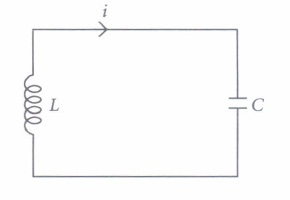
(i) The total energy stored initially is
| (a) 5 J | (b) 3 J | (c) 10 J | (d) 1 J |
(ii) The natural frequency of the circuit is
| (a) 159.24 Hz | (b) 200.12 Hz | (c) 110.25 Hz | (d) 95 Hz |
(iii) At what time is the energy stored completely electrical?
| \(\text { (a) } T, 5 T, 9 T\) | \(\text { (b) } \frac{T}{2}, \frac{5 T}{2}, \frac{9 T}{2}\) | (c) 0, T, 2T, 3T | \(\text { (d) } 0, \frac{T}{2}, T, \frac{3 T}{2}\) |
(iv) At what time is the energy stored completely magnetic?
| \(\text { (a) } \frac{T}{2}, \frac{3 T}{2}, \frac{T}{4}\) | \(\text { (b) } \frac{T}{3}, \frac{T}{9}, \frac{T}{12}\) | (c) 0, 2T, 3T | \(\text { (d) } \frac{T}{4}, \frac{3 T}{4}, \frac{5 T}{4}\) |
(v) The value of XL is
| \(\text { (a) } 20 \Omega\) | \(\text { (b) } 40 \Omega\) | \(\text { (c) } 60 \Omega\) | \(\text { (d) } 50 \Omega\) |
13.
When a current I flows through a coil, flux linked with it is \(\phi=L I,\) where L is a constant known as self-inductance of the coil. Any change in current sets up an induced emf in the coil. Thus, self-inductance of a coil is the induced emf set up in it when the current passing through it changes at the unit rate. It is a measure of the opposition to the growth or the decay of current flowing through the coil. Also, value of self-inductance depends on the number of turns in the solenoid, its area of cross-section, and the relative permeability of its core material.
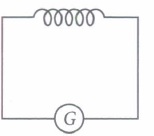
(I) The inductance in a coil plays the same role as
| (a) inertia in mechanics | (b) energy in mechanics |
| (c) momentum in mechanics | (d) force in mechanics |
(ii) A current of 2.5 A flows through a coil of inductance 5 H. The magnetic flux linked with the coil is
| (a) 0.5 Wb | (b) 12.5 Wb | (c) zero | (d) 2 Wb |
(iii) The inductance L of a solenoid depends upon its radius R as
| \(\text { (a) } L \propto R\) | \(\text { (b) } L \propto 1 / R\) | \(\text { (c) } L \propto R^{2}\) | \(\text { (d) } L \propto R^{3}\) |
(iv) The unit of self-inductance is
| (a) weber ampere | (b) weber-1 ampere | (c) ohm second | (d) farad |
(v) The induced e.m.f in a coil of 10 henry inductance in which current varies from 9 A to 4 A in 0.2 second is
| (a) 200 V | (b) 250 V | (c) 300 V | (d) 350 V |
14.
When the atomic dipoles are aligned partially or fully, there is a net magnetic moment in the direction of the field in any small volume of the material. The actual magnetic field inside material placed in magnetic field is the sum of the applied magnetic field and the magnetic field due to magnetisation. This field is called magnetic intensity (H).
\(H=\frac{B}{\mu_{0}}-M\)
where M is the magnetisation of the material, llo is the permittivity of vacuum and B is the total magnetic field. The measure that tells us how a magnetic material responds to an external field is given by a dimensionless quantity is appropriately called the magnetic susceptibility: for a certain class of magnetic materials, intensity of magnetisation is directly proportional to the magnetic intensity.
(i) Magnetization of a sample is
| (a) volume of sample per unit magnetic moment | (b) net magnetic moment per unit volume |
| (c) ratio of magnetic moment and pole strength | (d) ratio of pole strength to magnetic moment |
(ii) Identify the wrongly matched quantity and unit pair.
| (a) Pole strength | Am |
| (b) Magnetic susceptibility | dimensionless number |
| (c) Intensity of magnetisation | A m-1 |
| (d) Magnetic permeability | Henry m |
(iii) A bar magnet has length- 3 cm, cross-sectional area 2 cm2 and magnetic moment 3 A m2. The intensity of magnetisation of bar magnet is
| \(\text { (a) } 2 \times 10^{5} \mathrm{~A} / \mathrm{m}\) | \(\text { (b) } 3 \times 10^{5} \mathrm{~A} / \mathrm{m}\) |
| \(\text { (c) } 4 \times 10^{5} \mathrm{~A} / \mathrm{m}\) | \(\text { (d) } 5 \times 10^{5} \mathrm{~A} / \mathrm{m}\) |
(iv) A solenoid has core of a material with relative permeability 500 and its windings carry a current of 1 A. The number of turns of the solenoid is 500 per metre. The magnetization of the material is nearly
| \(\text { (a) } 2.5 \times 10^{3} \mathrm{Am}^{-1}\) | \(\text { (b) } 2.5 \times 10^{5} \mathrm{~A} \mathrm{~m}^{-1}\) |
| \(\text { (c) } 2.0 \times 10^{3} \mathrm{~A} \mathrm{~m}^{-1}\) | \(\text { (d) } 2.0 \times 10^{5} \mathrm{~A} \mathrm{~m}^{-1}\) |
(v) The relative permeability of iron is 6000. Its magnetic susceptibility is
| (a) 5999 | (b) 6001 |
| (c) 6000 x 10-7 | (d) 6000 x 107 |
15.
16.
17.
18.
19.

20.
Assertion (A) : Radio waves cannot be diffracted by the buildings.
Reason (R) : The wavelength of radio waves is very small
Codes:
(a) Both A and R are true and R is the correct explanation of A
(b) Both A and R are true but R is NOT the correct explanation of A
(c) A is true but R is false
(d) A is false and R is also false
21.
Assertion (A) : In an electromagnetic wave, magnitude of magnetic field vector is much smaller than the magnitude of electric field vector.
Reason (R) : Energy of electromagnetic waves is shared equally by the electric and magnetic fields
Codes:
(a) Both A and R are true and R is the correct explanation of A
(b) Both A and R are true but R is NOT the correct explanation of A
(c) A is true but R is false
(d) A is false and R is also false
22.
Assertion (A) : Step-down transformer increases the current.
Reason (R) : Transformer obeys the law of conservation of energy.
Codes:
(a) Both A and R are true and R is the correct explanation of A
(b) Both A and R are true but R is NOT the correct explanation of A
(c) A is true but R is false
(d) A is false and R is also false
23.
Assertion (A) : The ends of a magnet suspended freely point out always along north south.
Reason (R) : Earth behaves as a huge magnet.
Codes:
(a) Both A and R are true and R is the correct explanation of A
(b) Both A and R are true but R is NOT the correct explanation of A
(c) A is true but R is false
(d) A is false and R is also false
24.
Assertion (A) : The earth's magnetic field is due to iron present in its core.
Reason (R) : At a low temperature magnet losses its magnetic property or magnetism.
Codes:
(a) Both A and R are true and R is the correct explanation of A
(b) Both A and R are true but R is NOT the correct explanation of A
(c) A is true but R is false
(d) A is false and R is also false
1.
(b)
zero, infinity
2.
(c)
-1
3.
(c)
lines of B cannot end on any material and perfect shielding is not possible.
4.
(a)
Lenz's law
5.
(c)
7.85 \(\Omega\)
6.
(c)
Both (a) and (b)
7.
(a)
10 J
8.
(a)
speed of rotation of coil
9.
(d)
both (a) and (b)
10.
(c)
\(\frac { 1 }{ { r }^{ } } \)
11.
(i) (b): Infrared rays can be converted into electric energy as in solar cell.
(ii) (d): Radiowaves have longest wavelength.
(iii) (c) : Cathode rays are invisible fast moving streams of electrons emitted by the cathode of a discharge tube which is maintained at a pressure of about 0.01 mm of mercury.
(iv) (c): \(\Upsilon\)-rays have minimum wavelength
(v) (a): \(\lambda_{\text {micro }}>\lambda_{\text {infra }}>\lambda_{\text {ultra }}>\lambda_{\text {gamma }}\)
12.
(i) (d):Energy, \(E=\frac{1}{2} \frac{Q^{2}}{C}=\frac{\left(10 \times 10^{-3}\right)^{2}}{2 \times 50 \times 10^{-6}}=1 \mathrm{~J}\)
(ii) (a): Frequency \(v=\frac{1}{2 \pi \sqrt{L C}}\)
\(=\frac{1}{2 \pi \sqrt{20 \times 10^{-3} \times 50 \times 10^{-6}}}=\frac{10^{3}}{2 \pi}=159.24 \mathrm{~Hz}\)
(iii) (d): Total time period \(T=\frac{1}{v}=\frac{1}{159.24}=6.28 \mathrm{~ms}\)
Total charge on capacitor at time t \(Q^{\prime}=Q \cos \frac{2 \pi}{T} t\)
For energy stored is electrical, we can write \(Q^{\prime}=\pm Q\)
Hence, energy stored in the capacitor is completely electrical at \(t=0, \frac{T}{2}, T, \frac{3 T}{2}, \ldots .\)
(iv) (d): Magnetic energy is maximum when electrical energy is equal to zero
Hence \(t=\frac{T}{4}, \frac{3 T}{4}, \frac{5 T}{4}\)
(v) (a): \(X_{L}=\omega L=2 \pi \cup L=2 \times 3.14 \times 159.24 \times 20\) x 10-3
\(\Rightarrow \quad X_{L}=20 \Omega\)
13.
(i) (a) :The inductance in a coil plays the same role as inertia in mechanics
(ii) (b) : Here, I = 2.5 A, L = 5 H
Magnetic flux linked with the coil is \(\phi_{B}=L I=(5 \mathrm{H})(2.5 \mathrm{~A})=12.5 \mathrm{~Wb}\)
(iii) (c) : The inductance of a solenoid is \(L=\mu_{0} n^{2} A l\)
where A is the area of cross-section of the solenoid, I its length and n is the number of turns per unit length.
As \(A=\pi R^{2}\) where R is the radius of the solenoid.
\(\therefore \ L=\mu_{0} n^{2} \pi R^{2} l \Rightarrow L \propto R^{2}\)
(iv) (c) : The magnitude of induced emf is \(|\varepsilon|=L \frac{d I}{d t} \Rightarrow L=\frac{|\varepsilon| d t}{d I}\)
or \(L=\frac{\text { volt } \times \text { second }}{\text { ampere }}=\text { ohm second }\)
(v) (b) : Here L = 10 henry I1 = 9 A, I2 = 4 A
and \(\Delta t=0.2 \text { second }\)
Then induced e.m.f.
\(\varepsilon_{1}=-L \frac{d I}{d t}=-L \frac{\left(I_{2}-I_{1}\right)}{\Delta t}=\frac{-10 \times(4-9)}{0.2}=\frac{50}{0.2}=250 \mathrm{~V}\)
14.
(i) (b)
(ii) (d): Magnetic permeability - Henry m-1
(iii) (d): Given, L= 3 cm, A = 2 cm2, M = 3 A m2
.Intensity of magnetisation \(=\frac{M}{l A}=\frac{3}{3 \times 10^{-2} \times 2 \times 10^{-4}}\)
\(=\frac{1}{2 \times 10^{-6}}=0.5 \times 10^{6}=5 \times 10^{5} \mathrm{~A} / \mathrm{m}\)
(iv) (b): Here, n = 500 turns/m
\(I=1 \mathrm{~A}, \mu_{-}=500\)
Magnetic intensity \(H=n I=500 \mathrm{~m}^{-1} \times 1 \mathrm{~A}=500 \mathrm{~A} \mathrm{~m}^{-1}\)
As \(\mu_{r}=1+\chi \quad \text { or } \chi=\left(\mu_{r}-1\right)\)
Magnetisation, M = XH
\(=\left(\mu_{r}-1\right) H=(500-1) \times 500 \mathrm{~A} \mathrm{~m}^{-1}\)
\(=2.495 \times 10^{5} \mathrm{~A} \mathrm{~m}^{-1} \approx 2.5 \times 10^{5} \mathrm{~A} \mathrm{~m}^{-1}\)
(v) (a): Relative permeability of iron \(\mu_{r}=6000\)
Magnetic susceptibility \(\chi_{m}=\mu_{r}-1=5999\)
15.
16.
17.
18.
19.
20.
(d): For wave to suffer diffraction, the wavelength should be of the order of size of the obstacle. The wavelength of radio waves (short radio waves) is order of the size of the building and the other obstacles coming in their path and hence they easily get diffracted.
21.
(b): At every instant the ratio of the magnitudes of the electrip field to the magnetic field of an em wave is given by E/B = c.
From this equation, the magnitude of electric vector is much greater than the magnitude of magnetic vector. Also electromagnetic waves, carry energy which is equally shared by electric and magnetic field.
22.
(b): If there is no loss of energy in transformer, then instantaneous output power is equal to instantaneous input power. From this we get \(\frac{e_{s}}{e_{p}}=\frac{I_{p}}{I_{s}}\) So in step up transformer voltage illlcreases by decreasing the current. Similarly, step-down transformer decreases the voltage by increasing current. Therefore transformer simply transforms the voltage and current, obeying the law of conservation of energy.
23.
(a): Earth's magnetic field can be represented as the field of a huge bar magnet. If the magnet is freely suspended its north-pole points towards geographic north pole (really a south magnet pole of earth).
24.
(d): The temperature inside the earth is so high that it is impossible for iron core to behave as a magnet and act as a source of magnetic field. The magnetic field of earth ig.considered to be due to circulating
electric current in the iron (in molten state) and other conducting materials inside the earth.

12th Standard CBSE Syllabus & Materials
12th Standard CBSE
CBSE 12th Computer Science Python Revision Tour I - New Previous year Question Papers Study Material - QB365 Set A
NEW12th Standard CBSE
CBSE 12th Business Studies Planning Important Questions And Answers Study Material - QB365 Set A
NEW12th Standard CBSE
CBSE 12th Business Studies Business Environment Important Questions And Answers Study Material - QB365 Set A
NEW12th Standard CBSE
CBSE 12th Business Studies Principles of Management Important Questions And Answers Study Material - QB365 Set A



NCERT Books

Syllabus

Exam Pattern

Sample Question Papers

Previous year Question Papers

Important Notes

MCQ Practice test

NCERT Exemplers

Case study Questions

Image Based Questions

Passage based Questions

HOT Questions

Value Based Questions

Model Questions Papers
NCERT ( Book Back ) Questions

Assertion and Reason
Important Questions And Answers

CBSE 12th Standard CBSE Subjects
CBSE Standards








