
 100% FREE ACCESS
12th Standard CBSE Syllabus & Materials
12th Standard CBSE
CBSE 12th Economics Government Budget and the Economy Previous year Question Papers Study Material - QB365 Set A
NEW12th Standard CBSE
CBSE 12th Computer Science Interface Python with MySQL - New Previous year Question Papers Study Material - QB365 Set A
NEW12th Standard CBSE
CBSE 12th Computer Science Database Concept - New Previous year Question Papers Study Material - QB365 Set A
NEW12th Standard CBSE
CBSE 12th Computer Science Data Communication - New Previous year Question Papers Study Material - QB365 Set A
NEW12th Standard CBSE
CBSE 12th Computer Science Data Structures - New Previous year Question Papers Study Material - QB365 Set A
NEW12th Standard CBSE
CBSE 12th Computer Science Functions - New Previous year Question Papers Study Material - QB365 Set A

Published on: 25/10/2025
Download CBSE Class 12th Standard CBSE Physics question papers, sample papers, important questions, and previous year solved papers in PDF format. Get free study materials, NCERT solutions, and exam preparation resources for Class 12th Standard CBSE Physics
Questions + Answers key
Take MCQ Physics Test
1.
What is the angle of dip at a place where the horizontal and vertical components of the earth's magnetic field are equal?
2.
If a toroid uses bismuth for its core, will the field in the core be (slightly) greater or (slightly) less than when the core is empty?
3.
At a place, the horizontal component of earth's magnetic field is B and angle of dip is 60°. What is the value of horizontal component of the earth's magnetic field at equator?
4.
If the solenoid in Exercise 5.5 is free to turn about the vertical direction and a uniform horizontal magnetic field of 0.25 T is applied, what is the magnitude of torque on the solenoid when its axis makes an angle of 30° with the direction of applied field?
5.
A short bar magnet placed with its axis at 30º with a uniform external magnetic field of 0.25 T experiences a torque of magnitude equal to 4.5 x 10⁻² J. What is the magnitude of magnetic moment of the magnet?
6.
Deduce the expression for the magnetic dipole moment of an electron orbiting around the central nucleus.
7.
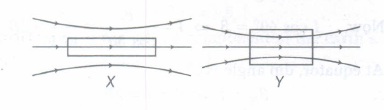
When two materials are placed in an external magnetic field, the behaviour of magnetic field lines is as shown in the figure. Identify the magnetic nature of each of these two materials.
8.
A uniform conducting wire of length 12 a and resistance R is wound up as a current carrying coil in the shape of
(i) an equilateral triangle of side a,
(ii) a square of sides a and
(iii) a regular hexagon of side a. The coil is connected to a voltage source Vo. Find the magnetic moment of the coils in each case.
9.
Two identical magnets with a length 100 cm are arranged freely with their like poles facing in a vertical glass tube. The upper magnet hangs in air above the lower one so that the distance between the nearest poles of the magnet is 3 mm. If the pole strength of the pole of these magnets is 6.64 A-m, then determine the force between the two magnets.
10.
A magnetic needle free to rotate in a vertical plane parallel to the magnetic meridian has its north tip pointing down at 22º with the horizontal. The horizontal component of the earth’s magnetic field at the place is known to be 0.35 G. Determine the magnitude of the earth’s magnetic field at the place.
11.
If a ferromagnetic material is inserted in a current carrying solenoid, the magnetic field of solenoid
largely increases
slightly increases.
largely decreases
slightly decreases
12.
At a certain place on earth, \(\boldsymbol{B}_{\boldsymbol{H}}=\frac{\mathbf{1}}{\sqrt{\mathbf{3}}} \boldsymbol{B}_{\boldsymbol{V}}\) angle of dip at this place is
60°
30°
45°
90°
13.
A diamagnetic material in a magnetic field moves
perpendicular to the field
from weaker to stronger parts
from stronger to weaker parts.
in random direction.
14.
In which type of material the magnetic susceptibility does not depend on temperature
Diamagnetic
Paramagnetic
Ferromagnetic
Ferrite
15.
If the magnetising field on a ferromagnetic material is increased, its permeability
is decreased
is increased
is unaffected
may be increased or decreased
16.
If M is magnetic moment and B is magnetic field intensity, then the torque is given by
\(\overline{\mathbf{M}} \cdot \overline{\mathbf{B}}\)
\(\frac{|\overline{\mathbf{M}}|}{|\overline{\mathbf{B}}|}\)
\(\overline{\mathbf{M}} \times \overline{\mathbf{B}}\)
MB
17.
Consider the two idealized systems: (i) a parallel plate capacitor with large plates and small separation and (ii) a long solenoid of length L >> R, radius of cross-section. In (i) E is ideally treated as a constant between plates and zero outside. In (ii) magnetic field is constant inside the solenoid and zero outside. These idealised assumptions, however, contradict fundamental laws as below.
case (i) contradicts Gauss's law for electrostatic fields.
case (ii) contradicts Gauss's law for magnetic fields.
case (i) agrees with \(\int E . d l=0 .\)
case (ii) contradicts \(\int \boldsymbol{H} . d l=I_{e n}\)
18.
To make electromagnet, substance should be of
high permeability and high susceptibility
low permeability and high susceptibility
high permeability and low susceptibility
low permeability and low susceptibility
19.
The earth's magnetic field at the equator is approximately 0.4 G, the earth's dipole moment is
1 x 10²³ Am 2
1.05 x 10²³ Am 2
8 x 10²² Am 2
4 x 10² Am 2
20.
A large magnet is broken into two pieces so that their lengths are in the ratio 2 : 1. The pole strengths of the two pieces will have ratio.
2: 1
1: 2
4: 1
1: 1
1.
Angle of dip is 45°.
2.
Bismuth is a diamagnetic material. So, when it is kept in an external magnetic field the field lines are repelled and the field inside the material is reduced.
3.

I is the total magnetic field.
Now, \(I \cos 60^{\circ}=B \Rightarrow I=\frac{B}{\cos 60^{\circ}}=\frac{B}{1 / 2}=2 B\)
At equator, dip angle is 0o
\(\therefore B H=1 \cos 0^{\circ}=1=2 B .\)
4.
Magnetic field strength, B = 0.25 T
Magnetic moment, M = 0.6 T-1
The angle θ, between the axis of the solenoid and the direction of the applied field, is 30°.
Therefore, the torque acting on the solenoid is given as:
\(\tau\) = MB sinθ
= 0.6 x 0.25 sin30°
= 7.5 x 10⁻² J
5.
Magnetic field strength, B = 0.25 T
Torque on the bar magnet, T = 4.5 x 10⁻² J
The angle between the bar magnet and the external magnetic field, θ = 30°
Torque is related to magnetic moment (M) as:
\(T=M B \sin \theta \therefore M=\frac{T}{B \sin \theta}\)
\(=\frac{4.5 \times 10^{-2}}{0.25 \times \sin 30^{\circ}}=0.36 J T^{-1}\)
Hence, the magnetic moment of the magnet is 0.36 J T-1.
6.
Consider an electron revolving around the nucleus of an atom. The electron is in a uniform circular motion around the nucleus of charge +Ze. This constitutes a current.
\(\therefore \ I=\frac{e}{T}\) .......(i)
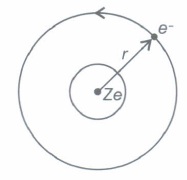
If r is the orbital radius of the electron and 'v' is the orbital speed, then the time period is given as
\(T=\frac{2 \pi r}{v}\) ............(ii)
From equations (i) and (ii), we get
\(I=\frac{e v}{2 \pi r}\) ............(iii)
As the magnetic moment is given by
\(\mu_{l}=I \pi r^{2}\)
We have \(\mu_{l}=\left(\frac{e v}{2 \pi r}\right) \pi r^{2}=\frac{e v r}{2}\)
Multiplying and dividing by me in above equation, we get
\(\mu_{l}=\frac{e v m_{e} r}{2 m_{e}}=\frac{e}{2 m_{e}} l\)
where I is the angular momentum of the electron.
Since magnetic dipole moment and angular momentum are oppositely directed,
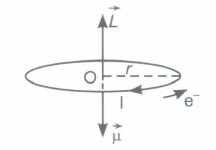
\(\therefore \ \overrightarrow{\mu_{e}}=-\frac{e}{2 m_{e}} \vec{L}\)
According to the Bohr hypothesis, the angular momentum can have discrete values only.
\(\text { i.e. } l=\frac{n h}{2 \pi}\)
So, \(\mu_{l}=\frac{e n h}{2 \pi(2 m)}=\frac{n e h}{4 \pi m}\)
In this case it is directed into the plane of the paper.
7.
(i) Material X is paramagnetic substance. When a specimen of a paramagnetic substance is placed in a magnetising field, the lines of force prefer to pass through the specimen rather than through air. Thus, magnetic induction inside the sample is more than the magnetic intensity.
(ii) Material Y is ferromagnetic substance. These are the substances in which a strong magnetism is produced in the same direction as the applied magnetic field, these are strongly attracted by a magnet, exhibits highly concentrated lines of force.
8.
We know that magnetic moment of the coil M = NIA. Since, the same wire is used in three cases with same potentials, therefore, same current flows in three cases.
The different shapes form figures of different area and hence, their magnetic moments vary.
(i) For an equilateral triangle of side a,
N = 4, as the total wire of length = 12a Magnetic moment of the coil,
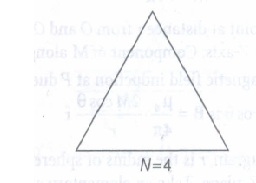
\(M=N I A=4 I\left(\frac{\sqrt{3}}{4} a^{2}\right)\)
\(\Rightarrow\) \(M=I a^{2} \sqrt{3}\)
(ii) For a square of side a, A = a2
N = 3, as the total wire oflength = 12a Magnetic moment of the coil,
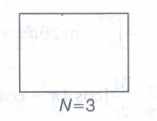
M = NLA = 3I (a2 ) = 3I a2
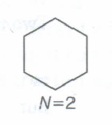
(iii) For a regular hexagon of sides a,
N = 2, as the total wire' of length = 12a Magnetic moment of the coils,
\(M=N I A=2 I\left(\frac{6 \sqrt{3}}{4} a^{2}\right)=3 \sqrt{3} a^{2} I\)
\(\therefore\) M is in a geometric series.
9.
Given, pole strength, m = 6.64 A-m
r = 3mm = 3 x 10⁻³m
\(\text { Since, force, } F=\frac{\mu_{0}}{4 \pi} \times \frac{m_{1} m_{2}}{r^{2}}\)
\(\therefore \quad F=\frac{\mu_{0}}{4 \pi} \times \frac{m^{2}}{r^{2}}\) \(\left[\because m_{1}=m_{2}=m\right]\)
\(=\frac{\mu_{0}}{4 \pi} \times \frac{(6.64)^{2}}{\left(3 \times 10^{-3}\right)^{2}}\)
\(=\frac{4 \pi \times 10^{-7}}{4 \pi} \times \frac{44.0896}{9 \times 10^{-6}}=10^{-1} \times 4.8988\)
= 0.49N
10.
Horizontal component of earth’s magnetic field, H = 0.35G
Angle made by the needle with the horizontal plane = Angle of dip = δ = 22°
Earth’s magnetic field strength = B
We can relate B and BH as:
\(B_{H}=B \cos \delta \therefore B=\frac{B_{H}}{\cos \delta}\)
\(=\frac{0.35}{\cos 22^{\circ}}=0.38 \mathrm{G}\)
Hence, the strength of the earth’s magnetic field at the given location is 0.38 G.
11.
(a)
largely increases
12.
(a)
60°
13.
(c)
from stronger to weaker parts.
14.
(a)
Diamagnetic
15.
(a)
is decreased
16.
(c)
\(\overline{\mathbf{M}} \times \overline{\mathbf{B}}\)
17.
(b)
case (ii) contradicts Gauss's law for magnetic fields.
18.
(a)
high permeability and high susceptibility
19.
(b)
1.05 x 10²³ Am 2
20.
(d)
1: 1

12th Standard CBSE Syllabus & Materials
12th Standard CBSE
CBSE 12th Computer Science Python Revision Tour I - New Previous year Question Papers Study Material - QB365 Set A
NEW12th Standard CBSE
CBSE 12th Business Studies Planning Important Questions And Answers Study Material - QB365 Set A
NEW12th Standard CBSE
CBSE 12th Business Studies Business Environment Important Questions And Answers Study Material - QB365 Set A
NEW12th Standard CBSE
CBSE 12th Business Studies Principles of Management Important Questions And Answers Study Material - QB365 Set A



NCERT Books

Syllabus

Exam Pattern

Sample Question Papers

Previous year Question Papers

Important Notes

MCQ Practice test

NCERT Exemplers

Case study Questions

Image Based Questions

Passage based Questions

HOT Questions

Value Based Questions

Model Questions Papers
NCERT ( Book Back ) Questions

Assertion and Reason
Important Questions And Answers

CBSE 12th Standard CBSE Subjects
CBSE Standards








