
 100% FREE ACCESS
12th Standard CBSE Syllabus & Materials
12th Standard CBSE
CBSE 12th Economics Government Budget and the Economy Previous year Question Papers Study Material - QB365 Set A
NEW12th Standard CBSE
CBSE 12th Computer Science Interface Python with MySQL - New Previous year Question Papers Study Material - QB365 Set A
NEW12th Standard CBSE
CBSE 12th Computer Science Database Concept - New Previous year Question Papers Study Material - QB365 Set A
NEW12th Standard CBSE
CBSE 12th Computer Science Data Communication - New Previous year Question Papers Study Material - QB365 Set A
NEW12th Standard CBSE
CBSE 12th Computer Science Data Structures - New Previous year Question Papers Study Material - QB365 Set A
NEW12th Standard CBSE
CBSE 12th Computer Science Functions - New Previous year Question Papers Study Material - QB365 Set A

Published on: 25/10/2025
Download CBSE Class 12th Standard CBSE Physics question papers, sample papers, important questions, and previous year solved papers in PDF format. Get free study materials, NCERT solutions, and exam preparation resources for Class 12th Standard CBSE Physics
Questions + Answers key
Take MCQ Physics Test
1.
What will happen if emitter as well as collector in a transistor are forwarded biased?
2.
A circular coil of 300 turns and diameter 14 cm carries a current of 15 A. What is the magnetic moment of the loop ?
3.
The core of a toroid having 3000 turns has inner and outer radii of 11cm and 12 cm respectively.The magnetic field in the core for a current of 0.70A is 2.5T.What is the relative permeability of the core?
4.
Magnetic field lines can be neither emanate from a point nor end on a point. Yet the field lines outside a bar magnet do seem to start from the North pole and end on the South pole. Does the second fact contradict the first? Explain.
5.
The number density of free electrons in a copper conductor estimated is \(8.5\times { 10 }^{ 28 }{ m }^{ -3 }\). How long does an electron take in drifting from one end of a wire 3.0m long to its other end? The area of cross-section of the wire is \(2.0\times { 10 }^{ -6 }{ m }^{ 2 }\) and it is carrying a current of 3.0 A.
6.
A regular hexagon of side 10 cm has a charge 5\(\mu\) C at each of its vertices. Calculate the potential at the centre of the hexagon.
7.
At room temperature (27.0oC) the resistance of a heating element is 100 \(\Omega\). What is the temperature of the element if the resistance is found to be 117\(\Omega\) given that the temperature coefficient of the material of the resistor is 1.70 x 10⁻⁴ oC-1.
8.
A closely wound solenoid 80 cm long has 5 layers of windings of 400 turns each. The diameter of the solenoid is 1.8 cm. If the current carried is 8.0 A, estimate the magnitude of B inside the solenoid near its centre.
9.
(a) calculate the potential at a point P due to a charge of \(4\times 10^{-7}C\) located 9 cm away.
(b) Hence obtain the work done in bringing a charge of \(2\times 10^{-9}C\) from infinity to the point P. Does the answer depend on the path along which the charge is brought?
10.
A heating element using nichrome connected to a 230 V supply draws an initial current of 3.2 A which settles after a few seconds to a steady value of 2.8 A. What is the steady temperature of the heating element if the room temperature is \({ 27.0 }^{ \circ }C\)? Temperature coefficient of resistance of nichrome averaged over the temperature range involved is \(1.70\times { 10 }^{ -4\circ }{ C }^{ -1 }\)?
11.
The magnetic field in a plane electromagnetic wave is given by By = (2 × 10⁻⁷) T sin (0.5 x10³x + 1.5 x 10¹¹t) .
(a) What is the wavelength and frequency of the wave?
(b) Write an expression for the electric field.
12.
(a) In the electron drift speed is estimated to be only a few mm s-1 for currents in the range of a few amperes? How then is current established almost the instant a circuit is closed?
(b) The electron drift arises due to the force experienced by electrons in the electric field inside the conductor. But force should cause acceleration. Why then do the electrons acquire a steady average drift speed?
(c) If the electron drift speed is so small, and the electron’s charge is small, how can we still obtain large amounts of current in a conductor?
(d) When electrons drift in a metal from lower to higher potential, does it mean that all the ‘free' electrons of the metal are moving in the same direction?
(e) Are the paths of electrons straight lines between successive collisions (with the positive ions of the metal) in the
(i) absence of electric field,
(ii) presence of electric field?
13.
The storage battery of a car has an emf of 12 V. If the internal resistance of the battery is 0.4\(\Omega \), what is the maximum current that can be drawn from the battery?
14.
(a) When monochromatic light is incident on a surface separating two media, the reflected and refracted light both have the same frequency as the incident frequency. Explain why?
(b) When light travels from a rarer to a denser medium, the speed decreases. Does the reduction in speed simply a reduction in the energy caried by the light wave?
(c) In the wave picture of light, intensity of light is determined by the square of the amplitude of the wave What determines the intensity of light in the photon picture of light.
15.
In a parallel plate capacitor with air between the plates, each plate has an area of 6\(\times\)10-3m2 and the distance between the plates is 3 mm. Calculate the capacitance if this capacitor. If this capacitor is connected to a 100 V supply, what is the charge on each plate of the capacitor?
16.
A current carrying wire kept in a uniform magnetic field will experience a maximum force, when it is
perpendicular to the magnetic field
parallel to the magnetic field
at an angle of 45° to the magnetic field
at an angle of 60° to the magnetic field
17.
If photons of frequency v are incident on the surfaces of metals A and B of threshold frequencies \(\frac{v}{2} \text { and } \frac{v}{3}\) respectively, the ratio of the maximum kinetic energy of electrons emitted from A to that from B is
2 : 3
3 : 4
1 : 3
\(\sqrt{3}: \sqrt{2}\)
18.
When unpolarised light beam is incident from air onto glass (n = 1.5) at the polarising angle.
Reflected beam is polarised completely
Reflected and refracted beams are partially polarised
Refracted beam is plane polarised
Whole beam of light is refracted
19.
If the magnitude of both charges and distance are doubled. the li»rce between two charges will be
Doubled
Tripled
Quadrupled
Remains unchanged
20.
The resolving power of teleoscope is
Directly proportional to the diameter (aperture) of the objective lens and inversely proportional to the wavelength of light used
Directly proportional to the diameter of the objective lens and also directly proportional to the wavelength of the light used
Directly proportional to the wavelength of light used and inversely proportional to the diameter of the objective lens
None of these
21.
The electric field at a point is
always continuous
continuous if there is no charge at that point
discontinuous only if there is a negative charge at that point
discontinuous if there is a charge at that point
22.
A conducting wire of length l is turned in the form of a circular coil and a current I is passed through it. For the torque, due to magnetic field produced at its centre, to be maximum, the number of turns in the coil will be
one
two
three
more than three.
23.
Proton, Deuteron and alpha particle of the same kinetic energy are moving in circular trajectories in a constant magnetic field. The radii of proton, deuteron and alpha particle are respectively \({ r }_{ p },{ r }_{ d }\quad and\quad { r }_{ \alpha }.\) Which one of the following relations is correct?
\({ r }_{ \alpha }={ r }_{ p }={ r }_{ d }\)
\({ r }_{ \alpha }={ r }_{ p }<{ r }_{ d }\)
\({ r }_{ \alpha }{ >r }_{ d }>{ r }_{ p }\)
\({ r }_{ \alpha }{ =r }_{ d }>{ r }_{ p }\)
24.
An electric charge + q moves with velocity \(\vec { \upsilon } =3\hat { i } +4\hat { j } +\hat { k } ,\) in an electromagnetic field give \(\vec { E } =3\hat { i } +\hat { j } +2\hat { k } ,\quad \vec { B } =\hat { i } +\hat { j } -3\hat { k } .\)They y-component of the force experienced by + q is
2 q
11 q
5 q
3 q
25.
A long straight wire of radius a carries a steady current i. The current is uniformly distributed across its cross-section. The ratio of the magnetic field at a/2 and 2 a is
1/2
1/4
4
1
26.
A npn transistor is connected in common emitter configuration in a give amplifier. A load resistance of \(800\Omega \) is connected in the collector circuit and the voltage drop across is 0.8 V. If the current amplification factor is 0.96 and the input resistance of the circuit is \(192 \ \Omega \), the voltage gain and the power gain of the amplifier will respectively be
4,3.84
3.69, 3.84
4, 4
4,3.69
27.
The ratio between masses of two particles is 1:2 and ratio between their temperatures is also 1:2 The ratio between their de-Broglie wavelength
1:2
2:1
1:3
3:1
28.
When a forward bias is applied to p-n junctions it
raises the potential barrier
reduces the majority carrier to zero
lower the potential barrier
None of these
29.
The total e.m. power of the sun is
\(5.6\times { 10 }^{ 20 }W\)
\(5.6\times { 10 }^{ 22 }W\)
\(5.6\times { 10 }^{ 26 }W\)
\(5.6\times { 10 }^{ 30 }W\)
30.
If \({ u }_{ E },{ u }_{ m }\) are the energy density of electromagnetic wave due to electric and magnetic field vectors, \({ E }_{ rms },{ B }_{ rms }\) are the rms value of electric and magnetic field vectors in an electromagnetic wave. then the total energy density of a sinusoidal electromagnetic wave is
\({ u }_{ E }\)
\({ u }_{ E }{ +u }_{ m }\)
\(\frac { 1 }{ 2 } { \epsilon }_{ 0 }{ E }_{ rms }^{ 2 }+\frac { { E }_{ rms }^{ 2 } }{ { 2\mu }_{ 0 } } \)
\(\frac { 1 }{ 2 } { \epsilon }_{ 0 }{ E }_{ 0 }^{ 2 }+\frac { 1 }{ 2 } \frac { { E }_{ 0 }^{ 2 } }{ { \mu }_{ 0 } } \)
31.
Figure below shows the parts of the electromagnetic spectrum.

(i) Name one type of radiation that has
(a) a higher frequency than ultraviolet.
(b) used in luggage security checks at airports
(c) Which part of spectrum is missing in the given figure? Write one use of this part.
(ii) Some \(\gamma\)-rays emitted from a radioactive source has a speed in air of 3.0 x 10⁸ m/s and a wavelength of 1.0 x 10- 12 m.
Calculate the frequency of the \(\gamma\)-rays.
32.
Various methods can be used to measure the mass of an atom. One possibility is through the use of a mass spectrometer. The basic feature of a Banbridge mass spectrometer is illustrated in figure. A particle carrying a charge +q is first sent through a velocity selector and comes out with velocity v = E/B.
The applied electric and magnetic fields satisfy the relation E = vB so that the trajectory of the particle is a straight line. Upon entering a region where a second magnetic field \(\vec{B}_{0}\) pointing into the page has been applied, the particle will move in a circular path with radius r and eventually strike the photographic plate.
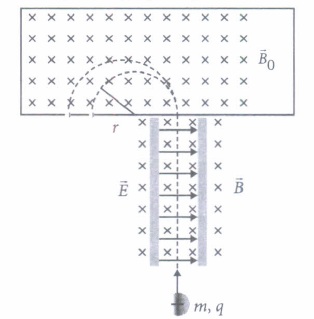
(i) In mass spectrometer, the ions are sorted out in which of the following ways?
| (a) By accelerating them through electric field |
| (b) By accelerating them through magnetic field |
| (c) By accelerating them through electric and magnetic field |
| (d) By applying a high voltage |
(ii) Radius of particle in second magnetic field Bo is
| \(\text { (a) } \frac{2 m v}{q E_{0}}\) | \(\text { (b) } \frac{m v}{q E_{0}}\) | \(\text { (c) } \frac{m v}{q B_{0}}\) | \(\text { (d) } \frac{2 m E_{0} v}{q B_{0}}\) |
(iii) Which of the following will trace a circular trajectory wit largest radius?
| (a) Proton | (b) -\(\alpha\)particle | (c) Electron | (d) A particle with charge twice and mass thrice that of electron |
(iv) Mass of the particle in terms q, Bo, B,r and E is
| \(\text { (b) } \frac{q B_{0} B r}{E}\) | \(\text { (c) } \frac{q B r}{E B_{0}}\) | \(\text { (d) } \frac{q B r E}{B_{0}}\) |
(v) The particle comes out of velocity selector along a straight line, because
| (a) electric force is less than magnetic force | (b) electric force is greater than magnetic force |
| (c) electric and magnetic force balance each other | (d) can't say. |
1.
In this situation, the majority charge carriers will flow in the emitter-base circuit and also in the collector-base circuit, In this case, the working of transistor will be equivalent to two \(p-n\) junction diodes with a common base. It means the purpose of transistor will be defeated.
2.
Here, N = 300, \(r=\frac { 14 }{ 2 } \) = 7 cm = 7 x 10⁻² m,
I = 15 A
\(M=NIA=NI\left( \pi { r }^{ 2 } \right) \)
\(=300\times 15\times \frac { 22 }{ 7 } \times { \left( 7\times { 10 }^{ -2 } \right) }^{ 2 }\)
M = 69.3 JT-1
3.
The magnetic field in the empty space enclosed by the windings of the toroid is given by
\(B={ \mu }_{ 0 }nI\)
where n is the number of turns per unit length and I is the current.If space is filled by a core of permeability \(\mu \)the formula modifies to
\( d B=\mu nI\)
\(\\ here \ B=2.5T,I=0.70A\)
\(n=\frac { 3000 }{ 2\pi \times 11.5\times { 10 }^{ -5 } } { m }^{ -1 }\ \)
where we have ignored the variation os B across the cross-section of the toroid and taken the radius of the toroid to be the mean of inner and outer radii.We then have
\(\mu =\frac { B }{ nI } =8.61\times { 10 }^{ -4 }{ TmA }^{ -1 }\quad \)
The relative permeability of the core is defined to be \(\frac { \mu }{ { \mu }_{ 0 } } \)
with \({ \mu }_{ 0 }=4\pi \times { 10 }^{ -7 }{ TmA }^{ -1 }\)
we get \(\frac { \mu }{ { \mu }_{ 0 } } =685\)
4.
There is no contradiction. Field lines inside the bar go away from S towards N. The next flux of B over any surface fully enclosing N or S must be identically zero.
5.
Number density of free electrons in a copper conductor, n = 8.5 x 1028 m-3 Length of the copper wire, l = 3.0 m
Area of cross-section of the wire, A = 2.0 x 10⁻⁶ m2
Current carried by the wire, I = 3.0 A, which is given by the relation,
I = nAeVd
Where,
e = Electric charge = 1.6 x 10⁻¹⁹ C
Vd = Drift velocity = \(\frac{\text { Length of the wire (l) }}{\text { Time taken to cover l(t) }}\)
\(I=n A e \frac{l}{t}\)
\(t=n A e \frac{l}{I}\)
\(=\frac{3 \times 8.5 \times 10^{28} \times 2 \times 10^{-6} \times 1.6 \times 10^{-19}}{3.0}\)
\(=2.7 \times 10^{4} s\)
Therefore, the time taken by an electron to drift from one end of the wire to the other is 2.7 x 10⁴ s.
6.
ABCDEF is a regular hexagon of side 10 cm each. At each corner, the charge q =5 \(\mu\)C is placed. O is the centre of the hexagon.
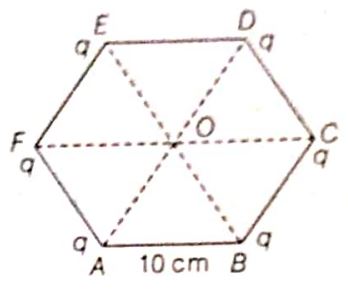
Given, AB = BC = CD = DE
= EF = FA = d = 10 cm
As, the hexagon has six equilateral triangles, so the distance of centre O from every vertex is 10 cm.
i.e. OA = OB = OC = OD
= OE = OF = d = 10 cm
\(\therefore\) Potential at point O = Sum of potentials at centre O due to individual point charge
i.e. VO = VA + VB + VC + VD + VE + VF
\(=\frac{1}{4\pi \varepsilon_{0}}.\left [ \frac{q}{OA}+\frac{q}{OB}+\frac{q}{OC}+\frac{q}{OD}+\frac{q}{OE}+\frac{q}{OF} \right ]\)
\(=\frac{1}{4\pi \varepsilon _{0}}.\frac{6q}{d}\) \(\left [ \because V=\frac{1}{4\pi \varepsilon _{0}.\frac{q}{r}} \right ]\)
Putting the values, we get
\(=9\times 10^{9}\times \frac{6\times 5 \times 10^{-6}}{10\times 10^{-2}}\)
= 2.7 \(\times\)106 V
7.
Given, resistance of heating element at temperature 27°C,
R27 = 100 \(\Omega\)
Resistance of heating element at temperature t°C,
Rt = 117 \(\Omega\)
\(\alpha\)=1.70 \(\times\)10-4 °C-1, t = ?
By using the formula of temperature coefficient of resistance,
\(\alpha=\frac{R_2-R_1}{R_1\left(t_2-t_1\right)}\) ...(i)
Here, R1 = Rt, R1 = R27, t2 = t and t1 = 27°C
Such that, \(\alpha=\frac{R_t-R_{27}}{R_{27}(t-27)}\)
Substituting given values in Eq. (i), we get
\(\begin{aligned} 1.70 \times 10^{-4} & =\frac{117-100}{100(t-27)} \\ \end{aligned}\)
\(\begin{aligned} \text { or } \quad t-27 & =\frac{17}{100 \times 1.70 \times 10^{-4}} \end{aligned}\)
or t = 1000 + 27 = 1027°C
8.
Length of the solenoid, l = 80 cm = 0.8 m
There are five layers of windings of 400 turns each on the solenoid.
∴ Total number of turns on the solenoid, N = 5 x 400 = 2000
Diameter of the solenoid, D = 1.8 cm = 0.018 m
Current carried by the solenoid, I = 8.0 A
Magnitude of the magnetic field inside the solenoid near its centre is given by the relation,
\(B=\frac{\mu_{0} N I}{l}\)
Where,
μ0 = Permeability of free space = 4π x 10–7 T m A–1
\(B=\frac{4 \pi \times 10^{-7} \times 2000 \times 8}{0.8}\)
\(=8 \pi \times 10^{-3}=2.512 \times 10^{-2} T\)
Hence, the magnitude of the magnetic field inside the solenoid near its centre is 2.512 x 10⁻² T.
9.
\(V=\frac{1}{4 \pi \varepsilon_{0}} \frac{Q}{r}=9 \times 10^{9} \mathrm{Nm}^{2} \mathrm{C}^{-2} \times \frac{4 \times 10^{-7} \mathrm{C}}{0.09 \mathrm{~m}}\)
= 4 x 10⁴ V
(b) W = qV = 2 x 10−9C x 4 x 104 V
= 8 x 10⁻⁵ J
No, work done will be path independent. Any arbitrary infinitesimal path can be resolved into two perpendicular displacements: One along r and another perpendicular to r. The work done corresponding to the later will be zero.
10.
Given, potential difference = 230 V
Initial current at 27°C = I27°C = 3.2 A
Final current at t°C = It°C = 2.8 A
Room temperature = 27°C
Temperature coefficient of resistance, \(\alpha=1.70 \times 10^{-4}{ }^{\circ} \mathrm{C}^{-1}\)
Resistance at 27°C, R27°C\(=\frac{V}{I_{27^{\circ} \mathrm{C}}}=\frac{230}{3.2}=\frac{2300}{32} \Omega\)
Resistance at t°C, Rt°C = \(\frac{V}{I_{t^{\circ} \mathrm{C}}}=\frac{230}{2.8}=\frac{2300}{28} \Omega\)
Temperature coefficient of resistance
\(\begin{aligned} \alpha & =\frac{R_t-R_{27}}{R_{27}(t-27)} \end{aligned}\)
\(\begin{aligned} \Rightarrow 1.70 \times 10^{-4} & =\frac{\frac{2300}{28}-\frac{2300}{32}}{\frac{2300}{32}(t-27)} \\ \end{aligned}\)
\(\begin{aligned} \text { or } \quad t-27 & =\frac{82.143-71.875}{71.875 \times 1.70 \times 10^{-4}}=840.347 \end{aligned}\)
or t = 840.3 + 27 = 867.3 °C
Thus, the steady temperature of heating element is 867.3 °C
11.
(a) Comparing the given equation with
\(B_{y}=B_{0} \sin \left[2 \pi\left(\frac{x}{\lambda}+\frac{t}{T}\right)\right]\)
We get, \(\lambda=\frac{2 \pi}{0.5 \times 10^{3}} \mathrm{~m}=1.26 \mathrm{~cm}\)
and \(\frac{1}{T}=v=\left(1.5 \times 10^{11}\right) / 2 \pi=23.9 \mathrm{GHz}\)
(b) E0 = B0c = 2 x 10–7 T x 3 x 108 m/s = 6 x 101 V/m
The electric field component is perpendicular to the direction of propagation and the direction of magnetic field. Therefore, the electric field component along the z-axis is obtained as
Ez = 60 sin (0.5 x 10³x + 1.5 x 10¹¹ t) V/m.
12.
(a) Electric field is established throughout the circuit, almost instantly (with the speed of light) causing at every point a local electron drift. Establishment of a current does not have to wait for electrons from one end of the conductor travelling to the other end. However, it does take a little while for the current to reach its steady value.
(b) Each ‘free’ electron does accelerate, increasing its drift speed until it collides with a positive ion of the metal. It loses its drift speed after collision but starts to accelerate and increases its drift speed again only to suffer a collision again and so on. On the average, therefore, electrons acquire only a drift speed.
(c) Simple, because the electron number density is enormous, ~1029 m-3.
(d) By no means. The drift velocity is superposed over the large random velocities of electrons.
(e) In the absence of electric field, the paths are straight lines; in the presence of electric field, the paths are, in general, curved.
13.
Emf of the battery, E = 12 V
Internal resistance of the battery, r = 0.4 Ω
Maximum current drawn from the battery = I
According to Ohm’s law,
E = Ir
\(I=\frac{E}{r}\)
\(=\frac{12}{0.4}=30 A\)
The maximum current drawn from the given battery is 30 A.
14.
(a) Reflection and refraction arise through interaction of incident light with the atomic constituents of matter. Atoms may be viewed as oscillators, which take up the frequency of the external agency (light) causing forced oscillations. The frequency of light emitted by a charged oscillator equals its frequency of oscillation. Thus the frequency of scattered light equals the frequency of incident light.
(b) No, Energy carried by a wave depends on the amplitude of the wave, not on the speed of wave propagation.
(c) For a given frequency, intensity of light in the photon crossing an unit area per uni time.
15.
Given,
The area of plate of the capacitor, A = 6 x 10⁻³ m2
Distances between the plates, d = 3mm = 3 x 10⁻³ m
Voltage supplied, V = 100V
Capacitance of a parallel plate capacitor is given by, \(C=\frac{\epsilon \times A}{d}\)
Here,
ε = permittivity of free space = 8.854 x10⁻¹² N-1 m -2 C-2
\(C=\frac{8.854 \times 10^{-12} \times 6 \times 10^{-3}}{3 \times 10^{-3}}=17.81 \times 10^{-12} \mathrm{~F}=17.71 \mathrm{pF}\)
Therefore, each plate of the capacitor is having a charge of
q = VC = 100 x 17.81 x 10-12 C = 1.771 x 10⁻⁹ C
16.
(a)
perpendicular to the magnetic field
17.
(b)
3 : 4
18.
(b)
Reflected and refracted beams are partially polarised
19.
(d)
Remains unchanged
20.
(d)
None of these
21.
(b)
continuous if there is no charge at that point
22.
(a)
one
23.
(b)
\({ r }_{ \alpha }={ r }_{ p }<{ r }_{ d }\)
24.
(b)
11 q
25.
(d)
1
26.
(a)
4,3.84
27.
(b)
2:1
28.
(b)
reduces the majority carrier to zero
29.
(c)
\(5.6\times { 10 }^{ 26 }W\)
30.
(b)
\({ u }_{ E }{ +u }_{ m }\)
31.
(i) (a) x-rays or y-rays
(b) x-rays
(c) Microwaves: Microwaves are used in RADAR for aircraft navigation/cooking food in microwave oven/knowing the speed of vehicles on road.
(ii) c = 3.0 x 10 8 m/s
\(\lambda\) = 1.0 x 10- 12 m
\(\therefore \quad v=\frac{c}{\lambda}=\frac{3 \times 10^{8}}{10^{-12}}=3 \times 10^{20} \mathrm{~Hz}\)
32.
(i) (c): In mass spectrometer, the ions are sorted out by accelerating them through electric and magnetic field.
(ii) (c): As \(\frac{m v^{2}}{r}=q v B_{0} \therefore r=\frac{m v}{q B_{0}}\)
(iii) (b): As radius \(r \propto \frac{m}{q}\)
\(\therefore\) r will be maximum for \(\alpha\) - particle.
(iv) (b) : Here, \(r=\frac{m v}{q B_{0}} \text { or } m=\frac{r q B_{0}}{v}\)
As \(v=\frac{E}{B}, \therefore m=\frac{q B_{0} B r}{E}\)
(v) (c): From the relation v = E/B, it is clear electric and magnetic force balance each other.

12th Standard CBSE Syllabus & Materials
12th Standard CBSE
CBSE 12th Computer Science Python Revision Tour I - New Previous year Question Papers Study Material - QB365 Set A
NEW12th Standard CBSE
CBSE 12th Business Studies Planning Important Questions And Answers Study Material - QB365 Set A
NEW12th Standard CBSE
CBSE 12th Business Studies Business Environment Important Questions And Answers Study Material - QB365 Set A
NEW12th Standard CBSE
CBSE 12th Business Studies Principles of Management Important Questions And Answers Study Material - QB365 Set A



NCERT Books

Syllabus

Exam Pattern

Sample Question Papers

Previous year Question Papers

Important Notes

MCQ Practice test

NCERT Exemplers

Case study Questions

Image Based Questions

Passage based Questions

HOT Questions

Value Based Questions

Model Questions Papers
NCERT ( Book Back ) Questions

Assertion and Reason
Important Questions And Answers

CBSE 12th Standard CBSE Subjects
CBSE Standards








