
 100% FREE ACCESS
12th Standard CBSE Syllabus & Materials
12th Standard CBSE
CBSE 12th Economics Government Budget and the Economy Previous year Question Papers Study Material - QB365 Set A
NEW12th Standard CBSE
CBSE 12th Computer Science Interface Python with MySQL - New Previous year Question Papers Study Material - QB365 Set A
NEW12th Standard CBSE
CBSE 12th Computer Science Database Concept - New Previous year Question Papers Study Material - QB365 Set A
NEW12th Standard CBSE
CBSE 12th Computer Science Data Communication - New Previous year Question Papers Study Material - QB365 Set A
NEW12th Standard CBSE
CBSE 12th Computer Science Data Structures - New Previous year Question Papers Study Material - QB365 Set A
NEW12th Standard CBSE
CBSE 12th Computer Science Functions - New Previous year Question Papers Study Material - QB365 Set A

Published on: 25/10/2025
Download CBSE Class 12th Standard CBSE Physics question papers, sample papers, important questions, and previous year solved papers in PDF format. Get free study materials, NCERT solutions, and exam preparation resources for Class 12th Standard CBSE Physics
Questions + Answers key
Take MCQ Physics Test
1.
What is velocity selector? Write its uses.
2.
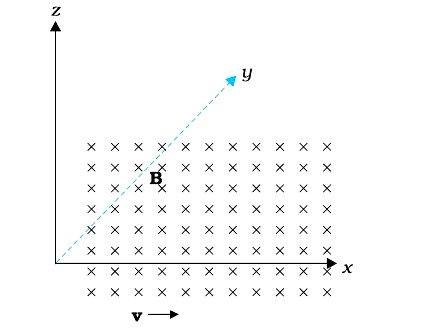
If the magnetic field is parallel to the positive y-axis and the charged particle is moving along the positive x-axis (Figure), which way would the Lorentz force be for
(a) an electron (negative charge),
(b) a proton (positive charge).
3.
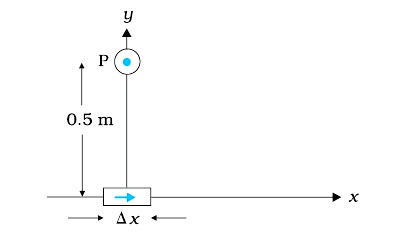
An element Δl = Δx \(\hat i\) is placed at the origin and carries a large current I = 10 A (Figure). What is the magnetic field on the y-axis at a distance of 0.5 m. Δ x = 1 cm.
4.
Name the elements or parameters of earth's magnetic field.
5.
(a) A Current carrying circular loop lies on a smooth horizontal plane. Can a uniform magnetic field be set up in such a manner that the loop turns around itself(i.e. turns about the vertical axis)?
(b) A current carrying circular loop is located in a uniform external magnetic field. If the loop is free to turn, what is it orientation of stable equilibrium? Show that in this orientation the flux of the total field (external field + field produced by the loop) is maximum.
(c) A loop of irregular shape carrying current is located in an external magnetic field. If the wire is flexible, why does it change to a circular shape?
6.
A long straight wire in the horizontal plane carries a current of 50 A in north to south direction. Give the magnitude and direction of B at a point 2.5 m east of the wire.
7.
A long straight wire carries a current of 35 A. What is the magnitude of the field B at a point 20 cm from the wire?
8.
The horizontal component of the earth's magnetic field at a certain place is 3.0 x 10⁻⁵ T and the direction of the field is from geographic south to the geographic north. A very long straight conductor is carrying a steady current of 1 A. What is the force per unit length on it when it is placed on a horizontal table and the direction of current is (a) east to west (b) south to north ?
9.
Two tangent galvanometers differ only in the matter of number of turns in the coil. On passing current through the two joined in series, the first shows a deflection of 35o and the other shows 45o deflection. Compute the ratio of their number of turns. Take tan 35o = 0.7.
10.
Two straight long conductors AOB and COD are perpendicular to each other and carry currents I1 and I2 . Find the magnitude of magnetic field induction at a point P at a distance a from the point O in a direction perpendicular to the plane ABCD.
11.
In a circular coil of radius r, the magnetic field at the centre is proportional to
r2
r
\(\frac{1}{r}\)
\(\frac{1}{r2}\)
12.
Three long, straight parallel wires, carrying current are arranged as shown in the figure. The force experienced by a 25 cm length of wire C is
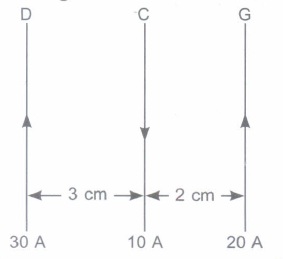
10-3 N
2.5 x 10⁻³ N
zero
1.5 x 10³ N
13.
An electron is projected along the axis of a circular conductor carrying the same current. Electron will experIence
a force along the axis.
a force perpendicular to the axis
a force at an angle of 4° with axis
no force experienced.
14.
The maximum current that can be measured by a galvanometer of resistance 40 Ω is 10 mA. It is converted into voltmeter that can read upto 50 V. The resistance to be connected in the series with the galvanometer is
2010 Ω
4050 Ω
5040 Ω
4960 Ω
15.
An electron is moving in a cyclotron at a speed of 3.2 x 10⁷ ms" in a magnetic field of 5 x 10⁻⁴ T perpendicular to it. What is the frequency of this electron? (q = 1.6 x 10⁻¹⁹ C,me = 9.1 x 10⁻³¹ kg)
1.4 x 10⁵ Hz
1.4 x 10⁷ Hz
1.4 x 10⁶ Hz
1.4 x 10⁹ Hz
16.
An electron is travelling horizontally towards East. Amagnetic field in vertically downward direction exerts a force on the electron along
East
West
North
South
17.
In a uniform magnetic field, an electron (or charge particle) enters perpendicular to the field. The path of electron will be
ellipse
circular
parabolic
linear
18.
A magnetic needle lying parallel to a magnetic field requires W units of work to turn it through \({ 60 }^{ ° }.\) The torque required to keep the needle in this position will be
2 W
W
\(\frac { W }{ \sqrt { 2 } } \)
\(\frac { W }{ \sqrt { 3 } } \)
\(\sqrt { 3 } W\)
19.
A long straight wire of radius a carries a steady current i. The current is uniformly distributed across its cross-section. The ratio of the magnetic field at a/2 and 2 a is
1/2
1/4
4
1
20.
In a permanent magnet at room temperature
the magnetic moment of each molecule is zero
the individual molecules have a non-zero magnetic moment which is all perfectly aligned
domains are partially aligned
domains are all perfectly aligned.
21.
A circular coil carrying current behaves as a
bar magnet
horse shoe magnet
magnetic shell
solenoid
22.
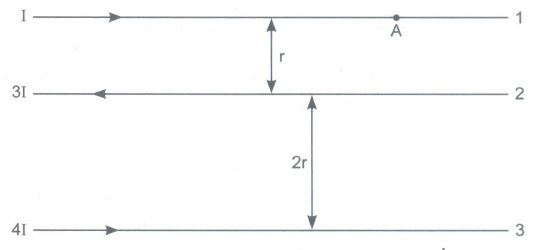
The figure shows three infinitely long straight parallel current carrying conductors. Find the
(i) magnitude and direction of the net magnetic field at point A laying on conductor 1,
(ii) magnetic force on conductor 2.
23.
A beam of protons passes undeflected with a horizontal velocity v, through a region of electric and magnetic fields, mutually perpendicular to each other and normal to the direction of beam. If the magnitudes of electric and magnetic fields are 100 kV / m and 50 mT respectively, calculate the
(i) velocity of the beam and
(ii) force with which it strikes the target on a screen, if the proton beam current is equal to 0.80 mA.
24.
Two moving coil meters, M1 and M2 have the following particulars:
R1 = 10 Ω, N1 = 30, A1 = 3.6 x 10⁻³ m2, B1 = 0.25 T
R2 = 14 Ω, N2 = 42, A2 = 1.8 x 10⁻³ m2, B2 = 0.50 T
(The spring constants are identical for the two meters). Determine the ratio of (a) current sensitivity and (b) voltage sensitivity of M2 and M1.
25.
The path of a charged particle in magnetic field depends upon angle between velocity and magnetic field.If velocity \(\vec{v}\) is at angle \(\theta\) to \(\vec{B}\) component of velocity parallel to magnetic field \((v \cos \theta)\) remains constant and component of velocity perpendicular to magnetic field \((v \sin \theta)\) is responsible for circular motion, thus the charge particle moves in a helical path.
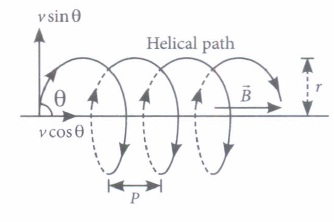
The plane of the circle is perpendicular to the magnetic field and the axis of the helix is parallel to the magnetic field. The charged particle. moves along helical path touching the line parallel to the magnetic field passing through the starting point after each rotation.
Radius of circular path is \(r=\frac{m v \sin \theta}{1 v_{q} B}\)
Hence the resultant path of the charged particle will be a helix, with its axis along the direction of \(\vec{B}\) as shown in figure.
(i) When a positively charged particle enters into a uniform magnetic field with uniform velocity, its trajectory can be (i) a straight line (ii) a circle (iii) a helix.
| (a) (i) only | (b) (i) or (ii) |
| (c) (i) or (iii) | (d) anyone of (i), (ii) and (iii) |
(ii) Two charged particles A and B having the same charge, mass and speed enter into a magnetic field in such a way that the initial path of A makes an angle of 30° and that of B makes an angle of 90° with the field. Then the trajectory of
| (a) B will have smaller radius of curvature than that of A |
| (b) both will have the same curvature |
| (c) A will have smaller radius of curvature than that of B |
| (d) both will move along the direction of their original velocities. |
(iii) An electron having momentum 2.4 x 10⁻²³kg m/ s enters a region of uniform magnetic field of 0.15 T. The field vector makes an angle of 30° with the initial velocity vector of the electron. The radius of the helical path of the electron in the field shall be
| (a) 2 mm | (b) 1 mm | \(\text { (c) } \frac{\sqrt{3}}{2} \mathrm{~mm}\) | (d) 0.5 mm |
(iv) The magnetic field in a certain region of space is given by \(\vec{B}=8.35 \times 10^{-2} \hat{i}\) T. A proton is shot into the field with velocity \(\vec{v}=\left(2 \times 10^{5} \hat{i}+4 \times 10^{5} \hat{j}\right) \mathrm{m} / \mathrm{s}\) The proton follows a helical path in the field. The distance moved by proton in the x-direction during the period of one revolution in the yz-plane will be
(Mass of proton = 1.67 x 10⁻²⁷kg)
| (a) 0.053 m | (b) 0.136 m | (c) 0.157 m | (d) 0.236 m |
(v) The frequency of revolution of the particle is
| \(\text { (a) } \frac{m}{q B}\) | \(\text { (b) } \cdot \frac{q B}{2 \pi m}\) | \(\text { (c) } \frac{2 \pi R}{v \cos \theta}\) | \(\text { (d) } \frac{2 \pi R}{v \sin \theta}\) |
1.
Velocity selector is a device consisting of perpendicular electric and magnetic fields that can be used as a velocity filter for charged particles. It is used to measure charge to mass ratio and is also used in Mass Spectrometer.
2.
The velocity v of particle is along the x-axis, while B, the magnetic field is along the y-axis, so v x B is along the z-axis (screw rule or right-hand thumb rule). So,
(a) for electron it will be along –z axis.
(b) for a positive charge (proton) the force is along + z axis.
3.
\(|\mathrm{dB}|=\frac{\mu_{0}}{4 \pi} \frac{I \mathrm{~d} l \sin \theta}{r^{2}}\)
dl = Δx = 10−2m , I = 10 A, r = 0.5 m = y, \(\mu_{0} / 4 \pi=10^{-7} \frac{\mathrm{T} \mathrm{m}}{\mathrm{A}}\) θ = 90° ; sin θ = 1
\(|\mathrm{dB}|=\frac{10^{-7} \times 10 \times 10^{-2}}{25 \times 10^{-2}}=4 \times 10^{-8} \mathrm{~T}\)
The direction of the field is in the +z-direction. This is so since
\(\mathrm{d} \mathbf{l} \times \mathbf{r}=\Delta x \hat{\mathbf{i}} \times y \hat{\mathbf{j}}=y \Delta x(\hat{\mathbf{i}} \times \hat{\mathbf{j}})=y \Delta x \hat{\mathbf{k}}\)
We remind you of the following cyclic property of cross-products
\(\hat{\mathbf{i}} \times \hat{\mathbf{j}}=\hat{\mathbf{k}} ; \hat{\mathbf{j}} \times \hat{\mathbf{k}}=\hat{\mathbf{i}} ; \hat{\mathbf{k}} \times \hat{\mathbf{i}}=\hat{\mathbf{j}}\)
Note that the field is small in magnitude.
4.
The three parameters of earth's magnetic field are : Declination, Dip and Horizontal component.
5.
(a) No, because that would require \(\tau \) to be in the vertical direction. But \(\tau =IA\times B\), and since A of the horizontal loop is in the vertical direction, \(\tau \) would be in the plane of the loop for any B.
(b) Orientation of stable equilibrium is one where the are vector A of the loop is in the direction of external magnetic field. In this orientation, the magnetic field produced by the loop is in the same direction as external field, both normal to the plane of the loop, thus giving rise to maximum flux of the total field.
(c) It assumes circular shape with its plane normal to the field to maximize flux, since, for a given perimeter, a circle encloses greater areas than any other shape.
6.
Current in the wire, I = 50 A
A point is 2.5 m away from the East of the wire.
∴ Magnitude of the distance of the point from the wire, r = 2.5 m.
Magnitude of the magnetic field at that point is given by the relation, B \(=\frac{\mu_{0} 2 I}{4 \pi r}\)
Where,
μ0 = Permeability of free space = 4π x 10–7 T m A–1
\(B=\frac{4 \pi \times 10^{-7} \times 2 \times 50}{4 \pi \times 2.5}\)
= 4 x 10 -6 T
The point is located normal to the wire length at a distance of 2.5 m. The direction of the current in the wire is vertically downward. Hence, according to the Maxwell’s right hand thumb rule, the direction of the magnetic field at the given point is vertically upward.
7.
Current in the wire, I = 35 A
Distance of a point from the wire, r = 20 cm = 0.2 m
Magnitude of the magnetic field at this point is given as:
\(B=\frac{\mu_{0}}{4 \pi} \frac{2 I}{r}\)
Where,
μ0 = Permeability of free space = 4π x 10–7 T m A–1
\(B=\frac{4 \pi \times 10^{-7} \times 2 \times 35}{4 \pi \times 0.2}\)
= 3.3 x 10⁻⁵ T
Hence, the magnitude of the magnetic field at a point 20 cm from the wire is 3.5 × 10⁻⁵ T.
8.
F = Il x B
F = Il B sinθ
The force per unit length is
f = F / l = I B sinθ
(a) When the current is flowing from east to west,
θ = 90°
Hence,
f = I B
= 1 x 3x 10–5 = 3 x 10⁻⁵ N m–1
This is larger than the value 2 x 10⁻⁷ Nm–1 quoted in the definition of the ampere. Hence it is important to eliminate the effect of the earth’s magnetic field and other stray fields while standardising the ampere.
The direction of the force is downwards. This direction may be obtained by the directional property of cross product of vectors.
(b) When the current is flowing from south to north,
θ = 0o
f = 0
Hence there is no force on the conductor.
9.
As the two tangent galvanometers are connected in series, they carry the same current.
\(\therefore \ { I }_{ 1 }=\frac { 2rH }{ { \mu }_{ o }{ n }_{ 1 } } tan{ \theta }_{ 1 }={ I }_{ 2 }=\frac { 2rH }{ { \mu }_{ o }{ n }_{ 2 } } tan{ \theta }_{ 2 }\)
\(\therefore \ =\frac { { n }_{ 1 } }{ { n }_{ 2 } } \frac { { tan\theta }_{ 1 } }{ { tan\theta }_{ 2 } } =\frac { { tan35 }^{ o } }{ { tan45 }^{ o } } =\frac { 0.7 }{ 1 } =\frac { 7 }{ 10 } \)
10.
Magnetic field induction at P due to current through AOB and COD will be
\({ B }_{ 1 }=\frac { { \mu }_{ o }2{ I }_{ 1 } }{ 4\pi a } { B }_{ 2 }=\frac { { \mu }_{ o }2{ I }_{ 2 } }{ 4\pi a }\)
\( Here \ \overset { \rightarrow }{ { B }_{ 1 } } and\overset { \rightarrow }{ { B }_{ 2 } } are \ perpendiculartoeachother.\quad\)
\(The \ magnitude \ of \ resultant \ magnetic \ field \ induction \ will \ be\)
\(B=\sqrt { { B }_{ 1 }^{ 2 }+{ B }_{ 2 }^{ 2 } } =\left[ \left( \frac { { \mu }_{ o }{ 2I }_{ 1 } }{ 4\pi a } \right) ^{ 2 }+\left( \frac { { \mu }_{ o }{ 2I }_{ 2 } }{ 4\pi a } \right) ^{ 2 } \right] ^{ 1/2 }\)
\(=\frac { { \mu }_{ o } }{ 2\pi a } \left( { I }_{ 1 }^{ 2 }+{ I }_{ 2 }^{ 2 } \right) ^{ 1/2 }\)
11.
(c)
\(\frac{1}{r}\)
12.
(c)
zero
13.
(d)
no force experienced.
14.
(d)
4960 Ω
15.
(b)
1.4 x 10⁷ Hz
16.
(d)
South
17.
(b)
circular
18.
(e)
\(\sqrt { 3 } W\)
19.
(d)
1
20.
(c)
domains are partially aligned
21.
(c)
magnetic shell
22.
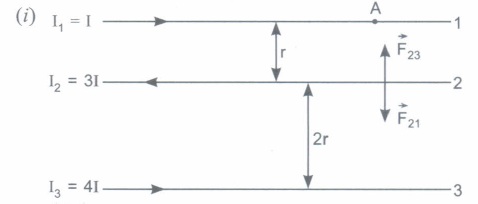
At A
Magnetic field due to conductor perpendlcuIarIy inwards \(2=B_{1}=\frac{\mu_{0}(3 I)}{2 \pi r}\)
Magnetic field due to conductor 3 perpendicular outwards \(3=B_{2}=\frac{\mu_{0}(4 I)}{2 \pi(3 r)}\)
Net magnetic field at A
\(B=B_{1}-B_{2}=\frac{\mu_{0} I}{2 \pi r}\left[3-\frac{4}{3}\right]\)
\(B=\frac{5 \mu_{0} I}{6 \pi r},\) perpendicularly inwards
(ii) Magnetic force per unit length on conductor 2 due to conductor \(1=F_{21}=\frac{\mu_{0}}{4 \pi} \cdot \frac{2 I_{1} I_{2}}{r}\)
Magnetic force per unit length on conductor 2 and due to current flowing in conductor 3
\(F_{23}=\frac{\mu_{0}}{4 \pi} \cdot \frac{2 I_{2} I_{3}}{2 r}\)
Since forces F23 and F21 are in opposite directions (as shown)
∴ Net force experienced by conductor 2
\(F_{2}=F_{23}-F_{21}=\frac{\mu_{0}}{2 \pi r}\left[3 I^{2}-\frac{12 I^{2}}{2}\right]\)
\(F_{2}=\frac{3 \mu_{0} I^{2}}{2 \pi r}\) ,towards conductor 1.
23.
For undeflected beam, \(v=\frac{E}{B}\)
i) 2 x 10⁶ m/s
(ii) F = q(E + v x B) = 1.675 x10⁻⁵ N
24.
Given, R1 = 10 \(\Omega\), N1 = 30, A1 = 3.6 \(\times\)10-3m2,
B1 = 0.25 T, R2 = 14 \(\Omega\), N2 = 42.
A2 = 1.8 \(\times\)10-3 m2, B2 = 0.50 T
k1 = k2 (spring constants are smae) ...(i)
(i) Using the formula of current sensitivity, \(I=\frac{N A B}{k}\)
\(\therefore \quad \frac{I_{S_2}}{I_{S_1}}=\frac{N_2 B_2 A_2 k_1}{N_1 B_1 A_1 k_2}=\frac{42 \times 0.50 \times 1.8 \times 10^{-3}}{30 \times 0.25 \times 3.6 \times 10^{-3}}\)
= 1.4 [from Eq. (i)]
(ii) Using the formula of voltage sensitivity,
\(\begin{aligned} V & =\frac{N A B}{k R} \end{aligned}\)
\(\begin{aligned} \therefore \quad \frac{V_{S_2}}{V_{S_1}} & =\frac{N_2 B_2 A_2 k_1 R_1}{k_2 R_2 N_1 B_1 A_1} \\ \end{aligned}\)
\(\begin{aligned} =\frac{42 \times 0.50 \times 1.8 \times 10^{-3} \times 10}{14 \times 30 \times 0.25 \times 3.6 \times 10^{-3}} \end{aligned}\)
= 1 [from Eq. (i)]
25.
(i) (d)
(ii) (a): Using \(q v B \sin \theta=\frac{m v^{2}}{r}\)
\(r \propto \frac{1}{\sin \theta}\) for the same values of m, v, q and B
\(\therefore \frac{r_{A}}{r_{B}}=\frac{\sin 90^{\circ}}{\sin 30^{\circ}}=2 \text { or } r_{A}=2 r_{B} \text { or } r_{B}<r_{A}\)
(iii) (d): The radius of the helical path of the electron in the uniform magnetic field is
\(r=\frac{m v_{\perp}}{e B}=\frac{m v \sin \theta}{e B}=\frac{\left(2.4 \times 10^{-23} \mathrm{~kg} \mathrm{~m} / \mathrm{s}\right) \times \sin 30^{\circ}}{\left(1.6 \times 10^{-19} \mathrm{C}\right) \times 0.15 \mathrm{~T}}\)
\(=5 \times 10^{-4} \mathrm{~m}=0.5 \times 10^{-3} \mathrm{~m}=0.5 \mathrm{~mm}\)
(iv) (c): Here \(\vec{B}=8.35 \times 10^{-2} \hat{i} \mathrm{~T}\)
\(\vec{v}=2 \times 10^{5} \hat{i}+4 \times 10^{5} \hat{j} \mathrm{~m} / \mathrm{s}, m=1.67 \times 10^{-27} \mathrm{~kg}\)
Pitch of the helix (i.e., the linear distance moved along the magnetic field in one rotation) is given by
Pitch of the helix \(=\frac{2 \pi m v_{\|}}{q B}\)
\(=\frac{2 \times 3.14 \times 1.67 \times 10^{-27} \times 2 \times 10^{5}}{1.6 \times 10^{-19} \times 8.35 \times 10^{-2}}=0.157 \mathrm{~m}\)
(v) (b): Period of revolution
\(T=\frac{2 \pi R}{v \sin \theta} \Rightarrow T=\frac{2 \pi\left(\frac{m v \sin \theta}{q B}\right)}{v \sin \theta} \Rightarrow T=\frac{2 \pi m}{q B}\)
\(\therefore \text { Frequency, } v=\frac{1}{T}=\frac{q B}{2 \pi m}\)

12th Standard CBSE Syllabus & Materials
12th Standard CBSE
CBSE 12th Computer Science Python Revision Tour I - New Previous year Question Papers Study Material - QB365 Set A
NEW12th Standard CBSE
CBSE 12th Business Studies Planning Important Questions And Answers Study Material - QB365 Set A
NEW12th Standard CBSE
CBSE 12th Business Studies Business Environment Important Questions And Answers Study Material - QB365 Set A
NEW12th Standard CBSE
CBSE 12th Business Studies Principles of Management Important Questions And Answers Study Material - QB365 Set A



NCERT Books

Syllabus

Exam Pattern

Sample Question Papers

Previous year Question Papers

Important Notes

MCQ Practice test

NCERT Exemplers

Case study Questions

Image Based Questions

Passage based Questions

HOT Questions

Value Based Questions

Model Questions Papers
NCERT ( Book Back ) Questions

Assertion and Reason
Important Questions And Answers

CBSE 12th Standard CBSE Subjects
CBSE Standards








