
 100% FREE ACCESS
12th Standard CBSE Syllabus & Materials
12th Standard CBSE
CBSE 12th Economics Government Budget and the Economy Previous year Question Papers Study Material - QB365 Set A
NEW12th Standard CBSE
CBSE 12th Computer Science Interface Python with MySQL - New Previous year Question Papers Study Material - QB365 Set A
NEW12th Standard CBSE
CBSE 12th Computer Science Database Concept - New Previous year Question Papers Study Material - QB365 Set A
NEW12th Standard CBSE
CBSE 12th Computer Science Data Communication - New Previous year Question Papers Study Material - QB365 Set A
NEW12th Standard CBSE
CBSE 12th Computer Science Data Structures - New Previous year Question Papers Study Material - QB365 Set A
NEW12th Standard CBSE
CBSE 12th Computer Science Functions - New Previous year Question Papers Study Material - QB365 Set A

Published on: 25/10/2025
Download CBSE Class 12th Standard CBSE Physics question papers, sample papers, important questions, and previous year solved papers in PDF format. Get free study materials, NCERT solutions, and exam preparation resources for Class 12th Standard CBSE Physics
Questions + Answers key
Take MCQ Physics Test
1.
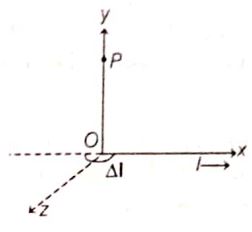
An element △l =△x\(\hat{\mathbf{i}}\) is placed at the origin (as shown in figure) and carries a current I = 2 A. Find out the magnetic field at a point P on the Y -axis at a distance of 1.0 m due to the element △x = w cm. Also, give the direction of the field produced.
2.
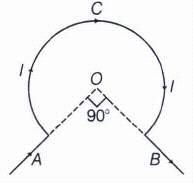
The wire shown in the figure, carries a current of 10 A. determine the magnitude of magnetic field induction at the centre O. Give the radius of bent coil is 3 cm.
3.
A particle of charge q and mass m is moving with velocity v. It is subjected to a uniform magnetic field B directed perpendicular to its velocity, Show that, it describes a circular path. Write the expression for its radius.
4.
Which one of the two, an ammeter or a milliammeter, has a higher resistance and why ?
5.
A charged particle moving with a uniform velocity \(\overset { \rightarrow }{ v } \) enters a region where uniform electric and magnetic fields \(\overset { \rightarrow }{ E } \ and \ \overset { \rightarrow }{ B } \) are present. It passes through the region without any change in its velocity. What can we conclude about the
(i) relative directions of \(\overset { \rightarrow }{ E } ,\overset { \rightarrow }{ v } \ and \ \overset { \rightarrow }{ B } \) ?
(ii) magnitude of \(\overset { \rightarrow }{ E } \ and \ \overset { \rightarrow }{ B } \) ?
6.
A circular coil, having 100 turns of wire, of radius (nearly) 20 cm each, lies in the XY plane with its centre at the origin of co-ordinates. Find the magnetic field at the point \((0,0,20\sqrt{3}\ cm)\) when this coil carries a current of \(\left({{2}\over{\pi}} \right)A.\)
7.
A wheel with 8 metallic spokes each 50 cm long is rotated with a speed of 120 rev/min in a plane normal to the horizontal component of the earth's magnetic field. The earth's magnetic field at the place is 0.4 G and the angle of dip is 60°. Calculate the emf induced between the axle and the rim of wheel. How will the value of emf be affected, if the number of spokes were increased?
8.
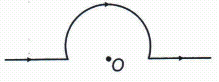
A straight wire carrying a current of 10 A is bent into a semi-circular are of radius 2.0 cm as shown in the figure. What is the magnetic field at O due to
(i) straight segments and
(ii) the semi-circular arc?
9.
An ammeter gives full scale deflection with a current of 1 ampere. It is converted into an ammeter of range 10 ampere. Find the ratio of the resistance of ammeter of the shunt resistance used.
10.
A galvanometer has a sensitivity of 60 division/ampere. When a shunt is used its sensitivity becomes 10 division/ampere. What is the value of shunt used if the resistance of the galvanometer is \(20\Omega \) ?
\(2\Omega \)
\(3\Omega \)
\(4\Omega \)
\(6\Omega \)
11.
A galvanometer of resistance \(25\Omega \) is connected to a battery of 2 volt along with a resistance in series. When the value of this resistance is \(3000\Omega ,\) a full scale deflection of 30 units is obtained in the galvanometer. In order to reduce this deflection 10 20 units, the resistance in series will be
\(4514\Omega \)
\(5413\Omega \)
\(2000\Omega \)
\(6000\Omega .\)
12.
The magnetic force acting on a charged particle of charge \(-2\mu C\) in a magnetic field of 2 T acting in y-direction, when the particle velocity is \(\left( 2\hat { i } +3\hat { j } \right) \times { 10 }^{ 6 }{ ms }^{ -1 }\) is
8 N in z-direction
8 N in -z-direction
4 N in z-direction
8 N in y-direction
13.
A thin ring of radius R metre has charge q coulomb uniformly spread on it. The ring rotates about its axis with a constant frequency of f revolutions/s. The value of magnetic field induction in Wb/m2 at the centre of the ring is
\(\frac { { \mu }_{ o }qf }{ 2\pi R } \)
\(\frac { { \mu }_{ o }q }{ 2\pi fR } \)
\(\frac { { \mu }_{ o }q }{ 2fR } \)
\(\frac { { \mu }_{ o }qf }{ 2R } \)
14.
(i) Derive an expression for the force between two long parallel current carrying conductors.
(ii) Use this expression to define SI unit of current.
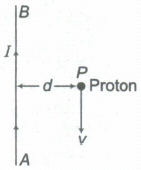
(iii) A long straight wire AB carries a current I. A proton P travels with a speed v, parallel to the wire at a distance d from it in a direction opposite to the current as shown in the figure. What is the force experienced by the proton and what is its direction?
15.
(a) Draw a labelled diagram of a moving coil galvanometer. Describe briefly its principle and working.
(b) Answer the following:
(i) Why is it necessary to introduce a cylindrical soft iron core inside the coil of a galvanometer?
(ii) Increasing the current sensitivity of a galvanometer may not necessarily increase its voltage sensitivity. Explain, giving reason.
16.
17.
18.
Assertion (A) : When current is represented by a straight line, the magnetic field will be circular.
Reason (R) : According to Fleming's left hand rule, direction of force is parallel to the magnetic field
Codes:
(a) Both A and R are true and R is the correct explanation of A
(b) Both A and R are true but R is NOT the correct explanation of A
(c) A is true but R is false
(d) A is false and R is also false
1.
Biot-Savarts law states that \(d \mathbf{B}=\frac{\mu_0}{4 \pi} \cdot \frac{\mathrm{I} d \mathbf{l} \times \hat{\mathbf{r}}}{|\mathbf{r}|^2}\)
Here, \(\Delta\)x = w cm
\(\because\) \(\Delta\)l = \(\Delta\)x \(\hat{\mathbf{i}}\)
\(\Rightarrow\) I = 2 A, r = 1 m
\(\begin{aligned}
\therefore \quad d B=\frac{\mu_0}{4 \pi} \cdot \frac{(2 w \hat{\mathbf{i}} \times \hat{\mathbf{j}})}{(1)^2} \\
\end{aligned}\)
\(\begin{aligned}
\mathrm{I} d l=2 \times w \hat{\mathrm{i}} \\
\end{aligned}\)
\(\begin{aligned}
& \because \quad \hat{\mathbf{r}}=\hat{\mathbf{j}} \Rightarrow|\mathbf{r}|=1 \mathrm{~m} \\
\end{aligned}\)
\(\begin{aligned}
& \therefore \quad d \mathrm{~B}=\frac{\mu_0 w}{2 \pi} \hat{\mathbf{k}} \\
\end{aligned}\)
\(\begin{aligned}
\Rightarrow \quad|d \mathrm{~B}|=\frac{\mu_0 w}{2 \pi} \\
\end{aligned}\)
and direction along + Z-axis.
2.
Here, I = 10 A, r = 3 cm, r = 3 x 10⁻² m
Angle subtended by coil at the centre,
\(\theta =360^{ \circ }-90^{ \circ }=270^{ \circ }=\frac { 3\pi }{ 2 } rad\)
Magnetic field induction at O due to current through circular path ACB is
\(B=\frac { \mu _{ 0 } }{ 4\pi } \times\frac { I }{ r } \emptyset ={ 10 }^{ -7 }\times\frac { 10 }{ (3\times{ 10 }^{ -2 }) } \times\frac { 3\pi }{ 2 } \)
\(\\ B=1.57\times{ 10 }^{ -4 }T\)
3.
A charge q projected perpendicular to the uniform magnetic field B with velocity v. The perpendicular force, F = q(v x B ), acts like a centripetal force perpendicular to the magnetic field. Then, the path followed by charge is circular as shown in the figure.
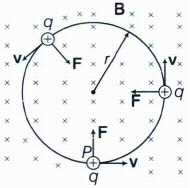
The Lorentz magnetic forces acts as centripetal force, thus
\(qvB=\frac { m{ v }^{ 2 } }{ r } \quad or\quad r=\frac { mv }{ qB }\)
here, r = radius of the circular path followed by charge projected perpendicular to the uniform magnetic field.
4.
An ammeter measures small current and milliammeter measures small current. We know that a galvanometer can be converted into an ammeter or milliammeter using a shunt resistance S, given by
\(S=\frac { { I }_{ g }\times G }{ I-{ I }_{ g } } \)
It shows that the shunt resistance to be used to convert a galvanometer into a milliammeter is more than that needed to convert into an ammeter. As the shunt is connected in parallel with the galvanometer, so the effective resistance of converted galvanometer into ammeter or milliammter is , \(R=\frac { GS }{ G+S } .\) ,. It shows that milliammter will have a higher resistance than that of ammeter.
5.
(i) A charged particle while passing through region goes undeflected (i..) without any change in velocity if \(\overset { \rightarrow }{ E } ,\overset { \rightarrow }{ v } \ and \ \overset { \rightarrow }{ B } \) are mutually perpendicular to each other, such that the forces on charged particle due to electric field and magnetic field are equal and opposite. Due to it, they cancel out each others effect.
(ii) The force on charged particle q due to perpendicular magnetic fild,
Fm = qvB sin 90o = qvB.
Force on charged particle due to perpendicular electric field, Fe = qE.
As the charged particle goes unde, so
qvB = qE or v = E/B elected
6.
The plane of coil is XY plane and field point is on the Z-axis.
\(\therefore\) Magnetic field on the axial point
\(B={{{\mu}_{0}I{R}^{2}N}\over{2({R}^{2}+{z}^{2})^{{{3}\over{2}}}}}\)
\(={{4\pi\times{10}^{-7}\times{{2}\over{\pi}}\times{(0.2)}^{2}\times100}\over{2[(0.2)^{2}+(0.2\sqrt{3})^{2}]{}^{{{3}\over{2}}}}}T\)
\(={{8\times0.04\times{10}^{-7}\times100}\over{2\times0.04\times8\times0.2}}T\)
\(=25\mu T\)
7.
\(\because \) Horizontal component
H = B \(cos\theta =0.4cos60^{ 0 }=0.4\times \frac { 1 }{ 2 } =0.2G\)
H = 0.2 x 10⁻⁴T \(\left[ \because cos60^{ 0 }=1/2 \right] \)
This component is parallel to the plane of wheel. The wheel is rotating in a plane normal to the horizontal component, so it will cut the horizontal component only, vertical component of earth will contribute nothing in emf.
Thus, the emf induced is given as
\(E=\frac { 1 }{ 2 } Ht^{ 2 }\omega \)
Where, \(\omega =\frac { 2\pi N }{ t } \) and
I = length of the spoke = 50 cm = 0.5 m
\(\therefore E=\frac { 1 }{ 2 } \times 0.2\times 10^{ -4 }\times (0.5)^{ 2 }\times \frac { 2\times 314\times 120 }{ 60 } \)
E = 3.14 x 10⁻⁵V
The value of emf induced is independent of the number of spokes as the emf's across the spokes are in parallel. So, the emf will be unaffected with the increase in spokes.
8.
(i) Magnetic field due to straight segments is
\(B=\int { \frac { \mu _{ \circ } }{ 4\pi } } .\frac { Id1\times r }{ { r }^{ 3 } } \)
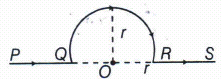
For point O, dI and r for each element of straight segments PQ and RS are parallel.
Therefore, dI x r = 0
Thus, magnetic field due to straight segments is zero.
(ii) Magnetic field at center O due to semi-circular arc
\(=\frac { Magnetic\ field\ at\ center\ of \ circular\ coil }{ 2 } \)
\(=\frac{1}{2}\left(\frac{\mu_0 I}{2 r}\right)=\frac{\mu_0 I}{4 r}=\frac{\left(4 \pi \times 10^{-7}\right) \times 10}{4 \times 2 \times 10^{-2}}\)
[Given, I = 10 A and r = 2.0 cm = \(2\times { 10 }^{ -2 }\)m]
\(=5\pi \times { 10 }^{ -5 }T\)
9.
\(S=\frac { { I }_{ g }G }{ I-{ I }_{ g } } =\frac { 1\times G }{ 10-1 } =\frac { G }{ 9 } \Omega \)
Resistance of ammeter formed
\({ R }_{ p }=\frac { S\times G }{ G+S } =\frac { (G/9)\times G }{ G+G/9 } =\frac { G/9 }{ 10/9 } =\frac { G }{ 10 } \)
\(\therefore \frac { { R }_{ p } }{ S } =\frac { G/10 }{ G/9 } =\frac { 9 }{ 10 } \)
10.
(c)
\(4\Omega \)
11.
(a)
\(4514\Omega \)
12.
(b)
8 N in -z-direction
13.
(d)
\(\frac { { \mu }_{ o }qf }{ 2R } \)
14.
(ii) As, \(\frac{F}{L}=\frac{\mu_0}{4\pi}.\frac{2 I_1 I_2}{r}\)
\(I_1=I_2=I A, r=1 m\)
\(\frac{F}{L}=2\times10^{-7} Nm^{-1}\)
(iii) Here, magnetic field due to the current carrying conductor at a distance d from it is
given by
\(B=\frac{\mu_0}{4\pi} \frac{2I}{d}\)
∴ Force on proton,
F = (e) (v) B sin 90°
⇒ F = evB
\(F=ev(\frac{\mu_0}{4\pi}\frac{2I}{d})\)
\(F=\frac{\mu_0}{4\pi}.\frac{2Iev}{d}\)
The proton is directed perpendicular to straight conductor and away from it.
15.
Principle and working: A current carrying coil, placed in a uniform magnetic field, (can) experience a torque.
Consider a rectangular coil for which no. of turns = N
rea of cross-section = 1 x b = A,
Intensity of the uniform magnetic field = B,
Current through the coil = I
∴ Deflecting torque = \(BIl \times b=BIA\)
For N turns \(\tau\) = NBIA
Restoring torque in the spring = k\(\theta\)
(k = restoring torque per unit twist)
\(\therefore NBIA=k\theta\)
\(\therefore I=(\frac{k}{NBA})\theta\)
\(\therefore I\alpha \theta\)
The deflection of the coil, is therefore, proportional to the current flowing through it.
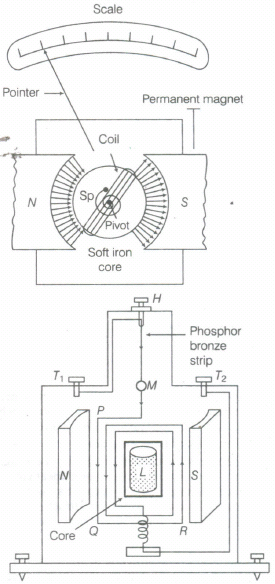
(b) the soft iron core not only makes the field radial but also increase the strength of the magnetic field
(ii) We have
\(Current sensitivity =\frac{\theta}{I}=NBA/k\)
Voltage sensitivity =\(\frac{\theta}{V}=\frac{\theta}{IR}=(\frac{NBA}{K}).\frac{1}{R}{ 1/2}\)
It follows that an increase in current sensitivity may not necessarily increase the voltage sensitivity.
16.
17.
18.
(c): When current is straight, it means the current is passing through a straight conductor, the magnetic field produced due to current through a straight conductor is in the form of concentric circular magnetic lines of force whose centres lie on the linear conductor and are in a plane perpendicular to the plane of linear conductor. It means the magnetic field is circular.

12th Standard CBSE Syllabus & Materials
12th Standard CBSE
CBSE 12th Computer Science Python Revision Tour I - New Previous year Question Papers Study Material - QB365 Set A
NEW12th Standard CBSE
CBSE 12th Business Studies Planning Important Questions And Answers Study Material - QB365 Set A
NEW12th Standard CBSE
CBSE 12th Business Studies Business Environment Important Questions And Answers Study Material - QB365 Set A
NEW12th Standard CBSE
CBSE 12th Business Studies Principles of Management Important Questions And Answers Study Material - QB365 Set A



NCERT Books

Syllabus

Exam Pattern

Sample Question Papers

Previous year Question Papers

Important Notes

MCQ Practice test

NCERT Exemplers

Case study Questions

Image Based Questions

Passage based Questions

HOT Questions

Value Based Questions

Model Questions Papers
NCERT ( Book Back ) Questions

Assertion and Reason
Important Questions And Answers

CBSE 12th Standard CBSE Subjects
CBSE Standards








