
 100% FREE ACCESS
12th Standard CBSE Syllabus & Materials
12th Standard CBSE
CBSE 12th Economics Government Budget and the Economy Previous year Question Papers Study Material - QB365 Set A
NEW12th Standard CBSE
CBSE 12th Computer Science Interface Python with MySQL - New Previous year Question Papers Study Material - QB365 Set A
NEW12th Standard CBSE
CBSE 12th Computer Science Database Concept - New Previous year Question Papers Study Material - QB365 Set A
NEW12th Standard CBSE
CBSE 12th Computer Science Data Communication - New Previous year Question Papers Study Material - QB365 Set A
NEW12th Standard CBSE
CBSE 12th Computer Science Data Structures - New Previous year Question Papers Study Material - QB365 Set A
NEW12th Standard CBSE
CBSE 12th Computer Science Functions - New Previous year Question Papers Study Material - QB365 Set A

Published on: 25/10/2025
Download CBSE Class 12th Standard CBSE Physics question papers, sample papers, important questions, and previous year solved papers in PDF format. Get free study materials, NCERT solutions, and exam preparation resources for Class 12th Standard CBSE Physics
Questions + Answers key
Take MCQ Physics Test
1.
A 0.5 m long solenoid has 500 turns and has strength of magnetic field of 2.52 x 10⁻³ T at its centre. Find the current in the solenoid.
2.
An electron moving at \({ 10 }^{ 6 }{ ms }^{ -1 }\) in a direction parallel to a current of 5A flowing through infinitely long wire separated by perpendicular distance of 10 cm in air. Calculate the force experienced by the electron.
3.
A galvanometer coil has a resistance of 15 Ω and the metre shows full scale deflection for a current of 4 mA. How will you convert the metre into an ammeter of range 0 to 6 A?
4.
A coil of 200 turns has a cross-sectional area 900mm2 It carries a current of 2 ampere. The plane of the coil is perpendicular to a uniform magnetic field of 0.5T. Calculate (i) the magnetic moment of the coil and (ii) the torque acting on the coil.
5.
State Biot-Savart law giving the mathematical expression for it. Use this law to derive the expression. Use this law to derive the expression for the magnetic field due to a circular coil carrying current at a point along its axis. How does a circular loop carrying current behave as a magnet?
6.
Explain using a labelled diagram, the principle and working of a moving coil galvanometer. What is the function of
(i) uniform radial magnetic field
(ii) soft iron core?
Also, define the terms
(iii) current sensitivity and
(iv) voltage sensitivity of a galvanometer.
Why does increasing the current sensitivity not necessarily increase voltage sensitivity?
7.
Discuss the sensitivity of a moving coil galvanometer.
8.
State Ampere's circuital law.
9.
Consider a tightly wound 100 turn coil of radius 10 cm, carrying a current of 1 A. What is the magnitude of the magnetic field at the centre of the coil?
10.
What is the radius of the path of an electron (mass 9 x 10-31 kg and charge 1.6 x 10⁻¹⁹ C) moving at a speed of 3 x 10⁷ m/s in a magnetic field of 6 x 10⁻⁴ T perpendicular to it? What is its frequency? Calculate its energy in keV. ( 1 eV = 1.6 x 10⁻¹⁹ J).
11.
A circular coil of wire consisting of 100 turns, each of radius 8.0 cm carries a current of 0.40 A. What is the magnitude of the magnetic field B at the centre of the coil?
12.
Using the concept of force between two infinitely long parallel current carrying conductors, define one ampere of current.
13.
A solenoid of length 0.5 m has a radius of 1 cm and is made up of 500 turns. It carries a current of 5 A. What is the magnitude of the magnetic field inside the solenoid ?
14.
Compare a voltmeter and an ammeter.
15.
Explain giving reasons, the basic difference in converting a galvanometer into
(i) an ammeter and
(ii) a voltmeter.
16.
A wire of length L metre carrying a current of I ampere is bent in the form of a circle. Find its magnetic moment.
17.
What is magnetic dipole moment of a current loop? Give its direction if any.
18.
Write the relation for the force \(\overset { \rightarrow }{ F } \) acting on a charge carrier q moving with a velocity \(\overset { \rightarrow }{ v } \) through a magnetic field \(\overset { \rightarrow }{ B } \) in vector notation. Using this relation, deduce the conditions under which this force will be (i) maximum (ii) minimum.
19.
A magnetic field can be produced by moving charges or electric current. The basic equation of magnetic field due to a current distribution is governed by Biot-Savart law. According to this law, the magnetic field at a point due to a current element of length d l carrying current I, at a distance r from the element d l is,
\(d \mathbf{B}=\frac{\mu_0}{4 \pi} \cdot \frac{I d \mathbf{l} \times \mathbf{r}}{r^3}\)This law has certain similarities as well as differences with coulomb's law of electrostatic. e.g. There is an angle dependence in Biot-Savart law which is absent in electrostatic case.
(i) Write the alternative way to express Biot-Savart law.
(ii) What is the difference between Biot-Savart law and Coulomb's law in electrostatic.
(iii) How magnetic field due to an infinitely long current carrying wire at a distance r on its perpendicular bisector is related with current?
(vi) What is the magnetic field at a point on a long current carrying wire?
1.
Here, l = 0.5 m; N = 500; B = 2.52 x 10⁻³ T
\(B=\frac { { \mu }_{ o }NI }{ l } or \ I=\frac { Bl }{ { \mu }_{ o }N } =\frac { \left( 2.52\times { 10 }^{ -3 } \right) \times 0.5 }{ \left( 4\pi \times { 10 }^{ -7 } \right) \times 500 }\)
\( =2.0 \ A\)
2.
\(B=\frac { { \mu }_{ 0 }I }{ 2\pi r }\)
\(F=Bqv=\frac { { \mu }_{ 0 }Iqv }{ 2\pi r }\)
\( F=\frac { 4\pi { 10 }^{ -7 }\times 5\times 1.6\times { 10 }^{ -19 }\times { 10 }^{ 6 } }{ 2\pi \left( 0.1 \right) }\)
\( F=\frac { 2\times 5\times 1.6\times { 10 }^{ -20 } }{ 0.1 } \)
\(=16\times { 10 }^{ -19 }N\)
3.
Resistance of the galvanometer coil, G = 15 Ω
Current for which the galvanometer shows full scale deflection,
= 4 mA = 4 x 10⁻³ A
Range of the ammeter is 0, which needs to be converted to 6 A.
Current, I = 6 A
A shunt resistor of resistance S is to be connected in parallel with the galvanometer to convert it into an ammeter. The value of S is given as:
\(S=\frac{I_{g} G}{I-I_{g}}\)
\(=\frac{4 \times 10^{-3} \times 15}{6-4 \times 10^{-3}}\)
\(S=\frac{6 \times 10^{-2}}{6-0.004}=\frac{0.06}{5.996}\)
\(\approx 0.01 \Omega=10 \mathrm{~m} \Omega\)
Hence, a 10 mΩ shunt resistor is to be connected in parallel with the galvanometer.
4.
(i) 36 x 10-2 Am2
(ii) 18 x 10-2Nm
5.
Statement for Biot-Savart Law: The magnitude of magnetic field \(d\overrightarrow { B } \) due to current element is directly proportional to the current I, the elements length \(\left| dl \right| \) and inversely proportional to the square of the distance r of the field point. Its direction is perpendicular to the plane containing \(\overrightarrow { dl } \)and \(\overrightarrow{r}\).
\(d\overrightarrow B\alpha\frac{I\overrightarrow dl \times \overrightarrow r}{r^{ 3}}\)
Or \(d\overrightarrow B=\frac {\mu_0}{4 \pi}\frac{I\overrightarrow dl \times \overrightarrow r}{r^{ 3}}\)
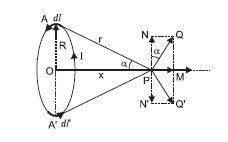
The magnetic field due to \(\overrightarrow {dl}\) is given by Biot Savart law as
\(dB=\frac {\mu_0}{4\pi}.\frac { I\left| \overrightarrow { dl } \times \overrightarrow { r } \right| }{ { r }^{ 3 } } \)
Now dBx= Db Cos \(\theta\) = \(\frac { \mu _{ 0 } }{ 4\pi } .\frac { Idl }{ \left( { x }^{ 2 }+{ R }^{ 2 } \right) } \cos { \theta } \)
\(=\frac { \mu _{ 0 } }{ 4\pi } .\frac { Idl }{ \left( { x }^{ 2 }+{ R }^{ 2 } \right) } \frac { R }{ \left( { x }^{ 2 }+{ R }^{ 2 } \right) ^{ 1/2 } } \)
So, \({ B }_{ x }=\int { dB_{ s }=\frac { { \mu }_{ 0 } }{ 4\pi } } \frac { IR }{ \left( { x }^{ 2 }+{ R }^{ 2 } \right) ^{ 3/2 } } \int { dl } \)
\(=\frac { { \mu }_{ 0 }IR^{ 2 } }{ 2\left( { x }^{ 2 }+{ R }^{ 2 } \right) ^{ 3/2 } } \)
(The y-components, of the field, add up to zero,due to symmetry)
\(\therefore\)Magnetic field at P due to a circular loop
\(=B={ B }_{ x }\overrightarrow { i } =\frac { { \mu }_{ 0 }IR^{ 2 } }{ 2\left( { x }^{ 2 }+{ R }^{ 2 } \right) ^{ 3/2 } } \overrightarrow { i } \)
Explanation: A circular current loop produces magnetic field and its magnetic moment is the product of current and its area \(\overrightarrow M=\overrightarrow {LA}\)
6.
Current sensitivity, \({ I }_{ s }=\frac { NAB }{ k } \) and
Voltage sensitivity, \(V_{ s }=\frac { NAB }{ kR } \)
Since, the resistance of the coil may vary, it implies an increase in current sensitivity may not necessarily increase voltage sensitivity.
Thus, the trajectory of both the particles will be same.
7.
A galvanometer is said to be sensitive, if it gives a large deflection, even when a small voltage is applied cross its coil.
Current sensitivity. It is defined as the deflection produced in the galvanometer on passing unit current through its coil. Therefore,
Current sensitivity \(=\frac { \theta }{ 1 } =\frac { nBA }{ k } \)
Voltage sensitivity. It is defined as the deflection produced in produced in the galvanometer when a unit voltage is applied across its coil. Therefore V, then Voltage sensitivity \(=\frac { \theta }{ V } \)
If R is resistance of coil and I is current that passes through coil on applying voltage V, then \(V=IR\)
\(\therefore \) Voltage sensitivity \(=\frac { \theta }{ IR } =\frac { nBA }{ kR } \)
Thus, a galvanometer will be highly sensitive, if (i) n is large ; (ii) B is large ; (iii) A is large ; (iv) R is small and (v) k is small.
However, n and A cannot be increased beyond certain limit otherwise, the sixe of the galvanomert and the resistance of the instrument will become large. Therefore, B is made as large as possible. To increase B, very strong permanent magnet is used. The suspension wire is made of phosphor bronze, as for this material, k is very small. The value of k further decreases, if the wire is hammered into flat strip. In very sensitive galvanometers, quartz k, is still smaller.
8.
The line integral of the magnetic field around some closed loop is equal to the times the algebraic sum of the currents which pass through the loop.
9.
Since the coil is tightly wound, we may take each circular element to have the same radius R = 10 cm = 0.1 m. The number of turns N = 100. The magnitude of the magnetic field is,
\(B=\frac{\mu_{0} N I}{2 R}=\frac{4 \pi \times 10^{-7} \times 10^{2} \times 1}{2 \times 10^{-1}}=2 \pi \times 10^{-4}=6.28 \times 10^{-4} \mathrm{~T}\)
10.
Using Eq. we find
r = m v / (qB) = 9 x 10–31 kg x 3 x 107 m s–1 / ( 1.6 x 10–19 C x 6 x 10–4 T )
= 28 x 10–2 m = 28 cm
ν = v / (2 \(\pi\)r) = 17 x 106 s–1 = 17 x 106 Hz = 17 MHz.
E = (½ ) mv2 = (½ ) 9 x 10–31 kg x 9 x 1014 m2/s2 = 40.5 x 10⁻¹⁷ J
\(\approx \) 4 x 10–16 J = 2.5 keV.
11.
Here, n = 100, r = 8 cm = 8 \(\times\)10-2m and I = 0.40 A
\(\therefore\) Magnetic field B at the centre,
\(\begin{aligned} B=\frac{\mu_0}{4 \pi} \cdot \frac{2 \pi I n}{r} & =\frac{10^{-7} \times 2 \times 3.14 \times 0.40 \times 100}{8 \times 10^{-2}} \\ \end{aligned}\)
\(\begin{aligned} =3.1 \times 10^{-4} \mathrm{~T} \end{aligned}\)
12.
One ampere of current can be defined as the amount of current which when flows through two infinitely long parellel wires seperated by one metere produces an attractive foce 2 x 10⁻⁷N/m.
13.
Given, total number of turns, N = 500
Length of solenoid, l = 0.5 m
Current, I = 5 A
Radius, r = 1 cm = 10-2 m
Here, \(\begin{aligned} \frac{l}{r} & =\frac{0.5}{10^{-2}}=50 \Rightarrow l>>r \\ \end{aligned}\)
\(\begin{aligned} \therefore B & =\mu_0 n I=\frac{\mu_0 N I}{l} \\ \end{aligned}\)
\(\begin{aligned} =4 \pi \times 10^{-7} \times \frac{500}{0.5} \times 5 \end{aligned}\)
= 6.28 \(\times\) 10-3 T
14.
(i) Voltmeter is a high resistance device which is used to measure potential difference. Ammeter is a low resistance device which is used to measure the current in electric circuit.
(ii) Voltmeter is obtained by using a high resistance of suitable value in series of the galvanometer. Ammeter is obtained by using a low resistance shunt in parallel with a galvanometer.
(iii) Voltmeter is always connected in parallel to the conductor in circuit across which potential difference is to be determined. Ammeter is always used in series of circuit to measure the current.
(iv) The range of voltmeter can be increased or decreased. The range of ammeter can be increased but cannot be decreased.
(v) Ideal voltmeter has infinite resistance. Ideal ammeter has zero resistance.
15.
(i) Ammeter is a low resistance galvanometer. When a low resistance shunt is connected across galvanometer, it becomes ammeter.
(ii) Voltmeter is a high resistance galvanometer. When a suitable high resistance is connected in series with the galvanometer, it becomes voltmeter.
16.
\(=2\pi R\quad or\quad R=L/2\pi ;\)
Magnetic moment=\(IA=I\pi { R }^{ 2 }\)
\(=I\pi \left( \frac { L }{ 2\pi } \right) =I{ L }^{ 2 }/4\pi \)
17.
Magnetic dipole moment of a current loop = niA where n = no. of turns in a current loop; i = current through the loop and A = area of each turn of the loop. Magnetic dipole moment is a vector quantity. Its direction is perpendicular to the plane of loop directed outwards for anticlockwise current in loop and is directed inwards for clockwise current in loop.
18.
\(\overset { \rightarrow }{ F } =q\left( \overset { \rightarrow }{ v } \times \overset { \rightarrow }{ B } \right) \)
\(\\ or \ \left| \overset { \rightarrow }{ F } \right| =q\left| \overset { \rightarrow }{ v } \times \overset { \rightarrow }{ B } \right| =qvBsin\theta \)
(i) F will be maximum, when \(sin\theta =1 \ or \ \theta ={ 90 }^{ o }\) , i.e., the charged particle is moving perpendicular to the direction of magnetic field.
(ii) F will be minimum, when \(sin\theta =0 \ or \ \theta ={ 0 }^{ o } \ or \ { 180 }^{ o }\) i.e., the charged particle is moving parallel to the direction of magnetic field.
19.
(i) Biot-Savart law can be expressed alternatively as Ampere's circuital law.
(ii) Biot-Savart law is angle dependence law, whereas Coulomb's law in electrostatic is angle independent law.
(iii) The magnetic field due to an infinitely long current carrying wire,
\(\begin{aligned}
B=\frac{\mu_0 I}{2 \pi r}
\end{aligned}\)
\(\begin{aligned}
\therefore \quad B & \propto I
\end{aligned}\)
(iv) The magnetic field at a point on the long current carrying wire,
\(\begin{aligned}
d B=\frac{\mu_0}{4 \pi} \cdot \frac{I d l \sin \theta}{r^2}
\end{aligned}\)
\(\begin{aligned}
=\frac{\mu_0}{4 \pi} \cdot \frac{I d l \sin 0^{\circ}}{r^2}
\quad \quad \quad{\left[\because \theta=0^{\circ}\right]}
\end{aligned}\)
= 0

12th Standard CBSE Syllabus & Materials
12th Standard CBSE
CBSE 12th Computer Science Python Revision Tour I - New Previous year Question Papers Study Material - QB365 Set A
NEW12th Standard CBSE
CBSE 12th Business Studies Planning Important Questions And Answers Study Material - QB365 Set A
NEW12th Standard CBSE
CBSE 12th Business Studies Business Environment Important Questions And Answers Study Material - QB365 Set A
NEW12th Standard CBSE
CBSE 12th Business Studies Principles of Management Important Questions And Answers Study Material - QB365 Set A



NCERT Books

Syllabus

Exam Pattern

Sample Question Papers

Previous year Question Papers

Important Notes

MCQ Practice test

NCERT Exemplers

Case study Questions

Image Based Questions

Passage based Questions

HOT Questions

Value Based Questions

Model Questions Papers
NCERT ( Book Back ) Questions

Assertion and Reason
Important Questions And Answers

CBSE 12th Standard CBSE Subjects
CBSE Standards








