
 100% FREE ACCESS
12th Standard CBSE Syllabus & Materials
12th Standard CBSE
CBSE 12th Economics Government Budget and the Economy Previous year Question Papers Study Material - QB365 Set A
NEW12th Standard CBSE
CBSE 12th Computer Science Interface Python with MySQL - New Previous year Question Papers Study Material - QB365 Set A
NEW12th Standard CBSE
CBSE 12th Computer Science Database Concept - New Previous year Question Papers Study Material - QB365 Set A
NEW12th Standard CBSE
CBSE 12th Computer Science Data Communication - New Previous year Question Papers Study Material - QB365 Set A
NEW12th Standard CBSE
CBSE 12th Computer Science Data Structures - New Previous year Question Papers Study Material - QB365 Set A
NEW12th Standard CBSE
CBSE 12th Computer Science Functions - New Previous year Question Papers Study Material - QB365 Set A

Published on: 25/10/2025
Download CBSE Class 12th Standard CBSE Physics question papers, sample papers, important questions, and previous year solved papers in PDF format. Get free study materials, NCERT solutions, and exam preparation resources for Class 12th Standard CBSE Physics
Questions + Answers key
Take MCQ Physics Test
1.
What is the force on a charge moving along the direction of the magnetic field?
2.
A proton and an electron travelling along parallel paths enter a region of uniform magnetic field, acting perpendicular to their paths. Which of them will move in a circular path with higher frequency?
3.
State Biot-Savart's law and express this law in the vector form.
4.
What is the value of absolute permeability of free space? Give its units.
5.
A wire of length L metre carrying a current of I ampere is bent in the form of a circle. Find its magnetic moment.
6.
What is magnetic dipole moment of a current loop? Give its direction if any.
7.
Write the relation for the force \(\overset { \rightarrow }{ F } \) acting on a charge carrier q moving with a velocity \(\overset { \rightarrow }{ v } \) through a magnetic field \(\overset { \rightarrow }{ B } \) in vector notation. Using this relation, deduce the conditions under which this force will be (i) maximum (ii) minimum.
8.
How is the magnetic field inside a given solenoid made strong?
9.
State the rule that is used to find the direction of magnetic field at a point near a current carrying straight conductor.
10.
If a particle of charge q is moving with velocity v along the y-axis and the magnetic field B is acting along the Z-axis, use the expression \(\overset { \rightarrow }{ F } =q\left( \overset { \rightarrow }{ v } \times \overset { \rightarrow }{ B } \right) \) to find the direction of the force \(\overset { \rightarrow }{ F } \) acting on it.
11.
An electron beam projected along + X-axis, experiences a force due to a magnetic field along the +Y-axis. What is the direction of the magnetic field?
12.
Name the physical quantity whose unit is tesla. Hence define a tesla.
13.
What are the dimensions of \({ \mu }_{ o }/4\pi \) ?
14.
Explain, how moving charge is a source of magnetic field.
15.
An electron moving with a velocity of 107 ms-1 enters a uniform magnetic field of 1 T, along a direction parallel to the field. What would be its trajectory?
16.
What is the unit of magnetic field strength in cgs system and SI? State the relation between them.
17.
The north pole of a magnet is brought near a stationary negatively charged conductor. Will the pole experience any force?
18.
A cyclotron's oscillator frequency is 10 MHz. What should be the operating magnetic field for accelerating protons? If the radius of its 'dees' is 60 cm, what is the kinetic energy of the proton beam produced by the accelerator?
(e = 1.60 \(\times\) 10-19 C, mp = 1.67 \(\times\) 10-27 kg 1 MeV = 1.6 x 10⁻¹³ J).
19.
An electron of kinetic energy 25 keV moves perpendicular to the direction of a uniform magnetic field of 0.2 millitesla. Calculate the time period of rotation of the electron in the magnetic field.
20.
A long straight wire carries a current of 35 A. What is the magnitude of the field B at a point 20 cm from the wire?
21.
A current of 3 A flows through a plane circular coil of radius 4 cm having 20 turns. Calculate dipole moment of the coil.
22.
A bar magnet of magnetic moment 5.0 Am2 has poles 20 cm apart. Calculate the pole strength.
23.
A 0.5 m long solenoid has 500 turns and has strength of magnetic field of 2.52 x 10⁻³ T at its centre. Find the current in the solenoid.
24.
Calculate the magnetic field \(\vec { B } \) at a distance 0.1 from a long straight wire carrying a current of 5A.
25.
(i) Derive the expression for the torque on a rectangular current carrying loop suspended in a uniform magnetic field
(ii) A proton and a deuteron having equal momentum enter in a region of a uniform magnetic field at right angle to the direction of the field.Depict their trajectories in the field
26.
A solenoid of length 50 cm, having 100 turns carries a current of 2.5 A. Find the magnetic field,
(a) in the interior of the solenoid,
(b) at one end of the solenoid.
27.
A circular loop of 2 turns carries a current of 5.0 A. If the magnetic field at the centre of loop is 0.40 mT, find the radius of the loop.
28.
An alpha particle is completing one circular round of radius 0.8 m in 2 seconds. Find the magnetic field at the centre of the circle. Electronic charge = 1.6 x 10⁻¹⁹ C.
29.
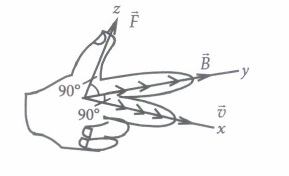
A charged particle moving in a magnetic field experiences a force that is proportional to the strength of the magnetic field, the component of the velocity that is perpendicular to the magnetic field and the charge of the particle.
This force is given by \(\vec{F}=q(\vec{v} \times \vec{B})\) where q is the electric charge of the particle, v is the instantaneous velocity of the particle, and B is the magnetic field (in tesla).
The direction of force is determined by the rules of cross product of two vectors
Force is perpendicular to both velocity and magnetic field. Its direction is same as \(\vec{v} \times \vec{B}\) if q is positive and opposite of \(\vec{v} \times \vec{B}\) if q is negative
The force is always perpendicular to both the velocity of the particle and the magnetic field that created it. Because the magnetic force is always perpendicular to the motion, the magnetic field can do no work on an isolated charge. It can only do work indirectly, via the electric field generated by a changing magnetic field.
(I) When a magnetic field is applied on a stationary electron, it
| (a) remains stationary |
| (b) spins about its own axis |
| (c) moves in the direction of the field |
| (d) moves perpendicular to the direction of the field. |
(ii) A proton is projected with a uniform velocity v along the axis of a current carrying solenoid, then
| (a) the proton will be accelerated along the axis |
| (b) the proton path will be circular about the axis |
| (c) the proton moves along helical path |
| (d) the proton will continue to move with velocity v along the axis. |
(iii) A charged particle experiences magnetic force in the presence of magnetic field. Which of the following statement is correct?
| (a) The particle is stationary and magnetic field is perpendicular. |
| (b) The particle is moving and magnetic field is perpendicular to the velocity |
| (c) The particle is stationary and magnetic field is parallel |
| (d) The particle is moving and magnetic field is parallel to velocity |
(iv) A charge q moves with a velocity 2 ms-1 along x-axis in a uniform magnetic field \(\vec{B}=(\hat{i}+2 \hat{j}+3 \hat{k}) \mathrm{T}\) then charge will experience a force
| (a) in z-y plane | (b) along -yaxis | (c) along +z axis | (d) along -z axis |
(v) Moving charge will produce
| (a) electric field only | (b) magnetic field only |
| (c) both electric and magnetic field | (d) none ofthese. |
1.
Force on a moving charge in magnetic field is given as F = qvB sin \(\theta\)
When charge particle is moving along the direction of magnetic field, then
\(\theta\)= 0° \(\Rightarrow\) F = 0
2.
As we know that in a circular path, frequency of a charged particle is given by
\(v=\frac{q B}{2 \pi m} \text { or } \quad v \propto \frac{1}{m}\)
Since, mp > me therefore electron will move in circular path with higher frequency.
3.
Biot-Savart's law states that, the magnitude of magnetic field intensity (dB) at a point P due to current element is given by
\(d B \propto \frac{I d l \sin \theta}{r^{2}}\)
or \(d B=\frac{\mu_{0}}{4 \pi} \frac{I d l \sin \theta}{r^{2}}\)
Thus, in vector notation,
\(d B=\frac{\mu_{0}}{4 \pi} \frac{I d 1 \times \mathbf{r}}{r^{3}}\)
4.
\(μ_o=4π×10−7TmA−1\ or\ Wbm^{−1}A^{−1}\)
5.
\(=2\pi R\quad or\quad R=L/2\pi ;\)
Magnetic moment=\(IA=I\pi { R }^{ 2 }\)
\(=I\pi \left( \frac { L }{ 2\pi } \right) =I{ L }^{ 2 }/4\pi \)
6.
Magnetic dipole moment of a current loop = niA where n = no. of turns in a current loop; i = current through the loop and A = area of each turn of the loop. Magnetic dipole moment is a vector quantity. Its direction is perpendicular to the plane of loop directed outwards for anticlockwise current in loop and is directed inwards for clockwise current in loop.
7.
\(\overset { \rightarrow }{ F } =q\left( \overset { \rightarrow }{ v } \times \overset { \rightarrow }{ B } \right) \)
\(\\ or \ \left| \overset { \rightarrow }{ F } \right| =q\left| \overset { \rightarrow }{ v } \times \overset { \rightarrow }{ B } \right| =qvBsin\theta \)
(i) F will be maximum, when \(sin\theta =1 \ or \ \theta ={ 90 }^{ o }\) , i.e., the charged particle is moving perpendicular to the direction of magnetic field.
(ii) F will be minimum, when \(sin\theta =0 \ or \ \theta ={ 0 }^{ o } \ or \ { 180 }^{ o }\) i.e., the charged particle is moving parallel to the direction of magnetic field.
8.
It is done by inserting laminated iron core inside the solenoid.
9.
Right hand thumb rule states that, if we imagine a linear wire conductor to be need in the grip of the right hand such that the thumb points in the direction of current, then the curvature of the fingers around the conductor will give the direction of magnetic field lines.
10.
The direction of \( F⃗ \) according to Right Hand rule or Fleming's Left Hand rule is along x-axis.
11.
According to Ampere's swimming rule, magnetic field is in - z-direction.
12.
Tesla is the SI unit of magnetic field induction or magnetic flux density at a point in the magnetic field. The magnetic field induction at a point in a magnetic field is said to be 1 tesla if one-coulomb charge while moving with a velocity of 1 m/s, perpendicular to the magnetic field experiences a force of 1 N at that point.
13.
[M1L1T-2A-2].
14.
The direction of magnetic field is along the +Z-axis, as per right hand rule or Fleming's Left hand rule.
15.
Straight line.
16.
Unit of magnetic field in cgs system is gauss and in SI is tesla or NA-1m-1 or weber m-2. 1 tesla = 104 gauss.
17.
No, a stationary charge does not produce magnetic field.
18.
The oscillator frequency should be same as proton’s cyclotron frequency.
Using Eqs. we have
B = 2π m ν / q = 6.3 x 1.67 x 10–27 x 107 / (1.6 x 10⁻¹⁹) = 0.66 T
Final velocity of protons is
v = r x 2π ν = 0.6 m x 6.3 x 107 = 3.78 x10⁷ m/s.
E = ½ mv 2 = 1.67 x10–27 x 14.3 x 1014 / (2 x 1.6 x 10–13) = 7 MeV
19.
E = 25 keV = 25 x 1.6 x 10-16J, B = 0.2 millitesla = 0.2 x 10⁻³ T,
As we know T \(=\frac{2 \pi m}{q B}\)
\( \therefore \ T=\frac{2 \pi}{\left(\frac{q}{m}\right) B}=\frac{2\left(\frac{22}{7}\right)}{\left(1.76 \times 10^{11}\right)\left(0.2 \times 10^{-3}\right)} \)
\(=1.79 \times 10^{-7} \mathrm{~s} {\left[\because \frac{q}{m}=1.76 \times 10^{11} \mathrm{Ckg}^{-1}\right]} \)
20.
Current in the wire, I = 35 A
Distance of a point from the wire, r = 20 cm = 0.2 m
Magnitude of the magnetic field at this point is given as:
\(B=\frac{\mu_{0}}{4 \pi} \frac{2 I}{r}\)
Where,
μ0 = Permeability of free space = 4π x 10–7 T m A–1
\(B=\frac{4 \pi \times 10^{-7} \times 2 \times 35}{4 \pi \times 0.2}\)
= 3.3 x 10⁻⁵ T
Hence, the magnitude of the magnetic field at a point 20 cm from the wire is 3.5 × 10⁻⁵ T.
21.
Here, I = 3A, r = 4 cm = 4 x 10⁻² m
N = 20, M = ?
\(M=NIA=NI\pi { r }^{ 2 }\)
\(=20\times 3\times \frac { 22 }{ 7 } \left( 4\times { 10 }^{ -2 } \right) ^{ 2 }\)
= 0.3 Am2
22.
Here, M = 5.0 Am2 , 2l = 20 cm, l = 10 cm = 0.1 m
\(m=\frac { M }{ 2l } =\frac { 5.0 }{ 0.2 } =25 \ Am\)
23.
Here, l = 0.5 m; N = 500; B = 2.52 x 10⁻³ T
\(B=\frac { { \mu }_{ o }NI }{ l } or \ I=\frac { Bl }{ { \mu }_{ o }N } =\frac { \left( 2.52\times { 10 }^{ -3 } \right) \times 0.5 }{ \left( 4\pi \times { 10 }^{ -7 } \right) \times 500 }\)
\( =2.0 \ A\)
24.
\(Given \ r=0.1m,I=5A.\)
\(\\ \therefore \ d B=\frac { { \mu }_{ 0 }I }{ 2\pi r } =\frac { 4\pi \times { 10 }^{ -7 }\times 5 }{ 2\pi \times 0.1 }\)
\(={ 10 }^{ -5 }J\)
25.
(ii) We know, Lorentz force, F = Bqv sin\(\theta \)
Where \(\theta \) = angle between velocity of particle and magnetic field=900
So,Lorentz force, F = Bqv [sin 900 = 1]
When a charged particle enters in a magnetic field in a direction normal to the field, then in this condition,
Lorentz force = Centripetal force
\(Bqv=\frac { mv^{ 2 } }{ r } \Rightarrow r=\frac { mv }{ Bq } \)
26.
Here, I = 2.5 A, N = 100, l = 50 cm = 0.50 m
\(n=\frac{N}{l}=\frac{100}{0.50}=200\)
(i) B = \(\mu\)0nI = 4\(\pi\)\(\times\)10-7 \(\times\)200 \(\times\)2.5
B = 6.28 \(\times\) 10-4 T
(ii) \(B=\frac{\mu_0 n I}{2}=\frac{4 \pi \times 10^{-7} \times 200 \times 2.5}{2}=3.14 \times 10^{-4} \mathrm{~T}\)
27.
Here, n = 2, I = 5.0 A,
B = 0.4 x 10⁻³ T, r = ?
Magnetic field at the centre of current loop is
\(B=\frac { { \mu }_{ o } }{ 4\pi } \frac { 2\pi nI }{ r } \ or \ r=\frac { { \mu }_{ o } }{ 4\pi } \frac { 2\pi nI }{ B } \)
\(\therefore \ r={ 10 }^{ -7 }\times 2\times \frac { 22 }{ 7 } \times \frac { 2\times 5.0 }{ 0.4\times { 10 }^{ -3 } } \)
= 157.1 x 10⁻⁴m = 1.57 cm
28.
Charge on alpha particle is +2 e. The revolving alpha particle is equivalent to current loop, having current
\(I=\frac { charge }{ time } =\frac { 2e }{ t } =\frac { 2\times 1.6\times { 10 }^{ -19 }C }{ 2\quad s } \)
= 1.6 x 10⁻¹⁹ A
Magnetic field at the centre of the circular loop is
\(B=\frac { { \mu }_{ o } }{ 4\pi } \frac { 2\pi I }{ r } =\frac { { \mu }_{ o }I }{ 2r } \)
\(=\frac { \left( 4\pi \times { 10 }^{ -7 } \right) \times \left( 1.6\times { 10 }^{ -19 } \right) }{ 2\times 0.8 } \)
\(=4\times \frac { 22 }{ 7 } \times \frac { { 10 }^{ -7 }\times 1.6\times { 10 }^{ -19 } }{ 2\times 0.8 } \)
= 12.57x s10-26 T
29.
(i) (a): For stationary electron, \(\vec{v}=0\)
\(\therefore\) Force on the electron is \(\vec{F}_{m}=-e(\vec{v} \times \vec{B})=0\)
(ii) (d): Force on the proton \(\vec{F}_{B}=e(\vec{v} \times \vec{B})\)
Since, \(\vec{v}\) is parallel to \(\vec{B}\)
\(\therefore \quad \vec{F}_{B} \doteq 0\)
Hence proton will continue to move with velocity v along the axis of solenoid.
(iii) (b): Magnetic force on the charged particle q is
\(\vec{F}_{m}=q(\vec{v} \times \vec{B}) \text { or } F_{m}=q v B \sin \theta\)
where \(\theta\) is the angle between \(\vec{v} \text { and } \vec{B}\)
Out of the given cases, only in case (b) it will experience the force while in other cases it will experience no force
(iv) (a) : \(\vec{F}=q(\vec{v} \times \vec{B})\)
\(=q[(2 \hat{i} \times(\hat{i}+2 \hat{j}+3 \hat{k})]=(4 q) \hat{k}-(6 q) \hat{j}\)
(v) (c): When an electric charge is moving both electric and magnetic fields are produced, whereas a static charge produces only electric field.

12th Standard CBSE Syllabus & Materials
12th Standard CBSE
CBSE 12th Computer Science Python Revision Tour I - New Previous year Question Papers Study Material - QB365 Set A
NEW12th Standard CBSE
CBSE 12th Business Studies Planning Important Questions And Answers Study Material - QB365 Set A
NEW12th Standard CBSE
CBSE 12th Business Studies Business Environment Important Questions And Answers Study Material - QB365 Set A
NEW12th Standard CBSE
CBSE 12th Business Studies Principles of Management Important Questions And Answers Study Material - QB365 Set A



NCERT Books

Syllabus

Exam Pattern

Sample Question Papers

Previous year Question Papers

Important Notes

MCQ Practice test

NCERT Exemplers

Case study Questions

Image Based Questions

Passage based Questions

HOT Questions

Value Based Questions

Model Questions Papers
NCERT ( Book Back ) Questions

Assertion and Reason
Important Questions And Answers

CBSE 12th Standard CBSE Subjects
CBSE Standards








