
 100% FREE ACCESS
12th Standard CBSE Syllabus & Materials
12th Standard CBSE
CBSE 12th Economics Government Budget and the Economy Previous year Question Papers Study Material - QB365 Set A
NEW12th Standard CBSE
CBSE 12th Computer Science Interface Python with MySQL - New Previous year Question Papers Study Material - QB365 Set A
NEW12th Standard CBSE
CBSE 12th Computer Science Database Concept - New Previous year Question Papers Study Material - QB365 Set A
NEW12th Standard CBSE
CBSE 12th Computer Science Data Communication - New Previous year Question Papers Study Material - QB365 Set A
NEW12th Standard CBSE
CBSE 12th Computer Science Data Structures - New Previous year Question Papers Study Material - QB365 Set A
NEW12th Standard CBSE
CBSE 12th Computer Science Functions - New Previous year Question Papers Study Material - QB365 Set A

Published on: 25/10/2025
Download CBSE Class 12th Standard CBSE Physics question papers, sample papers, important questions, and previous year solved papers in PDF format. Get free study materials, NCERT solutions, and exam preparation resources for Class 12th Standard CBSE Physics
Questions + Answers key
Take MCQ Physics Test
1.
A short bar magnet of magnetic moment m = 0.32 J/T is placed in a uniform magnetic field of 0.15 T. If the bar is free to rotate in the plane of the field, which orientation would correspond to its
(i) stable and
(b) unstable equilibrium?
What is the potential energy of the magnet in each case?
2.
(i) Draw a schematic sketch of a cyclotron, explain its working principle and deduce the expression for the kinetic energy of the ions accelerated.
(ii) Two long and parallel straight wires car.rying currents of 2A and 5A in the opposite directions are separated by a distance of 1 cm. Find the nature and magnitude of the magnetic force between them.
3.
In a chamber, a uniform magnetic field of 6.5 G (1 G = 10–4 T) is maintained. An electron is shot into the field with a speed of 4.8 x 10⁶ m s–1 normal to the field. Explain why the path of the electron is a circle. Determine the radius of the circular orbit. (e = 1.5 x 10⁻¹⁹ C, me = 9.1 x 10⁻³¹ kg)
4.
Define the term magnetic permeability of a magnetic material. Write any two characteristics of a magnetic substance if it is to be used to make a permanent magnet. Give an example of such a material.
5.
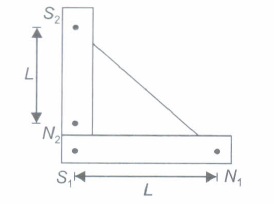
Two identical thin bar magnets, each of length L and pole strength In are placed at right angles to each other, with the north pole of one touching the south pole of the other. Find the magnetic moment of the system.
6.
A long straight wire in the horizontal plane carries a current of 50 A in north to south direction. Give the magnitude and direction of B at a point 2.5 m east of the wire.
7.
A magnetic dipole is under the influence of two magnetic fields. The angle between the field directions is 60º, and one of the fields has a magnitude of 1.2 × 10⁻² T. If the dipole comes to stable equilibrium at an angle of 15º with this field, what is the magnitude of the other field?
8.
A closely wound solenoid of 800 turns and area of cross section 2.5 × 10⁻⁴ m2 carries a current of 3.0 A. Explain the sense in which the solenoid acts like a bar magnet. What is its associated magnetic moment?
9.
A proton projected in a magnetic field of 0.02 T travels along a helical path of radius 6 cm and pitch 24 cm. Find the components of velocity of the proton along and perpendicular to the magnetic field. Take the mass of the proton = 1.6 x 10⁻²⁷ kg.
10.
A long horizontal rigidly supported wire carries \({ i }_{ a }\)of 100 A. Directed above it and parallels to it is a fine wire that carries a current \({ i }_{ a }\)of 20A and weighs 0.073N/m. How far above the lower wire should the second wire be kept if we wish to support it by magnetic repulsion?
Given permeability constant \({ \mu }_{ 0 }=4\pi \times { 10 }^{ -7 } \ Wb\ { A }^{ -1 }{ m }^{ -1 }\)
11.
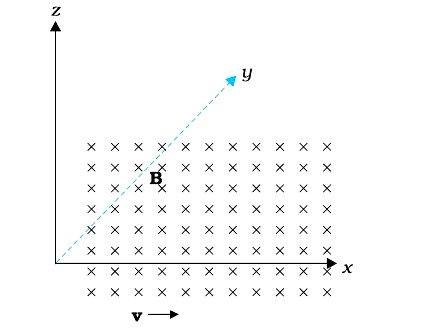
If the magnetic field is parallel to the positive y-axis and the charged particle is moving along the positive x-axis (Figure), which way would the Lorentz force be for
(a) an electron (negative charge),
(b) a proton (positive charge).
12.
A proton has spin and magnetic moment just like an electron. Why then its effect is neglected in magnetism of materials?
13.
A short bar magnet placed with its axis at 30º with a uniform external magnetic field of 0.25 T experiences a torque of magnitude equal to 4.5 x 10⁻² J. What is the magnitude of magnetic moment of the magnet?
14.
A circular coil fo N turns and radius R carries a current I. It is unwound and rewound to make another coil of radius R/2, current I remaining the same. Calculate the ratio of the magnetic moments of the new coil and the original coil.
15.
Write the formula for magnetic moment of a current loop.
16.
At a point on the right bisector of a magnetic dipole, the magnetic
potential varies as \(\frac{1}{r^{2}}\)
potential is zero at aU points on the right bisector.
field varies as r3
field is perpendicular to the axis of dipole
17.
A diamagnetic material in a magnetic field moves
perpendicular to the field
from weaker to stronger parts
from stronger to weaker parts.
in random direction.
18.
The best material for the ore of a transformer is
stainless steel
mild steel
hard steel
soft iron
19.
Essential difference between electrostatic shielding by a conducting shell and magnetostatic shielding is due to
electrostatic field lines cannot end on charges and conductors do not have free charges.
lines of B can also end but conductors cannot end them.
lines of B cannot end on any material and perfect shielding is not possible.
shells of high permeability materials cannot be used to divert lines of B from the interior region.
20.
An electron is travelling horizontally towards East. Amagnetic field in vertically downward direction exerts a force on the electron along
East
West
North
South
21.
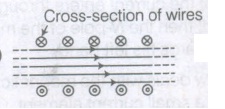
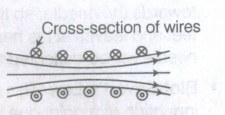
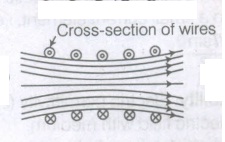
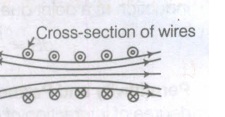
Which of the following represent a correct figure to display of magnetic field lines due to a solenoid?
22.
At a certain place, horizontal component is 1/\(\sqrt{3}\) times the vertical component. The angle of dip at this place is
zero
\(\pi/3\)
\(\pi/6\)
None of these
23.
The value of angle of dip is zero at the magnetic equator because on it
V and Hare equal
the values of V and Hare zero
the value of V is zero
the value ofH is zero
24.
A conducting wire of length l is turned in the form of a circular coil and a current I is passed through it. For the torque, due to magnetic field produced at its centre, to be maximum, the number of turns in the coil will be
one
two
three
more than three.
25.
Two particles X and Y having equal charges after being accelerated through the same potential difference, enter a region of uniform magnetic field and describe circular paths of radii \({ R }_{ 1 }\quad and\quad { R }_{ 2 }\) respectively. The ratio of the mass of X to that Y is
\(\frac { { R }_{ 1 } }{ { R }_{ 2 } } \)
\(\frac { { R }_{ 2 } }{ { R }_{ 1 } } \)
\({ \left( \frac { { R }_{ 1 } }{ { R }_{ 2 } } \right) }^{ 1/2 }\)
\({ \left( \frac { { R }_{ 1 } }{ { R }_{ 2 } } \right) }^{ 2 }\)
26.
A long solenoid has n turns per metre and current I A is flowing through it. The magnetic field induction at the ends of the solenoid is
zero
\({ \mu }_{ o }nI/2\)
\({ \mu }_{ o }nI\)
\(2{ \mu }_{ o }NI\)
27.
A coil of wire has an area of 600 sq. cm and has 500 turns. If it carries 1.5 A current, its magnetic dipole moment is
5 Am2
15 Am2
30 Am2
45 Am2
28.
Elements of the Earth’s Magnetic Field. The earth’s magnetic field at a point on its surface is usually characterized by three quantities: (a) declination (b) inclination or dip and (c) horizontal component of the field. These are known as the elements of the earth’s magnetic field. At a place, angle between geographic meridian and magnetic meridian is defined as magnetic declination, whereas angle made by the earth’s magnetic field with the horizontal in magnetic meridian is known as magnetic dip.

(i) In a certain place, the horizontal component of magnetic field is 1/ 3 times the vertical
component. The angle of dip at this place is
(a) Zero
(b) π/3
(c) π/2
(i) In a certain place, the horizontal component of magnetic field is 1/ 3 times the vertical
component. The angle of dip at this place is
(a) Zero
(b) π/3
(c) π/2
(d) π/6
(ii) The angle between the true geographic north and the north shown by a compass needle is
called as
(a) inclination
(b) magnetic declination
(c) angle of meridian
(d) magnetic pole
(iii) The angle of dip at the poles and the equator respectively are
(a) 30º, 60º
(b) 0º, 90º
(c) 45º, 90º
(d) 90º, 0º
(iv) A compass needle which is allowed to move in a horizontal plane is taken to a geomagnetic pole.
(a) It will become rigid showing no movement.
(b) It will stay in any position.
(c) It will stay in north-south direction only.
(d) It will stay in east-west direction only.
(v) Select the correct statement from the following:
(a) The magnetic dip is zero at the centre of the earth.
(b) Magnetic dip decreases as we move away from the equator towards the magnetic pole.
(c) Magnetic dip increases as we move away from the equator towards the magnetic pole.
(d) Magnetic dip does not vary from place to place
29.
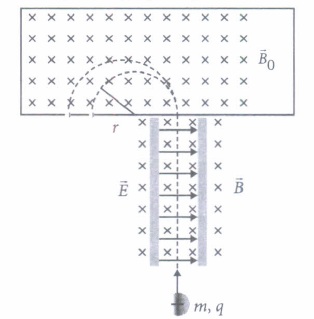
Various methods can be used to measure the mass of an atom. One possibility is through the use of a mass spectrometer. The basic feature of a Banbridge mass spectrometer is illustrated in figure. A particle carrying a charge +q is first sent through a velocity selector and comes out with velocity v = E/B.
The applied electric and magnetic fields satisfy the relation E = vB so that the trajectory of the particle is a straight line. Upon entering a region where a second magnetic field \(\vec{B}_{0}\) pointing into the page has been applied, the particle will move in a circular path with radius r and eventually strike the photographic plate.
(i) In mass spectrometer, the ions are sorted out in which of the following ways?
| (a) By accelerating them through electric field |
| (b) By accelerating them through magnetic field |
| (c) By accelerating them through electric and magnetic field |
| (d) By applying a high voltage |
(ii) Radius of particle in second magnetic field Bo is
| \(\text { (a) } \frac{2 m v}{q E_{0}}\) | \(\text { (b) } \frac{m v}{q E_{0}}\) | \(\text { (c) } \frac{m v}{q B_{0}}\) | \(\text { (d) } \frac{2 m E_{0} v}{q B_{0}}\) |
(iii) Which of the following will trace a circular trajectory wit largest radius?
| (a) Proton | (b) -\(\alpha\)particle | (c) Electron | (d) A particle with charge twice and mass thrice that of electron |
(iv) Mass of the particle in terms q, Bo, B,r and E is
| \(\text { (b) } \frac{q B_{0} B r}{E}\) | \(\text { (c) } \frac{q B r}{E B_{0}}\) | \(\text { (d) } \frac{q B r E}{B_{0}}\) |
(v) The particle comes out of velocity selector along a straight line, because
| (a) electric force is less than magnetic force | (b) electric force is greater than magnetic force |
| (c) electric and magnetic force balance each other | (d) can't say. |
30.
Assertion (A): A proton and an electron, with same momenta, enter in a magnetic field in a direction at right angles to the lines ofthe force. The radius of the paths followed by them willbe same.
Reason (R) : Electron has less mass than the proton.
(a) Both Assertion and Reason are true and Reason is the correct explanation of Assertion.
(b) Both Assertion and Reason are true but Reason is not the correct explanation of Assertion.
(c) Assertion is true but Reason is false.
(d) Assertion is false but Reason is true.
31.
Assertion (A) Diamagnetic substances exhibit magnetism.
Reason (R) Diamagnetic materials do not have permanent magnetic dipole moment.
(a) Both Assertion and Reason are true and Reason is the correct explanation of Assertion.
(b) Both Assertion and Reason are true but Reason is not the correct explanation of Assertion.
(c) Assertion is true but Reason is false.
(d) Assertion is false but Reason is true
32.
Assertion (A) : There is only one neutral points on a horizontal board when a magnet is held vertically on the board.
Reason (R) : At the neutral point the net magnetic field due to the magnetic and magnetic field of the earth is zero.
Codes:
(a) Both A and R are true and R is the correct explanation of A
(b) Both A and R are true but R is NOT the correct explanation of A
(c) A is true but R is false
(d) A is false and R is also false
33.
Assertion (A) : When a magnetic dipole is placed in a non uniform magnetic field, only a torque acts on the dipole.
Reason (R) : Force would act on dipole if magnetic field is uniform.
Codes:
(a) Both A and R are true and R is the correct explanation of A
(b) Both A and R are true but R is NOT the correct explanation of A
(c) A is true but R is false
(d) A is false and R is also false
1.
Given, magnetic moment of magnet, M = 0.32 J/T
Magnitude of magnetic field, B = 0.15 T
(i) For stable equilibrium, the angle between magnetic moment M and magnetic field B is \(\theta\) = 0°.
[\(\because\) In this position, it will be in a direction parallel to the magnetic field, thus no torque will act on it.]
\(\because\) The potential energy of the magnet,
U = - M . B = -MB cos \(\theta\) [\(\because\) M.B = MB cos \(\theta\)]
=-0.32 \(\times\)0.15 cos 0° = -4.8 \(\times\)10-2 J
Thus, for the stable equilibrium the potential energy is -4.8 \(\times\)10-2 J.
(ii) For unstable equilibrium, the angle between the magnetic moment and magnetic field is 180°.
(\(\because\)At \(\theta\)=180°, although torque is zero but if it is displaced by small angle d\(\theta\), then resulting torque would not restore it to the original position).
Potential energy of the magnet,
U = - MB cos 180° = -0.32 \(\times\)0.15 (-1)
= 4.8 \(\times\)10-2 J
Thus, for the unstable equilibrium, the potential energy is 4.8 \(\times\)10-2 J.
2.
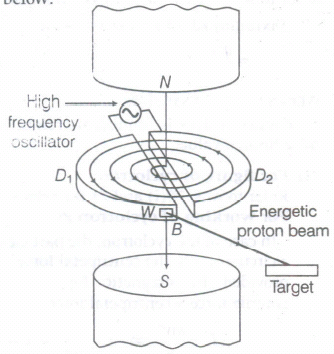
Working Let initially positively charged is accelerated towards D2 and enter into it.
Now, the charged particle experiences magnetic Lorentz force due to a strong normal magnetic field. It performs circular motion. The time taken by the charge particle to complete half revolution is equal to half of time period of AC oscillator between two dees.
The charge d particle again accelerated towards D1 as D2 acquires positive and d negative polarity. Thus, the charge particle is brought again and again in the small region of oscillating electrical field by strong normal magnetic field.
In case of the cyclotron, the particle moves on a circular path, the centripetal force required is provided by magnetic force, so magnetic
Lorentz force = centripetal force
qvB = \(\frac{mv^{2}}{r} \Rightarrow r=\frac{mv}{qB}\Rightarrow v=\frac{qBr}{m}\)
\(\therefore KE=\frac{1}{2}mv^{2}=\frac{1}{2}m(\frac{qBr}{m})^{2}=\frac{q^{2}B^{2}r^{2}}{2m}\)
For maximum KE, r = ro (radius of dees).
(ii) Given, I1 = 2A, I2 = 5A, r = 1 cm = 1 x 10⁻²m
Force per unit length between two wires.
\(\frac{F}{L}=\frac{\mu_0}{4\pi}\frac{2I_1 I_2}{r}=\frac{10^{-7}\times2\times2\times5}{1\times10^{2}}=20\times10^{-5}\)
\(\frac{F}{L}=2\times10^{4}Nm^{-1}\)
Currents flowing in wires are in opposite directions, so the force will be of repulsive nature.
3.
Magnetic field strength, B = 6.5 G = 6.5 x 10⁻⁴ T
Speed of the electron, v = 4.8 x 10⁶ m/s
Charge on the electron, e = 1.6 x 10⁻¹⁹ C
Mass of the electron, me = 9.1 x 10⁻³¹ kg
Angle between the shot electron and magnetic field, θ = 90°
Magnetic force exerted on the electron in the magnetic field is given as:
F = evB sinθ
This force provides centripetal force to the moving electron. Hence, the electron starts moving in a circular path of radius r.
Hence, centripetal force exerted on the electron,
\(F_{c}=\frac{m v^{2}}{r}\)
In equilibrium, the centripetal force exerted on the electron is equal to the magnetic force i.e.,
FC = F
\(\frac{m v^{2}}{r}=e v B \sin \theta\)
\(r=\frac{m v}{B e \sin \theta}\)
\(=\frac{9.1 \times 10^{-31} \times 4.8 \times 10^{6}}{6.5 \times 10^{-4} \times 1.6 \times 10^{-19} \times \sin 90^{\circ}}\)
= 4.2 x 10 -2 m = 4.2 cm
Hence, the radius of the circular orbit of the electron is 4.2 cm.
4.
Magnetic permeability: It is a measure of the extent to which magnetic field influence can pass through a material.
The following are the characteristics:
(i) Material should have high retentivity.
(ii) Material should have high coercivity.
(iii) Material should have high permeability.
A suitable material for permanent magnet is alnico steel.
5.
Since, \(L_{N_{1} S_{2}}=\sqrt{L^{2}+L^{2}}=\sqrt{2} L\)
So, the magnetic moment of the system is calculated as
\(M=m \times \sqrt{2} L=\sqrt{2} m L\)
6.
Current in the wire, I = 50 A
A point is 2.5 m away from the East of the wire.
∴ Magnitude of the distance of the point from the wire, r = 2.5 m.
Magnitude of the magnetic field at that point is given by the relation, B \(=\frac{\mu_{0} 2 I}{4 \pi r}\)
Where,
μ0 = Permeability of free space = 4π x 10–7 T m A–1
\(B=\frac{4 \pi \times 10^{-7} \times 2 \times 50}{4 \pi \times 2.5}\)
= 4 x 10 -6 T
The point is located normal to the wire length at a distance of 2.5 m. The direction of the current in the wire is vertically downward. Hence, according to the Maxwell’s right hand thumb rule, the direction of the magnetic field at the given point is vertically upward.
7.
Magnitude of one of the magnetic fields, B1 = 1.2 x 10⁻² T
Angle between the two fields, θ = 60°
At stable equilibrium, the angle between the dipole and field B1, θ1 = 15°
Let the magnitude of the other the other magnetic field be B2
Angle between the dipole and field B2, θ2 = θ − θ1 = 60° − 15° = 45°
At rotational equilibrium, the torques due to both the fields must balance each other. That is,
Torque due to field B1 = Torque due to field B2Torque due to field B1 = Torque due to field B2
⇒ MB1 sin θ1 = MB2 sin θ2
\(\Rightarrow \mathrm{B}_{2}=\frac{\mathrm{B}_{1} \times \sin \theta_{1}}{\sin \theta_{2}}\)
Where,
M = Magnetic moment of the dipole
Putting the values, we get,
\(\mathrm{B}_{2}=\frac{1.2 \times 10^{-2} \times \sin 15^{\circ}}{\sin 45^{\circ}}\)
= 4.39 x 10⁻³ T
Therefore, the magnitude of the other magnetic field is 4.39 x 10⁻³ T.
8.
Number of turns in the solenoid, n = 800
Area of cross-section, A = 2.5 × 10⁻⁴ m2
Current in the solenoid, I = 3.0 A
A current-carrying solenoid behaves like a bar magnet because a magnetic field develops along its axis, i.e., along with its length.
The magnetic moment associated with the given current-carrying solenoid is calculated as:
M = n I A
= 800 x 3 x 2.5 x 10-4
= 0.6 J T-1
9.
Here, B = 0.02 T, r = 6 x 10⁻² m;
pitch = 24 x 10-2 m
Let V1 be the component of velocity of proton perpendicular to magnetic field. Then
\(r=\frac { { mv }_{ 1 } }{ qB } \ or \ { V }_{ 1 }=\frac { rqB }{ m } \)
\(\therefore { V }_{ 1 }=\frac { \left( 6\times { 10 }^{ -2 } \right) \times \left( 1.6\times { 10 }^{ -19 } \right) \times 0.02 }{ 1.6\times { 10 }^{ -27 } } \)
= 1.2 x 10⁵ ms-1
Time period of revolution,
\(T=\frac { 2\pi r }{ { v }_{ 1 } } =\frac { 2\pi \times 6\times { 10 }^{ -2 } }{ 1.2\times { 10 }^{ 5 } } =\pi \times { 10 }^{ -6 }s\)
Let V2 be the component of velocity of proton along the direction of magnetic field. Then
\({ V }_{ 2 }=\frac { pitch }{ time\quad period } =\frac { 24\times { 10 }^{ -2 } }{ \pi \times { 10 }^{ -6 } } \)
= 7.6 x 10⁴ ms-1
10.
If \({ i }_{ a }\)and \({ i }_{ b }\) are the 3 antiparallel currents flowing in two parallel wires separated by a distance R, then the repulsive force experienced by unit length (1m) of either wire is
\(F=\frac { { \mu }_{ 0 }{ i }_{ a }{ i }_{ b } }{ 2\pi R } \)
Weight per meter length of above wire
\(=0.073{ Nm }^{ -1 }\)
According to problem, the weight of lower wire is supported by upward magnetic repulsion, therefore
\(\frac { { \mu }_{ 0 }{ i }_{ a }{ i }_{ b } }{ 2\pi R } \)\(=0.073\)
\(R=\frac { { \mu }_{ 0 }{ i }_{ a }{ i }_{ b } }{ 2\pi \times 0.073 } \)
\(=\frac { 4\pi \times { 10 }^{ -7 }\times 100\times 20 }{ 2\pi \times 0.073 } \)
\(=4.4\times { 10 }^{ -3 }m = 4.48mm\)
11.
The velocity v of particle is along the x-axis, while B, the magnetic field is along the y-axis, so v x B is along the z-axis (screw rule or right-hand thumb rule). So,
(a) for electron it will be along –z axis.
(b) for a positive charge (proton) the force is along + z axis.
12.
As we know that, the magnetic moment of electron or proton is inversely proportional to the mass of electron or proton, respectively.
Magnetic. moment of electron, \(\mu_{e} \text { oc } \frac{1}{m_{e}}\)
where, me = mass of electron
Magnetic moment of proton, \(\mu_{p} \propto \frac{1}{m_{p}}\)
where, mp = mass of proton
\(\frac{\mu_{e}}{\mu_{p}}=\frac{m_{p}}{m_{e}}\) .......(i)
As, we know that, me < < mp
So, \(\frac{m_{p}}{m_{e}}>>1 \Rightarrow \frac{\mu_{e}}{\mu_{p}}>>1\)
\(\Rightarrow\) \(\mu_{e}>>\mu_{p}\)
Thus, as the value of magnetic moment of electron is much more as compared to magnetic moment of proton, so the effect of proton is neglected.
13.
Magnetic field strength, B = 0.25 T
Torque on the bar magnet, T = 4.5 x 10⁻² J
The angle between the bar magnet and the external magnetic field, θ = 30°
Torque is related to magnetic moment (M) as:
\(T=M B \sin \theta \therefore M=\frac{T}{B \sin \theta}\)
\(=\frac{4.5 \times 10^{-2}}{0.25 \times \sin 30^{\circ}}=0.36 J T^{-1}\)
Hence, the magnetic moment of the magnet is 0.36 J T-1.
14.
\({ N }_{ 1 }.2\pi R={ N }_{ 2 }.2\pi (R/2)\)
\(\therefore \ { N }_{ 2 }=2{ N }_{ 1 }\)
Magnetic moment of a coil, M =NAI
For the coil of radius 'R'
\({ M }_{ 1 }={ N }_{ 1 }{ IA }_{ 1 }={ N }_{ 1 }I\pi { R }^{ 2 }\)
For the coil of radius R/2
\({ M }_{ 2 }={ N }_{ 2 }{ IA }_{ 2 }=2{ N }_{ 1 }I\pi { R }^{ 2 }/4={ N }_{ 1 }.\pi { R }^{ 2 }/2\)
\({ M }_{ 1 }:{ M }_{ 2 }=1:2\)
15.
M = NIA, when N is number of turns I, the current and A = area of cross section of loop.
16.
(b)
potential is zero at aU points on the right bisector.
17.
(c)
from stronger to weaker parts.
18.
(d)
soft iron
19.
(c)
lines of B cannot end on any material and perfect shielding is not possible.
20.
(d)
South
21.
(c)
22.
(b)
\(\pi/3\)
23.
(c)
the value of V is zero
24.
(a)
one
25.
(d)
\({ \left( \frac { { R }_{ 1 } }{ { R }_{ 2 } } \right) }^{ 2 }\)
26.
(b)
\({ \mu }_{ o }nI/2\)
27.
(d)
45 Am2
28.
29.
(i) (c): In mass spectrometer, the ions are sorted out by accelerating them through electric and magnetic field.
(ii) (c): As \(\frac{m v^{2}}{r}=q v B_{0} \therefore r=\frac{m v}{q B_{0}}\)
(iii) (b): As radius \(r \propto \frac{m}{q}\)
\(\therefore\) r will be maximum for \(\alpha\) - particle.
(iv) (b) : Here, \(r=\frac{m v}{q B_{0}} \text { or } m=\frac{r q B_{0}}{v}\)
As \(v=\frac{E}{B}, \therefore m=\frac{q B_{0} B r}{E}\)
(v) (c): From the relation v = E/B, it is clear electric and magnetic force balance each other.
30.
(b) Both Assertion and Reason are true but Reason is not the correct explanation of Assertion.
31.
(a) Both Assertion and Reason are true and Reason is the correct explanation of Assertion.
32.
(b): There will be only one neutral point on the horizontal board. This is because field of earth magnetic field is from south to north; and the field of pole on the board is radially outwards. At any point towards south of magnetic pole, field of earth and field of pole will cancel out to give a neutral point.
33.
(d): In a non-uniform magnetic field, a torque and a net force both act on the dipole. If magnetic field is uniform, net force on dipole would be zero.

12th Standard CBSE Syllabus & Materials
12th Standard CBSE
CBSE 12th Computer Science Python Revision Tour I - New Previous year Question Papers Study Material - QB365 Set A
NEW12th Standard CBSE
CBSE 12th Business Studies Planning Important Questions And Answers Study Material - QB365 Set A
NEW12th Standard CBSE
CBSE 12th Business Studies Business Environment Important Questions And Answers Study Material - QB365 Set A
NEW12th Standard CBSE
CBSE 12th Business Studies Principles of Management Important Questions And Answers Study Material - QB365 Set A



NCERT Books

Syllabus

Exam Pattern

Sample Question Papers

Previous year Question Papers

Important Notes

MCQ Practice test

NCERT Exemplers

Case study Questions

Image Based Questions

Passage based Questions

HOT Questions

Value Based Questions

Model Questions Papers
NCERT ( Book Back ) Questions

Assertion and Reason
Important Questions And Answers

CBSE 12th Standard CBSE Subjects
CBSE Standards








