
 100% FREE ACCESS
12th Standard CBSE Syllabus & Materials
12th Standard CBSE
CBSE 12th Economics Government Budget and the Economy Previous year Question Papers Study Material - QB365 Set A
NEW12th Standard CBSE
CBSE 12th Computer Science Interface Python with MySQL - New Previous year Question Papers Study Material - QB365 Set A
NEW12th Standard CBSE
CBSE 12th Computer Science Database Concept - New Previous year Question Papers Study Material - QB365 Set A
NEW12th Standard CBSE
CBSE 12th Computer Science Data Communication - New Previous year Question Papers Study Material - QB365 Set A
NEW12th Standard CBSE
CBSE 12th Computer Science Data Structures - New Previous year Question Papers Study Material - QB365 Set A
NEW12th Standard CBSE
CBSE 12th Computer Science Functions - New Previous year Question Papers Study Material - QB365 Set A

Published on: 25/10/2025
Download CBSE Class 12th Standard CBSE Physics question papers, sample papers, important questions, and previous year solved papers in PDF format. Get free study materials, NCERT solutions, and exam preparation resources for Class 12th Standard CBSE Physics
Questions + Answers key
Take MCQ Physics Test
1.
From the relation R = R0A1/3, where R0 is a constant and A is the mass number of a nucleus, show that the nuclear matter density is nearly constant (i.e. independent of A).
2.
Find the energy equivalent of one atomic mass unit, first in Joules and then in MeV. Using this, express the mass defect of \({ }_{8}^{16} \mathrm{O} \text { in } \mathrm{MeV} / \mathrm{c}^{2}\)
3.
Explain giving necessary reactions, how energy is released during
(i) fission
(ii) fusion
4.
Define the term
(i) mass defect
(ii) binding energy for a nuceus and state the relation between the two.
For a given nuclear reaction,the B.E/nucleon of the product nuclear/nuclei is more than that for the original nucleus/nuclei.Is this nuclear reaction exothermic or endothermic in nature?Justify your choice.
5.
The binding energy per nucleon for \(_{ 6 }{ { C }^{ 12 } }\) is 7.68 MeV/N and that for \(_{ 6 }{ { C }^{ 13 } }\) is 7.47 MeV/N. Calculate the energy required to remove a neutron \(_{ 6 }{ { C }^{ 13 } }\).
6.
Calculate the impact parameter of a 5 MeV particle scattered by \(90°\), when it approaches a gold nucleus (Z = 79).
7.
When impact parameter of \(\alpha\)-particle is zero, the -particle travelling directly towards the centre of the nucleus retraces its path.Explain why.
8.
Calculate the energy equivalent of 1 g of substance.
9.
Given the mass of iron nucleus as 55.85u and A = 56, find the nuclear density?
10.
Select the pairs of isotopes and isotones from the following nuclei: \(_{ 6 }{ C^{ 13 } },_{ 7 }{ N^{ 14 } },_{ 15 }{ P^{ 30 } },_{ 15 }{ P^{ 31 } }.\)
11.
State two characteristic properties of nuclear forces.
12.
Show that Bohr's second postulate "The electron revolves around the nucleus only in certain fixed orbits without radiating energy" can be explained on the basis of de-Broglie hypothesis of wave nature of electron.
13.
Draw the curve showing the variation of binding energy per nucleon with the mass number of nuclei. Using it explain the fusion of nuclei lying on ascending part and fission of nuclei lying on descending part of this curve.
14.
How long can an electric lamp of 100W be kept glowing by fusion of 2.0 kg of deuterium? Take the fusion reaction as
\({ }_{1}^{2} \mathrm{H}+{ }_{1}^{2} \mathrm{H} \rightarrow{ }_{2}^{3} \mathrm{He}+\mathrm{n}+3.27 \mathrm{MeV}\)
15.
Obtain the binding energy of the nuclei \(\begin{array}{l} 26 \\ 56 \end{array} \text { Fe }\) and \(\begin{array}{l} 209 \\ 83 \end{array} \text { Bi }\)in units of MeV from the following data:
m (\(\begin{array}{l} 26 \\ 56 \end{array} \text { Fe }\) ) = 55.934939 u
m (\(\begin{array}{l} 209 \\ 83 \end{array} \text { Bi }\) ) = 208.980388 u
16.
Einstein was the first to establish the equivalence between mass energy. According to him, whenever a certain mass \(\left( \Delta m \right) \) disappears in some process, the amount of energy released is \(E=\left( \Delta m \right) { c }^{ 2 },\) where c is velocity of light vacuum \(\left( =3\times { 10 }^{ 8 }m/s \right) .\) The reverse is also true, i.e., whenever energy E disappears, an equivalent mass \(\left( \Delta m \right) ={ E/c }^{ 2 }\) appears.
Read the above passage and answer the following questions :
(i) What is the energy released when 1 a.m.u. of mass disappears in a nuclear reaction?
(ii) Do you know any phenomenon in which energy materialises?
(iii) What values of life do you learn from this famous relation?
17.
Calculate the binding energy per nucleon of the nucleus \(_{ 26 }{ { Fe }^{ 56 } }\). Given that mass of \(_{ 26 }{ { Fe }^{ 56 } }\) = 55.934939 u, the mass of proton = 1.007825 u and mass of neutron = 1.008665 u and 1u = 931 MeV.
18.
Binding energy per nucleon of a stable nucleus is
8 eV
8 KeV
8 MeV
8 Bev
19.
The nuclear forces
are stronger, being roughly hundred times that of electromagnetic forces
have a short range dominant over a distance of about a few fermi
are central forces, independent of the spin of the nucleons
are independent of the nuclear charge.
20.
During a nuclear fusion reaction :
a heavy nucleus breaks into two fragments by itself
a light nucleus bombarded by thermal neutrons breaks up
a heavy nucleus bombarded by thermal neutrons breaks up
two light nuclei combine to give a heavier nucleus and possibly other products
21.
As the mass number 'A' increases, which of the following quantities related to nucleus do not change?
mass
volume
density
binding energy
22.
The mass number of a nucleus is :
always less than its atomic number
always more than its atomic number
sometimes equal to its atomic number
sometimes more than and sometimes equal to its atomic number
23.
The binding energies per nucleon of \(_{ 3 }{ { Li }^{ 7 } }\ and\ _{ 2 }{ { He }^{ 4 } }\) nuclei are 5.60 MeV and 7.06 MeV respectively. In the nucleon reaction \(_{ 3 }{ { Li }^{ 7 } }+_{ 1 }{ { H }^{ 1 } }\longrightarrow _{ 2 }{ { He }^{ 4 } }+_{ 2 }{ { He }^{ 4 } }+Q\) the value of energy Q released is
19.6 MeV
- 2.4 MeV
8.4 MeV
17.3 MeV
24.
If \(M\left( A,Z \right) ,\ { M }_{ p }\ and\ { M }_{ n }\) denote the masses of the nucleus \(_{ Z }{ { X }^{ A } },\) proton and neutron respectively in units of U \(\left( where\ 1\ U=931.5\quad MeV/{ c }^{ 2 } \right) \) and B.E. represents its B.E. in MeV, then
\(M\left( A,Z \right) =Z{ M }_{ p }+\left( A-Z \right) { M }_{ n }-BE/{ c }^{ 2 }\)
\(M\left( A,Z \right) =Z{ M }_{ p }+\left( A-Z \right) { M }_{ n }+BE\)
\(M\left( A,Z \right) =Z{ M }_{ p }+\left( A-Z \right) { M }_{ n }-BE\)
\(M\left( A,Z \right) =Z{ M }_{ p }+\left( A-Z \right) { M }_{ n }+BE/{ c }^{ 2 }\)
25.
A nucleus with mass number 220 initially at rest emits an \(\alpha \)-particle. If the energy released in the reaction is 5.5 MeV, calculate the K.E. of \(\alpha \)-particle.
4.4 MeV
5.4 MeV
5.6 MeV
6.5 MeV
26.
Out of \(_{ 6 }{ { C }^{ 14 } },_{ 7 }{ { N }^{ 13 } },_{ 7 }{ { N }^{ 14 } }and_{ 8 }{ { O }^{ 16 } }\)the pair of isotopes is
\(_{ 6 }{ { C }^{ 14 } },_{ 8 }{ { O }^{ 16 } }\)
\(_{ 7 }{ { N }^{ 13 } },_{ 7 }{ { N }^{ 14 } }\)
\(_{ 7 }{ { N }^{ 14 } },_{ 6 }{ { C }^{ 14 } }\)
\(_{ 7 }{ { N }^{ 14 } },_{ 8 }{ { O }^{ 16 } }\)
27.
The radii of two nuclei with mass numbers 1 and 8 are in the ratio
1:8
8:1
1:2
2:1
28.
Heavy stable nuclei have more neutrons than protons. This is because of the fact that
neutrons are heavier than protons
electrostatic force between protons is repulsive
neutrons decay into protons through beta decay
nuclear forces between neutrons are weaker than that between protons
29.
The nucleus was first discovered in 1911 by Lord Rutherford and his associates by experiments on scattering of a-particles by atoms. He found that the scattering results could be explained, if atoms consist of a small, central, massive and positive core surrounded by orbiting electrons. The experimental results indicated that the size of the nucleus is of the order of 10-14m and is thus 10000 times smaller than the size of atom.
(i) Ratio of mass of nucleus with mass of atom is approximately
| (a) 1 | (b) 10 | (c) 103 | (d) 1010 |
(ii) Masses of nuclei of hydrogen, deuterium and tritium are in ratio
| (a) 1:2:3 | (b) 1:1:1 | (c) 1:1:2 | (d) 1:2:4 |
(iii) Nuclides with same neutron number but different atomic number are
| (a) isobars | (b) isotopes | (c) isotones | (d) none of these |
(iv) If R is the radius and A is the mass number, then log R versus log A graph will be
| (a) a straight line | (b) aparabola | (c) anellipse | (d) none of these |
(v) The ratio of the nuclear radii of the gold isotope \({ }_{79}^{197} \mathrm{Au}\) and silver isotope \({ }_{47}^{107} \mathrm{Au}\) is
| (a) 1.23 | (b) 0.216 | (c) 2.13 | (d) 3.46 |
30.
In the year 1939, German scientist Otto Hahn and Strassmann discovered that when an uranium isotope was bombarded with a neutron, it breaks into two intermediate mass fragments. It was observed that, the sum of the masses of new fragments formed were less than the mass of the original nuclei. This difference in the mass appeared as the energy released in the process. Thus, the phenomenon of splitting of a heavy nucleus (usually A> 230) into two or more lighter nuclei by the bombardment of proton, neutron, a-particle, etc with liberation of energy is called nuclear fission.
\({ }_{92} \mathrm{U}^{235}+{ }_{0} n^{1} \rightarrow \quad{ }_{92} \mathrm{U}^{236} \rightarrow{ }_{56} \mathrm{Ba}^{144}+{ }_{36} \mathrm{Kr}^{89}+3{ }_{0} n^{1}+Q\)
Unstable nucleus
(i) Nuclear fission can be explained on the basis of
| (a) Millikan's oil drop method |
| (b) Liquid. drop model |
| (c) Shell model |
| (d) Bohr's model |
(ii) For sustaining the nuclear fission chain reaction in a sample (of small size) \({ }_{92}^{235} \mathrm{U}\), it is desirable to slow down fast neutrons by
| (a) friction | (b) elastic damping/scattering |
| (c) absorption | (d) none of these |
(iii) Which of the following is/are fission reaction(s)?
\(\text {(I) }{ }_{0}^{1} n+{ }_{92}^{235} \mathrm{U} \rightarrow{ }_{92}^{236} \mathrm{U} \rightarrow{ }_{51}^{133} \mathrm{Sb}+{ }_{41}^{99} \mathrm{Nb}+4_{0}^{1} n\)
\(\text {(II) }{ }_{0}^{1} n+{ }_{92}^{235} \mathrm{U} \rightarrow{ }_{54}^{1.40} \mathrm{Xe}+{ }_{38}^{94} \mathrm{Sr}+2{ }_{0}^{1} n\)
\((\mathrm{III}){ }_{1}^{2} \mathrm{H}+{ }_{1}^{2} \mathrm{H} \rightarrow{ }_{2}^{3} \mathrm{He}+{ }_{0}^{1} n\)
| (a) Both II and III | (b) Both I and III |
| (c) Only II | (d) Both I and II |
(iv) On an average, the number of neutrons and the energy of a neutron released per fission of a uranium atom are respectively
| (a) 2.5 and 2 keV | (b) 3 and 1 keV | (c) 2.5 and 2 MeV | (d) 2 and 2 keV |
(v) In any fission process, ratio of mass of daughter nucleus to mass of parent nucleus is
| (a) less than 1 | (b) greater than 1 |
| (c) equal to 1 | (d) depends 0 the mass of parent nucleus |
31.
32.
Assertion (A) : A fission reaction can be more easily controlled than a fission reaction.
Reason (R) : The percentage of mass converted to energy in a fission reaction is 0.1% whereas in a fission reaction it is 0.4%.
Codes:
(a) Both A and R are true and R is the correct explanation of A
(b) Both A and R are true but R is NOT the correct explanation of A
(c) A is true but R is false
(d) A is false and R is also false
33.
Assertion (A) : Nuclear density is extremely higher than atomic density.
Reason (R) : Most of the mass of the atom is concentrated in the nucleus
Codes:
(a) Both A and R are true and R is the correct explanation of A
(b) Both A and R are true but R is NOT the correct explanation of A
(c) A is true but R is false
(d) A is false and R is also false
34.
Assertion (A) : Isotopes of an element can be separated by using a mass spectrometer.
Reason (R) : Separation of isotopes is possible because of the difference in electron numbers of isotopes
Codes:
(a) Both A and R are true and R is the correct explanation of A
(b) Both A and R are true but R is NOT the correct explanation of A
(c) A is true but R is false
(d) A is false and R is also false
1.
We have the expression for nuclear radius as:
R = R0A1/3
Where,
R0 = Constant.
A = Mass number of the nucleus
Nuclear matter density, \(\rho \ =\frac{Mass\ of\ the\ nucles}{Volume\ of\ the\ nucles}\)
Let m be the average mass of the nucleus.
Hence, mass of the nucleus = mA
\(\therefore \rho=m \frac{A}{\frac{4}{3} \pi R^{3}}=\frac{3 \mathrm{~mA}}{4 \pi\left(R_{0} A^{\frac{1}{3}}\right)^{3}}=\frac{3 m A}{4 \pi R_{0}^{3} A}=\frac{3 \mathrm{~m}}{4 \pi R_{0}^{3}}\)
Hence, the nuclear matter density is independent of A. It is nearly constant.
2.
1u = 1.6605 x 10⁻²⁷ kg
To convert it into energy units, we multiply it by c2 and find that energy equivalent = \(1.6605 \times 10^{-27} \times\left(2.9979 \times 10^{8}\right)^{2} \mathrm{~kg} \mathrm{~m}^{2} / \mathrm{s}^{2}\)
\(=1.4924 \times 10^{-10} \mathrm{~J}\)
\(=\frac{1.4924 \times 10^{-10}}{1.602 \times 10^{-19}} \mathrm{eV}\)
\(=0.9315 \times 10^{9} \mathrm{eV}\)
\(=931.5 \mathrm{MeV}\)
or, \(1 \mathrm{u}=931.5 \mathrm{MeV} / \mathrm{c}^{2}\)
For, \({ }_{8}^{16} \mathrm{O}, \quad \Delta M=0.13691 \mathrm{u}=0.13691 \times 931.5 \mathrm{MeV} / \mathrm{c}^{2}\)
\(=127.5 \mathrm{MeV} / \mathrm{c}^{2}\)
The energy needed to separate \({ }_{8}^{16} \mathrm{O}\) into its constituents is thus 127.5 MeV/c2.
3.
Nuclear Fission The phenomenon of splitting of heavy nuclei (mass number> 120) into smaller nuclei of nearly equal masses is known as nuclear fission.
In nuclear fission, the sum of the masses Y of the product is less than the sum of masses of the reactants. This difference of mass gets converted into energy E = me! and hence sample amount of energy is released in a nuclear fission.
e.g. \(_{ 235 }^{ 92 }{ U }+_{ 0 }^{ 1 }{ n }\rightarrow _{ 56 }^{ 141 }{ Ba }+_{ 36 }^{ 92 }{ Kr }+6_{ 0 }^{1 }{ n }+Q\)
Masses of reactant
= 235.0439 amu + 1.0087 amu
= 236.0526 amu
Masses of product
= 140.9139 + 91.8973 + 3.0261
= 235.8373 amu
Mass defect = 236.0526 - 235.8373
= 0.2153 amu
\(\because\) 1amu \(\equiv\) 931 MeV
\(\Rightarrow\) Energy released = 0.2153 x 931 = 200 MeV nearly
Thus, energy is liberated in nuclear fission \(_{92}^{235}{U}.\)
4.
(i) Mass defect \((\triangle M)\) ,of any nucleus \(_{ Z }^{ A }{ X }\) is the sum of masses of the nucleus (=M) and the sum of masses of its constituent nucleons (=M')
\(\triangle M={ M }^{ ' }-M\)
\(=\left[ { Zm }_{ p }+(A-Z){ m }_{ n } \right] -M\)
where \({ m }_{ p }\) and \({ m }_{ n }\) denote the mass of the proton and the neutron respectively.
(ii) Binding energy is the energy required to seperate a nucleus into its constituent nucleons. The relation between the two is B.E=(mass defect) c2
(iii) There is a release of energy i.e., the reaction is exothermic. Reason: Increase in B.E/nucleon implies that more mass has been converted into energy.
5.
Total B.E of \(_{ 6 }{ { C }^{ 12 } }\)\(=12\times 7.68=92.16\quad MeV\)
Total B.E of \(_{ 6 }{ { C }^{ 13 } }\) \(=13\times 7.47=97.11\quad MeV\)
As \(_{ 6 }{ { C }^{ 13 } }\) has one excess neutron than \(_{ 6 }{ { C }^{ 12 } }\),
\(\therefore \) Energy required to remove a neutron
= 97.11-92.16 = 4.95 MeV
6.
\(2.27\times { 10 }^{ -14 }m\)
Here, \(b=?\ KE=5MeV=5\times 1.6\times { 10 }^{ -13 }J\)
\(\theta =90°,\ \quad Z=79\)
\( b=\frac { Z{ e }^{ 2 }cot{ \theta }/{ 2 } }{ 4\pi { \epsilon }_{ 0 }(KE) } \)
\( =\frac { 9\times { 10 }^{ 9 }\times 79{ \left( 1.6\times { 10 }^{ -19 } \right) }^{ 2 }cot45° }{ 5\times 1.6\times { 10 }^{ -13 } }\)
\( b=2.27\times { 10 }^{ -14 }m\)
7.
Since impact parameter is given by:
\(b={Ze^2cot{\theta\over2}\over4\pi\epsilon_0 E}\)
when b = 0, \(cot{\theta\over2}=0\)
or \({\theta\over2}=90^0\)
or \(\theta =180^0\)
i.e. \(\alpha\) -particle retrace its path as its angle of scattering is 1800
8.
Energy, \(E=10^{-3} \times\left(3 \times 10^{8}\right)^{2} \mathrm{~J}\)
\(E=10^{-3} \times 9 \times 10^{16}=9 \times 10^{13} \mathrm{~J}\)
Thus, if one gram of matter is converted to energy, there is a release of enormous amount of energy.
9.
mFe = 55.85
u = 9.27 × 10⁻²⁶ kg
Nuclear density = \(\frac{\text { mass }}{\text { volume }}=\frac{9.27 \times 10^{-26}}{(4 \pi / 3)\left(1.2 \times 10^{-15}\right)^{3}} \times \frac{1}{56}\)
= 2.29 × 10¹⁷ kg m–3
The density of matter in neutron stars (an astrophysical object) is comparable to this density. This shows that matter in these objects has been compressed to such an extent that they resemble a big nucleus.
10.
\(\text { Isotopes }\left({ }_{15} P^{30}{ }_{, 15} P^{31}\right) \text {, Isotones }\left({ }_6 C^{13}{ }_7 N^{14}\right) \text {. }\)
11.
Nuclear forces are the strongest forces in nature.They are effective only inside the nucleus.
12.
When an electron of mass m is confined to move on a line of length l with velocity v, the de-Broglie wavelength \(\lambda \) associated with electron is \(\lambda =\frac { h }{ mv } =\frac { h }{ p } \ \ or \ \ p=\frac { h }{ \lambda } =\frac { h }{ { 2l }/{ n } } =\frac { nh }{ 2l } \)
When electron revolves in a circular orbit of radius r; then \(2l=2\pi r\)
\( \ \therefore \ \ p=\frac { nh }{ 2\pi r } \\ \ \ or \ \ p\times r=\frac { nh }{ 2\pi } \)
i.e., angular momentum \((p\times r)\) of electron is integral multiple of \({ h }/{ 2\pi }\) . This is Bohr's quantization condition of angular momentum.
13.
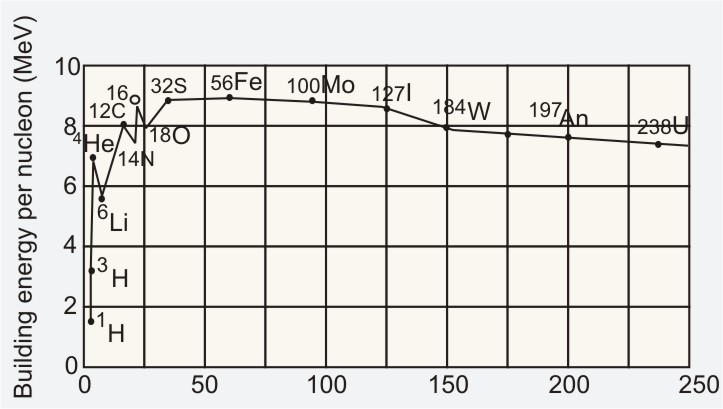
On the ascending part of the curve, B.E./A increases with the mass number (A).
So, B.E. of the resultant will be greater than that of the nuclei which are fused together. Hence the fusion of the nuclei on the ascending part results in an increase in binding energy, therefore, more stable nucleus
On the descending part of the curve, the B.E. of the heavier nuclei is lower. So the fission of the heavier nuclei, on the descending part, will cause an increase in B.E. and, therefore, more stable nucleus
14.
The given fusion reaction is:
\({ }_{1}^{2} \mathrm{H}+{ }_{1}^{2} \mathrm{H} \rightarrow{ }_{2}^{3} \mathrm{He}+\mathrm{n}+3.27 \mathrm{MeV}\)
Amount of deuterium, m = 2 kg
1 mole, i.e., 2 g of deuterium contains 6.023 x 10²³ atoms.
∴ 2.0 kg of deuterium contains \(=\frac{6.023 \times 10^{23}}{2} \times 2000=6.023 \times 10^{26} \text { atoms }\)
It can be inferred from the given reaction that when two atoms of deuterium fuse, 3.27 MeV energy is released.
∴Total energy per nucleus released in the fusion reaction:
\(E=\frac{3.27}{2} \times 6.023 \times 10^{26} \mathrm{MeV}\)
\(=\frac{3.27}{2} \times 6.023 \times 10^{26} \times 1.6 \times 10^{-19} \times 10^{6}\)
\(=1.576 \times 10^{14} J\)
Power of the electric lamp, P = 100 W = 100 J/s
Hence, the energy consumed by the lamp per second = 100 J
The total time for which the electric lamp will glow is calculated as:
\(\frac{1.576 \times 10^{14}}{100} s\)
\(\frac{1.576 \times 10^{14}}{100 \times 60 \times 60 \times 24 \times 365} \approx 4.9 \times 10^{4} \text { year }\)
15.
Atomic mass of \(\begin{array}{l} 26 \\ 56 \end{array} \text { Fe }\),m1 = 55.934939 u
\(\begin{array}{l} 26 \\ 56 \end{array} \text { Fe }\) nucleus has 26 protons and (56 − 26) = 30 neutrons
Hence, the mass defect of the nucleus,Δm = 26 x mH + 30 x mn − m1
Where,
Mass of a proton, mH = 1.007825 u
Mass of a neutron, mn = 1.008665 u
∴Δm = 26 x 1.007825 + 30 x 1.008665 − 55.934939
= 26.20345 + 30.25995 − 55.934939
= 0.528461 u
But 1 u = 931.5 MeV/c2
∴Δm = 0.528461 x 931.5 MeV/c2
The binding energy of this nucleus is given as:
Eb1 = Δmc2
Where,
c = Speed of light
∴Eb1 = 0.528461 x 931.5 \(\left(\frac{M e V}{c^{2}}\right) \times c^{2}\)
= 492.26 MeV
Average binding energy per nucleon =\(\frac{492.26}{56}=8.79 \mathrm{MeV}\)
Atomic mass of \(\begin{array}{l} 209 \\ 83 \end{array} \text { Bi }\), m2 = 208.980388 u
\(\begin{array}{l} 209 \\ 83 \end{array} \text { Bi }\) nucleus has 83 protons and (209 − 83) 126 neutrons.
Hence, the mass defect of this nucleus is given as:
Δm' = 83 x mH + 126 x mn − m2
Where,
Mass of a proton, mH = 1.007825 u
Mass of a neutron, mn = 1.008665 u
∴Δm' = 83 x 1.007825 + 126 x 1.008665 − 208.980388
= 83.649475 + 127.091790 − 208.980388
= 1.760877 u
But 1 u = 931.5 MeV/c2
∴Δm' = 1.760877 x 931.5 MeV/c2
Hence, the binding energy of this nucleus is given as:
Eb2 = Δm'c2
= 1.760877 x 931.5 \(\left(\frac{M e V}{c^{2}}\right) \times c^{2}\)
= 1640.26 MeV
Average bindingenergy per nucleon \(=\frac{1640.26}{209}=7.848 \mathrm{MeV}\)
16.
(i) Here, \(\Delta m=1\quad a.m.u.=1.66\times { 10 }^{ -27 }kg\)
\(E=\left( \Delta m \right) { c }^{ 2 }=1.66\times { 10 }^{ -27 }{ \left( 3\times { 10 }^{ 8 } \right) }^{ 2 }=1.49\times { 10 }^{ -10 }J\)
(ii) Yes, in the phenomenon of pair production. Under suitable conditions, a photon materialises into an electron and a position : \(\gamma ={ e }^{ -1 }+{ e }^{ +1 }\)
(iii) Einstein's relation, \(E=\left( \Delta m \right) { c }^{ 2 }\) emphasis that when certain mass disappears, an equivalent amount of energy appears. The reverse is also true. It Implies that to gain something, you have to lose another in equivalent amount. No one can have all gains together or all losses together. It also implies that nothing come for free. You have to pay the price in one form and acquire something in the desired form.
17.
\(In \ _{ 26 }{ { Fe }^{ 56 } },\ no.of \ protons \ 26;\)
no. of neutrons = 56 - 26 = 30
\( \therefore \ Mass\ defect=26{ m }_{ p }+30{ m }_{ n }-{ M }_{ Fe }\)
\(=26\times 1.007825+30\times 1.008665-55.934939\)
\( =26.20345+30.25995-55.934939\)
\( =0.528461\ u\)
\( B.E/nucleon=\frac { 0.528461\times 931 }{ 56 } =8.79MeV/N\)
18.
(c)
8 MeV
19.
(a)
are stronger, being roughly hundred times that of electromagnetic forces
20.
(d)
two light nuclei combine to give a heavier nucleus and possibly other products
21.
(c)
density
22.
(c)
sometimes equal to its atomic number
23.
(d)
17.3 MeV
24.
(a)
\(M\left( A,Z \right) =Z{ M }_{ p }+\left( A-Z \right) { M }_{ n }-BE/{ c }^{ 2 }\)
25.
(b)
5.4 MeV
26.
(a)
\(_{ 6 }{ { C }^{ 14 } },_{ 8 }{ { O }^{ 16 } }\)
27.
(c)
1:2
28.
(b)
electrostatic force between protons is repulsive
29.
(i) (a) : As nearly 99.9% mass of atom is in nucleus.
\(\therefore \quad \frac{\text { Mass of nucleus }}{\text { Mass of atom }}=\frac{99.9}{100}=0.99 \approx 1\)
(ii) (a): Since, the nuclei of deuterium and tritium are isotopes of hydrogen, they must contain only one proton each. But the masses of the nuclei of hydrogen, deuterium and tritium are in the ration of 1 : 2 : 3,because of presence of neutral matter in deuterium and tritium nuclei.
(iii) (c)
(iv) (a) : \(R=R_{0} A^{1 / 3}\)
\(\log R=\log R_{0}+\frac{1}{3} \log A\)
On comparing the above equation of straight line; y = mx + c. So, the graph between log A and log R is a straight line also.
(v) (a): Here, A1 = 197 and A2 = 107
\(\therefore \quad \frac{R_{1}}{R_{2}}=\left(\frac{A_{1}}{A_{2}}\right)^{1 / 3}=\left(\frac{197}{107}\right)^{1 / 3}=1.225 \simeq 1.23\)
30.
(i) (b)
(ii) (b): Fast neutrons are slowed down by elastic scattering with light nuclei as each collision takes away nearly 50% of energy.
(iii) (d): Reactions I and II represent fission of uranium isotope \({ }_{92}^{235} \mathrm{U}\), when bombarded with neutrons that breaks it into two intermediate mass nuclear fragments. However, reaction III represents two deuterons fuses together to from the light isotope of helium.
(iv) (c): On an average 2.5 neutrons are released per fission of the uranium atom.
The energy of the neutron released per fission of the uranium atom is 2 MeV.
(v) (a): In fission process, when a parent nucleus breaks. into daughter products, the some mass is lost in the form of energy. Thus,mass of fission products < mass of parent nucleus.
\(\Rightarrow \frac{\text { Mass of fission products }}{\text { Mass of parent nucleus }}<1\)
31.
32.
(b): Percentage of mass converted to energy in a fission reaction is 0.1% whereas in a fusion reaction it is 0.4%. Consequently the amount of energy released is more in a fusion than in a fission reaction. It is not easy to control a fusion reaction.
33.
(a): According to the planetary model of the atom the mass of the atom is concentrate at the centre, the nucleus. The electrons orbit around the nucleus in circular paths of different radii. The radius of the outermost orbit .gives the size of atom. The size of the atom is \(\sim\) 10-10m as compared to the size of the nucleus 10-15 m. Electrons being extremely light (me = 5.49 x 10⁻⁴ u = 9.11 x 10⁻³¹kg) as compared to protons and neutrons have a negligible contribution to the weight of the atom. They mainly increase the volume of the atom. Therefore, the nuclear density is much higher that the atomic density (103 kg/m3).
34.
(c): Isotopes have same number of electrons and protons but different neutron number. That's why the mass number of isotopes are different and can be separated by using a mass spectrometer.

12th Standard CBSE Syllabus & Materials
12th Standard CBSE
CBSE 12th Computer Science Python Revision Tour I - New Previous year Question Papers Study Material - QB365 Set A
NEW12th Standard CBSE
CBSE 12th Business Studies Planning Important Questions And Answers Study Material - QB365 Set A
NEW12th Standard CBSE
CBSE 12th Business Studies Business Environment Important Questions And Answers Study Material - QB365 Set A
NEW12th Standard CBSE
CBSE 12th Business Studies Principles of Management Important Questions And Answers Study Material - QB365 Set A



NCERT Books

Syllabus

Exam Pattern

Sample Question Papers

Previous year Question Papers

Important Notes

MCQ Practice test

NCERT Exemplers

Case study Questions

Image Based Questions

Passage based Questions

HOT Questions

Value Based Questions

Model Questions Papers
NCERT ( Book Back ) Questions

Assertion and Reason
Important Questions And Answers

CBSE 12th Standard CBSE Subjects
CBSE Standards








