
 100% FREE ACCESS
12th Standard CBSE Syllabus & Materials
12th Standard CBSE
CBSE 12th Economics Government Budget and the Economy Previous year Question Papers Study Material - QB365 Set A
NEW12th Standard CBSE
CBSE 12th Computer Science Interface Python with MySQL - New Previous year Question Papers Study Material - QB365 Set A
NEW12th Standard CBSE
CBSE 12th Computer Science Database Concept - New Previous year Question Papers Study Material - QB365 Set A
NEW12th Standard CBSE
CBSE 12th Computer Science Data Communication - New Previous year Question Papers Study Material - QB365 Set A
NEW12th Standard CBSE
CBSE 12th Computer Science Data Structures - New Previous year Question Papers Study Material - QB365 Set A
NEW12th Standard CBSE
CBSE 12th Computer Science Functions - New Previous year Question Papers Study Material - QB365 Set A

Published on: 25/10/2025
Download CBSE Class 12th Standard CBSE Physics question papers, sample papers, important questions, and previous year solved papers in PDF format. Get free study materials, NCERT solutions, and exam preparation resources for Class 12th Standard CBSE Physics
Questions + Answers key
Take MCQ Physics Test
1.
Given the value of Rydberg constant is \({ 10 }^{ 7 }{ m }^{ -1 }.\) The wave number of the last line of Balmer series in hydrogen spectrum will be
\(0.5\times { 10 }^{ 7 }{ m }^{ -1 }\)
\(0.25\times { 10 }^{ 7 }{ m }^{ -1 }\)
\(2.5\times { 10 }^{ 7 }{ m }^{ -1 }\)
\(0.025\times { 10 }^{ 4 }{ m }^{ -1 }\)
2.
1 curie = k disintegrations/sec, where kis
\(3.7\times { 10 }^{ 10 }\)
\(3.7\times { 10 }^{ -10 }\)
\(7.3\times { 10 }^{ -10 }\)
\(7.3\times { 10 }^{ 10 }\)
3.
Relation between decay constant and half-life of a radioactive element is
\(T=\frac { 1 }{ \lambda } \quad \)
\(\lambda =\frac { 1 }{ { T }^{ 2 } } \)
\(T=\frac { 0.693 }{ \lambda } \)
\(\lambda =0.693T\)
4.
The wavelength of matter wave is independent of
mass
velocity
momentum
charge
5.
The slope of frequency of incident light and stopping potential for a given surface will be
h
h/e
eh
e
6.
The series of hydrogen spectrum which lies in visible region is
Lyman series
Balmer series
Paschen series
none of the above
7.
Which of the following quantities has the same dimensions as those of Planck's constant?
angular momentum
torque
energy
momentum
8.
A proton,a neutron, an electron and an \(\alpha \)-particle have the same energy.Then their de-Broglie wavelengths compare as
\(\lambda _{ p }=\lambda _{ n }>\lambda _{ c }>\lambda _{ \alpha }\)
\(\lambda _{ \alpha }<\lambda _= \lambda _{ n }>\lambda _{ c }\)
\(\lambda _{ e }<\lambda _=\lambda _{ n }>\lambda _{ \alpha }\)
\(\lambda _{ c }=\lambda =\lambda _{ n }=\lambda _{ \alpha }\)
9.
Explain, in brief, why Rutherford's model cannot account for the stability of an atom.
10.
Show graphically how the stopping potential for a given photosensitive surface varies with the frequency of incident radiations.
11.
State de-Broglie hypothesis.
12.
Write Einstein's photoelectric equation.Explain the terms of threshold frequency
13.
Define the term stopping potential in relation to photoelectric effect.
14.
What is the
(i) momentum
(ii) speed
(iii) de-Broglie wavelength of an electron with kinetic energy of 120 eV?
15.
Calculate
(i) momentum and
(ii) de-Broglie wavelength of the electron accelerated through a potential difference of 56 V
16.
Calculate the shortest wavelength in the Balmer series of hydrogen atom. In which region (infrared, visible, ultraviolet) of hydrogen spectrum does this wavelength lie?
17.
Write the expression for the de-Broglie wavelength associated with a charged particle having charge q and mass m, when it is accelerated by a potential V.
18.
What are the values of first and second excitation potential of hydrogen atom?
19.
Define photoelectric work function. How is it related to threshold frequency?
20.
Why did Thomson atom model fail?
21.
Using postulates of Bohr's theory of hydrogen atom, show that
(i) radii of orbits increases as n2 and
(ii) the total energy of electron increases as 1/n2 where n is the principal quantum number of the atom.
22.
(a) Describe briefly how Davisson - Germer experiment demonstrated the wave nature of electrons.
(b) An electron is accelerated from rest through a potential V. Obtain the expression for the de- Broglie wavelength associated with it.
23.
Determine the de-Broglie wavelength associated with an electron,accelerated through a potential difference of 100 v
24.
Write the basic features of photon pictures of electromagnetic radiation on which Einstein's photoelectric equation is based.
25.
Calculate the (a) momentum and (b) de-Broglie wavelength of the electrons accelerated through a potential difference of 56 V.
26.
The work function of caesium metal is 2.14eV. When light of frequency \(6\times { 10 }^{ 14 }Hz\) is incident on the metal surface, photoemission of electrons occurs. What is the
(a) maximum kinetic energy of the emitted electrons.
(b) stopping potential and
(c) maximum speed of the emitted photoelectrons..
1.
(b)
\(0.25\times { 10 }^{ 7 }{ m }^{ -1 }\)
2.
(a)
\(3.7\times { 10 }^{ 10 }\)
3.
(c)
\(T=\frac { 0.693 }{ \lambda } \)
4.
(d)
charge
5.
(b)
h/e
6.
(b)
Balmer series
7.
(a)
angular momentum
8.
(b)
\(\lambda _{ \alpha }<\lambda _= \lambda _{ n }>\lambda _{ c }\)
9.
The following are the drawbacks of Rutherford's model
(i) When an electron revolves around the nucleus radiates electromagnetic energy and hence radius of the orbit of electron decreases gradually. Thus the electron will finally on the spiral path of decreasing radius and finally. it should fall into the nucleus. but this does not happen. Thus. Rutherford atomic model cannot account for the stability of the atom.
(ii) According to it, we should obtain radiation of all possible wavelength but in actual practice, the atomic spectrum is a line spectrum.
10.

11.
De-Broglie hypothesis states that atomic particles of matter moving with a given velocity, (or momentum) can display wave like properties.
12.
Einstein's photoelectric equation,
K.E. of photoelectron = Incident energy of photons - Work function
or K.E = hv - W0
or K.E = hv - hv0
where v0 is called threshold frequency
Threshold Frequency : For a given metal, there exists a certain minimum frequency of the incident radiation below which no emission of photoelectrons takes place. This frequency is called threshold frequency.
13.
For a particular frequency of incident radiation, the minimum negative (retarding) potential Vo given to plate A for which the photoelectric current becomes zero, is called cut-off or stopping potential.
14.
Given, Kinetic energy = KE = 120 eV
p=\(\sqrt { 2eVm } =\sqrt {2KE.m }\) \([\because K E=e V]\)
\(P=\sqrt { 2\times 120\times 1.6\times 10^{ -19 }\times 9.1\times 10^{ -31 } } \)
\(=5.91\times 10^{ -24 }\ kg-m/s\)
(ii) We know that momentum, p = mv
or, \(v=\frac{p}{m}=\frac{5.91 \times 10^{-24}}{9.1 \times 10^{-31}}\)
\(=6.5 \times 10^{6} \mathrm{~m} / \mathrm{s}\)
(iii) de-Broglie wavelength associated with electron,
\(\lambda =\frac { 12.27 }{ \sqrt { V_{ } } } \mathring { A } =\frac { 12.27 }{ \sqrt { 120 } } \mathring { A=0.112\times 10^{ -9 } } \ m=0.112 \ nm\)
15.
Protential difference V = 56 V
(i)Use the kinetic energy
eV = 1/2mv2
= 2eV/m
= v2
v = \(\sqrt { \frac { 2eV }{ m } } \)
where m is mass v is velocity
p = mv = m\(\sqrt { \frac { 2eV }{ m } } \)
\(=\sqrt { 2\times 1.6\times 10^{ -19 }\times 56\times 9\times 10^{ -31 } }\)
\( =4.02\times 10^{ -24 }\ kg-m/s\)
16.
Since, we Know that for Balmer series,
\(\frac { 1 }{ \lambda } =R\left( \cfrac { 1 }{ { 2 }^{ 2 } } -\cfrac { 1 }{ { n }_{ 2 }^{ 2 } } \right) ,{ n }_{ 2 }=\ 3,4,5,............\)
For shortest wavelength in Balmer series, the spectral series is given by
\({ n }_{ 1 }=2,{ n }_{ 2 }=\infty \Rightarrow \frac { 1 }{ \lambda } =R\left( \cfrac { 1 }{ { 2 }^{ 2 } } -\cfrac { 1 }{ { \infty }^{ 2 } } \right) \)
\(\Rightarrow \frac { 1 }{ \lambda } =R\times \cfrac { 1 }{ 4 } \Rightarrow \cfrac { 1 }{ \lambda } =\cfrac { R }{ 4 } \Rightarrow \lambda =\cfrac { 4 }{ R } \)
\(\lambda =\cfrac { 4 }{ 1.097\times { 10 }^{ 7 } } [\because R=1.097\times { 10 }^{ 7 }{ m }^{ -1 }]\)
\(\Rightarrow \lambda =3.64\times { 10 }^{ -7 }m\)
The lines of Balmer series are found in the visible part of the spectrum.
17.
de-Broglie wavelength, \(\lambda=\frac{b}{p}=\frac{b}{\sqrt{2 m q V}}\)
18.
10.2 V; 12.09 V.
19.
The work function of a metal is the minimum energy required by an electron to just escape from the metal surface so as to overcome the restraining forces at the surface.
The relation between work function \(\left(\phi_0\right)\) and threshold frequency \(\left(v_0\right) \text { is } \phi_0=h v_0\) where h is Plank's constant.
20.
This model could not explain scattering of \(\alpha\) particle through large angles.
21.
(i) As radius of electron's nth orbit in hydrogen atom
\({ r }_{ n }=\frac { { \varepsilon }_{ 0 }{ h }^{ 2 } }{ \pi m{ e }^{ 2 } } { n }^{ 2 }\quad \Rightarrow { r }_{ n }\propto { n }^{ 2 }\)
(ii) Also, the total energy of an electron belonging to nth orbit,
\({ E }_{ n }=-\frac { m{ e }^{ 2 } }{ 8{ \varepsilon }_{ 0 }^{ 2 }{ n }^{ 2 }{ h }^{ 2 } } \Rightarrow \left| { E }_{ n } \right| \propto \frac { 1 }{ { n }^{ 2 } } \)
i.e. total energy of electron increases as \(\frac { 1 }{ { n }^{ 2 } } \)
22.
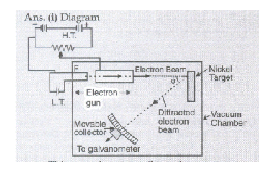
This experiment confirms the wave nature of electron.
(b) \(\lambda =\frac { h }{ p } =\frac { h }{ \sqrt { 2mK } }\)
\( K=K.E=eV\)
\(\lambda =\frac { h }{ \sqrt { 2meV } } \)
23.
Potential difference (V)=100 V
de-Broglie Wavelength \(\lambda =\frac { 12.27 }{ \sqrt { V } } =\frac { 12.27 }{ \sqrt { 100 } } =1.227 \ \mathring { A } \)
In this case wavelength associated with an electron is of the order of wavelength of X-ray.
24.
According to photon picture:
(i) Each quantum of radiation has energy hv
(ii) In photo - electric effect the electrons in the metal absorbs this quantum of energy (hv).
(iii) When this energy exceeds the minimum energy needed for the ejection of photoelectron, flow of photo current starts.
25.
Potential difference, V = 56 V
Planck’s constant, h = 6.6 x 10⁻³⁴ Js
Mass of an electron, m = 9.1 x 10⁻³¹ kg
Charge on an electron, e = 1.6 x 10⁻¹⁹ C
At equilibrium, the kinetic energy of each electron is equal to the accelerating potential, i.e., we can write the relation for velocity (v) of each electron as:
\(\frac{1}{2} m v^{2}=e V\)
\(v^{2}=2 e \frac{V}{m}\)
\(\therefore v=\sqrt{\frac{2 \times 1.6 \times 10^{-19} \times 56}{9.1 \times 10^{-31}}}\)
\(=\sqrt{19.69 \times 10^{12}}=4.44 \times 10^{6} \mathrm{~m} / \mathrm{s}\)
The momentum of each accelerated electron is given as:
p = mv
= 9.1 x 10−31 x 4.44 x 106
= 4.04 x 10⁻²⁴ kg m s−1
Therefore, the momentum of each electron is 4.04 x 10⁻²⁴ kg m s−1.
Potential difference, V = 56 V
Planck’s constant, h = 6.6 x 10⁻³⁴ Js
Mass of an electron, m = 9.1 x 10⁻³¹ kg
Charge on an electron, e = 1.6 x 10⁻¹⁹ C
De Broglie wavelength of an electron accelerating through a potential V, is given by the relation:
\(\lambda=\frac{12.27}{\sqrt{V}} \dot A\)
\(=\frac{12.27}{\sqrt{56}} \times 10^{-10} \mathrm{~m}\)
= 0.1639 nm
Therefore, the de Broglie wavelength of each electron is 0.1639 nm.
26.
(a) Work function of caesium metal, ϕ0 = 2.14eV
Frequency of light, v = 6.0 x 10¹⁴Hz
(a) The maximum kinetic energy is given by the photoelectric effect as:
= \(K=hv-{ \phi }_{ 0 }\)
Where,
h = Planck’s constant = 6.626 x 10⁻³⁴ Js
\(\therefore K=\frac{6.626 \times 10^{34} \times 6 \times 10^{14}}{1.6 \times 10^{-19}}-2.14\)
\(=2.485-2.140=0.345 \mathrm{eV}\)
Hence, the maximum kinetic energy of the emitted electrons is 0.345 eV.
(b) For stopping potential V0, we can write the equation for kinetic energy as:
\(K=e V_{o}\)
\(\therefore V_{o}=\frac{K}{e}\)
\(=\frac{0.345 \times 1.6 \times 10^{-19}}{1.6 \times 10^{-19}}=0.345 \mathrm{~V}\)
Hence, the stopping potential of the material is 0.345 V.
c) Maximum speed of the emitted photoelectrons = v
Hence, the relation for kinetic energy can be written as:
\(K=\frac{1}{2} m v^{2}\)
Where,
m = Mass of an electron = 9.1 x 10⁻³¹ kg
\(v^{2}=\frac{2 K}{m}\)
\(=\frac{2 \times 0.345 \times 1.6 \times 10^{-19}}{9.1 \times 10^{-31}}=0.1104 \times 10^{12}\)
\(\therefore v=3.323 \times 10^{5} \mathrm{~m} / \mathrm{s}=332.3 \mathrm{~km} / \mathrm{s}\)
Hence, the maximum speed of the emitted photoelectrons is 332.3 km/s.

12th Standard CBSE Syllabus & Materials
12th Standard CBSE
CBSE 12th Computer Science Python Revision Tour I - New Previous year Question Papers Study Material - QB365 Set A
NEW12th Standard CBSE
CBSE 12th Business Studies Planning Important Questions And Answers Study Material - QB365 Set A
NEW12th Standard CBSE
CBSE 12th Business Studies Business Environment Important Questions And Answers Study Material - QB365 Set A
NEW12th Standard CBSE
CBSE 12th Business Studies Principles of Management Important Questions And Answers Study Material - QB365 Set A



NCERT Books

Syllabus

Exam Pattern

Sample Question Papers

Previous year Question Papers

Important Notes

MCQ Practice test

NCERT Exemplers

Case study Questions

Image Based Questions

Passage based Questions

HOT Questions

Value Based Questions

Model Questions Papers
NCERT ( Book Back ) Questions

Assertion and Reason
Important Questions And Answers

CBSE 12th Standard CBSE Subjects
CBSE Standards








