
 100% FREE ACCESS
12th Standard CBSE Syllabus & Materials
12th Standard CBSE
CBSE 12th Economics Government Budget and the Economy Previous year Question Papers Study Material - QB365 Set A
NEW12th Standard CBSE
CBSE 12th Computer Science Interface Python with MySQL - New Previous year Question Papers Study Material - QB365 Set A
NEW12th Standard CBSE
CBSE 12th Computer Science Database Concept - New Previous year Question Papers Study Material - QB365 Set A
NEW12th Standard CBSE
CBSE 12th Computer Science Data Communication - New Previous year Question Papers Study Material - QB365 Set A
NEW12th Standard CBSE
CBSE 12th Computer Science Data Structures - New Previous year Question Papers Study Material - QB365 Set A
NEW12th Standard CBSE
CBSE 12th Computer Science Functions - New Previous year Question Papers Study Material - QB365 Set A

Published on: 25/10/2025
Download CBSE Class 12th Standard CBSE Physics question papers, sample papers, important questions, and previous year solved papers in PDF format. Get free study materials, NCERT solutions, and exam preparation resources for Class 12th Standard CBSE Physics
Questions + Answers key
Take MCQ Physics Test
1.
The power of a thin lens is + 5D. When it is immersed in a liquid, it behaves like a concave lens of focal length 100 cm. Calculate the refractive index of the liquid. Given, refractive index of glass = 1.5.
2.
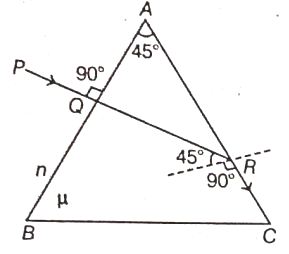
A ray of light is incident normally on one face of an equilateral glass prism of refractive index \(\mu\). When the prism is completely immersed in a transparent medium, it is observed that the emergent ray just grazes the adjacent face. Find the refractive index of the medium.
3.
How does the angle of deviation of a prism vary with the angle of incidence?
4.
A water tank appears shallower, i.e. less deeper than what it actually is. Obtain an expression to explain this.
5.
When monochromatic light travels from one medium to another, its wavelength changes, but frequency remains same. Explain.
6.
Choose the statement as wrong or right and justify.
(i) Linear magnification of a spherical mirror is given by \(\frac{v}{u}\)
(ii) Focal length of plane mirror is zero
(iii) \(\frac{1}{v}+\frac{1}{u}=\frac{1}{f}\) can be applied to all types of mirror.
7.
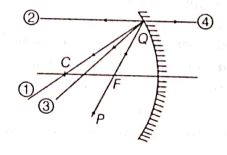
The direction of ray of light incident on a concave mirror is shown by PQ while directions in which the ray would travel after reflection is shown by four rays marked as 1,2, 3 and 4 in the figure? Which of the four rays correctly shows the direction of reflected rays?
8.
How can the real image of an object be obtained with a convex mirror?
9.
A boy is running towards a plane mirror with a speed of 2 m/s, With what speed, the image of the boy approach him?
10.
A mirror is turned through 15°. With what angle will the reflected ray turn?
11.
What focal length should the reading spectacles have for a person for whom the least distance of distinct vision is 50 cm?
12.
A screen is placed 90cm from an object. The image of the object on the screen is formed by a convex lens at two different locations separated by 20cm. Determine the focal length of the lens.
13.
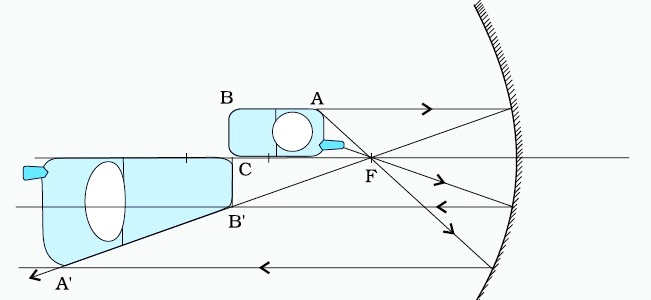
A mobile phone lies along the principal axis of a concave mirror, as shown in Fig. Show by suitable diagram, the formation of its image. Explain why the magnification is not uniform. Will the distortion of image depend on the location of the phone with respect to the mirror?
14.
Suppose that the lower half of the concave mirror’s reflecting surface in Fig. is covered with an opaque (non-reflective) material. What effect will this have on the image of an object placed in front of the mirror?
15.
An object is placed at (i) 10 cm, (ii) 5 cm in front of a concave mirror of radius of curvature 15 cm. Find the position, nature, and magnification of the image in each case.
16.
The image of a small electric bulb fixed on the wall of a room is to be obtained on the opposite wall 3m away by means of a large convex lens. What is the maximum possible focal length of the lens required for the purpose?
17.
A small pin fixed on a table top is viewed from above from a distance of 50cm. By what distance would the pin appear to be raised if it is viewed from the same point through a 15cm thick glass slab held parallel to the table? Refractive index of glass = 1.5. Does the answer depend on the location of the slab?
18.
A small telescope has an objective lens of focal length 144cm and an eyepiece of focal length 6.0cm. What is the magnifying power of the telescope? What is the separation between the objective and the eyepiece?
19.
What is the focal length of a convex lens of focal length 30cm in contact with a concave lens of focal length 20cm? Is the system a converging or a diverging lens? Ignore thickness of the lenses.
20.
Double-convex lenses are to be manufactured from a glass of refractive index 1.55, with both faces of the same radius of curvature. What is the radius of curvature required if the focal length is to be 20cm?
1.
Power of thin lens,
P = + 5D
\(\mu_g=15 \)
Focal length of thin lens, in air,
\(f_{\text {air }}=\frac{1}{P}=\frac{1}{5}\) = 0.2m = 20cm
By using lens Maker formula,
\( \frac{1}{f_{\text {air }}} =\left(\mu_g-1\right)\left(\frac{1}{R_1}-\frac{1}{R_2}\right) \)
\(=(1.5-1)\left(\frac{1}{R_1}-\frac{1}{R_2}\right) \frac{1}{f_{\text {air }}}
=\left(\frac{1}{R_1}-\frac{1}{R_2}\right)\)
when lens is dipped in liquied, then focal length in liquid.
\(f_l=-100 \mathrm{~cm}\)
Using lens Maker's formula,
\(\frac{1}{f_l}=\left(h \mathrm{k}_g-1\right)\left(\frac{1}{R_1}-\frac{1}{R_2}\right)\)
\( =\left(\frac{\mu_g}{\mu_1}-1\right)\left(\frac{1}{R_1}-\frac{1}{R_2}\right) \)
\(\frac{1}{100}=\left(\frac{15-\mu_l}{\mu_l}\right) \cdot \frac{2}{f_{\text {atr }}} \)
\(\Rightarrow \frac{1}{-100}=\frac{15-\mu_i}{\mu_l} \cdot \frac{2}{20} \)
\(-\frac{1}{10}=\frac{15-\mu_l}{\mu_l} \Rightarrow 15-10 \mu_l=\mu_l \)
\( \Rightarrow \quad \mu_t=\frac{15}{9} \equiv \frac{5}{3} \text { [from Eq. (i)] } \)
2.
By Snell's law,
\(\begin{aligned}
\frac{\sin i}{\sin r} & =\frac{n}{\mu}
\end{aligned}\)
\(\begin{aligned}
\frac{\sin 45^{\circ}}{\sin 90^{\circ}} & =\frac{n}{\mu}
\end{aligned}\)
n = \(\mu\) sin 45° [\(\because\) sin 90° = 1]
\(n=\frac{\mu}{\sqrt{2}}\) \(\left[\because \sin 45^{\circ}=\frac{1}{\sqrt{2}}\right]\)
Thus, refractive index ofthe transparent medium is \(n=\frac{\mu}{\sqrt{2}}\)
3.
If the angle of incidence is increased gradually, then the angle of deviation first decreases, attains a minimum value (\(\delta_{m}\)) and then again starts increasing.
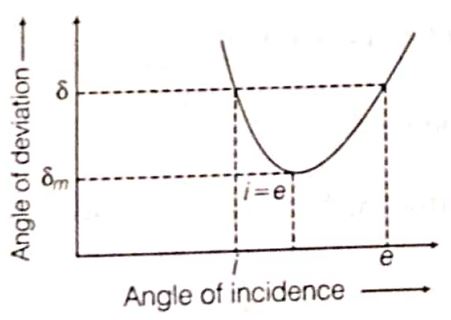
When angle of deviation is minimum, the prism is said to be placed in the minimum deviation position.There is only one angle of incidence for which the angle of deviation is minimum.
When \(\delta =\delta_{m}\) [prism in minimum deviation position]
e = i and r2 = r1 ....(i)
\(\because\) r1 + r2 = A
\(\Rightarrow r+r=A \quad or \quad r=\frac{A}{2}\)
Also, we have
A + \(\delta\) = i + e ....(ii)
Putting \(\delta\) = \(\delta\)m and e = i in Eq. (ii), we get
A + \(\delta\)m = i + i
\(\Rightarrow i=\left ( \frac{A+\delta_{m}}{2} \right )\)
From Snell's law, \(\mu =\frac{sin \quad i}{sin \quad r}\)
\(\therefore \mu=\frac{\sin \left(\frac{A+\delta_m}{2}\right)}{\sin \frac{A}{2}}\)
This relation is called a prism formula.
For thin prisms (i.e. A is very small), the value of \(\delta\)m is also very small.
So, \(\begin{aligned} \mu & =\frac{\sin \left(\frac{A+\delta_m}{2}\right)}{\sin \frac{A}{2}} \\ \end{aligned}\) \(\approx \frac{A+\delta_m}{\frac{2}{A / 2}}\)
\(\Rightarrow \quad \delta_m=(\mu-1) A\)
4.
To prove this, suppose O is a point object at an actual depth OA below the free surface of water XY in a tank.
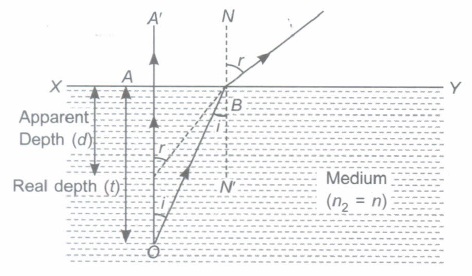
A ray of light incident onXY, normally along OA passes straight along OAA'. Another ray oflight from O incident at ∠i on XY, along OB deviates away from normal. It is refracted at ∠r along BC On producing back, BC meets OA at I. Therefore, I is a virtual image of 0, i.e. when seen through water, O appears at I. Therefore, apparent depth = lA, which is less than the real depth OA.
\(
\angle A O B=\angle O B N^{\prime}=i \ \text { (alt. angles) }
\)
\(\angle A I B=\angle N B C=r
\text { Corresponding angles) }
\)
In \(\Delta O A B, \sin i \approx \tan i=\frac{A B}{O B} \quad(\angle i \text { is a small angle. })\)
In \(\Delta I A B, \sin r \approx \tan r=\frac{A B}{I B} \quad(\angle r \text { is a small angle. })\)
Using Snell's law,
n2 sin i = n1 sin r
∴ n21 = refractive index of denser medium w.r.t. rarer, i.e. air (n1 = 1)
\(
\frac{n_{2}}{n_{1}} =\frac{\sin r}{\sin i}=\frac{\tan r}{\tan i}=\frac{A B}{A I} \times \frac{A O}{A B}
\)
\(\therefore \quad n_{1}=1 ; n_{2}=n
\)
\(n =\frac{O A}{I A}
\)
\(n =\frac{\text { real depth }}{\text { apparent depth }}=\frac{t}{d}\)
5.
Because refractive index for a given pair of media depends on the ratio of wavelengths and velocity of light in two media but not on frequency, So, frequency remains constant during refraction of light.
6.
(i) Wrong, linear magnification of spherical mirror is \(-\frac{v}{u}\) (using sign conventions).
(ii) Wrong, as the plane mirror can be considered to be the limit of either a concave or convex spherical curved mirror as the radius, therefore. the focal length of plane mirror becomes infinite.
(iii) Right, but for plane mirror using this formula, focal length becomes infinite.
7.
The incident ray PQ passes through the focus, so the reflected ray is parallel to the principal axis. So, the answer is ray 2.
8.
A convex mirror produces a real image of a virtual object. Therefore, if a beam of light from a virtual object converges to a point behind the convex mirror, then its real image will be formed in front of the mirror.
9.
The image of the object in a plane mirror is as far behind the mirror as the object is in front of it. Therefore, the image of the boy comes near the mirror through the distance equal to that moved by the boy towards the plane mirror. Hence, the image of the boy will approach him with double his speed, i.e. with 4 m/s.
10.
The reflected ray turns twice the angle through which mirror is turned, i.e. 30°.
11.
The distance of normal vision is 25 cm. So if a book is at u = -25 cm, its image should be formed at v = -50 cm. Therefore, the desired focal length is given by
\(\frac{1}{f}=\frac{1}{v}-\frac{1}{u}\)
\(\text { or } \frac{1}{f}=\frac{1}{-50}-\frac{1}{-25}=\frac{1}{50}\)
or f = + 50 cm (convex lens).
12.
Distance between the image (screen) and the object, D = 90 cm
Distance between two locations of the convex lens, d = 20 cm
Focal length of the lens = f
Focal length is related to d and D as:
f = \(\frac { { D }^{ 2 }-{ d }^{ 2 } }{ 4D } \)
= \(\frac { { (90) }^{ 2 }-({ 20) }^{ 2 } }{ 4\times 90 } =\frac { 770 }{ 36 } =21.3\) cm
Therefore, the focal length of the convex lens is 21.39 cm.
13.
The ray diagram for the formation of the image of the phone is shown in Fig. The image of the part which is on the plane perpendicular to principal axis will be on the same plane. It will be of the same size, i.e., B'C = BC. You can yourself realise why the image is distorted.
14.
You may think that the image will now show only half of the object, but taking the laws of reflection to be true for all points of the remaining part of the mirror, the image will be that of the whole object. However, as the area of the reflecting surface has been reduced, the intensity of the image will be low (in this case, half).
15.
The focal length f = -15/2 cm = -7.5 cm
(i) The object distance u = -10 cm. Then Eq gives
\(\frac { 1 }{ v } +\frac { 1 }{ 10 } =\frac { 1 }{ -7.5 } \)
or \(v=\frac { 10\times 7.5 }{ -2.5 } =-30\) cm
The image is 30 cm from the mirror on the same side as the object
Also, magnification m = \(\frac { v }{ u } =-\frac { (-30) }{ (-10) } =-3\)
The image is magnified, real and inverted.
(ii) The object distance u = -5 cm. Then from Eq
\(\frac { 1 }{ v } +\frac { 1 }{ -5 } =\frac { 1 }{ -7.5 } \)
or \(v=\frac { 5\times 7.5 }{ (7.5-5) } =15\) cm
This image is formed at 15 cm behind the mirror. It is a virtual image.
Magnification m = 15 \(-\frac { v }{ u } =-\frac { 15 }{ (-5) } =3\)
The image is magnified, virtual and erect.
16.
Distance between the object and the image, d = 3 m
Maximum focal length of the convex lens = fmax
For real images, the maximum focal length is given as:
fmax = \(\frac{d}{4}\)
= \(\frac{3}{4}\) = 0.75 m
Hence, for the required purpose, the maximum possible focal length of the convex lens is 0.75 m.
17.
Actual depth of the pin, d = 15 cm
Apparent dept of the pin = d'
Refractive index of glass, μ = 1.5
Ratio of actual depth to the apparent depth is equal to the refractive index of glass, i.e.
μ = \(\frac { d }{ { d }^{ ' } } \)
∴ d' = \(\frac { d }{ \mu } \)
= \(\frac{15}{1.5}\) = 10 cm
The distance at which the pin appears to be raised = d' - d
= 15 - 10 = 5 cm
For a small angle of incidence, this distance does not depend upon the location of the slab.
18.
Focal length of the objective lens, fo = 144 cm
Focal length of the eyepiece, fe = 6.0 cm
The magnifying power of the telescope is given as:
m = \(\frac{f_o}{f_c}\)
= \(\frac{144}{6}\) = 24
The separation between the objective lens and the eyepiece is calculated as:
fo + fe
= 144 + 6 = 150 cm
Hence, the magnifying power of the telescope is 24 and the separation between the objective lens and the eyepiece is 150 cm.
19.
Given, focal length of convex lens, f1 = 30 cm
Focal length of the concave lens, f2 = -20 cm
Using the formula of combination of lenses,
\(\frac{1}{f}=\frac{1}{f_{1}}+\frac{1}{f_{2}}=\frac{1}{30}-\frac{1}{20}=\frac{2-3}{60}=-\frac{1}{60}\)
\(\Rightarrow\) f = -60 cm
Since, the focal length of combination is negative in nature. so, the combination behaves like a diverging lens, i.e. as a concave lens.
20.
Refractive index of glass, μ
Focal length of the double-convex lens, f = 20 cm
Radius of curvature of one face of the lens = R1
Radius of curvature of the other face of the lens = R2
Radius of curvature of the double-convex lens = R The value of R can be calculated as:
∴ R1 = R and R2 = -R
The value of R can be calculated as:
\(\frac { 1 }{ f } =(\mu -1)\left[ \frac { 1 }{ { R }_{ 1 } } -\frac { 1 }{ { R }_{ 2 } } \right] \)
\(\frac { 1 }{ 20 } =(1.55)\left[ \frac { 1 }{ R } +\frac { 1 }{ R } \right] \)
\(\frac { 1 }{ 20 } =0.55\times \frac { 2 }{ R } \)
∴ R = 0.55 x 2 x 20 = 22 cm
Hence, the radius of curvature of the double-convex lens is 22 cm.

12th Standard CBSE Syllabus & Materials
12th Standard CBSE
CBSE 12th Computer Science Python Revision Tour I - New Previous year Question Papers Study Material - QB365 Set A
NEW12th Standard CBSE
CBSE 12th Business Studies Planning Important Questions And Answers Study Material - QB365 Set A
NEW12th Standard CBSE
CBSE 12th Business Studies Business Environment Important Questions And Answers Study Material - QB365 Set A
NEW12th Standard CBSE
CBSE 12th Business Studies Principles of Management Important Questions And Answers Study Material - QB365 Set A



NCERT Books

Syllabus

Exam Pattern

Sample Question Papers

Previous year Question Papers

Important Notes

MCQ Practice test

NCERT Exemplers

Case study Questions

Image Based Questions

Passage based Questions

HOT Questions

Value Based Questions

Model Questions Papers
NCERT ( Book Back ) Questions

Assertion and Reason
Important Questions And Answers

CBSE 12th Standard CBSE Subjects
CBSE Standards








