
 100% FREE ACCESS
12th Standard CBSE Syllabus & Materials
12th Standard CBSE
CBSE 12th Economics Government Budget and the Economy Previous year Question Papers Study Material - QB365 Set A
NEW12th Standard CBSE
CBSE 12th Computer Science Interface Python with MySQL - New Previous year Question Papers Study Material - QB365 Set A
NEW12th Standard CBSE
CBSE 12th Computer Science Database Concept - New Previous year Question Papers Study Material - QB365 Set A
NEW12th Standard CBSE
CBSE 12th Computer Science Data Communication - New Previous year Question Papers Study Material - QB365 Set A
NEW12th Standard CBSE
CBSE 12th Computer Science Data Structures - New Previous year Question Papers Study Material - QB365 Set A
NEW12th Standard CBSE
CBSE 12th Computer Science Functions - New Previous year Question Papers Study Material - QB365 Set A

Published on: 25/10/2025
Download CBSE Class 12th Standard CBSE Physics question papers, sample papers, important questions, and previous year solved papers in PDF format. Get free study materials, NCERT solutions, and exam preparation resources for Class 12th Standard CBSE Physics
Questions + Answers key
Take MCQ Physics Test
1.
A prism is made of glass of unknown refractive index. A parallel beam of light is incident on a face of the prism. The angle of minimum deviation is measured to be 40°. What is the refractive index of the material of the prism? The refracting angle of the prism is 60°. If the prism is placed in water (refractive index 1.33), predict the new angle of minimum deviation of a parallel beam of light.
2.
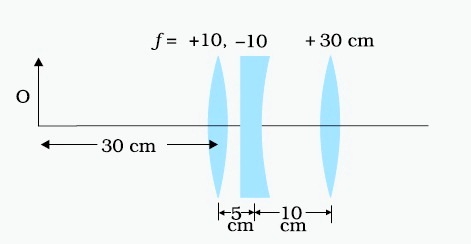
Find the position of the image formed by the lens combination given in the Fig.
3.
A ray of light is refracted by a glass prism. Obtain an expression for the refractive index of the glass in terms of the angle of prism A and the angle of minimum deviation \(\delta_m\)
4.
Define critical angle for a given pair of media and total internal reflection. Obtain the relation between the critical angle and refractive index of the medium.
5.
Use the mirror equation to show that
(i) an object placed between f and 2f of a concave mirror produces a real image beyond 2f.
(ii) a convex mirror always produces a virtual image independent of the location of the object.
(iii) an object placed between the pole and focus of a concave mirror produces a virtual and enlarged image.
6.
A candle flame is held 3 cm away from a concave mirror of radius of curvature 24 cm. Where is the image formed? What is the nature of the image?
7.
A small telescope has an objective lens of focal length 144cm and an eyepiece of focal length 6.0cm. What is the magnifying power of the telescope? What is the separation between the objective and the eyepiece?
8.
Double-convex lenses are to be manufactured from a glass of refractive index 1.55, with both faces of the same radius of curvature. What is the radius of curvature required if the focal length is to be 20cm?
9.
Under minimum deviation condition in a prism, if a ray is an incident at an angle 30°, then the angle between the emergent ray and the second refracting surface of the prism is
0°
30°
45°
60°
10.
A ray of light travelling in a transparent medium of refractive index \(\mu\) on a surface separating the medium from air at an angle of incidence of 450 For which of the following value of \(\mu\) the ray can undergo total internal reflection?
\(\mu\) = 1.33
\(\mu\) = 1.40
\(\mu\) = 1.50
\(\mu\) = 1.25
11.
For an optical arrangement as shown in the figure, Find the position and nature of image.
32 cm
0.6 cm
6 cm
0.5 cm
12.
The frequency of a light wave in a material and wavelength is 5000 A The refractive index of material will be
1.40
1.50
3.00
1.33
13.
The power of a thin lens is + 5D. When it is immersed in a liquid, it behaves like a concave lens of focal length 100 cm. Calculate the refractive index of the liquid. Given, refractive index of glass = 1.5.
14.
A ray of monochromatic light passes from medium (1) to medium (2). If the angle of incidence in medium (1) is θ and the corresponding angle of refraction in medium (2) is θ/2, which of the two media is optically denser? Give reason.
15.
A telescope consists of two lenses of focal lengths 20 cm and 5 cm. Obtain its magnifying power when the final image is
(i) at infinity
(ii) at 25 cm from the eye.
16.
A converging lens of refractive index 1.5 is kept in a liquid medium having the same refractive index. What would be the focal length of lens in the medium?
17.
What is the critical angle for a material of refractive index \(\sqrt {2}\)?
18.
What focal length should the reading spectacles have for a person for whom the least distance of distinct vision is 50 cm?
19.
Assertion (A) : Microscope magnifies the image.
Reason (R) : Angular magnification for image is more than object in microscope.
Codes:
(a) Both A and R are true and R is the correct explanation of A
(b) Both A and R are true but R is NOT the correct explanation of A
(c) A is true but R is false
(d) A is false and R is also false
1.
Angle of minimum deviation, \({ \delta }^{ ' }_{ m }\) = 40°
Angle of the prism, A = 60°
Refractive index of water, µ = 1.33
Refractive index of the material of the prism = µ'
The angle of deviation is related to refractive index (µ') as:
\({ \mu }^{ ' }=\frac { sin\frac { (A+{ \delta }_{ m }) }{ 2 } }{ sin\frac { A }{ 2 } }\)
\(=\frac { sin\frac { ({ 60 }^{ o }+{ 40 }^{ o }) }{ 2 } }{ sin\frac { { 60 }^{ o } }{ 2 } }\)\(=\frac { sin{ 50 }^{ o } }{ sin{ 30 }^{ o } } =1.532\)
Hence, the refractive index of the material of the prism is 1.532.
Since the prism is placed in water, let be the new angle of minimum deviation for the same prism.
The refractive index of glass with respect to water is given by the relation:
\({ \mu }_{ g }^{ w }=\frac { { \mu }^{ ' } }{ \mu } =\frac { sin\frac { (A+{ \delta }^{ ' }_{ m }) }{ 2 } }{ sin\frac { A }{ 2 } }\)
=\(sin\frac { (A+{ \delta }^{ ' }_{ m }) }{ 2 } =\frac { { \mu }^{ ' } }{ \mu } sin\frac { A }{ 2 }\)
= \(sin\frac { (A+{ \delta }^{ ' }_{ m }) }{ 2 } =\frac { 1.532 }{ 1.33 } \times sin\frac { { 60 }^{ o } }{ 2 } =\)0.5759
= \(\frac { (A+{ \delta }^{ ' }_{ m }) }{ 2 } ={ sin }^{ -1 }{ 0.5759=35.16 }^{ o }\)
= \({ 60 }^{ o }+{ \delta }^{ ' }_{ m }={ 70.32 }^{ o }\)
\(\therefore { \delta }^{ ' }_{ m }={ 70.32 }^{ o }-{ 60 }^{ o }={ 10.32 }^{ o }\)
Hence, the new minimum angle of deviation is 10.32°.
2.
Image formed by the first lens
\(\frac { 1 }{ { v }_{ 1 } } -\frac { 1 }{ { u }_{ 1 } } =\frac { 1 }{ { f }_{ 1 } } \)
\(\frac { 1 }{ { v }_{ 1 } } -\frac { 1 }{ { -30 } } =\frac { 1 }{ 10 } \)
or v1 = 15 cm
The image formed by the first lens serves as the object for the second.
This is at a distance of (15 - 5) cm = 10 cm to the right of the second lens. Though the image is real, it serves as a virtual object for the second lens, which means that the rays appear to come from it for the second lens.
\(\frac { 1 }{ { v }_{ 2 } } -\frac { 1 }{ 10 } =\frac { 1 }{ -10 } \)
or v2 = ∞
The virtual image is formed at an infinite distance to the left of the second lens. This acts as an object for the third lens.
\(\frac { 1 }{ { v }_{ 3 } } -\frac { 1 }{ { u }_{ 3 } } =\frac { 1 }{ { f }_{ 3 } } \)
or \(\frac { 1 }{ { v }_{ 3 } } =\frac { 1 }{ \infty } +\frac { 1 }{ 30 } \)
or v3 = 30 cm
The final image is formed 30 cm to the right of the third lens.
3.
In the given diagram,
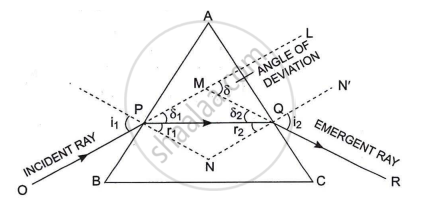
OP is the incident ray, which makes the angle i1 normal, and \(\angle N ' Q R\) is the angle of emergence, which is represented by \(\mathrm{i}_2\).
A is the prism angle, and \(\mu\) is the refractive index of the prism.
A = Prism angle, \(\delta=\) Angle of deviation, i1 = Angle of incidence,i2= Angle of emergence .
In the case of minimum deviation,
\( \angle r_1=\angle r_2=\angle r\)
\(\mathrm{~A}=\angle r_1+\angle r_2\)
So,\(A=\angle r+\angle r=\angle 2 r\)
\(\angle \mathrm{r}=\frac{A}{2}\)
Now, again
\(A+\delta=i_1+i_2 \ldots\left(\because\right.\) In the case of minimum deviation \(i_1=i_2=i\) and \(\left.\delta=\delta_m\right)\)
So, \(A+\delta_m=i+i=2 i\)
Now, \(i=\frac{\left(A+\delta_m\right)}{2}\)
Now, from Snell's rule,
\(\mu=\frac{\sin i}{\sin r}\)
\(\mu=\frac{\sin \left(\frac{A+\delta_m}{2}\right)}{\sin \frac{A}{2}}\)
4.
The angle of incidence corresponding to an angle of refraction of \(90^{\circ}\) is called the critical angle for the given pair of media. If the angle of incidence of light, when travelling from a denser medium to a rarer medium, is greater than the critical angle then total internal reflection takes place.
Let the angle of incidence i and C be the critical angle =C.
Let the angle of refraction \(r=90^{\circ}\).
The refractive index of the rarer medium is \(\mu_{\mathrm{a}}\).
The refractive index of the denser medium is \(\mu_{\mathrm{b}}\).
Applying Snell's law, \(\frac{\sin i}{\sin r}=\frac{\mu_a}{\mu_b} \)
\(\mu_{\mathrm{b}} \sin C=\mu_{\mathrm{a}} \sin 90^{\circ} \ldots\left[\because \mathrm{i}=\mathrm{C} \text { and } \mathrm{r}=90^{\circ}\right]\)
\(\frac{\mu_a}{\mu_b}=\frac{1}{\sin C}\)
Thus, we arrive at a formula expressing the critical angle and refractive index relation:
\({ }_a \mu_b=\frac{1}{\sin C}\)
5.
(i) According to the mirror equation, we have
\(\frac{1}{v}+\frac{1}{u}=\frac{1}{f}\)
where, U = distance of the object from the mirror, v = distance of the image from the mirror and f = focal length of the mirror.
From the mirror equation, we have
\(v=\frac{u f}{u-f}\) ..........(i)
Applying new cartesian sign convention, we get
f = - ve and u = - ve
Given, f < u < 2f
\(\Rightarrow\) v = - ve [from Eq. (i)]
Magnification is given by m = \(-\left(\frac{-v}{-u}\right)=-v e\)
Hence, the image formed is real.
From the mirror formula, whenu = - 2f
\( \Rightarrow \frac{1}{-2 f}+\frac{1}{v}=\frac{1}{-f} \)
\(\Rightarrow \frac{1}{v}=\frac{1}{2 f}-\frac{1}{f}=\frac{-1}{2 f} \)
When the object is at f, then image is formed at infinity.
This shows that when f < u < 2f, then \(\infty\) > v > 2f.
(ii) For convex mirror, f > 0
Also, u < 0
But from mirror equation,
\( \frac{1}{f}=\frac{1}{v}+\frac{1}{u}=\frac{1}{v}+\frac{1}{|-u|} \) [taking u with sign]
\(\frac{1}{v}=\frac{1}{f}+\frac{1}{u}\)
If f and u to be positive. then
\(\frac{1}{v}>0 \Rightarrow v>0\)
Hence, virtual image is formed.
(iii) For concave mirror,
f < 0, u < 0, | f | > | u | > 0
But from mirror equation,
\( \frac{1}{f}=\frac{1}{v}+\frac{1}{u} \quad \Rightarrow \frac{-1}{|f|}=\frac{1}{v}-\frac{1}{|u|} \)
∵ \(\frac{1}{v}=\frac{1}{|u|}-\frac{1}{|f|} \)
⇒ \(|v|<|f| \quad \Rightarrow \frac{1}{|u|}>\frac{1}{|f|} \)
\(\frac{1}{v}>0 \Rightarrow v>0 \)
Image is formed on RHS of mirror; i.e. virtual image.
Also, \(\frac{1}{f}=\frac{1}{|v|}-\frac{1}{|u|}\)
For concave mirror, f is negative.
\(\Rightarrow \quad \frac{1}{|v|}<\frac{1}{|u|} \quad \Rightarrow\frac{|v|}{|u|}>1 \Rightarrow m>1\)
Enlarged virtual image formed on the other side of mirror.
6.
Given, object distance, u = -3 cm
Radius of curvature, R = -24 cm
∴ \(f=\frac{R}{2}=\frac{-24}{2}=-12 \mathrm{~cm}\)
According to mirror formula,
\( \frac{1}{f}=\frac{1}{v}+\frac{1}{u} \)
⇒ \(\frac{1}{v}=\frac{1}{f}-\frac{1}{u}=\frac{1}{(-12)}-\frac{1}{-3} \)
⇒ \(\frac{1}{v}=\frac{1}{-12}+\frac{1}{3}=\frac{-1+4}{12} \)
⇒ \(v=4 \mathrm{~cm}\)
∵ Magnifiiccaatitoin, m \(=-\frac{v}{u}=\frac{-4}{-3}=+1.33\)
i.e. The image formed is virtual, erect and magnified.
7.
Focal length of the objective lens, fo = 144 cm
Focal length of the eyepiece, fe = 6.0 cm
The magnifying power of the telescope is given as:
m = \(\frac{f_o}{f_c}\)
= \(\frac{144}{6}\) = 24
The separation between the objective lens and the eyepiece is calculated as:
fo + fe
= 144 + 6 = 150 cm
Hence, the magnifying power of the telescope is 24 and the separation between the objective lens and the eyepiece is 150 cm.
8.
Refractive index of glass, μ
Focal length of the double-convex lens, f = 20 cm
Radius of curvature of one face of the lens = R1
Radius of curvature of the other face of the lens = R2
Radius of curvature of the double-convex lens = R The value of R can be calculated as:
∴ R1 = R and R2 = -R
The value of R can be calculated as:
\(\frac { 1 }{ f } =(\mu -1)\left[ \frac { 1 }{ { R }_{ 1 } } -\frac { 1 }{ { R }_{ 2 } } \right] \)
\(\frac { 1 }{ 20 } =(1.55)\left[ \frac { 1 }{ R } +\frac { 1 }{ R } \right] \)
\(\frac { 1 }{ 20 } =0.55\times \frac { 2 }{ R } \)
∴ R = 0.55 x 2 x 20 = 22 cm
Hence, the radius of curvature of the double-convex lens is 22 cm.
9.
(d)
60°
10.
(a)
\(\mu\) = 1.33
11.
(b)
0.6 cm
12.
(c)
3.00
13.
Power of thin lens,
P = + 5D
\(\mu_g=15 \)
Focal length of thin lens, in air,
\(f_{\text {air }}=\frac{1}{P}=\frac{1}{5}\) = 0.2m = 20cm
By using lens Maker formula,
\( \frac{1}{f_{\text {air }}} =\left(\mu_g-1\right)\left(\frac{1}{R_1}-\frac{1}{R_2}\right) \)
\(=(1.5-1)\left(\frac{1}{R_1}-\frac{1}{R_2}\right) \frac{1}{f_{\text {air }}}
=\left(\frac{1}{R_1}-\frac{1}{R_2}\right)\)
when lens is dipped in liquied, then focal length in liquid.
\(f_l=-100 \mathrm{~cm}\)
Using lens Maker's formula,
\(\frac{1}{f_l}=\left(h \mathrm{k}_g-1\right)\left(\frac{1}{R_1}-\frac{1}{R_2}\right)\)
\( =\left(\frac{\mu_g}{\mu_1}-1\right)\left(\frac{1}{R_1}-\frac{1}{R_2}\right) \)
\(\frac{1}{100}=\left(\frac{15-\mu_l}{\mu_l}\right) \cdot \frac{2}{f_{\text {atr }}} \)
\(\Rightarrow \frac{1}{-100}=\frac{15-\mu_i}{\mu_l} \cdot \frac{2}{20} \)
\(-\frac{1}{10}=\frac{15-\mu_l}{\mu_l} \Rightarrow 15-10 \mu_l=\mu_l \)
\( \Rightarrow \quad \mu_t=\frac{15}{9} \equiv \frac{5}{3} \text { [from Eq. (i)] } \)
14.
Given \(i=\theta, r=\frac{\theta}{2}\)
\( \because \quad \frac{\sin i}{\sin r}=\frac{n_2}{n_1} \\ \text { i.e. } \quad \sin r<\sin i \Rightarrow n_2>n_1 \)
Hence, 2nd medium is optically denser.
15.
(i) When the final image is at infinity,
\(m=-\frac{f_{0}}{f_{e}}=\frac{-20}{5}\)
⇒ m = -4
(ii) When the final image is at 25 cm from the eye,
i.e. D = 25 cm
\(m=\frac{-f_{o}}{f_{e}}\left(1+\frac{f_{e}}{D}\right)=\frac{-20}{5}\left(1+\frac{5}{25}\right)\)
⇒ m = -4.8
16.
When lens is immersed in a liquid, then
\(\frac{1}{f_{L}}=\left({ }^{L} \mu_{g}-1\right)\left(\frac{1}{R_{1}}-\frac{1}{R_{2}}\right)\)
where, lμg = refractive index of lens material (glass) w.r.t. liquid.
\(\therefore \quad \frac{\mu_{g}}{\mu_{L}}=\frac{1.5}{1.5}=1\)
Hence, \(\frac{1}{f_{l}}=(1-1)\left(\frac{l}{R_{1}}-\frac{1}{R_{2}}\right)=0 \Rightarrow f_{L}=\infty\)
17.
We know that, \(\mu=\frac{1}{\sin C}\)
\( \Rightarrow \ \sin C=\frac{1}{\mu}=\frac{1}{\sqrt{2}} \\ \therefore C=45 \)
18.
The distance of normal vision is 25 cm. So if a book is at u = -25 cm, its image should be formed at v = -50 cm. Therefore, the desired focal length is given by
\(\frac{1}{f}=\frac{1}{v}-\frac{1}{u}\)
\(\text { or } \frac{1}{f}=\frac{1}{-50}-\frac{1}{-25}=\frac{1}{50}\)
or f = + 50 cm (convex lens).
19.
(a): Microscope is an optical instrument which forms a magnified image of a small nearby object and thus, increases the visual angle sub tended by the image at the eye so that the object is seen to be bigger and distinct. Therefore, angular magnification for image is more than object.

12th Standard CBSE Syllabus & Materials
12th Standard CBSE
CBSE 12th Computer Science Python Revision Tour I - New Previous year Question Papers Study Material - QB365 Set A
NEW12th Standard CBSE
CBSE 12th Business Studies Planning Important Questions And Answers Study Material - QB365 Set A
NEW12th Standard CBSE
CBSE 12th Business Studies Business Environment Important Questions And Answers Study Material - QB365 Set A
NEW12th Standard CBSE
CBSE 12th Business Studies Principles of Management Important Questions And Answers Study Material - QB365 Set A



NCERT Books

Syllabus

Exam Pattern

Sample Question Papers

Previous year Question Papers

Important Notes

MCQ Practice test

NCERT Exemplers

Case study Questions

Image Based Questions

Passage based Questions

HOT Questions

Value Based Questions

Model Questions Papers
NCERT ( Book Back ) Questions

Assertion and Reason
Important Questions And Answers

CBSE 12th Standard CBSE Subjects
CBSE Standards








