
 100% FREE ACCESS
12th Standard CBSE Syllabus & Materials
12th Standard CBSE
CBSE 12th Economics Government Budget and the Economy Previous year Question Papers Study Material - QB365 Set A
NEW12th Standard CBSE
CBSE 12th Computer Science Interface Python with MySQL - New Previous year Question Papers Study Material - QB365 Set A
NEW12th Standard CBSE
CBSE 12th Computer Science Database Concept - New Previous year Question Papers Study Material - QB365 Set A
NEW12th Standard CBSE
CBSE 12th Computer Science Data Communication - New Previous year Question Papers Study Material - QB365 Set A
NEW12th Standard CBSE
CBSE 12th Computer Science Data Structures - New Previous year Question Papers Study Material - QB365 Set A
NEW12th Standard CBSE
CBSE 12th Computer Science Functions - New Previous year Question Papers Study Material - QB365 Set A

Published on: 25/10/2025
Download CBSE Class 12th Standard CBSE Physics question papers, sample papers, important questions, and previous year solved papers in PDF format. Get free study materials, NCERT solutions, and exam preparation resources for Class 12th Standard CBSE Physics
Questions + Answers key
Take MCQ Physics Test
1.
Ratio of intensities of two waves is 9 : 1. If these waves are superimposed, what is the ratio of maximum and minimum intensities?
9 : 1
3 : 1
4 : 1
5 : 3
2.
A magician during a show makes a glass lens with n = 1.47 disappear in a trough of liquid. Refractive index of the liquid is
1.47
1.33
\(\frac{4}{3}\)
\(\frac{12}{5}\)
3.
An object is 8 cm high. It is desired to form a real image 4 cm high at 60 cm from the mirror. The type of mirror needed with the focal length is
convex mirror with focal length f = 40 cm
convex mirror with focal length f = 20 cm
concave mirror with focal length f = - 40 cm
concave mirror with focal length f = - 20 cm
4.
A person wants a real image of his own, 3 times enlarged. Where should he stand in front of a concave mirror of radius of curvature of 30 cm?
90 cm
10 cm
20 cm
30 cm
5.
The minimum magnifying power of telescope is M. If the focal length of its eye lens is halved, the magnifying power will become
m/2
2m
3m
4m
6.
A simple telescope, consisting of an objective of focal length 60 cm and a single eye lens of focal length 5cm is focusedon a distant object in such a way that parallel rays emerge from the eye lens. If the object subtends an angle of 2o at the objective,the angular width of the image is
100
240
500
(1/6)0
7.
The final image formed by a terrestrial telescope is
erect
inverted
sometimes erect and sometimes inverted
none of the above
8.
A divergent lens is one which
Collect rays
Spreads rays
Forms real image
Neither collects nor spreads rays
9.
The image formed by a concave lens is
always virtual
Always real
Always inverted
May virtual or real
10.
The angle of prism is 600 and the refractive index of the material of prism is 1.5.If angles of incidence and emergence at first and second refracting faces are i1 and i2, then for minimum deviation:
i1 = 0
i1 < i2
i1 > i2
i1 = i2
11.
A compound microscope is an optical instrument used for observing highly magnified images of tiny objects. Magnifying power of a compound microscope is defined as the ratio of the angle subtended at the eye by the final image to the angle subtended at the eye by the object, when both the final image and the object are situated at the least distance of distinct vision from the eye. It can be given that:\(m=m_{e} \times m_{o}\) where me is magnification
produced by eye lens and mo is magnification produced by objective lens. Consider a compound microscope that consists of an objective lens of focal length 2.0 cm and an eyepiece of focal length 6.25 cm separated by a distance of 15 cm.
(i) The object distance for eye-piece, so that final image is formed at the least distance of distinct vision, will be
| (a) 3.45 cm | (b) 5.cm | (c) 1.29 cm | (d) 2.59 cm |
(ii) How far from the objective should an object be placed in order to obtain the condition described in part(i)?
| (a) 4.5 cm | (b) 2.5 cm | (c) 1.5 cm | (d) 3.0 cm |
(iii) What is the magnifying power of the microscope in case ofleast distinct vision?
| (a) 20 | (b) 30 | (c) 40 | (d) 10 |
(iv) The intermediate image formed by the objective of a compound microscope is
| (a) real, inverted and magnified | (b) real, erect, and magnified |
| (c) virtual, erect and magnified | (d) virtual, inverted and magnified |
(v) The magnifying power of a compound microscope increases with
| (a) the focal length of objective lens is increased and that of eye lens is decreased |
| (b) the focal length of eye lens is increased and that of objective lens is decreased |
| (c) focal lengths of both objects and eye-piece are increased |
| (d) focal lengths of both objects and eye-piece are decreased. |
12.
An astronomical telescope is an optical instrument which is used for observing distinct images of heavenly bodies libe stars, planets etc. It consists of two lenses. In normal adjustment of telescope, the final image is formed at infinity. Magnifying power of an astronomical telescope in normal adjustment is defined as the ratio of the angle subtended at the eye by the angle subtended at the eye by the final image to the angle subtended at the eye, by the object directly, when the final image and the object both lie at infinite distance from the eye. It is given by,\(m=\frac{f_{0}}{f_{e}}\) To increase magnifying power of an astronomical telescope in normal adjustment, focal length of objective lens should be large and focal length of eye lens should be small.
(i) An astronomical telescope of magnifying power 7 consists of the two thin lenses 40 cm apart, in normal adjustment. The focal lengths of the lenses are
| (a) 5cm,35cm | (b) 7cm,35cm | (c) 17cm,35cm | (d) 5cm,30cm |
(ii) An astronomical telescope has a magnifying power of 10. In normal adjustment, distance between the objective and eye piece is 22 cm. The focal length of objective lens is
| (a) 25 cm | (b) 10 cm | (c) 15 cm | (d) 20 cm |
(iii) In astronomical telescope compare to eye piece, objective lens has
| (a) negative focal length | (b) zero focal length | (c) small focal length | (d) large focal length |
(iv) To see stars, use
| (a) simple microscope | (b) compound microscope |
| (c) endoscope | (d) astronomical telescope |
(v) For large magnifying power of astronomical telescope
| \((a) f_{v}< |
\((b) f_{v}=f_{\mathrm{e}}\) | \((c) f_{o}>>f_{\mathrm{e}}\) | (d) none of these |
13.
Huygen's principle is the basis of wave theory of light. Each point on a wavefront acts as a fresh source of new disturbance, called secondary waves or wavelets. The secondary wavelets spread out in all directions with the speed light in the given medium.An initially parallel cylindrical beam travels in a medium of refractive index \(\mu(I)=\mu_{0}+\mu_{2} I\), where \(\mu_{0} \text { and } \mu_{2}\)are positive constants and I is the intensity of the light beam. The intensity of the beam is decreasing with increasing radius.
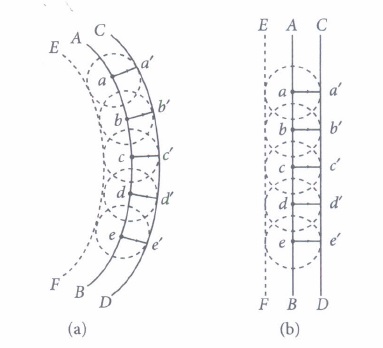
(i) The initial shape of the wavefront of the beam is
| (a) planar | (b) convex |
| (c) concave | (d) convex near the axis and concave near the periphery |
(ii) According to Huygens Principle, the surface of constant phase is
| (a) called an optical ray | (b) called a wave |
| (c) called a wavefront | (d) always linear in shape |
(iii) As the beam enters the medium, it will
| (a) travel as a cylindrical beam | (b) diverge |
| (c) converge | (d) diverge near tile axis and converge near the periphery. |
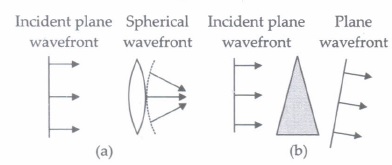
(iv) Two plane wavefronts of ligbt, one incident on a thin convex lens and another on the refracting face of a thin prism. After refraction at them, the emerging wavefronts respectively become
| (a) plane wavefront and plane wavefront | (b) plane wavefront and spherical wavefront |
| (c) spherical wavefront and plane wavefront | (d) spherical wavefront and spherical wavefront |
(v) Which of the following phenomena support the wave theory of light?
1. Scattering
2. Interference
3. Diffraction
4. Velocity of light in a denser medium is less than the velocity of light in the rarer medium
| (a) 1,2,3 | (b) 1,2,4 | (c) 2,3,4 | (d) 1,3,4 |
14.
If double slit apparatus is immersed in a liquid of refractive index, I-l the wavelength of light reduces to \(\lambda\) and fringe width also reduces to \(\beta^{\prime}=\frac{\beta}{\mu} \text { . }\)
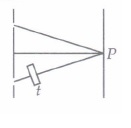
The given figure shows a double-slit experiment in which coherent monochromatic light of wavelength A from a distant source is incident upon the two slits, each of width w(w >> \(\lambda\)) and the interference pattern is viewed on a distant screen. A thin piece of glass of thickness t and refractive index n is placed between one of the slit and the screen, perpendicular to the light path.
(i) In Young's double slit interference pattern, the fringe width
| (a) can be changed only by changing the wavelength of incident light |
| (b) can be changed only by changing the separation between the two slits |
| (c) can be changed either by changing the wavelength or by changing the separation between two sources |
| (d) is a universal constant and hence cannot be changed |
(ii) If the width w of one of the slits is increased to 2w, the become the amplitude due to slit
| (a) 1.5a | (b) a/2 | (c) 2a | (d) no change |
(iii) In YDSE, let A and B be two slits. Films of thicknesses tA and tB and refractive indices mA and mB are placed in front of A and B, respectively. If \(\mu_{\mathrm{A}} t_{A}=\mu_{B} t_{B}\) then the central maxima will
| (a) not shift |
| (b) shift towards A |
| (c) shift towards B |
| (d) shift towards A if tB = tA and shift towards B if tB < tA |
(iv) In Young's double slit experiment, a third slit is made in between the double slits. Then
| (a) fringes of unequal width are formed. |
| (b) contrast between bright and dark fringes is reduced |
| (c) intensity of fringes totally disappears |
| (d) only bright light is observed on the screen |
(v) In Young's double slit experiment, if one of the slits is covered with a microscope cover slip, then
| (a) fringe pattern disappears |
| (b) the screen just gets illuminated |
| (c) in the fringe pattern, the brightness of the bright fringes will decreases and the dark fringes will become more dark |
| (d) bright fringes will be more bright and dark fringes will become more dark. |
15.
Assertion : Coloured spectrum is seen when we look through a muslin cloth.
Reason : It is due the diffraction of white light on passing through fine slits.
Codes:
(a) If both Assertion and Reason are correct and the Reason is a correct explanation of the Assertion.
(b) If both Assertion and Reason are correct but Reason is not a correct explanation of the Assertion.
(c) If the Assertion is correct but Reason is incorrect.
(d) If both the Assertion and Reason are incorrect.
16.
17.
Assertion (A) : Convergent property of converging lens remains same in mediums.
Reason (R) : Property of lens whether the ray is diverging or converging depends on the surrounding medium.
(a) Both Assertion and Reason are true and Reason is the correct explanation of Assertion.
(b) Both Assertion and Reason are true but Reason is not the correct explanation of Assertion.
(c) Assertion is true but Reason is false.
(d) Assertion is false but Reason is true.
18.
Assertion (A) : When monochromatic light is Incident on a surface separating two media, the reflected and refracted lights both have the same frequency as the incident frequency.
Reason (R) : Speed of light and wavelength of light both changes in refraction and hence, the ratio v= c/λ is a constant.
(a) Both A and R are true and R is the correct explanation of A.
(b) Both A and R are true but R is not the correct explanation of A.
(c) A is true but R is false.
(d) A is false but R is true.
19.
Assertion (A) : In the field of geometrical optics, light can in assumed to approximately travel in straight line.
Reason (R) : The wavelength of visible light is very small in comparison to the dimensions of typical mirrors and lenses, then light can be assumed to approximately travel in straight line.
(a) Both A and R are true and R is the correct explanation of A.
(b) Both A and R are true but R is not the correct explanation of A.
(c) A is true but R is false.
(d) A is false but R is true.
20.
Assertion (A) : A double convex lens (\(\mu\) = 1.5) has focal length 10 cm. When the lens is immersed in water (\(\mu\) = 4/3) its focal length becomes 75.24 cm
Reason (R) : \(\frac{1}{f}=\frac{\mu_{g}-\mu_{m}}{\mu_{m}}\left(\frac{1}{R_{1}}-\frac{1}{R_{2}}\right)\)
Codes:
(a) Both A and R are true and R is the correct explanation of A
(b) Both A and R are true but R is NOT the correct explanation of A
(c) A is true but R is false
(d) A is false and R is also false
21.
Assertion (A) : Optical fibers are used to transmit light without any loss in its intensity over distance of several kilometers.
Reason (R) : Optical fibers are very thick and all the light is passed through it without any loss.
Codes:
(a) Both A and R are true and R is the correct explanation of A
(b) Both A and R are true but R is NOT the correct explanation of A
(c) A is true but R is false
(d) A is false and R is also false
22.
Assertion (A) : A convex lens of glass (\(\mu\) = 1.5) behave as a diverging lens when immersed in carbon disulphide of higher refractive index (\(\mu\) = 1.65).
Reason (R) : A diverging lens is thinner in the middle and thicker at the edges.
Codes:
(a) Both A and R are true and R is the correct explanation of A
(b) Both A and R are true but R is NOT the correct explanation of A
(c) A is true but R is false
(d) A is false and R is also false
23.
Assertion (A) : When monochromatic light is incident on a surface separating two media, the reflected and refracted light both have the same frequency as the incident frequency.
Reason (R) : The frequency of monochromatic light depends on media.
Codes:
(a) Both A and R are true and R is the correct explanation of A
(b) Both A and R are true but R is NOT the correct explanation of A
(c) A is true but R is false
(d) A is false and R is also false
1.
(c)
4 : 1
2.
(a)
1.47
3.
(a)
convex mirror with focal length f = 40 cm
4.
(c)
20 cm
5.
(b)
2m
6.
(b)
240
7.
(a)
erect
8.
(b)
Spreads rays
9.
(a)
always virtual
10.
(b)
i1 < i2
11.
(i) (b): Here, \(f_{0}=2.0, f_{e}=6.25 \mathrm{~cm}, u_{0}=?\)
When the final image is obtained at the least distance of distinct vision:
Ve = - 25 cm
\(\text {As } \frac{1}{v_{e}}-\frac{1}{u_{e}}=\frac{1}{f_{e}} \)
\(\therefore \ \frac{1}{u_{e}}=\frac{1}{v_{e}}-\frac{1}{f_{e}}=\frac{1}{-25}-\frac{1}{6.25} \)
\(=\frac{-1-4}{25}=\frac{-5}{25}=-\frac{1}{5} \)
\(\text {or } u_{e}=-5 \mathrm{~cm}\)
(ii) (b): Distance between objective and eye-piece = 15cm
\(\therefore\) Distance of the image from objective is
\(v_{0}=15-5=10 \mathrm{~cm} \)
\(\therefore \quad \frac{1}{u_{0}}=\frac{1}{v_{0}}-\frac{1}{f_{0}}=\frac{1}{10}-\frac{1}{2}=\frac{1-5}{10}=-\frac{2}{5} \)
\(\text {or } \ u_{0}=-\frac{5}{2}=-2.5 \mathrm{~cm}\)
\(\therefore\) Distance of object from objective = 2.5 cm
(iii) (a): Magnifying power
\(m=m_{0} \times m_{e}=\frac{v_{0}}{u_{0}}\left(1+\frac{D}{f_{e}}\right)=\frac{10}{2.5}\left(1+\frac{25}{6.25}\right)=20\)
(iv) (a): The intermediate image formed, by the objective of a compound microscope is real, inverted and magnified.
(v) (d)
12.
(i) (a): \(m=\frac{f_{o}}{f_{e}}=7\)
\(f_{o}=7 f_{e}\)
In normal adjustment, distance between the lenses
\(f_{o}+f_{e}=40 \)
\(7 f_{0}+f_{e}=40 \Rightarrow f_{e}=\frac{40}{8}=5 \mathrm{~cm} \)
\(f_{o}=7 f_{e}=7 \times 5=35 \mathrm{~cm}\)
(ii) (d): \(m=-10 ; L=22 \mathrm{~cm}\)
\(\text { As } m=\frac{-f_{o}}{f_{e}} \Rightarrow-10=-\frac{f_{o}}{f_{e}}\)
\(f_{o}=10 f_{\mathrm{e}} \)
\(\text { As } L=f_{o}+f_{e} \)
\(22=10 f_{e}+f_{e}=11 f_{e} \)
\(\text { or } f_{e}=\frac{22}{11}=2 \mathrm{~cm}\)
\(f_{o}=10 f_{e}=20 \mathrm{~cm}\)
(iii) (d): Objective lens has larger focal length than eye-piece.
(iv) (d): Astronomial telescope is used to see stars, sun etc.
(v) (c) :f0>>fe
13.
(i) (a): As the beam is initially parallel, the shape of wavefront is planar.
(ii) (c): According to Huygens Principle, the surface of constant phase is called a wavefront.
(iii) (c)
(iv) (c): After refraction, the emerging wavefronts respectively become spherical. wavefront and plane wavefront as shown in figures (a) and (b).
(v) (c)
14.
(i) (c): In Young's double slit experiment, the fringe width is \(\beta=\frac{D \lambda}{d}\) where Dis the distance of the slits from the screen, d is the separation of the slits and \(\lambda\), the wavelength. Therefore the fringe width \(\beta\) can be changed either by changing the separation between the sources or the distance of the screen from the sources.
(ii) (c): As the width of one of the slits is increased to 2w, the amplitude due to slit become 2a.
(iii) (d): \(\Delta x=\left(\mu_{A}-1\right) t_{A}-\left(\mu_{B}-1\right) t_{B}\)
\(=\mu_{A} t_{A}-\mu_{B} t_{B}-t_{A}+t_{B}=t_{B}-t_{A}\)
If \(\Delta x\)> 0, then fringe pattern will shift upward.
If \(\Delta x\)< 0, then fringe pattern will shift downwards.
(iv) (b): Contrast between the bright and dark fringes will be reduced.
(v) (a): Since, one of the slit is covered, interference will not occur and fringe pattern will disappear.
15.
(a) If both Assertion and Reason are correct and the Reason is a correct explanation of the Assertion.
16.
17.
(d) Assertion is false but Reason is true.
In air or water, a convex lens made of glass behaves as a convergent lens but when it is placed in carbon disulfide, it behaves as a divergent lens. Therefore, when a convergent lens is placed inside a transparent medium having refractive index greater than that of material of lens, it behaves as a divergent lens.
18.
(b) Both A and R are true but R is not the correct explanation of A.
19.
(a) Both A and R are true and R is the correct explanation of A.
20.
(a): \(\frac{1}{f}=\left({ }^{w} \mu_{g}-1\right)\left[\frac{1}{R_{1}}-\frac{1}{R_{2}}\right]=\left(\frac{\mu_{g}}{\mu_{w}}-1\right)\left(\frac{1}{R_{1}}-\frac{1}{R_{2}}\right)\)
\(\frac{1}{f}=\left(\frac{\mu_{g}-\mu_{w}}{\mu_{w}}\right) \cdot\left[\frac{1}{R_{1}}-\frac{1}{R_{2}}\right]=\left(\frac{1.5-1.33}{1.33}\right) \cdot\left[\frac{1}{20}+\frac{1}{20}\right] \)
\(\therefore \quad f=78.24 \mathrm{~cm}\)
21.
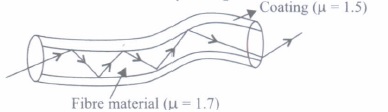
(c): Optical fiber is extremely thin (radius of few microns) and long strand of very fine quality glass or quartz. When light is incident at a small angle at one end, it gets refracted into the strands (or fibres) and incident on the interface of the fibres and the coating. The angle of incidence being greater than the critical angle, the ray of light undergoes total internal reflections. It suffers the internal reflection again and again, till the angle of incidence remains greater than the critical angle for fibre material with respect to coating. Due to successive total internal reflection there is no loss of intensity in optical fibres.
22.
(b) : \(\mu=\frac{\mu_{g}}{\mu_{c}}=\frac{1.5}{1.65}<1\)
\(\text { From } \frac{1}{f}=(\mu-1)\left(\frac{1}{R_{1}}-\frac{1}{R_{2}}\right)\)
f becomes negative.
Therefore, the lens behaves as a diverging lens.
23.
(c): The reflection and refraction of light occurs on account of interaction of light with the atoms of the surface of separation. These atoms can be regarded as oscillators. Light incident on the interface forces the atomic oscillators to oscillate with frequency of incident light. As frequency oflight emitted by these (charged). oscillators is equal to their own frequency of oscillation, therefore, reflected and refracted light have the same frequency as that of incident light.

12th Standard CBSE Syllabus & Materials
12th Standard CBSE
CBSE 12th Computer Science Python Revision Tour I - New Previous year Question Papers Study Material - QB365 Set A
NEW12th Standard CBSE
CBSE 12th Business Studies Planning Important Questions And Answers Study Material - QB365 Set A
NEW12th Standard CBSE
CBSE 12th Business Studies Business Environment Important Questions And Answers Study Material - QB365 Set A
NEW12th Standard CBSE
CBSE 12th Business Studies Principles of Management Important Questions And Answers Study Material - QB365 Set A



NCERT Books

Syllabus

Exam Pattern

Sample Question Papers

Previous year Question Papers

Important Notes

MCQ Practice test

NCERT Exemplers

Case study Questions

Image Based Questions

Passage based Questions

HOT Questions

Value Based Questions

Model Questions Papers
NCERT ( Book Back ) Questions

Assertion and Reason
Important Questions And Answers

CBSE 12th Standard CBSE Subjects
CBSE Standards








