
 100% FREE ACCESS
12th Standard CBSE Syllabus & Materials
12th Standard CBSE
CBSE 12th Economics Government Budget and the Economy Previous year Question Papers Study Material - QB365 Set A
NEW12th Standard CBSE
CBSE 12th Computer Science Interface Python with MySQL - New Previous year Question Papers Study Material - QB365 Set A
NEW12th Standard CBSE
CBSE 12th Computer Science Database Concept - New Previous year Question Papers Study Material - QB365 Set A
NEW12th Standard CBSE
CBSE 12th Computer Science Data Communication - New Previous year Question Papers Study Material - QB365 Set A
NEW12th Standard CBSE
CBSE 12th Computer Science Data Structures - New Previous year Question Papers Study Material - QB365 Set A
NEW12th Standard CBSE
CBSE 12th Computer Science Functions - New Previous year Question Papers Study Material - QB365 Set A

Published on: 25/10/2025
Download CBSE Class 12th Standard CBSE Physics question papers, sample papers, important questions, and previous year solved papers in PDF format. Get free study materials, NCERT solutions, and exam preparation resources for Class 12th Standard CBSE Physics
Questions + Answers key
Take MCQ Physics Test
1.
Calculate the energy equivalent of 1 g of substance.
2.
In the Rutherford’s nuclear model of the atom, the nucleus (radius about 10–15 m) is analogous to the sun about which the electron move in orbit (radius \(\approx \) 10–10 m) like the earth orbits around the sun. If the dimensions of the solar system had the same proportions as those of the atom, would the earth be closer to or farther away from the sun than actually it is? The radius of earth’s orbit is about 1.5 x 10¹¹ m. The radius of sun is taken as 7 x 10⁸ m.
3.
A short bar magnet placed with its axis at 30º with a uniform external magnetic field of 0.25 T experiences a torque of magnitude equal to 4.5 x 10⁻² J. What is the magnitude of magnetic moment of the magnet?
4.
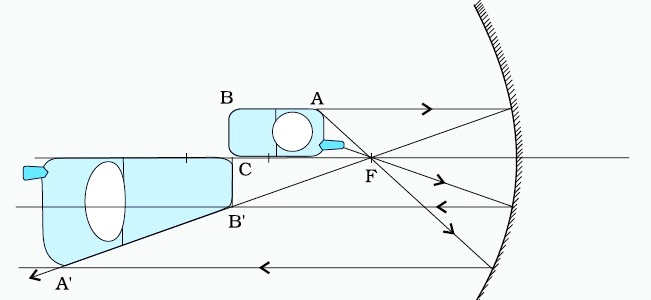
A mobile phone lies along the principal axis of a concave mirror, as shown in Fig. Show by suitable diagram, the formation of its image. Explain why the magnification is not uniform. Will the distortion of image depend on the location of the phone with respect to the mirror?
5.
Can one have an inductance without a resistance ? How about a resistance with an inductance?
6.
From the relation R = R0A1/3, where R0 is a constant and A is the mass number of a nucleus, show that the nuclear matter density is nearly constant (i.e. independent of A).
7.
Find the energy equivalent of one atomic mass unit, first in Joules and then in MeV. Using this, express the mass defect of \({ }_{8}^{16} \mathrm{O} \text { in } \mathrm{MeV} / \mathrm{c}^{2}\)
8.
According to the classical electromagnetic theory, calculate the initial frequency of the light emitted by the electron revolving around a proton in hydrogen atom.
9.
Careful measurement of the electric field at the surface of a black box indicates that the net outward flux through the surface of the box is 8.0 × 10³ Nm2/C.
(a) What is the net charge inside the box?
(b) If the net outward flux through the surface of the box were zero, could you conclude that there were no charges inside the box? Why or Why not?
10.
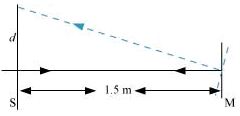
Light incident normally on a plane mirror attached to a galvanometer coil retraces backwards as shown in Fig. A current in the coil produces a deflection of 3.5° of the mirror. What is the displacement of the reflected spot of light on a screen placed 1.5 m away?
11.
A charged 30\(\mu \)F capacitor is connected to a 27mH inductor. What is the angular frequency of free oscillations of the circuit?
12.
Compute the mutual inductance for a given pair of coils if increase in current from 2A to 6A in 0.1 s in one causes an induced e.m.f. of 1 V in the other coil.
13.
An AC voltage V = Vosin\(\omega\)t is applicd to a series combination of a resistor R and an element X. The instantancous current in the circuit is \(I=I_0 \sin \left(\omega t+\frac{\pi}{4}\right)\) . Then, which of the following is correct?
X is a capacitor and X C = \(\sqrt2\)R
X is a inductor and X L = R
X is a inductor and X L =\(\sqrt2\) R
X is a capacitor X C = R
14.
A nucleus \({ }_{\mathbf{Z}}^{\mathbf{A}} \mathbf{X}\) emits an α-particle. The resultant nucleus emits a β-particle. The respective atomic and mass numbers of the daughter nucleus will be
Z - 3, A - 4
Z - 1, A - 4
Z - 2, A - 4
Z, A - 2
15.
Which of the following spectral series in hydrogen atom gives spectral line of 4860 \(\overset { \circ }{ A } \)?
Lyman
Balmer
Paschen
Brackett
16.
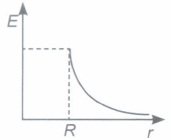
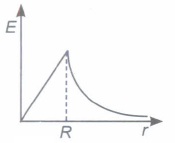
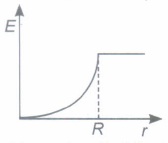
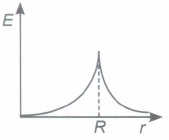
Which of the following graphs shows the variation of electric field E due to a hollow spherical conductor of radius R as a function of distance from the centre of the sphere?
17.
Electric field at a point varies as ro for
an electric dipole
a point charge
a plane infinite sheet of charge
a line charge of infinite length
18.
The effective area of the coil exposed to the magnetic field lines changes with time, the flux at any time is
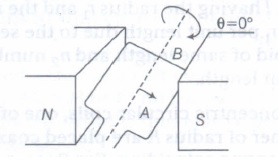
\(\phi_{B}=B A \cot \omega t\)
\(\phi_{B}=B A \cos \omega t\)
\(\phi_{B}=B A \tan \omega t\)
\( \phi_{B}=B A \sec \omega t\)
19.
If the reading of AC mains voltage by a voltmeter is 200 V, then the root mean square value of this voltage will be
200\(\sqrt{2}\) V
100\(\sqrt{2}\) V
200 V
400/\(\pi\) V
20.
In a permanent magnet at room temperature,
magnetic moment of each molecule is zero
the individual molecules have non-zero magnetic moment which are all perfectly aligned
domains are partially aligned
domains are all perfectly aligned
21.
Two charges + 1 \(\mu\) Cand +4\(\mu\) C are situated at a distance in air. The ratio of the forces acting on them is
1 : 4
4 : 1
1 : 1
1 : 16
22.
A large magnet is broken into two pieces so that their lengths are in the ratio 2 : 1. The pole strengths of the two pieces will have ratio.
2: 1
1: 2
4: 1
1: 1
23.
A person can see clearly objects only when they lie bet ween 50 cm and 400 cm from his eyes. In order to increase the maximum distance of distinct vision to infinity, the type and power of the correcting lens, the person has to use, will be
convex, + 2.25 D
concave, - 0.25D
concave, - 0.2 D
convex, + 0.15 D
24.
The r efracting angle of a prism is A and refractive index of the material of the prism is cot(A/2). The angle of minimum deviation is
180o-3A
180-2A
90o-A
180o+2A
25.
A nucleus \(_{ Z }{ { X }^{ A } }\) has mass represented by M (A,Z). If \({ M }_{ p } \ and \ { M }_{ n }\) denote the mass of proton and neutron respectively and B.E., the binding energy in MeV, then
\(B.E.=\left[ Z{ M }_{ p }+\left( A-Z \right) { M }_{ n }-M\left( A,Z \right) \right] { c }^{ 2 }\)
\(B.E.=\left[ Z{ M }_{ p }+A{ M }_{ n }-M\left( A,Z \right) \right] { c }^{ 2 }\)
\(B.E.=M\left( A,Z \right) -Z{ M }_{ p }-\left( A-Z \right) { M }_{ n }\)
\(B.E.=\left[ M\left( A,Z \right) -Z{ M }_{ p }-\left( A-Z \right) Mn \right] { c }^{ 2 }\)
26.
The average value of a.c. voltage E = E0 sin \(\omega\)t over the time interval t = 0 to t = \(\pi /\omega \) is
\(-2{ E }_{ 0 }/\pi \)
\({ E }_{ 0 }/\pi \)
\(\frac { 2{ E }_{ 0 } }{ \pi } \)
zero
27.
When a nucleus in an atom undergoes a radioactive decay, the electronic energy levels of the atom
do not change for any type of radioactivity
change for \(\alpha \ and\ \beta \) radioactivity but not for \(\gamma \)-radioactivity
change for \(\alpha \)-radioactivity but not for others
change for \(\beta \)-radioactivity but not for others
28.
SI unit of magnetic flux is
henry
weber
coulomb
volt
29.
The Q value of a nuclear reaction \(A+b \rightarrow C+d\) is defined by \(Q=\left[m_{A}+m_{b}-m_{C}-m_{d}\right] c^{2}\) where the masses refer to the respective nuclei. Determine from the given data the Q-value of the following reactions and state whether the reactions are exothermic or endothermic.
\(\text { (i) }{ }_{1}^{1} \mathrm{H}+{ }_{1}^{3} \mathrm{H} \rightarrow{ }_{1}^{2} \mathrm{H}+{ }_{1}^{2} \mathrm{H}\)
\(\text { (ii) }{ }_{6}^{12} \mathrm{C}+{ }_{6}^{12} \mathrm{C} \rightarrow{ }_{10}^{20} \mathrm{Ne}+{ }_{2}^{4} \mathrm{He}\)
Atomic masses are given to be
\(m\left({ }_{1}^{2} \mathrm{H}\right)=2.014102 \mathrm{u}\)
\(m\left({ }_{1}^{3} \mathrm{H}\right)=3.016049 \mathrm{u}\)
\(m\left(\begin{array}{c} 12 \\ 6 \end{array} \mathrm{C}\right)=12.000000 \mathrm{u}\)
\(m\left(\begin{array}{l} 20 \\ 10 \end{array} \mathrm{Ne}\right)=19.992439 \mathrm{u}\)
30.
In small fields, ferromagnetic materials typically have much larger susceptibility, and therefore larger permeability, than paramagnetic materials. Ferromagnetism results because of spontaneous, self-aligning, cooperative interaction among relatively large number of iron atoms in regions called domains. As a result of molecular interactions the molecular magnetic moments in each domain are aligned parallel to one another. In other words, each domain is spontaneously magnetized to saturation even in the absence of any external magnetic field. The directions of magnetization in different domains are random, so that the resultant magnetization is zero and the specimen is unmagnetized.
(i) If above specimen is placed inside a solenoid; and slowly the magnetic intensity H (=ni) is increased from zero.
(a) What changes will occur in specimen on increasing H?
(b) Write the formula of magnetic flux density \((\overrightarrow{\mathbf{B}})\) for the specimen inside current carrying solenoid.
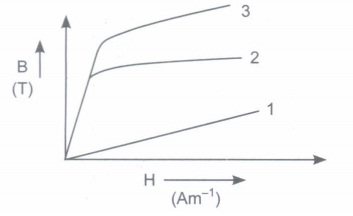
(c) Graphs of \(\mathbf{B}, \mu_{0} \mathbf{H} \text { and } \mu_{0} \mathbf{I}\) as a function of H are drawn. Identify which of the above physical quantities are contributing curves 1,2 and 3.
(ii) Why saturation of paramagnetic substances can be attained only at low temperatures?
31.
In the year 1939, German scientist Otto Hahn and Strassmann discovered that when an uranium isotope was bombarded with a neutron, it breaks into two intermediate mass fragments. It was observed that, the sum of the masses of new fragments formed were less than the mass of the original nuclei. This difference in the mass appeared as the energy released in the process. Thus, the phenomenon of splitting of a heavy nucleus (usually A> 230) into two or more lighter nuclei by the bombardment of proton, neutron, a-particle, etc with liberation of energy is called nuclear fission.
\({ }_{92} \mathrm{U}^{235}+{ }_{0} n^{1} \rightarrow \quad{ }_{92} \mathrm{U}^{236} \rightarrow{ }_{56} \mathrm{Ba}^{144}+{ }_{36} \mathrm{Kr}^{89}+3{ }_{0} n^{1}+Q\)
Unstable nucleus
(i) Nuclear fission can be explained on the basis of
| (a) Millikan's oil drop method |
| (b) Liquid. drop model |
| (c) Shell model |
| (d) Bohr's model |
(ii) For sustaining the nuclear fission chain reaction in a sample (of small size) \({ }_{92}^{235} \mathrm{U}\), it is desirable to slow down fast neutrons by
| (a) friction | (b) elastic damping/scattering |
| (c) absorption | (d) none of these |
(iii) Which of the following is/are fission reaction(s)?
\(\text {(I) }{ }_{0}^{1} n+{ }_{92}^{235} \mathrm{U} \rightarrow{ }_{92}^{236} \mathrm{U} \rightarrow{ }_{51}^{133} \mathrm{Sb}+{ }_{41}^{99} \mathrm{Nb}+4_{0}^{1} n\)
\(\text {(II) }{ }_{0}^{1} n+{ }_{92}^{235} \mathrm{U} \rightarrow{ }_{54}^{1.40} \mathrm{Xe}+{ }_{38}^{94} \mathrm{Sr}+2{ }_{0}^{1} n\)
\((\mathrm{III}){ }_{1}^{2} \mathrm{H}+{ }_{1}^{2} \mathrm{H} \rightarrow{ }_{2}^{3} \mathrm{He}+{ }_{0}^{1} n\)
| (a) Both II and III | (b) Both I and III |
| (c) Only II | (d) Both I and II |
(iv) On an average, the number of neutrons and the energy of a neutron released per fission of a uranium atom are respectively
| (a) 2.5 and 2 keV | (b) 3 and 1 keV | (c) 2.5 and 2 MeV | (d) 2 and 2 keV |
(v) In any fission process, ratio of mass of daughter nucleus to mass of parent nucleus is
| (a) less than 1 | (b) greater than 1 |
| (c) equal to 1 | (d) depends 0 the mass of parent nucleus |
1.
Energy, \(E=10^{-3} \times\left(3 \times 10^{8}\right)^{2} \mathrm{~J}\)
\(E=10^{-3} \times 9 \times 10^{16}=9 \times 10^{13} \mathrm{~J}\)
Thus, if one gram of matter is converted to energy, there is a release of enormous amount of energy.
2.
The ratio of the radius of electron’s orbit to the radius of nucleus is (10–10 m) /(10–15 m) = 105, that is, the radius of the electron’s orbit is 105 times larger than the radius of nucleus. If the radius of the earth’s orbit around the sun were 105 times larger than the radius of the sun, the radius of the earth’s orbit would be 105 x 7 x 108 m = 7 x 10¹³ m. This is more than 100 times greater than the actual orbital radius of earth. Thus, the earth would be much farther away from the sun. It implies that an atom contains a much greater fraction of empty space than our solar system does.
3.
Magnetic field strength, B = 0.25 T
Torque on the bar magnet, T = 4.5 x 10⁻² J
The angle between the bar magnet and the external magnetic field, θ = 30°
Torque is related to magnetic moment (M) as:
\(T=M B \sin \theta \therefore M=\frac{T}{B \sin \theta}\)
\(=\frac{4.5 \times 10^{-2}}{0.25 \times \sin 30^{\circ}}=0.36 J T^{-1}\)
Hence, the magnetic moment of the magnet is 0.36 J T-1.
4.
The ray diagram for the formation of the image of the phone is shown in Fig. The image of the part which is on the plane perpendicular to principal axis will be on the same plane. It will be of the same size, i.e., B'C = BC. You can yourself realise why the image is distorted.
5.
No, as every material has some resistance. Yes, we can coil a wire to have resistance with inductance.
6.
We have the expression for nuclear radius as:
R = R0A1/3
Where,
R0 = Constant.
A = Mass number of the nucleus
Nuclear matter density, \(\rho \ =\frac{Mass\ of\ the\ nucles}{Volume\ of\ the\ nucles}\)
Let m be the average mass of the nucleus.
Hence, mass of the nucleus = mA
\(\therefore \rho=m \frac{A}{\frac{4}{3} \pi R^{3}}=\frac{3 \mathrm{~mA}}{4 \pi\left(R_{0} A^{\frac{1}{3}}\right)^{3}}=\frac{3 m A}{4 \pi R_{0}^{3} A}=\frac{3 \mathrm{~m}}{4 \pi R_{0}^{3}}\)
Hence, the nuclear matter density is independent of A. It is nearly constant.
7.
1u = 1.6605 x 10⁻²⁷ kg
To convert it into energy units, we multiply it by c2 and find that energy equivalent = \(1.6605 \times 10^{-27} \times\left(2.9979 \times 10^{8}\right)^{2} \mathrm{~kg} \mathrm{~m}^{2} / \mathrm{s}^{2}\)
\(=1.4924 \times 10^{-10} \mathrm{~J}\)
\(=\frac{1.4924 \times 10^{-10}}{1.602 \times 10^{-19}} \mathrm{eV}\)
\(=0.9315 \times 10^{9} \mathrm{eV}\)
\(=931.5 \mathrm{MeV}\)
or, \(1 \mathrm{u}=931.5 \mathrm{MeV} / \mathrm{c}^{2}\)
For, \({ }_{8}^{16} \mathrm{O}, \quad \Delta M=0.13691 \mathrm{u}=0.13691 \times 931.5 \mathrm{MeV} / \mathrm{c}^{2}\)
\(=127.5 \mathrm{MeV} / \mathrm{c}^{2}\)
The energy needed to separate \({ }_{8}^{16} \mathrm{O}\) into its constituents is thus 127.5 MeV/c2.
8.
we know that velocity of electron moving around a proton in hydrogen atom in an orbit of radius 5.3 × 10⁻¹¹ m is 2.2 × 10⁻⁶ m/s. Thus, the frequency of the electron moving around the proton is
\(v=\frac{v}{2 \pi r}=\frac{2.2 \times 10^{6} \mathrm{~m} \mathrm{~s}^{-1}}{2 \pi\left(5.3 \times 10^{-11} \mathrm{~m}\right)}\)
\(\approx \) 6.6 × 10¹⁵ Hz
According to the classical electromagnetic theory we know that the frequency of the electromagnetic waves emitted by the revolving electrons is equal to the frequency of its revolution around the nucleus. Thus the initial frequency of the light emitted is 6.6 × 10¹⁵ Hz.
9.
Net outward flux through the surface of the box, Φ = 8.0 × 10³ N m2/C
For a body containing net charge q, flux is given by the relation,
\(\phi=\frac{q}{\epsilon_{0}}\)
∈0 = Permittivity of free space
= 8.854 × 10⁻¹² N−1C2 m−2
q = ∈0Φ
= 8.854 × 10−12 × 8.0 × 103
= 7.08 × 10−8
= 0.07 μC
Therefore, the net charge inside the box is 0.07 μC.
(b) No
Net flux piercing out through a body depends on the net charge contained in the body. If net flux is zero, then it can be inferred that net charge inside the body is zero. The body may have equal amount of positive and negative charges.
10.
Angle of deflection, θ = 3.5°
Distance of the screen from the mirror, D = 1.5 m
The reflected rays get deflected by an amount twice the angle of deflection i.e., 2θ = 7.0°
The displacement (d) of the reflected spot of light on the screen is given as:
\(tan2\theta =\frac { d }{ 1.5 } \)
∴ d = 1.5 x tan 70° = 0.184 m = 18.4 cm
Hence, the displacement of the reflected spot of light is 18.4 cm.
11.
Capacitance, C = 30μF = 30 × 10−6F
Inductance, L = 27 mH = 27 × 10−3 H
Angular frequency is given as:
\({ \omega }_{ r }=\frac { 1 }{ \sqrt { LC } } =\frac { 1 }{ \sqrt { 27\times { 10 }^{ -3 }\times 30\times { 10 }^{ -6 } } } =\frac { { 10 }^{ 4 } }{ 9 } =1.1\times { 10 }^{ 3 }rad/s\)
Hence, the angular frequency of free oscillations of the circuit is 1.11 × 10³ rad/s.
12.
\(Here,M=? \ dI=6-2=4A,dt=0.1 \ s,e=1V\)
\( From \ e=M \ dI/dt\)
\(M=\frac { e.dt }{ dI } =\frac { 1 \ times 0.1 }{ 4 } =0.025 \ H\)
13.
(c)
X is a inductor and X L =\(\sqrt2\) R
14.
(b)
Z - 1, A - 4
15.
(b)
Balmer
16.
(a)
17.
(c)
a plane infinite sheet of charge
18.
(b)
\(\phi_{B}=B A \cos \omega t\)
19.
(c)
200 V
20.
(d)
domains are all perfectly aligned
21.
(c)
1 : 1
22.
(d)
1: 1
23.
(b)
concave, - 0.25D
24.
(b)
180-2A
25.
(a)
\(B.E.=\left[ Z{ M }_{ p }+\left( A-Z \right) { M }_{ n }-M\left( A,Z \right) \right] { c }^{ 2 }\)
26.
(c)
\(\frac { 2{ E }_{ 0 } }{ \pi } \)
27.
(b)
change for \(\alpha \ and\ \beta \) radioactivity but not for \(\gamma \)-radioactivity
28.
(b)
weber
29.
The given nuclear reaction is:
\({ }_{1}^{1} H+{ }_{1}^{3} H \rightarrow_{1}^{2} H+{ }_{1}^{2} H\)
It is given that:
Atomic mass \(m\left({ }_{1}^{1} H\right)=1.007825 \mathrm{u}\)
Atomic mass \(m\left({ }_{1}^{3} H\right)=3.016049 \mathrm{u}\)
Atomic mass \(m\left({ }_{1}^{2} H\right)=2.014102 u\)
According to the question, the Q-value of the reaction can be written as:
\(Q=\left[m\left({ }_{1}^{1} H\right)+m\left({ }_{1}^{3} H\right)-2 m\left({ }_{1}^{2} H\right)\right] c^{2}\)
\(=[1.007825+3.016049-2 \times 2.014102] c^{2}\)
\(Q=-0.00433 \times 931.5=-4.0334 \mathrm{MeV}\)
The negativeQ-value of the reaction shows that the reaction is endothermic.
The given nuclear reaction is:
\(\text { (ii) }{ }_{6}^{12} \mathrm{C}+{ }_{6}^{12} \mathrm{C} \rightarrow{ }_{10}^{20} \mathrm{Ne}+{ }_{2}^{4} \mathrm{He}\)
t is given that:
Atomic mass of \(m\left({ }_{6}^{12} C\right)=12.0 u\)
Atomic mass of \(m\left(\begin{array}{l} 20 \\ 10 \end{array}\right)=19.992439\)
Atomic mass of \(m\left({ }_{2}^{4} \mathrm{He}\right)=4.002603 \mathrm{u}\)
The Q-value of this reaction is given as:
\(Q=\left[2 m\left({ }_{6}^{12} C\right)-m\left({ }_{10}^{20} N e\right)-m\left({ }_{2}^{4} H e\right)\right] c^{2}\)
\(=[2 \times 12.0-19.992439-4.002603] c^{2}\)
\(=\left(0.004958 c^{2}\right) u\)
\(=0.004958 \times 931.5=4.618377 \mathrm{MeV}\)
The positive Q-value of the reaction shows that the reaction is exothermic.
30.
(i) (a) On increasing H (= ni); intensity of magnetization I (magnetic dipole moments induced per unit volume) increases due to more and more alignment of spinning electrons with the H-field, when all the magnetic dipole moments are aligned along H-field, the intensity of magnetisation reaches its maximum value and specimen is saturated.
(b) \(\overrightarrow{\mathrm{B}}=\mu_{0} \overrightarrow{\mathrm{H}}+\mu_{0} \overrightarrow{\mathrm{I}}\)
Here I = Intensity of Magnetization
(c) Graph 1 represents \(\mathrm{B} \propto \mu_{0} \mathrm{H}\)
Graph 2 represents variation of B with \(\mu\)0I
Graph 3 represents variation B with \(\left(\mu_{0} \mathrm{H}+\mu_{0} \mathrm{I}\right)\)
(ii) At high temperature the randomness in paramagnetic substances increases according to formula.
\(\chi=\frac{\mathrm{I}}{\mathrm{H}} \propto \frac{1}{\text { Temperature }}\)
\(\therefore\) When a paramagnetic substance is cooled to extremely low temperature, then disorientation effect is highly reduced.
31.
(i) (b)
(ii) (b): Fast neutrons are slowed down by elastic scattering with light nuclei as each collision takes away nearly 50% of energy.
(iii) (d): Reactions I and II represent fission of uranium isotope \({ }_{92}^{235} \mathrm{U}\), when bombarded with neutrons that breaks it into two intermediate mass nuclear fragments. However, reaction III represents two deuterons fuses together to from the light isotope of helium.
(iv) (c): On an average 2.5 neutrons are released per fission of the uranium atom.
The energy of the neutron released per fission of the uranium atom is 2 MeV.
(v) (a): In fission process, when a parent nucleus breaks. into daughter products, the some mass is lost in the form of energy. Thus,mass of fission products < mass of parent nucleus.
\(\Rightarrow \frac{\text { Mass of fission products }}{\text { Mass of parent nucleus }}<1\)

12th Standard CBSE Syllabus & Materials
12th Standard CBSE
CBSE 12th Computer Science Python Revision Tour I - New Previous year Question Papers Study Material - QB365 Set A
NEW12th Standard CBSE
CBSE 12th Business Studies Planning Important Questions And Answers Study Material - QB365 Set A
NEW12th Standard CBSE
CBSE 12th Business Studies Business Environment Important Questions And Answers Study Material - QB365 Set A
NEW12th Standard CBSE
CBSE 12th Business Studies Principles of Management Important Questions And Answers Study Material - QB365 Set A



NCERT Books

Syllabus

Exam Pattern

Sample Question Papers

Previous year Question Papers

Important Notes

MCQ Practice test

NCERT Exemplers

Case study Questions

Image Based Questions

Passage based Questions

HOT Questions

Value Based Questions

Model Questions Papers
NCERT ( Book Back ) Questions

Assertion and Reason
Important Questions And Answers

CBSE 12th Standard CBSE Subjects
CBSE Standards








