
 100% FREE ACCESS
12th Standard CBSE Syllabus & Materials
12th Standard CBSE
CBSE 12th Economics Government Budget and the Economy Previous year Question Papers Study Material - QB365 Set A
NEW12th Standard CBSE
CBSE 12th Computer Science Interface Python with MySQL - New Previous year Question Papers Study Material - QB365 Set A
NEW12th Standard CBSE
CBSE 12th Computer Science Database Concept - New Previous year Question Papers Study Material - QB365 Set A
NEW12th Standard CBSE
CBSE 12th Computer Science Data Communication - New Previous year Question Papers Study Material - QB365 Set A
NEW12th Standard CBSE
CBSE 12th Computer Science Data Structures - New Previous year Question Papers Study Material - QB365 Set A
NEW12th Standard CBSE
CBSE 12th Computer Science Functions - New Previous year Question Papers Study Material - QB365 Set A

Published on: 25/10/2025
Download CBSE Class 12th Standard CBSE Physics question papers, sample papers, important questions, and previous year solved papers in PDF format. Get free study materials, NCERT solutions, and exam preparation resources for Class 12th Standard CBSE Physics
Questions + Answers key
Take MCQ Physics Test
1.
When an object is placed 40 cm from a diverging lens, its virtual image is formed 20 cm from the lens.The focal length and power of lens are
F = - 20 cm, P = - 5 D
F = - 40 cm, P = - 5 D
F = - 40 cm,P = -2.5 D
F = -20 cm,P = -2.5 D
2.
A magnifying glass of focal length 5 cm is used to view an object by a person whose smallest distance of distinct vision is 25cm. If he holds the glass close to eye, then the magnification is
5
6
2.5
3
3.
In vacuum, to travel distance d, light takes time t and in medium to travel distance 5d, it takes time T. The critical angle of the medium is
\({ sin }^{ -1 }\left( \frac { 5T }{ t } \right) \)
\({ sin }^{ -1 }\left( \frac { 5t }{3T } \right) \)
\({ sin }^{ -1 }\left( \frac { 5t }{ T } \right) \)
\({ sin }^{ -1 }\left( \frac { 3t }{ 5T } \right) \)
4.
When sun light is scattered by minute particles of atmosphere, then the intensity of light scattered away is proportional to
(wavelength ot light)4
(frequency of light)4
(wavelength of light)2
(frequency of light)2
5.
Rainbow is caused due to
Refraction
reflection
dispersion
All of these
6.
For a normal eye, the least distance of distinct vision is
0.25 m
0.50 m
25 m
infinite
7.
When light of wavelength \(\lambda\) is incident on an equilateral prism kept in, its minimum deviation position, it is found that the angle of deviation equals the angle of the prism itself The refractive index of the material of the prism for the wavelength \(\lambda\) is, then
\(\sqrt { 3 } \)
\(\frac { \sqrt { 3 } }{ 2 } \)
2
\(\sqrt { 2 } \)
8.
The minimum distance between an object and its real image formed by a convex lens is
1.5 f
2 f
2.5 f
4 f
9.
A plano-convex lens is made of glass of refractive index 1.5. The radius of curvature of its convex surface is R. Its focal length is
R/2
R
2R
1.5R
10.
A thin prism of angle \({ 7 }^{ 0 }\) and refractive index 1.5 is combined with another prism of angle \(\theta \) and refractive index 1.7. The emergent ray goes undeviated. What is the value of \(\theta \) ?
\({ 3 }^{ 0 }\)
\({ 5 }^{ 0 }\)
\({ 9 }^{ 0 }\)
\({ 1 }^{ 0 }\)
11.
A ray of light passes through an equilateral glass prism, such that the angle of incidence is equal to the angle of emergence. If the angle of emergence is 3/4 times the angle of prism, calculate the refractive index of the glass prism.
12.
Using the lens formula, show that an object placed between the optical centre and the focus of a convex lens produces a virtual and an enlarged image.
13.
A lens behaves as a converging lens in air and a diverging lens in water (μ = 4/3). What will be the condition on the value of refractive index (μ)of the material of the lens?
14.
How will you distinguish between a compound microscope and a telescope simply by seeing it?
15.
A biconvex lens has a focal length 2/3 times the radius of curvature of either surface. Calculate the refractive index of lens material.
16.
Find the radius of curvature of the convex surface of a plano-convex lens, whose focal length is 0.3 m and the refractive index of the material of the lens is 1.5.
17.
A lens is made of two different materials. A point object is placed on the principal axis of this lens. How many images will be obtained?
18.
A glass lens is immersed in water. How is power of the lens affected?
19.
Why prisms are used in many optical instruments?
20.
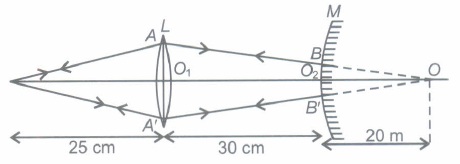
A convex lens, and a convex mirror, (of radius of curvature 20 cm) are placed co-axially with the convex mirror placed at a distance of 30 cm from the lens. For a point object at a distance of 20 cm from the lens, the final image; due to this combination, coincides with the object itself. What is the focal length of the convex lens?
21.
A convex lens of focal length 20 cm and made of glass (μ = 1.5) is immersed in water of μ = 1.33. Calculate change in focal length of the lens.
22.
How does the refractive index of a transparent medium depend on the wavelength of incident light used? Velocity of light in glass is 2 x 10⁸ m/s and in air is 3 x 10⁸ m/s, If the ray of light passes from glass to air, calculate the value of critical angle.
23.
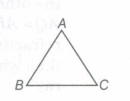
(i) A ray of light incident of face prism, of an shows equilateral minimum glass 6 deviation of 30°. Calculate the speed of light through the prism.
(ii) Find the angle of incidence at face AB, so that the emergent ray grazes along the face AC.
24.
(i) Monochromatic light of wavelength 589 nm is incident from air on a water surface. If μ for water is 1.33, find the wavelength, frequency and speed of the refracted light.
(ii) A double convex lens is made of a glass of refractive index 1.55 with both faces of the same radius of curvature. Find the radius of curvature required, if the focal length is 20 cm.
25.
Figure shows a convex spherical surface with centre of curvature C, separating the two media of refractive indices n1 and n2. Draw a ray diagram showing the formation of the image of a point object lying on the principal axis. Derive the relationship between the object and image distance in terms of refractive indices of the media and the radius of curvature R on the surface.
26.
Draw a labelled ray diagram of an astronomical telescope for the near point adjustment.
You are given three lenses of powers 0.5 0, 4 0, 10 D. State, with reason, which two lenses will you select for constructing a good astronomical telescope. Calculate the resolving power of this telescqpe, assuming the diameter of the objective lens to be 6 em and the wavelength of light used to be 540 nm.
27.
(a) Draw a ray diagram for the formation of image by a compound microscope. Define its magnifying power. Deduce the expression for the magnifying power of the microscope.
(b) Explain:
(i) why must both the objective and the eyepiece of a compound microscope have short focal lengths?
(ii) while viewing through a compound microscope, why should our eyes be positioned not on the eyepiece but a short distance away from it for best viewing?
28.
(i) Deduce the expression by drawing a suitable ray diagram for the refractive index of a triangular glass prism in terms of the. angle of minimum deviation (D) and the angle of prism (A) Draw a plot showing the variation of the angle of deviation with the angle of incidence.
(ii) Calculate the value of the angle of incidence when a ray of light incident on one face of an equilateral glass prism produces the emergent ray, which just grazes along the adjacent face. Refractive index of the prism is \(\sqrt {2}\).
29.
Define magnifying power of a telescope. Write its expression. A small telescope has an objective lens of focal length 150 cm and an eyepiece of focal length 5 cm. If this telescope is used to view a 100 m high tower 3 km away, find the height of the final image, when it is formed 25 cm away from the eyepiece.
30.
The lens Maker's formula is useful to design lenses of desired focal lengths using surfaces of suitable radii of curvature. The focal length also depends on the refractive index of the material of the lens and the surrounding medium. The refractive index depends on the wavelength of the light used. The power of a lens is related to its focal length.
Answer the following questions based on the above.
(i) How will the power of a lens be affected with an increase of wavelength of light?
(ii) The radius of curvature of two surfaces of a convex lens is R each. For what value of \(u\) of its material, will its focal length become equal to R?
(iii) The focal length of a concave lens of \(u\) = 1.5 is 20 cm in air. It is completely immersed in water of \(\mu=\frac{4}{3}\) = Calculate its focal length in water.
(iv) An object is placed in front of a lens which forms its erect image of magnification 3. The power of the lens is 5 D. Calculate the distance of the object and the image from the lens,
31.
An optical fibre is a thin tube of transparent material that allows light to pass through, without being refracted into the air or another external medium. It make use of total internal reflection. These fibres are fabricated in such a way that light reflected at one side of the inner surface strikes the other at an angle larger than critical angle. Even, if fibre is bent, light can easily travel along the length.
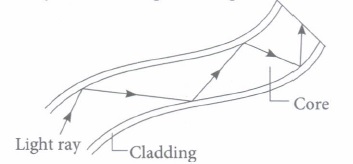
(i) Which of the following is based on the phenomenon of total internal reflection of light?
| (a) Sparkling of diamond | (c) Instrument used by doctors for endoscopy |
| (b) Optical fibre communication | (d) All of these |
(ii) A ray of light will undergo rotal internal reflection inside the optical fibre, if it
| (a) goes from rarer medium to denser medium |
| (b) is incident at an angle less than the critical angle |
| (c) strikes the interface normally |
| (d) is incident at an angle greater than the critical angle |
(iii) If in core, angle of incidence is equal to critical angle, then angle of refraction will be
| (a) 0° | (b) 45° | (c) 90 | (d) 180° |
(iv) In an optical fibre (shown), correct relation for refractive indices of core and cladding is
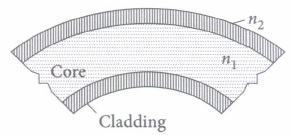
| (a) n1 = n2 | (b) n1 > n2 | (c) n1 < n2 | (d) n1 + n2 = 2 |
(v) If the value of critical angle is 30° for total internal reflection from given optical fibre, then speed of light in that fibre is
| (a) 3 x 10⁸ m S-1 | (b) 1.5 x 10⁸ m S-1 | (c) 6 x 10⁸ m s-1 | (d) 4.5 x 10⁸ m s-1 |
32.
Refraction of light is the change in the path oflight as it passes obliquely from one transparent medium to another medium. According to law of refraction \(\frac{\sin i}{\sin r}={ }^{1} \mu_{2}\) where \({ }^{1} \mu_{2}\) is called refractive index of second medium with respect to first medium. From refraction at a convex spherical surface, we have \(\frac{\mu_{2}}{v}-\frac{\mu_{1}}{u}=\frac{\mu_{2}-\mu_{1}}{R}\) Similarly from refraction at a concave spherical surface when object lies in the rarer medium, we have \(\frac{\mu_{2}}{v}-\frac{\mu_{1}}{u}=\frac{\mu_{2}-\mu_{1}}{R}\) and when object lies in the denser medium, we have \(\frac{\mu_{1}}{v}-\frac{\mu_{2}}{u}=\frac{\mu_{1}-\mu_{2}}{R}\).
(i) Refractive index of a medium depends upon
| (a) nature of the medium | (b) wavelength of the light used |
| (c) temperature | (d) all of these |
(ii) A ray of light of frequency 5 x 10¹⁴ Hz is passed through a liquid. The wavelength of light measured inside the liquid is found to be 450 x 10-9 m. The refractive index of the liquid is
| (a) 1.33 | (b) 2.52 | (c) 2.22 | (d) 0.75 |
(iii) A ray of light is incident at an angle of 60° on one face of a rectangular glass slab of refractive index 1.5. The angle of refraction is
| (a) sin-1(0.95) | (b) sin-1(0.58) | (c) sin-1(0.79) | (d) sin-1(0.86) |
(iv) A point object is placed at the centre of a glass sphere of radius 6 cm and refractive index 1.5. The distance of the virtual image from the surface of sphere is
| (a) 2 cm | (b) 4 cm | (c) 6 cm | (d) 12 cm |
(v) In refraction, light waves are bent on passing from one medium to the second medium because in the second medium
| (a) the frequency is different | (b) the co-efficient of elasticity is different |
| (c) the speed is different | (d) the amplitude is smaller. |
33.
Total internal reflection is the phenomenon of reflection of light into denser medium at the interface of denser medium with a rarer medium. For this phenomenon to occur necessary condition is that light must travel from denser to rarer and angle of incidence in denser medium must be greater than critical angle (C) for the pair of media in contact. Critical angle depends on nature of medium and wavelength of light. We can show that
\(\mu=\frac{1}{\sin C} .\)
(i) Critical angle for glass air interface, where \(\mu\) of glass is \(\frac{3}{2}\) is
| (a) 41.8° | (b) 60° | (c) 30° | (d) 15° |
(ii) Critical angle for water air interface is 48.6°. What is the refractive index of water?
| (a) 1 | (b) \(\frac{3}{2}\) | (c) \(\frac{4}{3}\) | (d) \(\frac{3}{4}\) |
(iii) Critical angle for air water interface for violet colour is 49°. Its value for red colour would be
| (a) 49° | (b) 50° | (c) 48° | (d) cannot say |
(iv) Which of the following is not due to total internal reflection?
| (a) Working of optical fibre. |
| (b) Difference between apparent and real depth of a pond. |
| (c) Mirage on hot summer days. |
| (d) Brilliance of diamond |
(v) Critical angle of glass is \(\theta\)1 and that of water is \(\theta\)2, The critical angle for water and glass surface would be \(\left(\mu_{g}=3 / 2, \mu_{w}=4 / 3\right)\)
| (a) less than \(\theta\)2 | (b) between \(\theta\)1 and \(\theta\)2 | (c) greater than \(\theta\)2 | (d) less than \(\theta\)1 |
34.
A convex or converging lens is thicker at the centre than at the edges. It converges a parallel beam of light on refraction through it. It has a real focus. Convex lens is of three types:
(i) Double convex lens
(ii) Plano-convex lens
(iii) Concavo-convex lens. Concave lens is thinner at the centre than at the edges. It diverges a parallel beam of light on refraction through it. It has a virtual focus.
(i) A point object 0 is placed at a distance of 0.3 m from a convex lens (focal length 0.2 m) cut into two halves each of which is displaced by 0.0005 m as shown in figure.What will be the location of the image?
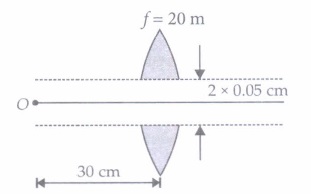
| (a) 30 cm right of lens | (b) 60 ern right of lens |
| (c) 70 ern left of lens | (d) 40 cm left oflens |
(ii) Two thin lenses are in contact and the focal length of the combination is 80 cm. If the focal length of one lens is 20 cm, the focal length of the other would be
| (a) -26.7 cm | (b) 60 crn |
| (c) 80 cm | (d) 20 cm |
(iii) A spherical air bubble is embedded in a piece of glass. For a ray of light passing through the bubble, it behaves like a
| (a) converging lens | (b) diverging lens |
| (c) plano-converging lens | (d) plano-diverging lens |
(iv) Lens used in magnifying glass is
| (a) Concave lens | (b) Convex lens | (c) Both (a) and (b) | (d) None of the above |
(v) The magnification of an image by a convex lens is positive only when the object is placed
| (a) at its focus F | (b) between F and 2F |
| (c) at 2F | (d) between F and optical centre |
35.
36.
37.
38.
Assertion (A) : Light travels than in air.
Reason (R) : Glass is denser than air.
(a) Both Assertion and Reason are true and Reason is the correct explanation of Assertion.
(b) Both Assertion and Reason are true but Reason is not the correct explanation of Assertion.
(c) Assertion is true but Reason is false.
(d) Assertion is false but Reason is true.
39.
Assertion (A) : Convergent property of converging lens remains same in mediums.
Reason (R) : Property of lens whether the ray is diverging or converging depends on the surrounding medium.
(a) Both Assertion and Reason are true and Reason is the correct explanation of Assertion.
(b) Both Assertion and Reason are true but Reason is not the correct explanation of Assertion.
(c) Assertion is true but Reason is false.
(d) Assertion is false but Reason is true.
1.
(c)
F = - 40 cm,P = -2.5 D
2.
(b)
6
3.
(c)
\({ sin }^{ -1 }\left( \frac { 5t }{ T } \right) \)
4.
(b)
(frequency of light)4
5.
(d)
All of these
6.
(a)
0.25 m
7.
(a)
\(\sqrt { 3 } \)
8.
(d)
4 f
9.
(c)
2R
10.
(b)
\({ 5 }^{ 0 }\)
11.
\( \text { Given: } \angle A=60^{\circ}, \angle i=\angle e, \angle i=\frac{3}{4} \angle A=45^{\circ} \text { and } \)
\(\angle r=\frac{\angle A}{2}=30^{\circ} \)
\(\mu=\frac{\sin i}{\sin r}=\frac{2}{\sqrt{2}}=1.414\)
12.
We know that \(\frac{1}{f}=\frac{1}{v}-\frac{1}{u}\)
For a convex lens, j > 0 and u < 0
Given that \(0<|u|<f\)
From lens formula,
\(\frac{1}{v}=\frac{1}{f}+\frac{1}{u}=\left[\frac{1}{|f|}-\frac{1}{|u|}\right]<0\)
\(\Rightarrow v<0, \text { i.e. } v \text { is negative. }\)
This shows that the image is virtual and lies on the same side as that of the object.
As \(\frac{1}{|v|}<\frac{1}{|u|}, \text { we get }|v|>|u| \Rightarrow m=\frac{|v|}{|u|}>1\)
This shows that the image is enlarged.
13.
The refractive index μ of the lens is less than the refractive index of water \(\text { i.e. } \frac{4}{3}>\mu_L>1\)
14.
In compound microscope objective lens has smaller aperture and smaller focal length than the eyepiece, while in telescope, the objective has a larger aperture and larger focal length than the eyepiece.
15.
Given, \(f=\frac{2}{3} R, R_{1}=+R, R_{2}=-R\)
∴ Using lens Maker's formula,
\(\frac{1}{f}=(\mu-1)\left(\frac{1}{R_{1}}-\frac{1}{R_{2}}\right)\)
\( \Rightarrow \frac{3}{2 R}=(\mu-1)\left(\frac{2}{R}\right) \)
\(\Rightarrow \quad \mu-1=\frac{3}{4} \)
\(\Rightarrow \quad \mu=1+\frac{3}{4}=\frac{7}{4} \)
16.
For a plano-convex lens, R1 = ∞
R2 = -R, f = 0.3 m = 30 cm
μ = 1.5
Radius of curvature of plano-convex lens, R = ?
Applying lens Maker's formula, \(\frac{1}{f}=(\mu-1)\left(\frac{1}{R_{1}}-\frac{1}{R_{2}}\right)\)
\(\Rightarrow \frac{1}{30}=(\mu-1)\left ( \frac{1}{\infty }-\frac{1}{-R} \right )=\frac{(1.5-1)}{R}\Rightarrow R=15 cm\)
17.
Since, refractive index of each material is different, so the lens will have two different focal lengths, one for each material. Hence, two images will be formed.
18.
When a glass lens (\(\mu\)g = 1.5) is immersed in water (\(\mu\)w = 1.33), then focal length of the lens increases but its nature remains unchanged. due to increase in focal length, its power reduces.
19.
Since, prisms can bend the light rays by 90° and 180° by total internal reflection, so they are used in many optical instruments.
20.
The final image, formed by the combination, is coinciding with the object itself. This implies that the rays, from the object, are retracing their path, after refraction from the lens and reflection from the mirror.
The (refracted) rays are, therefore, falling normally on the mirror. It follows that the rays AB, and A'B' when produced, are meeting at the centre of curvature, C of the mirror. Hence, O2O = 20 cm, i.e. the radius of curvature of the
mirror.
From the figure, we then see that for the convex lens, u = - 25 cm and v = + (30 + 20) cm = + 50 cm. from the focal length of the lens, we have
\(
\frac{1}{50}-\frac{1}{(-25)} =\frac{1}{f} \Rightarrow \frac{1}{f}=\frac{1+2}{50}
f =\frac{50}{3} \mathrm{~cm}=16.67 \mathrm{~cm}
\)
21.
Given: \(f=20 \mathrm{~cm}, \mu=1.5, \mu_{w}=1.33\)
As \(
\frac{1}{f^{\prime}}=\left(\frac{1.5-1.33}{1.33}\right)\left(\frac{1}{r_{1}}-\frac{1}{r_{2}}\right)
\) .........(i)
Also, \(\frac{1}{20}=(1.5-1)\left(\frac{1}{r_{1}}-\frac{1}{r_{2}}\right)
\) .........(ii)
Dividing equation (i) by (ii), we get
\(\frac{20}{f^{\prime}}=\frac{0.17}{1.33 \times 0.5} \Rightarrow f^{\prime}=78.24 \mathrm{~cm}\)
22.
The refractive index of a transparent medium decreases with increase in wavelength of the incident light.
We have \(\mu_{g a}=\frac{v_{a}}{v_{g}}=\frac{3 \times 10^{8}}{2 \times 10^{8}}=\frac{3}{2}=1.5\)
\(
\therefore \quad \mu_{g a}=\frac{1}{\sin i_{c}}
\)
\(\Rightarrow i_{c}=\sin ^{-1}\left(\frac{1}{\mu_{g a}}\right)
\)
\(\Rightarrow \quad i_{c}=\sin ^{-1}\left(\frac{2}{3}\right)=41.8\)
23.
(i) Given, angle of minimum deviation, 8 m = 30°
Angle of prism, A = 60°
By prism formula, reflected index,
\(\mu=\frac{\sin \frac{\delta_{m}+A}{2}}{\sin A / 2}=\frac{\sin \frac{30^{\circ}+60^{\circ}}{2}}{\sin 30^{\circ}}=\frac{\sin 45^{\circ}}{\sin 30^{\circ}}\)
\(=\frac{1}{\sqrt{2}} \times 2=\sqrt{2}\)
Also, \(\mu=\frac{\text { speed of light in vacuum }(c)}{\text { speed of light in prism }(v)}\)
⇒ v = c/μ = (3 x I08) m/s
Hence, speed of light through prism is
(3 x I08 /\(\sqrt {2}\)) m/s
(ii) Critical angle ic is given as
\(\sin i_{c}=\frac{1}{\sqrt{2}} \quad\left[\because \sin i_{c}=\frac{1}{\mu}\right]\)
⇒ ic = 45°
A = r + ic = 60°
⇒ r = 60° - 45° = 15
Using Snell's law \(\frac{\sin i}{\sin r}=\sqrt{2}\)
⇒ sin i = \(\sqrt {2}\) sin r = \(\sqrt {2}\) x sin 15°
∴ i = sin -1 (\(\sqrt {2}\) sin 15°)
24.
(i) In refraction, frequency remains same, so
f refracted beam = f incident beam
Also, \(\mu_{21}=\frac{v_{1}}{v_{2}}=\frac{f \lambda_{1}}{f \lambda_{2}}=\frac{\lambda_{1}}{\lambda_{2}}[\because \ v=f \lambda]\)
\( \Rightarrow v_{2}=\frac{v_{1}}{\mu_{21}}=\frac{3 \times 10^{8}}{133}=2.25 \times 10^{8} \mathrm{~ms}^{-1} \)
\(\therefore \ \lambda_{2}=\frac{\lambda_{1}}{\mu_{21}}=\frac{589}{1.33}=442.85 \approx 443 \mathrm{nm} \)
So, wavelength of reflected beam \(\approx\) 443 nm and its speed = 2.25 x 10⁸ ms -1
(ii) For a biconvex lens, using lens Maker's formula,
\(\frac{1}{f}=(\mu-1)\left(\frac{1}{R_{1}}-\frac{1}{R_{2}}\right)\)
Here, f = 20 cm, μ = 1.55 ⇒ R1 = + R and R2 = - R
We have, \(\frac{1}{f}=(\mu-1) \frac{2}{R}\)
⇒ R = 2 (μ - 1) f = 2 x (1.55 - 1) x 20 = 22 cm
∴ Radius of 22 cm is required.
25.
(a) The ray diagram showing the formation of image is given below:
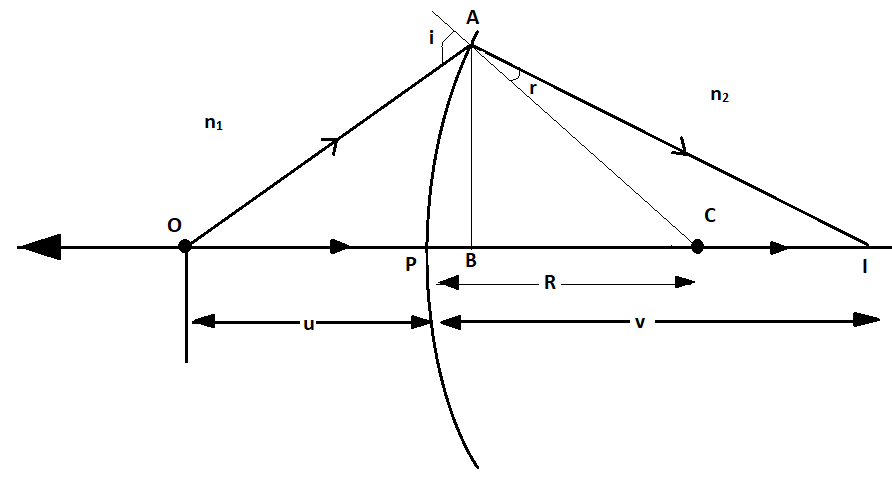
The object O is placed in the medium having refractive index n1n1 and the ray is incident from that medium to another medium of refractive index n2.
Here, AB is taken as the perpendicular to the principal axis.
Here, all the angles are very very small,
So, \(\tan \angle A O B=\frac{A B}{O B}\)
As the angle is very small, this becomes
\(\Rightarrow \frac{A B}{O B} \cong \angle A O B\)
Now, \(\tan \angle A C B=\frac{A B}{B C}\)
As the angle is very small, this becomes
\(\Rightarrow \frac{A B}{B C} \cong \angle A C B\)
Again, \(\tan \angle A I B=\frac{A B}{B I}\)
As the angle is very small, this becomes
\(\Rightarrow \frac{A B}{B C} \cong \angle A C B\)
Again, \(\tan \angle A I B=\frac{A B}{B I}\)
As the angle is very small, this becomes
\(\Rightarrow \frac{A B}{B I} \cong \angle A I B\)
Now in \(\triangle A O C\)
Here, it is the exterior angle.
Therefore, \(i=\angle A O B+\angle A C B\)
On putting the values from above equations, we get
\(\Rightarrow i=\frac{A B}{O B}+\frac{A B}{B C}\)
Similarly, in \(\triangle A C I\)
\(r=\angle A B C-\angle A I B\)
On putting values from above equations we get,
\(\Rightarrow r=\frac{A B}{B C}+\frac{A B}{B I}\)
Now using snell's law, we have
\(n_1 \sin i=n_2 \sin r\)
For very small angle we have,
\(\Rightarrow n_1 i=n_2 r\)
Now on putting values from equation (i) and (ii), we have
\(\Rightarrow n_1\left(\frac{A B}{O B}+\frac{A B}{B C}\right)=n_2\left(\frac{A B}{B C}+\frac{A B}{B I}\right)\)
On further solving, we get
\(\Rightarrow \frac{n_1}{O B}+\frac{n_2}{B I}=\frac{n_2-n_1}{B C}\)
Now, from the ray diagram, we have
OB = -u
BI = +v
BC = +R
On putting these values on the above equation we get,
\(\frac{n_2}{v}-\frac{n_1}{u}=\frac{n_2-n_1}{R}\)
26.
If the final image is formed at the distance of distinct visioa, the magnifying power of the telescope is given as
\(m=\frac{f_{o}}{-f_{e}}\left(1+\frac{f_{e}}{D}\right)\)
Astronomical telescope in near point adjustment.
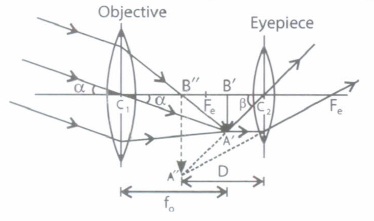
For an astronomical telescope, we will select lens of power 10D for eye piece and lens of power 0.5 D for objective because magnifying power of telescope is \(m=\frac{f_{o}}{f_{e}}\)
Resolving power of the telescope:
Given: \(
D_{0}=6 \mathrm{~cm}, \lambda =540 \times 10^{-9} \mathrm{~m}
\)
\(
\text { R.P. } =\frac{D_{o}}{1.22 \lambda}=\frac{6 \times 10^{-2}}{1.22 \times 540 \times 10^{-9}}
\)
\(= 0.9 \times 10^{5}
\)
27.
A compound microscope consists of two convex lenses. The lens facing the object to be seen is called an objective lens. The lens facing the eye is called an eye lens. Generally, the eye lens is a combination of lenses and is called an eyepiece. The aperture and the focal length of the objective lens are smaller as compared with those of eye lens. The object to be magnified is placed just beyond the focal point of the objective lens which forms its real, magnified and inverted image. This image acts as the object for the eye lens whose position is so adjusted that the final image formed by the eye lens is at the distance of distinct vision as shown in the diagram.
(b) (i) To achieve a large magni fication of small object, the eyepiece and the objective must have short focal lengths.
(ii) If we place our eyes too close to the eyepiece, the area of the pupil of the eye is less than the area of the eye-ring. So, our eyes will not collect much of the light and our field of view will get reduced.
28.
(ii) Given, the emergent ray grazes along the face AC,
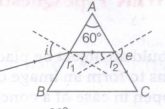
e = 90\(\unicode{xb0} \)
μ = \(\sqrt {2}\)
\(\frac{\sin i}{\sin r_{1}}=\mu=\frac{\sin e}{\sin r_{2}}\)
\(\Rightarrow \ \frac{\sin 90^{\circ}}{\sin r_{2}}=\sqrt{2}\)
\(\text { i.e. } \ \sin r_{2}=\frac{1}{\sqrt{2}} \text { or } r_{2}=45^{\circ}\)
⇒ r1 + r2 = ∠A = 60\(\unicode{xb0} \)
r1 = 60 - r2 = 15\(\unicode{xb0} \)
\(\Rightarrow \ \frac{\sin i}{\sin 15^{\circ}}=\sqrt{2}\)
⇒ i = 21.47\(\unicode{xb0} \)
29.
The magnifying power of a telescope is equal to the ratio of the visual angle subtended at the eye by final image formed at least distance' of distinct vision to the visual angle subtended at naked eye by the object at infinity.
Magnification, m = \(\frac{I}{O}=\frac{v_{0}}{u_{0}}=\frac{f_{0}}{u_{0}}\)
\(\Rightarrow \ \frac{I}{100}=\frac{150 \times 10^{-2}}{3 \times 10^{3}}\)
⇒ I = 5 x 10⁻² m = 5 cm
30.
() According to lens Maker's formula, focal length of a lens is given by
\(\frac{1}{f}=(\mu-1)\left(\frac{1}{R_1}-\frac{1}{R_2}\right)\)
Since, \(\frac{1}{f}\) = P (Power of lens)
\(\begin{aligned} & \therefore \quad P=(\mu-1)\left(\frac{1}{R_1}-\frac{1}{R_2}\right) \\ & \Rightarrow \quad P \propto \mu \end{aligned}\)
Since, refractive index (\(u\)) of the medium decreases with increase of wavelength (λ) of light. Hence, from Eq.(i),
\(P \propto \mu \propto \frac{1}{\lambda}\)
Hence, with increase of wavelength of light, power of lens decreases.
(ii) For convex lens,
R1 = R and R2 = - R
By lens Maker's formula,
\(\begin{aligned} & \frac{1}{f_{\text {air }}}=\left(\mu_g-1\right)\left(\frac{1}{R_1}-\frac{1}{R_2}\right) \\ & \frac{1}{-20}=(15-1)\left(\frac{1}{R_1}-\frac{1}{R_2}\right) \\ & \left(\frac{1}{R_1}-\frac{1}{R_2}\right)=-\frac{1}{10} \end{aligned}\)
When the lens is completely immersed in water, then focal length of lens in water is given by
\(\frac{1}{f_w}=\left({ }^\omega \mu_g-1\right)\left(\frac{1}{R_1}-\frac{1}{R_2}\right)\)
\( \begin{aligned} f_w & =\left(\frac{\mu_g}{\mu_w}-1\right)\left(-\frac{1}{10}\right) \quad \text { ffr } \\ & =\left(\frac{1.5}{4 / 3}-1\right)\left(-\frac{1}{10}\right) \\ & =\left(\frac{4.5-4}{4}\right)\left(-\frac{1}{10}\right)=-\frac{1}{80} \\ \Rightarrow \quad f_w & =-80 \mathrm{~cm} \end{aligned} $$ [from Eq. (i)]\)
(iv) Given, magnification, m =3
since, \(m=\frac{v}{u}=3 \Rightarrow v=3 u\)
Power, P = 5D
\(f=\frac{1}{5}=0.2=20 \mathrm{~cm}\)
Now, by lens formula,\(\frac{1}{f}=\frac{1}{v}-\frac{1}{u}\)
\(\begin{gathered} \frac{1}{20}=\frac{1}{3 u}-\frac{1}{4} \\ \Rightarrow \quad u=-\frac{40}{3} \mathrm{~cm}=-1333 \mathrm{~cm} \end{gathered}\)
Distance of the image,
V = 34 = 3(-133) = - 40 cm
31.
(i) (d): Total internal reflection is the basis for following phenomenon:
(a) Sparkling of diamond.
(b) Optical fibre communication.
(c) Instrument used by doctors for endoscopy.
(ii) (d): Total internal reflection (TIR) is the phenomenon that involves the reflection of all the incident light off the boundary. TIR only takes place when both of the following two conditions are met:The light is in the more denser medium and approaching the less denser medium.The angle of incidence is greater than the critical angle.
(iii) (c) : If incidence of angle, i = critical angle e, then angle of refraction, r = \(90^{\circ}\)
(iv) (b): In optical fibres, core is surrounded by cladding, where the refractive index of the material of the core is higher than that of cladding to bound the light rays inside the core.
(v) (b): From Snell's law, \(\sin C={ }_{1} n_{2}=\frac{v_{1}}{v_{2}}\)
where, c = critical angle = 30° and V1 and V2 are speed oflight in medium and vacuum, respectively.
We know that, v2 = 3 x 10⁸ m s-l
\(\therefore \quad \sin 30^{\circ}=\frac{v_{1}}{3 \times 10^{8}} \)
\(\Rightarrow \quad v_{1}=3 \times 10^{8} \times \frac{1}{2} \Rightarrow v_{1}=1.5 \times 10^{8} \mathrm{~ms}^{-1} \)
32.
(i) (d): Refractive index ofa medium depends upon nature and temperature of the medium, wavelength of light.
(ii) (a): Here \(v=5 \times 10^{14} \mathrm{~Hz} ; \lambda=450 \times 10^{-9} \mathrm{~m}\)
\(c=3 \times 10^{8} \mathrm{~m} \mathrm{~s}^{-1}\)
Refractive index of the liquid,
\(\mu=\frac{c}{v}=\frac{c}{v \lambda}=\frac{3 \times 10^{8}}{5 \times 10^{14} \times 450 \times 10^{-9}} \)
\(\mu=1.33\)
(iii) (b): Here i = 60° ; \(\mu\)= 1.5
By snell's law, \(\mu=\frac{\sin i}{\sin r}\)
\(\sin r=\frac{\sin i}{\mu}=\frac{\sin 60^{\circ}}{1.5}=\frac{0.866}{1.5} \)
\(\sin r=0.5773 \text { or } r=\sin ^{-1}(0.58)\)
(iv) (c): As object is at the centre of the sphere, the image must be at the centre only.
\(\therefore\) Distance of virtual image from centre of sphere = 6cm.
(v) (c): Speed of light in second medium is different than that in first medium.
33.
(i) (a): \(\sin C=\frac{1}{\mu}=\frac{1}{3 / 2}=\frac{2}{3}=0.6667\)
\(C=\sin ^{-1}(0.6667)=41.8^{\circ}\)
(ii) (c): \(\mu=\frac{1}{\sin C}=\frac{1}{\sin 48.6}=\frac{1}{0.75}=\frac{4}{3}\)
(iii) (c): From \(\mu=\frac{1}{\sin C}, \sin C=\frac{1}{\mu}\)
\((\text { As } \mu_{v}>\mu_{r} \therefore C_{v}\)
The correct alternative may be (c).
(iv) (b): Difference between apparent and real depth of a pond is due to refraction. Other three are due to total internal reflection
(v) (c) :\(\text { As }^{w} \mu_{g}<^{a} \mu_{w}<^{a} \mu_{g} ; \therefore \theta>\theta_{2}>\theta_{1}\)
34.
(i) (b): Each half lens will form an image in the same plane. The optic axes of the lenses are displaced
\(\frac{1}{v}-\frac{1}{(-30)}=\frac{1}{20} ; v=60 \mathrm{~cm}\)
(ii) (a): Here \(f_{1}=20 \mathrm{~cm} ; f_{2}=?\)
F= 80 cm
\(\text { As } \frac{1}{f_{1}}+\frac{1}{f_{2}}=\frac{1}{F} \Rightarrow \frac{1}{f_{2}}=\frac{1}{F}-\frac{1}{f_{1}}\)
\(\frac{1}{f_{2}}=\frac{1}{80}-\frac{1}{20}=\frac{-3}{80}\)
\(f_{2}=\frac{-80}{3}=-26.7 \mathrm{~cm}\)
(iii) (b): The bubble behaves libe a diverging lens
(iv) (b): Convex lens is used in magnifying glass.
(v) (d)
35.
36.
37.
38.
(d) Assertion is false but Reason is true.
39.
(d) Assertion is false but Reason is true.
In air or water, a convex lens made of glass behaves as a convergent lens but when it is placed in carbon disulfide, it behaves as a divergent lens. Therefore, when a convergent lens is placed inside a transparent medium having refractive index greater than that of material of lens, it behaves as a divergent lens.

12th Standard CBSE Syllabus & Materials
12th Standard CBSE
CBSE 12th Computer Science Python Revision Tour I - New Previous year Question Papers Study Material - QB365 Set A
NEW12th Standard CBSE
CBSE 12th Business Studies Planning Important Questions And Answers Study Material - QB365 Set A
NEW12th Standard CBSE
CBSE 12th Business Studies Business Environment Important Questions And Answers Study Material - QB365 Set A
NEW12th Standard CBSE
CBSE 12th Business Studies Principles of Management Important Questions And Answers Study Material - QB365 Set A



NCERT Books

Syllabus

Exam Pattern

Sample Question Papers

Previous year Question Papers

Important Notes

MCQ Practice test

NCERT Exemplers

Case study Questions

Image Based Questions

Passage based Questions

HOT Questions

Value Based Questions

Model Questions Papers
NCERT ( Book Back ) Questions

Assertion and Reason
Important Questions And Answers

CBSE 12th Standard CBSE Subjects
CBSE Standards








